RESTful Architecture
Kabir Baidhya
kabeer182010@gmail.com
● Representational State Transfer (REST)
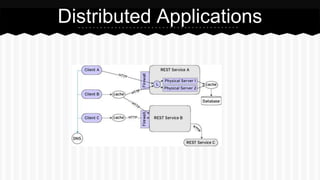
● a software architecture style for designing scalable distributed applications.
● a simpler alternative to SOAP, WSDL-based Web services.
● typically based on HTTP, but not always
● not a "standard" but is widespread due to its simplicity & ease of use
What is REST?
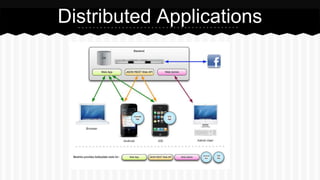
Distributed Applications
● uniform interface
● stateless
● cacheable
● client-server
● layered systems
● code on demand (optional)
RESTful Architecture
● uniform interface between the client and server
● simplification & decoupling of the architecture
● in HTTP,
o URIs - represent resources
o http verbs (GET / POST / PUT / DELETE) - represent actions
o http response, status code, headers
Uniform Interface
● no client’s state is stored on the server
● every request is self contained & self descriptive i.e all requests from
clients contain all the information necessary for the server to provide
service.
● session state is kept entirely on the client
Stateless
● separation of concerns
● distributed and disconnected components
● encourages components to evolve independently
● provides much more:
o scalability
o maintainability
o portability
Client-Server
● responses should be cacheable
o implicitly or
o explicitly
Cacheable
● there could be different layers in between the client and server like proxies,
middlewares, services, caches, load balancers etc.
● client doesn’t know how the response is being generated, and is not
concerned either (separation of concern again)
Layered Systems
● simplicity & ease of use
● made for web
● both machine & human friendly
● scalability, modifiability, portability etc.
Why REST?
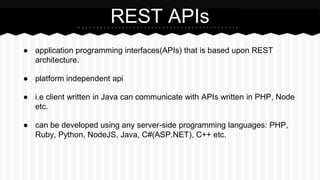
● application programming interfaces(APIs) that is based upon REST
architecture.
● platform independent api
● i.e client written in Java can communicate with APIs written in PHP, Node
etc.
● can be developed using any server-side programming languages: PHP,
Ruby, Python, NodeJS, Java, C#(ASP.NET), C++ etc.
REST APIs
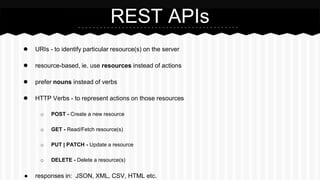
● URIs - to identify particular resource(s) on the server
● resource-based, ie. use resources instead of actions
● prefer nouns instead of verbs
● HTTP Verbs - to represent actions on those resources
o POST - Create a new resource
o GET - Read/Fetch resource(s)
o PUT | PATCH - Update a resource
o DELETE - Delete a resource(s)
● responses in: JSON, XML, CSV, HTML etc.
REST APIs
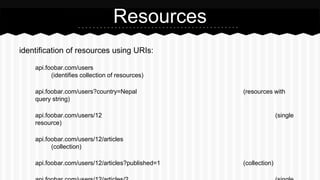
identification of resources using URIs:
api.foobar.com/users
(identifies collection of resources)
api.foobar.com/users?country=Nepal (resources with
query string)
api.foobar.com/users/12 (single
resource)
api.foobar.com/users/12/articles
(collection)
api.foobar.com/users/12/articles?published=1 (collection)
Resources
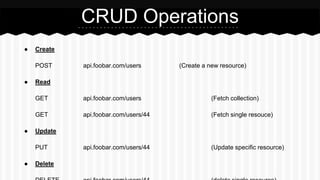
● Create
POST api.foobar.com/users (Create a new resource)
● Read
GET api.foobar.com/users (Fetch collection)
GET api.foobar.com/users/44 (Fetch single resouce)
● Update
PUT api.foobar.com/users/44 (Update specific resource)
● Delete
CRUD Operations
● http://en.wikipedia.org/wiki/Representational_state_transfer
● http://stackoverflow.com/
● http://www.restapitutorial.com/lessons/whatisrest.html
● http://rest.elkstein.org/
● http://www.ics.uci.edu/~fielding/pubs/dissertation/rest_arch_style.htm
● http://www.slideshare.net/shriteshbhattarai/restful-web-architecture
● http://laravel.com/docs/5.0/controllers#restful-resource-controllers
● https://laracasts.com/lessons/understanding-rest
References
Thank You :)
Kabir Baidhya
kabeer182010@gmail.com

RESTful Architecture

  • 1.
  • 2.
    ● Representational StateTransfer (REST) ● a software architecture style for designing scalable distributed applications. ● a simpler alternative to SOAP, WSDL-based Web services. ● typically based on HTTP, but not always ● not a "standard" but is widespread due to its simplicity & ease of use What is REST?
  • 3.
  • 4.
  • 5.
    ● uniform interface ●stateless ● cacheable ● client-server ● layered systems ● code on demand (optional) RESTful Architecture
  • 6.
    ● uniform interfacebetween the client and server ● simplification & decoupling of the architecture ● in HTTP, o URIs - represent resources o http verbs (GET / POST / PUT / DELETE) - represent actions o http response, status code, headers Uniform Interface
  • 7.
    ● no client’sstate is stored on the server ● every request is self contained & self descriptive i.e all requests from clients contain all the information necessary for the server to provide service. ● session state is kept entirely on the client Stateless
  • 8.
    ● separation ofconcerns ● distributed and disconnected components ● encourages components to evolve independently ● provides much more: o scalability o maintainability o portability Client-Server
  • 9.
    ● responses shouldbe cacheable o implicitly or o explicitly Cacheable
  • 10.
    ● there couldbe different layers in between the client and server like proxies, middlewares, services, caches, load balancers etc. ● client doesn’t know how the response is being generated, and is not concerned either (separation of concern again) Layered Systems
  • 11.
    ● simplicity &ease of use ● made for web ● both machine & human friendly ● scalability, modifiability, portability etc. Why REST?
  • 12.
    ● application programminginterfaces(APIs) that is based upon REST architecture. ● platform independent api ● i.e client written in Java can communicate with APIs written in PHP, Node etc. ● can be developed using any server-side programming languages: PHP, Ruby, Python, NodeJS, Java, C#(ASP.NET), C++ etc. REST APIs
  • 13.
    ● URIs -to identify particular resource(s) on the server ● resource-based, ie. use resources instead of actions ● prefer nouns instead of verbs ● HTTP Verbs - to represent actions on those resources o POST - Create a new resource o GET - Read/Fetch resource(s) o PUT | PATCH - Update a resource o DELETE - Delete a resource(s) ● responses in: JSON, XML, CSV, HTML etc. REST APIs
  • 14.
    identification of resourcesusing URIs: api.foobar.com/users (identifies collection of resources) api.foobar.com/users?country=Nepal (resources with query string) api.foobar.com/users/12 (single resource) api.foobar.com/users/12/articles (collection) api.foobar.com/users/12/articles?published=1 (collection) Resources
  • 15.
    ● Create POST api.foobar.com/users(Create a new resource) ● Read GET api.foobar.com/users (Fetch collection) GET api.foobar.com/users/44 (Fetch single resouce) ● Update PUT api.foobar.com/users/44 (Update specific resource) ● Delete CRUD Operations
  • 16.
    ● http://en.wikipedia.org/wiki/Representational_state_transfer ● http://stackoverflow.com/ ●http://www.restapitutorial.com/lessons/whatisrest.html ● http://rest.elkstein.org/ ● http://www.ics.uci.edu/~fielding/pubs/dissertation/rest_arch_style.htm ● http://www.slideshare.net/shriteshbhattarai/restful-web-architecture ● http://laravel.com/docs/5.0/controllers#restful-resource-controllers ● https://laracasts.com/lessons/understanding-rest References
  • 17.
    Thank You :) KabirBaidhya kabeer182010@gmail.com