Getting SPAMMED for
architecture
Arnon Rotem-Gal-Oz
Biometrics Line Development Manager
Rafael LTD.
Haifa, Israel
arnon@rgoarchitects.com
Famous Last Words…
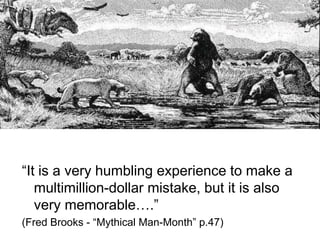
“It is a very humbling experience to make a
multimillion-dollar mistake, but it is also
very memorable….”
(Fred Brooks - “Mythical Man-Month” p.47)
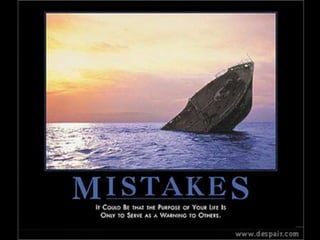
We don’t want to get there
So, What is Software
Architecture exactly?
Software architecture is the
fundamental organization of a system,
embodied in its components, their
relationships to each other and the
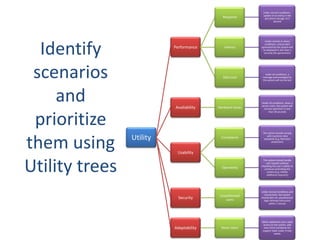
environment, and the principles
governing its design and evolution
The architect doesn't talk, he acts.
When this is done,
the team says, "Amazing:
we did it, all by ourselves!" (17)
The architect observes the world
but trusts his inner vision.
He allows things to come and go.
His heart is open as the sky. (12)
Philippe Kruchten - http://www.bredemeyer.com/tao_by_Kruchten.htm
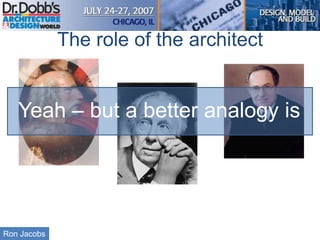
Explorer
Designer
Advocate
The role of the architect
Ron Jacobs
Yeah – but a better analogy is
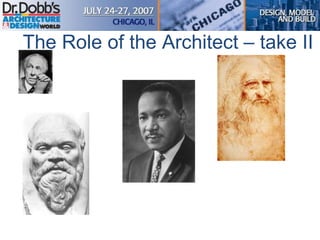
The Role of the Architect – take II
Designer
Renaissance Man
Visionary & Leader
Mentor
At the end of the day it is the
Architect who is ultimately
responsible for the quality of the
system/product
First, who are we working for?
The Usual Suspects
Customer End-User Project Manager Management
Developers Maintainers Security Analysts
Project New comers Testers Customer’s IT group
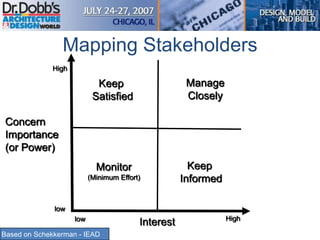
Mapping Stakeholders
low High
low
High
Concern
Importance
(or Power)
Interest
Monitor
(Minimum Effort)
Keep
Informed
Keep
Satisfied
Manage
Closely
Based on Schekkerman - IEAD
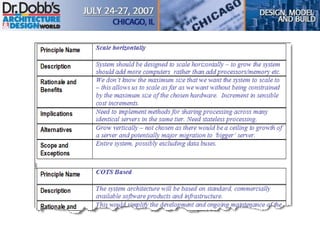
Architecture Principles
Set the direction for the solution
Initial guidelines to consider for the solution
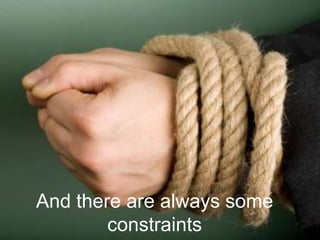
And there are always some
constraints
Next, we have to think
about the quality Attributes
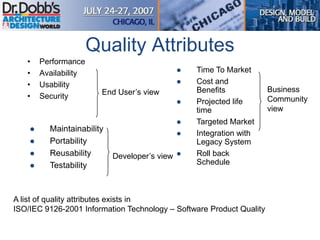
Quality Attributes
• Performance
• Availability
• Usability
• Security
 Maintainability
 Portability
 Reusability
 Testability
End User’s view
Developer’s view
 Time To Market
 Cost and
Benefits
 Projected life
time
 Targeted Market
 Integration with
Legacy System
 Roll back
Schedule
Business
Community
view
A list of quality attributes exists in
ISO/IEC 9126-2001 Information Technology – Software Product Quality
Utility
Performance
Response
Under normal conditions -
update of an entity in the
persistent storage <0.5
Second
Latency
Under normal or stress
conditions, critical alert
generated by the system will
be displayed in less than 1
seconds (for generation)
Data Loss
under all conditions, a
message acknowledged by
the system will not be lost
Availability Hardware Issues
Under all conditions, when a
server crash, the system will
resume operation in less
than 30 seconds
Usability
Compliance
The system should comply
with maritime data
standards (e.g. Mercator
projection)
Operability
The system should handle
user request without
impeding the user's ability to
continue controlling the
system (e.g. initiate
additional requests)
Security
Unauthorized
users
under normal conditions and
connectivity the system
should alert an unauthorized
login attempt (intrusion)
within 1 minute
Adaptability More Users
When additional users need
access to the system, add
new /more hardware (to
support load) under 4 man
weeks
Identify
scenarios
and
prioritize
them using
Utility trees
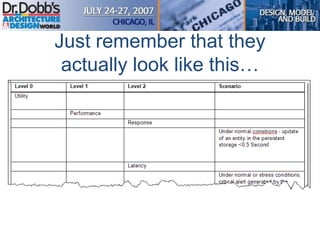
Just remember that they
actually look like this…
The secret to quality attribute
analysis is the scenarios
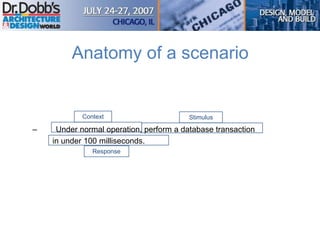
Anatomy of a scenario
– Under normal operation, perform a database transaction
in under 100 milliseconds.
Context Stimulus
Response
Oh yeah – there’s also
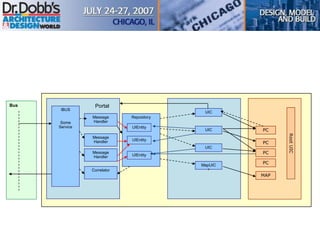
modeling and design…
Repository
PC
UIEntity
PC
PC
MapUIC
+
UIC
UIC
UIEntity
UIEntity
MAP
Bus
IBUS
Some
Service
Message
Handler
RootUIC
PC
Message
Handler
Message
Handler
UIC
Correlator
Portal
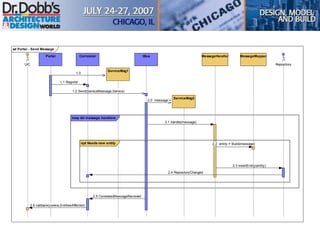
sd Portal - Send Message
Portal Corrolator
ServiceMsg1
IBus MessageHandler MessageMapper
UIC Repository
ServiceMsg2
opt Needs new entity
loop All message handlers
1.0
1.1 Register
1.2 Send(ServiceMessage,Service)
2.0 message:=
2.1 handle(message)
2.2 entity:= Build(message)
2.3 insertEntity(entity)
2.4 RepositoryChanged
2.5 CorrelatedMessageRecieved
2.6 callback(cookie,EntitiesAffected)
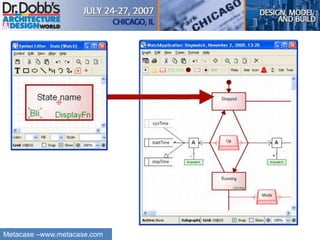
Metacase –www.metacase.com
Pattern can save
you the trouble of
reinventing the
wheel
If you want the
architecture to
be effective it
has to be
communicated
Two roads diverged in a yellow wood,
And sorry I could not travel both
And be one traveler, long I stood
And looked down one as far as I could
To where it bent in the undergrowth
(The road not taken, Robert Frost 1915)
When you present an architecture
you should consider your
target audience
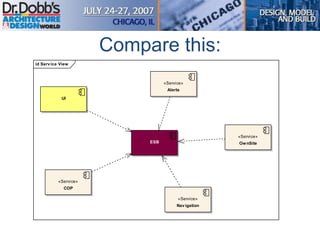
Compare this:
id Service View
UI
«Service»
COP
«Service»
Navigation
«Service»
OwnSiteESB
«Service»
Alerts
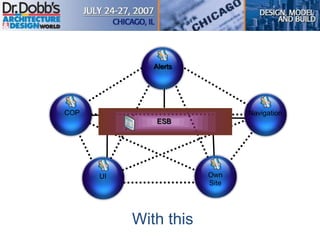
With this
COP
Alerts
UI Own
Site
Navigation
ESB
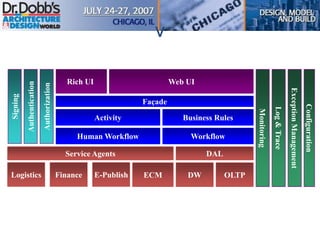
Technology Mapping
v
Human Workflow
ECM DW OLTP
DALService Agents
Business RulesActivity
Workflow
Authorization
Monitoring
Façade
Log&Trace
ExceptionManagement
Configuration
Authentication
Signing
Rich UI Web UI
Logistics E-PublishFinance
K2
SQL 2005 SQL 2005
Generated C#
ILOG RulesC#
BizTalk 2004
Tamuz+Win2003
CAUnicenter
WCF
EnterpriseLibrary
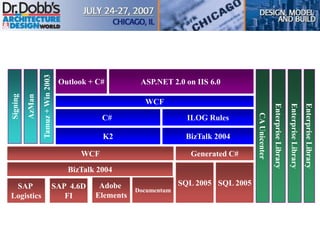
EnterpriseLibrary
EnterpriseLibrary
AzMan
Signing
Outlook + C# ASP.NET 2.0 on IIS 6.0
Documentum
WCF
SAP
Logistics
Adobe
Elements
SAP 4.6D
FI
BizTalk 2004
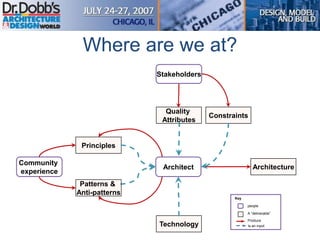
Where are we at?
Architecture
Quality
Attributes
Technology
Patterns &
Anti-patterns
Principles
Community
experience
Stakeholders
Architect
people
A “deliverable”
Produce
Key
Is an input
Constraints
OK then, so we are all set
The architecture
has to be
Evaluated to make
sure it is any good
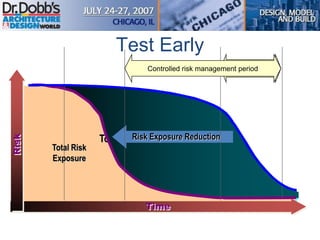
Test Early
Total Risk ExposureRisk Exposure Reduction
Time
Risk
Risk Reduction
Period
Controlled risk management period
Total Risk
Exposure
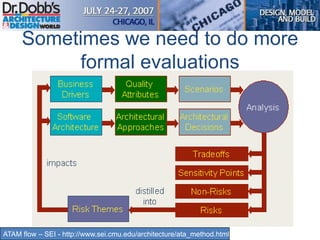
Sometimes we need to do more
formal evaluations
ATAM flow – SEI - http://www.sei.cmu.edu/architecture/ata_method.html
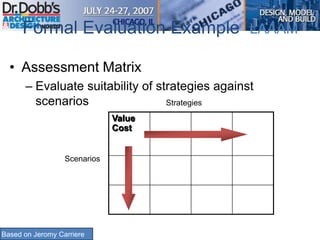
Formal Evaluation Example LAAAM
• Assessment Matrix
– Evaluate suitability of strategies against
scenarios
Value
Cost
Strategies
Scenarios
Based on Jeromy Carriere
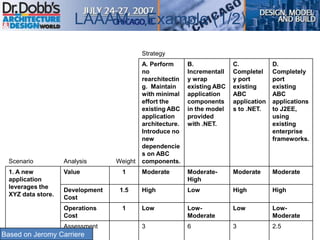
LAAAM – Example (1/2)
Strategy
Scenario Analysis Weight
A. Perform
no
rearchitectin
g. Maintain
with minimal
effort the
existing ABC
application
architecture.
Introduce no
new
dependencie
s on ABC
components.
B.
Incrementall
y wrap
existing ABC
application
components
in the model
provided
with .NET.
C.
Completel
y port
existing
ABC
application
s to .NET.
D.
Completely
port
existing
ABC
applications
to J2EE,
using
existing
enterprise
frameworks.
1. A new
application
leverages the
XYZ data store.
Value 1 Moderate Moderate-
High
Moderate Moderate
Development
Cost
1.5 High Low High High
Operations
Cost
1 Low Low-
Moderate
Low Low-
Moderate
Assessment 3 6 3 2.5
Based on Jeromy Carriere
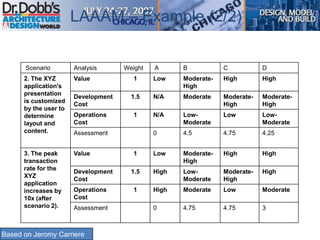
LAAAM – Example (2/2)
Scenario Analysis Weight A B C D
2. The XYZ
application's
presentation
is customized
by the user to
determine
layout and
content.
Value 1 Low Moderate-
High
High High
Development
Cost
1.5 N/A Moderate Moderate-
High
Moderate-
High
Operations
Cost
1 N/A Low-
Moderate
Low Low-
Moderate
Assessment 0 4.5 4.75 4.25
3. The peak
transaction
rate for the
XYZ
application
increases by
10x (after
scenario 2).
Value 1 Low Moderate-
High
High High
Development
Cost
1.5 High Low-
Moderate
Moderate-
High
High
Operations
Cost
1 High Moderate Low Moderate
Assessment 0 4.75 4.75 3
Based on Jeromy Carriere
All we have to
do now is to
deploy the
architecture
Stakeholders
Principles
Attributes
Modeling
Mapping
Evaluation
Deployment
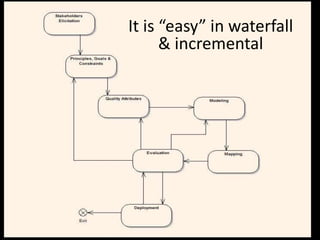
It is “easy” in waterfall
& incremental
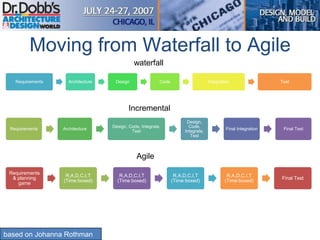
Requirements Architecture Design Code Integration Test
Requirements
& planning
game
R,A,D,C,I,T
(Time boxed)
R,A,D,C,I,T
(Time boxed)
R,A,D,C,I,T
(Time boxed)
R,A,D,C,I,T
(Time boxed)
Final Test
Requirements Architecture
Design, Code, Integrate,
Test
Design,
Code,
Integrate,
Test
Final Integration Final Test
Moving from Waterfall to Agile
waterfall
Incremental
Agile
based on Johanna Rothman
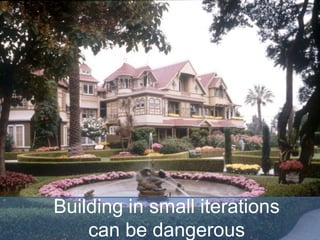
Building in small iterations
can be dangerous
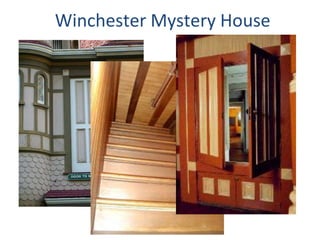
Winchester Mystery House
Can you do Agile Architecture?
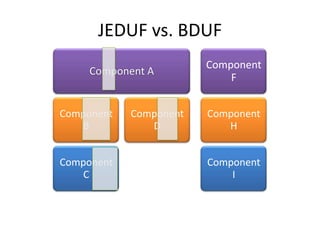
JEDUF vs. BDUF
Component A
Component
B
Component
C
Component
D
Component
F
Component
H
Component
I
Evolve the
architecture
http://www.flickr.com/photos/hyperclouds/459716791/
Architect must
implement?
Stakeholders
Principles
Attributes
Modeling
Mapping
Evaluation
Deployment

SAF

  • 1.
    Getting SPAMMED for architecture ArnonRotem-Gal-Oz Biometrics Line Development Manager Rafael LTD. Haifa, Israel arnon@rgoarchitects.com
  • 2.
    Famous Last Words… “Itis a very humbling experience to make a multimillion-dollar mistake, but it is also very memorable….” (Fred Brooks - “Mythical Man-Month” p.47)
  • 3.
    We don’t wantto get there
  • 4.
    So, What isSoftware Architecture exactly?
  • 5.
    Software architecture isthe fundamental organization of a system, embodied in its components, their relationships to each other and the environment, and the principles governing its design and evolution
  • 6.
    The architect doesn'ttalk, he acts. When this is done, the team says, "Amazing: we did it, all by ourselves!" (17) The architect observes the world but trusts his inner vision. He allows things to come and go. His heart is open as the sky. (12) Philippe Kruchten - http://www.bredemeyer.com/tao_by_Kruchten.htm
  • 7.
    Explorer Designer Advocate The role ofthe architect Ron Jacobs Yeah – but a better analogy is
  • 8.
    The Role ofthe Architect – take II Designer Renaissance Man Visionary & Leader Mentor
  • 9.
    At the endof the day it is the Architect who is ultimately responsible for the quality of the system/product
  • 11.
    First, who arewe working for?
  • 12.
    The Usual Suspects CustomerEnd-User Project Manager Management Developers Maintainers Security Analysts Project New comers Testers Customer’s IT group
  • 13.
    Mapping Stakeholders low High low High Concern Importance (orPower) Interest Monitor (Minimum Effort) Keep Informed Keep Satisfied Manage Closely Based on Schekkerman - IEAD
  • 14.
    Architecture Principles Set thedirection for the solution Initial guidelines to consider for the solution
  • 16.
    And there arealways some constraints
  • 17.
    Next, we haveto think about the quality Attributes
  • 18.
    Quality Attributes • Performance •Availability • Usability • Security  Maintainability  Portability  Reusability  Testability End User’s view Developer’s view  Time To Market  Cost and Benefits  Projected life time  Targeted Market  Integration with Legacy System  Roll back Schedule Business Community view A list of quality attributes exists in ISO/IEC 9126-2001 Information Technology – Software Product Quality
  • 19.
    Utility Performance Response Under normal conditions- update of an entity in the persistent storage <0.5 Second Latency Under normal or stress conditions, critical alert generated by the system will be displayed in less than 1 seconds (for generation) Data Loss under all conditions, a message acknowledged by the system will not be lost Availability Hardware Issues Under all conditions, when a server crash, the system will resume operation in less than 30 seconds Usability Compliance The system should comply with maritime data standards (e.g. Mercator projection) Operability The system should handle user request without impeding the user's ability to continue controlling the system (e.g. initiate additional requests) Security Unauthorized users under normal conditions and connectivity the system should alert an unauthorized login attempt (intrusion) within 1 minute Adaptability More Users When additional users need access to the system, add new /more hardware (to support load) under 4 man weeks Identify scenarios and prioritize them using Utility trees
  • 20.
    Just remember thatthey actually look like this…
  • 21.
    The secret toquality attribute analysis is the scenarios
  • 22.
    Anatomy of ascenario – Under normal operation, perform a database transaction in under 100 milliseconds. Context Stimulus Response
  • 23.
    Oh yeah –there’s also modeling and design…
  • 24.
  • 25.
    sd Portal -Send Message Portal Corrolator ServiceMsg1 IBus MessageHandler MessageMapper UIC Repository ServiceMsg2 opt Needs new entity loop All message handlers 1.0 1.1 Register 1.2 Send(ServiceMessage,Service) 2.0 message:= 2.1 handle(message) 2.2 entity:= Build(message) 2.3 insertEntity(entity) 2.4 RepositoryChanged 2.5 CorrelatedMessageRecieved 2.6 callback(cookie,EntitiesAffected)
  • 26.
  • 27.
    Pattern can save youthe trouble of reinventing the wheel
  • 28.
    If you wantthe architecture to be effective it has to be communicated
  • 29.
    Two roads divergedin a yellow wood, And sorry I could not travel both And be one traveler, long I stood And looked down one as far as I could To where it bent in the undergrowth (The road not taken, Robert Frost 1915)
  • 30.
    When you presentan architecture you should consider your target audience
  • 31.
    Compare this: id ServiceView UI «Service» COP «Service» Navigation «Service» OwnSiteESB «Service» Alerts
  • 32.
  • 33.
  • 34.
    v Human Workflow ECM DWOLTP DALService Agents Business RulesActivity Workflow Authorization Monitoring Façade Log&Trace ExceptionManagement Configuration Authentication Signing Rich UI Web UI Logistics E-PublishFinance
  • 35.
    K2 SQL 2005 SQL2005 Generated C# ILOG RulesC# BizTalk 2004 Tamuz+Win2003 CAUnicenter WCF EnterpriseLibrary EnterpriseLibrary EnterpriseLibrary AzMan Signing Outlook + C# ASP.NET 2.0 on IIS 6.0 Documentum WCF SAP Logistics Adobe Elements SAP 4.6D FI BizTalk 2004
  • 36.
    Where are weat? Architecture Quality Attributes Technology Patterns & Anti-patterns Principles Community experience Stakeholders Architect people A “deliverable” Produce Key Is an input Constraints
  • 37.
    OK then, sowe are all set
  • 38.
    The architecture has tobe Evaluated to make sure it is any good
  • 39.
    Test Early Total RiskExposureRisk Exposure Reduction Time Risk Risk Reduction Period Controlled risk management period Total Risk Exposure
  • 40.
    Sometimes we needto do more formal evaluations ATAM flow – SEI - http://www.sei.cmu.edu/architecture/ata_method.html
  • 41.
    Formal Evaluation ExampleLAAAM • Assessment Matrix – Evaluate suitability of strategies against scenarios Value Cost Strategies Scenarios Based on Jeromy Carriere
  • 42.
    LAAAM – Example(1/2) Strategy Scenario Analysis Weight A. Perform no rearchitectin g. Maintain with minimal effort the existing ABC application architecture. Introduce no new dependencie s on ABC components. B. Incrementall y wrap existing ABC application components in the model provided with .NET. C. Completel y port existing ABC application s to .NET. D. Completely port existing ABC applications to J2EE, using existing enterprise frameworks. 1. A new application leverages the XYZ data store. Value 1 Moderate Moderate- High Moderate Moderate Development Cost 1.5 High Low High High Operations Cost 1 Low Low- Moderate Low Low- Moderate Assessment 3 6 3 2.5 Based on Jeromy Carriere
  • 43.
    LAAAM – Example(2/2) Scenario Analysis Weight A B C D 2. The XYZ application's presentation is customized by the user to determine layout and content. Value 1 Low Moderate- High High High Development Cost 1.5 N/A Moderate Moderate- High Moderate- High Operations Cost 1 N/A Low- Moderate Low Low- Moderate Assessment 0 4.5 4.75 4.25 3. The peak transaction rate for the XYZ application increases by 10x (after scenario 2). Value 1 Low Moderate- High High High Development Cost 1.5 High Low- Moderate Moderate- High High Operations Cost 1 High Moderate Low Moderate Assessment 0 4.75 4.75 3 Based on Jeromy Carriere
  • 44.
    All we haveto do now is to deploy the architecture
  • 45.
  • 46.
    It is “easy”in waterfall & incremental
  • 47.
    Requirements Architecture DesignCode Integration Test Requirements & planning game R,A,D,C,I,T (Time boxed) R,A,D,C,I,T (Time boxed) R,A,D,C,I,T (Time boxed) R,A,D,C,I,T (Time boxed) Final Test Requirements Architecture Design, Code, Integrate, Test Design, Code, Integrate, Test Final Integration Final Test Moving from Waterfall to Agile waterfall Incremental Agile based on Johanna Rothman
  • 48.
    Building in smalliterations can be dangerous
  • 49.
  • 50.
    Can you doAgile Architecture?
  • 51.
    JEDUF vs. BDUF ComponentA Component B Component C Component D Component F Component H Component I
  • 52.
  • 53.
  • 54.

Editor's Notes

  • #3 More than 30 years ago (1975)
  • #4 We don’t want to get there- right?What is architectureWhat’s the architect roleHow are we going to get from nothing to a working, breathing architecture
  • #6 IEEE 1471 – recommended practice for architecture description of software intensive systemSoftware architecture is the collection of the fundamental decisions about a software product/solution designed to meet the project&apos;s quality attributes (i.e. requirements). The architecture includes the main components, their main attributes, and their collaboration (i.e. interactions and behavior) to meet the quality attributes. Architecture can and usually should be expressed in several levels of abstraction (depending on the project&apos;s size). If an architecture is to be intentional (rather than accidental), it should be communicated. Architecture is communicated from multiple viewpoints to cater the needs of the different stakeholders.Architectural decisions are global tied to quality attributesDesigns decisions are local –tied to functionality
  • #7 The Tao of Software Architect
  • #8 ColumbosAlan DershowitzAt the age of 28 he became the youngest full professor in Harvard law school historySuccessfully defended high profile clientsO.J. SimpsonClaus von BülowFrank Lloyd WrightFrank Lloyd Wright (June 8, 1867 – April 9, 1959) was one of the most prominent and influential architects of the first half of 20th century. He not only developed a series of highly individual styles over his extraordinarily long architectural career (spanning the years 1887-1959), he influenced the whole course of American architecture and building. To this day he remains probably America&apos;s most famous architect. (wikipedia)
  • #9 A teacherA visionaryA renaissance manAn architect is someone who has an holistic view of something (Natty Gur)
  • #11 SPAMMED
  • #17 constraints limit the (architectural) solution space Vs. requirements that set goals for the systemStakeholders should therefore not only specify requirements, but also constraints!Technical – Platform/technology (e.g. use .NET)Financial – Budget (don’t event think about that fancy Rule Engine)
  • #20 decompose and refines the business goals and quality attributesThe root of the tree is “utility” – the overall “goodness” of the systemSelect the most important quality goals to be the high-level nodesE.g. performance, modifiability, security, and availabilityThe tree reflects the hierarchical nature of quality attributes and provides the basis for prioritization
  • #23 Remote user requests a database report via the Web during peak period and receives it within 5 seconds.Growth scenarioAdd a new data server to reduce latency in scenario 1 to 2.5 seconds within 1 person-week.For a new release, integrate a new component implementation in three weeks.Exploratory scenarioHalf of the servers go down during normal operation without affecting overall system availability.ResponseUnder normal conditions update 100 moving objects on the map &lt; 200 miliseconsLatencyUnder normal or stress conditions, a critical alert generated by the system will be displayed to the user in less than 1 secondData lossUnder all conditions a message acknowledged by the system shall not be lost (10^5 probability)Availability Hardware failureWhen a mission is in progress, upon a server mal-function, the system will be fully operable within 30 seconds or lessChangeability Add FeatureAdd a new sensor-type to the system in 2 man-months or less
  • #25 Block diagram, UMLs DSL
  • #27 DSLI can’t show you an example from a tool we’ve made to – simulate and integrate systems.Software Factories, MDAOnce we had “Model” -&gt; “code” (CASE tools) – didn’t work because of “The Generation Gap”Model + framework -&gt; code +frameworkModel -&gt; Model -&gt; Model -&gt; model + framework -&gt; code + framework
  • #28 Patterns- package an experience Context and solutions (not “best practices”)Encapsulate forces and challenges ConsiderationsRemember that patterns are not a silver bullet either..
  • #29 Viewpoints,Document architecture at the last responsible moment
  • #39 On PaperSEIATAM; SAAM; ARIDLAAAMActive Design ReviewsIn CodePOCsprototypeSkeleton
  • #40 Lets try to think about architectural risks in our little project…
  • #41 SEIATAM; SAAM; ARIDLAAAMActive Design Reviews
  • #42 Each dimension is rated on a five point scale, from High to LowValue Operational costDevelopment costEach dimension is given a weight, to express its importance relative to the other dimensionsAssessment is performed in two passes:Treat each cell as independentNormalize across each row
  • #45 Making sure the architecture really fits the problemMaking sure the architecture is followedTip: Short iterations allow for better feedback loopConsider SCRUM’s 30 day sprints
  • #46 Not a process guidanceJust a framework of activities that can be used in a variety of ways
  • #47 But we’ve learned that Waterfall is problematic
  • #48 Iterative is better – but essentially we are doing smaller waterfalls…Incremental we are doing “mini-waterfalls”In Agile we don’t We can’t fixTime boxing gives us rhythmPotentially shippable softwareManage requirements changesIncrease trust (demonstration)
  • #50 This is what hacks look like38 years of construction – 147 builders 0 architects160 rooms – 40 bedrooms, 6 kitchens, 2 basements, 950 doors65 doors to blank walls, 13 staircases abandoned, 24 skylights in floorsNo architectural blueprint exists
  • #52 Just Enough Design Up Frontinstead of Big Design Up FrontLean Architecture
  • #53 Architect product ownerEmphasize FlexibilityPostpone decisionsAnother statement Johanna made, which I wholeheartedly agree with, is that you should let the architecture evolve. Evolving an architecture sounds very compelling but it is not a simple feat. Architectural decisions tend to have system wide implications which means that changing one too late in the game you&apos;d get a lot of rewrite and/or refactoring to do. My strategy to solve that conflict is to:Set the first one or two iterations as architectural ones. Some of the work in these iterations is to spike technological and architectural risk. Nevertheless most of architectural iterations are still about delivering business value and user stories. The difference is that the prioritization of the requirements is also done based on technical risks and not just business ones. By the way, when you write quality attribute requirements as scenarios makes them usable as user stories helps customers understand their business value.Try to think about prior experience to produce the baseline architecture One of the quality attributes that you should bring into the table is flexibility - but be weary of putting too much effort into building this flexibility inDon&apos;t try to implement architectural components thoroughly - it is enough to run a thin thread through them and expand then when the need arise. Sometimes it is even enough just to identify them as possible future extensions.Try to postpone architectural decisions to the last responsible moment. However, when that moment comes -make the decision. try to validate the architectural decisions by spiking them out before you introduce them into the projectThese steps don&apos;t promise that the initial architecture sticks, but in my experience it makes it possible to minimize the number of architectural decisions but still have a relatively solid foundation to base your project on

  • #54 Scott Ambler told me that “agile ones do”, Jim Coplien “Architect Also Implements” patternReports that they’ve seen this time and time again in successful projects.For instance, In one presentation I heared Jim mentioned one stellar team- the dev. Team of Quatro pro where the architects had a daily standup (that was 93 mind-you)In my experience Architect should almost never own features I don’t find a lot of value in architects implementing production code unless there are enough architects to go aroundArchitect must know how to implementArchitect must be able to prove his design in codeArchitect can pair program to mentor/validate/solve problem and provide guidance -&gt; this solves the getting recognition by developers part and better
  • #55 Services interactions are message drivenServices should be Loosely coupledEdges should provide location transparencyBusiness logic and edge are separate layersScale inside the serviceYou can use workflows for long-running interactions again - inside the service