PLANNING
STEPS OF NURSING
PROCESS
Planning
“Planning is a deliberative ,systematic phase
of the nursing process that involves decision
making and problem solving”
• Formulating client goals and designing the
nursing interventions required to prevent
,reduce or eliminate the client’s health
problems
Nursing interventions
“ Any treatment , bared upon clinical
judgment and knowledge ,that a nurse
performs to enhance patient or client
outcomes”
• Product of planning phase is a clients care
plan
Types of planning
• Initial planning
• Ongoing planning
• Discharge planning
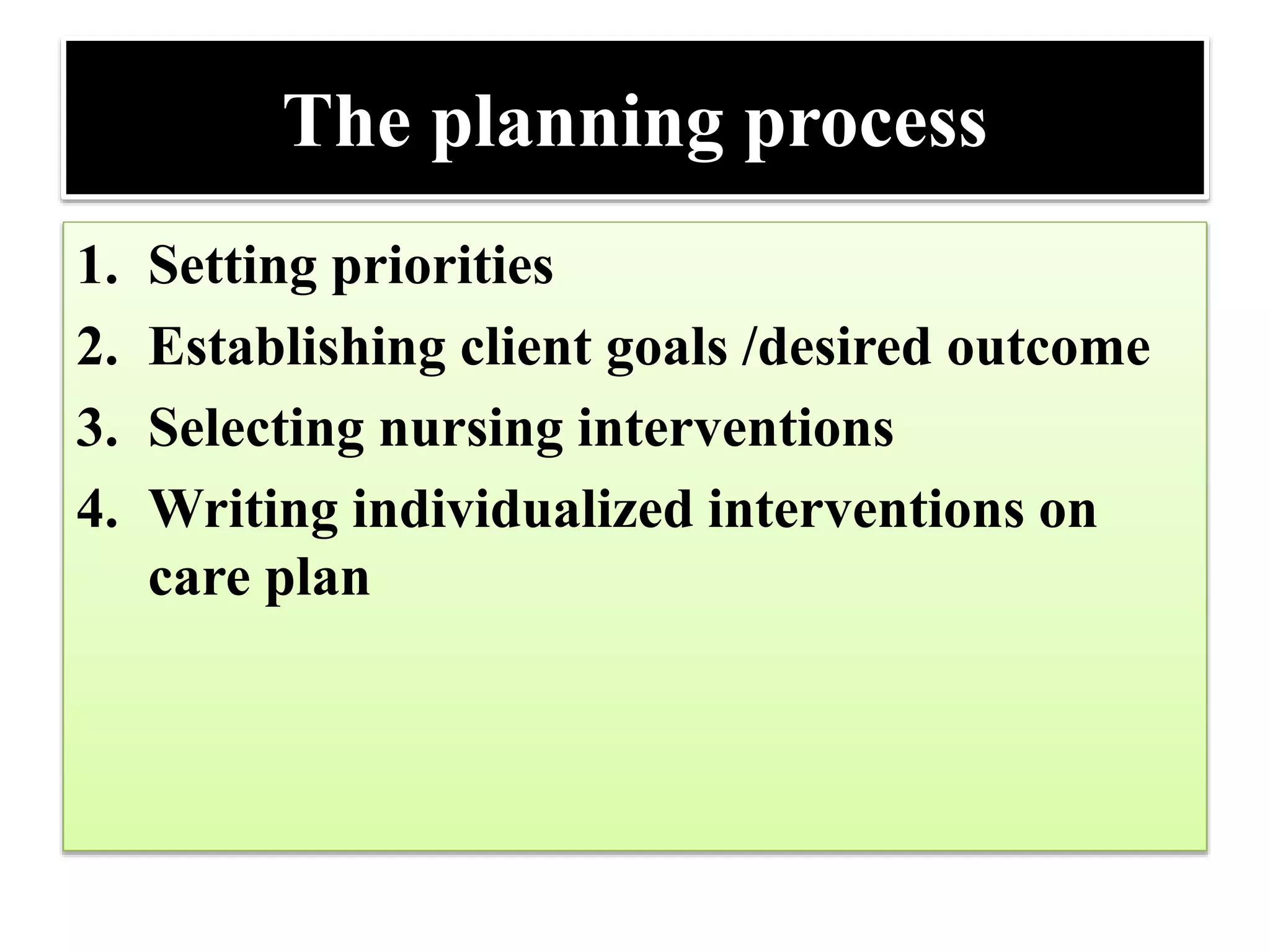
The planning process
1. Setting priorities
2. Establishing client goals /desired outcome
3. Selecting nursing interventions
4. Writing individualized interventions on
care plan
1. Setting priorities
– Priority setting is the process of establishing a
preferential sequence for addressing nursing
diagnosis and interventions
– High priority
– Medium priority
– Low priority
• Nurses use frequently use Maslow’s
hierarchy of needs when setting priorities
Setting priorities
• Factors effecting priorities
– Client health values and beliefs
– Client’s priorities
– Resources available to the nurse and client
– Urgency of health problem
– Medical treatment plan
2. Establishing client goals /desired
outcome
• Goals or desired outcomes
– Nurses hope to achieve by implementing the nursing
interventions
• Expected outcome
• Predicted outcome
• Outcome criterion
• Objective
• Goals are broad statement of client status
• Desired outcomes as more specific, observable
criteria used to evaluate whether the goals have
been met
Goal (broad): improved nutritional status
Desired outcomes (specific): gain 5lb by April 15
2. Establishing client goals /desired
outcome
• Purposes of desired goals and outcomes
– Provide direction for planning nursing
interventions
– Serve as a criteria for evaluating client progress
– Enable the client and nurses to determine when the
problem has been resolved
– Help to motivate the client and nurse by providing
a sense of achievement
2. Establishing client goals /desired
outcome
Short
term goal
Long
term goal
2. Establishing client goals /desired
outcome
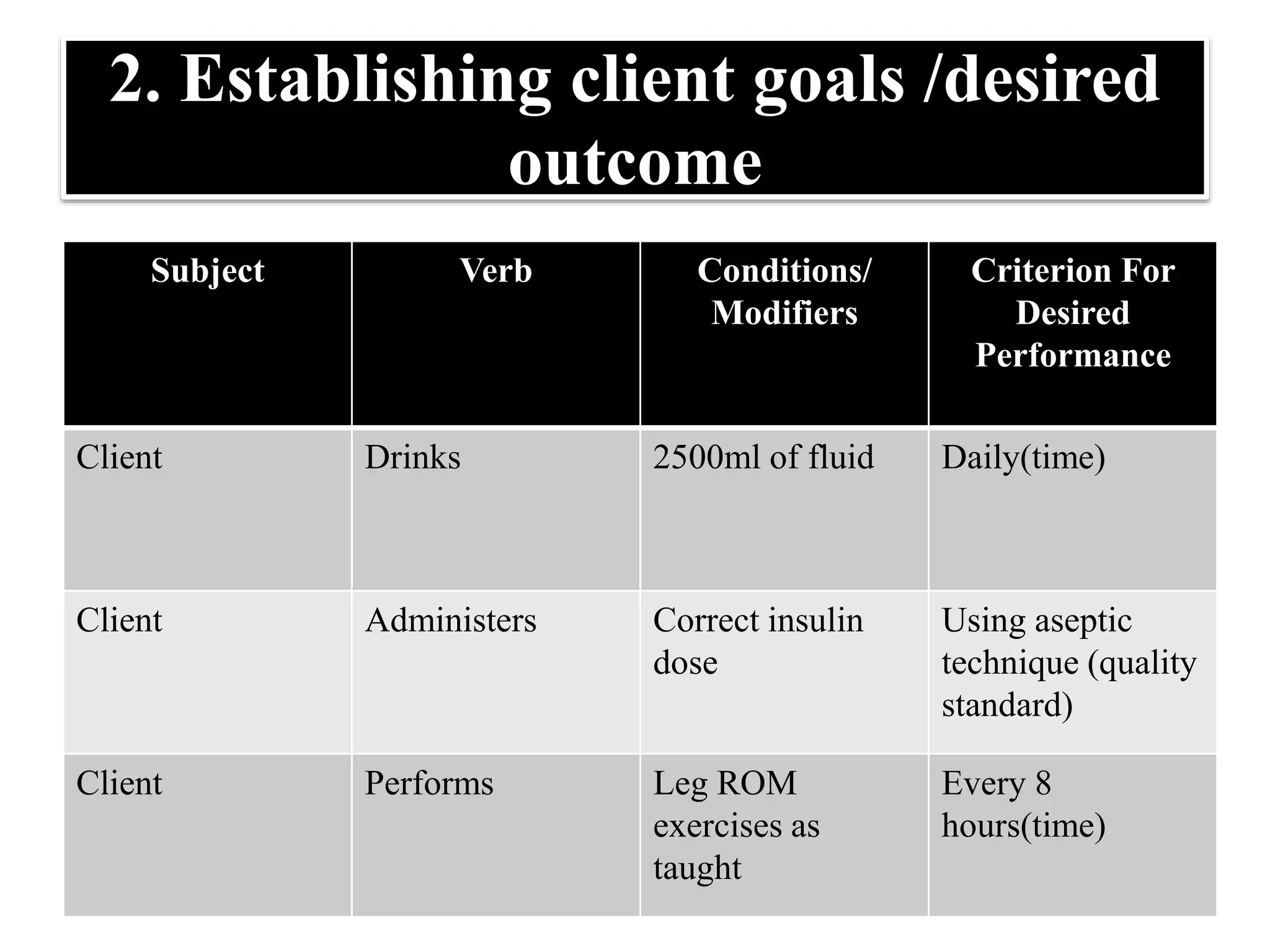
Components of goal
•Subject : a noun ,is the client ,any part of client or
some attribute to client
•Verb: the verbs specifies an action the client is to
perform Eg: show, walk and drink
•Condition or modifiers :are added to the verb to
explain the circumstances under which the
behavior is to be performed. Eg: walks wit the help
of cane
•Criterion of desired performance :the criterion
indicates the standard by which performance is
evaluated Eg: walks one block per day
2. Establishing client goals /desired
outcome
Subject Verb Conditions/
Modifiers
Criterion For
Desired
Performance
Client Drinks 2500ml of fluid Daily(time)
Client Administers Correct insulin
dose
Using aseptic
technique (quality
standard)
Client Performs Leg ROM
exercises as
taught
Every 8
hours(time)
Guidelines for writing goals and
outcomes
• Client centered
• Singular goal and outcome
• Observable
• Measurable
• Realistic
• Time limited
• Mutual factors
• Compatible
• Make sure client considers the goals important
and value
3. Selecting nursing interventions
Nursing interventions are the actions
that a nurse performs to achieve the client
goals
• Nurse chooses interventions to treat the signs
and symptoms
Eg: pain, anxiety
• Interventions for risk nursing diagnoses
should focus on measures to reduce the client
risk factors
Types of nursing interventions
Nursing
interventions
Independent
interventions
Dependent
interventions
Collaborative
interventions
Types of nursing interventions
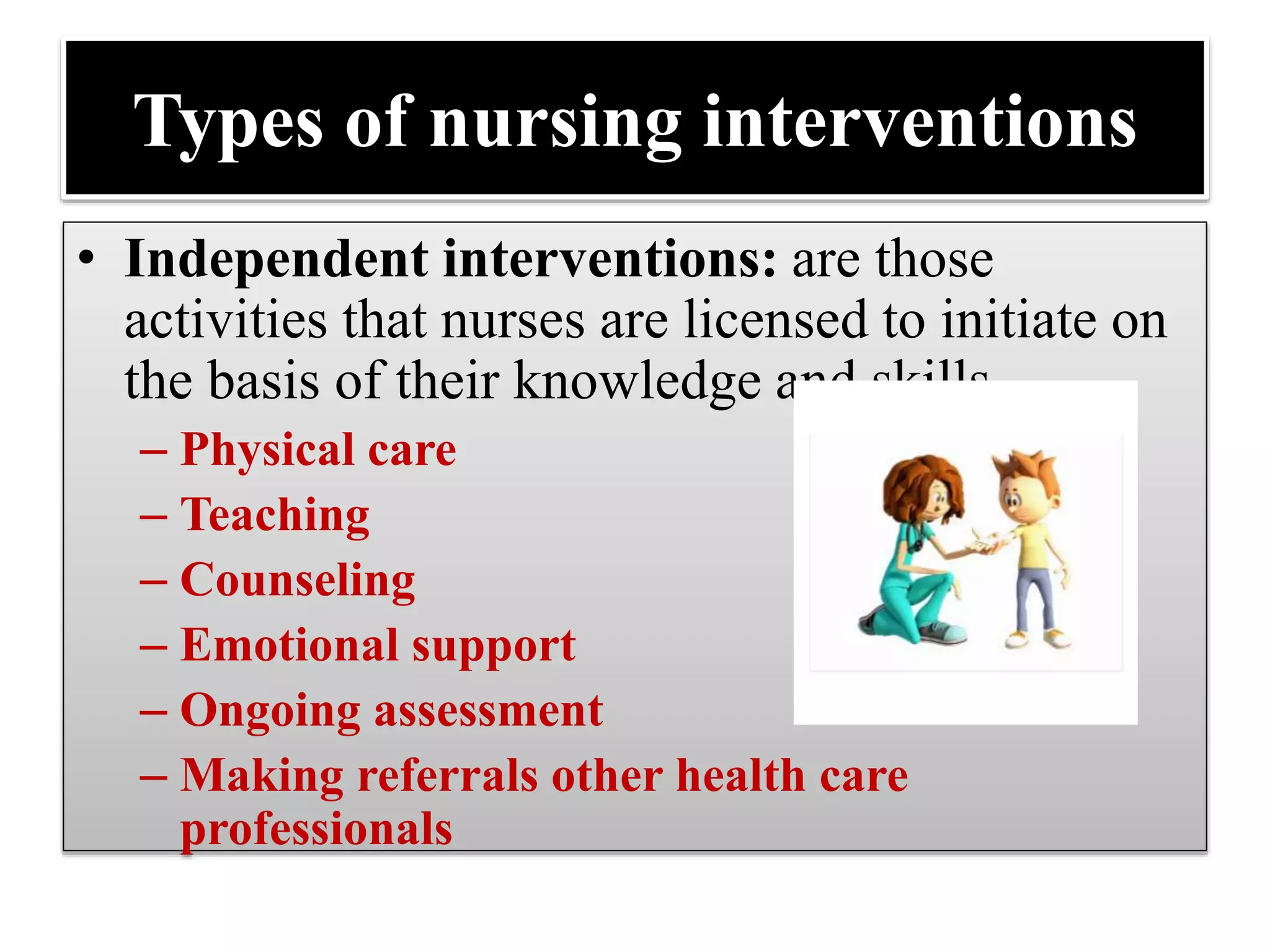
• Independent interventions: are those
activities that nurses are licensed to initiate on
the basis of their knowledge and skills
– Physical care
– Teaching
– Counseling
– Emotional support
– Ongoing assessment
– Making referrals other health care
professionals
Types of nursing interventions
• Dependent interventions :Are activities
carried out under the physician orders or
supervision or according to specific routine
– Medications
– Treatments
– Intravenous therapy
– Diagnostic tests
– Diet and activity
Types of nursing interventions
• Collaborative interventions : are actions the
nurse carries out in collaboration with other
health team members such as physical
therapists, social workers, dietitians and
physicians.
Criteria for choosing nursing
interventions
• Safe, appropriate for individuals age and health
condition
• Achievable with the resources available
• Congruent with the client’s values ,beliefs and
culture
• Congruent with other therapies
• Based on nursing knowledge and experience
• Written established standards of care as
determined by state laws , professional
association and policies of the institution
4. Writing individualized nursing
interventions
• After choosing appropriate interventions the
nurse write them on the care plan
• The format of written interventions
– Verb
– Conditions and modifiers
– Plus time element
• The action verb starts the intervention and
must be precise
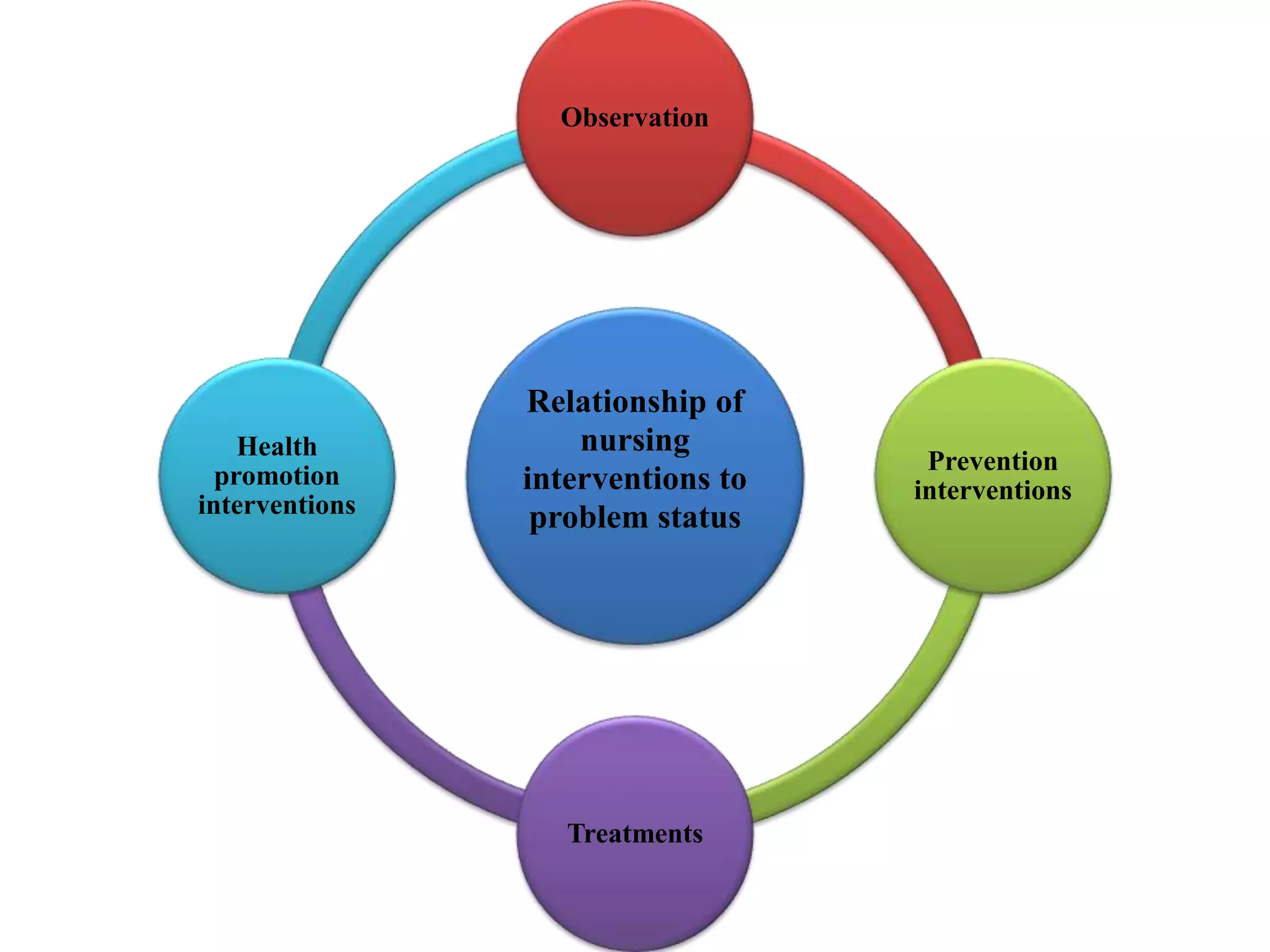
Relationship of
nursing
interventions to
problem status
Observation
Prevention
interventions
Treatments
Health
promotion
interventions
Nursing intervention classification
(NIC) taxonomy
• NIC taxonomy was first published in 1992
and been updated every 4yrs after then…..
• Consist of three levels
– Level 1 –Domains
– Level 2 – Classes
– Level 3 – Interventions
• All NIC interventions are linked to NANDA
nursing diagnostic label
Nursing intervention classification
(NIC) taxonomy
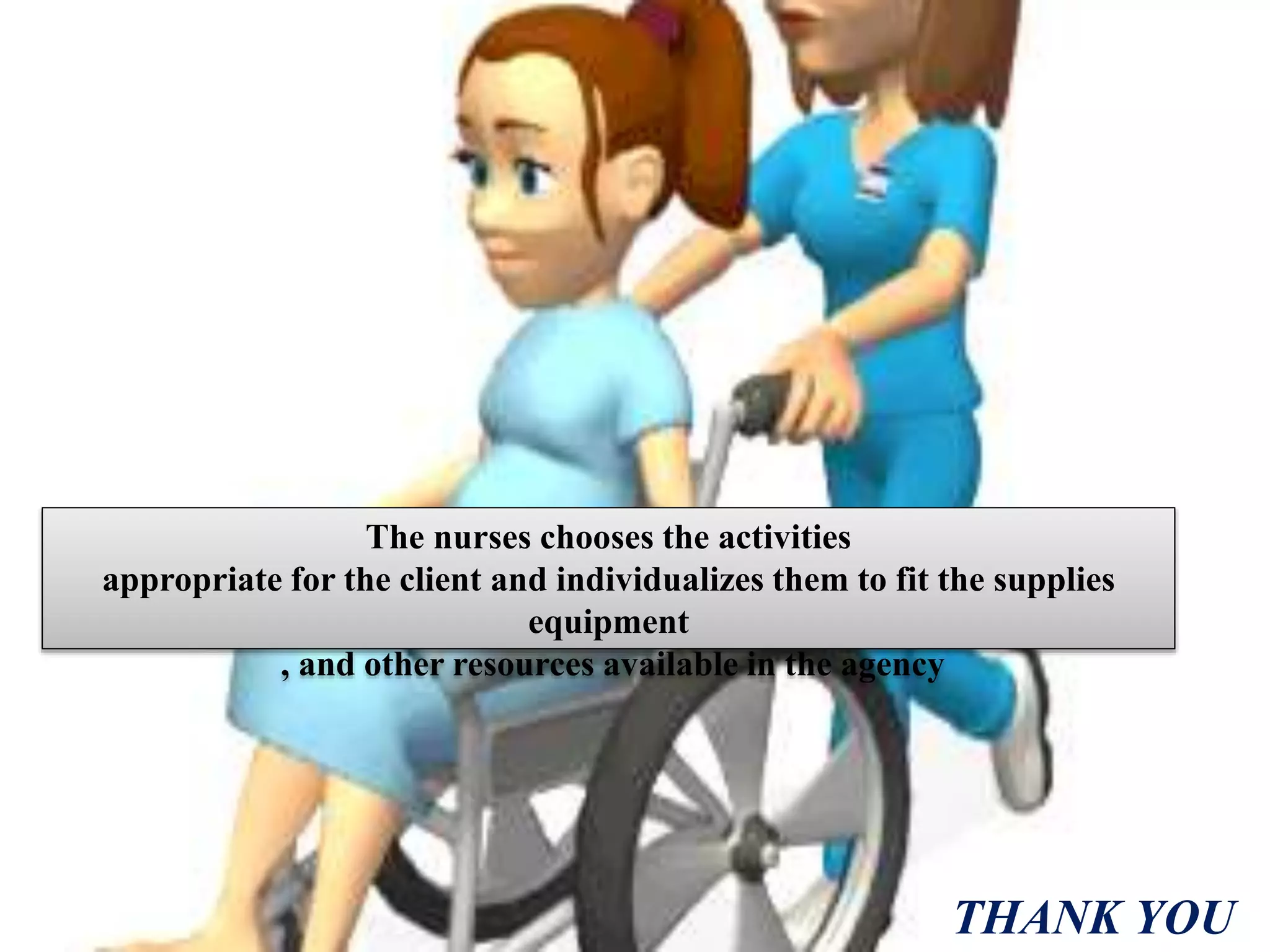
The nurses chooses the activities
appropriate for the client and individualizes them to fit the supplies
equipment
, and other resources available in the agency
THANK YOU

steps of nursing process, Planning

  • 1.
  • 2.
    Planning “Planning is adeliberative ,systematic phase of the nursing process that involves decision making and problem solving” • Formulating client goals and designing the nursing interventions required to prevent ,reduce or eliminate the client’s health problems
  • 3.
    Nursing interventions “ Anytreatment , bared upon clinical judgment and knowledge ,that a nurse performs to enhance patient or client outcomes” • Product of planning phase is a clients care plan
  • 4.
    Types of planning •Initial planning • Ongoing planning • Discharge planning
  • 5.
    The planning process 1.Setting priorities 2. Establishing client goals /desired outcome 3. Selecting nursing interventions 4. Writing individualized interventions on care plan
  • 6.
    1. Setting priorities –Priority setting is the process of establishing a preferential sequence for addressing nursing diagnosis and interventions – High priority – Medium priority – Low priority • Nurses use frequently use Maslow’s hierarchy of needs when setting priorities
  • 7.
    Setting priorities • Factorseffecting priorities – Client health values and beliefs – Client’s priorities – Resources available to the nurse and client – Urgency of health problem – Medical treatment plan
  • 8.
    2. Establishing clientgoals /desired outcome • Goals or desired outcomes – Nurses hope to achieve by implementing the nursing interventions • Expected outcome • Predicted outcome • Outcome criterion • Objective • Goals are broad statement of client status • Desired outcomes as more specific, observable criteria used to evaluate whether the goals have been met Goal (broad): improved nutritional status Desired outcomes (specific): gain 5lb by April 15
  • 9.
    2. Establishing clientgoals /desired outcome • Purposes of desired goals and outcomes – Provide direction for planning nursing interventions – Serve as a criteria for evaluating client progress – Enable the client and nurses to determine when the problem has been resolved – Help to motivate the client and nurse by providing a sense of achievement
  • 10.
    2. Establishing clientgoals /desired outcome Short term goal Long term goal
  • 11.
    2. Establishing clientgoals /desired outcome Components of goal •Subject : a noun ,is the client ,any part of client or some attribute to client •Verb: the verbs specifies an action the client is to perform Eg: show, walk and drink •Condition or modifiers :are added to the verb to explain the circumstances under which the behavior is to be performed. Eg: walks wit the help of cane •Criterion of desired performance :the criterion indicates the standard by which performance is evaluated Eg: walks one block per day
  • 12.
    2. Establishing clientgoals /desired outcome Subject Verb Conditions/ Modifiers Criterion For Desired Performance Client Drinks 2500ml of fluid Daily(time) Client Administers Correct insulin dose Using aseptic technique (quality standard) Client Performs Leg ROM exercises as taught Every 8 hours(time)
  • 13.
    Guidelines for writinggoals and outcomes • Client centered • Singular goal and outcome • Observable • Measurable • Realistic • Time limited • Mutual factors • Compatible • Make sure client considers the goals important and value
  • 14.
    3. Selecting nursinginterventions Nursing interventions are the actions that a nurse performs to achieve the client goals • Nurse chooses interventions to treat the signs and symptoms Eg: pain, anxiety • Interventions for risk nursing diagnoses should focus on measures to reduce the client risk factors
  • 15.
    Types of nursinginterventions Nursing interventions Independent interventions Dependent interventions Collaborative interventions
  • 16.
    Types of nursinginterventions • Independent interventions: are those activities that nurses are licensed to initiate on the basis of their knowledge and skills – Physical care – Teaching – Counseling – Emotional support – Ongoing assessment – Making referrals other health care professionals
  • 17.
    Types of nursinginterventions • Dependent interventions :Are activities carried out under the physician orders or supervision or according to specific routine – Medications – Treatments – Intravenous therapy – Diagnostic tests – Diet and activity
  • 18.
    Types of nursinginterventions • Collaborative interventions : are actions the nurse carries out in collaboration with other health team members such as physical therapists, social workers, dietitians and physicians.
  • 19.
    Criteria for choosingnursing interventions • Safe, appropriate for individuals age and health condition • Achievable with the resources available • Congruent with the client’s values ,beliefs and culture • Congruent with other therapies • Based on nursing knowledge and experience • Written established standards of care as determined by state laws , professional association and policies of the institution
  • 20.
    4. Writing individualizednursing interventions • After choosing appropriate interventions the nurse write them on the care plan • The format of written interventions – Verb – Conditions and modifiers – Plus time element • The action verb starts the intervention and must be precise
  • 21.
    Relationship of nursing interventions to problemstatus Observation Prevention interventions Treatments Health promotion interventions
  • 22.
    Nursing intervention classification (NIC)taxonomy • NIC taxonomy was first published in 1992 and been updated every 4yrs after then….. • Consist of three levels – Level 1 –Domains – Level 2 – Classes – Level 3 – Interventions • All NIC interventions are linked to NANDA nursing diagnostic label
  • 23.
  • 24.
    The nurses choosesthe activities appropriate for the client and individualizes them to fit the supplies equipment , and other resources available in the agency THANK YOU