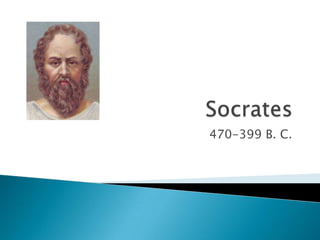
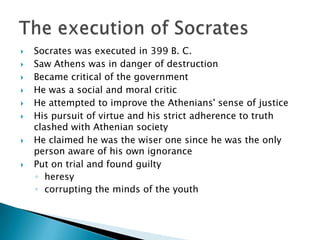
The Sophists were traveling teachers in ancient Athens who charged fees to educate wealthy citizens. They believed that truth was subjective and depended on circumstances rather than absolutes. This contradicted Socrates' view that morality could be objectively defined. Socrates used questioning dialogues to expose contradictions in people's beliefs and advance his view that virtue and wisdom come from seeking moral truths. However, his criticism of Athenian society led to his trial and execution by poisoning, establishing him as one of the founders of Western philosophy.