


CASTING DEFECTS IN
DENTISTRY
1
ANUPRABHA SHRIVASTAVA
PG-2nd YR
DEPT OF CONSERVATIVE
DENTISTRY & ENDODONTICS
CONTENTS
2
1) Introduction
2) Classification
3) Distortion
4) Surface roughness, Irregularities and Discoloration
a) Air bubbles
b) Water Films
c)Rapid heating rate
d) Underheating
e) Liquid/Powder ratio
3
f) Prolonged heating
g) Temperature of the alloy
h) Casting pressure
i) Composition of the Investment
j) Foreign bodies
k) Impact of the molten alloy
l) Pattern Position
m) Carbon inclusions
n) Other Causes
5) Porosity
a) Solidification Defects
i) Localized shrinkage porosity
ii) Microporosity
b) Trapped gases
i) Pinhole porosity
ii) Gas inclusions
iii) Subsurface porosity
c) Residual Air/Entrapped air/Back pressure porosity
6) Incomplete casting
7) Discoloration
8) References
4
INTRODUCTION
Definition- A Casting defect is an irregularity in the metal
casting that is undesired. Some defects can be tolerated while
others can be repaired, otherwise they must be eliminated.
 An unsuccessful casting results in considerable trouble &
loss of time.
 Casting defects can be avoided by strictly observing the
procedures, which are governed by certain fundamental rules
and principles.
Casting failures should be an exception & not the rule.
5
CLASSIFICATION (COOMBE)
Casting defects can be classified as:
a) Distortion
b) Surface roughness & irregularities
c) Porosity
d) Incomplete casting or missing details
e) Sulphur compounds, formed when ring is overheated &
there is breakdown of investment. ( Discoloration)
6
DISTORTION
 Distortion of the casting is due to a distortion of the wax pattern.
Some distortion of the wax pattern some wax distortion occurs
occurs as the investment hardens during manipulation,
around it or due to hygroscopic because of release of
& setting expansion. stresses caused by:
Contraction on cooling
Occluded air
Molding & carving
Removal
Time & temperature of storage
It does not
cause serious
problem, but
accounts for
some
unexplained
inaccuracies.
Minimized or
prevented by
proper
manipulation of
the wax and
handling of the
pattern.
7
Distortion can be minimized by:
1. Manipulation of wax at high temperature.
2. Investing pattern within one hour after finishing.
3. If storage is necessary, store in a refrigerator.
8
SURFACE ROUGHNESS & IRREGULARITIES
9
Definition of Surface roughness
It is defined as relatively finely spaced surface imperfections
whose height, width & direction establish the predominant
surface pattern.
( Phillip’s Science of Dental Materials, 11th edition)
Definition of Surface irregularities
Surface irregularities are isolated imperfections, such as
nodules, that are not characteristic of the entire surface area.
( Phillip’s Science of Dental materials, 11th edition)
10
The surface of a dental casting should be an accurate
reproduction of the surface of the wax pattern from which it
is made.
Even under optimal conditions, the surface roughness of
the casting is invariably somewhat greater than that of the
wax pattern from which it is made.
Excessive roughness or irregularities on the outer surface
of the casting requires additional finishing & polishing
whereas irregularities on the cavity surface (inner surface)
prevents proper seating of the casting.
CAUSES OF SURFACE ROUGHNESS &
IRREGULARITIES
11
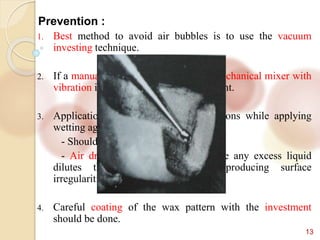
1) AIR BUBBLES-
 Air bubbles on wax pattern causes nodules on the casting.
 These air bubbles may occur on the outside or inside of
the casting.
 If the voids occur on the outside, they are theoretically
removable, but requires great expense of time and money.
(When nodules are small, they can be removed with a
small round bur.)
 If they occur on margins or internal surfaces, successful
removal is extremely difficult & often the restoration will
have to be recast.
12
Magnification with a binocular microscope is extremely
useful for detecting nodules & later removing them.
 Cause:
a) Lack of surfactant / wetting agent.
b) Improper brush technique.
c) Inadequate vibration during mixing.
d) Inadequate vacuum during investing.
13
Prevention :
1. Best method to avoid air bubbles is to use the vacuum
investing technique.
2. If a manual method is used, use of a mechanical mixer with
vibration i.e. proper mixing of investment.
3. Application of wetting agent. Precautions while applying
wetting agents are:
- Should be applied in thin layer
- Air drying the wetting agent, since any excess liquid
dilutes the investment, possibly producing surface
irregularities on the casting.
4. Careful coating of the wax pattern with the investment
should be done.
14
2) WATER FILMS
If the investment becomes separated from the wax pattern in
some manner, a water film may form irregularly over the
pattern surface as wax is repellent to water.
This is manifested as minute ridges or veins on the surface of
casting.
Causes –
a) If the pattern is slightly moved, jarred or vibrated after
investing.
b) Too high L/P ratio.
c) If the painting procedure does not result in an intimate
contact of the investment with the pattern.
15
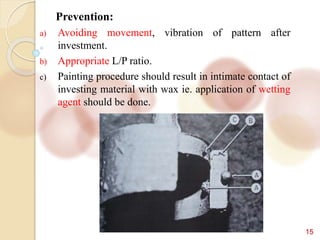
Prevention:
a) Avoiding movement, vibration of pattern after
investment.
b) Appropriate L/P ratio.
c) Painting procedure should result in intimate contact of
investing material with wax ie. application of wetting
agent should be done.
16
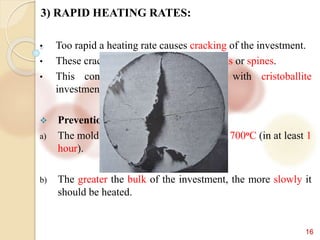
3) RAPID HEATING RATES:
• Too rapid a heating rate causes cracking of the investment.
• These cracks produces a casting with fins or spines.
• This condition is especially seen with cristoballite
investment.
 Prevention-
a) The mold should be heated gradually to 700oC (in at least 1
hour).
b) The greater the bulk of the investment, the more slowly it
should be heated.
17
4) OVERHEATING:
• Overheating of investment above 700ºC, disintegrates
the investment, liberating Sulphur or Sulphur compounds.
• These combine in metal in the gold alloy & form sulfide
film. This gives a dark casting (Black casting) which
cannot be cleaned by pickling.
5) PROLONGED HEATING:
• Same effect as that of overheating i.e disintegration of
investment / mould cavity.
18
6) UNDER HEATING-
• Incomplete elimination of wax residues may occur if the heating time is
too short or heating temperature is too low.
• A carbonized wax (wax residue) is left behind.
1. This carbonized wax sticks to the surface of the casting. This leads to
a black casting. It can be removed by heating over the flame.
2. Wax residue + Molten metal = Gas (Porosity / Blow holes/ Voids)
3. Wax residue + Oxygen in mould cavity = CO
• This CO prevents oxidation of the surface of casting gold & results in
bright, shiny casting.
• Also because of incomplete wax elimination, if large amount of
combustion products remain in the mould, they cloge the pores of
investment resulting in back pressure effect.
PREVENTION:
 Heating the investment ring, for adequate time &
temperature so as to remove carbon residues.
 The burn out should be done with sprue hole facing
downwards (for the wax to run down). This facilitates its
complete removal.
19
20
7) COMPOSITION OF THE INVESTMENT-
• The ratio of the binder to the quartz influences the
surface texture of the casting.
• A coarse silica causes surface roughness.
8) CASTING PRESSURE-
• Too high casting pressure during casting can produce a
rough surface on the casting.
• A gauge pressure of 0.10 to 0.14 MPa in an air pressure
casting machine OR 15 Ibs/sq inch of air pressure.
• Three to four turns of centrifugal casting machine is
sufficient for small castings.
21
9) FOREIGN BODIES:
•Identified by sharp, well-defined deficiencies.
• Cause:
1. Pieces of investment.
2. Bits of carbon from a flux. (Bright-appearing concavities may
be the result of flux carried into the mold with the metal.)
3. Carelessness in the removal of sprue former
• It may result in
1. Surface roughness
2. Surface voids or incomplete areas
Prevention:
• Avoiding carrying pieces of investment loosened during
removal of sprue former and crucible former.
22
10)IMPACT OF MOLTEN ALLOY :
The direction of the sprue former should be such that the
molten alloy does not hit a weak portion of the mold surface.
Occasionally, the molten alloy may fracture the mold surface
on impact, regardless of its bulk.
Such a depression / concave area in the mold is reflected as
a raised area on the casting, and prevents the complete seating
of the casting.
23
Prevention:
a) It can be avoided by proper spruing so as to prevent the
direct impact of the molten metal at an angle of 90
degrees to the investment surface.
b) A glancing impact is less damaging & also avoids
undesirable turbulence.
24
11) TEMPERATURE OF THE ALLOY :
If an alloy is heated to too high temperature, the surface of
the investment is likely to be attacked, and a surface
roughness may result.
12) LIQUID / POWDER RATIO
 The higher the L:P ratio, the rougher the casting.
 However, if too little water is used, the investment may be
unmanageably thick and cannot be properly applied to the
pattern.
 In either conditions, a rough surface on the casting may
result.
25
26
13) PATTERN POSITION
If several patterns are invested in the same ring they should
not be placed too close to each other.
 They should also be not placed in the same plane.
The expansion of wax is much greater than that of the
investment, causing breakdown or cracking of the investment
if the spacing between patterns is less than 3 mm.
27
14) CARBON INCLUSIONS
Carbon, as from a crucible, an improperly adjusted torch,
or a carbon-containing investment, can be absorbed by the
alloy during casting.
These particles may lead to the formation of carbides or
even create visible carbon inclusions.
28
POROSITY
Porosity may occur both within the interior region of a
casting and on the external surface.
External porosity may be a manifestation of internal
porosity. Whenever internal porosity extends to the surface, it
can cause for discoloration.
 The external porosity results in surface roughness, whereas
internal porosity weakens the casting.
 Severe porosity can cause plaque accumulation at the
tooth-restoration interface, and secondary caries may result.
Although the porosity in a casting cannot be prevented
entirely, it can be minimized by use of proper techniques.
29
Porosities in noble metal alloy castings may be classified
as follows:
I. Solidification defects
A. Localized shrinkage porosity
B. Suck back porosity
C. Micro porosity
II. Trapped gases
A. Pinhole porosity
B. Gas inclusions
C. Subsurface porosity
D. Back pressure porosity
( Phillip’s Science of Dental Materials, 12th edition)
30
LOCALIZED SHRINKAGE / SHRINK SPOT
POROSITY –
Cause:
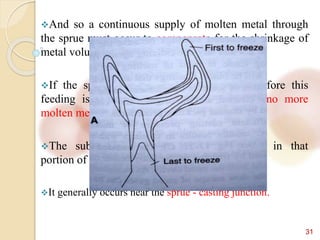
 By premature termination of the flow of molten metal
during solidification.
 Incorrect sequence of cooling. Usually the sprue should
freeze at last. If it freezes before the rest of the casting, it
leads to porosity.
(Ideally, molten alloy located farthest from the sprue button
should freeze first.)
 Metal on solidification shrinks. The linear contraction of
noble metal alloys in changing from a liquid to a solid is at
least 1.25%.
31
And so a continuous supply of molten metal through
the sprue must occur to compensate for the shrinkage of
metal volume during solidification.
If the sprue freezes in its cross section before this
feeding is completed to the casting proper, no more
molten metal can be supplied from the sprue.
The subsequent shrinkage produces voids in that
portion of the casting which solidifies at last.
It generally occurs near the sprue - casting junction.
PREVENTED BY:
1. Use sprue of correct thickness. ( Inc. sprue thickness)
2. Decreasing the length of sprue.
3. Increasing the melt temperature.
4. Increasing the mould temperature.
5. Attach the sprue to thickest portion of wax pattern.
6. Flare the sprue at the point of attachment.
7. Place a reservoir close to the wax pattern.
32
33
SUCK-BACK POROSITY
It often occurs in occlusoaxial or incisoaxial line angle that
is not well rounded.
The entering metal impinges onto the mold surface at this
point & creates a higher localized mold temperature in this
region that is called ‘hot spot’.
 A hot spot may retain a localized pool of molten metal after
other areas of casting have solidified i.e. it causes the local
region to freeze last resulting in ‘Suck -back porosity’.
 It is an external void seen in the interior of a crown near the
area of the sprue, if a hot spot is created.
34
Prevention –
 By reducing the temperature difference between the mould
& molten alloy. (i.e. lowering the casting temperature by
about 30 ºC)
35
MICROPOROSITY
 It is generally present in fine grain alloy castings when the
solidification is too rapid for the micro voids to segregate to
the liquid pool.
 The porosity is in the form of small, irregular voids.
 Cause: Rapid solidification if the mold or casting
temperature is too low.
36
This defect is detected only if casting is sectioned.
It is generally not a serious defect.
It is reduced by –
a) Increase in melt temperature
b) Increase in mold temperature
37
PINHOLE & GAS INCLUSION POROSITY
 Gases are dissolved by some metals when they are in
molten state, during solidification these gases are expelled /
released out resulting in PINHOLE POROSITY.
 For ex: Cu & Ag dissolve oxygen.
Pt & Pd dissolve hydrogen & oxygen.
 GAS INCLUSION POROSITY: Due to entrapment of
gas by molten metal or gas inclusion during casting
procedure.
38
Gas inclusion porosity may be caused by gas that is :
a) Gas occluded from a poorly adjusted torch flame
b) Using of the mixing or oxidizing zones of the flame (rather
than reducing zone)
MICROPOROSITY VOIDS : IRREGULAR
PIN HOLE & GAS INCLUSION : SPHERICAL
(GAS INCLUSION : LARGER THAN PINHOLE)
39
Prevention of Gas inclusion porosity:
It can be minimized by –
a) Use of graphite crucible for heating the alloy.
b) Correctly adjusting & positioning the torch flame during
melting.
40
SUBSURFACE POROSITY
 They may be caused by simultaneous nucleation of solid
grains & gas bubbles when the alloy freezes at the mold
walls.
Prevention-
a) By controlling the rate at which the molten metal enters
the mold.
41
It is increased by -
a) Increase in sprue thickness.
b) Increase in melt temperature.
c) Increase in mold temperature.
 It is reduced by increase in sprue length.
42
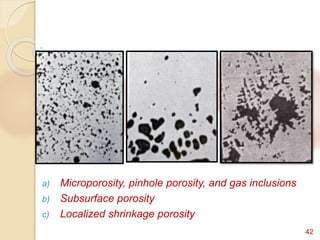
a) Microporosity, pinhole porosity, and gas inclusions
b) Subsurface porosity
c) Localized shrinkage porosity
43
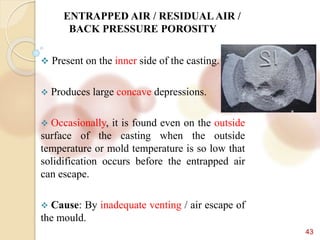
ENTRAPPED AIR / RESIDUAL AIR /
BACK PRESSURE POROSITY
 Present on the inner side of the casting.
 Produces large concave depressions.
 Occasionally, it is found even on the outside
surface of the casting when the outside
temperature or mold temperature is so low that
solidification occurs before the entrapped air
can escape.
 Cause: By inadequate venting / air escape of
the mould.
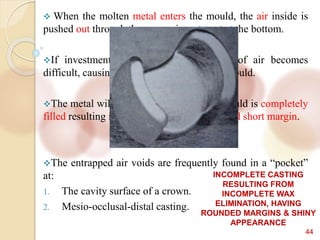
44
 When the molten metal enters the mould, the air inside is
pushed out through the porous investment at the bottom.
If investment is too bulky, the escape of air becomes
difficult, causing increased pressure in the mould.
The metal will then solidify, before the mould is completely
filled resulting in porous casting with rounded short margin.
The entrapped air voids are frequently found in a “pocket”
at:
1. The cavity surface of a crown.
2. Mesio-occlusal-distal casting.
INCOMPLETE CASTING
RESULTING FROM
INCOMPLETE WAX
ELIMINATION, HAVING
ROUNDED MARGINS & SHINY
APPEARANCE
45
 Incidence of entrapped air increases by -
a) Dense modern investments. (Vacuum investment
which causes less voids)
b) Improper wax elimination – residual wax will
clog the pores.
c) Low casting temperature.
d) Low casting pressure.
Use of investment with adequate porosity. (Low L:P
ratio – Less porosity)
Proper burnout
Adequate casting pressure, temperature & force.
The thickness of the investment between the tip of
the pattern & end of the ring should not be greater
than 6mm.
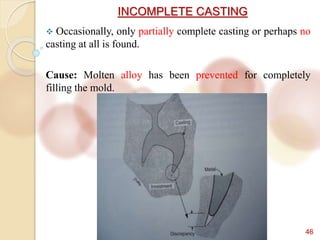
INCOMPLETE CASTING
46
 Occasionally, only partially complete casting or perhaps no
casting at all is found.
Cause: Molten alloy has been prevented for completely
filling the mold.
Factors that might inhibit the ingress of the liquefied metal
are :
47
Insufficient alloy used.
Alloy not hot enough. ( High viscosity of the fused metal) & so
alloy is not able to enter thin parts of mould.
Premature solidification of alloy.
Low casting pressure.
Improper burnout. (Incomplete wax elimination & Insufficient
venting of the mold ).
Pattern too far from end of the ring.
Sprue blocked with foreign body.
PREMATURE SOLIDIFICATION OF ALLOY
The temperature of the alloy should be raised higher than its
liquidus temperature
This decreases the viscosity & surface tension of the alloy
Prevents premature solidification of the alloy
NOTE:
 White gold alloys have high liquidus temperature & so are
more susceptible to porosity.
 Due to same reason, it is difficult to melt white gold alloys
with gas- air torch flame.
48
49
INSUFFICIENT VENTING
Insufficient venting is directly related to the back pressure
exerted by the air in the mold.
 So, casting pressure has to be increased to overcome the
back pressure. The pressure should be applied for at least 4
seconds.
The mold is filled & metal is solidified in 1 sec or less, yet it
is quite soft during the early stages.
Therefore, the pressure should be maintained for a few
seconds beyond this point.
SMALL CASTING
 If the compensation of alloy shrinkage is not done by
adequate expansion of mould cavity, it will result in small
casting.
 Another reason is shrinkage of impression material.
50
51
SURFACE DISCOLORATION
Surface discoloration may be due to:
1. Overheating.
2. Incomplete elimination of wax.
3. High sulfur content of the torch flame.
4. Absence of reducing agents in the investment.
A source of discoloration often overlooked is the surface
contamination of a gold alloy restoration by mercury.
Mercury penetrates rapidly into the alloy and causes a
marked loss in ductility and a greater susceptibility to
corrosion.
Thus, it is not a good practice to place a new amalgam
restoration adjacent to a high noble alloy restoration.
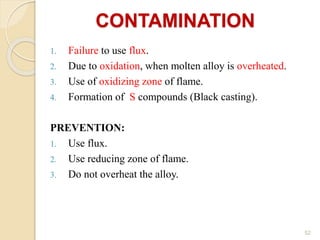
CONTAMINATION
1. Failure to use flux.
2. Due to oxidation, when molten alloy is overheated.
3. Use of oxidizing zone of flame.
4. Formation of S compounds (Black casting).
PREVENTION:
1. Use flux.
2. Use reducing zone of flame.
3. Do not overheat the alloy.
52
53
REFERENCES
Phillips’ Science of Dental Materials, Anusavice, 11th
Edition
Craig’s Restorative Dental Materials, Powers & Sakaguchi,
12th Edition
Contemporary Fixed Prosthodontics, Rosenstiel, 4th Edition
A text book of operative dentistry by Vimal Sikri
Internet sources
54

Casting defects in dentistry

  • 1.
    CASTING DEFECTS IN DENTISTRY 1 ANUPRABHASHRIVASTAVA PG-2nd YR DEPT OF CONSERVATIVE DENTISTRY & ENDODONTICS
  • 2.
    CONTENTS 2 1) Introduction 2) Classification 3)Distortion 4) Surface roughness, Irregularities and Discoloration a) Air bubbles b) Water Films c)Rapid heating rate d) Underheating e) Liquid/Powder ratio
  • 3.
    3 f) Prolonged heating g)Temperature of the alloy h) Casting pressure i) Composition of the Investment j) Foreign bodies k) Impact of the molten alloy l) Pattern Position m) Carbon inclusions n) Other Causes 5) Porosity a) Solidification Defects
  • 4.
    i) Localized shrinkageporosity ii) Microporosity b) Trapped gases i) Pinhole porosity ii) Gas inclusions iii) Subsurface porosity c) Residual Air/Entrapped air/Back pressure porosity 6) Incomplete casting 7) Discoloration 8) References 4
  • 5.
    INTRODUCTION Definition- A Castingdefect is an irregularity in the metal casting that is undesired. Some defects can be tolerated while others can be repaired, otherwise they must be eliminated.  An unsuccessful casting results in considerable trouble & loss of time.  Casting defects can be avoided by strictly observing the procedures, which are governed by certain fundamental rules and principles. Casting failures should be an exception & not the rule. 5
  • 6.
    CLASSIFICATION (COOMBE) Casting defectscan be classified as: a) Distortion b) Surface roughness & irregularities c) Porosity d) Incomplete casting or missing details e) Sulphur compounds, formed when ring is overheated & there is breakdown of investment. ( Discoloration) 6
  • 7.
    DISTORTION  Distortion ofthe casting is due to a distortion of the wax pattern. Some distortion of the wax pattern some wax distortion occurs occurs as the investment hardens during manipulation, around it or due to hygroscopic because of release of & setting expansion. stresses caused by: Contraction on cooling Occluded air Molding & carving Removal Time & temperature of storage It does not cause serious problem, but accounts for some unexplained inaccuracies. Minimized or prevented by proper manipulation of the wax and handling of the pattern. 7
  • 8.
    Distortion can beminimized by: 1. Manipulation of wax at high temperature. 2. Investing pattern within one hour after finishing. 3. If storage is necessary, store in a refrigerator. 8
  • 9.
    SURFACE ROUGHNESS &IRREGULARITIES 9 Definition of Surface roughness It is defined as relatively finely spaced surface imperfections whose height, width & direction establish the predominant surface pattern. ( Phillip’s Science of Dental Materials, 11th edition) Definition of Surface irregularities Surface irregularities are isolated imperfections, such as nodules, that are not characteristic of the entire surface area. ( Phillip’s Science of Dental materials, 11th edition)
  • 10.
    10 The surface ofa dental casting should be an accurate reproduction of the surface of the wax pattern from which it is made. Even under optimal conditions, the surface roughness of the casting is invariably somewhat greater than that of the wax pattern from which it is made. Excessive roughness or irregularities on the outer surface of the casting requires additional finishing & polishing whereas irregularities on the cavity surface (inner surface) prevents proper seating of the casting.
  • 11.
    CAUSES OF SURFACEROUGHNESS & IRREGULARITIES 11 1) AIR BUBBLES-  Air bubbles on wax pattern causes nodules on the casting.  These air bubbles may occur on the outside or inside of the casting.  If the voids occur on the outside, they are theoretically removable, but requires great expense of time and money. (When nodules are small, they can be removed with a small round bur.)  If they occur on margins or internal surfaces, successful removal is extremely difficult & often the restoration will have to be recast.
  • 12.
    12 Magnification with abinocular microscope is extremely useful for detecting nodules & later removing them.  Cause: a) Lack of surfactant / wetting agent. b) Improper brush technique. c) Inadequate vibration during mixing. d) Inadequate vacuum during investing.
  • 13.
    13 Prevention : 1. Bestmethod to avoid air bubbles is to use the vacuum investing technique. 2. If a manual method is used, use of a mechanical mixer with vibration i.e. proper mixing of investment. 3. Application of wetting agent. Precautions while applying wetting agents are: - Should be applied in thin layer - Air drying the wetting agent, since any excess liquid dilutes the investment, possibly producing surface irregularities on the casting. 4. Careful coating of the wax pattern with the investment should be done.
  • 14.
    14 2) WATER FILMS Ifthe investment becomes separated from the wax pattern in some manner, a water film may form irregularly over the pattern surface as wax is repellent to water. This is manifested as minute ridges or veins on the surface of casting. Causes – a) If the pattern is slightly moved, jarred or vibrated after investing. b) Too high L/P ratio. c) If the painting procedure does not result in an intimate contact of the investment with the pattern.
  • 15.
    15 Prevention: a) Avoiding movement,vibration of pattern after investment. b) Appropriate L/P ratio. c) Painting procedure should result in intimate contact of investing material with wax ie. application of wetting agent should be done.
  • 16.
    16 3) RAPID HEATINGRATES: • Too rapid a heating rate causes cracking of the investment. • These cracks produces a casting with fins or spines. • This condition is especially seen with cristoballite investment.  Prevention- a) The mold should be heated gradually to 700oC (in at least 1 hour). b) The greater the bulk of the investment, the more slowly it should be heated.
  • 17.
    17 4) OVERHEATING: • Overheatingof investment above 700ºC, disintegrates the investment, liberating Sulphur or Sulphur compounds. • These combine in metal in the gold alloy & form sulfide film. This gives a dark casting (Black casting) which cannot be cleaned by pickling. 5) PROLONGED HEATING: • Same effect as that of overheating i.e disintegration of investment / mould cavity.
  • 18.
    18 6) UNDER HEATING- •Incomplete elimination of wax residues may occur if the heating time is too short or heating temperature is too low. • A carbonized wax (wax residue) is left behind. 1. This carbonized wax sticks to the surface of the casting. This leads to a black casting. It can be removed by heating over the flame. 2. Wax residue + Molten metal = Gas (Porosity / Blow holes/ Voids) 3. Wax residue + Oxygen in mould cavity = CO • This CO prevents oxidation of the surface of casting gold & results in bright, shiny casting. • Also because of incomplete wax elimination, if large amount of combustion products remain in the mould, they cloge the pores of investment resulting in back pressure effect.
  • 19.
    PREVENTION:  Heating theinvestment ring, for adequate time & temperature so as to remove carbon residues.  The burn out should be done with sprue hole facing downwards (for the wax to run down). This facilitates its complete removal. 19
  • 20.
    20 7) COMPOSITION OFTHE INVESTMENT- • The ratio of the binder to the quartz influences the surface texture of the casting. • A coarse silica causes surface roughness. 8) CASTING PRESSURE- • Too high casting pressure during casting can produce a rough surface on the casting. • A gauge pressure of 0.10 to 0.14 MPa in an air pressure casting machine OR 15 Ibs/sq inch of air pressure. • Three to four turns of centrifugal casting machine is sufficient for small castings.
  • 21.
    21 9) FOREIGN BODIES: •Identifiedby sharp, well-defined deficiencies. • Cause: 1. Pieces of investment. 2. Bits of carbon from a flux. (Bright-appearing concavities may be the result of flux carried into the mold with the metal.) 3. Carelessness in the removal of sprue former • It may result in 1. Surface roughness 2. Surface voids or incomplete areas Prevention: • Avoiding carrying pieces of investment loosened during removal of sprue former and crucible former.
  • 22.
    22 10)IMPACT OF MOLTENALLOY : The direction of the sprue former should be such that the molten alloy does not hit a weak portion of the mold surface. Occasionally, the molten alloy may fracture the mold surface on impact, regardless of its bulk. Such a depression / concave area in the mold is reflected as a raised area on the casting, and prevents the complete seating of the casting.
  • 23.
    23 Prevention: a) It canbe avoided by proper spruing so as to prevent the direct impact of the molten metal at an angle of 90 degrees to the investment surface. b) A glancing impact is less damaging & also avoids undesirable turbulence.
  • 24.
    24 11) TEMPERATURE OFTHE ALLOY : If an alloy is heated to too high temperature, the surface of the investment is likely to be attacked, and a surface roughness may result.
  • 25.
    12) LIQUID /POWDER RATIO  The higher the L:P ratio, the rougher the casting.  However, if too little water is used, the investment may be unmanageably thick and cannot be properly applied to the pattern.  In either conditions, a rough surface on the casting may result. 25
  • 26.
    26 13) PATTERN POSITION Ifseveral patterns are invested in the same ring they should not be placed too close to each other.  They should also be not placed in the same plane. The expansion of wax is much greater than that of the investment, causing breakdown or cracking of the investment if the spacing between patterns is less than 3 mm.
  • 27.
    27 14) CARBON INCLUSIONS Carbon,as from a crucible, an improperly adjusted torch, or a carbon-containing investment, can be absorbed by the alloy during casting. These particles may lead to the formation of carbides or even create visible carbon inclusions.
  • 28.
    28 POROSITY Porosity may occurboth within the interior region of a casting and on the external surface. External porosity may be a manifestation of internal porosity. Whenever internal porosity extends to the surface, it can cause for discoloration.  The external porosity results in surface roughness, whereas internal porosity weakens the casting.  Severe porosity can cause plaque accumulation at the tooth-restoration interface, and secondary caries may result. Although the porosity in a casting cannot be prevented entirely, it can be minimized by use of proper techniques.
  • 29.
    29 Porosities in noblemetal alloy castings may be classified as follows: I. Solidification defects A. Localized shrinkage porosity B. Suck back porosity C. Micro porosity II. Trapped gases A. Pinhole porosity B. Gas inclusions C. Subsurface porosity D. Back pressure porosity ( Phillip’s Science of Dental Materials, 12th edition)
  • 30.
    30 LOCALIZED SHRINKAGE /SHRINK SPOT POROSITY – Cause:  By premature termination of the flow of molten metal during solidification.  Incorrect sequence of cooling. Usually the sprue should freeze at last. If it freezes before the rest of the casting, it leads to porosity. (Ideally, molten alloy located farthest from the sprue button should freeze first.)  Metal on solidification shrinks. The linear contraction of noble metal alloys in changing from a liquid to a solid is at least 1.25%.
  • 31.
    31 And so acontinuous supply of molten metal through the sprue must occur to compensate for the shrinkage of metal volume during solidification. If the sprue freezes in its cross section before this feeding is completed to the casting proper, no more molten metal can be supplied from the sprue. The subsequent shrinkage produces voids in that portion of the casting which solidifies at last. It generally occurs near the sprue - casting junction.
  • 32.
    PREVENTED BY: 1. Usesprue of correct thickness. ( Inc. sprue thickness) 2. Decreasing the length of sprue. 3. Increasing the melt temperature. 4. Increasing the mould temperature. 5. Attach the sprue to thickest portion of wax pattern. 6. Flare the sprue at the point of attachment. 7. Place a reservoir close to the wax pattern. 32
  • 33.
    33 SUCK-BACK POROSITY It oftenoccurs in occlusoaxial or incisoaxial line angle that is not well rounded. The entering metal impinges onto the mold surface at this point & creates a higher localized mold temperature in this region that is called ‘hot spot’.  A hot spot may retain a localized pool of molten metal after other areas of casting have solidified i.e. it causes the local region to freeze last resulting in ‘Suck -back porosity’.  It is an external void seen in the interior of a crown near the area of the sprue, if a hot spot is created.
  • 34.
    34 Prevention –  Byreducing the temperature difference between the mould & molten alloy. (i.e. lowering the casting temperature by about 30 ºC)
  • 35.
    35 MICROPOROSITY  It isgenerally present in fine grain alloy castings when the solidification is too rapid for the micro voids to segregate to the liquid pool.  The porosity is in the form of small, irregular voids.  Cause: Rapid solidification if the mold or casting temperature is too low.
  • 36.
    36 This defect isdetected only if casting is sectioned. It is generally not a serious defect. It is reduced by – a) Increase in melt temperature b) Increase in mold temperature
  • 37.
    37 PINHOLE & GASINCLUSION POROSITY  Gases are dissolved by some metals when they are in molten state, during solidification these gases are expelled / released out resulting in PINHOLE POROSITY.  For ex: Cu & Ag dissolve oxygen. Pt & Pd dissolve hydrogen & oxygen.  GAS INCLUSION POROSITY: Due to entrapment of gas by molten metal or gas inclusion during casting procedure.
  • 38.
    38 Gas inclusion porositymay be caused by gas that is : a) Gas occluded from a poorly adjusted torch flame b) Using of the mixing or oxidizing zones of the flame (rather than reducing zone) MICROPOROSITY VOIDS : IRREGULAR PIN HOLE & GAS INCLUSION : SPHERICAL (GAS INCLUSION : LARGER THAN PINHOLE)
  • 39.
    39 Prevention of Gasinclusion porosity: It can be minimized by – a) Use of graphite crucible for heating the alloy. b) Correctly adjusting & positioning the torch flame during melting.
  • 40.
    40 SUBSURFACE POROSITY  Theymay be caused by simultaneous nucleation of solid grains & gas bubbles when the alloy freezes at the mold walls. Prevention- a) By controlling the rate at which the molten metal enters the mold.
  • 41.
    41 It is increasedby - a) Increase in sprue thickness. b) Increase in melt temperature. c) Increase in mold temperature.  It is reduced by increase in sprue length.
  • 42.
    42 a) Microporosity, pinholeporosity, and gas inclusions b) Subsurface porosity c) Localized shrinkage porosity
  • 43.
    43 ENTRAPPED AIR /RESIDUAL AIR / BACK PRESSURE POROSITY  Present on the inner side of the casting.  Produces large concave depressions.  Occasionally, it is found even on the outside surface of the casting when the outside temperature or mold temperature is so low that solidification occurs before the entrapped air can escape.  Cause: By inadequate venting / air escape of the mould.
  • 44.
    44  When themolten metal enters the mould, the air inside is pushed out through the porous investment at the bottom. If investment is too bulky, the escape of air becomes difficult, causing increased pressure in the mould. The metal will then solidify, before the mould is completely filled resulting in porous casting with rounded short margin. The entrapped air voids are frequently found in a “pocket” at: 1. The cavity surface of a crown. 2. Mesio-occlusal-distal casting. INCOMPLETE CASTING RESULTING FROM INCOMPLETE WAX ELIMINATION, HAVING ROUNDED MARGINS & SHINY APPEARANCE
  • 45.
    45  Incidence ofentrapped air increases by - a) Dense modern investments. (Vacuum investment which causes less voids) b) Improper wax elimination – residual wax will clog the pores. c) Low casting temperature. d) Low casting pressure. Use of investment with adequate porosity. (Low L:P ratio – Less porosity) Proper burnout Adequate casting pressure, temperature & force. The thickness of the investment between the tip of the pattern & end of the ring should not be greater than 6mm.
  • 46.
    INCOMPLETE CASTING 46  Occasionally,only partially complete casting or perhaps no casting at all is found. Cause: Molten alloy has been prevented for completely filling the mold.
  • 47.
    Factors that mightinhibit the ingress of the liquefied metal are : 47 Insufficient alloy used. Alloy not hot enough. ( High viscosity of the fused metal) & so alloy is not able to enter thin parts of mould. Premature solidification of alloy. Low casting pressure. Improper burnout. (Incomplete wax elimination & Insufficient venting of the mold ). Pattern too far from end of the ring. Sprue blocked with foreign body.
  • 48.
    PREMATURE SOLIDIFICATION OFALLOY The temperature of the alloy should be raised higher than its liquidus temperature This decreases the viscosity & surface tension of the alloy Prevents premature solidification of the alloy NOTE:  White gold alloys have high liquidus temperature & so are more susceptible to porosity.  Due to same reason, it is difficult to melt white gold alloys with gas- air torch flame. 48
  • 49.
    49 INSUFFICIENT VENTING Insufficient ventingis directly related to the back pressure exerted by the air in the mold.  So, casting pressure has to be increased to overcome the back pressure. The pressure should be applied for at least 4 seconds. The mold is filled & metal is solidified in 1 sec or less, yet it is quite soft during the early stages. Therefore, the pressure should be maintained for a few seconds beyond this point.
  • 50.
    SMALL CASTING  Ifthe compensation of alloy shrinkage is not done by adequate expansion of mould cavity, it will result in small casting.  Another reason is shrinkage of impression material. 50
  • 51.
    51 SURFACE DISCOLORATION Surface discolorationmay be due to: 1. Overheating. 2. Incomplete elimination of wax. 3. High sulfur content of the torch flame. 4. Absence of reducing agents in the investment. A source of discoloration often overlooked is the surface contamination of a gold alloy restoration by mercury. Mercury penetrates rapidly into the alloy and causes a marked loss in ductility and a greater susceptibility to corrosion. Thus, it is not a good practice to place a new amalgam restoration adjacent to a high noble alloy restoration.
  • 52.
    CONTAMINATION 1. Failure touse flux. 2. Due to oxidation, when molten alloy is overheated. 3. Use of oxidizing zone of flame. 4. Formation of S compounds (Black casting). PREVENTION: 1. Use flux. 2. Use reducing zone of flame. 3. Do not overheat the alloy. 52
  • 53.
    53 REFERENCES Phillips’ Science ofDental Materials, Anusavice, 11th Edition Craig’s Restorative Dental Materials, Powers & Sakaguchi, 12th Edition Contemporary Fixed Prosthodontics, Rosenstiel, 4th Edition A text book of operative dentistry by Vimal Sikri Internet sources
  • 54.