



Ali E. H. Hajiah, PhD
ENERGY CONSERVATION PROGRAM IN KUWAIT:
A LOCAL PERSPECTIVE

Department of Building and Energy Technologies
Environment and Urban Development Division
Kuwait Institute for Scientific Research
Fifteenth Symposium on Improving
Building Systems in Hot and Humid
 Climates, Orlando, FL, July 24-26,
               2006
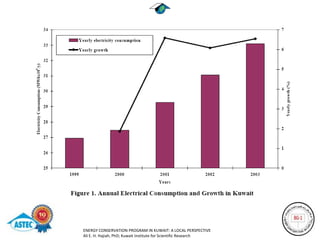
Due to heavy use of air conditioning,
reliance on desalination for water,
and highly subsidized electricity
prices, Kuwait's per capita electricity
consumption is amongst the highest
in the world.


       ENERGY CONSERVATION PROGRAM IN KUWAIT: A LOCAL PERSPECTIVE
       Ali E. H. Hajiah, PhD; Kuwait Institute for Scientific Research
In Kuwait, nearly 300-350 MW
power is added every year only to
satisfy the growing demand of the
            A/C systems


      ENERGY CONSERVATION PROGRAM IN KUWAIT: A LOCAL PERSPECTIVE
      Ali E. H. Hajiah, PhD; Kuwait Institute for Scientific Research
Kuwait
• Seven months of summer
• Temperatures over 50 C.
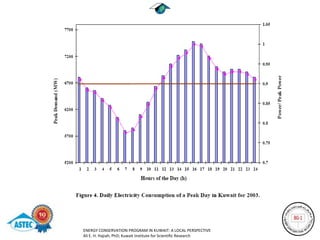
• “Air-conditioning of buildings is the single
  largest consumer of electricity and accounts
  for nearly 75% of nation’s peak power
  demand and over 50% of annual energy
  consumption. “


           ENERGY CONSERVATION PROGRAM IN KUWAIT: A LOCAL PERSPECTIVE
           Ali E. H. Hajiah, PhD; Kuwait Institute for Scientific Research
• MEW is spending nearly 80 million
  Kuwaiti Dinars at 400 KD/kW every year
  to add additional power generation and
  distribution.

• The amount spent annually on fuel to
  generate electricity for the operation of
  the A/C systems is well over 90 million
  KD (MEW, 2002).

          ENERGY CONSERVATION PROGRAM IN KUWAIT: A LOCAL PERSPECTIVE
          Ali E. H. Hajiah, PhD; Kuwait Institute for Scientific Research
ENERGY CONSERVATION PROGRAM IN KUWAIT: A LOCAL PERSPECTIVE
Ali E. H. Hajiah, PhD; Kuwait Institute for Scientific Research
ENERGY CONSERVATION PROGRAM IN KUWAIT: A LOCAL PERSPECTIVE
Ali E. H. Hajiah, PhD; Kuwait Institute for Scientific Research
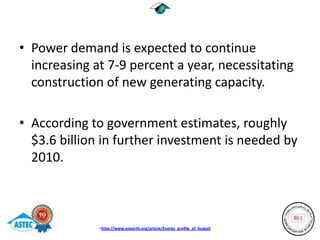
• Power demand is expected to continue
  increasing at 7-9 percent a year, necessitating
  construction of new generating capacity.

• According to government estimates, roughly
  $3.6 billion in further investment is needed by
  2010.


              <http://www.eoearth.org/article/Energy_profile_of_Kuwait
September 14, 2009


GE Energy announced that the Kuwait Ministry
 of Electricity and Water signed a $2.65 billion
      USD contract for a new power plant

Kuwait’s robust business and residential growth
  has strained the country’s power generation
  capability, resulting in power outages during
            the hot summer months.


         http://www.zawya.com/Story.cfm/sidZAWYA20090914093137
From the Energy Information
Administration:

Kuwait seeks to significantly increase
its use of natural gas in electricity
generation, water desalination, and
petrochemicals to free up as much as
100,000 barrels per day of oil for
export.

         http://www.eia.doe.gov/emeu/cabs/Kuwait/Full.html
Kuwait Consumption & Imports

In 2006, an annual basis - natural gas consumption
matches production.

Kuwait’s electricity demand, has outpaced natural
gas production during the summer months.

Result is the shutdown of refinery and
petrochemical operations to meet the increased
demand in electricity.

             http://www.eia.doe.gov/emeu/cabs/Kuwait/Full.html
By 2014 regional energy demand is
forecasted to have a 25.1% growth over
         the period since 2009.


   Kuwait's thermal power generation is forecast to rise 70.2% between 2009 and 2019
   by Mike King
   http://www.pr-inside.com/kuwait-s-thermal-power-generation-is-r1724985.htm
GOALS
•   Reduce Electrical Demand
•   Increase Energy Exports
•   Reduce Energy Imports
•   Provide More Reliability
•   Provide a Better Environment
Our world is changing…

we need to change with it.

  Our Designs, our Products, our Processes
Lawrence Berkeley National
  Laboratory Heat Island
          Study
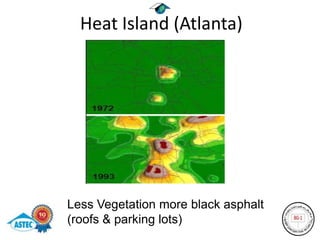
Heat Island (Atlanta)


Less Vegetation more black asphalt
(roofs & parking lots)
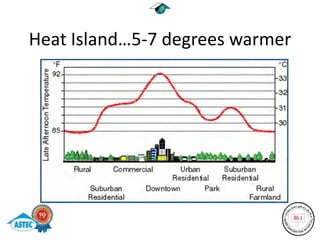
Heat Island…5-7 degrees warmer
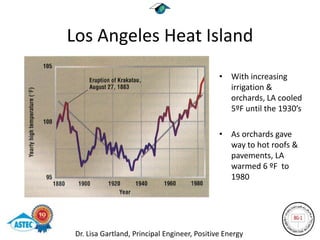
Los Angeles Heat Island
                                               • With increasing
                                                 irrigation &
                                                 orchards, LA cooled
                                                 5ºF until the 1930’s

                                               • As orchards gave
                                                 way to hot roofs &
                                                 pavements, LA
                                                 warmed 6 ºF to
                                                 1980


 Dr. Lisa Gartland, Principal Engineer, Positive Energy
Lawrence Berkeley National
  Laboratory Heat Island
          Study
     One degree increase in air temperature
   raises energy demand by two percent …and
           raises smog by three percent
Buildings account for…
   36% of total energy use
   65% of electricity consumption
   30% of greenhouse gas emissions
   30% of raw materials use
   30% of waste output/136 million tons annually
   12% of potable water consumption

                  data from USGBC Website
Heat Transfer


Where there is a temperature difference
between objects in proximity, heat transfer
between them can never be stopped; it can
         only be slowed down.
SOLAR RADIATION
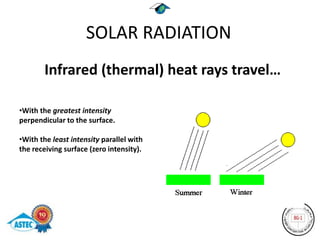
SOLAR RADIATION
       Infrared (thermal) heat rays travel…

•With the greatest intensity
perpendicular to the surface.

•With the least intensity parallel with
the receiving surface (zero intensity).
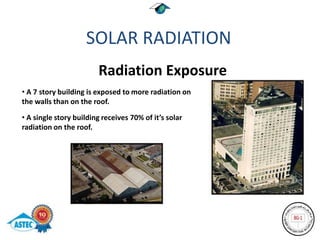
SOLAR RADIATION
                        Radiation Exposure
• A 7 story building is exposed to more radiation on
the walls than on the roof.

• A single story building receives 70% of it’s solar
radiation on the roof.
Environmental Factors


Cannot be manipulated:

• Ambient air temperature
• Solar radiation
• Wind
Building Material Factors

Can be manipulated:

•   Material resistivity (r-value)
•   Surface Solar reflectivity
•   Surface Solar absorptivity
•   Surface Thermal radiation emissivity
Heat Transfer and Buildings

The best way to reduce heat transfer:

    Prevent it from entering the building.

The best way to manage heat transfer:

    Re-emit it quickly.
Solutions That Require
Large Scale Investments
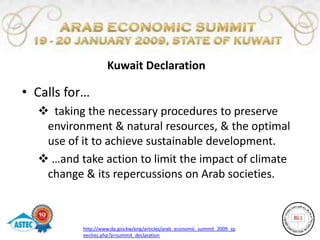
Kuwait Declaration

• Calls for…
   taking the necessary procedures to preserve
   environment & natural resources, & the optimal
   use of it to achieve sustainable development.
   …and take action to limit the impact of climate
   change & its repercussions on Arab societies.


          http://www.da.gov.kw/eng/articles/arab_economic_summit_2009_sp
          eeches.php?p=summit_declaration
History
• In 1995, the Kuwait Environment Public Authority (EPA) was created.

• With the help of the ESCWA (the Economic Commission for Western Asia
  (ECWA) in 2005 set forth an environmental strategy with three types of
  objectives:

     the reduction of the rate of pollution;
     introduction of the environmental dimension in policies, plans and
      national programs;
     the protection of the national resources and the biodiversity in the
      context of sustainable development. (LEED)

  “The adoption of such strategies can hardly be considered as a luxury in all Gulf countries;
  in which environmental problems are somewhat similar”.


                            http://www.escwa.un.org/divisions/pptcdadvisors.asp?id=12
Questions
Can Kuwait avoid the need to build new power plants?

Can economic competitiveness be increased?

Can health conditions be improved ?

Can building maintenance and operation costs be
decreased?

Can green house gas emissions be reduced?
HOW?
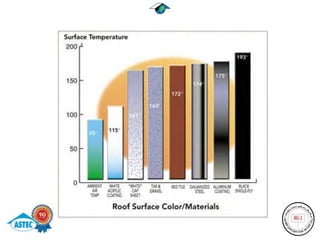
A Radiant Heat Barrier…
 Reduces surface temperatures by as much as 20˚ C

 Reflects at least 70% of radiant heat

 Limits radiant heat absorption between 15% and 20%

 Emissivity level of 90% quickly reducing heat transfer

 Reduces energy consumption by as much as 40%
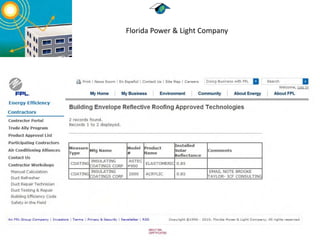
Florida Power & Light Company
Reflective roof surfaces

  $0.45 per square foot of reflective roof

  When the retrofit application reflects at least
  73% of the sun’s heat.
San Antonio, TX
• CPS Energy
• The Largest Municipally Owned Energy
  Company in the Nation
• (Provides Both Gas and Electricity)
Residential Cool Roof Rebate
    $0.20 per square foot.

Must be ENERGY STAR® cool roof
          products.
$0.10 per Sq. Ft. for Commercial Roofs
• Rated reflectivity must be measured by test
  method ASTM E424-71, ASTM E903-96

• Must have a minimum reflectivity of 75%.
California
Low - Sloped Roofs: $.20 per sq ft

Steep-sloped: $.10 - $.20 per sq ft.
The USA Federal Energy Policy
             Act of 2005
• Commercial buildings are eligible for tax
  deductions up to $1.80 USD per square foot.
• Many buildings are eligible for improvements
  completed within the normal course of
  business.
• For municipal buildings, benefits are passed
  through to the primary designers/architects in
  an attempt to encourage innovative municipal
  design.
Hashem Akbari Heat Island Group
        Lawrence Berkeley National Laboratory

• Cool roof standards are designed to reduce a/c
  demand, save money, and save emissions.

• In Los Angeles they will eventually save $100,000
  per hour.

• Each 25m2 of cool roof offsets 1 ton of CO2
REDUCE PEAK DEMAND


A reflective roof can reduce peak
   cooling demand by 10-15%.
Power Grid Benefits with
          “Cool Roofs”
Utility Grid/Operator Benefits
 Reduced need for infrastructure spending
    Generation
    Transmission
    Local Distribution
 Mitigation of System Peaks
 Reduced Spending will lower rates over long term
Department of Energy


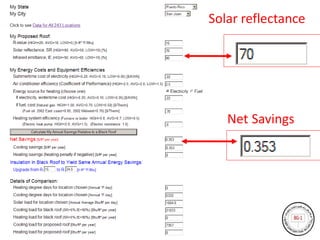
DOE “Cool Roof” Calculator shows
substantial savings in Puerto Rico.
DOE…PR   Solar reflectance


            Net Savings
• Since 2005 California has required most flat-
  roofed buildings to be white.

• 75% of Wal-Mart stores in the US have
  installed “cool roofs”.

• Washington, D.C. will require new flat roofs on
  commercial buildings to be covered in
  vegetation or a reflective material.
Hashem Akbari

"It buys us precious time" to figure out
ways to limit greenhouse-gas emissions or
remove the gases from the atmosphere. “

"It basically buys us time until we come up
to our senses."
1998 US established the
Cool Roof Rating Council

First products rated in 2003.

2009 EU established its Cool
Roof Rating Council
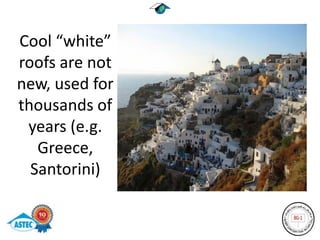
Cool “white”
roofs are not
new, used for
thousands of
 years (e.g.
   Greece,
  Santorini)
“Cool Roofing”…Why?


• Environmental Benefits

• Economic Benefits

• Health & Community Benefits
Environmental benefits:
Enhance and protect ecosystems and biodiversity

Reduce waste - Nothing added to landfills

Conserve natural resources

  Sustainable…extends life of roof

     • Renewable every 10 years
Economic benefits:
• Reduce operating costs

• Enhance asset value and profits

• Improve employee productivity, safety and
  satisfaction

• Optimize life-cycle economic performance
Health and community benefits:
• Improve air, thermal and acoustic
  environments

• Minimize strain on local infrastructure

• Mitigate Heat Island Effect
Health and community benefits:
• Lower roof top and building temperatures
     • Less heat transfer
     • Increased occupant comfort

• Reduced AC load
     • Lower building occupant’s electricity bills
             » Up to 40% reduction in cooling costs
     • Reduce peak electricity demand (avoid black-outs)

• LBNL estimates Worldwide energy savings of
  $27 billion (2008)
“Cool Roof”
 Cost vs. Benefits


 Good design, but is it
economically feasible?
Economics
Astec Roof Coatings:

• No need to tear off old roof.

• No need to raise equipment on roof.
      • No Facility Downtime


• Makes most roofs better than original.
Economics
 Astec Roof Coatings:
• Reduced Air-Conditioning Demand
      • Equipment lasts longer


• Sustainable, Renewable…lower life-cycle cost.

• Substantial savings over other conventional roofing
  systems... Up to 50% savings
Cool Roofing Energy Savings


“Cool” roof systems will eventually pay
 for themselves and continue to pay a
               premium.
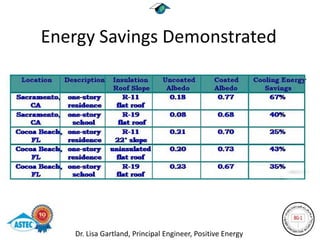
Energy Savings Demonstrated


   Dr. Lisa Gartland, Principal Engineer, Positive Energy
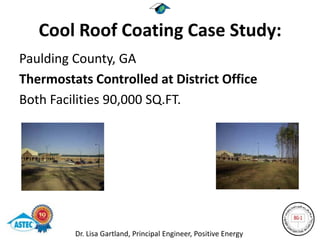
Cool Roof Coating Case Study:
Paulding County, GA
Thermostats Controlled at District Office
Both Facilities 90,000 SQ.FT.


         Dr. Lisa Gartland, Principal Engineer, Positive Energy
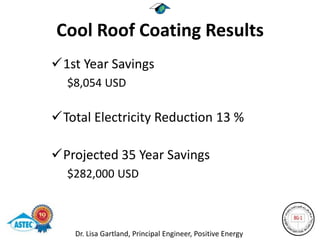
Cool Roof Coating Results
1st Year Savings
  $8,054 USD

Total Electricity Reduction 13 %

Projected 35 Year Savings
  $282,000 USD


    Dr. Lisa Gartland, Principal Engineer, Positive Energy
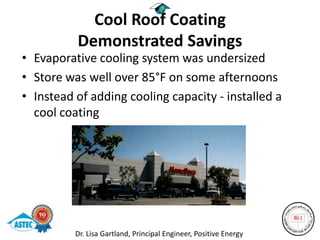
Cool Roof Coating
          Demonstrated Savings
• Evaporative cooling system was undersized
• Store was well over 85°F on some afternoons
• Instead of adding cooling capacity - installed a
  cool coating


          Dr. Lisa Gartland, Principal Engineer, Positive Energy
Cool Roof Coating
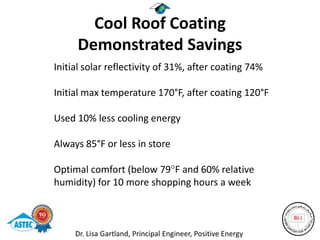
     Demonstrated Savings
Initial solar reflectivity of 31%, after coating 74%

Initial max temperature 170°F, after coating 120°F

Used 10% less cooling energy

Always 85°F or less in store

Optimal comfort (below 79 F and 60% relative
humidity) for 10 more shopping hours a week


     Dr. Lisa Gartland, Principal Engineer, Positive Energy
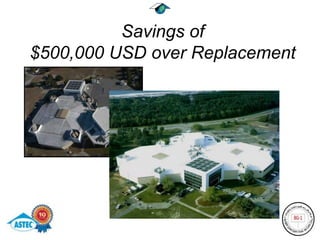
Savings of
$500,000 USD over Replacement
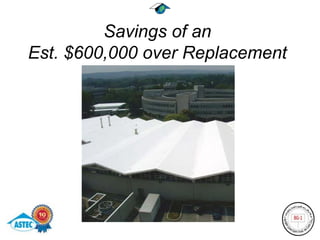
Savings of an
Est. $600,000 over Replacement
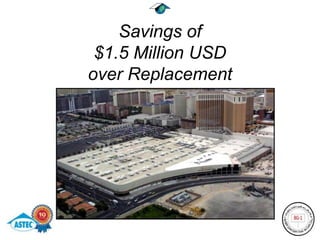
Savings of
 $1.5 Million USD
over Replacement
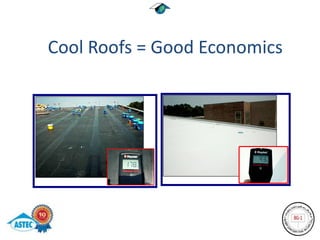
Cool Roofs = Good Economics
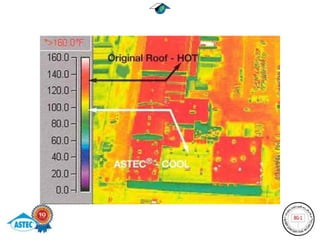
REDUCES
TEMPERATURES
“…almost immediately the room temperature
  inside was cooled by 19° F.”
               -Donald E., Yakima Ice Arena
FOR
COLD STORAGE
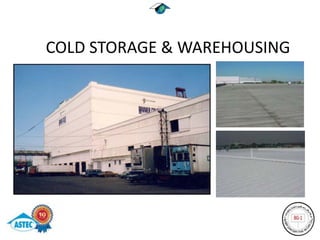
COLD STORAGE & WAREHOUSING
“Our engineering department reported
that the plant is consuming less energy …”

        -Vice President, Rainier Cold Storage & Ice
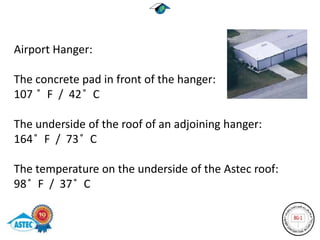
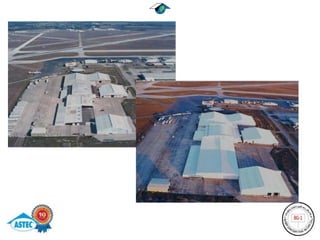
Airport Hanger:

The concrete pad in front of the hanger:
107 ̊ F / 42 ̊ C

The underside of the roof of an adjoining hanger:
164 ̊ F / 73 ̊ C

The temperature on the underside of the Astec roof:
98 ̊ F / 37 ̊ C
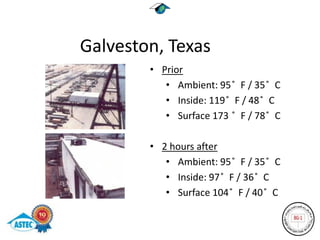
Galveston, Texas
        • Prior
           • Ambient: 95 ̊ F / 35 ̊ C
           • Inside: 119 ̊ F / 48 ̊ C
           • Surface 173 ̊ F / 78 ̊ C

        • 2 hours after
           • Ambient: 95 ̊ F / 35 ̊ C
           • Inside: 97 ̊ F / 36 ̊ C
           • Surface 104 ̊ F / 40 ̊ C
“In the past, we have struggled to maintain
  minus 12° F / -11° C … Since the application, we
  have been able to maintain minus 15° F / -9° C
  or less.”
           -Plant Superintendent, Land-O-Sun Dairies
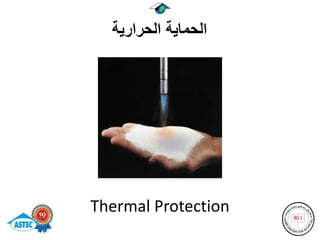
‫الحماية الحرارية‬


Thermal Protection
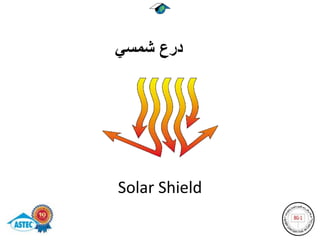
‫درع شمسي‬


Solar Shield
Cool Roofing
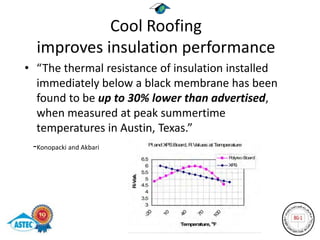
  improves insulation performance
• “The thermal resistance of insulation installed
   immediately below a black membrane has been
   found to be up to 30% lower than advertised,
   when measured at peak summertime
   temperatures in Austin, Texas.”
  -Konopacki and Akbari
Fluid Applied Cool Roof Systems

 Provide durable / flexible surfaces

 Protect from Ultra-violet degradation

 Eliminates/minimizes roof tear-off

 Sustainable, Renewable, lower life-cycle cost
Some Benefits of the
       Astec Re-Ply and Ceramic Coating Systems:

 Save on annual electricity bills by reducing summer air
conditioning costs.

Save peak electricity demand.

 Reduce roof maintenance and replacement expenses by
extending roof life.

 Increase indoor comfort in summer by reflecting heat from
the roof surface.
Benefits of the Astec Re-Ply
        and Ceramic Coating Systems:
 Reduce the heat island effect in cities and suburbs.

 Reduce air pollution and smog formation.

 Reduce waste added to landfills.

 Help builders and building managers meet Energy
Efficiency Building Standards such as Perl, LEED, etc.
INSULATING
  COATINGS
CORPORATION
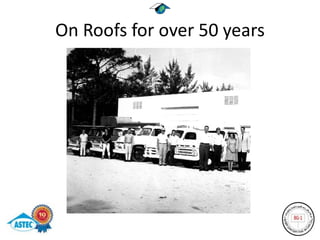
On Roofs for over 50 years
History

• Early 60’s Roof Painting Contractor…FL.
• Manufacturing…South Florida
• Ceramic Coating Technology…late 70’s
  (started the Ceramic Coating Industry)
• Astec Products started in 1986
Important Affiliations
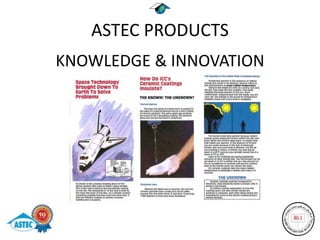
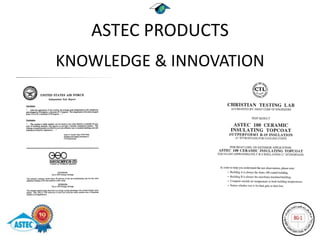
ASTEC PRODUCTS
KNOWLEDGE & INNOVATION
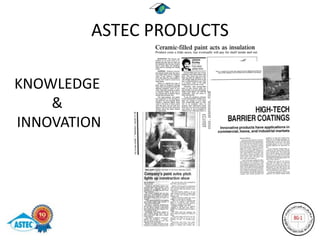
ASTEC PRODUCTS

KNOWLEDGE
    &
INNOVATION
ASTEC PRODUCTS
KNOWLEDGE & INNOVATION
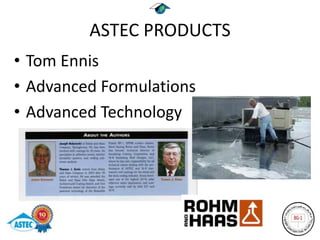
ASTEC PRODUCTS
• Tom Ennis
• Advanced Formulations
• Advanced Technology
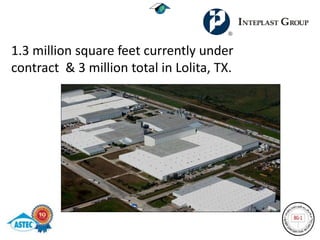
1.3 million square feet currently under
contract & 3 million total in Lolita, TX.
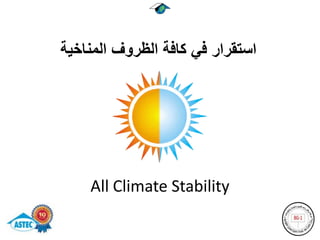
‫استقرار في كافة الظروف المناخية‬


    ‫‪All Climate Stability‬‬
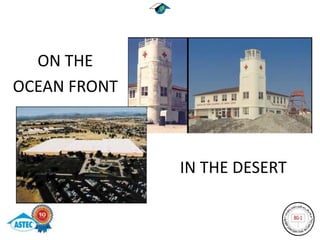
ON THE
OCEAN FRONT


              IN THE DESERT
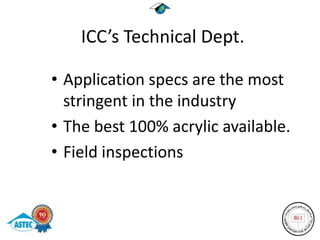
ICC’s Technical Dept.

• Application specs are the most
  stringent in the industry
• The best 100% acrylic available.
• Field inspections
Insulating Coatings Corporation


   All fluid applied products are
  manufactured by us…no outside
               sources
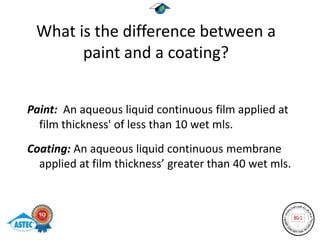
What is the difference between a
       paint and a coating?


Paint: An aqueous liquid continuous film applied at
  film thickness' of less than 10 wet mls.
Coating: An aqueous liquid continuous membrane
  applied at film thickness’ greater than 40 wet mls.
Benefits of
               Acrylic Roof Membrane
                          vs.
                         Paint
Remain Flexible
Resist standing Water
Excellent Adhesion to a variety of substrates
Resist UV exposure
Applied at greater film thickness for increased flexibility
Resistance to Foot Traffic…tensile strength
Higher Reflectivity and increased emissivity
Definition of an
          Advanced Roof Coating

An aqueous liquid suspension, applied to roofing
substrates, which dries to a seamless, resilient,
durable membrane which is flexible across a
broad temperature range.
What is the
difference in coatings?
White coatings have good solar reflectance, but…..
 Chalks, talc and clay can be added to make the
coating white and increase solid content.
 They have a higher rate of erosion over advanced
roof coatings using titanium and ceramics.
   Ceramics dramatically reduce erosion.

 Premium resins are superior for adhesion,
flexibility and durability.
So what makes a quality
     Roof Coating?
Binder
Volume Solids
PVC
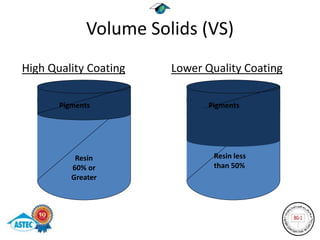
Volume Solids (VS)
High Quality Coating    Lower Quality Coating

       Pigments                Pigments


           Resin                Resin less
          60% or                than 50%
          Greater
How to insure you are
        getting quality products?

Testing - ASTM
Earned credibility in the field
ISO
Fluid-Applied Membranes


                QUALITY

            is the only way to go!

Cheap coatings lead to continued roof problems.
Insulating Coatings Corporation


  ASTEC Authorized Applicators insure
that the applications are done to ASTEC
            Specifications.
Burgan One
General Trading & Contracting
BG1
• Established 1992

• Working in the oil industry with KOC for 16 years

• Working with the US Army for 7 years
APPLICATIONS
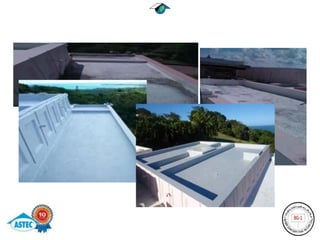
ROOFING
Restore or Replace?
Big savings over replacement:

 Avoid Costly Tear-Off
 Eliminate Facility Downtime
 Cool Roof Energy Savings
 Sustainable
 Helps the Planet
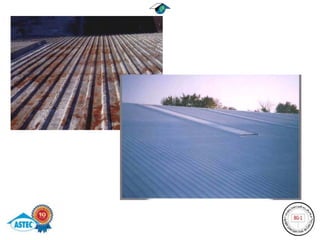
Metal Roofs
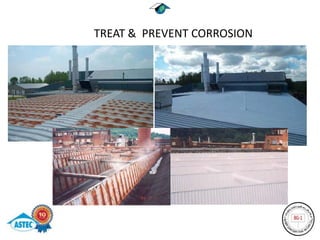
TREAT & PREVENT CORROSION
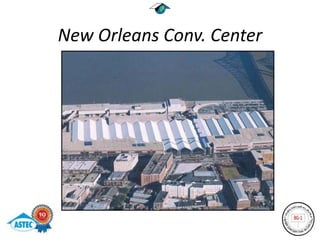
New Orleans Conv. Center
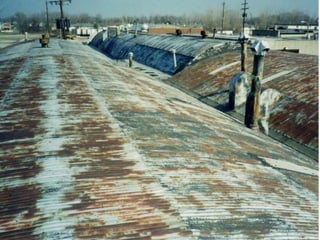
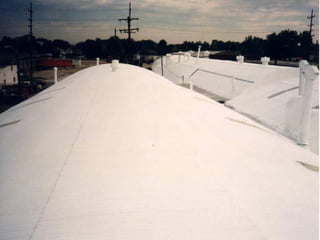
Concrete Roofs
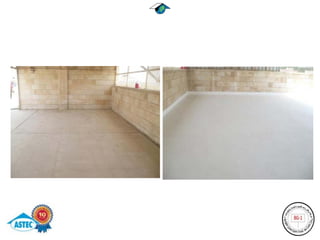
Concrete Roof   Before
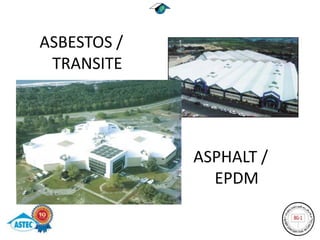
Other Substrates
ASBESTOS /
 TRANSITE


             ASPHALT /
               EPDM
Other Substrates
•   Polyurethane Foam
•   Hypalon
•   PVC
•   Stucco
•   Vinyl
•   Thermoplastic
Other Applications
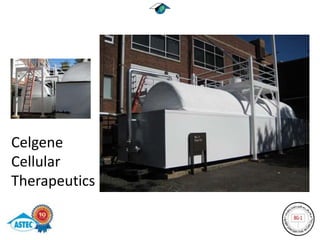
Celgene
Cellular
Therapeutics
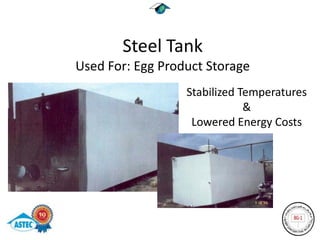
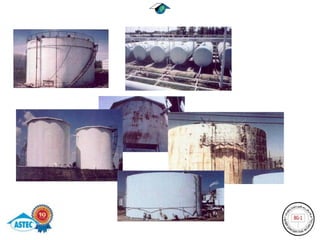
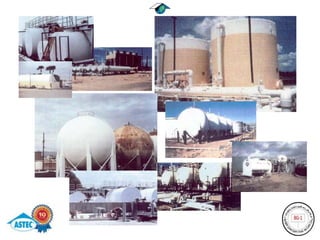
Steel Tank
Used For: Egg Product Storage
                  Stabilized Temperatures
                              &
                   Lowered Energy Costs
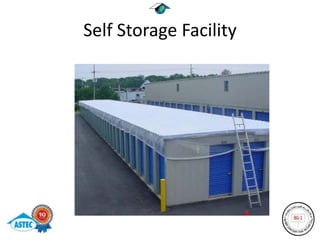
Self Storage Facility
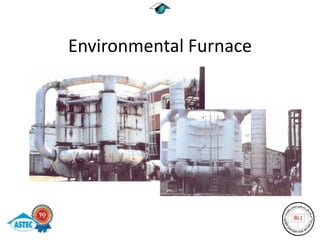
Environmental Furnace
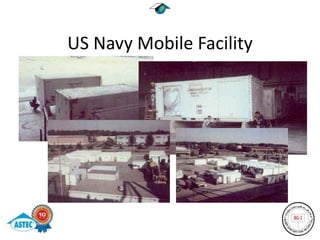
US Navy Mobile Facility
Air Ducts

•   Continental Airline
•   Disney
•   American Airlines
•   Campbell’s
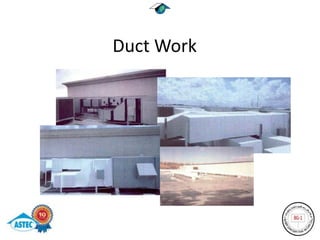
Duct Work
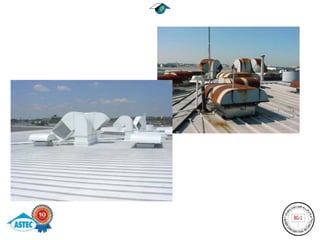
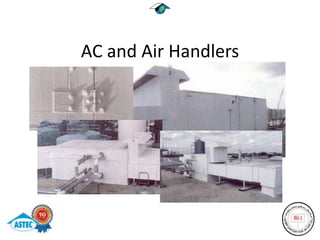
AC and Air Handlers
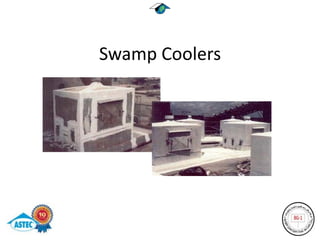
Swamp Coolers
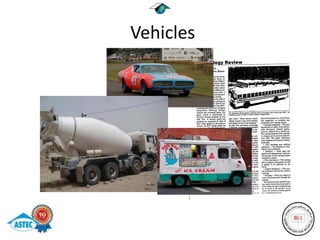
Vehicles
MILITARY
APPLICATIONS
• In the United States:

     •   China Lake, California
     •   Nellis Air Force Base, Nevada
     •   Fort Dix, New Jersey
     •   Aberdeen Proving Grounds, Maryland
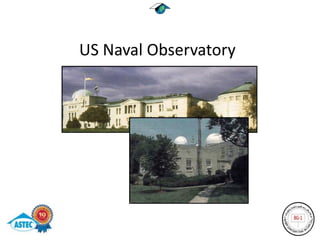
US Naval Observatory
United States Air Force

“… After the application of the coating,
the average peak temperature in the
warehouse area dropped to 86° F,
a decrease of 17° F. “
- James A., Capt. USAF Chief RSD of Civil Engineering
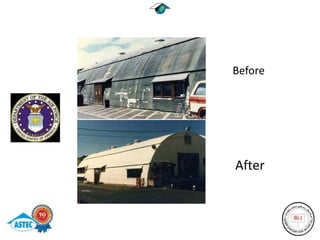
Before


After
United States Army

“… a 64° F reduction in roof surface
temperature, a 23° F reduction in attic
temperature and a 10° F reduction in room
temperature as a result of the insulative and
reflective value of the coating.”
        - Benjamin S., Col, Dept. of the Army
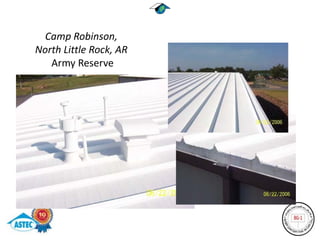
Camp Robinson,
North Little Rock, AR
   Army Reserve
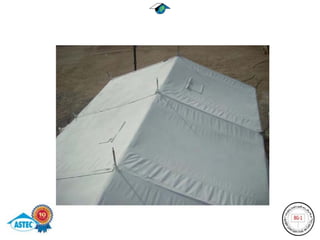
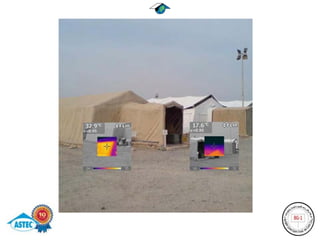
US Army in Kuwait

• Camp Arifjan
• Tent Project
• Thermal Protection
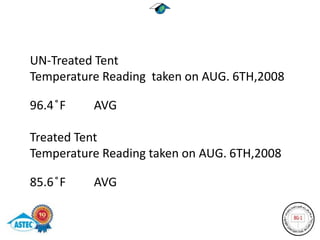
UN-Treated Tent
Temperature Reading taken on AUG. 6TH,2008

96.4 ̊F   AVG

Treated Tent
Temperature Reading taken on AUG. 6TH,2008

85.6 ̊F   AVG
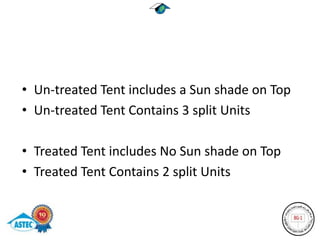
• Un-treated Tent includes a Sun shade on Top
• Un-treated Tent Contains 3 split Units

• Treated Tent includes No Sun shade on Top
• Treated Tent Contains 2 split Units
Further Tests….

• Un-treated tent
     • Removed the third air conditioner
• Same air conditioning units in both tents.
• Treated tent used 26% less energy.
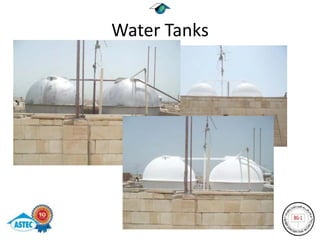
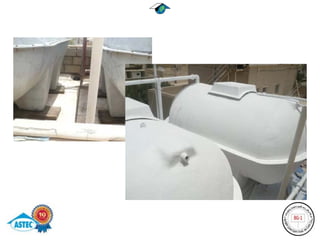
Water Tanks
“I avoided taking a shower during
the noon time, but after you have
coated my water tank with Astec,
there is no issue with hot water in
my house any more, at any time
of the day". – Recent Customer in Kuwait
“Astec is amazing, after 4 years the finish on the
  tanks still look great”
                 -President, Studer Fertilizer
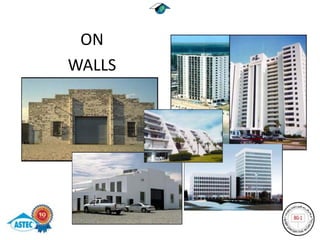
ON
WALLS
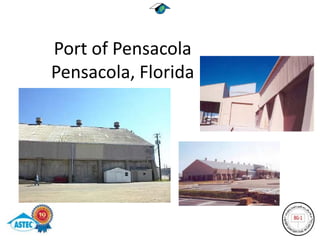
Port of Pensacola
Pensacola, Florida
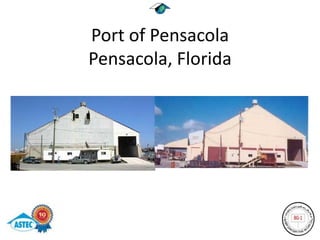
Port of Pensacola
Pensacola, Florida
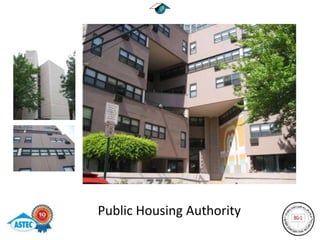
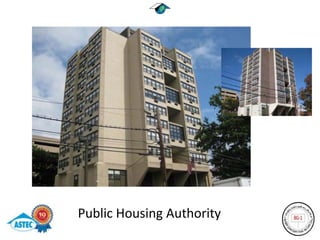
Public Housing Authority
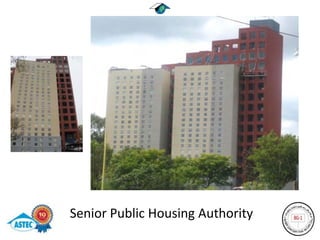
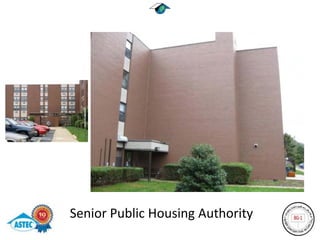
Senior Public Housing Authority
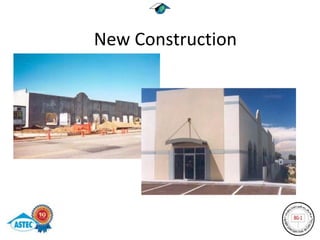
New Construction
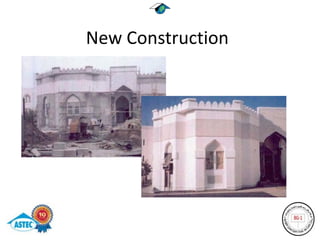
New Construction
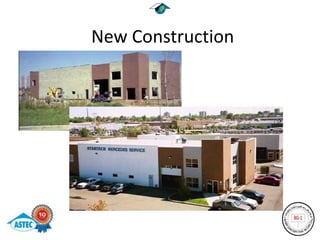
New Construction
EXTEND YOUR FACILITY
          &
 YOUR EQUIPMENT’S
     LIFE-CYCLE
SOLVE YOUR
  HEAT & WATER
RELATED PROBLEMS
Renewable & Sustainable

Extend the system after 10 years with a recoat.

Only a fraction (40 -70%) of the original cost.
“We can extend the life of existing roofing
 for a fraction of the cost of conventional roof
 replacement.” - Benjamin S., Col, Dept. of the Army
Astec Benefits

 Radiant Heat Barrier
   Reduces Surface Temperatures
   Provides more stable internal temperatures
   Lower energy costs
Astec Benefits

Sustainable / Renewable Systems
   Environmentally friendly
   Low VOCs (volatile organic chemicals)
   Eliminate tear-offs and landfill usage
   Reduce capital expenditures
Astec Benefits
Resists UV Exposure & Thermal Shock
   A/C equipment lasts longer
   Requires less maintenance
   Less surface degradation
For Further Information Please Contact:
Saad Al-Yaseen
Burgan One General Trading and Contracting
Tel: +965 22409685 or Tel: +965 22409686
Fax: +965 22409551
PO Box 29770 Code: 13158 Safat – Kuwait
saadalyaseen@burganone.com
www.whyreplace.com
www.icc-astec.com
References
• http://www.escwa.un.org

• http://www.eia.doe.gov/emeu/cabs/Kuwait/Full.html

• Energy Information Administration (Content source); Langdon D. Clough
  (Topic Editor). 2008. "Energy profile of Kuwait." In: Encyclopedia of Earth.
  Eds. Cutler J. Cleveland (Washington, D.C.: Environmental Information
  Coalition, National Council for Science and the Environment). [First
  published in the Encyclopedia of Earth June 28, 2007; Last revised
  September 2, 2008; Retrieved February 15, 2010].
• http://www.eoearth.org/article/Energy_profile_of_Kuwait

• http://www.da.gov.kw/eng/articles/arab_economic_summit_2009_speec
  hes.php?p=summit_declaration
References
• ENERGY CONSERVATION PROGRAM IN KUWAIT: A LOCAL
  PERSPECTIVE ; Ali E. H. Hajiah, PhD; Kuwait Institute for Scientific
  Research

• http://www.zawya.com/Story.cfm/sidZAWYA20090914093137

• http://www.goodplanet.org/en/

• Dr. Lisa Gartland, Principal Engineer, Positive Energy

• Kuwait's thermal power generation is forecast to rise 70.2%
  between 2009 and 2019 by Mike King,
  http://www.pr-inside.com/kuwait-s-thermal-power-generation-is-
  r1724985.htm
Energy Solutions in Kuwait

Energy Solutions in Kuwait

  • 2.
    Ali E. H.Hajiah, PhD ENERGY CONSERVATION PROGRAM IN KUWAIT: A LOCAL PERSPECTIVE Department of Building and Energy Technologies Environment and Urban Development Division Kuwait Institute for Scientific Research
  • 3.
    Fifteenth Symposium onImproving Building Systems in Hot and Humid Climates, Orlando, FL, July 24-26, 2006
  • 4.
    Due to heavyuse of air conditioning, reliance on desalination for water, and highly subsidized electricity prices, Kuwait's per capita electricity consumption is amongst the highest in the world. ENERGY CONSERVATION PROGRAM IN KUWAIT: A LOCAL PERSPECTIVE Ali E. H. Hajiah, PhD; Kuwait Institute for Scientific Research
  • 5.
    In Kuwait, nearly300-350 MW power is added every year only to satisfy the growing demand of the A/C systems ENERGY CONSERVATION PROGRAM IN KUWAIT: A LOCAL PERSPECTIVE Ali E. H. Hajiah, PhD; Kuwait Institute for Scientific Research
  • 6.
    Kuwait • Seven monthsof summer • Temperatures over 50 C. • “Air-conditioning of buildings is the single largest consumer of electricity and accounts for nearly 75% of nation’s peak power demand and over 50% of annual energy consumption. “ ENERGY CONSERVATION PROGRAM IN KUWAIT: A LOCAL PERSPECTIVE Ali E. H. Hajiah, PhD; Kuwait Institute for Scientific Research
  • 7.
    • MEW isspending nearly 80 million Kuwaiti Dinars at 400 KD/kW every year to add additional power generation and distribution. • The amount spent annually on fuel to generate electricity for the operation of the A/C systems is well over 90 million KD (MEW, 2002). ENERGY CONSERVATION PROGRAM IN KUWAIT: A LOCAL PERSPECTIVE Ali E. H. Hajiah, PhD; Kuwait Institute for Scientific Research
  • 8.
    ENERGY CONSERVATION PROGRAMIN KUWAIT: A LOCAL PERSPECTIVE Ali E. H. Hajiah, PhD; Kuwait Institute for Scientific Research
  • 9.
    ENERGY CONSERVATION PROGRAMIN KUWAIT: A LOCAL PERSPECTIVE Ali E. H. Hajiah, PhD; Kuwait Institute for Scientific Research
  • 10.
    • Power demandis expected to continue increasing at 7-9 percent a year, necessitating construction of new generating capacity. • According to government estimates, roughly $3.6 billion in further investment is needed by 2010. <http://www.eoearth.org/article/Energy_profile_of_Kuwait
  • 11.
    September 14, 2009 GEEnergy announced that the Kuwait Ministry of Electricity and Water signed a $2.65 billion USD contract for a new power plant Kuwait’s robust business and residential growth has strained the country’s power generation capability, resulting in power outages during the hot summer months. http://www.zawya.com/Story.cfm/sidZAWYA20090914093137
  • 12.
    From the EnergyInformation Administration: Kuwait seeks to significantly increase its use of natural gas in electricity generation, water desalination, and petrochemicals to free up as much as 100,000 barrels per day of oil for export. http://www.eia.doe.gov/emeu/cabs/Kuwait/Full.html
  • 13.
    Kuwait Consumption &Imports In 2006, an annual basis - natural gas consumption matches production. Kuwait’s electricity demand, has outpaced natural gas production during the summer months. Result is the shutdown of refinery and petrochemical operations to meet the increased demand in electricity. http://www.eia.doe.gov/emeu/cabs/Kuwait/Full.html
  • 14.
    By 2014 regionalenergy demand is forecasted to have a 25.1% growth over the period since 2009. Kuwait's thermal power generation is forecast to rise 70.2% between 2009 and 2019 by Mike King http://www.pr-inside.com/kuwait-s-thermal-power-generation-is-r1724985.htm
  • 15.
    GOALS • Reduce Electrical Demand • Increase Energy Exports • Reduce Energy Imports • Provide More Reliability • Provide a Better Environment
  • 16.
    Our world ischanging… we need to change with it. Our Designs, our Products, our Processes
  • 17.
    Lawrence Berkeley National Laboratory Heat Island Study
  • 18.
    Heat Island (Atlanta) LessVegetation more black asphalt (roofs & parking lots)
  • 19.
  • 21.
    Los Angeles HeatIsland • With increasing irrigation & orchards, LA cooled 5ºF until the 1930’s • As orchards gave way to hot roofs & pavements, LA warmed 6 ºF to 1980 Dr. Lisa Gartland, Principal Engineer, Positive Energy
  • 22.
    Lawrence Berkeley National Laboratory Heat Island Study One degree increase in air temperature raises energy demand by two percent …and raises smog by three percent
  • 23.
    Buildings account for…  36% of total energy use  65% of electricity consumption  30% of greenhouse gas emissions  30% of raw materials use  30% of waste output/136 million tons annually  12% of potable water consumption data from USGBC Website
  • 24.
    Heat Transfer Where thereis a temperature difference between objects in proximity, heat transfer between them can never be stopped; it can only be slowed down.
  • 25.
  • 26.
    SOLAR RADIATION Infrared (thermal) heat rays travel… •With the greatest intensity perpendicular to the surface. •With the least intensity parallel with the receiving surface (zero intensity).
  • 27.
    SOLAR RADIATION Radiation Exposure • A 7 story building is exposed to more radiation on the walls than on the roof. • A single story building receives 70% of it’s solar radiation on the roof.
  • 28.
    Environmental Factors Cannot bemanipulated: • Ambient air temperature • Solar radiation • Wind
  • 29.
    Building Material Factors Canbe manipulated: • Material resistivity (r-value) • Surface Solar reflectivity • Surface Solar absorptivity • Surface Thermal radiation emissivity
  • 30.
    Heat Transfer andBuildings The best way to reduce heat transfer:  Prevent it from entering the building. The best way to manage heat transfer:  Re-emit it quickly.
  • 32.
  • 37.
    Kuwait Declaration • Callsfor…  taking the necessary procedures to preserve environment & natural resources, & the optimal use of it to achieve sustainable development.  …and take action to limit the impact of climate change & its repercussions on Arab societies. http://www.da.gov.kw/eng/articles/arab_economic_summit_2009_sp eeches.php?p=summit_declaration
  • 38.
    History • In 1995,the Kuwait Environment Public Authority (EPA) was created. • With the help of the ESCWA (the Economic Commission for Western Asia (ECWA) in 2005 set forth an environmental strategy with three types of objectives:  the reduction of the rate of pollution;  introduction of the environmental dimension in policies, plans and national programs;  the protection of the national resources and the biodiversity in the context of sustainable development. (LEED) “The adoption of such strategies can hardly be considered as a luxury in all Gulf countries; in which environmental problems are somewhat similar”. http://www.escwa.un.org/divisions/pptcdadvisors.asp?id=12
  • 39.
    Questions Can Kuwait avoidthe need to build new power plants? Can economic competitiveness be increased? Can health conditions be improved ? Can building maintenance and operation costs be decreased? Can green house gas emissions be reduced?
  • 40.
  • 41.
    A Radiant HeatBarrier…  Reduces surface temperatures by as much as 20˚ C  Reflects at least 70% of radiant heat  Limits radiant heat absorption between 15% and 20%  Emissivity level of 90% quickly reducing heat transfer  Reduces energy consumption by as much as 40%
  • 43.
    Florida Power &Light Company
  • 44.
    Reflective roof surfaces $0.45 per square foot of reflective roof When the retrofit application reflects at least 73% of the sun’s heat.
  • 45.
    San Antonio, TX •CPS Energy • The Largest Municipally Owned Energy Company in the Nation • (Provides Both Gas and Electricity)
  • 46.
    Residential Cool RoofRebate $0.20 per square foot. Must be ENERGY STAR® cool roof products.
  • 47.
    $0.10 per Sq.Ft. for Commercial Roofs • Rated reflectivity must be measured by test method ASTM E424-71, ASTM E903-96 • Must have a minimum reflectivity of 75%.
  • 48.
    California Low - SlopedRoofs: $.20 per sq ft Steep-sloped: $.10 - $.20 per sq ft.
  • 49.
    The USA FederalEnergy Policy Act of 2005 • Commercial buildings are eligible for tax deductions up to $1.80 USD per square foot. • Many buildings are eligible for improvements completed within the normal course of business. • For municipal buildings, benefits are passed through to the primary designers/architects in an attempt to encourage innovative municipal design.
  • 50.
    Hashem Akbari HeatIsland Group Lawrence Berkeley National Laboratory • Cool roof standards are designed to reduce a/c demand, save money, and save emissions. • In Los Angeles they will eventually save $100,000 per hour. • Each 25m2 of cool roof offsets 1 ton of CO2
  • 51.
    REDUCE PEAK DEMAND Areflective roof can reduce peak cooling demand by 10-15%.
  • 52.
    Power Grid Benefitswith “Cool Roofs” Utility Grid/Operator Benefits  Reduced need for infrastructure spending  Generation  Transmission  Local Distribution  Mitigation of System Peaks  Reduced Spending will lower rates over long term
  • 53.
    Department of Energy DOE“Cool Roof” Calculator shows substantial savings in Puerto Rico.
  • 54.
    DOE…PR Solar reflectance Net Savings
  • 55.
    • Since 2005California has required most flat- roofed buildings to be white. • 75% of Wal-Mart stores in the US have installed “cool roofs”. • Washington, D.C. will require new flat roofs on commercial buildings to be covered in vegetation or a reflective material.
  • 56.
    Hashem Akbari "It buysus precious time" to figure out ways to limit greenhouse-gas emissions or remove the gases from the atmosphere. “ "It basically buys us time until we come up to our senses."
  • 57.
    1998 US establishedthe Cool Roof Rating Council First products rated in 2003. 2009 EU established its Cool Roof Rating Council
  • 58.
    Cool “white” roofs arenot new, used for thousands of years (e.g. Greece, Santorini)
  • 59.
    “Cool Roofing”…Why? • EnvironmentalBenefits • Economic Benefits • Health & Community Benefits
  • 60.
    Environmental benefits: Enhance andprotect ecosystems and biodiversity Reduce waste - Nothing added to landfills Conserve natural resources Sustainable…extends life of roof • Renewable every 10 years
  • 61.
    Economic benefits: • Reduceoperating costs • Enhance asset value and profits • Improve employee productivity, safety and satisfaction • Optimize life-cycle economic performance
  • 62.
    Health and communitybenefits: • Improve air, thermal and acoustic environments • Minimize strain on local infrastructure • Mitigate Heat Island Effect
  • 63.
    Health and communitybenefits: • Lower roof top and building temperatures • Less heat transfer • Increased occupant comfort • Reduced AC load • Lower building occupant’s electricity bills » Up to 40% reduction in cooling costs • Reduce peak electricity demand (avoid black-outs) • LBNL estimates Worldwide energy savings of $27 billion (2008)
  • 64.
    “Cool Roof” Costvs. Benefits Good design, but is it economically feasible?
  • 65.
    Economics Astec Roof Coatings: •No need to tear off old roof. • No need to raise equipment on roof. • No Facility Downtime • Makes most roofs better than original.
  • 66.
    Economics Astec RoofCoatings: • Reduced Air-Conditioning Demand • Equipment lasts longer • Sustainable, Renewable…lower life-cycle cost. • Substantial savings over other conventional roofing systems... Up to 50% savings
  • 67.
    Cool Roofing EnergySavings “Cool” roof systems will eventually pay for themselves and continue to pay a premium.
  • 68.
    Energy Savings Demonstrated Dr. Lisa Gartland, Principal Engineer, Positive Energy
  • 69.
    Cool Roof CoatingCase Study: Paulding County, GA Thermostats Controlled at District Office Both Facilities 90,000 SQ.FT. Dr. Lisa Gartland, Principal Engineer, Positive Energy
  • 70.
    Cool Roof CoatingResults 1st Year Savings $8,054 USD Total Electricity Reduction 13 % Projected 35 Year Savings $282,000 USD Dr. Lisa Gartland, Principal Engineer, Positive Energy
  • 71.
    Cool Roof Coating Demonstrated Savings • Evaporative cooling system was undersized • Store was well over 85°F on some afternoons • Instead of adding cooling capacity - installed a cool coating Dr. Lisa Gartland, Principal Engineer, Positive Energy
  • 72.
    Cool Roof Coating Demonstrated Savings Initial solar reflectivity of 31%, after coating 74% Initial max temperature 170°F, after coating 120°F Used 10% less cooling energy Always 85°F or less in store Optimal comfort (below 79 F and 60% relative humidity) for 10 more shopping hours a week Dr. Lisa Gartland, Principal Engineer, Positive Energy
  • 73.
    Savings of $500,000 USDover Replacement
  • 74.
    Savings of an Est.$600,000 over Replacement
  • 75.
    Savings of $1.5Million USD over Replacement
  • 76.
    Cool Roofs =Good Economics
  • 77.
  • 78.
    “…almost immediately theroom temperature inside was cooled by 19° F.” -Donald E., Yakima Ice Arena
  • 81.
  • 82.
    COLD STORAGE &WAREHOUSING
  • 83.
    “Our engineering departmentreported that the plant is consuming less energy …” -Vice President, Rainier Cold Storage & Ice
  • 84.
    Airport Hanger: The concretepad in front of the hanger: 107 ̊ F / 42 ̊ C The underside of the roof of an adjoining hanger: 164 ̊ F / 73 ̊ C The temperature on the underside of the Astec roof: 98 ̊ F / 37 ̊ C
  • 85.
    Galveston, Texas • Prior • Ambient: 95 ̊ F / 35 ̊ C • Inside: 119 ̊ F / 48 ̊ C • Surface 173 ̊ F / 78 ̊ C • 2 hours after • Ambient: 95 ̊ F / 35 ̊ C • Inside: 97 ̊ F / 36 ̊ C • Surface 104 ̊ F / 40 ̊ C
  • 86.
    “In the past,we have struggled to maintain minus 12° F / -11° C … Since the application, we have been able to maintain minus 15° F / -9° C or less.” -Plant Superintendent, Land-O-Sun Dairies
  • 88.
  • 89.
  • 93.
    Cool Roofing improves insulation performance • “The thermal resistance of insulation installed immediately below a black membrane has been found to be up to 30% lower than advertised, when measured at peak summertime temperatures in Austin, Texas.” -Konopacki and Akbari
  • 94.
    Fluid Applied CoolRoof Systems  Provide durable / flexible surfaces  Protect from Ultra-violet degradation  Eliminates/minimizes roof tear-off  Sustainable, Renewable, lower life-cycle cost
  • 95.
    Some Benefits ofthe Astec Re-Ply and Ceramic Coating Systems:  Save on annual electricity bills by reducing summer air conditioning costs. Save peak electricity demand.  Reduce roof maintenance and replacement expenses by extending roof life.  Increase indoor comfort in summer by reflecting heat from the roof surface.
  • 96.
    Benefits of theAstec Re-Ply and Ceramic Coating Systems:  Reduce the heat island effect in cities and suburbs.  Reduce air pollution and smog formation.  Reduce waste added to landfills.  Help builders and building managers meet Energy Efficiency Building Standards such as Perl, LEED, etc.
  • 97.
  • 98.
    On Roofs forover 50 years
  • 99.
    History • Early 60’sRoof Painting Contractor…FL. • Manufacturing…South Florida • Ceramic Coating Technology…late 70’s (started the Ceramic Coating Industry) • Astec Products started in 1986
  • 100.
  • 102.
  • 103.
  • 104.
  • 105.
  • 106.
    ASTEC PRODUCTS • TomEnnis • Advanced Formulations • Advanced Technology
  • 108.
    1.3 million squarefeet currently under contract & 3 million total in Lolita, TX.
  • 109.
    ‫استقرار في كافةالظروف المناخية‬ ‫‪All Climate Stability‬‬
  • 110.
    ON THE OCEAN FRONT IN THE DESERT
  • 113.
    ICC’s Technical Dept. •Application specs are the most stringent in the industry • The best 100% acrylic available. • Field inspections
  • 114.
    Insulating Coatings Corporation All fluid applied products are manufactured by us…no outside sources
  • 115.
    What is thedifference between a paint and a coating? Paint: An aqueous liquid continuous film applied at film thickness' of less than 10 wet mls. Coating: An aqueous liquid continuous membrane applied at film thickness’ greater than 40 wet mls.
  • 116.
    Benefits of Acrylic Roof Membrane vs. Paint Remain Flexible Resist standing Water Excellent Adhesion to a variety of substrates Resist UV exposure Applied at greater film thickness for increased flexibility Resistance to Foot Traffic…tensile strength Higher Reflectivity and increased emissivity
  • 117.
    Definition of an Advanced Roof Coating An aqueous liquid suspension, applied to roofing substrates, which dries to a seamless, resilient, durable membrane which is flexible across a broad temperature range.
  • 118.
  • 119.
    White coatings havegood solar reflectance, but…..  Chalks, talc and clay can be added to make the coating white and increase solid content.  They have a higher rate of erosion over advanced roof coatings using titanium and ceramics. Ceramics dramatically reduce erosion.  Premium resins are superior for adhesion, flexibility and durability.
  • 120.
    So what makesa quality Roof Coating? Binder Volume Solids PVC
  • 121.
    Volume Solids (VS) HighQuality Coating Lower Quality Coating Pigments Pigments Resin Resin less 60% or than 50% Greater
  • 122.
    How to insureyou are getting quality products? Testing - ASTM Earned credibility in the field ISO
  • 123.
    Fluid-Applied Membranes QUALITY is the only way to go! Cheap coatings lead to continued roof problems.
  • 124.
    Insulating Coatings Corporation ASTEC Authorized Applicators insure that the applications are done to ASTEC Specifications.
  • 125.
  • 126.
    BG1 • Established 1992 •Working in the oil industry with KOC for 16 years • Working with the US Army for 7 years
  • 128.
  • 129.
  • 130.
    Restore or Replace? Bigsavings over replacement:  Avoid Costly Tear-Off  Eliminate Facility Downtime  Cool Roof Energy Savings  Sustainable  Helps the Planet
  • 131.
  • 132.
    TREAT & PREVENTCORROSION
  • 133.
  • 140.
  • 146.
  • 147.
  • 148.
    ASBESTOS / TRANSITE ASPHALT / EPDM
  • 149.
    Other Substrates • Polyurethane Foam • Hypalon • PVC • Stucco • Vinyl • Thermoplastic
  • 150.
  • 151.
  • 152.
    Steel Tank Used For:Egg Product Storage Stabilized Temperatures & Lowered Energy Costs
  • 153.
  • 154.
  • 155.
  • 156.
    Air Ducts • Continental Airline • Disney • American Airlines • Campbell’s
  • 157.
  • 158.
    AC and AirHandlers
  • 159.
  • 160.
  • 161.
  • 162.
    • In theUnited States: • China Lake, California • Nellis Air Force Base, Nevada • Fort Dix, New Jersey • Aberdeen Proving Grounds, Maryland
  • 163.
  • 164.
    United States AirForce “… After the application of the coating, the average peak temperature in the warehouse area dropped to 86° F, a decrease of 17° F. “ - James A., Capt. USAF Chief RSD of Civil Engineering
  • 165.
  • 166.
    United States Army “…a 64° F reduction in roof surface temperature, a 23° F reduction in attic temperature and a 10° F reduction in room temperature as a result of the insulative and reflective value of the coating.” - Benjamin S., Col, Dept. of the Army
  • 167.
    Camp Robinson, North LittleRock, AR Army Reserve
  • 168.
    US Army inKuwait • Camp Arifjan • Tent Project • Thermal Protection
  • 170.
    UN-Treated Tent Temperature Readingtaken on AUG. 6TH,2008 96.4 ̊F AVG Treated Tent Temperature Reading taken on AUG. 6TH,2008 85.6 ̊F AVG
  • 171.
    • Un-treated Tentincludes a Sun shade on Top • Un-treated Tent Contains 3 split Units • Treated Tent includes No Sun shade on Top • Treated Tent Contains 2 split Units
  • 173.
    Further Tests…. • Un-treatedtent • Removed the third air conditioner • Same air conditioning units in both tents. • Treated tent used 26% less energy.
  • 174.
  • 176.
    “I avoided takinga shower during the noon time, but after you have coated my water tank with Astec, there is no issue with hot water in my house any more, at any time of the day". – Recent Customer in Kuwait
  • 178.
    “Astec is amazing,after 4 years the finish on the tanks still look great” -President, Studer Fertilizer
  • 182.
  • 183.
  • 184.
  • 185.
  • 186.
  • 187.
  • 188.
  • 189.
  • 190.
  • 191.
  • 192.
    EXTEND YOUR FACILITY & YOUR EQUIPMENT’S LIFE-CYCLE
  • 193.
    SOLVE YOUR HEAT & WATER RELATED PROBLEMS
  • 194.
    Renewable & Sustainable Extendthe system after 10 years with a recoat. Only a fraction (40 -70%) of the original cost.
  • 195.
    “We can extendthe life of existing roofing for a fraction of the cost of conventional roof replacement.” - Benjamin S., Col, Dept. of the Army
  • 196.
    Astec Benefits  RadiantHeat Barrier  Reduces Surface Temperatures  Provides more stable internal temperatures  Lower energy costs
  • 197.
    Astec Benefits Sustainable /Renewable Systems  Environmentally friendly  Low VOCs (volatile organic chemicals)  Eliminate tear-offs and landfill usage  Reduce capital expenditures
  • 198.
    Astec Benefits Resists UVExposure & Thermal Shock  A/C equipment lasts longer  Requires less maintenance  Less surface degradation
  • 199.
    For Further InformationPlease Contact: Saad Al-Yaseen Burgan One General Trading and Contracting Tel: +965 22409685 or Tel: +965 22409686 Fax: +965 22409551 PO Box 29770 Code: 13158 Safat – Kuwait saadalyaseen@burganone.com www.whyreplace.com www.icc-astec.com
  • 200.
    References • http://www.escwa.un.org • http://www.eia.doe.gov/emeu/cabs/Kuwait/Full.html •Energy Information Administration (Content source); Langdon D. Clough (Topic Editor). 2008. "Energy profile of Kuwait." In: Encyclopedia of Earth. Eds. Cutler J. Cleveland (Washington, D.C.: Environmental Information Coalition, National Council for Science and the Environment). [First published in the Encyclopedia of Earth June 28, 2007; Last revised September 2, 2008; Retrieved February 15, 2010]. • http://www.eoearth.org/article/Energy_profile_of_Kuwait • http://www.da.gov.kw/eng/articles/arab_economic_summit_2009_speec hes.php?p=summit_declaration
  • 201.
    References • ENERGY CONSERVATIONPROGRAM IN KUWAIT: A LOCAL PERSPECTIVE ; Ali E. H. Hajiah, PhD; Kuwait Institute for Scientific Research • http://www.zawya.com/Story.cfm/sidZAWYA20090914093137 • http://www.goodplanet.org/en/ • Dr. Lisa Gartland, Principal Engineer, Positive Energy • Kuwait's thermal power generation is forecast to rise 70.2% between 2009 and 2019 by Mike King, http://www.pr-inside.com/kuwait-s-thermal-power-generation-is- r1724985.htm