CONDITIONAL SENTENCES
DEFINITION The conditional tense says that an action is reliant on something else.  The conditionals are used to talk about real or unreal situations, they are sometimes called if-clauses.  Real Conditional describes real-life situations. Unreal Conditional describes unreal, imaginary situations.
TYPES OF CONDITIONALS There are four basic conditionals that we use in English. Zero Conditional First Conditional Second Conditional Third Conditional
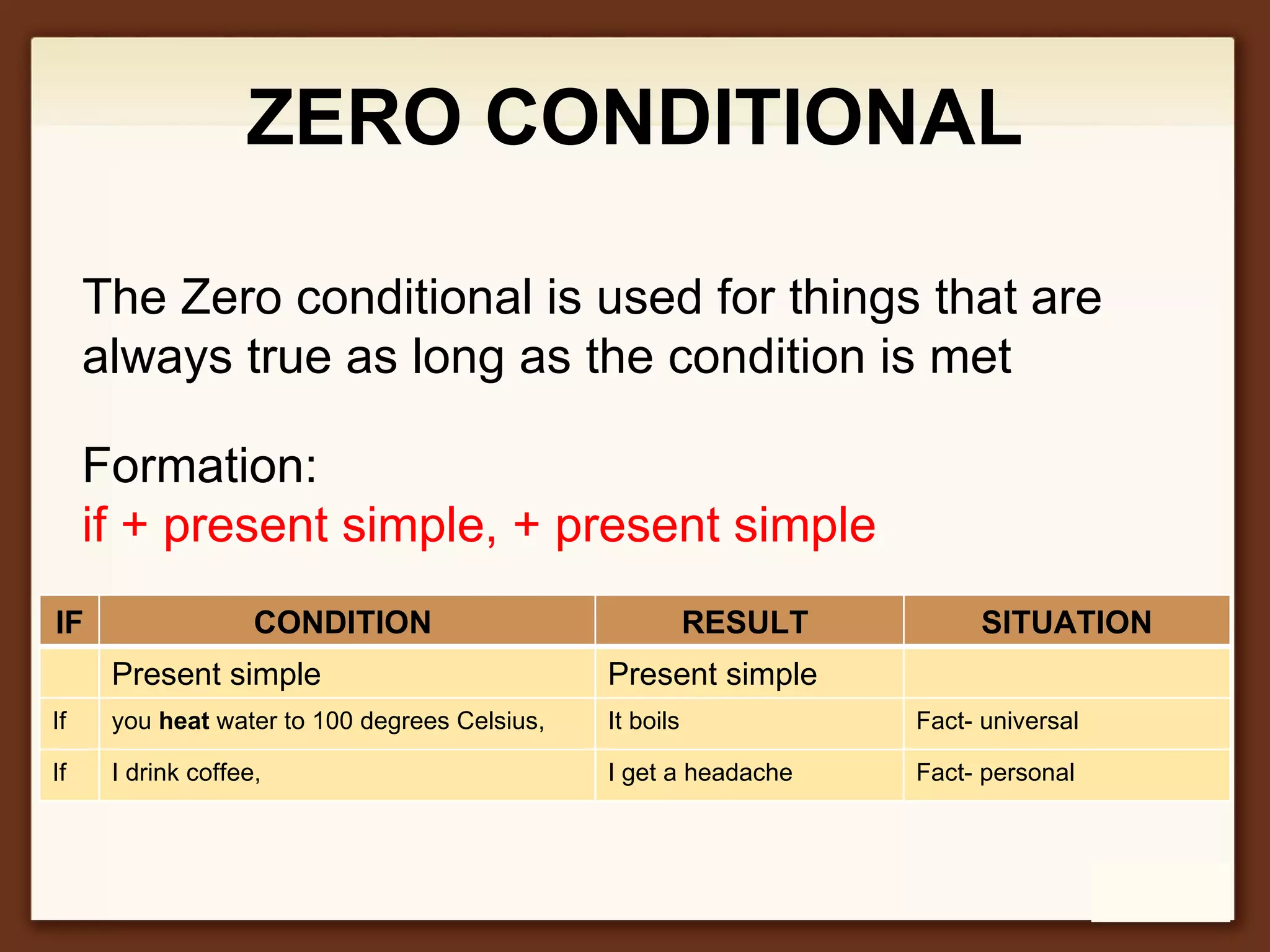
ZERO CONDITIONAL Formation:  if + present simple, + present simple The Zero conditional is used for things that are always true as long as the condition is met IF  CONDITION  RESULT  SITUATION Present simple Present simple If  you  heat  water to 100 degrees Celsius, It boils Fact- universal If I drink coffee, I get a headache Fact- personal
ZERO CONDITIONAL
FIRST CONDITIONAL A First Conditional sentence is for future actions dependent on the result of another future action or event, where there is a reasonable possibility of the conditions for the action being satisfied.
FIRST CONDITIONAL Formation If + present simple, + will For example:  If she gets good grades, she will go to university. We are talking about the future, but we use a present tense for the condition and will for the result. In this case, the person is sure about going to university. 
FIRST CONDITIONAL We can use other modal verbs in the result part of the sentence. For example:   IF  CONDITION  RESULT  SITUATION If  she gets good grades, she  will  go to university. If the condition is met, then she  definitely  will go If  he gets good grades, he  may  go to university. He is  not sure  about going to university. If she gets good grades, she  should  go to university. The speaker is expressing his or her  opinion , giving  advice . If  he gets good grades, he  can  go to university. This means that it is  possible . If  she gets good grades, she  could  go to university. This means that it is  possible , but  not  that  likely . If  he gets good grades, he  might  go to university. This means that it is  possible , but  not  that  likely .
FIRST CONDITIONAL
SECOND CONDITIONAL It can be used to talk about imaginary present situations, where we are imagining something different from what is really the case. We can also use it to talk about things in the future that are unlikely to happen, as the condition is unlikely to be met. We use the past tense in the condition part and would for the result.
SECOND CONDITIONAL Formation:  If + past simple, + would + base form   For Example: If I were you, I'd tell her. IF  CONDITION  RESULT  SITUATION Past simple Would + base form If  I  had  the time, I  would learn  Italian. Impossible I don't have the time, so I'm not going to learn Italian. If I  won  the lottery I  would travel  around the world. Unlikely There's a very small chance of winning the lottery, so the trip is unlikely
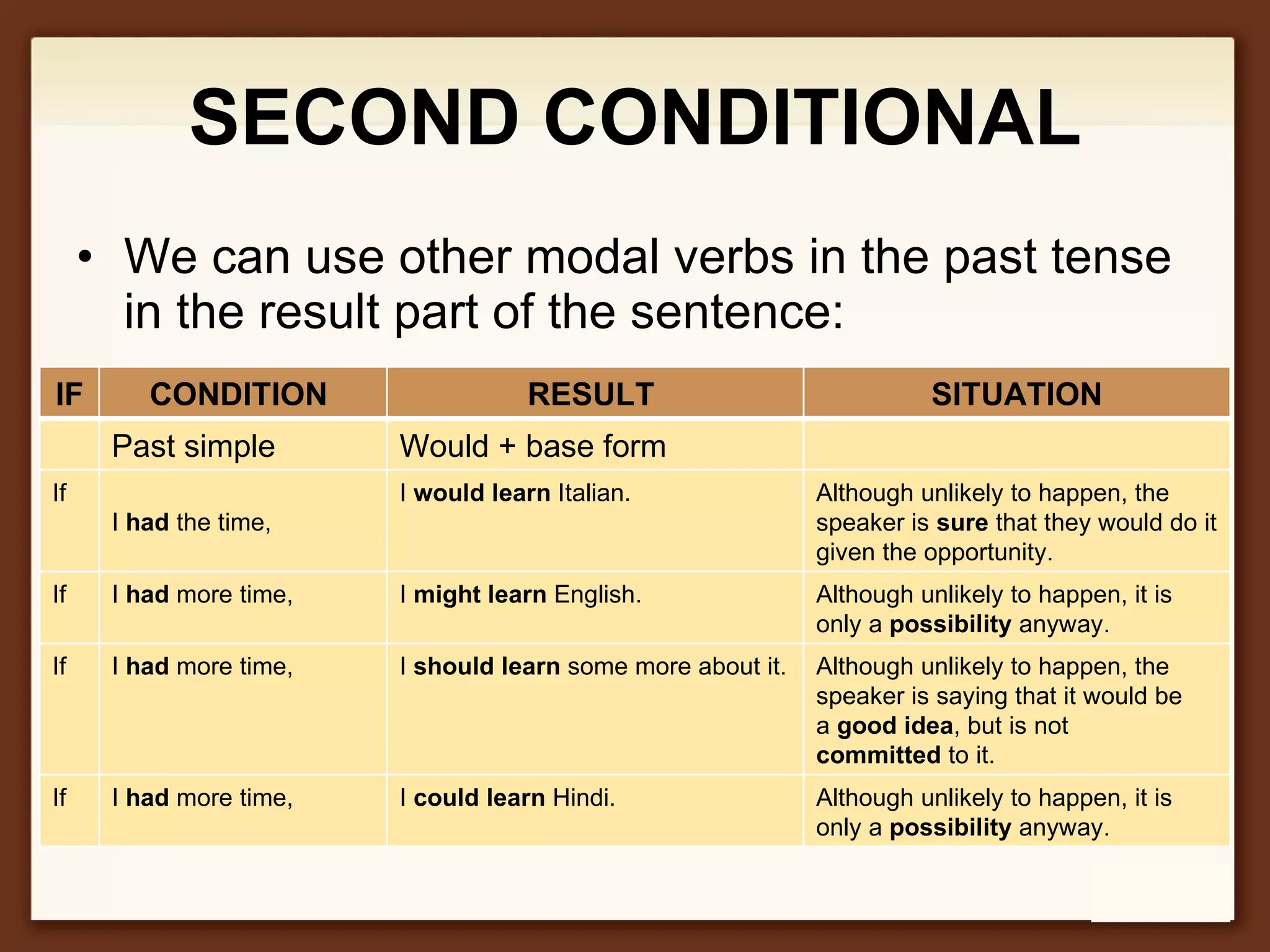
SECOND CONDITIONAL We can use other modal verbs in the past tense in the result part of the sentence: IF  CONDITION  RESULT  SITUATION Past simple Would + base form If  I  had  the time, I  would learn  Italian. Although unlikely to happen, the speaker is  sure  that they would do it given the opportunity. If I  had  more time, I  might   learn  English. Although unlikely to happen, it is only a  possibility  anyway. If  I  had  more time, I  should   learn  some more about it. Although unlikely to happen, the speaker is saying that it would be a  good idea , but is not  committed  to it. If  I  had  more time, I  could   learn  Hindi. Although unlikely to happen, it is only a  possibility  anyway.
SECOND CONDITIONAL
THIRD CONDITIONAL The third conditional is used when we are talking about the past and imagining something different from what actually happened, that means for imaginary past actions, where the conditions for the action WERE NOT satisfied.
THIRD CONDITIONAL Formation:  If + past perfect, + would have + past participle IF  CONDITION  RESULT  SITUATION Past perfect Would have + past participle If  I  had known , I  would have helped . Although this didn't happen, the speaker is  sure  about the result. If I  had known , I  could have helped . Although this didn't happen, the result is only a  possibility. If  I  had known , I  might have helped . Although this didn't happen, the result is only a  possibility. If  you  had known , you  should have helped . Although this didn't happen, it is only a good  suggestion  or piece of  advice .
BY CAMILO HERRERA  JORGE MOLINA Fundación Universitaria Luis Amigó Faculty of Education
REFERENCES http://www.englishlanguageguide.com/english/grammar/conditionals.asp

Conditional sentences grammar

  • 1.
  • 2.
    DEFINITION The conditionaltense says that an action is reliant on something else. The conditionals are used to talk about real or unreal situations, they are sometimes called if-clauses. Real Conditional describes real-life situations. Unreal Conditional describes unreal, imaginary situations.
  • 3.
    TYPES OF CONDITIONALSThere are four basic conditionals that we use in English. Zero Conditional First Conditional Second Conditional Third Conditional
  • 4.
    ZERO CONDITIONAL Formation: if + present simple, + present simple The Zero conditional is used for things that are always true as long as the condition is met IF CONDITION RESULT SITUATION Present simple Present simple If you  heat  water to 100 degrees Celsius, It boils Fact- universal If I drink coffee, I get a headache Fact- personal
  • 5.
  • 6.
    FIRST CONDITIONAL AFirst Conditional sentence is for future actions dependent on the result of another future action or event, where there is a reasonable possibility of the conditions for the action being satisfied.
  • 7.
    FIRST CONDITIONAL FormationIf + present simple, + will For example: If she gets good grades, she will go to university. We are talking about the future, but we use a present tense for the condition and will for the result. In this case, the person is sure about going to university. 
  • 8.
    FIRST CONDITIONAL Wecan use other modal verbs in the result part of the sentence. For example:   IF CONDITION RESULT SITUATION If she gets good grades, she  will  go to university. If the condition is met, then she definitely  will go If he gets good grades, he  may  go to university. He is  not sure  about going to university. If she gets good grades, she  should  go to university. The speaker is expressing his or her opinion , giving  advice . If he gets good grades, he  can  go to university. This means that it is  possible . If she gets good grades, she  could  go to university. This means that it is  possible , but  not that  likely . If he gets good grades, he  might  go to university. This means that it is  possible , but  not that  likely .
  • 9.
  • 10.
    SECOND CONDITIONAL Itcan be used to talk about imaginary present situations, where we are imagining something different from what is really the case. We can also use it to talk about things in the future that are unlikely to happen, as the condition is unlikely to be met. We use the past tense in the condition part and would for the result.
  • 11.
    SECOND CONDITIONAL Formation: If + past simple, + would + base form   For Example: If I were you, I'd tell her. IF CONDITION RESULT SITUATION Past simple Would + base form If I  had  the time, I  would learn Italian. Impossible I don't have the time, so I'm not going to learn Italian. If I  won  the lottery I  would travel around the world. Unlikely There's a very small chance of winning the lottery, so the trip is unlikely
  • 12.
    SECOND CONDITIONAL Wecan use other modal verbs in the past tense in the result part of the sentence: IF CONDITION RESULT SITUATION Past simple Would + base form If I  had  the time, I  would learn Italian. Although unlikely to happen, the speaker is  sure that they would do it given the opportunity. If I  had more time, I  might   learn English. Although unlikely to happen, it is only a possibility  anyway. If I  had more time, I  should   learn some more about it. Although unlikely to happen, the speaker is saying that it would be a  good idea , but is not committed  to it. If I  had more time, I  could   learn Hindi. Although unlikely to happen, it is only a possibility  anyway.
  • 13.
  • 14.
    THIRD CONDITIONAL Thethird conditional is used when we are talking about the past and imagining something different from what actually happened, that means for imaginary past actions, where the conditions for the action WERE NOT satisfied.
  • 15.
    THIRD CONDITIONAL Formation: If + past perfect, + would have + past participle IF CONDITION RESULT SITUATION Past perfect Would have + past participle If I  had known , I  would have helped . Although this didn't happen, the speaker is  sure  about the result. If I  had known , I  could have helped . Although this didn't happen, the result is only a  possibility. If I  had known , I  might have helped . Although this didn't happen, the result is only a  possibility. If you  had known , you  should have helped . Although this didn't happen, it is only a good  suggestion  or piece of  advice .
  • 16.
    BY CAMILO HERRERA JORGE MOLINA Fundación Universitaria Luis Amigó Faculty of Education
  • 17.