COMMUNITY LEARNING PROGRAMME (CLP):
INNOVATIVE CONTENT DEVELOPMENT AND
DISSEMINATION APPROACH
Dr Ankuran Dutta
Associate Professor, Bhupen Hazarika School of Mass Communication, KKHSOU
Managing Trustee, Dr. Anamika Ray Memorial Trust
14 FEBRUARY 2016© DR ANAMIKA RAY MEMORIAL TRUST, 2015; CC-BY-SA 1
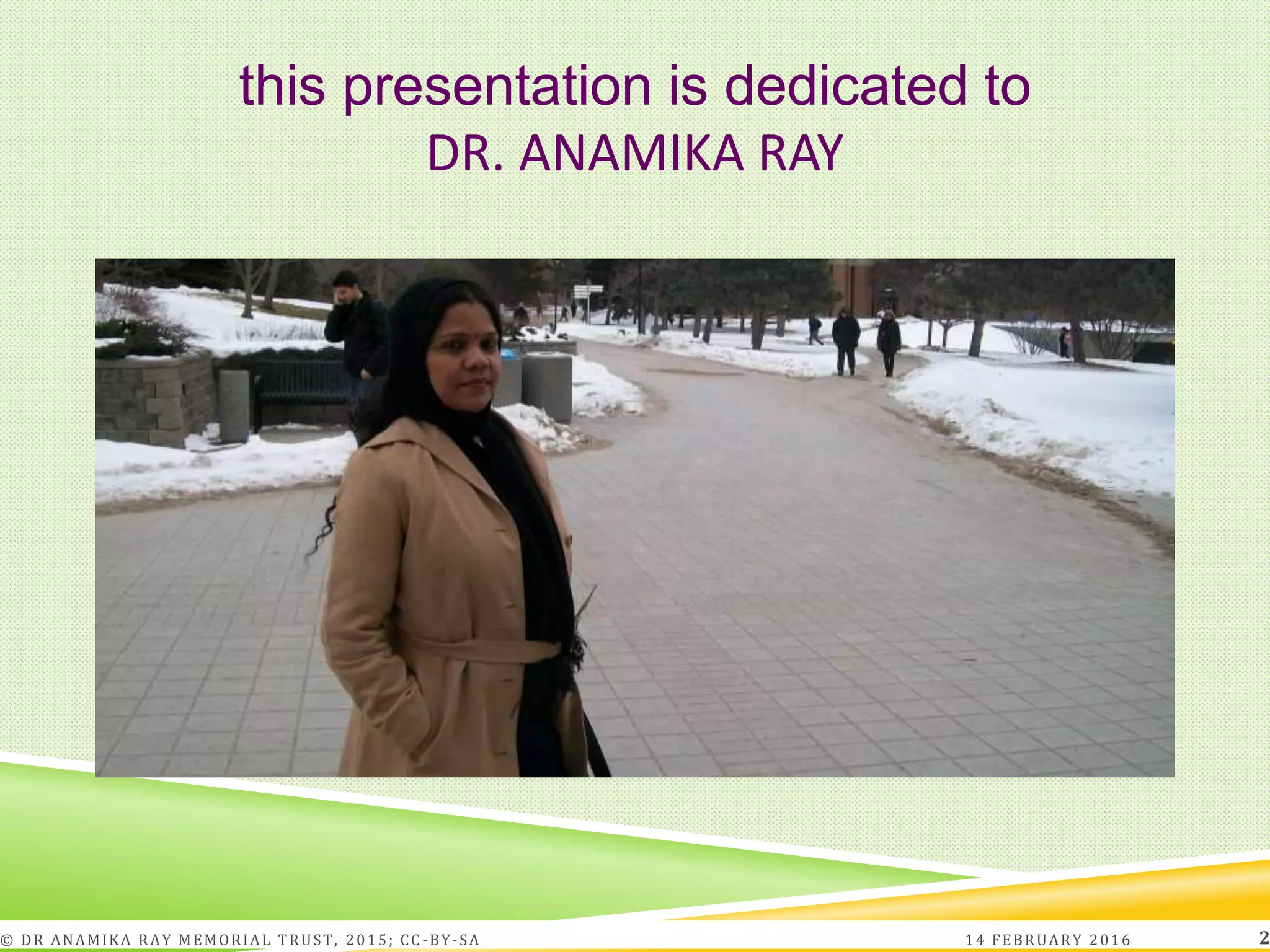
this presentation is dedicated to
DR. ANAMIKA RAY
14 FEBRUARY 2016© DR ANAMIKA RAY MEMORIAL TRUST, 2015; CC -BY-SA 2
UNDERSTANDING COMMUNITY
 Defining the term community is a complex concern, with various diverging
perspectives and outlooks. How can we define the term 'community' in a
simplest yet most comprehensive way?
 As we try to understand the term with a slightly different approach it’s
observed ‘community’ comprises of two distinct yet intricately imbibed
phrases- Common and Unity (Common + Unity = Community)*
 Commons, simply refers to people or masses
 Unity stands for the state or feature of being one, uniformity, being
in accord, harmony with one another or towards a particular cause.
 So, Community is a group of people with unification of some specific
genre, may be geographical, political, economic, cultural, identity
real or virtual.
 Examples.
 * Concept by Dr Anamika Ray
14 FEBRUARY 2016© DR ANAMIKA RAY MEMORIAL TRUST, 2015; CC -BY-SA 3
EFFECTIVE COMMUNICATION FOR
COMMUNITY LEVEL
 Remember Seven Cs of Communication
 Command attention
 Cater to the heart and the head
 Clarify the message
 Communicate a benefit
 Create trust
 Call to action
 Be consistent
 Esta de Fossard (1996) How To Write a Radio Serial Drama for Social Development
14 FEBRUARY 2016© DR ANAMIKA RAY MEMORIAL TRUST, 2015; CC -BY-SA 4
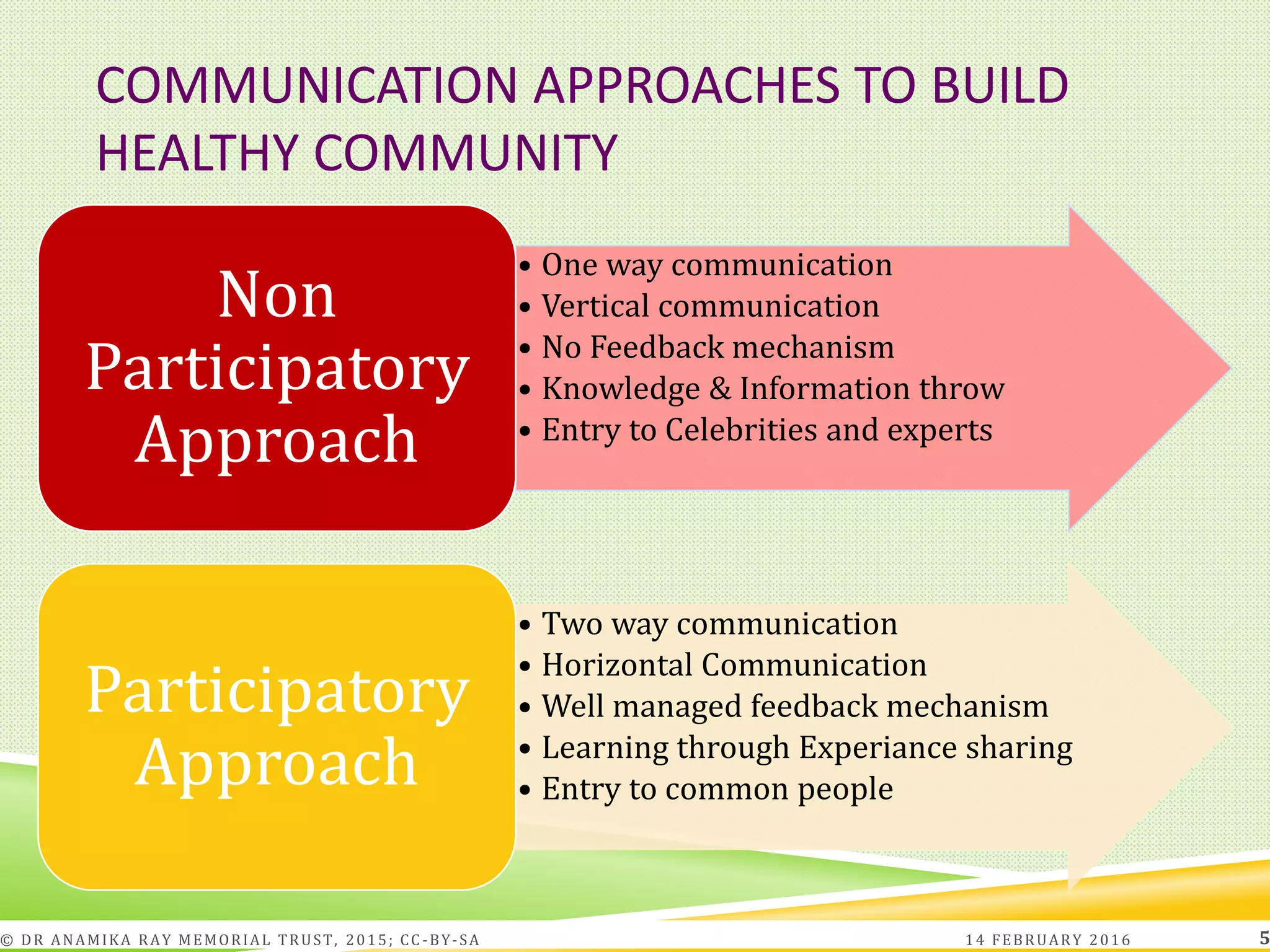
COMMUNICATION APPROACHES TO BUILD
HEALTHY COMMUNITY
• One way communication
• Vertical communication
• No Feedback mechanism
• Knowledge & Information throw
• Entry to Celebrities and experts
Non
Participatory
Approach
• Two way communication
• Horizontal Communication
• Well managed feedback mechanism
• Learning through Experiance sharing
• Entry to common people
Participatory
Approach
14 FEBRUARY 2016© DR ANAMIKA RAY MEMORIAL TRUST, 2015; CC -BY-SA 5
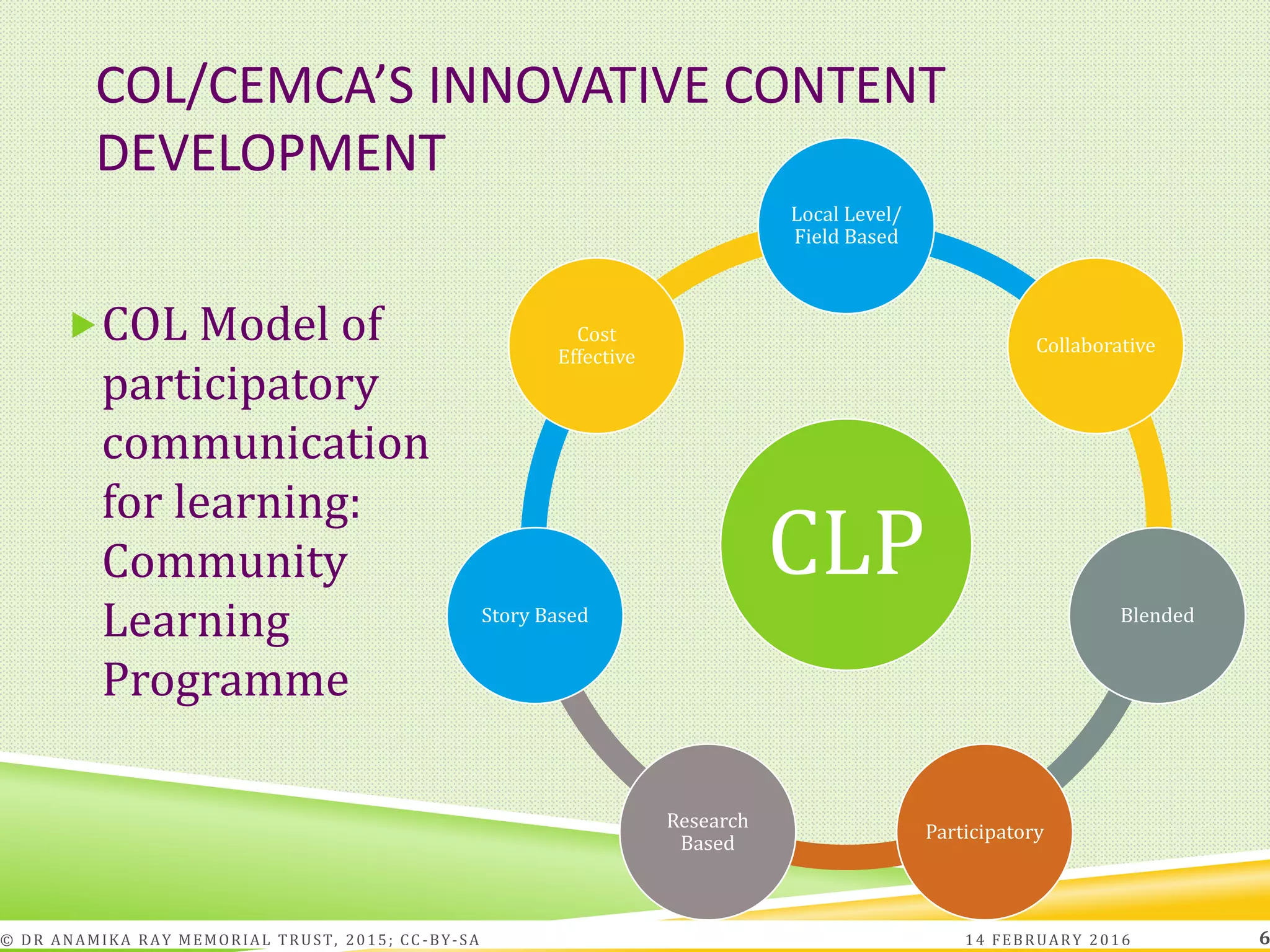
COL/CEMCA’S INNOVATIVE CONTENT
DEVELOPMENT
COL Model of
participatory
communication
for learning:
Community
Learning
Programme
CLP
Local Level/
Field Based
Collaborative
Blended
Participatory
Research
Based
Story Based
Cost
Effective
14 FEBRUARY 2016© DR ANAMIKA RAY MEMORIAL TRUST, 2015; CC -BY-SA 6
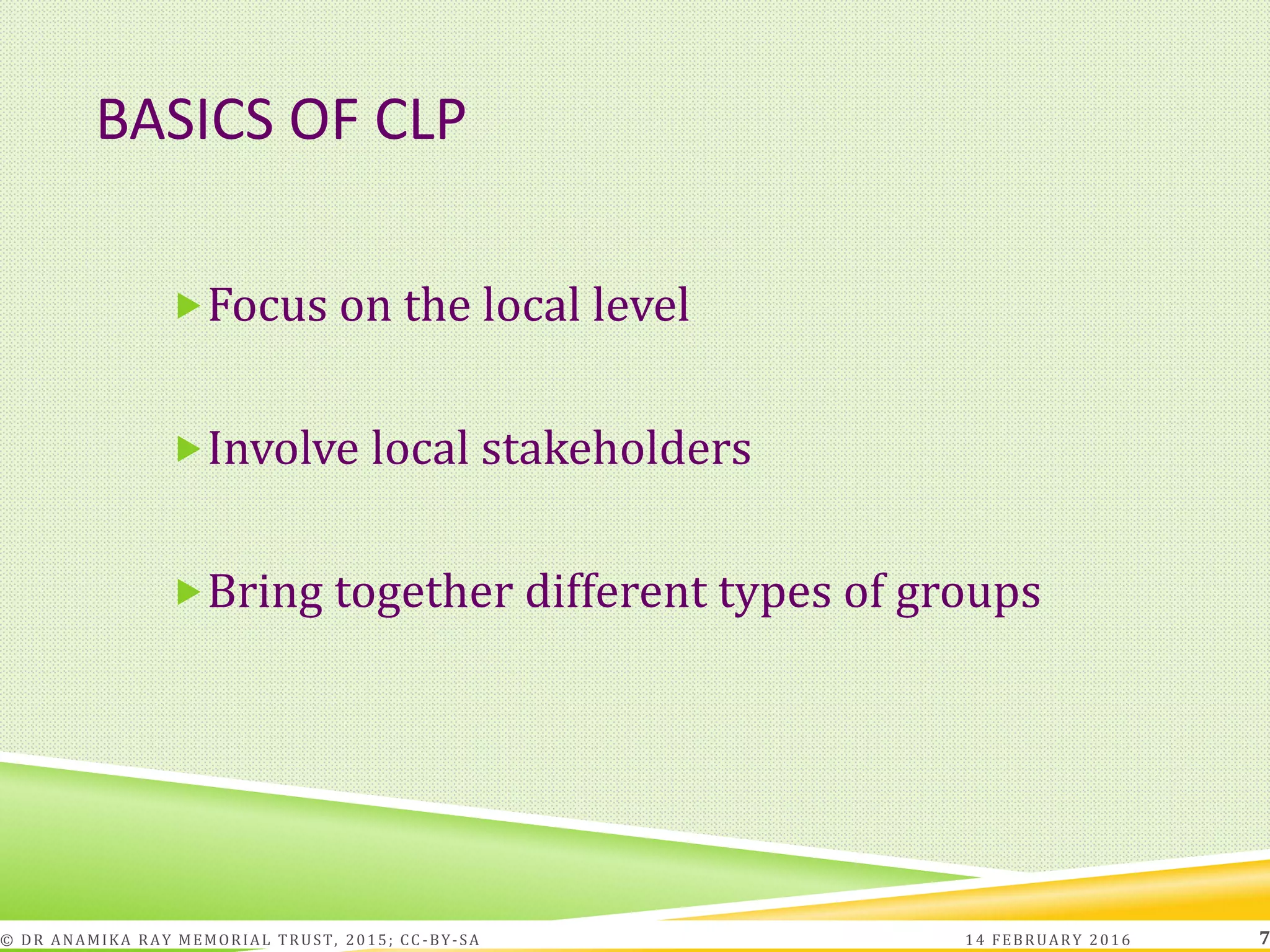
BASICS OF CLP
Focus on the local level
Involve local stakeholders
Bring together different types of groups
14 FEBRUARY 2016© DR ANAMIKA RAY MEMORIAL TRUST, 2015; CC -BY-SA 7
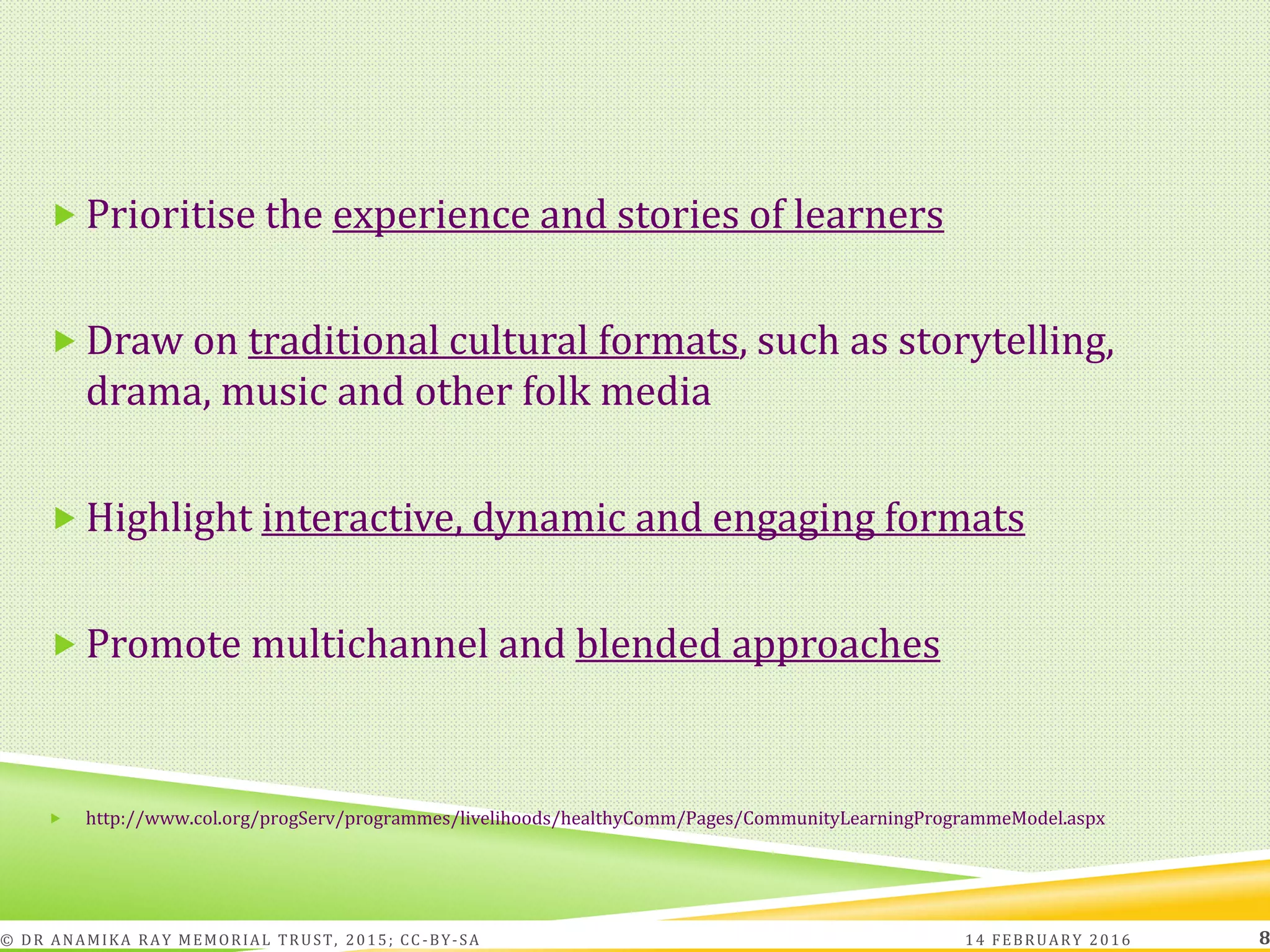
 Prioritise the experience and stories of learners
 Draw on traditional cultural formats, such as storytelling,
drama, music and other folk media
 Highlight interactive, dynamic and engaging formats
 Promote multichannel and blended approaches
 http://www.col.org/progServ/programmes/livelihoods/healthyComm/Pages/CommunityLearningProgrammeModel.aspx
14 FEBRUARY 2016© DR ANAMIKA RAY MEMORIAL TRUST, 2015; CC -BY-SA 8
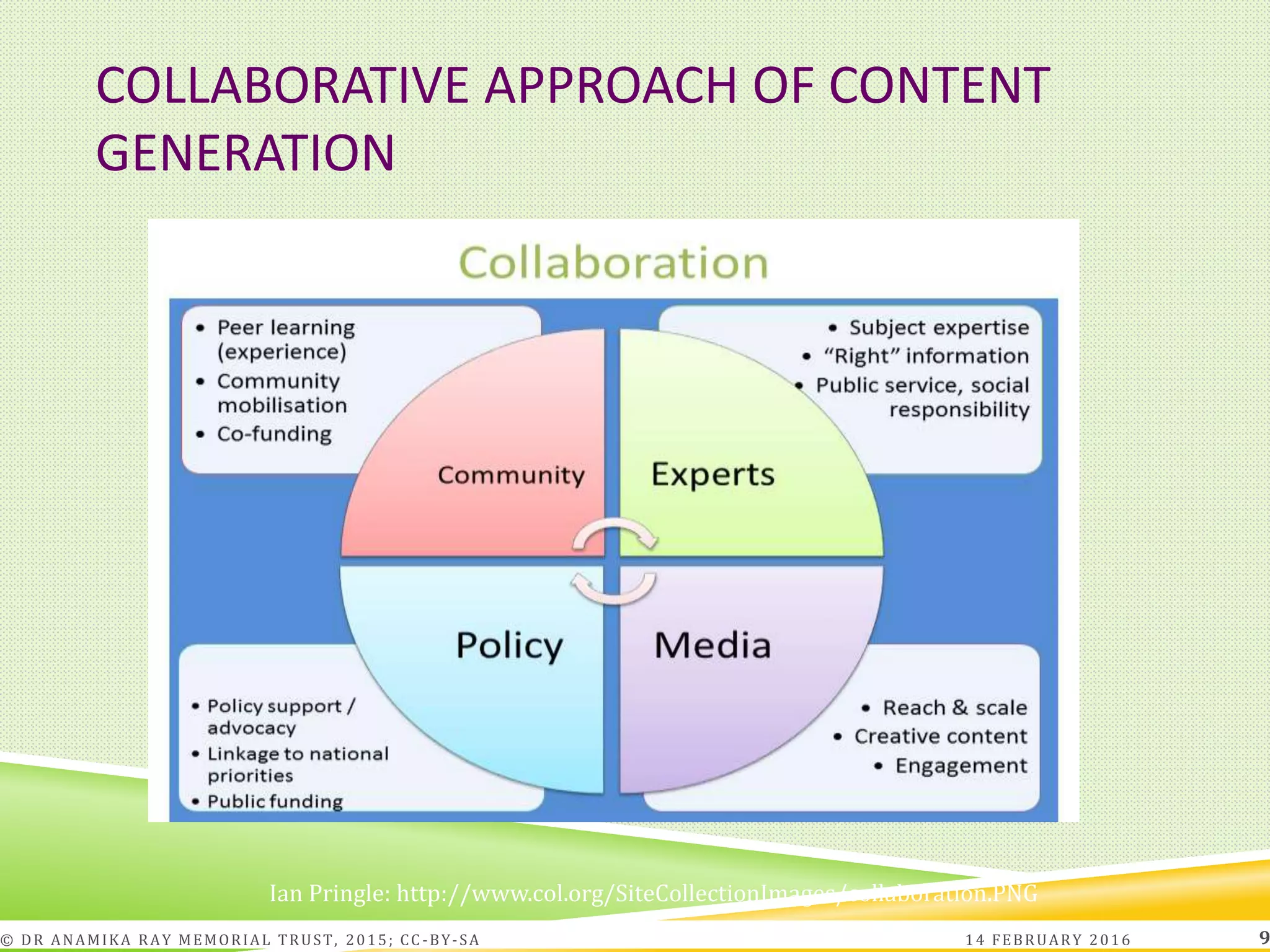
COLLABORATIVE APPROACH OF CONTENT
GENERATION
Ian Pringle: http://www.col.org/SiteCollectionImages/collaboration.PNG
14 FEBRUARY 2016© DR ANAMIKA RAY MEMORIAL TRUST, 2015; CC -BY-SA 9
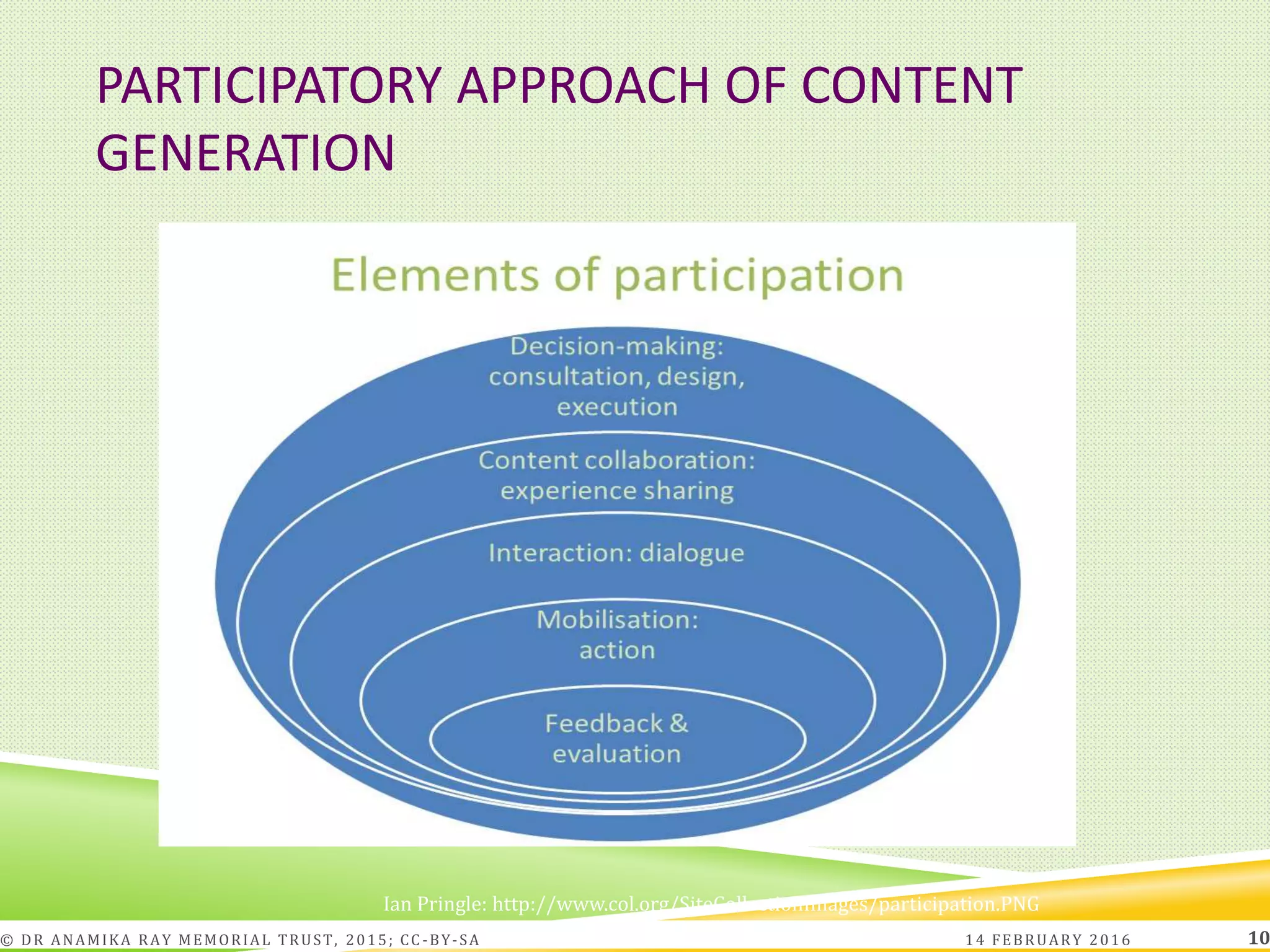
PARTICIPATORY APPROACH OF CONTENT
GENERATION
Ian Pringle: http://www.col.org/SiteCollectionImages/participation.PNG
14 FEBRUARY 2016© DR ANAMIKA RAY MEMORIAL TRUST, 2015; CC -BY-SA 10
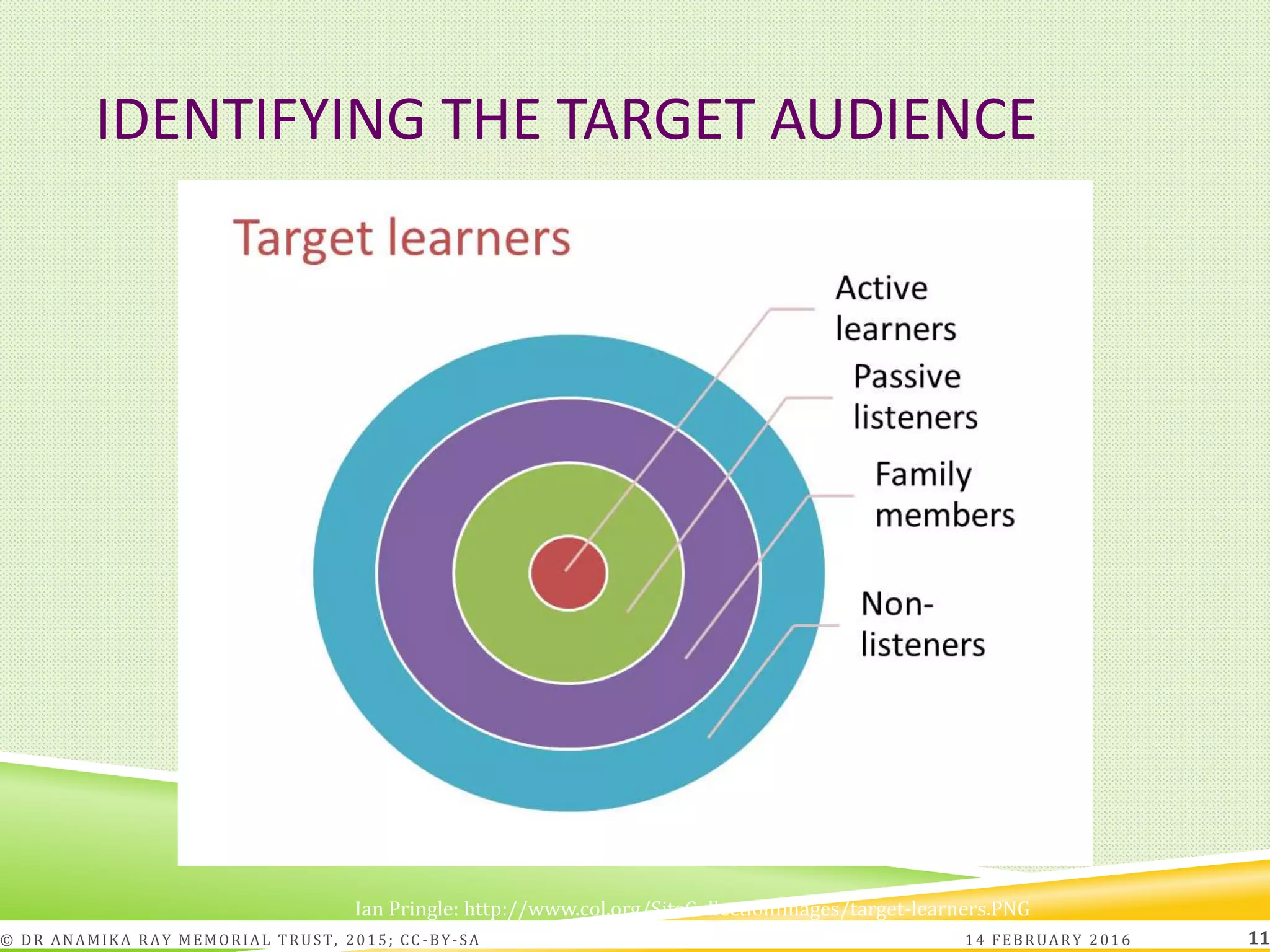
IDENTIFYING THE TARGET AUDIENCE
Ian Pringle: http://www.col.org/SiteCollectionImages/target-learners.PNG
14 FEBRUARY 2016© DR ANAMIKA RAY MEMORIAL TRUST, 2015; CC -BY-SA 11
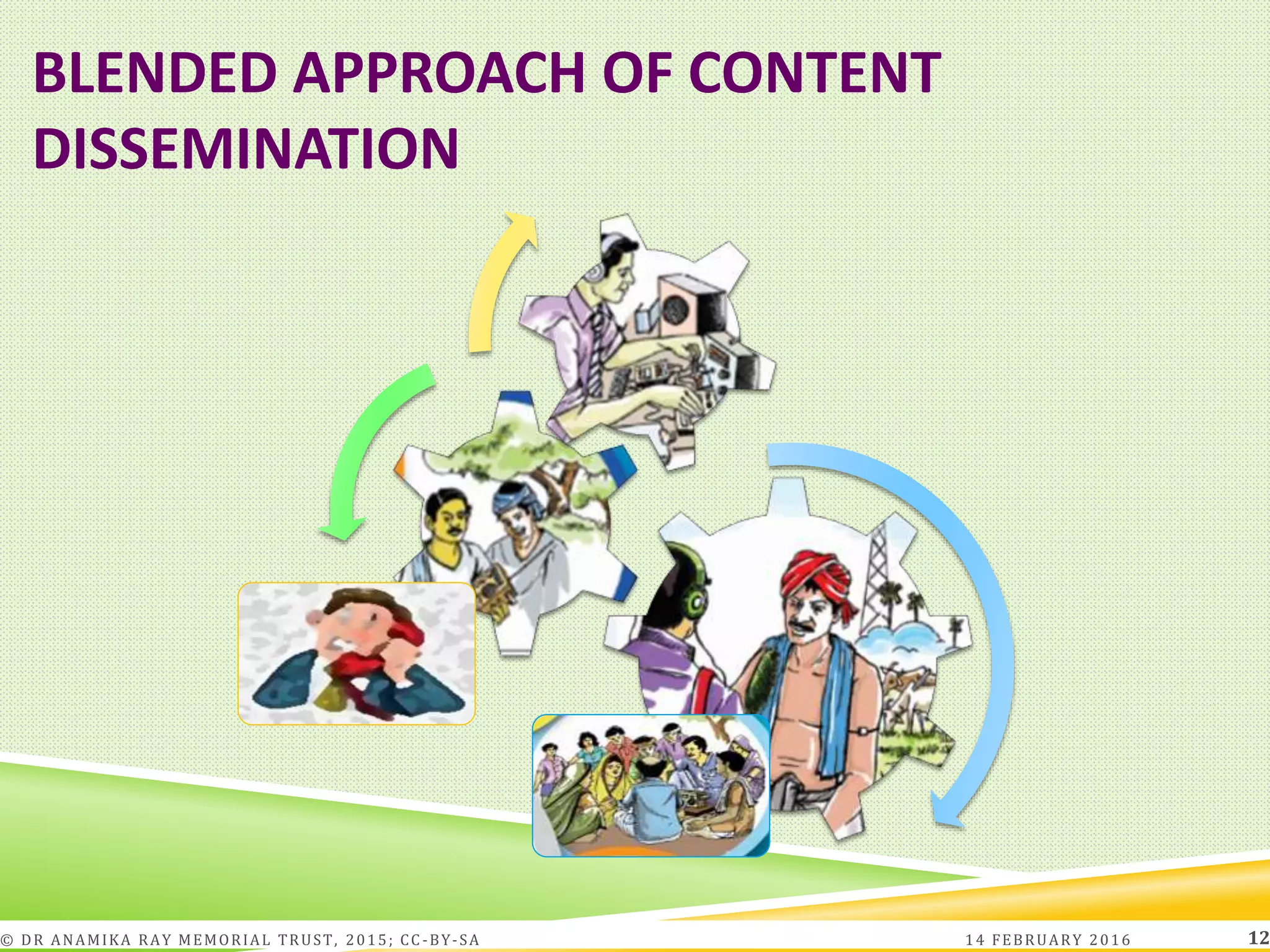
BLENDED APPROACH OF CONTENT
DISSEMINATION
14 FEBRUARY 2016© DR ANAMIKA RAY MEMORIAL TRUST, 2015; CC -BY-SA 12
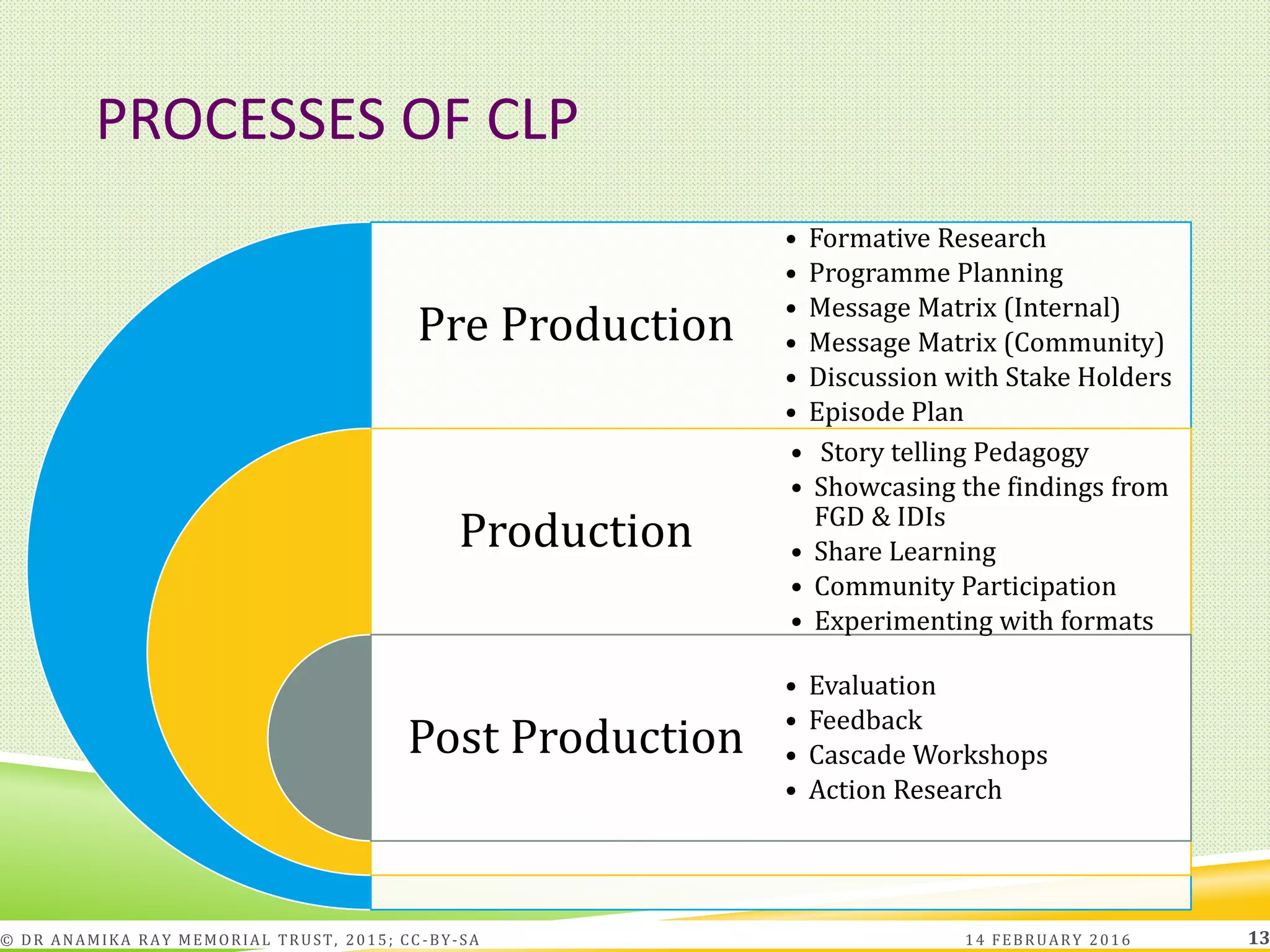
PROCESSES OF CLP
Pre Production
Production
Post Production
• Formative Research
• Programme Planning
• Message Matrix (Internal)
• Message Matrix (Community)
• Discussion with Stake Holders
• Episode Plan
• Story telling Pedagogy
• Showcasing the findings from
FGD & IDIs
• Share Learning
• Community Participation
• Experimenting with formats
• Evaluation
• Feedback
• Cascade Workshops
• Action Research
14 FEBRUARY 2016© DR ANAMIKA RAY MEMORIAL TRUST, 2015; CC -BY-SA 13
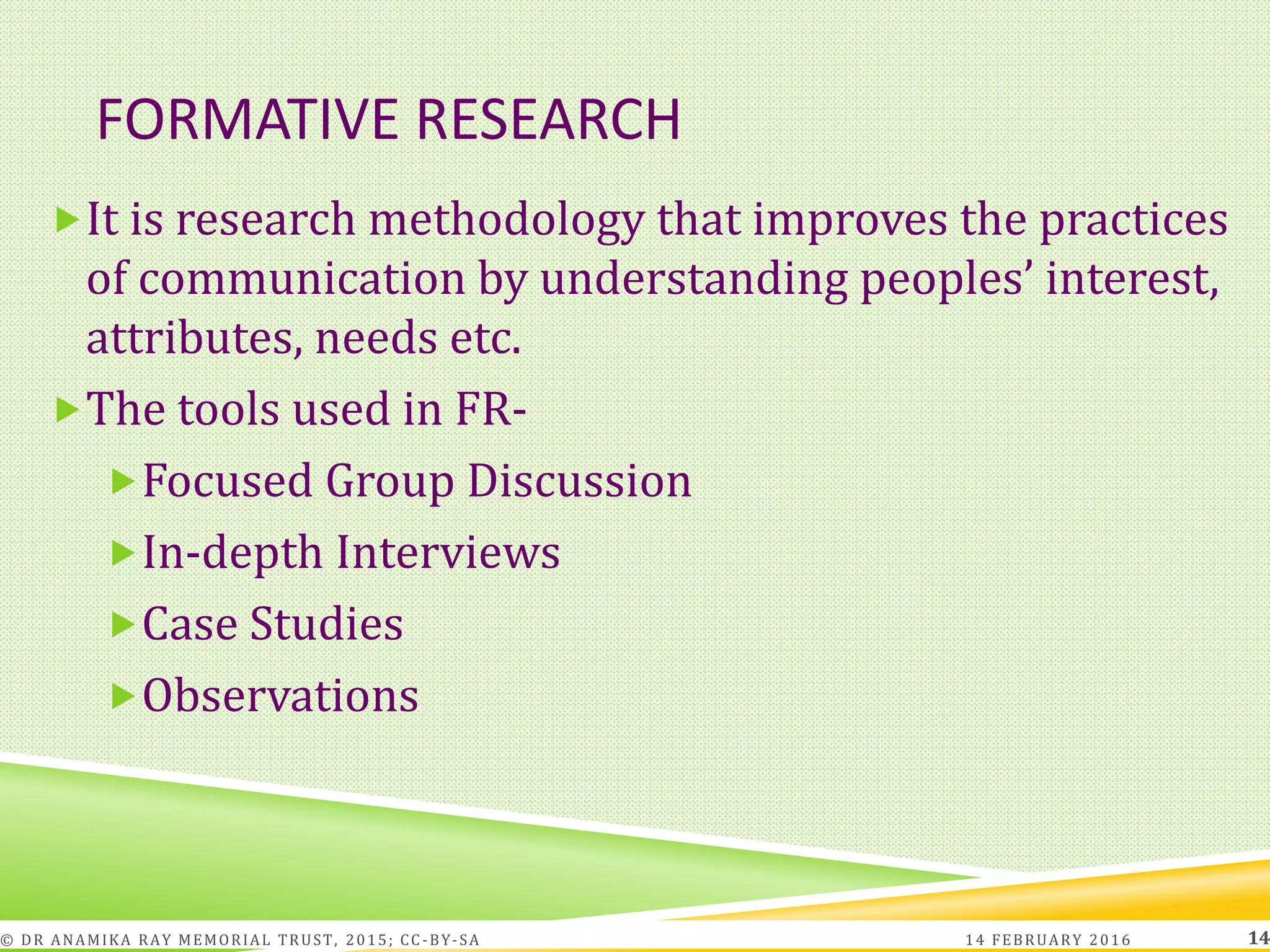
FORMATIVE RESEARCH
It is research methodology that improves the practices
of communication by understanding peoples’ interest,
attributes, needs etc.
The tools used in FR-
Focused Group Discussion
In-depth Interviews
Case Studies
Observations
14 FEBRUARY 2016© DR ANAMIKA RAY MEMORIAL TRUST, 2015; CC -BY-SA 14
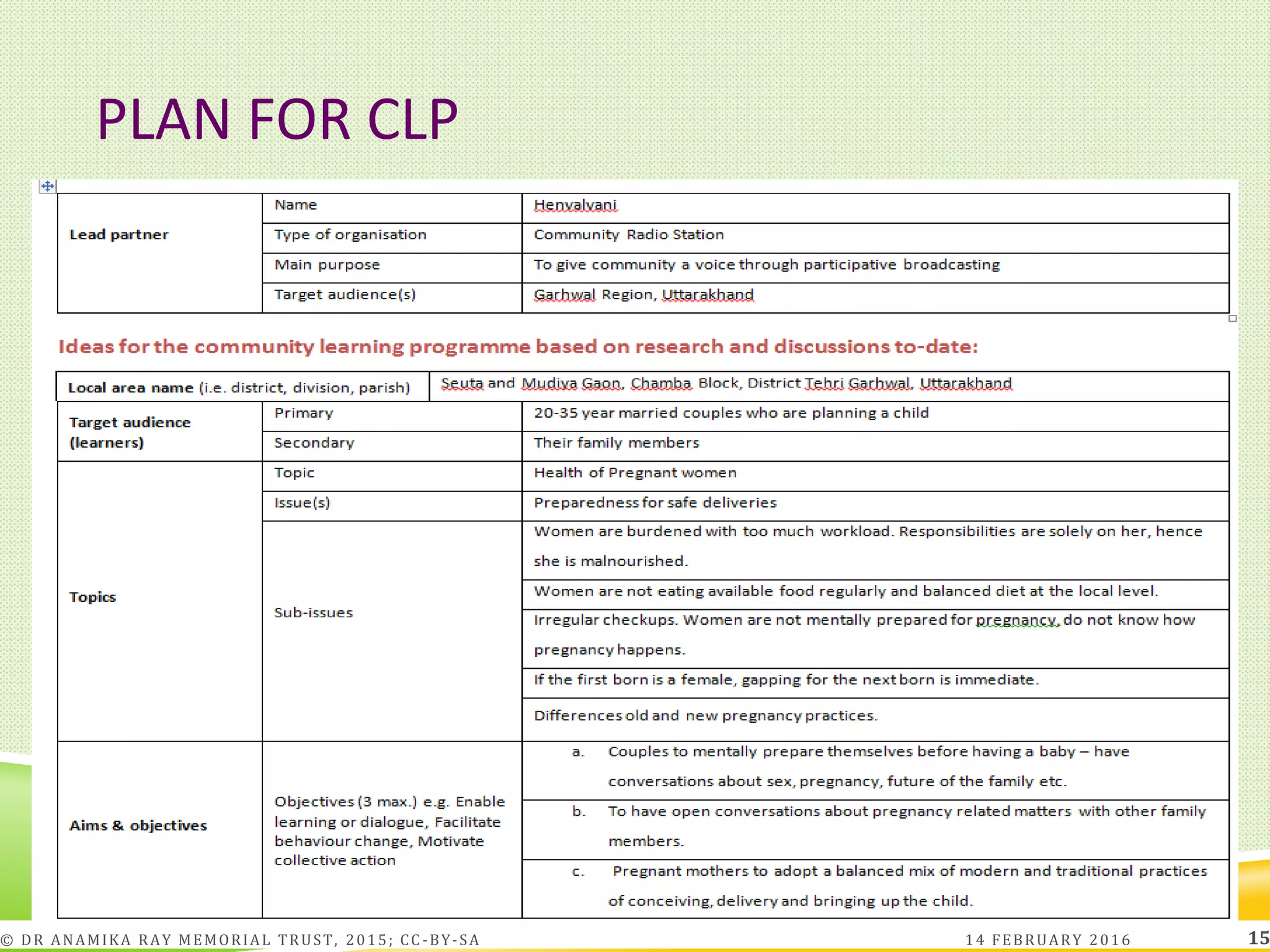
PLAN FOR CLP
14 FEBRUARY 2016© DR ANAMIKA RAY MEMORIAL TRUST, 2015; CC -BY-SA 15
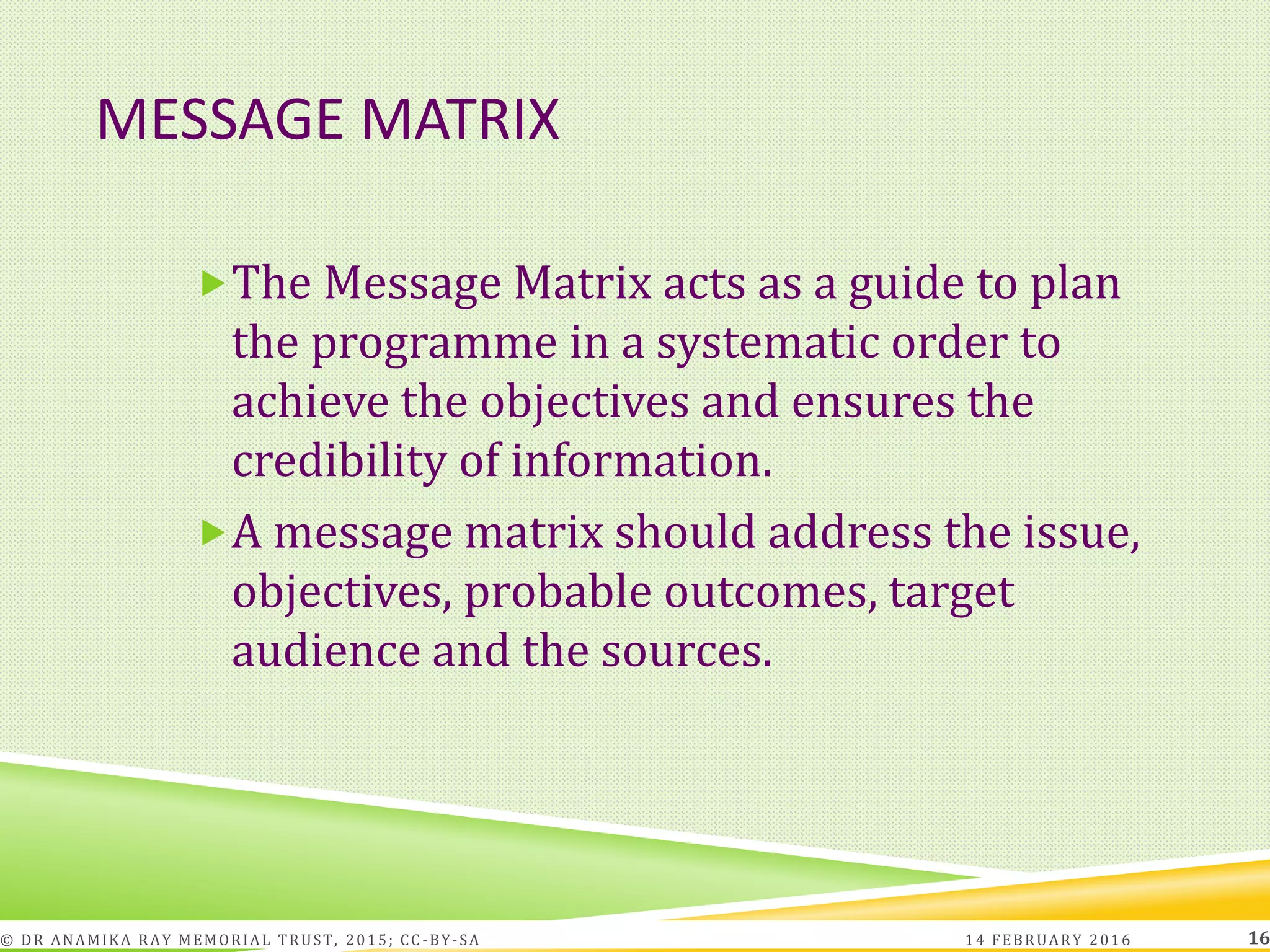
MESSAGE MATRIX
The Message Matrix acts as a guide to plan
the programme in a systematic order to
achieve the objectives and ensures the
credibility of information.
A message matrix should address the issue,
objectives, probable outcomes, target
audience and the sources.
14 FEBRUARY 2016© DR ANAMIKA RAY MEMORIAL TRUST, 2015; CC -BY-SA 16
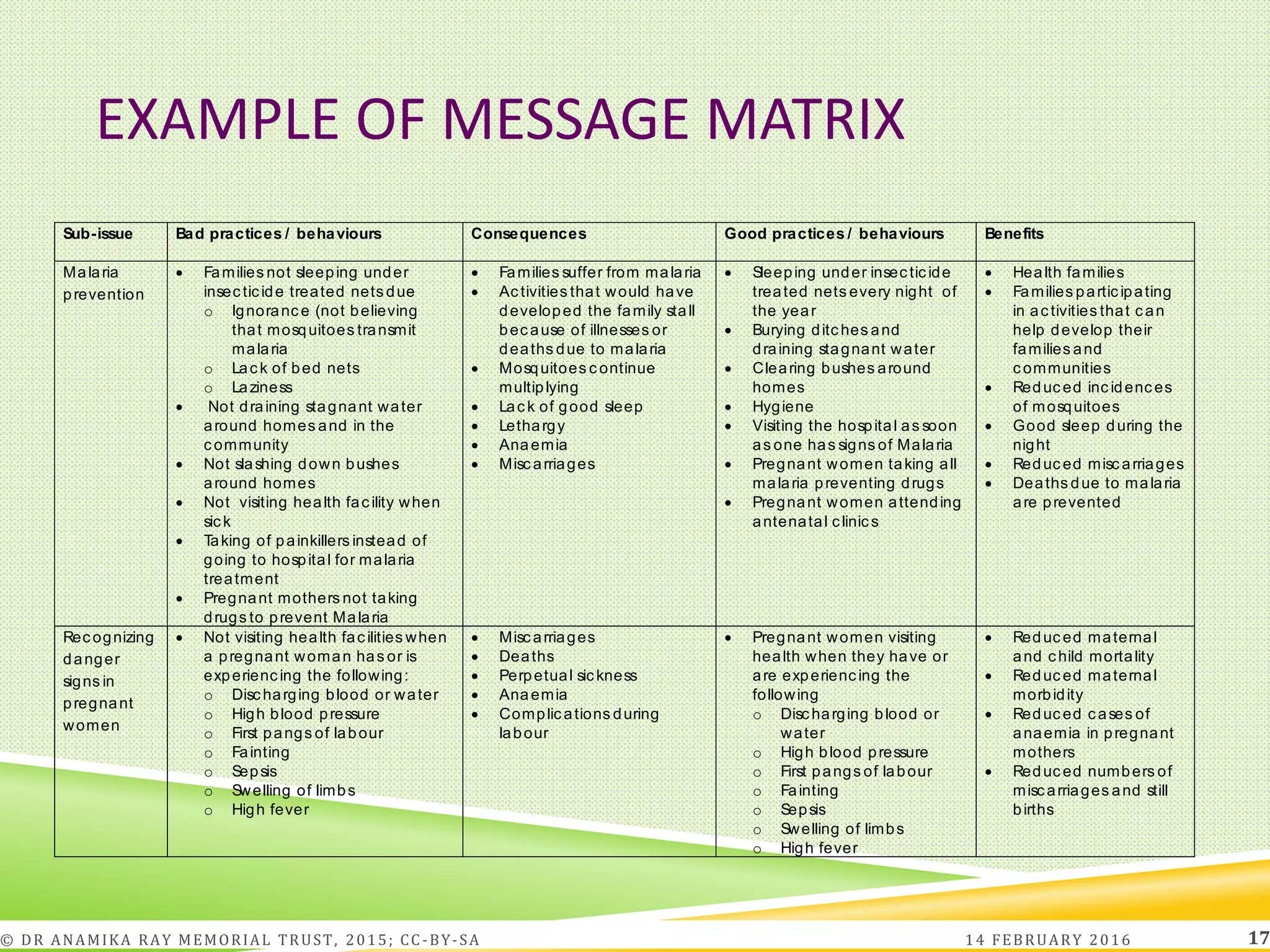
EXAMPLE OF MESSAGE MATRIX
Sub-issue Bad practices / behaviours Consequences Good practices / behaviours Benefits
Malaria
prevention
 Families not sleeping under
insecticide treated nets due
o Ignorance (not believing
that mosquitoes transmit
malaria
o Lack of bed nets
o Laziness
 Not draining stagnant water
around homes and in the
community
 Not slashing down bushes
around homes
 Not visiting health facility when
sick
 Taking of painkillers instead of
going to hospital for malaria
treatment
 Pregnant mothers not taking
drugs to prevent Malaria
 Families suffer from malaria
 Activities that would have
developed the family stall
because of illnesses or
deaths due to malaria
 Mosquitoes c ontinue
multiplying
 Lack of good sleep
 Lethargy
 Anaemia
 Miscarriages
 Sleeping under insecticide
treated nets every night of
the year
 Burying ditches and
draining stagnant water
 Clearing bushes around
homes
 Hygiene
 Visiting the hospital as soon
as one has signs of Malaria
 Pregnant women taking all
malaria preventing drugs
 Pregnant women attending
antenatal clinics
 Health families
 Families participating
in activities that can
help develop their
families and
communities
 Reduced incidences
of mosquitoes
 Good sleep during the
night
 Reduced miscarriages
 Deaths due to malaria
are prevented
Recognizing
danger
signs in
pregnant
women
 Not visiting health facilities when
a pregnant woman has or is
experiencing the following:
o Discharging blood or water
o High blood pressure
o First pangs of labour
o Fainting
o Sepsis
o Swelling of limbs
o High fever
 Miscarriages
 Deaths
 Perpetual sickness
 Anaemia
 Complications during
labour
 Pregnant women visiting
health when they have or
are experiencing the
following
o Discharging blood or
water
o High blood pressure
o First pangs of labour
o Fainting
o Sepsis
o Swelling of limbs
o High fever
 Reduced maternal
and child mortality
 Reduced maternal
morbidity
 Reduced cases of
anaemia in pregnant
mothers
 Reduced numbers of
miscarriages and still
births
14 FEBRUARY 2016© DR ANAMIKA RAY MEMORIAL TRUST, 2015; CC -BY-SA 17
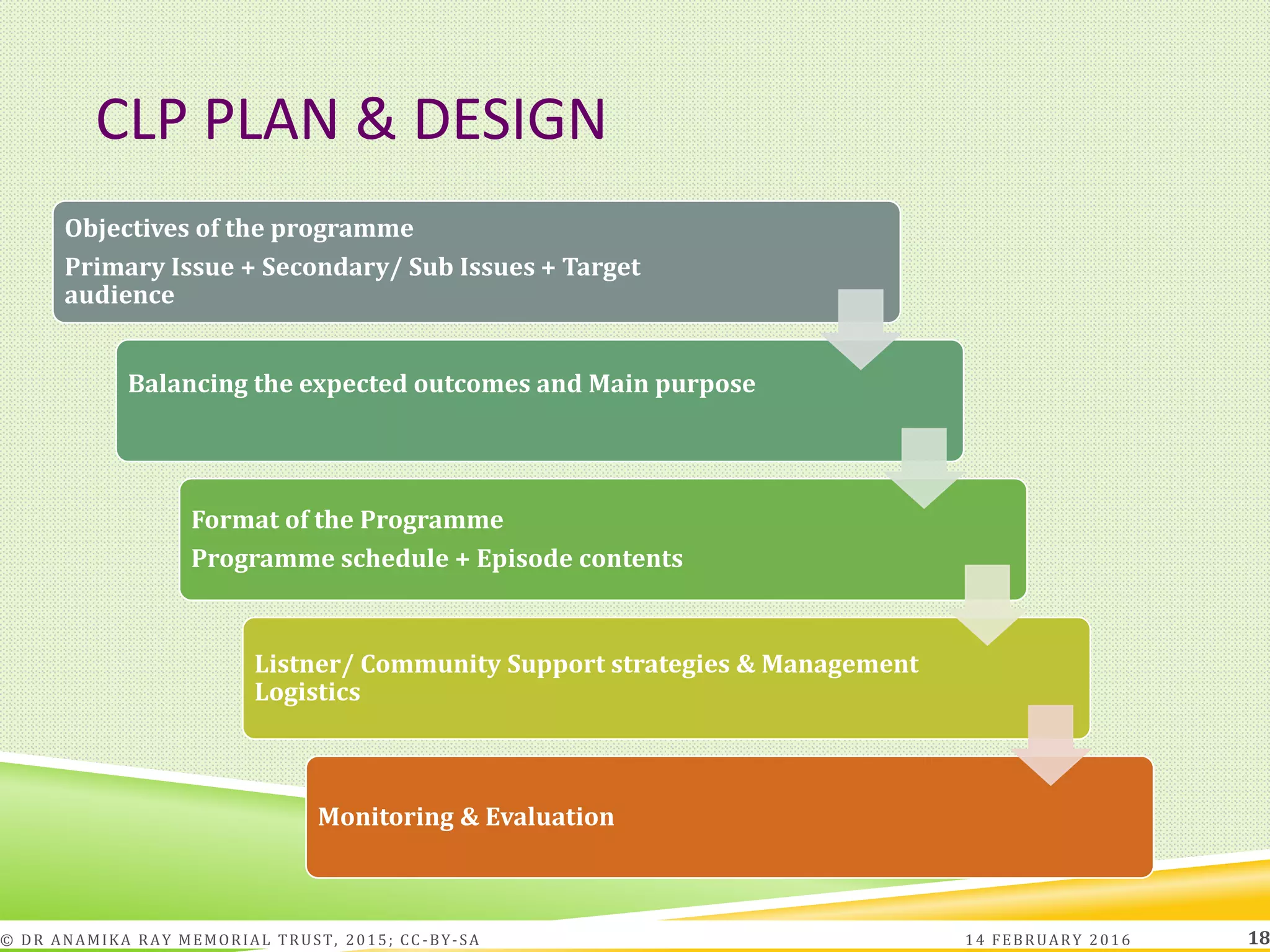
CLP PLAN & DESIGN
Objectives of the programme
Primary Issue + Secondary/ Sub Issues + Target
audience
Balancing the expected outcomes and Main purpose
Format of the Programme
Programme schedule + Episode contents
Listner/ Community Support strategies & Management
Logistics
Monitoring & Evaluation
14 FEBRUARY 2016© DR ANAMIKA RAY MEMORIAL TRUST, 2015; CC -BY-SA 18
Thank you
Contact
ankurandutta@gmail.com
14 FEBRUARY 2016© DR ANAMIKA RAY MEMORIAL TRUST, 2015; CC -BY-SA 19

Community Learning Programme (CLP): Innovative content development and dissemination approach

  • 1.
    COMMUNITY LEARNING PROGRAMME(CLP): INNOVATIVE CONTENT DEVELOPMENT AND DISSEMINATION APPROACH Dr Ankuran Dutta Associate Professor, Bhupen Hazarika School of Mass Communication, KKHSOU Managing Trustee, Dr. Anamika Ray Memorial Trust 14 FEBRUARY 2016© DR ANAMIKA RAY MEMORIAL TRUST, 2015; CC-BY-SA 1
  • 2.
    this presentation isdedicated to DR. ANAMIKA RAY 14 FEBRUARY 2016© DR ANAMIKA RAY MEMORIAL TRUST, 2015; CC -BY-SA 2
  • 3.
    UNDERSTANDING COMMUNITY  Definingthe term community is a complex concern, with various diverging perspectives and outlooks. How can we define the term 'community' in a simplest yet most comprehensive way?  As we try to understand the term with a slightly different approach it’s observed ‘community’ comprises of two distinct yet intricately imbibed phrases- Common and Unity (Common + Unity = Community)*  Commons, simply refers to people or masses  Unity stands for the state or feature of being one, uniformity, being in accord, harmony with one another or towards a particular cause.  So, Community is a group of people with unification of some specific genre, may be geographical, political, economic, cultural, identity real or virtual.  Examples.  * Concept by Dr Anamika Ray 14 FEBRUARY 2016© DR ANAMIKA RAY MEMORIAL TRUST, 2015; CC -BY-SA 3
  • 4.
    EFFECTIVE COMMUNICATION FOR COMMUNITYLEVEL  Remember Seven Cs of Communication  Command attention  Cater to the heart and the head  Clarify the message  Communicate a benefit  Create trust  Call to action  Be consistent  Esta de Fossard (1996) How To Write a Radio Serial Drama for Social Development 14 FEBRUARY 2016© DR ANAMIKA RAY MEMORIAL TRUST, 2015; CC -BY-SA 4
  • 5.
    COMMUNICATION APPROACHES TOBUILD HEALTHY COMMUNITY • One way communication • Vertical communication • No Feedback mechanism • Knowledge & Information throw • Entry to Celebrities and experts Non Participatory Approach • Two way communication • Horizontal Communication • Well managed feedback mechanism • Learning through Experiance sharing • Entry to common people Participatory Approach 14 FEBRUARY 2016© DR ANAMIKA RAY MEMORIAL TRUST, 2015; CC -BY-SA 5
  • 6.
    COL/CEMCA’S INNOVATIVE CONTENT DEVELOPMENT COLModel of participatory communication for learning: Community Learning Programme CLP Local Level/ Field Based Collaborative Blended Participatory Research Based Story Based Cost Effective 14 FEBRUARY 2016© DR ANAMIKA RAY MEMORIAL TRUST, 2015; CC -BY-SA 6
  • 7.
    BASICS OF CLP Focuson the local level Involve local stakeholders Bring together different types of groups 14 FEBRUARY 2016© DR ANAMIKA RAY MEMORIAL TRUST, 2015; CC -BY-SA 7
  • 8.
     Prioritise theexperience and stories of learners  Draw on traditional cultural formats, such as storytelling, drama, music and other folk media  Highlight interactive, dynamic and engaging formats  Promote multichannel and blended approaches  http://www.col.org/progServ/programmes/livelihoods/healthyComm/Pages/CommunityLearningProgrammeModel.aspx 14 FEBRUARY 2016© DR ANAMIKA RAY MEMORIAL TRUST, 2015; CC -BY-SA 8
  • 9.
    COLLABORATIVE APPROACH OFCONTENT GENERATION Ian Pringle: http://www.col.org/SiteCollectionImages/collaboration.PNG 14 FEBRUARY 2016© DR ANAMIKA RAY MEMORIAL TRUST, 2015; CC -BY-SA 9
  • 10.
    PARTICIPATORY APPROACH OFCONTENT GENERATION Ian Pringle: http://www.col.org/SiteCollectionImages/participation.PNG 14 FEBRUARY 2016© DR ANAMIKA RAY MEMORIAL TRUST, 2015; CC -BY-SA 10
  • 11.
    IDENTIFYING THE TARGETAUDIENCE Ian Pringle: http://www.col.org/SiteCollectionImages/target-learners.PNG 14 FEBRUARY 2016© DR ANAMIKA RAY MEMORIAL TRUST, 2015; CC -BY-SA 11
  • 12.
    BLENDED APPROACH OFCONTENT DISSEMINATION 14 FEBRUARY 2016© DR ANAMIKA RAY MEMORIAL TRUST, 2015; CC -BY-SA 12
  • 13.
    PROCESSES OF CLP PreProduction Production Post Production • Formative Research • Programme Planning • Message Matrix (Internal) • Message Matrix (Community) • Discussion with Stake Holders • Episode Plan • Story telling Pedagogy • Showcasing the findings from FGD & IDIs • Share Learning • Community Participation • Experimenting with formats • Evaluation • Feedback • Cascade Workshops • Action Research 14 FEBRUARY 2016© DR ANAMIKA RAY MEMORIAL TRUST, 2015; CC -BY-SA 13
  • 14.
    FORMATIVE RESEARCH It isresearch methodology that improves the practices of communication by understanding peoples’ interest, attributes, needs etc. The tools used in FR- Focused Group Discussion In-depth Interviews Case Studies Observations 14 FEBRUARY 2016© DR ANAMIKA RAY MEMORIAL TRUST, 2015; CC -BY-SA 14
  • 15.
    PLAN FOR CLP 14FEBRUARY 2016© DR ANAMIKA RAY MEMORIAL TRUST, 2015; CC -BY-SA 15
  • 16.
    MESSAGE MATRIX The MessageMatrix acts as a guide to plan the programme in a systematic order to achieve the objectives and ensures the credibility of information. A message matrix should address the issue, objectives, probable outcomes, target audience and the sources. 14 FEBRUARY 2016© DR ANAMIKA RAY MEMORIAL TRUST, 2015; CC -BY-SA 16
  • 17.
    EXAMPLE OF MESSAGEMATRIX Sub-issue Bad practices / behaviours Consequences Good practices / behaviours Benefits Malaria prevention  Families not sleeping under insecticide treated nets due o Ignorance (not believing that mosquitoes transmit malaria o Lack of bed nets o Laziness  Not draining stagnant water around homes and in the community  Not slashing down bushes around homes  Not visiting health facility when sick  Taking of painkillers instead of going to hospital for malaria treatment  Pregnant mothers not taking drugs to prevent Malaria  Families suffer from malaria  Activities that would have developed the family stall because of illnesses or deaths due to malaria  Mosquitoes c ontinue multiplying  Lack of good sleep  Lethargy  Anaemia  Miscarriages  Sleeping under insecticide treated nets every night of the year  Burying ditches and draining stagnant water  Clearing bushes around homes  Hygiene  Visiting the hospital as soon as one has signs of Malaria  Pregnant women taking all malaria preventing drugs  Pregnant women attending antenatal clinics  Health families  Families participating in activities that can help develop their families and communities  Reduced incidences of mosquitoes  Good sleep during the night  Reduced miscarriages  Deaths due to malaria are prevented Recognizing danger signs in pregnant women  Not visiting health facilities when a pregnant woman has or is experiencing the following: o Discharging blood or water o High blood pressure o First pangs of labour o Fainting o Sepsis o Swelling of limbs o High fever  Miscarriages  Deaths  Perpetual sickness  Anaemia  Complications during labour  Pregnant women visiting health when they have or are experiencing the following o Discharging blood or water o High blood pressure o First pangs of labour o Fainting o Sepsis o Swelling of limbs o High fever  Reduced maternal and child mortality  Reduced maternal morbidity  Reduced cases of anaemia in pregnant mothers  Reduced numbers of miscarriages and still births 14 FEBRUARY 2016© DR ANAMIKA RAY MEMORIAL TRUST, 2015; CC -BY-SA 17
  • 18.
    CLP PLAN &DESIGN Objectives of the programme Primary Issue + Secondary/ Sub Issues + Target audience Balancing the expected outcomes and Main purpose Format of the Programme Programme schedule + Episode contents Listner/ Community Support strategies & Management Logistics Monitoring & Evaluation 14 FEBRUARY 2016© DR ANAMIKA RAY MEMORIAL TRUST, 2015; CC -BY-SA 18
  • 19.
    Thank you Contact ankurandutta@gmail.com 14 FEBRUARY2016© DR ANAMIKA RAY MEMORIAL TRUST, 2015; CC -BY-SA 19