SOCIAL WORK
COMMUNITY EDUCATION AND
TRAINING
Prepared by:
HASANIE M. ALI, RSW
Community Education?
According to the White Paper 2000.
(1) Sees it as education that takes place in the community
but is not necessarily of the community. They sees
Community Education as a system of provision
within the community by a range of institutions
including schools, training agencies, universities,
churches and others who make premises and
resources available locally and
(2) The second ideologically based definition describes
Community Education as a process of communal
education towards empowerment, both at an
individual and a collective level’
� Community Education is education and learning,
which is rooted in a process of empowerment,
social justice, change, challenge, respect and
collective consciousness. It is within the
community and of the community, reflecting
the developing needs of individuals and their
locale. It builds the capacity of local
communities to engage in developing responses
to educational and structural disadvantage
and to take part in decision-making and policy-
formation within community. It is distinct from
general adult education provision, due both to its
ethos and to the methodologies, it employs.
(AONTAS 2000)
Mainstream or formal education is passing through generation with
the existing norms and structures of the society. Community
Education has as its intention the empowerment of participants with
the skills, knowledge and collective analysis to challenge oppression
and to engage in action to bring about change.
Although it can be said that Community Education sometimes fails to
reach this level and that its transforming effects are limited,
nonetheless it is underpinned by this radical theory. Traditional views
of education place teachers and learners in a particular relationship,
where the teacher holds the knowledge and power and decides what
information the learner needs at any given time
COMMUNITY EDUCATION AS A MODEL FOR
TRANSFORMATION
Power is shared equally, and tutor and participant
engage together in the education process.
Participants identify what knowledge is most useful
to them, and this agenda is pursued in a flexible,
developmental way. At the more advanced level of
the process, a critique of existing social structures
can be achieved, and participants develop the
capacity to engage in collective action for change.
COMMUNITY EDUCATION MODEL
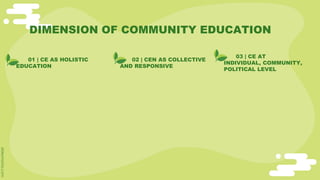
DIMENSION OF COMMUNITY EDUCATION
01 | CE AS HOLISTIC
EDUCATION
02 | CEN AS COLLECTIVE
AND RESPONSIVE
03 | CE AT
INDIVIDUAL, COMMUNITY,
POLITICAL LEVEL
The holistic nature of Community Education is such that the
program of learning being undertaken is merged into a
wider learning experience within a Community Education
group or center. The whole environment is learner rather
than curriculum centered, with specific attention being paid
to welcoming and supporting each participant.
COMMUNITY EDUCATIONN IS HOLISTIC EDUCATION
Community Education often caters to those for whom general
education is a step too far. It offers a non-threatening and non-
competitive environment for learners who feel alienated from
education because of a poor early experience or other reasons. It
provides the opportunity for adults to be involved in developing
programs to address the issues directly affecting their own lives.
Learner experiences are valued, and become a learning tool. The
power rests with the group, usually working in group sessions with a
facilitator who recognizes their experiences as a base for learning,
unlike the formal setting where a teacher holds power and learning
focuses on the individual acquisition of knowledge.
COMMUNITY EDUCATIONN AS COLLECTIVE AND RESPONSIVE
At individual level, there is learning, both in terms of the acquisition
of knowledge and skills, and more importantly in terms of confidence
and self-development. At group or community level, participants
develop their capacity to interact as a group, to work on local issues
that affect the group and to analyze their own and their community’s
situation. At a political level, the learning is used to form a sense of
solidarity with other groups in society who are experiencing the same
issues in their lives. There is learning about national policy issues
particularly in the realm of social justice. This may eventually lead to
active campaigning or support of national movements or lobby
groups. All levels are distinct and yet intertwined.
COMMUNITY EDUCATIONN WORKS AT INDIVIDUAL, COMMUNITY AND POLITICAL LEVELS
OUTCOMES OF COMMUNITY EDUCATION
● Individual Outcomes of Community Education include:
• Improved confidence & self-esteem
• Improved communication skills
• Improved ability to commit to and reach specific goals
• Increased knowledge, skill and competence
• Increased motivation and expectations
OUTCOMES OF COMMUNITY EDUCATION
● Individual Outcomes of Community Education include:
• Increased awareness of educational and life choices
• Awareness of self and community
• Critical thinking and analytical skills
• Accreditation
OUTCOMES OF COMMUNITY EDUCATION
● Collective Outcomes include:
• Development of a mutual support network
• Development of social consciousness and analysis
• Development of capacity to influence policy and decision-making
• Ability to organize further personal and group development
• Action to tackle social and community issues
ELEMENTS OF
COMMUNITY
EDUCATION
MODEL
OUTREACH WORK
Extensive personal outreach to, and development of contact
with, those in the community who might benefit from
participation in the group, and who may be quite alienated
from education for a variety of reasons. Non-threatening
approaches are used to build trust often over a considerable
period before the learner may decide to first come into a
group. Learners are also encouraged back no matter how
often they may leave a program or missed sessions.
CONSULTATION
The group identifies the issues
or content to be explored and
in co-operation with the
facilitator, develops a program
to meet its needs and
interests. Development with,
rather than delivery to learners,
is the approach used
PRE-DEVELOPMENT
Non-academic activities are undertaken
initially to help a group to bond, relax,
build confidence and begin to associate
learning with enjoyment. Crafts are often a
starting point for learners in this phase, as
are field trips or small social events.
Support needs can be identified at this
point.
FLEXIBLE PROVISION
Time, location and program
content in Community
Education are flexible and
learner centered.
POLITICAL ACTIVISM
As effecting change is at the heart of the
Community Education model, groups will
engage in activism at a variety of levels, through
both staff and learners, and will work towards
social justice where possible.
REFLECTIVE EVALUATION
Community Education groups reflect
critically on their work and program, to
ensure that their centre and program
evolve and develop good practices.
TO BE CONTINUE..
― Irene M. Pepperberg
Did you know?
Did you know that a cat uses its whiskers
as feelers to determine if a space is too
small to squeeze through?
Also, cats love to sleep. A fifteen-year-old
cat has probably spent ten years of its life
sleeping.
Did you know that dogs can smell your
feelings?
Dogs can pick up on subtle changes in
your scent, which can help him figure out
how you are feeling, such as by smelling
your perspiration when you become
nervous or fearful.
A fifteen-year-old cat has probably spent
ten years of its life sleeping.
Also, cats use their whiskers as feelers to
determine if a space is too small to squeeze
through.
CATS LOVE TO SLEEP
Very
interesting
facts!
This is where you section ends. Duplicate this set of slides as many times you need to go over all your sections.
Erika V. John S. Marie M.
This is our team.
Lorem ipsum dolor sit
amet, consectetuer
adipiscing elit. Aenean
commodo ligula eget
dolor.
Lorem ipsum dolor sit
amet, consectetuer
adipiscing elit. Aenean
commodo ligula eget
dolor.
Lorem ipsum dolor sit
amet, consectetuer
adipiscing elit. Aenean
commodo ligula eget
dolor.
And this is a timeline.
1999
Lorem ipsum
dolor sit amet,
consectetuer
adipiscing elit.
2005
Lorem ipsum
dolor sit amet,
consectetuer
adipiscing elit.
2015
Lorem ipsum
dolor sit amet,
consectetuer
adipiscing elit.
2019
2022
Lorem ipsum
dolor sit amet,
consectetuer
adipiscing elit.
Lorem ipsum
dolor sit amet,
consectetuer
adipiscing elit.
Presenting a
website or an app?
If you are presenting a website, an internet
product or an app, you can place a screenshot
of it here.
Presenting a
website or an app?
If you are presenting a website, an internet
product or an app, you can place a screenshot
of it here.
Thank you!
hello@mail.com
555-111-222
mydomain.com
Do you have any questions?
Certificate of Completion
Anna Smith.
You have successfully completed
This course.
Congratulations!
Date Signature
03/05/2023
Today is Monday April 17th.
Lorem ipsum dolor sit
amet, consectetuer
adipiscing elit.
Aenean commodo ligula
eget dolor.
Lorem ipsum dolor sit
amet, consectetuer
adipiscing elit.
Aenean commodo ligula
eget dolor. Aenean
massa.
Do the best you can until you know better.
Then when you know better, do better.
Something here.
Something else here
And a third thing here.
Duplicate the check
mark.
And the check boxes.
― Maya Angelou
ANNOUNCEMENTS QUOTE OF THE DAY CHECK LIST
WOULD YOU RATHER…
Credits.
Presentation Template: SlidesMania
Sample Images: Unsplash
Fonts used in this presentation: DM Sans
and Arial Black
Editable Icons
Free themes and templates for
Google Slides or PowerPoint
NOT to be sold as is or modified!
Read FAQ on slidesmania.com
Do not remove the slidesmania.com text on the sides.
Sharing is caring!

CET 1 PPT.pptx

  • 1.
    SOCIAL WORK COMMUNITY EDUCATIONAND TRAINING Prepared by: HASANIE M. ALI, RSW
  • 2.
    Community Education? According tothe White Paper 2000. (1) Sees it as education that takes place in the community but is not necessarily of the community. They sees Community Education as a system of provision within the community by a range of institutions including schools, training agencies, universities, churches and others who make premises and resources available locally and (2) The second ideologically based definition describes Community Education as a process of communal education towards empowerment, both at an individual and a collective level’
  • 3.
    � Community Educationis education and learning, which is rooted in a process of empowerment, social justice, change, challenge, respect and collective consciousness. It is within the community and of the community, reflecting the developing needs of individuals and their locale. It builds the capacity of local communities to engage in developing responses to educational and structural disadvantage and to take part in decision-making and policy- formation within community. It is distinct from general adult education provision, due both to its ethos and to the methodologies, it employs. (AONTAS 2000)
  • 4.
    Mainstream or formaleducation is passing through generation with the existing norms and structures of the society. Community Education has as its intention the empowerment of participants with the skills, knowledge and collective analysis to challenge oppression and to engage in action to bring about change. Although it can be said that Community Education sometimes fails to reach this level and that its transforming effects are limited, nonetheless it is underpinned by this radical theory. Traditional views of education place teachers and learners in a particular relationship, where the teacher holds the knowledge and power and decides what information the learner needs at any given time COMMUNITY EDUCATION AS A MODEL FOR TRANSFORMATION
  • 5.
    Power is sharedequally, and tutor and participant engage together in the education process. Participants identify what knowledge is most useful to them, and this agenda is pursued in a flexible, developmental way. At the more advanced level of the process, a critique of existing social structures can be achieved, and participants develop the capacity to engage in collective action for change. COMMUNITY EDUCATION MODEL
  • 6.
    DIMENSION OF COMMUNITYEDUCATION 01 | CE AS HOLISTIC EDUCATION 02 | CEN AS COLLECTIVE AND RESPONSIVE 03 | CE AT INDIVIDUAL, COMMUNITY, POLITICAL LEVEL
  • 7.
    The holistic natureof Community Education is such that the program of learning being undertaken is merged into a wider learning experience within a Community Education group or center. The whole environment is learner rather than curriculum centered, with specific attention being paid to welcoming and supporting each participant. COMMUNITY EDUCATIONN IS HOLISTIC EDUCATION
  • 8.
    Community Education oftencaters to those for whom general education is a step too far. It offers a non-threatening and non- competitive environment for learners who feel alienated from education because of a poor early experience or other reasons. It provides the opportunity for adults to be involved in developing programs to address the issues directly affecting their own lives. Learner experiences are valued, and become a learning tool. The power rests with the group, usually working in group sessions with a facilitator who recognizes their experiences as a base for learning, unlike the formal setting where a teacher holds power and learning focuses on the individual acquisition of knowledge. COMMUNITY EDUCATIONN AS COLLECTIVE AND RESPONSIVE
  • 9.
    At individual level,there is learning, both in terms of the acquisition of knowledge and skills, and more importantly in terms of confidence and self-development. At group or community level, participants develop their capacity to interact as a group, to work on local issues that affect the group and to analyze their own and their community’s situation. At a political level, the learning is used to form a sense of solidarity with other groups in society who are experiencing the same issues in their lives. There is learning about national policy issues particularly in the realm of social justice. This may eventually lead to active campaigning or support of national movements or lobby groups. All levels are distinct and yet intertwined. COMMUNITY EDUCATIONN WORKS AT INDIVIDUAL, COMMUNITY AND POLITICAL LEVELS
  • 10.
    OUTCOMES OF COMMUNITYEDUCATION ● Individual Outcomes of Community Education include: • Improved confidence & self-esteem • Improved communication skills • Improved ability to commit to and reach specific goals • Increased knowledge, skill and competence • Increased motivation and expectations
  • 11.
    OUTCOMES OF COMMUNITYEDUCATION ● Individual Outcomes of Community Education include: • Increased awareness of educational and life choices • Awareness of self and community • Critical thinking and analytical skills • Accreditation
  • 12.
    OUTCOMES OF COMMUNITYEDUCATION ● Collective Outcomes include: • Development of a mutual support network • Development of social consciousness and analysis • Development of capacity to influence policy and decision-making • Ability to organize further personal and group development • Action to tackle social and community issues
  • 13.
  • 14.
    OUTREACH WORK Extensive personaloutreach to, and development of contact with, those in the community who might benefit from participation in the group, and who may be quite alienated from education for a variety of reasons. Non-threatening approaches are used to build trust often over a considerable period before the learner may decide to first come into a group. Learners are also encouraged back no matter how often they may leave a program or missed sessions.
  • 15.
    CONSULTATION The group identifiesthe issues or content to be explored and in co-operation with the facilitator, develops a program to meet its needs and interests. Development with, rather than delivery to learners, is the approach used
  • 16.
    PRE-DEVELOPMENT Non-academic activities areundertaken initially to help a group to bond, relax, build confidence and begin to associate learning with enjoyment. Crafts are often a starting point for learners in this phase, as are field trips or small social events. Support needs can be identified at this point.
  • 17.
    FLEXIBLE PROVISION Time, locationand program content in Community Education are flexible and learner centered.
  • 18.
    POLITICAL ACTIVISM As effectingchange is at the heart of the Community Education model, groups will engage in activism at a variety of levels, through both staff and learners, and will work towards social justice where possible.
  • 19.
    REFLECTIVE EVALUATION Community Educationgroups reflect critically on their work and program, to ensure that their centre and program evolve and develop good practices.
  • 20.
    TO BE CONTINUE.. ―Irene M. Pepperberg
  • 21.
    Did you know? Didyou know that a cat uses its whiskers as feelers to determine if a space is too small to squeeze through? Also, cats love to sleep. A fifteen-year-old cat has probably spent ten years of its life sleeping. Did you know that dogs can smell your feelings? Dogs can pick up on subtle changes in your scent, which can help him figure out how you are feeling, such as by smelling your perspiration when you become nervous or fearful.
  • 22.
    A fifteen-year-old cathas probably spent ten years of its life sleeping. Also, cats use their whiskers as feelers to determine if a space is too small to squeeze through. CATS LOVE TO SLEEP
  • 23.
    Very interesting facts! This is whereyou section ends. Duplicate this set of slides as many times you need to go over all your sections.
  • 24.
    Erika V. JohnS. Marie M. This is our team. Lorem ipsum dolor sit amet, consectetuer adipiscing elit. Aenean commodo ligula eget dolor. Lorem ipsum dolor sit amet, consectetuer adipiscing elit. Aenean commodo ligula eget dolor. Lorem ipsum dolor sit amet, consectetuer adipiscing elit. Aenean commodo ligula eget dolor.
  • 25.
    And this isa timeline. 1999 Lorem ipsum dolor sit amet, consectetuer adipiscing elit. 2005 Lorem ipsum dolor sit amet, consectetuer adipiscing elit. 2015 Lorem ipsum dolor sit amet, consectetuer adipiscing elit. 2019 2022 Lorem ipsum dolor sit amet, consectetuer adipiscing elit. Lorem ipsum dolor sit amet, consectetuer adipiscing elit.
  • 26.
    Presenting a website oran app? If you are presenting a website, an internet product or an app, you can place a screenshot of it here.
  • 27.
    Presenting a website oran app? If you are presenting a website, an internet product or an app, you can place a screenshot of it here.
  • 28.
  • 29.
    Certificate of Completion AnnaSmith. You have successfully completed This course. Congratulations! Date Signature 03/05/2023
  • 30.
    Today is MondayApril 17th. Lorem ipsum dolor sit amet, consectetuer adipiscing elit. Aenean commodo ligula eget dolor. Lorem ipsum dolor sit amet, consectetuer adipiscing elit. Aenean commodo ligula eget dolor. Aenean massa. Do the best you can until you know better. Then when you know better, do better. Something here. Something else here And a third thing here. Duplicate the check mark. And the check boxes. ― Maya Angelou ANNOUNCEMENTS QUOTE OF THE DAY CHECK LIST WOULD YOU RATHER…
  • 31.
    Credits. Presentation Template: SlidesMania SampleImages: Unsplash Fonts used in this presentation: DM Sans and Arial Black
  • 32.
  • 33.
    Free themes andtemplates for Google Slides or PowerPoint NOT to be sold as is or modified! Read FAQ on slidesmania.com Do not remove the slidesmania.com text on the sides. Sharing is caring!