Justifying war
THREE BROAD JUSTIFICATIONS:
 REALPOLITIK: NEEDS NO MORAL JUSTIFICATION
 JUST WAR THEORY: ONLY IF IT CONFORMS TO MORAL JUSTIFICATIONS
 PACIFISM: CAN NEVER BE JUSTIFIED
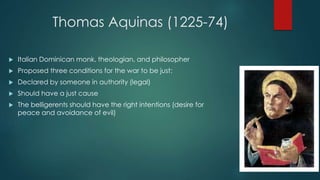
Thomas Aquinas (1225-74)
 Italian Dominican monk, theologian, and philosopher
 Proposed three conditions for the war to be just:
 Declared by someone in authority (legal)
 Should have a just cause
 The belligerents should have the right intentions (desire for
peace and avoidance of evil)
Realpolitik
 War and peace are beyond morality and should be determined by
pusuit of national interests
 Peace is temporary, but war is perpetual
 Innate human aggression and mismatch between unlimited human
apetite and scarce resources
 Not warmongers, but believe that it’s ‘better to be hard-headed
than be wrong-headed’ (Appeasement)
 Moral relativists rather than ‘amoral’
 Have been criticised for their narrow approach to marality and
human ethics
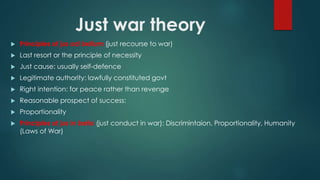
Just war theory
 Principles of jus ad bellum (just recourse to war)
 Last resort or the principle of necessity
 Just cause: usually self-defence
 Legitimate authority: lawfully constituted govt
 Right intention: for peace rather than revenge
 Reasonable prospect of success:
 Proportionality
 Principles of jus in bello (just conduct in war): Discrimintaion, Proportionality, Humanity
(Laws of War)
Just war contd....
 Stands between Realpolitik and pacifism
 Cicero, Thomas Aquinas, Hugo Grotius, etc
 2 assumptions: Human nature is mix of good and evil; war can be subjected to
moral constraints
 Limitation: Should a war satisfy ALL the conditions of jus ad bellum and jus ad bello
to be called a just war? Is there a hierarchy within those principles? Which is
more/most important? Practical difficulties in applying these principles to real life
situations. Makes sense when both parties share moral and cultural beliefs
 Questions for discussion in class: Considering the principles
of jus ad bellum and jus ad bello, do you think that WW2
was a just war? Is the ‘war on terror’ a just war?
World War 2: A just war???
Yes No
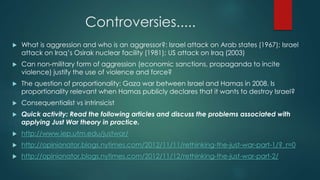
Controversies.....
 What is aggression and who is an aggressor?: Israel attack on Arab states (1967); Israel
attack on Iraq’s Osirak nuclear facility (1981); US attack on Iraq (2003)
 Can non-military form of aggression (economic sanctions, propaganda to incite
violence) justify the use of violence and force?
 The question of proportionality: Gaza war between Israel and Hamas in 2008. Is
proportionality relevant when Hamas publicly declares that it wants to destroy Israel?
 Consequentialist vs intrinsicist
 Quick activity: Read the following articles and discuss the problems associated with
applying Just War theory in practice.
 http://www.iep.utm.edu/justwar/
 http://opinionator.blogs.nytimes.com/2012/11/11/rethinking-the-just-war-part-1/?_r=0
 http://opinionator.blogs.nytimes.com/2012/11/12/rethinking-the-just-war-part-2/
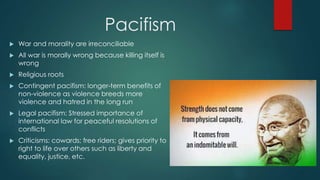
Pacifism
 War and morality are irreconciliable
 All war is morally wrong because killing itself is
wrong
 Religious roots
 Contingent pacifism: longer-term benefits of
non-violence as violence breeds more
violence and hatred in the long run
 Legal pacifism: Stressed importance of
international law for peaceful resolutions of
conflicts
 Criticisms: cowards; free riders; gives priority to
right to life over others such as liberty and
equality, justice, etc.

Justifying war

  • 1.
    Justifying war THREE BROADJUSTIFICATIONS:  REALPOLITIK: NEEDS NO MORAL JUSTIFICATION  JUST WAR THEORY: ONLY IF IT CONFORMS TO MORAL JUSTIFICATIONS  PACIFISM: CAN NEVER BE JUSTIFIED
  • 2.
    Thomas Aquinas (1225-74) Italian Dominican monk, theologian, and philosopher  Proposed three conditions for the war to be just:  Declared by someone in authority (legal)  Should have a just cause  The belligerents should have the right intentions (desire for peace and avoidance of evil)
  • 3.
    Realpolitik  War andpeace are beyond morality and should be determined by pusuit of national interests  Peace is temporary, but war is perpetual  Innate human aggression and mismatch between unlimited human apetite and scarce resources  Not warmongers, but believe that it’s ‘better to be hard-headed than be wrong-headed’ (Appeasement)  Moral relativists rather than ‘amoral’  Have been criticised for their narrow approach to marality and human ethics
  • 4.
    Just war theory Principles of jus ad bellum (just recourse to war)  Last resort or the principle of necessity  Just cause: usually self-defence  Legitimate authority: lawfully constituted govt  Right intention: for peace rather than revenge  Reasonable prospect of success:  Proportionality  Principles of jus in bello (just conduct in war): Discrimintaion, Proportionality, Humanity (Laws of War)
  • 5.
    Just war contd.... Stands between Realpolitik and pacifism  Cicero, Thomas Aquinas, Hugo Grotius, etc  2 assumptions: Human nature is mix of good and evil; war can be subjected to moral constraints  Limitation: Should a war satisfy ALL the conditions of jus ad bellum and jus ad bello to be called a just war? Is there a hierarchy within those principles? Which is more/most important? Practical difficulties in applying these principles to real life situations. Makes sense when both parties share moral and cultural beliefs  Questions for discussion in class: Considering the principles of jus ad bellum and jus ad bello, do you think that WW2 was a just war? Is the ‘war on terror’ a just war?
  • 6.
    World War 2:A just war??? Yes No
  • 7.
    Controversies.....  What isaggression and who is an aggressor?: Israel attack on Arab states (1967); Israel attack on Iraq’s Osirak nuclear facility (1981); US attack on Iraq (2003)  Can non-military form of aggression (economic sanctions, propaganda to incite violence) justify the use of violence and force?  The question of proportionality: Gaza war between Israel and Hamas in 2008. Is proportionality relevant when Hamas publicly declares that it wants to destroy Israel?  Consequentialist vs intrinsicist  Quick activity: Read the following articles and discuss the problems associated with applying Just War theory in practice.  http://www.iep.utm.edu/justwar/  http://opinionator.blogs.nytimes.com/2012/11/11/rethinking-the-just-war-part-1/?_r=0  http://opinionator.blogs.nytimes.com/2012/11/12/rethinking-the-just-war-part-2/
  • 8.
    Pacifism  War andmorality are irreconciliable  All war is morally wrong because killing itself is wrong  Religious roots  Contingent pacifism: longer-term benefits of non-violence as violence breeds more violence and hatred in the long run  Legal pacifism: Stressed importance of international law for peaceful resolutions of conflicts  Criticisms: cowards; free riders; gives priority to right to life over others such as liberty and equality, justice, etc.