Word and its
semantic
structure
The notion of semasiology
Semasiology is a branch of linguistics which studies meaning.
The semantic structure of word is one of the main objects of
semasiology.
Word is a single distinct meaningful element of speech or writing used
to form a sentence.
There are two levels of meaning study:
• Syntagmatic level
The semantic structure of the word is analysed in its linear relationships
with neighbouring words in connected speech.
• Paradigmatic level
The word is studied in its relationships with other words in the
vocabulary system.
Most English words are polysemantic: they have several meanings which
allow them to enhance the expressive potential of the language.
Analysis of polysemantic words
There are two levels of analysis of words semantic structure:
1. The semantic structure of a word is treated as a system of meanings,
for example:

2. The semantic structure of semantic components within each separate
meaning is under research.
For a monosemantic word (i.e. a word with one meaning) the first
level is naturally excluded.
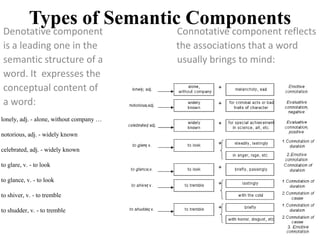
Types of Semantic Components

Denotative component
is a leading one in the
semantic structure of a
word. It expresses the
conceptual content of
a word:
lonely, adj. - alone, without company …
notorious, adj. - widely known
celebrated, adj. - widely known
to glare, v. - to look
to glance, v. - to look
to shiver, v. - to tremble
to shudder, v. - to tremble

Connotative component reflects
the associations that a word
usually brings to mind:
Meaning and Context
Sometimes a polysemantic word is used in a certain meaning but
accepted by a listener or reader in another. It is context which allows to
avoid such misunderstanding. Sometimes a minimum context fails to
reveal the meaning of the word, for example in the sentence “The man
was large, but his wife was even fatter”. The word “fatter” here serves
as a kind of indicator pointing that “large” describes a stout man and not
a big one.
One of the more promising methods of investigating the semantic
structure of a word is by studying the word's linear relationships with
other words in typical contexts, i. e. its combinability or collocability.
It’s a common error to see a different meaning in every new set of
combinations. Actually, words can realize the same meanings in
different sets, for example, in the pairs “merry children”, “merry
laughter”, “merry faces”, “merry songs” the adjective “merry” conveys
the same concept of high spirits.

Word and its semantic structure

  • 1.
  • 2.
    The notion ofsemasiology Semasiology is a branch of linguistics which studies meaning. The semantic structure of word is one of the main objects of semasiology. Word is a single distinct meaningful element of speech or writing used to form a sentence. There are two levels of meaning study: • Syntagmatic level The semantic structure of the word is analysed in its linear relationships with neighbouring words in connected speech. • Paradigmatic level The word is studied in its relationships with other words in the vocabulary system. Most English words are polysemantic: they have several meanings which allow them to enhance the expressive potential of the language.
  • 3.
    Analysis of polysemanticwords There are two levels of analysis of words semantic structure: 1. The semantic structure of a word is treated as a system of meanings, for example: 2. The semantic structure of semantic components within each separate meaning is under research. For a monosemantic word (i.e. a word with one meaning) the first level is naturally excluded.
  • 4.
    Types of SemanticComponents Denotative component is a leading one in the semantic structure of a word. It expresses the conceptual content of a word: lonely, adj. - alone, without company … notorious, adj. - widely known celebrated, adj. - widely known to glare, v. - to look to glance, v. - to look to shiver, v. - to tremble to shudder, v. - to tremble Connotative component reflects the associations that a word usually brings to mind:
  • 5.
    Meaning and Context Sometimesa polysemantic word is used in a certain meaning but accepted by a listener or reader in another. It is context which allows to avoid such misunderstanding. Sometimes a minimum context fails to reveal the meaning of the word, for example in the sentence “The man was large, but his wife was even fatter”. The word “fatter” here serves as a kind of indicator pointing that “large” describes a stout man and not a big one. One of the more promising methods of investigating the semantic structure of a word is by studying the word's linear relationships with other words in typical contexts, i. e. its combinability or collocability. It’s a common error to see a different meaning in every new set of combinations. Actually, words can realize the same meanings in different sets, for example, in the pairs “merry children”, “merry laughter”, “merry faces”, “merry songs” the adjective “merry” conveys the same concept of high spirits.