16/6/15
Optimised Rear Twist Beam Design
Altair Conference
1©2015 GESTAMP
Gestamp Global Locations
Optimized Rear Twist Beam Design
2©2015 GESTAMP
Gestamp Chassis Products
Optimization based Chassis Design
3©2015 GESTAMP
RTB Suspension System
Rigid trailing
arms/side rails with
Body Mounts
Torsion Element
Optimized Rear Twist Beam Design
Reinforcer
Image from Wikipedia
4©2015 GESTAMP
Optimized Rear Twist Beam Design
Advantages of RTB Rear Suspension
Image from a2mac1.com
5©2015 GESTAMP
Optimized Rear Twist Beam Design
Several interlinked targets, which depend on
shape, position and gauge of structural
members
6©2015 GESTAMP
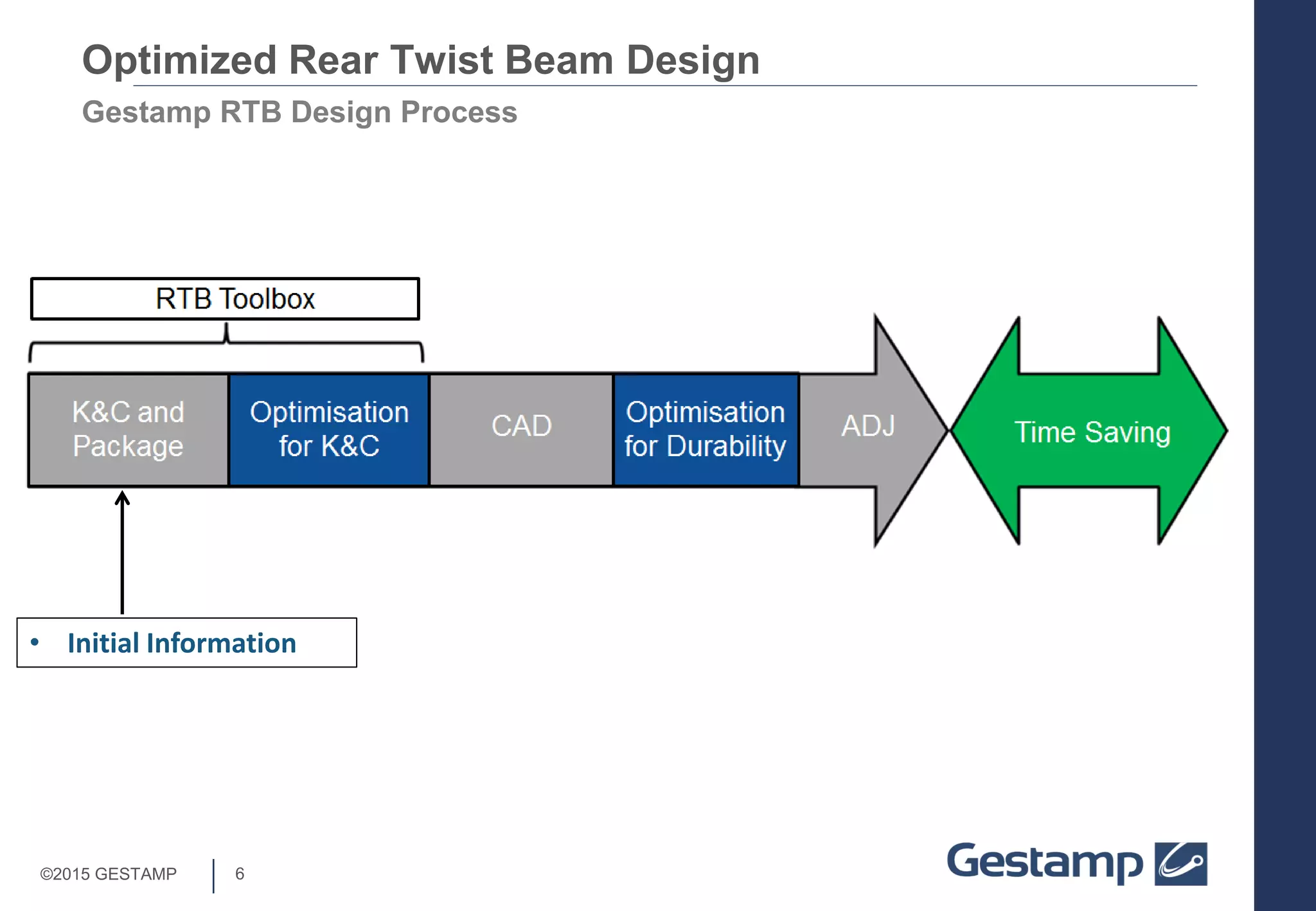
Gestamp RTB Design Process
• Initial Information
Optimized Rear Twist Beam Design
7©2015 GESTAMP
Key Inputs Defining Basic RTB Geometry
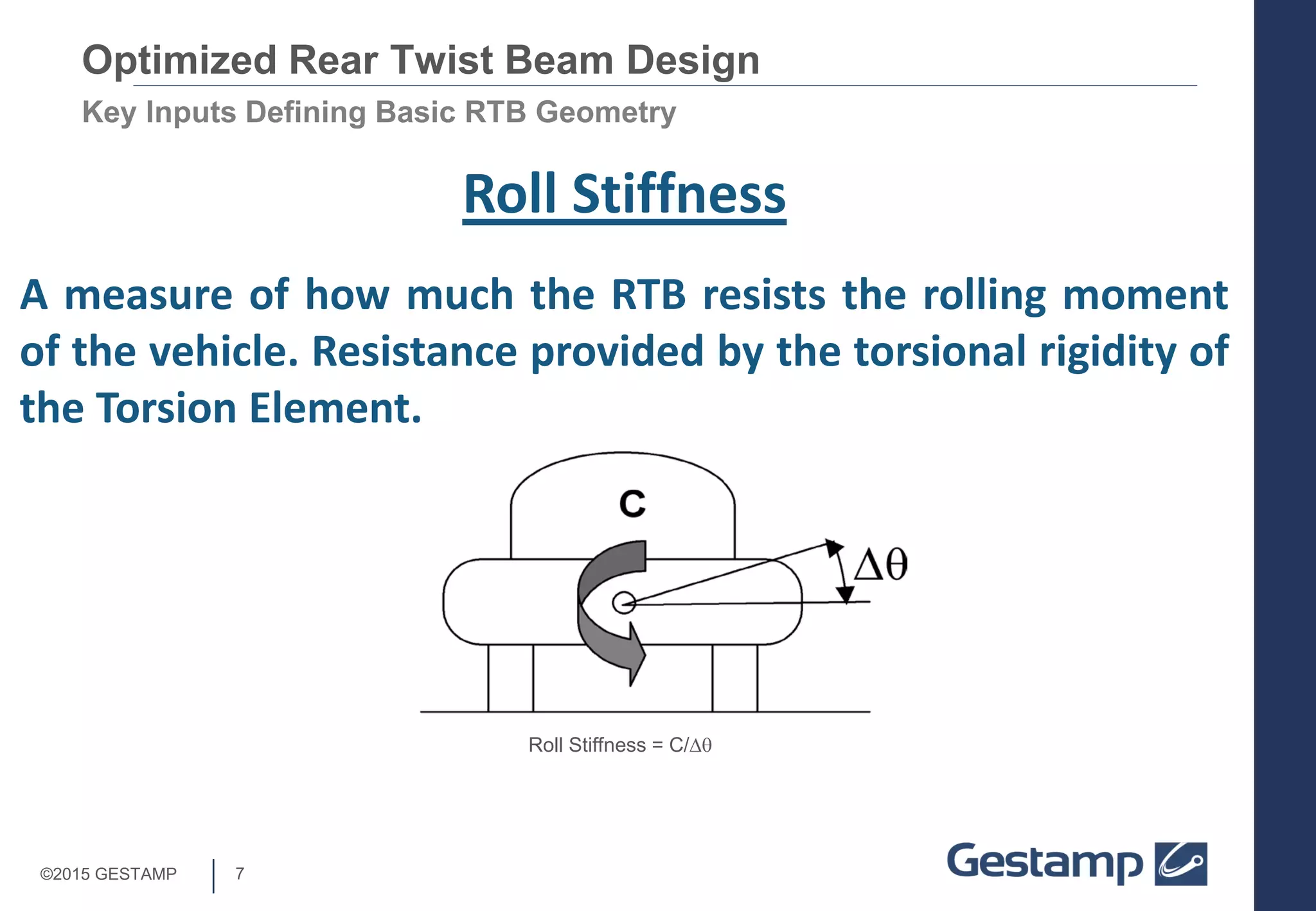
Roll Stiffness = C/∆θ
Optimized Rear Twist Beam Design
Roll Stiffness
A measure of how much the RTB resists the rolling moment
of the vehicle. Resistance provided by the torsional rigidity of
the Torsion Element.
8©2015 GESTAMP
Key Inputs Defining Basic RTB Geometry
Optimized Rear Twist Beam Design
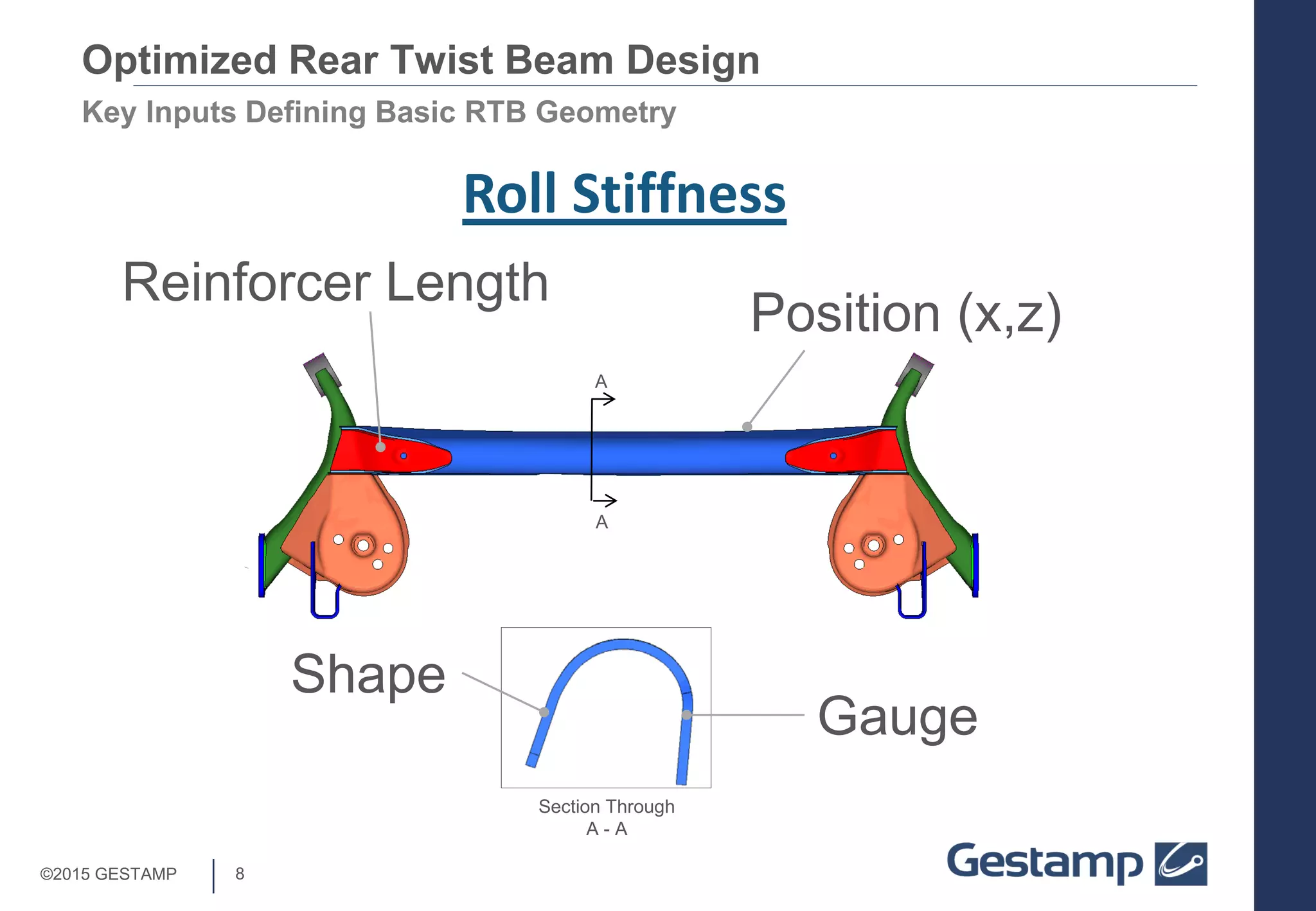
Roll Stiffness
A
A
Section Through
A - A
Position (x,z)
Shape
Gauge
Reinforcer Length
9©2015 GESTAMP
Key Inputs Defining Basic RTB Geometry
Optimized Rear Twist Beam Design
Roll Steer
Steer angle change of rear wheels during vehicle
cornering. This can be used to generate “Roll Understeer”.
Turn Direction
10©2015 GESTAMP
Key Inputs Defining Basic RTB Geometry
Optimized Rear Twist Beam Design
A
A
Section Through
A - A
Position (x,z)
Shape
Roll Steer
Gauge
11©2015 GESTAMP
Key Inputs Defining Basic RTB Geometry
Optimized Rear Twist Beam Design
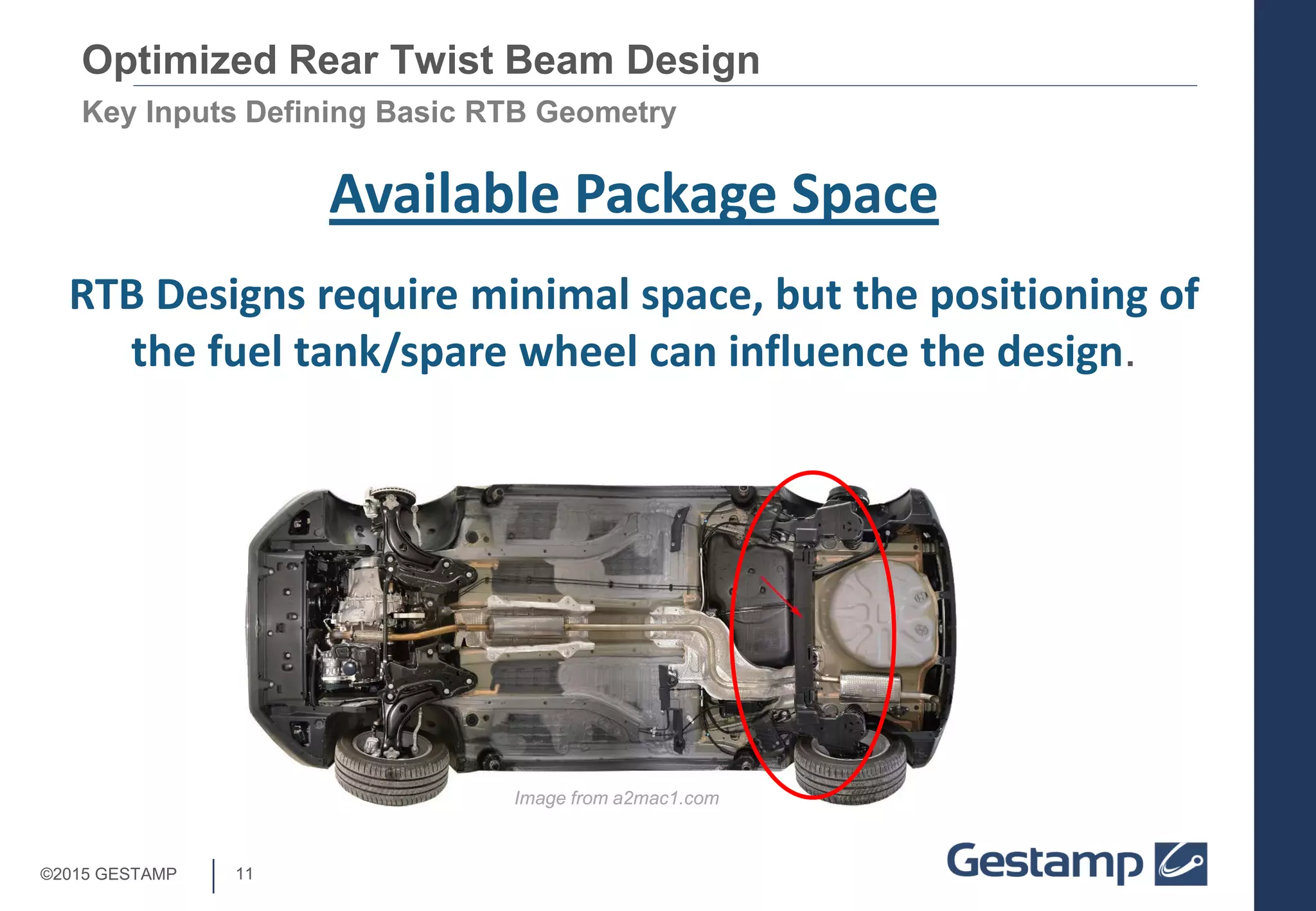
Available Package Space
RTB Designs require minimal space, but the positioning of
the fuel tank/spare wheel can influence the design.
Image from a2mac1.com
12©2015 GESTAMP
Optimized Rear Twist Beam Design
Gestamp have worked with Altair to develop
a method of quickly producing RTB concept
designs which meet K&C and package
requirements.
13©2015 GESTAMP
RTB Toolbox
Optimized Rear Twist Beam Design
Optimisation
14©2015 GESTAMP
RTB Toolbox
DOE sensitivity study
Optimized Rear Twist Beam Design
Optimisation
Design Variables
15©2015 GESTAMP
Gestamp RTB Design Process
• Initial “Trial and Error” CAD loop
eliminated.
Optimized Rear Twist Beam Design
16©2015 GESTAMP
Optimized Rear Twist Beam Design
Next Design Stage: Optimisation for Antiphase Durability Target
17©2015 GESTAMP
Target Conflict: Roll Stiffness and Antiphase Durability
There is a relationship between the Roll Stiffness and Fatigue Life for the Antiphase Durability
Load Case.
Long Reinforcer
Thin Gauge Torsion Element
Short Reinforcer
Thick Gauge Torsion Element
Mass
Stress
z
y
Optimized Rear Twist Beam Design
18©2015 GESTAMP
Optimized Rear Twist Beam Design
There is an optimum combination of
reinforcer length and torsion element gauge
for a given Roll Stiffness and Fatigue
requirement.
19©2015 GESTAMP
Optimisation of Basic Concept
Optimized Rear Twist Beam Design
VARIABLES Length and profile of reinforcer
SectionGauge
OBJECTIVE
20©2015 GESTAMP
Optimized Rear Twist Beam Design
21©2015 GESTAMP
Optimized Rear Twist Beam Design
22©2015 GESTAMP
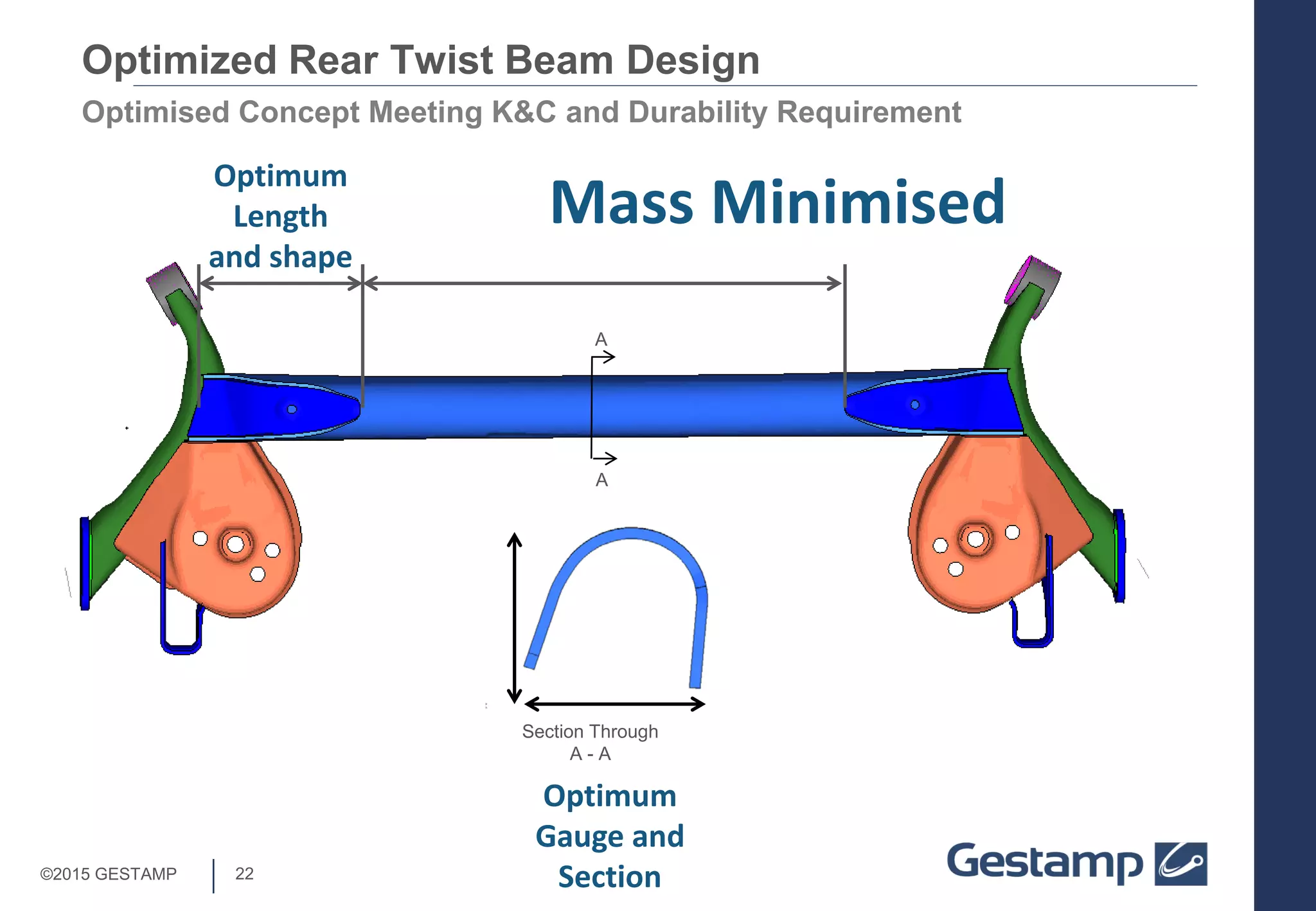
Optimised Concept Meeting K&C and Durability Requirement
Optimum
Length
and shape
Optimum
Gauge and
Section
Optimized Rear Twist Beam Design
Mass Minimised
A
A
Section Through
A - A
23©2015 GESTAMP
Gestamp RTB Design Process
Basic Design complete
Optimized Rear Twist Beam Design
24©2015 GESTAMP
40mm Antiphase Rolling Load Case -
Von Mises Stress (MPa)
Local Shape Optimisation for Stress Reduction
Optimized Rear Twist Beam Design
Max = 295MPa
25©2015 GESTAMP
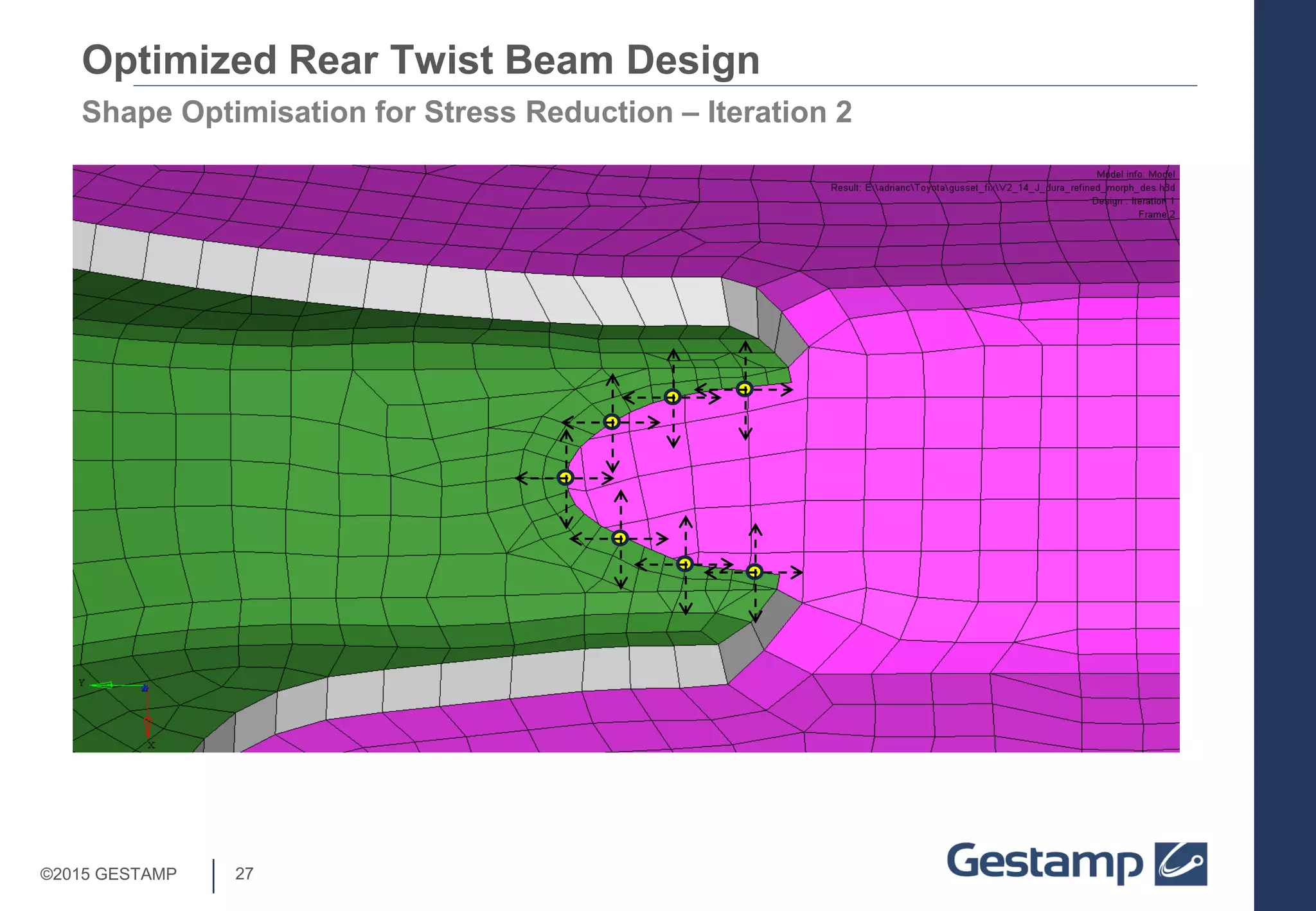
Moveable control point defining edge shape
• Variables - xy grid co-ordinates of 7control
points defining a curve.
• Constraints - Don’t move too far (within bounds of
feasible design)
• Objective - minimize the maximum stress in any
of the measured elements
Record stress in edge elements
Shape Optimisation for Stress Reduction
Optimized Rear Twist Beam Design
26©2015 GESTAMP
Moveable control point defining edge shape
Shape Optimisation for Stress Reduction – Iteration 1
Optimized Rear Twist Beam Design
27©2015 GESTAMP
Shape Optimisation for Stress Reduction – Iteration 2
Optimized Rear Twist Beam Design
28©2015 GESTAMP
Shape Optimisation for Stress Reduction – Iteration 3
Optimized Rear Twist Beam Design
29©2015 GESTAMP
Shape Optimisation for Stress Reduction – Iteration 5
Optimized Rear Twist Beam Design
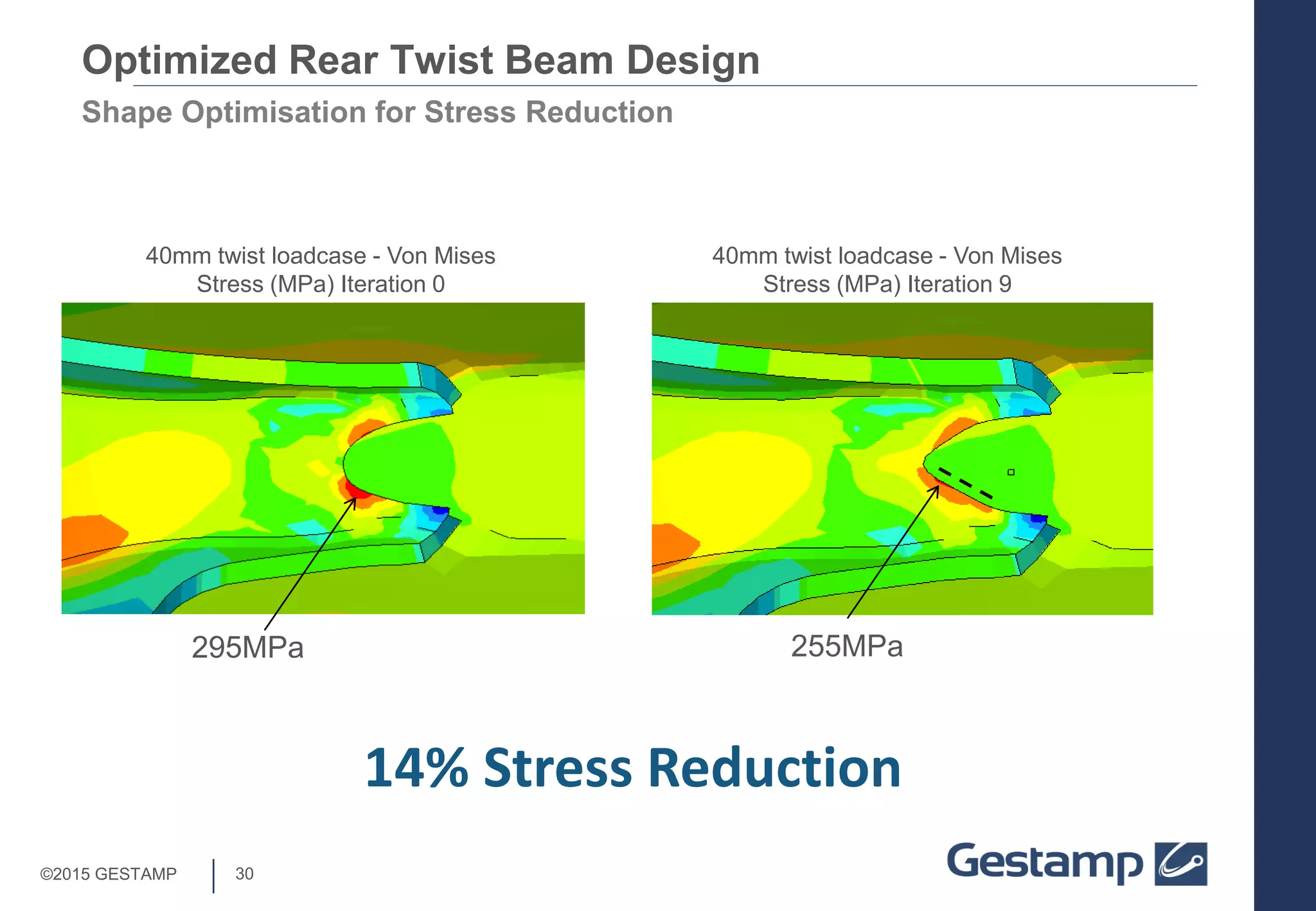
30©2015 GESTAMP
295MPa
40mm twist loadcase - Von Mises
Stress (MPa) Iteration 0
40mm twist loadcase - Von Mises
Stress (MPa) Iteration 9
295MPa 255MPa
Shape Optimisation for Stress Reduction
Optimized Rear Twist Beam Design
14% Stress Reduction
31©2015 GESTAMP
Gestamp RTB Design Process
Benefit of using an Optimisation led
approach
Optimized Rear Twist Beam Design
Typical RTB Design Process
32©2015 GESTAMP
Conclusions
Optimized Rear Twist Beam Design
• This design process has allowed Gestamp to react quickly and
produce competitive, low cost, low mass designs
for RTB suspension systems.
• Gestamp have recognised the potential for mass reduction
through optimisation of the U section design.
©2013 GESTAMP AUTOMOCIÓN
Optimised Rear Twist Beam Design
16/06/15
A Charlesworth

UK ATC 2015: Optimised Rear Twist Beam Design

  • 1.
    16/6/15 Optimised Rear TwistBeam Design Altair Conference
  • 2.
    1©2015 GESTAMP Gestamp GlobalLocations Optimized Rear Twist Beam Design
  • 3.
    2©2015 GESTAMP Gestamp ChassisProducts Optimization based Chassis Design
  • 4.
    3©2015 GESTAMP RTB SuspensionSystem Rigid trailing arms/side rails with Body Mounts Torsion Element Optimized Rear Twist Beam Design Reinforcer Image from Wikipedia
  • 5.
    4©2015 GESTAMP Optimized RearTwist Beam Design Advantages of RTB Rear Suspension Image from a2mac1.com
  • 6.
    5©2015 GESTAMP Optimized RearTwist Beam Design Several interlinked targets, which depend on shape, position and gauge of structural members
  • 7.
    6©2015 GESTAMP Gestamp RTBDesign Process • Initial Information Optimized Rear Twist Beam Design
  • 8.
    7©2015 GESTAMP Key InputsDefining Basic RTB Geometry Roll Stiffness = C/∆θ Optimized Rear Twist Beam Design Roll Stiffness A measure of how much the RTB resists the rolling moment of the vehicle. Resistance provided by the torsional rigidity of the Torsion Element.
  • 9.
    8©2015 GESTAMP Key InputsDefining Basic RTB Geometry Optimized Rear Twist Beam Design Roll Stiffness A A Section Through A - A Position (x,z) Shape Gauge Reinforcer Length
  • 10.
    9©2015 GESTAMP Key InputsDefining Basic RTB Geometry Optimized Rear Twist Beam Design Roll Steer Steer angle change of rear wheels during vehicle cornering. This can be used to generate “Roll Understeer”. Turn Direction
  • 11.
    10©2015 GESTAMP Key InputsDefining Basic RTB Geometry Optimized Rear Twist Beam Design A A Section Through A - A Position (x,z) Shape Roll Steer Gauge
  • 12.
    11©2015 GESTAMP Key InputsDefining Basic RTB Geometry Optimized Rear Twist Beam Design Available Package Space RTB Designs require minimal space, but the positioning of the fuel tank/spare wheel can influence the design. Image from a2mac1.com
  • 13.
    12©2015 GESTAMP Optimized RearTwist Beam Design Gestamp have worked with Altair to develop a method of quickly producing RTB concept designs which meet K&C and package requirements.
  • 14.
    13©2015 GESTAMP RTB Toolbox OptimizedRear Twist Beam Design Optimisation
  • 15.
    14©2015 GESTAMP RTB Toolbox DOEsensitivity study Optimized Rear Twist Beam Design Optimisation Design Variables
  • 16.
    15©2015 GESTAMP Gestamp RTBDesign Process • Initial “Trial and Error” CAD loop eliminated. Optimized Rear Twist Beam Design
  • 17.
    16©2015 GESTAMP Optimized RearTwist Beam Design Next Design Stage: Optimisation for Antiphase Durability Target
  • 18.
    17©2015 GESTAMP Target Conflict:Roll Stiffness and Antiphase Durability There is a relationship between the Roll Stiffness and Fatigue Life for the Antiphase Durability Load Case. Long Reinforcer Thin Gauge Torsion Element Short Reinforcer Thick Gauge Torsion Element Mass Stress z y Optimized Rear Twist Beam Design
  • 19.
    18©2015 GESTAMP Optimized RearTwist Beam Design There is an optimum combination of reinforcer length and torsion element gauge for a given Roll Stiffness and Fatigue requirement.
  • 20.
    19©2015 GESTAMP Optimisation ofBasic Concept Optimized Rear Twist Beam Design VARIABLES Length and profile of reinforcer SectionGauge OBJECTIVE
  • 21.
  • 22.
  • 23.
    22©2015 GESTAMP Optimised ConceptMeeting K&C and Durability Requirement Optimum Length and shape Optimum Gauge and Section Optimized Rear Twist Beam Design Mass Minimised A A Section Through A - A
  • 24.
    23©2015 GESTAMP Gestamp RTBDesign Process Basic Design complete Optimized Rear Twist Beam Design
  • 25.
    24©2015 GESTAMP 40mm AntiphaseRolling Load Case - Von Mises Stress (MPa) Local Shape Optimisation for Stress Reduction Optimized Rear Twist Beam Design Max = 295MPa
  • 26.
    25©2015 GESTAMP Moveable controlpoint defining edge shape • Variables - xy grid co-ordinates of 7control points defining a curve. • Constraints - Don’t move too far (within bounds of feasible design) • Objective - minimize the maximum stress in any of the measured elements Record stress in edge elements Shape Optimisation for Stress Reduction Optimized Rear Twist Beam Design
  • 27.
    26©2015 GESTAMP Moveable controlpoint defining edge shape Shape Optimisation for Stress Reduction – Iteration 1 Optimized Rear Twist Beam Design
  • 28.
    27©2015 GESTAMP Shape Optimisationfor Stress Reduction – Iteration 2 Optimized Rear Twist Beam Design
  • 29.
    28©2015 GESTAMP Shape Optimisationfor Stress Reduction – Iteration 3 Optimized Rear Twist Beam Design
  • 30.
    29©2015 GESTAMP Shape Optimisationfor Stress Reduction – Iteration 5 Optimized Rear Twist Beam Design
  • 31.
    30©2015 GESTAMP 295MPa 40mm twistloadcase - Von Mises Stress (MPa) Iteration 0 40mm twist loadcase - Von Mises Stress (MPa) Iteration 9 295MPa 255MPa Shape Optimisation for Stress Reduction Optimized Rear Twist Beam Design 14% Stress Reduction
  • 32.
    31©2015 GESTAMP Gestamp RTBDesign Process Benefit of using an Optimisation led approach Optimized Rear Twist Beam Design Typical RTB Design Process
  • 33.
    32©2015 GESTAMP Conclusions Optimized RearTwist Beam Design • This design process has allowed Gestamp to react quickly and produce competitive, low cost, low mass designs for RTB suspension systems. • Gestamp have recognised the potential for mass reduction through optimisation of the U section design.
  • 34.
    ©2013 GESTAMP AUTOMOCIÓN OptimisedRear Twist Beam Design 16/06/15 A Charlesworth