REPRODUCTIONREPRODUCTION
UNIT 3
NATURAL SCIENCE
UNIT 3
NATURAL SCIENCE
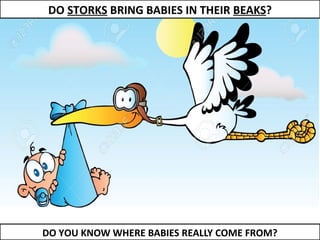
DO YOU KNOW WHERE BABIES REALLY COME FROM?
DO STORKS BRING BABIES IN THEIR BEAKS?
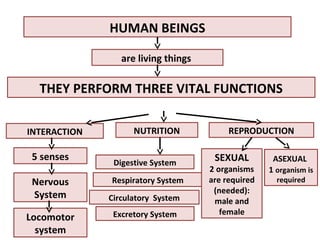
HUMAN BEINGS
are living things
THEY PERFORM THREE VITAL FUNCTIONS
INTERACTION REPRODUCTIONNUTRITION
5 senses
Nervous
System
Locomotor
system
Digestive System
Respiratory System
Circulatory System
Excretory System
SEXUAL
2 organisms
are required
(needed):
male and
female
ASEXUAL
1 organism is
required
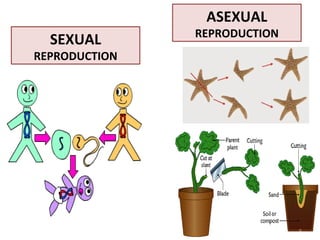
SEXUAL
REPRODUCTION
ASEXUAL
REPRODUCTION
Reproduction
It is the third vital function
The process by which living things generate or produce
new living things (offspring/children/descendants) so
they cannot become extinct.
The process by which living things generate or produce
new living things (offspring/children/descendants) so
they cannot become extinct.
Human being performs a sexual reproduction
(a male and a female are required/needed)
Human being performs a sexual reproduction
(a male and a female are required/needed)
REPRODUCTION
• What kind of reproduction do human beingsperform?
• What is the meaning ofsperm?
• How do you call the female reproductive cell?
• What happen when sperm andovum meet?
• How doesthe zygote progress/change to?
• How do you call the stage between childhood and adulthood?
• What happen intheadolescence?
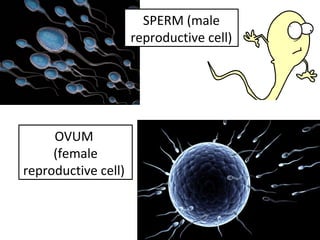
SPERM (male
reproductive cell)
OVUM
(female
reproductive cell)
PREBIRTH
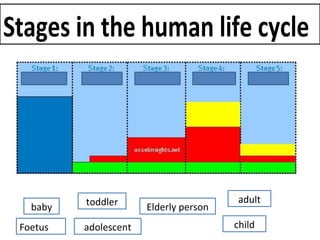
Stages in the human life cycle
baby toddler
child
adult
adolescent
Elderly person
Foetus
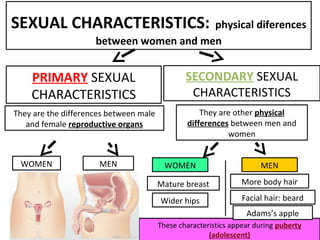
SEXUAL CHARACTERISTICS: physical diferences
between women and men
PRIMARY SEXUAL
CHARACTERISTICS
SECONDARY SEXUAL
CHARACTERISTICS
They are other physical
differences between men and
women
Wider hips
More body hair
WOMEN MEN
These characteristics appear during puberty
(adolescent)
WOMEN MEN
Facial hair: beard
Adams’s apple
Mature breast
They are the differences between male
and female reproductive organs
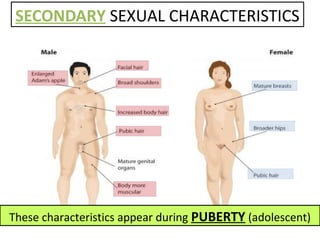
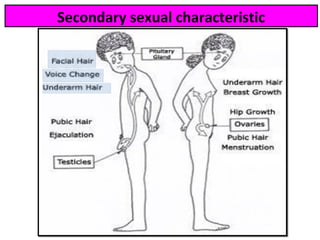
SECONDARY SEXUAL CHARACTERISTICS
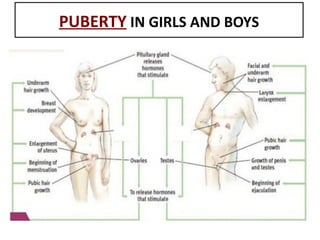
These characteristics appear during PUBERTY (adolescent)
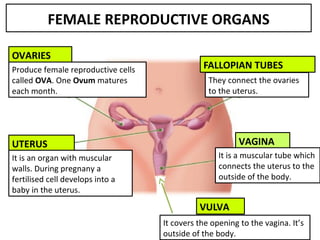
OVARIES
Produce female reproductive cells
called OVA. One Ovum matures
each month.
FALLOPIAN TUBES
They connect the ovaries
to the uterus.
UTERUS
It is an organ with muscular
walls. During pregnany a
fertilised cell develops into a
baby in the uterus.
VAGINA
It is a muscular tube which
connects the uterus to the
outside of the body.
VULVA
It covers the opening to the vagina. It’s
outside of the body.
FEMALE REPRODUCTIVE ORGANS
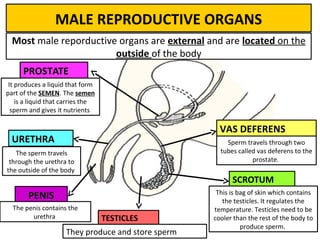
MALE REPRODUCTIVE ORGANS
Most male reporductive organs are external and are located on the
outside of the body
TESTICLES
VAS DEFERENS
PROSTATE
URETHRA
PENIS
SCROTUM
They produce and store sperm
This is bag of skin which contains
the testicles. It regulates the
temperature. Testicles need to be
cooler than the rest of the body to
produce sperm.
Sperm travels through two
tubes called vas deferens to the
prostate.
It produces a liquid that form
part of the SEMEN. The semen
is a liquid that carries the
sperm and gives it nutrients
The sperm travels
through the urethra to
the outside of the body
The penis contains the
urethra
Secondary sexual characteristic
PUBERTY IN GIRLS AND BOYS
MENSTRUAL CYCLE?
MENSTRUATION?
HAVE THE PERIOD?
?
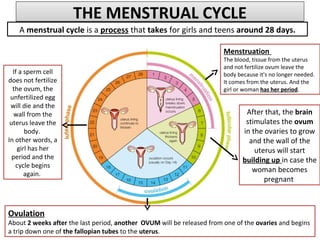
A menstrual cycle is a process that takes for girls and teens around 28 days.
THE MENSTRUAL CYCLETHE MENSTRUAL CYCLE
If a sperm cell
does not fertilize
the ovum, the
unfertilized egg
will die and the
wall from the
uterus leave the
body.
In other words, a
girl has her
period and the
cycle begins
again.
Menstruation
The blood, tissue from the uterus
and not fertilize ovum leave the
body because it's no longer needed.
It comes from the uterus. And the
girl or woman has her period.
After that, the brain
stimulates the ovum
in the ovaries to grow
and the wall of the
uterus will start
building up in case the
woman becomes
pregnant
Ovulation
About 2 weeks after the last period, another OVUM will be released from one of the ovaries and begins
a trip down one of the fallopian tubes to the uterus.
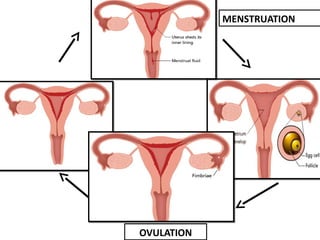
MENSTRUATION
OVULATION
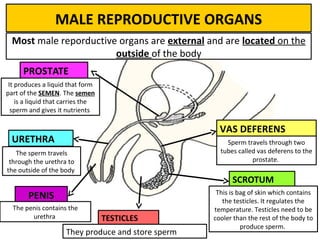
MALE REPRODUCTIVE ORGANS
Most male reporductive organs are external and are located on the
outside of the body
TESTICLES
VAS DEFERENS
PROSTATE
URETHRA
PENIS
SCROTUM
They produce and store sperm
This is bag of skin which contains
the testicles. It regulates the
temperature. Testicles need to be
cooler than the rest of the body to
produce sperm.
Sperm travels through two
tubes called vas deferens to the
prostate.
It produces a liquid that form
part of the SEMEN. The semen
is a liquid that carries the
sperm and gives it nutrients
The sperm travels
through the urethra to
the outside of the body
The penis contains the
urethra
HOW LONG DOES
PREGNANCY LAST?
HOW LONG DOES
PREGNANCY LAST?
It is the period of time from
conception to childbirth (9 months).
The state of being pregnant.
It is the act of giving birth.
The appearance of a baby from
the body of its mother.
PREGNANCY (noun)
GIVE BIRTH TO... (verb)
CHILDBIRTH (noun)
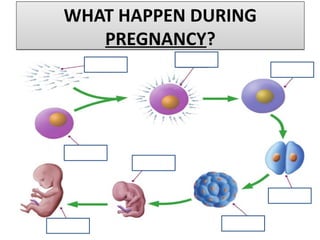
WHAT HAPPEN DURING
PREGNANCY?
WHAT HAPPEN DURING
PREGNANCY?
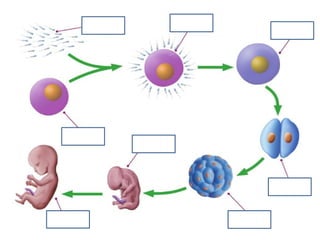
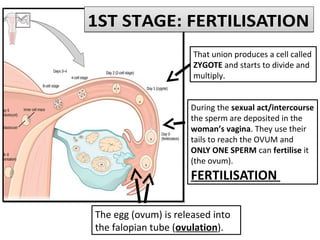
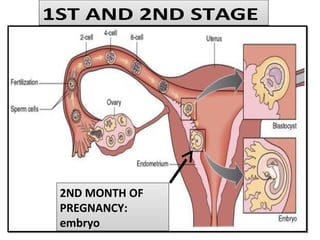
1ST STAGE: FERTILISATION1ST STAGE: FERTILISATION
The egg (ovum) is released into
the falopian tube (ovulation).
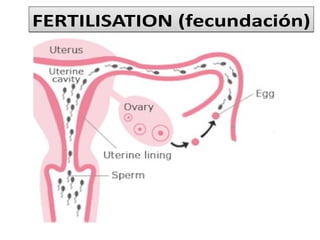
During the sexual act/intercourse
the sperm are deposited in the
woman’s vagina. They use their
tails to reach the OVUM and
ONLY ONE SPERM can fertilise it
(the ovum).
FERTILISATION
That union produces a cell called
ZYGOTE and starts to divide and
multiply.
FERTILISATION (fecundación)FERTILISATION (fecundación)
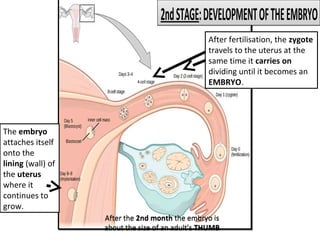
2ndSTAGE:DEVELOPMENTOFTHEEMBRYO2ndSTAGE:DEVELOPMENTOFTHEEMBRYO
After fertilisation, the zygote
travels to the uterus at the
same time it carries on
dividing until it becomes an
EMBRYO.
The embryo
attaches itself
onto the
lining (wall) of
the uterus
where it
continues to
grow.
After the 2nd month the embryo is
about the size of an adult’s THUMB
After the 2nd month the embryo is
about the size of an adult’s THUMB
1ST AND 2ND STAGE1ST AND 2ND STAGE
2ND MONTH OF
PREGNANCY:
embryo
2ND MONTH OF
PREGNANCY:
embryo
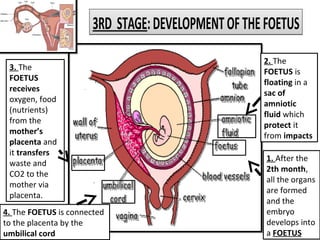
3. The
FOETUS
receives
oxygen, food
(nutrients)
from the
mother’s
placenta and
it transfers
waste and
CO2 to the
mother via
placenta.
3RD STAGE:DEVELOPMENTOFTHEFOETUS3RD STAGE:DEVELOPMENTOFTHEFOETUS
1. After the
2th month,
all the organs
are formed
and the
embryo
develops into
a FOETUS
2. The
FOETUS is
floating in a
sac of
amniotic
fluid which
protect it
from impacts
4. The FOETUS is connected
to the placenta by the
umbilical cord
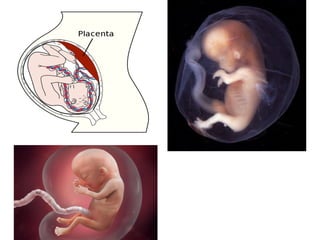
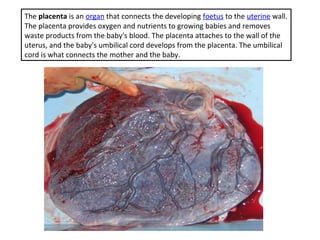
The placenta is an organ that connects the developing foetus to the uterine wall.
The placenta provides oxygen and nutrients to growing babies and removes
waste products from the baby's blood. The placenta attaches to the wall of the
uterus, and the baby's umbilical cord develops from the placenta. The umbilical
cord is what connects the mother and the baby.
4th STAGE: BIRTH4th STAGE: BIRTH
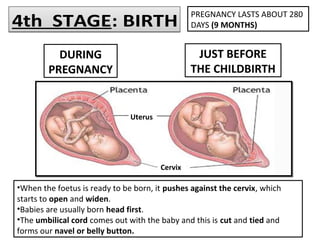
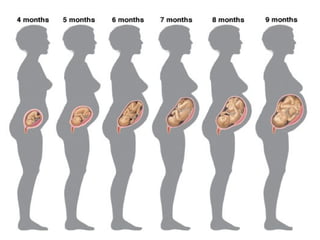
PREGNANCY LASTS ABOUT 280
DAYS (9 MONTHS)
DURING
PREGNANCY
JUST BEFORE
THE CHILDBIRTH
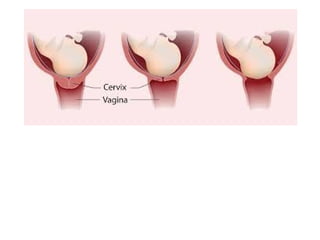
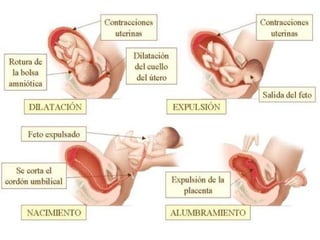
•When the foetus is ready to be born, it pushes against the cervix, which
starts to open and widen.
•Babies are usually born head first.
•The umbilical cord comes out with the baby and this is cut and tied and
forms our navel or belly button.
Uterus
Cervix
Unit 3. REPRODUCTION

Unit 3. REPRODUCTION

  • 1.
  • 2.
    DO YOU KNOWWHERE BABIES REALLY COME FROM? DO STORKS BRING BABIES IN THEIR BEAKS?
  • 3.
    HUMAN BEINGS are livingthings THEY PERFORM THREE VITAL FUNCTIONS INTERACTION REPRODUCTIONNUTRITION 5 senses Nervous System Locomotor system Digestive System Respiratory System Circulatory System Excretory System SEXUAL 2 organisms are required (needed): male and female ASEXUAL 1 organism is required
  • 4.
  • 5.
    Reproduction It is thethird vital function The process by which living things generate or produce new living things (offspring/children/descendants) so they cannot become extinct. The process by which living things generate or produce new living things (offspring/children/descendants) so they cannot become extinct. Human being performs a sexual reproduction (a male and a female are required/needed) Human being performs a sexual reproduction (a male and a female are required/needed)
  • 6.
    REPRODUCTION • What kindof reproduction do human beingsperform? • What is the meaning ofsperm? • How do you call the female reproductive cell? • What happen when sperm andovum meet? • How doesthe zygote progress/change to? • How do you call the stage between childhood and adulthood? • What happen intheadolescence?
  • 7.
  • 9.
    PREBIRTH Stages in thehuman life cycle baby toddler child adult adolescent Elderly person Foetus
  • 10.
    SEXUAL CHARACTERISTICS: physicaldiferences between women and men PRIMARY SEXUAL CHARACTERISTICS SECONDARY SEXUAL CHARACTERISTICS They are other physical differences between men and women Wider hips More body hair WOMEN MEN These characteristics appear during puberty (adolescent) WOMEN MEN Facial hair: beard Adams’s apple Mature breast They are the differences between male and female reproductive organs
  • 11.
    SECONDARY SEXUAL CHARACTERISTICS Thesecharacteristics appear during PUBERTY (adolescent)
  • 12.
    OVARIES Produce female reproductivecells called OVA. One Ovum matures each month. FALLOPIAN TUBES They connect the ovaries to the uterus. UTERUS It is an organ with muscular walls. During pregnany a fertilised cell develops into a baby in the uterus. VAGINA It is a muscular tube which connects the uterus to the outside of the body. VULVA It covers the opening to the vagina. It’s outside of the body. FEMALE REPRODUCTIVE ORGANS
  • 13.
    MALE REPRODUCTIVE ORGANS Mostmale reporductive organs are external and are located on the outside of the body TESTICLES VAS DEFERENS PROSTATE URETHRA PENIS SCROTUM They produce and store sperm This is bag of skin which contains the testicles. It regulates the temperature. Testicles need to be cooler than the rest of the body to produce sperm. Sperm travels through two tubes called vas deferens to the prostate. It produces a liquid that form part of the SEMEN. The semen is a liquid that carries the sperm and gives it nutrients The sperm travels through the urethra to the outside of the body The penis contains the urethra
  • 14.
  • 15.
  • 16.
  • 17.
    A menstrual cycleis a process that takes for girls and teens around 28 days. THE MENSTRUAL CYCLETHE MENSTRUAL CYCLE If a sperm cell does not fertilize the ovum, the unfertilized egg will die and the wall from the uterus leave the body. In other words, a girl has her period and the cycle begins again. Menstruation The blood, tissue from the uterus and not fertilize ovum leave the body because it's no longer needed. It comes from the uterus. And the girl or woman has her period. After that, the brain stimulates the ovum in the ovaries to grow and the wall of the uterus will start building up in case the woman becomes pregnant Ovulation About 2 weeks after the last period, another OVUM will be released from one of the ovaries and begins a trip down one of the fallopian tubes to the uterus.
  • 18.
  • 19.
    MALE REPRODUCTIVE ORGANS Mostmale reporductive organs are external and are located on the outside of the body TESTICLES VAS DEFERENS PROSTATE URETHRA PENIS SCROTUM They produce and store sperm This is bag of skin which contains the testicles. It regulates the temperature. Testicles need to be cooler than the rest of the body to produce sperm. Sperm travels through two tubes called vas deferens to the prostate. It produces a liquid that form part of the SEMEN. The semen is a liquid that carries the sperm and gives it nutrients The sperm travels through the urethra to the outside of the body The penis contains the urethra
  • 20.
    HOW LONG DOES PREGNANCYLAST? HOW LONG DOES PREGNANCY LAST? It is the period of time from conception to childbirth (9 months). The state of being pregnant. It is the act of giving birth. The appearance of a baby from the body of its mother. PREGNANCY (noun) GIVE BIRTH TO... (verb) CHILDBIRTH (noun)
  • 21.
    WHAT HAPPEN DURING PREGNANCY? WHATHAPPEN DURING PREGNANCY?
  • 22.
    1ST STAGE: FERTILISATION1STSTAGE: FERTILISATION The egg (ovum) is released into the falopian tube (ovulation). During the sexual act/intercourse the sperm are deposited in the woman’s vagina. They use their tails to reach the OVUM and ONLY ONE SPERM can fertilise it (the ovum). FERTILISATION That union produces a cell called ZYGOTE and starts to divide and multiply.
  • 23.
  • 24.
    2ndSTAGE:DEVELOPMENTOFTHEEMBRYO2ndSTAGE:DEVELOPMENTOFTHEEMBRYO After fertilisation, thezygote travels to the uterus at the same time it carries on dividing until it becomes an EMBRYO. The embryo attaches itself onto the lining (wall) of the uterus where it continues to grow. After the 2nd month the embryo is about the size of an adult’s THUMB After the 2nd month the embryo is about the size of an adult’s THUMB
  • 25.
    1ST AND 2NDSTAGE1ST AND 2ND STAGE 2ND MONTH OF PREGNANCY: embryo 2ND MONTH OF PREGNANCY: embryo
  • 26.
    3. The FOETUS receives oxygen, food (nutrients) fromthe mother’s placenta and it transfers waste and CO2 to the mother via placenta. 3RD STAGE:DEVELOPMENTOFTHEFOETUS3RD STAGE:DEVELOPMENTOFTHEFOETUS 1. After the 2th month, all the organs are formed and the embryo develops into a FOETUS 2. The FOETUS is floating in a sac of amniotic fluid which protect it from impacts 4. The FOETUS is connected to the placenta by the umbilical cord
  • 28.
    The placenta isan organ that connects the developing foetus to the uterine wall. The placenta provides oxygen and nutrients to growing babies and removes waste products from the baby's blood. The placenta attaches to the wall of the uterus, and the baby's umbilical cord develops from the placenta. The umbilical cord is what connects the mother and the baby.
  • 29.
    4th STAGE: BIRTH4thSTAGE: BIRTH PREGNANCY LASTS ABOUT 280 DAYS (9 MONTHS) DURING PREGNANCY JUST BEFORE THE CHILDBIRTH •When the foetus is ready to be born, it pushes against the cervix, which starts to open and widen. •Babies are usually born head first. •The umbilical cord comes out with the baby and this is cut and tied and forms our navel or belly button. Uterus Cervix

Editor's Notes

  • #7 <número>