SUBMITTED TO :- SUBMITTED BY:-
A K GANGWAR SIR AKASH
KANOJIA
DR. MUKESH KUMAR SINGH SIR VIKASH SHEEL
DR.D.B. SHAKYAWAR SIR ANKUR VISWAKARMA
 Introduction of PBO polymer
 Classification of PBO polymer
 Key Features of PBO polymer
 Structure of PBO polymer
 Raw material of PBO polymer
 Basic properties of PBO polymer
 Manufacture of PBO polymer
 Usage of PBO polymer
 PBO(polybenzoxazole) was first
developed in the 1980’s by TOYOBA
Corp. Ltd., JAPAN and is the world’s
strongest man-made fiber. It is also
the first organic fiber whose cross-
sectional strength outperforms both
steel and carbon fiber.
 IUPAC Name - poly(p-phenylene-2,6-
benzobisoxazole)
Polybenzazoles polymers can be classified
into two categories-
1. PBO ( polybenzoxazole )
2. PBT ( polybenzothiazoles )
Note :- These two polymer is the formation
of the benzothiozole and benzoxazole
ring structures.
 Excellent thermal stability
 Excellent strength & modulus
 Good flame resistance
 Excellent creep resistance
 Good chemical resistance
 PBO is a rigid-rod isotropic crystal
polymer that is spun by a dry-jet wet
spinning process
 PBO is synthesized by condensation
polymerization of 4,6-diamino-1,3-
benzenedoldihydrochloride (DABCO)
with terephthalic acid (TA) at 60-80°c.
 P B O fiber is the next generation
super fiber with strength and modulus
almost doubles that of p-Aramid fiber.
P B O shows 100 ° C higher
decomposition temperature than p-
Aramid fiber. The limiting oxygen
index is 68, which is the highest among
organic super fibers.
ZYLON®AS ZYLON®HM
Filament Decitex 1.7 1.7
Density (g/cm3) 1.54 1.56
Tensile Strength (cN/dtex)
(GPa)
(kg/mm2)
3.7
5.8
590
3.7
5.8
590
Tensile Modulus (cN/dtex)
(GPa)
(kg/mm2)
1150
180
18000
1720
270
28000
Elongation at break (%) 3.5 2.5
Moisture regain (%) 2.0 0.6
Decomposition Temp. (°C) 650 650
LOI 68 68
Thermal expansion coefficient _ -6×10⁻6
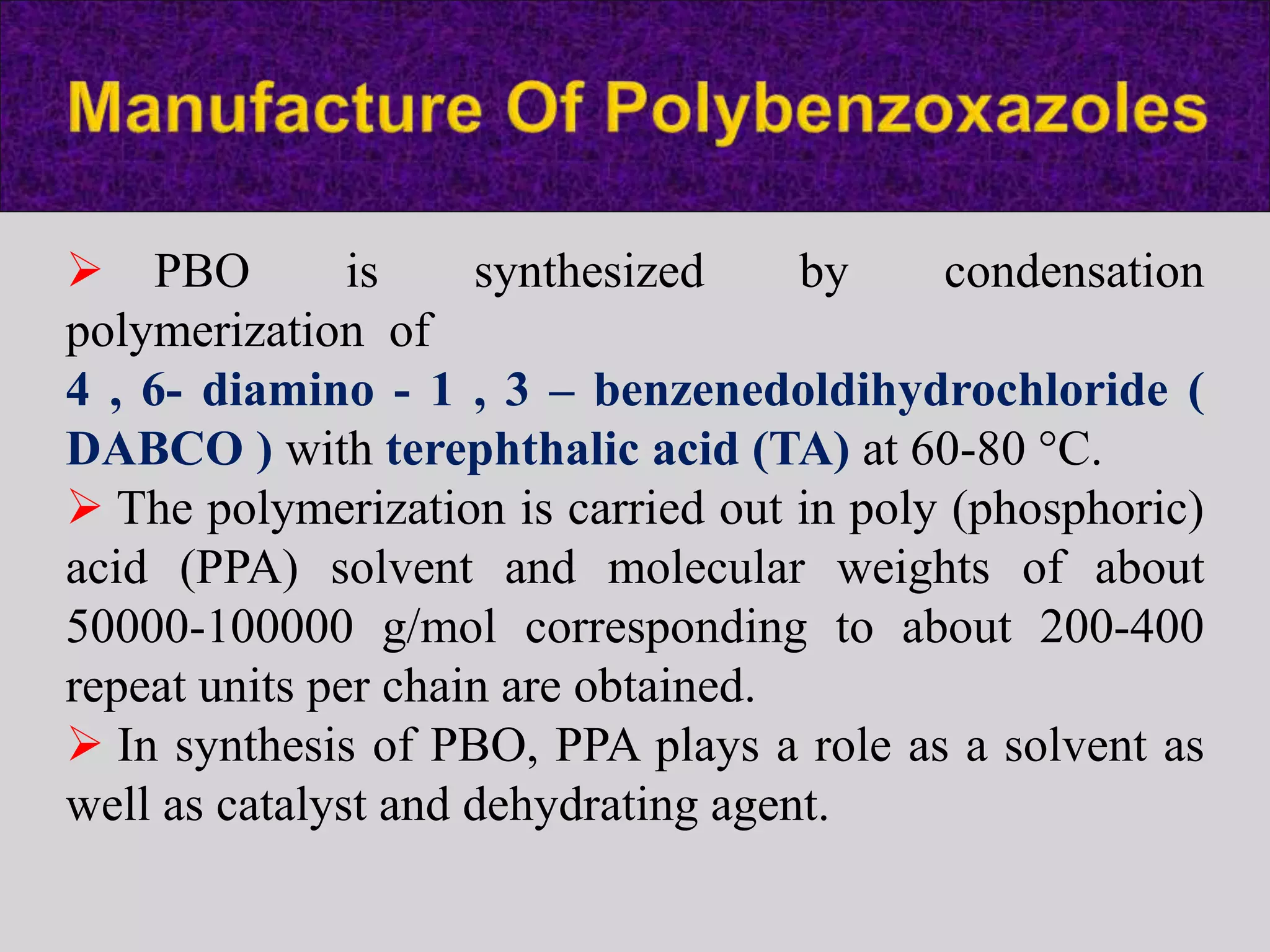
 PBO is synthesized by condensation
polymerization of
4 , 6- diamino - 1 , 3 – benzenedoldihydrochloride (
DABCO ) with terephthalic acid (TA) at 60-80 °C.
 The polymerization is carried out in poly (phosphoric)
acid (PPA) solvent and molecular weights of about
50000-100000 g/mol corresponding to about 200-400
repeat units per chain are obtained.
 In synthesis of PBO, PPA plays a role as a solvent as
well as catalyst and dehydrating agent.
These polymers decompose at high temperatures without
melting and are soluble in very few solvent systems due to their
rigid molecular backbone.
 PBO is soluble in strong protonic acids such as PPA,
methane sulfonic acid (MSA), chlorosulfonic acid, and
trifluoroacetic acid via backbone protonation, which weakens
intermolecular interaction.
 PBO fibres are prepared using 13-17% solid content in poly-
phosphoric acid solution at 60-90 °C. The structure formed
during coagulation shows a network of oriented microfibrils.
 Heat treatment at 450-500 °C for one minute under tension
results in about eight times and 10-20% improvement in modulus
and strength, respectively.
 Improvement in overall axial orientation, crystal perfection and
improved mechanical properties.
 The mechanical properties of PBO fibre depend on polymer
molecular weight, as well as on processing and post processing
conditions.
 PBO fibres should be stored in low RH environment because
PBO tensile strength also drops sharply with UV exposure in the
initial stage, which indicates that the products of PBO fibre for
outdoor use have to be protected from the UV radiation.
 PBO staple fibre showed low resistance under acid and base at
high temperature.
1. BODY ARMOR
Zylon gained wide use in U.S. police officers body
armor protection in 1998 with its introduction
by Second Chance Body Armor, Inc.
3. Motorsport
As has been the case since 2001, Zylon tethers are used
in Formula One to affix the wheel to the chassis for
preventing the wheel.
In 2011, a Zylon strip was introduced to reinforce the top of
the racing helmet visor/front part.
3. Standing rigging
On modern racing yachts Zylon is used
for parts of the standing rigging. It is
used as shrouds and stays in racing
yachts.
4. Conductive textile
Zylon has been incorporated as the
base fiber for some conductive textiles,
where the Zylon fiber is plated with
nickel, copper, silver, or gold.
5.HIGH-ALTITUDE BALLOON SCIENCE
Zylon is used by NASA in long-duration, high-
altitude data collection. Braided Zylon strands
maintain the structure of PE superpressure balloons.
Zylon is the material of choice due to its low weight,
high tensile strength and thermal properties.
Pbo polymer

Pbo polymer

  • 1.
    SUBMITTED TO :-SUBMITTED BY:- A K GANGWAR SIR AKASH KANOJIA DR. MUKESH KUMAR SINGH SIR VIKASH SHEEL DR.D.B. SHAKYAWAR SIR ANKUR VISWAKARMA
  • 2.
     Introduction ofPBO polymer  Classification of PBO polymer  Key Features of PBO polymer  Structure of PBO polymer  Raw material of PBO polymer  Basic properties of PBO polymer  Manufacture of PBO polymer  Usage of PBO polymer
  • 3.
     PBO(polybenzoxazole) wasfirst developed in the 1980’s by TOYOBA Corp. Ltd., JAPAN and is the world’s strongest man-made fiber. It is also the first organic fiber whose cross- sectional strength outperforms both steel and carbon fiber.  IUPAC Name - poly(p-phenylene-2,6- benzobisoxazole)
  • 4.
    Polybenzazoles polymers canbe classified into two categories- 1. PBO ( polybenzoxazole ) 2. PBT ( polybenzothiazoles ) Note :- These two polymer is the formation of the benzothiozole and benzoxazole ring structures.
  • 6.
     Excellent thermalstability  Excellent strength & modulus  Good flame resistance  Excellent creep resistance  Good chemical resistance  PBO is a rigid-rod isotropic crystal polymer that is spun by a dry-jet wet spinning process
  • 8.
     PBO issynthesized by condensation polymerization of 4,6-diamino-1,3- benzenedoldihydrochloride (DABCO) with terephthalic acid (TA) at 60-80°c.
  • 9.
     P BO fiber is the next generation super fiber with strength and modulus almost doubles that of p-Aramid fiber. P B O shows 100 ° C higher decomposition temperature than p- Aramid fiber. The limiting oxygen index is 68, which is the highest among organic super fibers.
  • 10.
    ZYLON®AS ZYLON®HM Filament Decitex1.7 1.7 Density (g/cm3) 1.54 1.56 Tensile Strength (cN/dtex) (GPa) (kg/mm2) 3.7 5.8 590 3.7 5.8 590 Tensile Modulus (cN/dtex) (GPa) (kg/mm2) 1150 180 18000 1720 270 28000 Elongation at break (%) 3.5 2.5 Moisture regain (%) 2.0 0.6 Decomposition Temp. (°C) 650 650 LOI 68 68 Thermal expansion coefficient _ -6×10⁻6
  • 12.
     PBO issynthesized by condensation polymerization of 4 , 6- diamino - 1 , 3 – benzenedoldihydrochloride ( DABCO ) with terephthalic acid (TA) at 60-80 °C.  The polymerization is carried out in poly (phosphoric) acid (PPA) solvent and molecular weights of about 50000-100000 g/mol corresponding to about 200-400 repeat units per chain are obtained.  In synthesis of PBO, PPA plays a role as a solvent as well as catalyst and dehydrating agent.
  • 14.
    These polymers decomposeat high temperatures without melting and are soluble in very few solvent systems due to their rigid molecular backbone.  PBO is soluble in strong protonic acids such as PPA, methane sulfonic acid (MSA), chlorosulfonic acid, and trifluoroacetic acid via backbone protonation, which weakens intermolecular interaction.  PBO fibres are prepared using 13-17% solid content in poly- phosphoric acid solution at 60-90 °C. The structure formed during coagulation shows a network of oriented microfibrils.  Heat treatment at 450-500 °C for one minute under tension results in about eight times and 10-20% improvement in modulus and strength, respectively.
  • 15.
     Improvement inoverall axial orientation, crystal perfection and improved mechanical properties.  The mechanical properties of PBO fibre depend on polymer molecular weight, as well as on processing and post processing conditions.  PBO fibres should be stored in low RH environment because PBO tensile strength also drops sharply with UV exposure in the initial stage, which indicates that the products of PBO fibre for outdoor use have to be protected from the UV radiation.  PBO staple fibre showed low resistance under acid and base at high temperature.
  • 16.
    1. BODY ARMOR Zylongained wide use in U.S. police officers body armor protection in 1998 with its introduction by Second Chance Body Armor, Inc.
  • 17.
    3. Motorsport As hasbeen the case since 2001, Zylon tethers are used in Formula One to affix the wheel to the chassis for preventing the wheel. In 2011, a Zylon strip was introduced to reinforce the top of the racing helmet visor/front part.
  • 18.
    3. Standing rigging Onmodern racing yachts Zylon is used for parts of the standing rigging. It is used as shrouds and stays in racing yachts.
  • 19.
    4. Conductive textile Zylonhas been incorporated as the base fiber for some conductive textiles, where the Zylon fiber is plated with nickel, copper, silver, or gold.
  • 20.
    5.HIGH-ALTITUDE BALLOON SCIENCE Zylonis used by NASA in long-duration, high- altitude data collection. Braided Zylon strands maintain the structure of PE superpressure balloons. Zylon is the material of choice due to its low weight, high tensile strength and thermal properties.