DISK ALLOCATION METHODS
Presented BY :
Rollno:- 13-mc-2015
Teacher In-charge :
Dr. Sanjay Jamwal
Disk Allocation :
• Refers to how disk blocks are allocated for files.
•Allocation methods are used for:
oEffective disk space utilization.
oAllows fast file access.
Allocation Methods:
•Contiguous
•Linked
•indexed
Contiguous Allocation:
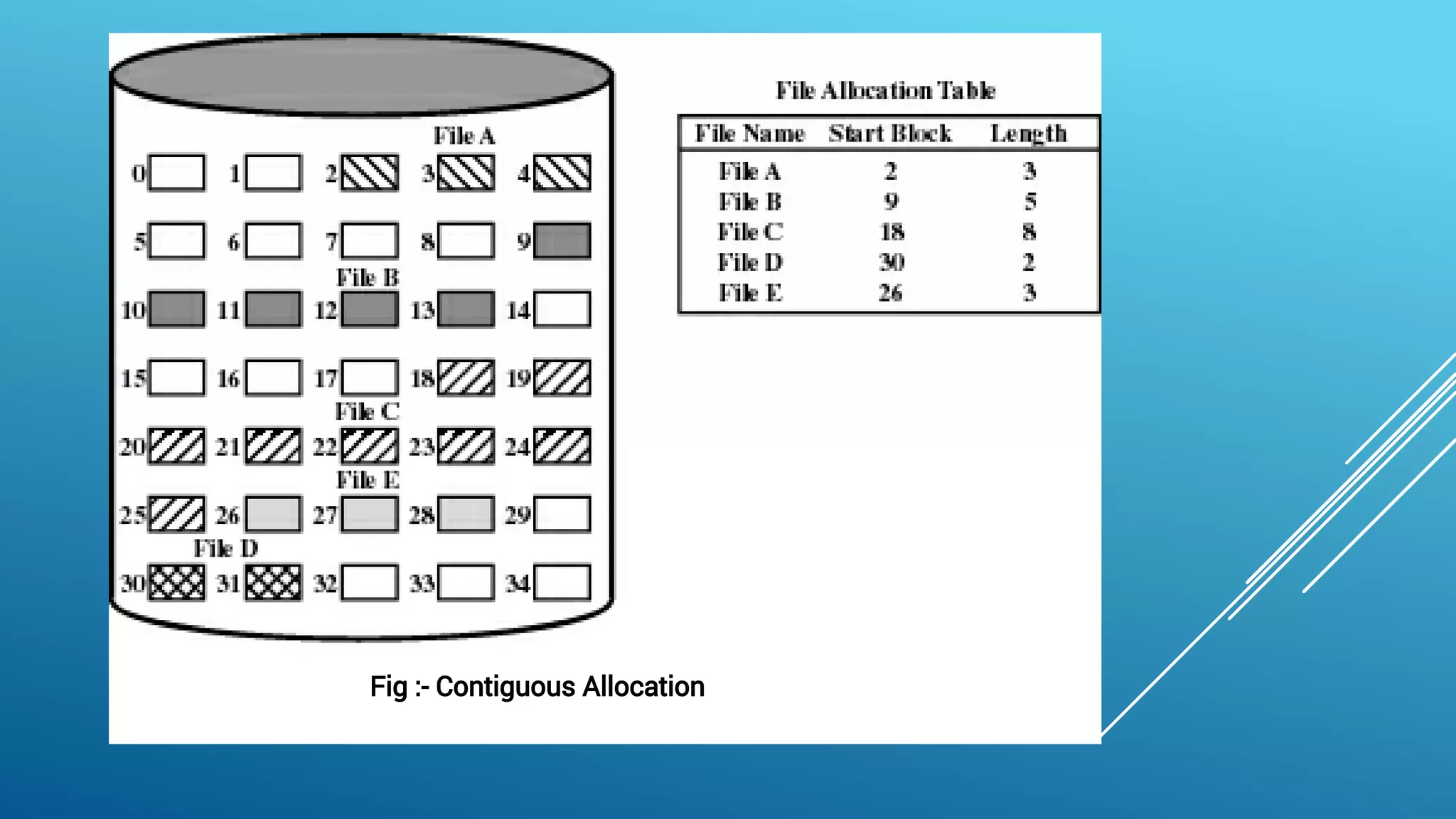
In contiguous allocation, files are assigned to contiguous areas of secondary storage.
A user specifies in advance the size of the area needed to hold a file to be created. If
the desired amount of contiguous space is not available, the file cannot be created.
• Starting block and length of the file
• Two most common strategies are:
First - fit 
Best - fit
• First-fit:- In this case as soon as the first hole (that is big enough) is encountered,
searching is stopped and memory is allocated for creating a file. Searching can
start either at the beginning of the set of holes or where the previous first-fit search
ended.
• Best - fit - In this case the entire list is searched for and the smallest hole, that is big
enough, is allocated for creating a file.
• Neither first-fit nor best-fit is clearly best in terms of storage utilization, but first-fit is
generally faster.
• External fragmentation will occur
Fig :- Contiguous Allocation
Linked Allocation (Chained Allocation):
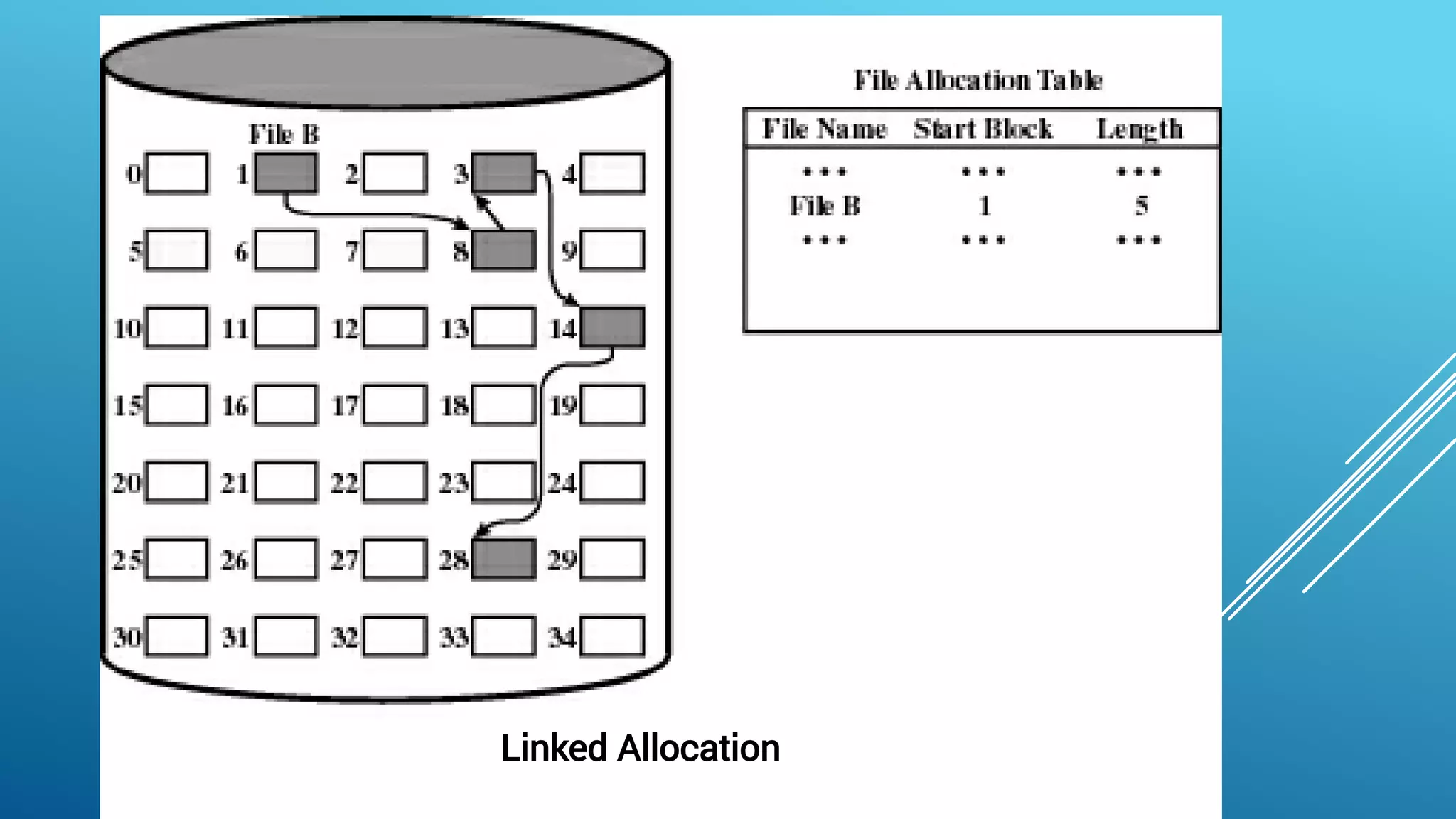
•In linked list allocation each file is linked list of disk blocks.
• These disk blocks may be scattered through the disk.
• A few bytes of each disk block contains the address of the next block. 
•A single entry in the file allocation table
• Starting block and length of file
•No external fragmentation
•Best for sequential files
Linked Allocation
Indexed Allocation:
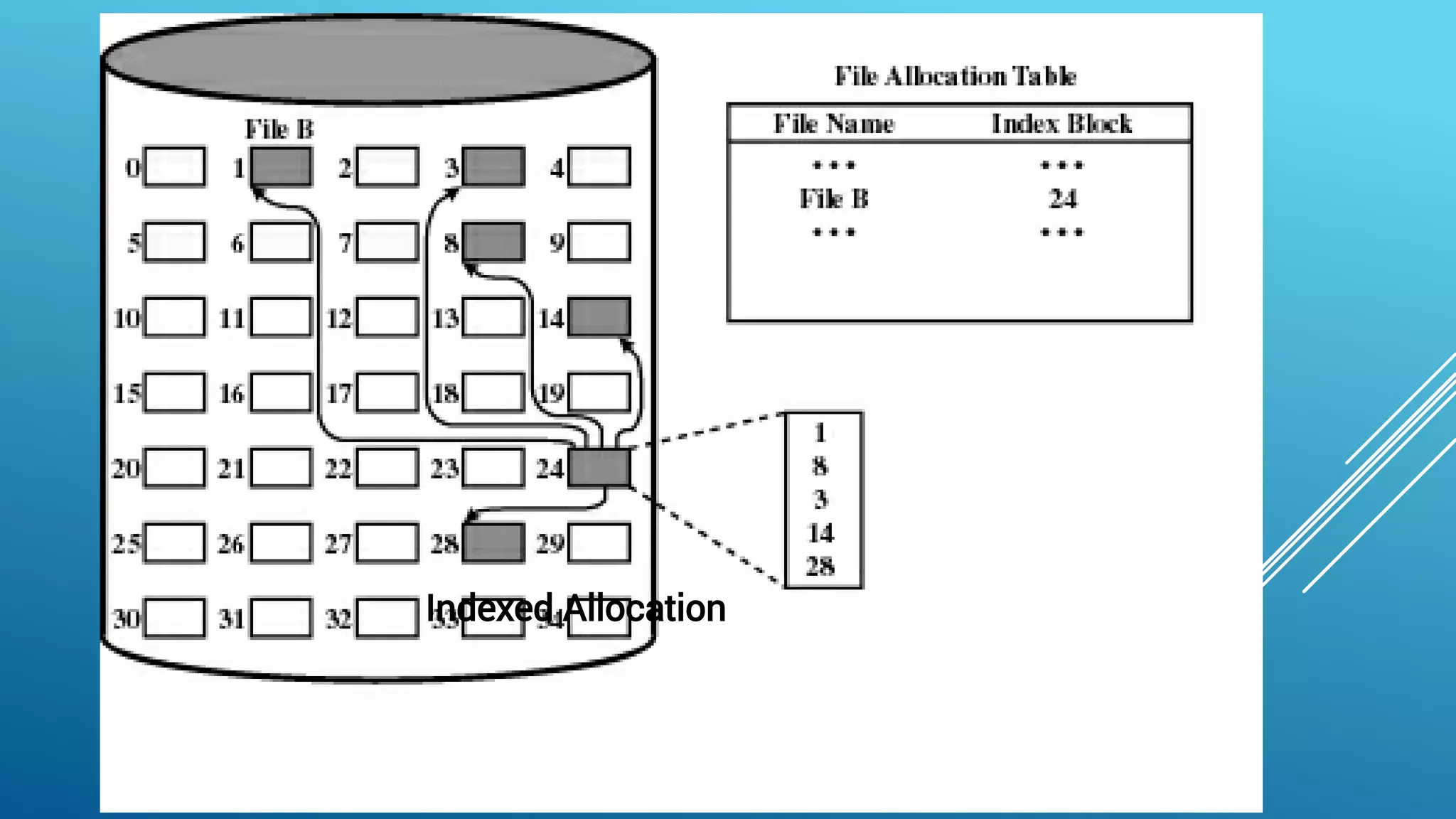
•In this scheme each file is provided with its own index block, which is an array of
disk block pointers (addresses).
•The Kth entry in the index block points to the Kth disk block of the file.
•The file allocation table contains block number for the index
•Indexed allocation solves this problem by bringing all the pointers together into
one location known as the index block.
•Each file has its own index block, which is an array of disk-block addresses. The
“i” entry in the index block points to the “i‘” block of the file
Indexed Allocation
• The advantage of indexed file allocation include
the absence of external fragmentation and the
efficiency of random accessing.
• indexed allocation requires lots of space for
keeping pointers.
THANKS

Disk allocation methods

  • 1.
    DISK ALLOCATION METHODS PresentedBY : Rollno:- 13-mc-2015 Teacher In-charge : Dr. Sanjay Jamwal
  • 2.
    Disk Allocation : •Refers to how disk blocks are allocated for files. •Allocation methods are used for: oEffective disk space utilization. oAllows fast file access.
  • 3.
  • 4.
    Contiguous Allocation: In contiguousallocation, files are assigned to contiguous areas of secondary storage. A user specifies in advance the size of the area needed to hold a file to be created. If the desired amount of contiguous space is not available, the file cannot be created. • Starting block and length of the file • Two most common strategies are: First - fit  Best - fit
  • 5.
    • First-fit:- Inthis case as soon as the first hole (that is big enough) is encountered, searching is stopped and memory is allocated for creating a file. Searching can start either at the beginning of the set of holes or where the previous first-fit search ended. • Best - fit - In this case the entire list is searched for and the smallest hole, that is big enough, is allocated for creating a file. • Neither first-fit nor best-fit is clearly best in terms of storage utilization, but first-fit is generally faster. • External fragmentation will occur
  • 6.
  • 7.
    Linked Allocation (ChainedAllocation): •In linked list allocation each file is linked list of disk blocks. • These disk blocks may be scattered through the disk. • A few bytes of each disk block contains the address of the next block.  •A single entry in the file allocation table • Starting block and length of file •No external fragmentation •Best for sequential files
  • 8.
  • 9.
    Indexed Allocation: •In thisscheme each file is provided with its own index block, which is an array of disk block pointers (addresses). •The Kth entry in the index block points to the Kth disk block of the file. •The file allocation table contains block number for the index •Indexed allocation solves this problem by bringing all the pointers together into one location known as the index block. •Each file has its own index block, which is an array of disk-block addresses. The “i” entry in the index block points to the “i‘” block of the file
  • 10.
  • 11.
    • The advantageof indexed file allocation include the absence of external fragmentation and the efficiency of random accessing. • indexed allocation requires lots of space for keeping pointers.
  • 12.