Greek
Architecture
:
The
Parthenon
Presented by:
INTRODUCTION
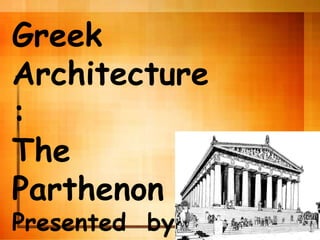
 The Parthenon is a temple on the
Athenian Acropolis, Greece, dedicated
to the maiden goddess Athena.
 Its construction started in 447 BC and
ended in 438 BC
 Architects: Ictinus and Callicrates
 Master sculptor: Phidias
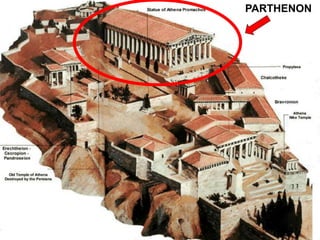
PARTHENON
PLAN (FORM)
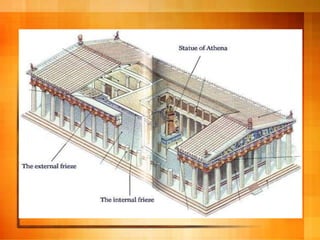
 The temple stands on the conventional three
steps, the top step being 30.9m x 69.5m
 The cella consist of two room end to end
with hexastyle prostyle porches.
 The eastern room being 29.8m long and
19.2m wide , with Doric colonnades in two
tiers , structurally necessary to support the
timber roof.
PLAN (PARTHENOS AT ACROPOLIS)
INTERIOR
 Inside, the Temple has a double cella (inner sanctum)
with pronaos (the antechamber, with the only door into the cella)
and opisthodomos (the rear room).
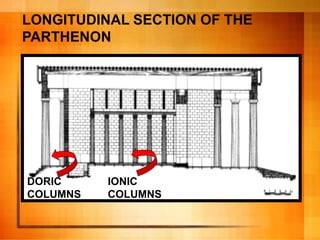
 The smaller west cella had 4 interior columns.
 Inside the east cella was a U-shaped colonnade of 9 columns and a
pier on each long side, and 3 columns between the 2 piers on the
short side.
 Toward the west end of the interior colonnade was a statue base for
the cult statue of Athena Parthenos with a large shallow rectangle cut
to create a reflecting pool in front of it.
 The Phidias' statue was made of gold and ivory with polychrome
details.
 . Bronze doors are postulated for both eastern and western cellas.
 Here the roof is supported by four ionic columns placed in a rectangle
4.7 x 7 m. The ceiling was of wood with painted & gilded
decoration.
LONGITUDINAL SECTION OF THE
PARTHENON
DORIC
COLUMNS
IONIC
COLUMNS
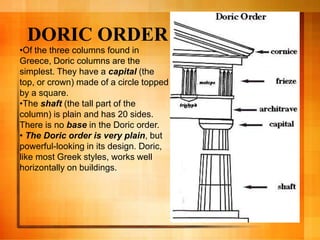
DORIC ORDER
•Of the three columns found in
Greece, Doric columns are the
simplest. They have a capital (the
top, or crown) made of a circle topped
by a square.
•The shaft (the tall part of the
column) is plain and has 20 sides.
There is no base in the Doric order.
• The Doric order is very plain, but
powerful-looking in its design. Doric,
like most Greek styles, works well
horizontally on buildings.
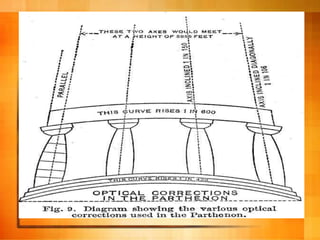
OPTICAL REFINEMENT
 The Parthenon is the best example in Greek temple
architecture of the practice of optical refinement.
 To the unaided eye, columns tend to look narrower in the
middle than at the top or bottom.
 Each of the columns in the Parthenon was built with a slight
bulge in the middle, to make them appear" straight”.
 Furthermore, the spacing between the columns appear smaller
towards the centre. Therefore, they were spaced wider apart
accordingly.
ROOF

Greek temples typically covered the wooden roof rafters with
fired clay tiles.
 In contrast, the roof of the Parthenon was covered with light
weight, thinly-sliced (only 3 centimeters thick), nearly
translucent marble tiles.
 Along the roof-line, Parthenon builders removed the
appearance of 'fussiness' and clutter by positioning decorative
antefixes (roof-line ornaments) between alternate rows of
roof tiles, rather than the traditional placement at the end of
each row of tiles.
ANTEFIXES
 DESTRUCTION: In 1687 ,the Venetians
sent an expedition led by Francesco Morosini
to attack Athens and capture the Acropolis
 RECONSTRUCTION:In 1975, the Greek governme
nt began a concerted effort to restore the Parthenon
and other Acropolis structures.
COMMON TERMS
(ARCHITECTURE OF PARTHENON)
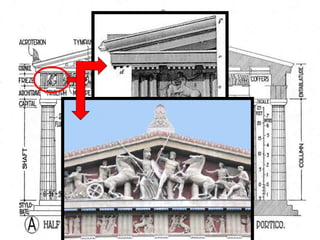
METOPE: is a rectangular architectural
element that fills the space between
two triglyphs in a Doric frieze, which is a
decorative band of alternating triglyphs
and metopes above the architrave of a
building of the Doric order.
FRIEZE:In architecture the frieze /ˈfriːz/ i
s the wide central section part of
an entablature and may be plain in
the Ionic or Doric order, or decorated
withbas-reliefs..
TRIGLYPH: is an architectural term for
the vertically channeled tablets of
the Doric frieze, so called because of the
angular channels in them, two perfect
and one divided, the
two chamfered angles
or hemiglyphs being reckoned as one.
PEDIMENT :is an element in which
the tympanum, or triangular area
within the pediment, was often
decorated
with relief sculpture depicting
scenes from Greek and
Roman mythology or allegorical
figures
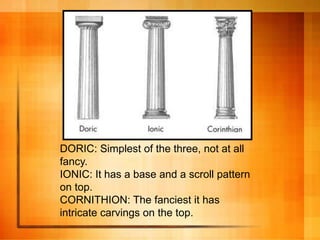
DORIC: Simplest of the three, not at all
fancy.
IONIC: It has a base and a scroll pattern
on top.
CORNITHION: The fanciest it has
intricate carvings on the top.
BIBLIOGRAPHY
 REFFERENCE B . FLETTCHER
 WWW.ANCIENT GREECE .ORG
 WWW.GODESS ATHENA . ORG
 WWW.WIKIPEDIA.ORG

Parthenon

  • 1.
  • 2.
    INTRODUCTION  The Parthenonis a temple on the Athenian Acropolis, Greece, dedicated to the maiden goddess Athena.  Its construction started in 447 BC and ended in 438 BC  Architects: Ictinus and Callicrates  Master sculptor: Phidias
  • 3.
  • 4.
    PLAN (FORM)  Thetemple stands on the conventional three steps, the top step being 30.9m x 69.5m  The cella consist of two room end to end with hexastyle prostyle porches.  The eastern room being 29.8m long and 19.2m wide , with Doric colonnades in two tiers , structurally necessary to support the timber roof.
  • 5.
  • 6.
    INTERIOR  Inside, theTemple has a double cella (inner sanctum) with pronaos (the antechamber, with the only door into the cella) and opisthodomos (the rear room).  The smaller west cella had 4 interior columns.  Inside the east cella was a U-shaped colonnade of 9 columns and a pier on each long side, and 3 columns between the 2 piers on the short side.  Toward the west end of the interior colonnade was a statue base for the cult statue of Athena Parthenos with a large shallow rectangle cut to create a reflecting pool in front of it.  The Phidias' statue was made of gold and ivory with polychrome details.  . Bronze doors are postulated for both eastern and western cellas.  Here the roof is supported by four ionic columns placed in a rectangle 4.7 x 7 m. The ceiling was of wood with painted & gilded decoration.
  • 10.
    LONGITUDINAL SECTION OFTHE PARTHENON DORIC COLUMNS IONIC COLUMNS
  • 11.
    DORIC ORDER •Of thethree columns found in Greece, Doric columns are the simplest. They have a capital (the top, or crown) made of a circle topped by a square. •The shaft (the tall part of the column) is plain and has 20 sides. There is no base in the Doric order. • The Doric order is very plain, but powerful-looking in its design. Doric, like most Greek styles, works well horizontally on buildings.
  • 12.
    OPTICAL REFINEMENT  TheParthenon is the best example in Greek temple architecture of the practice of optical refinement.  To the unaided eye, columns tend to look narrower in the middle than at the top or bottom.  Each of the columns in the Parthenon was built with a slight bulge in the middle, to make them appear" straight”.  Furthermore, the spacing between the columns appear smaller towards the centre. Therefore, they were spaced wider apart accordingly.
  • 14.
    ROOF  Greek temples typicallycovered the wooden roof rafters with fired clay tiles.  In contrast, the roof of the Parthenon was covered with light weight, thinly-sliced (only 3 centimeters thick), nearly translucent marble tiles.  Along the roof-line, Parthenon builders removed the appearance of 'fussiness' and clutter by positioning decorative antefixes (roof-line ornaments) between alternate rows of roof tiles, rather than the traditional placement at the end of each row of tiles.
  • 15.
  • 16.
     DESTRUCTION: In1687 ,the Venetians sent an expedition led by Francesco Morosini to attack Athens and capture the Acropolis  RECONSTRUCTION:In 1975, the Greek governme nt began a concerted effort to restore the Parthenon and other Acropolis structures.
  • 17.
    COMMON TERMS (ARCHITECTURE OFPARTHENON) METOPE: is a rectangular architectural element that fills the space between two triglyphs in a Doric frieze, which is a decorative band of alternating triglyphs and metopes above the architrave of a building of the Doric order. FRIEZE:In architecture the frieze /ˈfriːz/ i s the wide central section part of an entablature and may be plain in the Ionic or Doric order, or decorated withbas-reliefs.. TRIGLYPH: is an architectural term for the vertically channeled tablets of the Doric frieze, so called because of the angular channels in them, two perfect and one divided, the two chamfered angles or hemiglyphs being reckoned as one. PEDIMENT :is an element in which the tympanum, or triangular area within the pediment, was often decorated with relief sculpture depicting scenes from Greek and Roman mythology or allegorical figures
  • 18.
    DORIC: Simplest ofthe three, not at all fancy. IONIC: It has a base and a scroll pattern on top. CORNITHION: The fanciest it has intricate carvings on the top.
  • 19.
    BIBLIOGRAPHY  REFFERENCE B. FLETTCHER  WWW.ANCIENT GREECE .ORG  WWW.GODESS ATHENA . ORG  WWW.WIKIPEDIA.ORG

Editor's Notes

  • #7 Inside the colonnades , towards the end ,there stood the gold & ivory statue of Athena Parthenos ,the work of Phidias ,representing the Athena fully armed with spear , helmet & shield , accompanied by a snake & holding in her right arm a statue of victory. The ceiling was of wood with painted & gilded decoration. To the west with its own porch , is a square chamber , the PARTHENON or the VIRGIN LADY, a depository for valuable offerings . Here the roof is supported by four ionic columns placed in a rectangle 4.7 x 7 m.