


HOW TO WRITE AN ACADEMIC BOOK CHAPTER?
Ahsan Zaman
ACADEMIC BOOK CHAPTER
1. Focused on a research theme
2. An expert compilation that provides a perspective on research (usually scattered in journals and other
publications)
3. More broadly focused than a journal article
4. Greater educational value!
Often appear in the reading lists of undergraduate and postgraduate students
BRAINSTORMING BEFORE HEAD-
START!
The questions that may arise when you plan on writing a book chapter are:
1. Where do I start from?
2. How do I even do this?
3. What should be the length of book chapter?
4. How should I link one chapter to the following chapter?
HOW LONG SHOULD A BOOK
CHAPTER BE?
Between 3500 and 7000 words
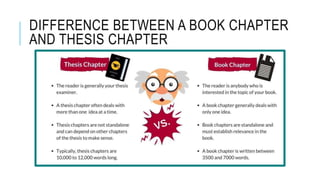
DIFFERENCE BETWEEN A BOOK CHAPTER
AND THESIS CHAPTER
HOW TO WRITE A BOOK CHAPTER?
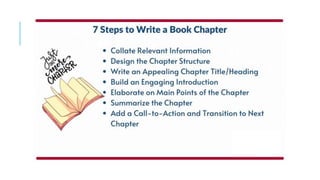
Step 1: Collate Relevant Information
• To review and collate all the relevant data
• Must focus on one concrete idea (it should not include any gaps that perplexes the
reader)
• Creating mind-maps to link different sources and compile them
• Sort the ideas into a logical order of how you should present them in your chapter
HOW TO WRITE A BOOK CHAPTER?
Step 2: Design the Chapter Structure
• Create a structured outline
A WELL STRUCTURED CHAPTER
A well-structured chapter includes the following elements:
1. A title or heading
2. An interesting introduction
3. Main body informative paragraphs
4. A summary of the chapter
5. Smooth transition to the next chapter
HOW TO WRITE A BOOK CHAPTER?
Step 3: Write an Appealing Chapter Title/Heading
• An impactful chapter title captures the reader’s attention. It’s basically the “first
sight” rule!
HOW TO WRITE A BOOK CHAPTER?
Step 4: Build an Engaging Introduction
• Write an introduction that keeps them hooked on
• Use a narrative approach or build a fictional plot to grab the attention of the reader
• Ensure that you do not deviate from the main context of your chapter
• Writing an effective introduction will help you in presenting an overview of your
chapter
HOW TO WRITE A BOOK CHAPTER?
Step 4: Build an Engaging Introduction
Some of the tricks to follow when writing an exceptional introduction are:
• Share an anecdote
• Create a dialogue or conversation
• Include quotations
• Create a fictional plot
HOW TO WRITE A BOOK CHAPTER?
Step 5: Elaborate on Main Body of the Chapter
• Expand your opening statement and begin to explain your points in detail
• Leave no space for speculation in the reader’s mind
This section should answer the following questions of the reader:
• Why has the reader chosen to read your book?
• What do they need to know?
• Are their questions and doubts being resolved with the content of your chapter?
HOW TO WRITE A BOOK CHAPTER?
Step 5: Elaborate on Main Body of the Chapter
You could formulate these points into 4-5 paragraphs based on the details of your
chapter.
• Build each point coherently (follow a cohesive flow)
• Provide statistical data
• Evidence-based information
• Experimental data
• Graphical presentations, etc.
HOW TO WRITE A BOOK CHAPTER?
Step 5: Elaborate on Main Body of the Chapter
• Write in a clear language
• Avoiding jargon
• Explain concepts clearly so your work is easy to understand
• Get support and feedback from senior academics (any gaps or references you
should include?)
HOW TO WRITE A BOOK CHAPTER?
Step 6: Summarize the Chapter
• This section is a key takeaway for your readers!
• Revisit your chapter’s main content and summarize it
“Since your chapter has given a lot of information, you’d want the reader to
remember the gist of it as they reach the end of your chapter. Hence, writing
a concise summary that constitutes the crux of your chapter is imperative.”
HOW TO WRITE A BOOK CHAPTER?
Step 7: Add a Call-to-Action & Transition to Next Chapter
This section comes at the extreme end of the book chapter
• You ask the reader to implement the learnings from the chapter
• It is a way of applying their newly acquired knowledge
• Can also add a transition from your chapter to the succeeding chapter
ADVANTAGES OF PUBLISHING AN ACADEMIC
BOOK CHAPTER
Publishing a book chapter can help you to be considered as a credible author and expert in your field.
• Academics often read chapter books to keep up to date and for teaching purposes, which means your work might be cited in
essays and dissertations.
• A chapter in a good, edited collection indicates to an employment panel or a publisher that your work has been sought by senior
academics and that you have the potential to author a book.
• You can use a book chapter to expand on a topic you introduced in a journal article, although you will need permission from
the journal’s editor to quote passages of the article if it is behind a paywall.
• You don’t need to convince readers that your contribution is important. The editors will take care of this in the foreword of
the book. This will allow you to be more confident and creative in your writing.

Book Chapter Writing.pptx

  • 1.
    HOW TO WRITEAN ACADEMIC BOOK CHAPTER? Ahsan Zaman
  • 2.
    ACADEMIC BOOK CHAPTER 1.Focused on a research theme 2. An expert compilation that provides a perspective on research (usually scattered in journals and other publications) 3. More broadly focused than a journal article 4. Greater educational value! Often appear in the reading lists of undergraduate and postgraduate students
  • 3.
    BRAINSTORMING BEFORE HEAD- START! Thequestions that may arise when you plan on writing a book chapter are: 1. Where do I start from? 2. How do I even do this? 3. What should be the length of book chapter? 4. How should I link one chapter to the following chapter?
  • 4.
    HOW LONG SHOULDA BOOK CHAPTER BE? Between 3500 and 7000 words
  • 5.
    DIFFERENCE BETWEEN ABOOK CHAPTER AND THESIS CHAPTER
  • 7.
    HOW TO WRITEA BOOK CHAPTER? Step 1: Collate Relevant Information • To review and collate all the relevant data • Must focus on one concrete idea (it should not include any gaps that perplexes the reader) • Creating mind-maps to link different sources and compile them • Sort the ideas into a logical order of how you should present them in your chapter
  • 8.
    HOW TO WRITEA BOOK CHAPTER? Step 2: Design the Chapter Structure • Create a structured outline
  • 9.
    A WELL STRUCTUREDCHAPTER A well-structured chapter includes the following elements: 1. A title or heading 2. An interesting introduction 3. Main body informative paragraphs 4. A summary of the chapter 5. Smooth transition to the next chapter
  • 10.
    HOW TO WRITEA BOOK CHAPTER? Step 3: Write an Appealing Chapter Title/Heading • An impactful chapter title captures the reader’s attention. It’s basically the “first sight” rule!
  • 11.
    HOW TO WRITEA BOOK CHAPTER? Step 4: Build an Engaging Introduction • Write an introduction that keeps them hooked on • Use a narrative approach or build a fictional plot to grab the attention of the reader • Ensure that you do not deviate from the main context of your chapter • Writing an effective introduction will help you in presenting an overview of your chapter
  • 12.
    HOW TO WRITEA BOOK CHAPTER? Step 4: Build an Engaging Introduction Some of the tricks to follow when writing an exceptional introduction are: • Share an anecdote • Create a dialogue or conversation • Include quotations • Create a fictional plot
  • 13.
    HOW TO WRITEA BOOK CHAPTER? Step 5: Elaborate on Main Body of the Chapter • Expand your opening statement and begin to explain your points in detail • Leave no space for speculation in the reader’s mind This section should answer the following questions of the reader: • Why has the reader chosen to read your book? • What do they need to know? • Are their questions and doubts being resolved with the content of your chapter?
  • 14.
    HOW TO WRITEA BOOK CHAPTER? Step 5: Elaborate on Main Body of the Chapter You could formulate these points into 4-5 paragraphs based on the details of your chapter. • Build each point coherently (follow a cohesive flow) • Provide statistical data • Evidence-based information • Experimental data • Graphical presentations, etc.
  • 15.
    HOW TO WRITEA BOOK CHAPTER? Step 5: Elaborate on Main Body of the Chapter • Write in a clear language • Avoiding jargon • Explain concepts clearly so your work is easy to understand • Get support and feedback from senior academics (any gaps or references you should include?)
  • 16.
    HOW TO WRITEA BOOK CHAPTER? Step 6: Summarize the Chapter • This section is a key takeaway for your readers! • Revisit your chapter’s main content and summarize it “Since your chapter has given a lot of information, you’d want the reader to remember the gist of it as they reach the end of your chapter. Hence, writing a concise summary that constitutes the crux of your chapter is imperative.”
  • 17.
    HOW TO WRITEA BOOK CHAPTER? Step 7: Add a Call-to-Action & Transition to Next Chapter This section comes at the extreme end of the book chapter • You ask the reader to implement the learnings from the chapter • It is a way of applying their newly acquired knowledge • Can also add a transition from your chapter to the succeeding chapter
  • 18.
    ADVANTAGES OF PUBLISHINGAN ACADEMIC BOOK CHAPTER Publishing a book chapter can help you to be considered as a credible author and expert in your field. • Academics often read chapter books to keep up to date and for teaching purposes, which means your work might be cited in essays and dissertations. • A chapter in a good, edited collection indicates to an employment panel or a publisher that your work has been sought by senior academics and that you have the potential to author a book. • You can use a book chapter to expand on a topic you introduced in a journal article, although you will need permission from the journal’s editor to quote passages of the article if it is behind a paywall. • You don’t need to convince readers that your contribution is important. The editors will take care of this in the foreword of the book. This will allow you to be more confident and creative in your writing.