Introduction
 Extensive fossil fuel consumption by human activities has
led to serious atmospheric and environmental problems.
 Consequently, global warming, greenhouse gas emission,
climate change, ozone layer depletion and acid rain
terminologies have started to appear frequently in the
literature.
 To abate the impact of the above disasters, the
thermoelectric (TE) energy converters is proposed as one
of the possible technologies for this aim, which currently
gains the most popularity owing to its capability in
converting the heat given off from vehicles, electrical
instruments, etc., into the electricity.
Introduction
 In addition, the TE technology is reversible to transform
the electrical energy into the thermal energy for the
purpose of cooling or heating.
 The merits of this conversion lie in the solid-state
operation, the gas-free emissions, the vast scalability, the
maintenance-free operation without any moving parts and
chemical reactions, no damage to the environment and a
long life-span of reliable operation.
 However, the TE devices are still in the limited application
mainly because of its low energy-conversion efficiency and
the corresponding high material cost.
Introduction
 The basic theory behind the TE technologies are all
depended upon the principles of Seebeck effect (main for
power generation) and Peltier effect (main for
refrigeration).
Working principles
1. Seebeck Effect,
 Discovered in 1821 by thomas seebeck.
 The Seebeck Effect is the conversion of temperature
differences directly into electricity.
 It is a classic example of an electromotive force (emf)
and leads to measurable currents or voltages in the
same way as any other emf.
 Electromotive forces modify Ohm’s law by generating
currents even in the absence of voltage differences (or vice
versa); the local current density is given by,
𝑱 = 𝝈(−∆𝑽 + 𝑬 𝒆𝒎𝒇)
Where, V the local voltage and σ is the local conductivity.
Working principles
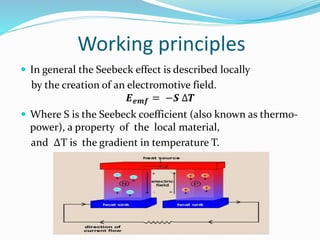
 In general the Seebeck effect is described locally
by the creation of an electromotive field.
𝑬 𝒆𝒎𝒇 = −𝑺 ∆𝑻
 Where S is the Seebeck coefficient (also known as thermo-
power), a property of the local material,
and ∆T is the gradient in temperature T.
Working principles
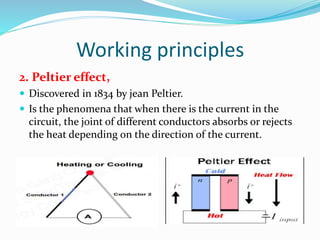
2. Peltier effect,
 Discovered in 1834 by jean Peltier.
 Is the phenomena that when there is the current in the
circuit, the joint of different conductors absorbs or rejects
the heat depending on the direction of the current.
Working principles
 This phenomenon is largely due to the difference of the
Fermi energies between two materials.
 The capacity of the heat absorption or rejection is largely
related to the property of the two dissimilar conductors
and the temperature of the joint.
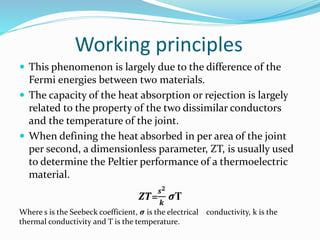
 When defining the heat absorbed in per area of the joint
per second, a dimensionless parameter, ZT, is usually used
to determine the Peltier performance of a thermoelectric
material.
𝒁𝑻=
𝒔 𝟐
𝒌
𝝈T
Where s is the Seebeck coefficient, 𝝈 is the electrical conductivity, k is the
thermal conductivity and T is the temperature.
Working principles
 As a result, the TE technology can be divided into two
categories according to the Seebeck and Peltier
respectively:
1. thermoelectric generator (TEG) for power generation
when the two materials are exposed in different
temperatures.
2. thermoelectric cooler (TEC) for cooling when the voltage
is added onto the two materials.
Working principles
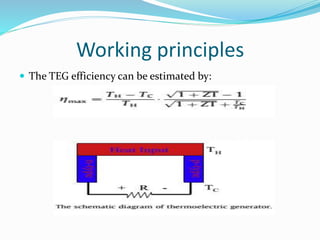
 The TEG efficiency can be estimated by:
Working principles
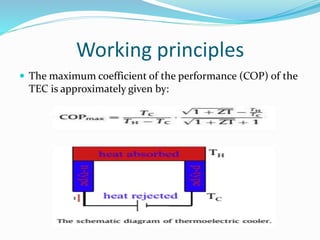
 The maximum coefficient of the performance (COP) of the
TEC is approximately given by:
Thermoelectric Principle of
Operation
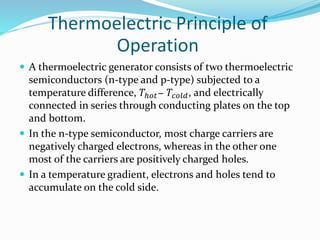
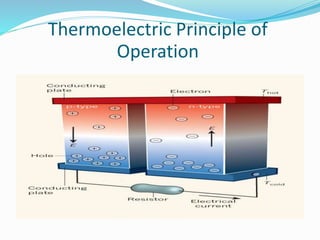
 A thermoelectric generator consists of two thermoelectric
semiconductors (n-type and p-type) subjected to a
temperature difference, 𝑇ℎ𝑜𝑡− 𝑇𝑐𝑜𝑙𝑑, and electrically
connected in series through conducting plates on the top
and bottom.
 In the n-type semiconductor, most charge carriers are
negatively charged electrons, whereas in the other one
most of the carriers are positively charged holes.
 In a temperature gradient, electrons and holes tend to
accumulate on the cold side.
Thermoelectric Principle of
Operation
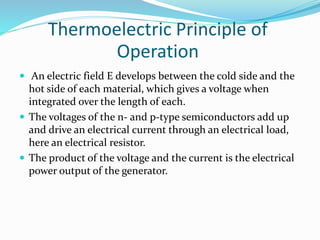
 An electric field E develops between the cold side and the
hot side of each material, which gives a voltage when
integrated over the length of each.
 The voltages of the n- and p-type semiconductors add up
and drive an electrical current through an electrical load,
here an electrical resistor.
 The product of the voltage and the current is the electrical
power output of the generator.
Thermoelectric Principle of
Operation
Thermoelectric Materials
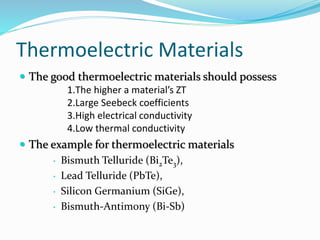
 The good thermoelectric materials should possess
1.The higher a material’s ZT
2.Large Seebeck coefficients
3.High electrical conductivity
4.Low thermal conductivity
 The example for thermoelectric materials
• Bismuth Telluride (Bi2Te3),
• Lead Telluride (PbTe),
• Silicon Germanium (SiGe),
• Bismuth-Antimony (Bi-Sb)
Applications
 Due to the distinct advantages, thermoelectric devices have
been utilized or attempted to be used in areas like
aerospace applications, transportation tools, industrial
utilities, medical services, electronic devices and
temperature detecting and measuring facilities.
 Compared to PV which is also solid-state green technology,
thermoelectric power generation gives lower energy
conversion efficiency.
 However, due to the great potential of power generation by
using solar radiation and any other kinds of possible heat
sources as well as the reliable long period maintenance-free
operation, thermoelectric generators have become
technically attractive.
Applications
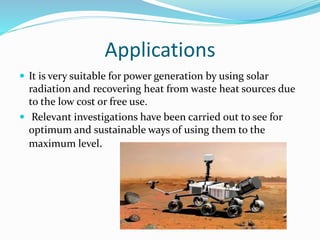
 It is very suitable for power generation by using solar
radiation and recovering heat from waste heat sources due
to the low cost or free use.
 Relevant investigations have been carried out to see for
optimum and sustainable ways of using them to the
maximum level.
Applications in Egypt
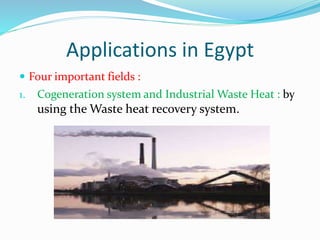
 Four important fields :
1. Cogeneration system and Industrial Waste Heat : by
using the Waste heat recovery system.
Applications in Egypt
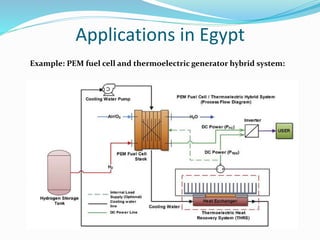
Example: PEM fuel cell and thermoelectric generator hybrid system:
Applications in Egypt
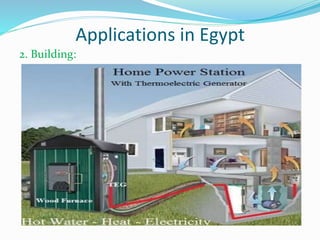
2. Building:
Applications in Egypt
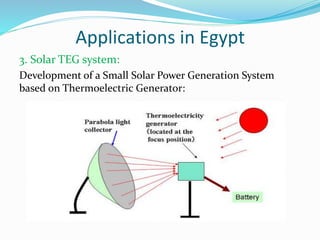
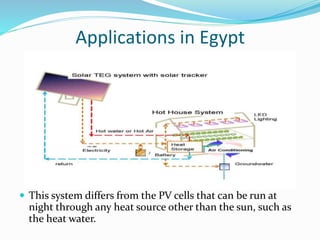
3. Solar TEG system:
Development of a Small Solar Power Generation System
based on Thermoelectric Generator:
Applications in Egypt
 This system differs from the PV cells that can be run at
night through any heat source other than the sun, such as
the heat water.
Applications in Egypt
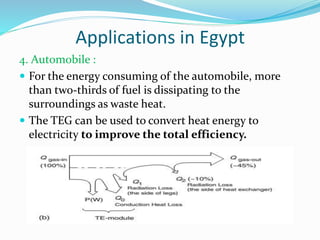
4. Automobile :
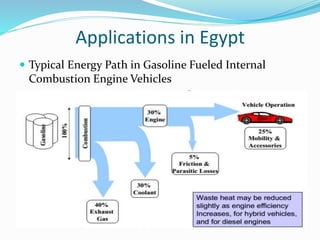
 For the energy consuming of the automobile, more
than two-thirds of fuel is dissipating to the
surroundings as waste heat.
 The TEG can be used to convert heat energy to
electricity to improve the total efficiency.
Applications in Egypt
 Typical Energy Path in Gasoline Fueled Internal
Combustion Engine Vehicles
Applications in Egypt
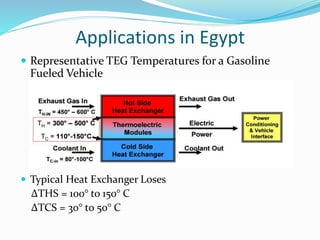
 Representative TEG Temperatures for a Gasoline
Fueled Vehicle
 Typical Heat Exchanger Loses
ΔTHS = 100° to 150° C
ΔTCS = 30° to 50° C
Applications in Egypt
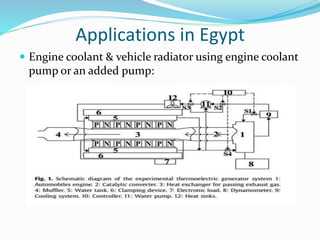
 Engine coolant & vehicle radiator using engine coolant
pump or an added pump:
Applications in Egypt
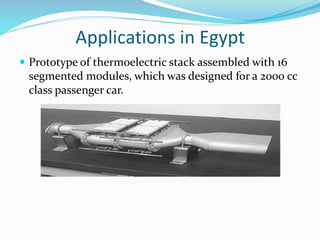
 Prototype of thermoelectric stack assembled with 16
segmented modules, which was designed for a 2000 cc
class passenger car.
Applications in Egypt
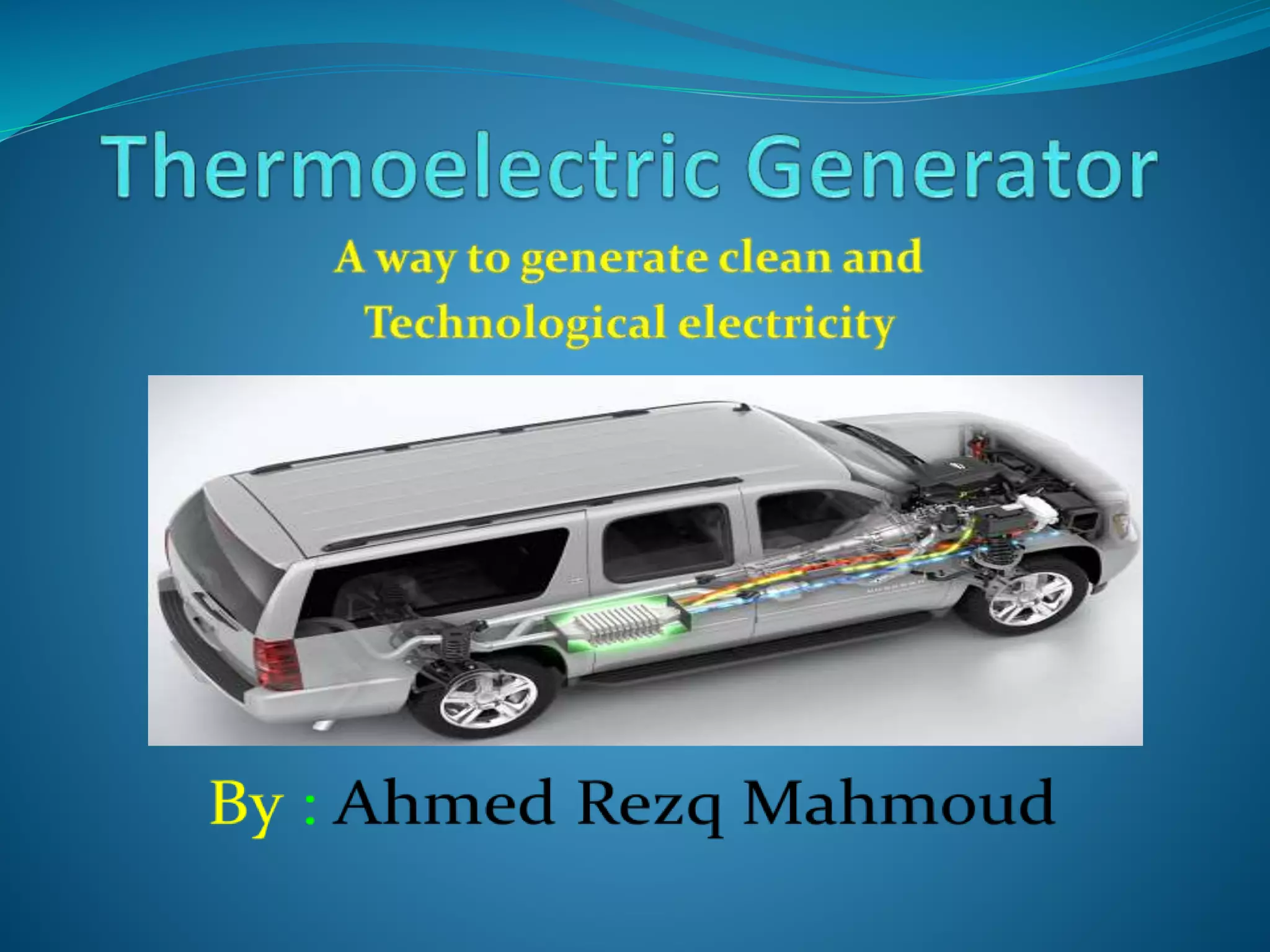
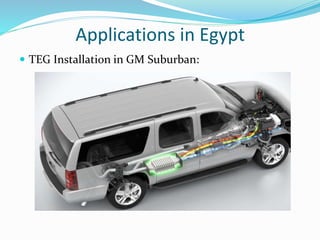
 TEG Installation in GM Suburban:
References
[1] S.B. Riffat*, Xiaoli Ma ," Thermoelectrics: a review of present and
potential applications" , www.elsevier.com/locate/apthermeng.
[2] Mostafa Hasania and Nader Rahbar," Application of thermoelectric
cooler as a power generator in waste heat recovery from a PEM fuel cell-
An experimental study", www.elsevier.com/locate/he.
[3] Wei Hea, Gan Zhang,Xingxing Zhang, Jie Ji, Guiqiang Li and Xudong
Zhao," Recent development and application of thermoelectric generator
and cooler", www.elsevier.com/locate/apenergy .
[4] X.F. Zheng, C.X. Liu, Y.Y. Yann, Q. Wang, “A review of thermoelectrics
research–Recent developments and potentials for sustainable and
renewable energy applications” , www.elsevier.com/locate/rser .
[5] Francis Stabler, “Automotive Thermoelectric Generator Design Issues”
[6] P. Mohamed Shameer, D. Christopher, “Design of Exhaust Heat
Recovery Power Generation System Using Thermo-Electric Generator”
[7] http://www.nature.com
Thermoelectric Generation

Thermoelectric Generation

  • 2.
    Introduction  Extensive fossilfuel consumption by human activities has led to serious atmospheric and environmental problems.  Consequently, global warming, greenhouse gas emission, climate change, ozone layer depletion and acid rain terminologies have started to appear frequently in the literature.  To abate the impact of the above disasters, the thermoelectric (TE) energy converters is proposed as one of the possible technologies for this aim, which currently gains the most popularity owing to its capability in converting the heat given off from vehicles, electrical instruments, etc., into the electricity.
  • 3.
    Introduction  In addition,the TE technology is reversible to transform the electrical energy into the thermal energy for the purpose of cooling or heating.  The merits of this conversion lie in the solid-state operation, the gas-free emissions, the vast scalability, the maintenance-free operation without any moving parts and chemical reactions, no damage to the environment and a long life-span of reliable operation.  However, the TE devices are still in the limited application mainly because of its low energy-conversion efficiency and the corresponding high material cost.
  • 4.
    Introduction  The basictheory behind the TE technologies are all depended upon the principles of Seebeck effect (main for power generation) and Peltier effect (main for refrigeration).
  • 5.
    Working principles 1. SeebeckEffect,  Discovered in 1821 by thomas seebeck.  The Seebeck Effect is the conversion of temperature differences directly into electricity.  It is a classic example of an electromotive force (emf) and leads to measurable currents or voltages in the same way as any other emf.  Electromotive forces modify Ohm’s law by generating currents even in the absence of voltage differences (or vice versa); the local current density is given by, 𝑱 = 𝝈(−∆𝑽 + 𝑬 𝒆𝒎𝒇) Where, V the local voltage and σ is the local conductivity.
  • 6.
    Working principles  Ingeneral the Seebeck effect is described locally by the creation of an electromotive field. 𝑬 𝒆𝒎𝒇 = −𝑺 ∆𝑻  Where S is the Seebeck coefficient (also known as thermo- power), a property of the local material, and ∆T is the gradient in temperature T.
  • 7.
    Working principles 2. Peltiereffect,  Discovered in 1834 by jean Peltier.  Is the phenomena that when there is the current in the circuit, the joint of different conductors absorbs or rejects the heat depending on the direction of the current.
  • 8.
    Working principles  Thisphenomenon is largely due to the difference of the Fermi energies between two materials.  The capacity of the heat absorption or rejection is largely related to the property of the two dissimilar conductors and the temperature of the joint.  When defining the heat absorbed in per area of the joint per second, a dimensionless parameter, ZT, is usually used to determine the Peltier performance of a thermoelectric material. 𝒁𝑻= 𝒔 𝟐 𝒌 𝝈T Where s is the Seebeck coefficient, 𝝈 is the electrical conductivity, k is the thermal conductivity and T is the temperature.
  • 9.
    Working principles  Asa result, the TE technology can be divided into two categories according to the Seebeck and Peltier respectively: 1. thermoelectric generator (TEG) for power generation when the two materials are exposed in different temperatures. 2. thermoelectric cooler (TEC) for cooling when the voltage is added onto the two materials.
  • 10.
    Working principles  TheTEG efficiency can be estimated by:
  • 11.
    Working principles  Themaximum coefficient of the performance (COP) of the TEC is approximately given by:
  • 12.
    Thermoelectric Principle of Operation A thermoelectric generator consists of two thermoelectric semiconductors (n-type and p-type) subjected to a temperature difference, 𝑇ℎ𝑜𝑡− 𝑇𝑐𝑜𝑙𝑑, and electrically connected in series through conducting plates on the top and bottom.  In the n-type semiconductor, most charge carriers are negatively charged electrons, whereas in the other one most of the carriers are positively charged holes.  In a temperature gradient, electrons and holes tend to accumulate on the cold side.
  • 13.
    Thermoelectric Principle of Operation An electric field E develops between the cold side and the hot side of each material, which gives a voltage when integrated over the length of each.  The voltages of the n- and p-type semiconductors add up and drive an electrical current through an electrical load, here an electrical resistor.  The product of the voltage and the current is the electrical power output of the generator.
  • 14.
  • 15.
    Thermoelectric Materials  Thegood thermoelectric materials should possess 1.The higher a material’s ZT 2.Large Seebeck coefficients 3.High electrical conductivity 4.Low thermal conductivity  The example for thermoelectric materials • Bismuth Telluride (Bi2Te3), • Lead Telluride (PbTe), • Silicon Germanium (SiGe), • Bismuth-Antimony (Bi-Sb)
  • 16.
    Applications  Due tothe distinct advantages, thermoelectric devices have been utilized or attempted to be used in areas like aerospace applications, transportation tools, industrial utilities, medical services, electronic devices and temperature detecting and measuring facilities.  Compared to PV which is also solid-state green technology, thermoelectric power generation gives lower energy conversion efficiency.  However, due to the great potential of power generation by using solar radiation and any other kinds of possible heat sources as well as the reliable long period maintenance-free operation, thermoelectric generators have become technically attractive.
  • 17.
    Applications  It isvery suitable for power generation by using solar radiation and recovering heat from waste heat sources due to the low cost or free use.  Relevant investigations have been carried out to see for optimum and sustainable ways of using them to the maximum level.
  • 18.
    Applications in Egypt Four important fields : 1. Cogeneration system and Industrial Waste Heat : by using the Waste heat recovery system.
  • 19.
    Applications in Egypt Example:PEM fuel cell and thermoelectric generator hybrid system:
  • 20.
  • 21.
    Applications in Egypt 3.Solar TEG system: Development of a Small Solar Power Generation System based on Thermoelectric Generator:
  • 22.
    Applications in Egypt This system differs from the PV cells that can be run at night through any heat source other than the sun, such as the heat water.
  • 23.
    Applications in Egypt 4.Automobile :  For the energy consuming of the automobile, more than two-thirds of fuel is dissipating to the surroundings as waste heat.  The TEG can be used to convert heat energy to electricity to improve the total efficiency.
  • 24.
    Applications in Egypt Typical Energy Path in Gasoline Fueled Internal Combustion Engine Vehicles
  • 25.
    Applications in Egypt Representative TEG Temperatures for a Gasoline Fueled Vehicle  Typical Heat Exchanger Loses ΔTHS = 100° to 150° C ΔTCS = 30° to 50° C
  • 26.
    Applications in Egypt Engine coolant & vehicle radiator using engine coolant pump or an added pump:
  • 27.
    Applications in Egypt Prototype of thermoelectric stack assembled with 16 segmented modules, which was designed for a 2000 cc class passenger car.
  • 28.
    Applications in Egypt TEG Installation in GM Suburban:
  • 29.
    References [1] S.B. Riffat*,Xiaoli Ma ," Thermoelectrics: a review of present and potential applications" , www.elsevier.com/locate/apthermeng. [2] Mostafa Hasania and Nader Rahbar," Application of thermoelectric cooler as a power generator in waste heat recovery from a PEM fuel cell- An experimental study", www.elsevier.com/locate/he. [3] Wei Hea, Gan Zhang,Xingxing Zhang, Jie Ji, Guiqiang Li and Xudong Zhao," Recent development and application of thermoelectric generator and cooler", www.elsevier.com/locate/apenergy . [4] X.F. Zheng, C.X. Liu, Y.Y. Yann, Q. Wang, “A review of thermoelectrics research–Recent developments and potentials for sustainable and renewable energy applications” , www.elsevier.com/locate/rser . [5] Francis Stabler, “Automotive Thermoelectric Generator Design Issues” [6] P. Mohamed Shameer, D. Christopher, “Design of Exhaust Heat Recovery Power Generation System Using Thermo-Electric Generator” [7] http://www.nature.com