UFS 104 : CREATIVE AND CRITICAL THINKING

CHAPTER 1:
What is Creative Thinking

                   © 2010 Cosmopoint
Chapter 1: What is Creative Thinking

Topic Outlines


         What is Creative Thinking and why should you be creative ?
         How to be creative and Myths about Creative Thinking and
          Problem Solving
         3 Basic Principles
         Theories of Creative Process
         Characteristic of Creative Thinking
         Enhancing Creative Thinking in Students and Removing
          Blockage


                                       © 2010 Cosmopoint               Slide 2 of 28
Chapter 1: What is Creative Thinking

Learning Outcomes

    At the end of this chapter, students should be able to:

        Understand and describe what is creative thinking
        Understand the views of creative thinking
        Understand the principles of creative thinking
        Understanding and enhance creative in their thinking


                                       © 2010 Cosmopoint        Slide 3 of 28
Chapter 1: What is Creative Thinking

What is Creative Thinking?

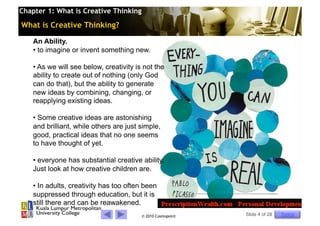
    An Ability.
    •  to imagine or invent something new.

    •  As we will see below, creativity is not the
    ability to create out of nothing (only God
    can do that), but the ability to generate
    new ideas by combining, changing, or
    reapplying existing ideas.

    •  Some creative ideas are astonishing
    and brilliant, while others are just simple,
    good, practical ideas that no one seems
    to have thought of yet.

    •  everyone has substantial creative ability.
    Just look at how creative children are.

    •  In adults, creativity has too often been
    suppressed through education, but it is
    still there and can be reawakened.
                                          © 2010 Cosmopoint   Slide 4 of 28   Topics
Chapter 1: What is Creative Thinking

What is Creative Thinking?

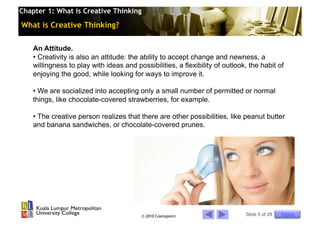
    An Attitude.
    •  Creativity is also an attitude: the ability to accept change and newness, a
    willingness to play with ideas and possibilities, a flexibility of outlook, the habit of
    enjoying the good, while looking for ways to improve it.

    •  We are socialized into accepting only a small number of permitted or normal
    things, like chocolate-covered strawberries, for example.

    •  The creative person realizes that there are other possibilities, like peanut butter
    and banana sandwiches, or chocolate-covered prunes.


                                          © 2010 Cosmopoint                   Slide 5 of 28   Topics
Chapter 1: What is Creative Thinking

What is Creative Thinking?

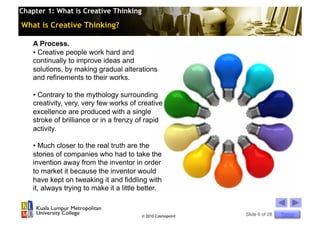
    A Process.
    •  Creative people work hard and
    continually to improve ideas and
    solutions, by making gradual alterations
    and refinements to their works.

    •  Contrary to the mythology surrounding
    creativity, very, very few works of creative
    excellence are produced with a single
    stroke of brilliance or in a frenzy of rapid
    activity.

    •  Much closer to the real truth are the
    stories of companies who had to take the
    invention away from the inventor in order
    to market it because the inventor would
    have kept on tweaking it and fiddling with
    it, always trying to make it a little better.


                                         © 2010 Cosmopoint   Slide 6 of 28   Topics
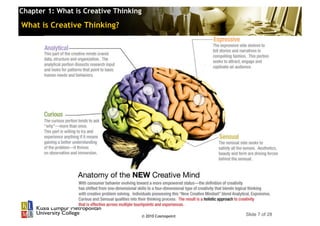
Chapter 1: What is Creative Thinking

What is Creative Thinking?


                                       © 2010 Cosmopoint   Slide 7 of 28
Chapter 1: What is Creative Thinking

Why should you be Creative?


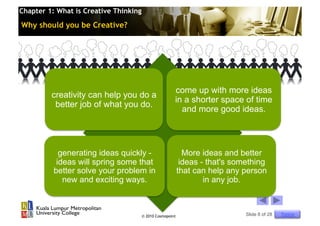
                                                       come up with more ideas
         creativity can help you do a
                                                       in a shorter space of time
          better job of what you do.
                                                         and more good ideas.


            generating ideas quickly -                       More ideas and better
           ideas will spring some that                      ideas - that's something
          better solve your problem in                     that can help any person
             new and exciting ways.                                in any job.


                                       © 2010 Cosmopoint                      Slide 8 of 28   Topics
Chapter 1: What is Creative Thinking

Why should you be Creative?


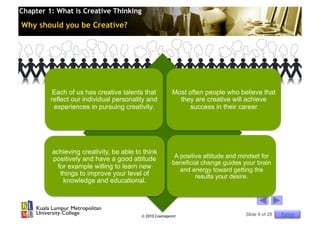
          Each of us has creative talents that          Most often people who believe that
         reflect our individual personality and           they are creative will achieve
          experiences in pursuing creativity.                 success in their career


         achieving creativity, be able to think
         positively and have a good attitude             A positive attitude and mindset for
                                                        beneficial change guides your brain
           for example willing to learn new                and energy toward getting the
            things to improve your level of                      results your desire.
             knowledge and educational.


                                         © 2010 Cosmopoint                        Slide 9 of 28   Topics
Chapter 1: What is Creative Thinking

How to be Creative?


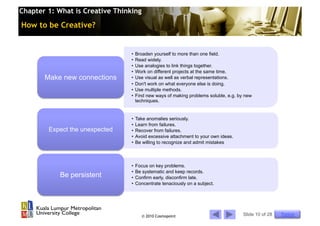
                                 •  Broaden yourself to more than one field.
                                 •  Read widely.
                                 •  Use analogies to link things together.
                                 •  Work on different projects at the same time.
       Make new connections      •  Use visual as well as verbal representations.
                                 •  Don't work on what everyone else is doing.
                                 •  Use multiple methods.
                                 •  Find new ways of making problems soluble, e.g. by new
                                    techniques.


                                 •  Take anomalies seriously.
                                 •  Learn from failures.
        Expect the unexpected    •  Recover from failures.
                                 •  Avoid excessive attachment to your own ideas.
                                 •  Be willing to recognize and admit mistakes


                                 •  Focus on key problems.
                                 •  Be systematic and keep records.
            Be persistent        •  Confirm early, disconfirm late.
                                 •  Concentrate tenaciously on a subject.


                                       © 2010 Cosmopoint                             Slide 10 of 28   Topics
Chapter 1: What is Creative Thinking

How to be Creative?
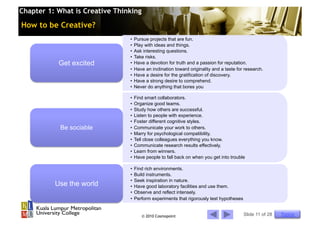
                                •  Pursue projects that are fun.
                                •  Play with ideas and things.
                                •  Ask interesting questions.
                                •  Take risks.
           Get excited          •  Have a devotion for truth and a passion for reputation.
                                •  Have an inclination toward originality and a taste for research.
                                •  Have a desire for the gratification of discovery.
                                •  Have a strong desire to comprehend.
                                •  Never do anything that bores you

                                •  Find smart collaborators.
                                •  Organize good teams.
                                •  Study how others are successful.
                                •  Listen to people with experience.
                                •  Foster different cognitive styles.
            Be sociable         •  Communicate your work to others.
                                •  Marry for psychological compatibility.
                                •  Tell close colleagues everything you know.
                                •  Communicate research results effectively.
                                •  Learn from winners.
                                •  Have people to fall back on when you get into trouble

                                •  Find rich environments.
                                •  Build instruments.
                                •  Seek inspiration in nature.
          Use the world         •  Have good laboratory facilities and use them.
                                •  Observe and reflect intensely.
                                •  Perform experiments that rigorously test hypotheses


                                       © 2010 Cosmopoint                                 Slide 11 of 28   Topics
Chapter 1: What is Creative Thinking

Three Basic Principles

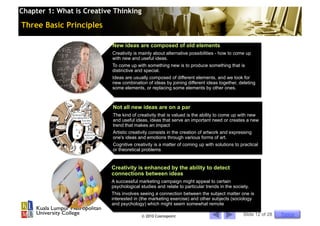
                           New ideas are composed of old elements
                           Creativity is mainly about alternative possibilities - how to come up
                           with new and useful ideas.
                           To come up with something new is to produce something that is
                           distinctive and special.
                           Ideas are usually composed of different elements, and we look for
                           new combination of ideas by joining different ideas together, deleting
                           some elements, or replacing some elements by other ones.


                           Not all new ideas are on a par
                           The kind of creativity that is valued is the ability to come up with new
                           and useful ideas, ideas that serve an important need or creates a new
                           trend that makes an impact
                           Artistic creativity consists in the creation of artwork and expressing
                           one's ideas and emotions through various forms of art.
                           Cognitive creativity is a matter of coming up with solutions to practical
                           or theoretical problems


                           Creativity is enhanced by the ability to detect
                           connections between ideas
                           A successful marketing campaign might appeal to certain
                           psychological studies and relate to particular trends in the society.
                           This involves seeing a connection between the subject matter one is
                           interested in (the marketing exercise) and other subjects (sociology
                           and psychology) which might seem somewhat remote

                                          © 2010 Cosmopoint                                  Slide 12 of 28   Topics
Chapter 1: What is Creative Thinking

Myths about Creative Thinking and Problem Solving

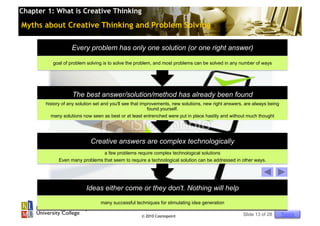
                   Every problem has only one solution (or one right answer)

          goal of problem solving is to solve the problem, and most problems can be solved in any number of ways


                   The best answer/solution/method has already been found
       history of any solution set and you'll see that improvements, new solutions, new right answers, are always being
                                                          found.yourself.
         many solutions now seen as best or at least entrenched were put in place hastily and without much thought


                            Creative answers are complex technologically
                                a few problems require complex technological solutions
             Even many problems that seem to require a technological solution can be addressed in other ways.


                          Ideas either come or they don't. Nothing will help
                                 many successful techniques for stimulating idea generation

                                                     © 2010 Cosmopoint                               Slide 13 of 28       Topics
Chapter 1: What is Creative Thinking

Using Sensing and meaning

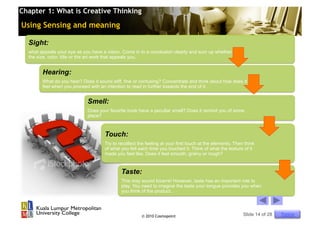
  Sight:
  what appeals your eye as you have a vision. Come in to a conclusion clearly and sum up whether it is
  the size, color, title or the art work that appeals you.


        Hearing:
        What do you hear? Does it sound stiff, fine or confusing? Concentrate and think about how does it
        feel when you proceed with an intention to read in further towards the end of it.


                             Smell:
                             Does your favorite book have a peculiar smell? Does it remind you of some
                             place?


                                      Touch:
                                      Try to recollect the feeling at your first touch at the elements. Then think
                                      of what you felt each time you touched it. Think of what the texture of it
                                      made you feel like. Does it feel smooth, grainy or rough?


                                              Taste:
                                              This may sound bizarre! However, taste has an important role to
                                              play. You need to imagine the taste your tongue provides you when
                                              you think of the product.


                                                        © 2010 Cosmopoint                                   Slide 14 of 28   Topics
Chapter 1: What is Creative Thinking

Using your Sense


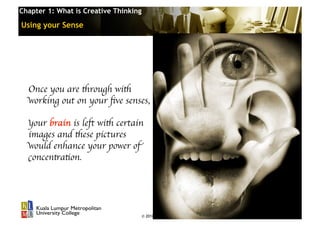
  Once you are through with 	

  working out on your five senses, 	


  your brain is left with certain 	

  images and these pictures 	

  would enhance your power of
  concentration. 	


                                       © 2010 Cosmopoint   Slide 15 of 28
Chapter 1: What is Creative Thinking

Using your Sense


  Remember, 	

 that you require putting in a lot of 	

  sensations into your creative thinking activity. 	


  The exercise for creative thinking …will storm your brain with
  excellent IDEAS 	

                                       © 2010 Cosmopoint   Slide 16 of 28
Chapter 1: What is Creative Thinking

Theories of Creative Process

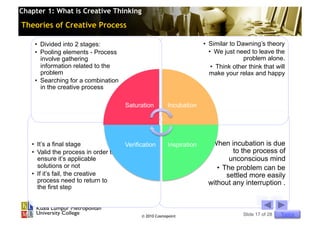
    •  Divided into 2 stages:                                          •  Similar to Dawning’s theory
    •  Pooling elements - Process                                         •  We just need to leave the
       involve gathering                                                                problem alone.
       information related to the                                          •  Think other think that will
       problem                                                            make your relax and happy
    •  Searching for a combination
       in the creative process

                                      Saturation         Incubation


   •  It’s a final stage              Verification       Inspiration    •  When incubation is due
   •  Valid the process in order to                                               to the process of
      ensure it’s applicable                                                     unconscious mind
      solutions or not                                                      •  The problem can be
   •  If it’s fail, the creative                                                settled more easily
      process need to return to                                          without any interruption .
      the first step


                                            © 2010 Cosmopoint                          Slide 17 of 28   Topics
Chapter 1: What is Creative Thinking

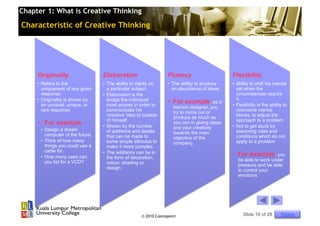
Characteristic of Creative Thinking


     Originality                   Elaboration                      Fluency                     Flexibility
     •  Refers to the              •  The ability to clarify on     •  The ability to produce   •  ability to shift his mental
        uniqueness of any given       a particular subject.            an abundance of ideas       set when the
        response.                  •  Elaboration is the                                           circumstances require
     •  Originality is shown by       bridge the individual                                        it.
        an unusual, unique, or        must access in order to
                                                                    •  For example, as a        •  Flexibility is the ability to
                                                                      fashion designer, you
        rare response                 communicate his                 try to come out or           overcome mental
                                      ‘creative’ idea to outside      produce as much as           blocks, to adjust the
                                      of himself.                                                  approach to a problem
     •  For example                •  Shown by the number
                                                                      you can in giving ideas
                                                                                                •  Not to get stuck by
      •  Design a dream                                               and your creativity
                                      of additions and details        towards the main             assuming rules and
         computer of the future.      that can be made to                                          conditions which do not
                                                                      objective of the
      •  Think of how many            some simple stimulus to         company.                     apply to a problem
         things you could use a       make it more complex.
         cable for.                •  The additions can be in
      •  How many uses can            the form of decoration,
                                                                                                •  For example, you
         you list for a VCD?                                                                       be able to work under
                                      colour, shading or                                           pressure and be able
                                      design.                                                      to control your
                                                                                                   emotions


                                                       © 2010 Cosmopoint                              Slide 18 of 28        Topics
Chapter 1: What is Creative Thinking

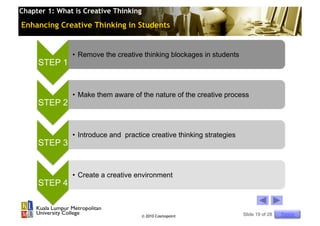
Enhancing Creative Thinking in Students


               •  Remove the creative thinking blockages in students
     STEP 1


               •  Make them aware of the nature of the creative process
     STEP 2


               •  Introduce and practice creative thinking strategies
     STEP 3


               •  Create a creative environment
     STEP 4


                                       © 2010 Cosmopoint                Slide 19 of 28   Topics
Chapter 1: What is Creative Thinking

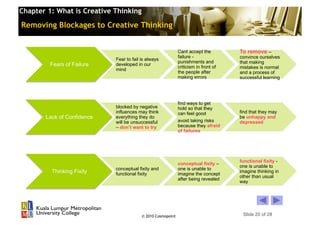
Removing Blockages to Creative Thinking


                                                             Cant accept the         To remove –
                                                             failure -               convince ourselves
                            Fear to fail is always
                                                             punishments and         that making
         Fears of Failure   developed in our
                                                             criticism in front of   mistakes is normal
                            mind
                                                             the people after        and a process of
                                                             making errors           successful learning


                                                             find ways to get
                            blocked by negative              hold so that they
                            influences may think             can feel good           find that they may
       Lack of Confidence   everything they do                                       be unhappy and
                            will be unsuccessful             avoid taking risks      depressed
                            – don’t want to try              because they afraid
                                                             of failures


                                                                                     functional fixity -
                                                             conceptual fixity –
                                                                                     one is unable to
                            conceptual fixity and            one is unable to
         Thinking Fixity    functional fixity                imagine the concept
                                                                                     imagine thinking in
                                                                                     other than usual
                                                             after being revealed
                                                                                     way


                                         © 2010 Cosmopoint                            Slide 20 of 28
Chapter 1: What is Creative Thinking

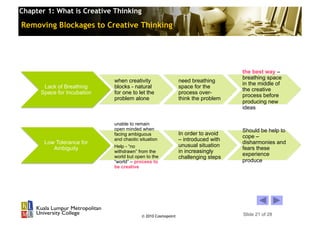
Removing Blockages to Creative Thinking


                                                                                  the best way –
                                                                                  breathing space
                             when creativity                  need breathing
                                                                                  in the middle of
       Lack of Breathing     blocks - natural                 space for the
                                                                                  the creative
      Space for Incubation   for one to let the               process over-
                                                                                  process before
                             problem alone                    think the problem
                                                                                  producing new
                                                                                  ideas

                             unable to remain
                             open minded when                                     Should be help to
                             facing ambiguous                 In order to avoid
                                                                                  cope –
                             and chaotic situation            – introduced with
       Low Tolerance for                                                          disharmonies and
                             Help - “no                       unusual situation
          Ambiguity                                                               fears these
                             withdrawn” from the              in increasingly
                             world but open to the                                experience
                                                              challenging steps
                             “world” – process to                                 produce
                             be creative


                                          © 2010 Cosmopoint                       Slide 21 of 28
Chapter 1: What is Creative Thinking

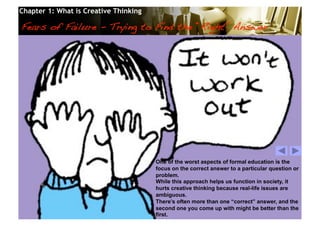
Fears of Failure - Trying to Find the “Right” Answer!


                                              One of the worst aspects of formal education is the
                                              focus on the correct answer to a particular question or
                                              problem.
                                              While this approach helps us function in society, it
                                              hurts creative thinking because real-life issues are
                                              ambiguous.
                                              There’s often more than one “correct” answer, and the
                                              second one you come up with might be better than the
                                              first.
                                       © 2010 Cosmopoint                       Slide 22 of 28
Chapter 1: What is Creative Thinking

Lack of Confidence - don’t want to try!


                                                  We hate being wrong, and yet mistakes often teach
                                                  us the most.
                                                  Thomas Edison was wrong 1,800 times before
                                                  getting the light bulb right. Edison’s greatest
                                                  strength was that he was not afraid to be wrong.
                                                  The best thing we do is learn from our mistakes,
                                                  but we have to free ourselves to make mistakes in
                                                  the first place.
                                       © 2010 Cosmopoint                           Slide 23 of 28
Chapter 1: What is Creative Thinking

Thinking Fixity - Following Rules !


                                One way to view creative thinking is to look at it as a destructive
                                force. You’re tearing away the often arbitrary rules that others
                                have set for you, and asking either “why” or “why not”
                                whenever confronted with the way “everyone” does things.
                                This is easier said than done, since people will often defend the
                                rules they follow even in the face of evidence that the rule
                                doesn’t work. People love to celebrate rebels like Richard
                                Branson, but few seem brave enough to emulate him. Quit
                                worshipping rule breakers and start breaking some rules.
                                     © 2010 Cosmopoint                       Slide 24 of 28
Chapter 1: What is Creative Thinking

Lack of Breathing Space for Incubation!


Give time…..!


Try not to evaluate the actual feasibility of an approach until you’ve allowed it to exist on its own for a bit.
Spend time asking “what if” as often as possible, and simply allow your imagination to go where it wants.
You might just find yourself discovering a crazy idea that’s so insanely practical that no one’s thought of
it before.                                       © 2010 Cosmopoint                       Slide 25 of 28
Chapter 1: What is Creative Thinking

Low Tolerance for Ambiguity!


We rationally realize that
most every situation is
ambiguous to some
degree.
And although dividing
complex situations into
black and white boxes
can lead to disaster, we
still do it. The fact that
most people are
uncomfortable exploring
uncertainty gives you an
advantage, as long as you
can embrace ambiguity
rather than run from it.


                                       © 2010 Cosmopoint   Slide 26 of 28
Chapter 1: What is Creative Thinking

Movie – How to be creative by Tony Buzan


                                       © 2010 Cosmopoint   Slide 27 of 28
Chapter 1: What is Creative Thinking


                              THANK YOU
                           SEE YOU NEXT WEEK WITH


                                 CHAPTER 2
                           THE CREATIVE TECHNIQUE


                                       © 2010 Cosmopoint   Slide 28 of 28

Chapter 1 slides

  • 1.
    UFS 104 :CREATIVE AND CRITICAL THINKING CHAPTER 1: What is Creative Thinking © 2010 Cosmopoint
  • 2.
    Chapter 1: Whatis Creative Thinking Topic Outlines   What is Creative Thinking and why should you be creative ?   How to be creative and Myths about Creative Thinking and Problem Solving   3 Basic Principles   Theories of Creative Process   Characteristic of Creative Thinking   Enhancing Creative Thinking in Students and Removing Blockage © 2010 Cosmopoint Slide 2 of 28
  • 3.
    Chapter 1: Whatis Creative Thinking Learning Outcomes At the end of this chapter, students should be able to:   Understand and describe what is creative thinking   Understand the views of creative thinking   Understand the principles of creative thinking   Understanding and enhance creative in their thinking © 2010 Cosmopoint Slide 3 of 28
  • 4.
    Chapter 1: Whatis Creative Thinking What is Creative Thinking? An Ability. •  to imagine or invent something new. •  As we will see below, creativity is not the ability to create out of nothing (only God can do that), but the ability to generate new ideas by combining, changing, or reapplying existing ideas. •  Some creative ideas are astonishing and brilliant, while others are just simple, good, practical ideas that no one seems to have thought of yet. •  everyone has substantial creative ability. Just look at how creative children are. •  In adults, creativity has too often been suppressed through education, but it is still there and can be reawakened. © 2010 Cosmopoint Slide 4 of 28 Topics
  • 5.
    Chapter 1: Whatis Creative Thinking What is Creative Thinking? An Attitude. •  Creativity is also an attitude: the ability to accept change and newness, a willingness to play with ideas and possibilities, a flexibility of outlook, the habit of enjoying the good, while looking for ways to improve it. •  We are socialized into accepting only a small number of permitted or normal things, like chocolate-covered strawberries, for example. •  The creative person realizes that there are other possibilities, like peanut butter and banana sandwiches, or chocolate-covered prunes. © 2010 Cosmopoint Slide 5 of 28 Topics
  • 6.
    Chapter 1: Whatis Creative Thinking What is Creative Thinking? A Process. •  Creative people work hard and continually to improve ideas and solutions, by making gradual alterations and refinements to their works. •  Contrary to the mythology surrounding creativity, very, very few works of creative excellence are produced with a single stroke of brilliance or in a frenzy of rapid activity. •  Much closer to the real truth are the stories of companies who had to take the invention away from the inventor in order to market it because the inventor would have kept on tweaking it and fiddling with it, always trying to make it a little better. © 2010 Cosmopoint Slide 6 of 28 Topics
  • 7.
    Chapter 1: Whatis Creative Thinking What is Creative Thinking? © 2010 Cosmopoint Slide 7 of 28
  • 8.
    Chapter 1: Whatis Creative Thinking Why should you be Creative? come up with more ideas creativity can help you do a in a shorter space of time better job of what you do. and more good ideas. generating ideas quickly - More ideas and better ideas will spring some that ideas - that's something better solve your problem in that can help any person new and exciting ways. in any job. © 2010 Cosmopoint Slide 8 of 28 Topics
  • 9.
    Chapter 1: Whatis Creative Thinking Why should you be Creative? Each of us has creative talents that Most often people who believe that reflect our individual personality and they are creative will achieve experiences in pursuing creativity. success in their career achieving creativity, be able to think positively and have a good attitude A positive attitude and mindset for beneficial change guides your brain for example willing to learn new and energy toward getting the things to improve your level of results your desire. knowledge and educational. © 2010 Cosmopoint Slide 9 of 28 Topics
  • 10.
    Chapter 1: Whatis Creative Thinking How to be Creative? •  Broaden yourself to more than one field. •  Read widely. •  Use analogies to link things together. •  Work on different projects at the same time. Make new connections •  Use visual as well as verbal representations. •  Don't work on what everyone else is doing. •  Use multiple methods. •  Find new ways of making problems soluble, e.g. by new techniques. •  Take anomalies seriously. •  Learn from failures. Expect the unexpected •  Recover from failures. •  Avoid excessive attachment to your own ideas. •  Be willing to recognize and admit mistakes •  Focus on key problems. •  Be systematic and keep records. Be persistent •  Confirm early, disconfirm late. •  Concentrate tenaciously on a subject. © 2010 Cosmopoint Slide 10 of 28 Topics
  • 11.
    Chapter 1: Whatis Creative Thinking How to be Creative? •  Pursue projects that are fun. •  Play with ideas and things. •  Ask interesting questions. •  Take risks. Get excited •  Have a devotion for truth and a passion for reputation. •  Have an inclination toward originality and a taste for research. •  Have a desire for the gratification of discovery. •  Have a strong desire to comprehend. •  Never do anything that bores you •  Find smart collaborators. •  Organize good teams. •  Study how others are successful. •  Listen to people with experience. •  Foster different cognitive styles. Be sociable •  Communicate your work to others. •  Marry for psychological compatibility. •  Tell close colleagues everything you know. •  Communicate research results effectively. •  Learn from winners. •  Have people to fall back on when you get into trouble •  Find rich environments. •  Build instruments. •  Seek inspiration in nature. Use the world •  Have good laboratory facilities and use them. •  Observe and reflect intensely. •  Perform experiments that rigorously test hypotheses © 2010 Cosmopoint Slide 11 of 28 Topics
  • 12.
    Chapter 1: Whatis Creative Thinking Three Basic Principles New ideas are composed of old elements Creativity is mainly about alternative possibilities - how to come up with new and useful ideas. To come up with something new is to produce something that is distinctive and special. Ideas are usually composed of different elements, and we look for new combination of ideas by joining different ideas together, deleting some elements, or replacing some elements by other ones. Not all new ideas are on a par The kind of creativity that is valued is the ability to come up with new and useful ideas, ideas that serve an important need or creates a new trend that makes an impact Artistic creativity consists in the creation of artwork and expressing one's ideas and emotions through various forms of art. Cognitive creativity is a matter of coming up with solutions to practical or theoretical problems Creativity is enhanced by the ability to detect connections between ideas A successful marketing campaign might appeal to certain psychological studies and relate to particular trends in the society. This involves seeing a connection between the subject matter one is interested in (the marketing exercise) and other subjects (sociology and psychology) which might seem somewhat remote © 2010 Cosmopoint Slide 12 of 28 Topics
  • 13.
    Chapter 1: Whatis Creative Thinking Myths about Creative Thinking and Problem Solving Every problem has only one solution (or one right answer) goal of problem solving is to solve the problem, and most problems can be solved in any number of ways The best answer/solution/method has already been found history of any solution set and you'll see that improvements, new solutions, new right answers, are always being found.yourself. many solutions now seen as best or at least entrenched were put in place hastily and without much thought Creative answers are complex technologically a few problems require complex technological solutions Even many problems that seem to require a technological solution can be addressed in other ways. Ideas either come or they don't. Nothing will help many successful techniques for stimulating idea generation © 2010 Cosmopoint Slide 13 of 28 Topics
  • 14.
    Chapter 1: Whatis Creative Thinking Using Sensing and meaning Sight: what appeals your eye as you have a vision. Come in to a conclusion clearly and sum up whether it is the size, color, title or the art work that appeals you. Hearing: What do you hear? Does it sound stiff, fine or confusing? Concentrate and think about how does it feel when you proceed with an intention to read in further towards the end of it. Smell: Does your favorite book have a peculiar smell? Does it remind you of some place? Touch: Try to recollect the feeling at your first touch at the elements. Then think of what you felt each time you touched it. Think of what the texture of it made you feel like. Does it feel smooth, grainy or rough? Taste: This may sound bizarre! However, taste has an important role to play. You need to imagine the taste your tongue provides you when you think of the product. © 2010 Cosmopoint Slide 14 of 28 Topics
  • 15.
    Chapter 1: Whatis Creative Thinking Using your Sense Once you are through with working out on your five senses, your brain is left with certain images and these pictures would enhance your power of concentration. © 2010 Cosmopoint Slide 15 of 28
  • 16.
    Chapter 1: Whatis Creative Thinking Using your Sense Remember, that you require putting in a lot of sensations into your creative thinking activity. The exercise for creative thinking …will storm your brain with excellent IDEAS © 2010 Cosmopoint Slide 16 of 28
  • 17.
    Chapter 1: Whatis Creative Thinking Theories of Creative Process •  Divided into 2 stages: •  Similar to Dawning’s theory •  Pooling elements - Process •  We just need to leave the involve gathering problem alone. information related to the •  Think other think that will problem make your relax and happy •  Searching for a combination in the creative process Saturation Incubation •  It’s a final stage Verification Inspiration •  When incubation is due •  Valid the process in order to to the process of ensure it’s applicable unconscious mind solutions or not •  The problem can be •  If it’s fail, the creative settled more easily process need to return to without any interruption . the first step © 2010 Cosmopoint Slide 17 of 28 Topics
  • 18.
    Chapter 1: Whatis Creative Thinking Characteristic of Creative Thinking Originality Elaboration Fluency Flexibility •  Refers to the •  The ability to clarify on •  The ability to produce •  ability to shift his mental uniqueness of any given a particular subject. an abundance of ideas set when the response. •  Elaboration is the circumstances require •  Originality is shown by bridge the individual it. an unusual, unique, or must access in order to •  For example, as a •  Flexibility is the ability to fashion designer, you rare response communicate his try to come out or overcome mental ‘creative’ idea to outside produce as much as blocks, to adjust the of himself. approach to a problem •  For example •  Shown by the number you can in giving ideas •  Not to get stuck by •  Design a dream and your creativity of additions and details towards the main assuming rules and computer of the future. that can be made to conditions which do not objective of the •  Think of how many some simple stimulus to company. apply to a problem things you could use a make it more complex. cable for. •  The additions can be in •  How many uses can the form of decoration, •  For example, you you list for a VCD? be able to work under colour, shading or pressure and be able design. to control your emotions © 2010 Cosmopoint Slide 18 of 28 Topics
  • 19.
    Chapter 1: Whatis Creative Thinking Enhancing Creative Thinking in Students •  Remove the creative thinking blockages in students STEP 1 •  Make them aware of the nature of the creative process STEP 2 •  Introduce and practice creative thinking strategies STEP 3 •  Create a creative environment STEP 4 © 2010 Cosmopoint Slide 19 of 28 Topics
  • 20.
    Chapter 1: Whatis Creative Thinking Removing Blockages to Creative Thinking Cant accept the To remove – failure - convince ourselves Fear to fail is always punishments and that making Fears of Failure developed in our criticism in front of mistakes is normal mind the people after and a process of making errors successful learning find ways to get blocked by negative hold so that they influences may think can feel good find that they may Lack of Confidence everything they do be unhappy and will be unsuccessful avoid taking risks depressed – don’t want to try because they afraid of failures functional fixity - conceptual fixity – one is unable to conceptual fixity and one is unable to Thinking Fixity functional fixity imagine the concept imagine thinking in other than usual after being revealed way © 2010 Cosmopoint Slide 20 of 28
  • 21.
    Chapter 1: Whatis Creative Thinking Removing Blockages to Creative Thinking the best way – breathing space when creativity need breathing in the middle of Lack of Breathing blocks - natural space for the the creative Space for Incubation for one to let the process over- process before problem alone think the problem producing new ideas unable to remain open minded when Should be help to facing ambiguous In order to avoid cope – and chaotic situation – introduced with Low Tolerance for disharmonies and Help - “no unusual situation Ambiguity fears these withdrawn” from the in increasingly world but open to the experience challenging steps “world” – process to produce be creative © 2010 Cosmopoint Slide 21 of 28
  • 22.
    Chapter 1: Whatis Creative Thinking Fears of Failure - Trying to Find the “Right” Answer! One of the worst aspects of formal education is the focus on the correct answer to a particular question or problem. While this approach helps us function in society, it hurts creative thinking because real-life issues are ambiguous. There’s often more than one “correct” answer, and the second one you come up with might be better than the first. © 2010 Cosmopoint Slide 22 of 28
  • 23.
    Chapter 1: Whatis Creative Thinking Lack of Confidence - don’t want to try! We hate being wrong, and yet mistakes often teach us the most. Thomas Edison was wrong 1,800 times before getting the light bulb right. Edison’s greatest strength was that he was not afraid to be wrong. The best thing we do is learn from our mistakes, but we have to free ourselves to make mistakes in the first place. © 2010 Cosmopoint Slide 23 of 28
  • 24.
    Chapter 1: Whatis Creative Thinking Thinking Fixity - Following Rules ! One way to view creative thinking is to look at it as a destructive force. You’re tearing away the often arbitrary rules that others have set for you, and asking either “why” or “why not” whenever confronted with the way “everyone” does things. This is easier said than done, since people will often defend the rules they follow even in the face of evidence that the rule doesn’t work. People love to celebrate rebels like Richard Branson, but few seem brave enough to emulate him. Quit worshipping rule breakers and start breaking some rules. © 2010 Cosmopoint Slide 24 of 28
  • 25.
    Chapter 1: Whatis Creative Thinking Lack of Breathing Space for Incubation! Give time…..! Try not to evaluate the actual feasibility of an approach until you’ve allowed it to exist on its own for a bit. Spend time asking “what if” as often as possible, and simply allow your imagination to go where it wants. You might just find yourself discovering a crazy idea that’s so insanely practical that no one’s thought of it before. © 2010 Cosmopoint Slide 25 of 28
  • 26.
    Chapter 1: Whatis Creative Thinking Low Tolerance for Ambiguity! We rationally realize that most every situation is ambiguous to some degree. And although dividing complex situations into black and white boxes can lead to disaster, we still do it. The fact that most people are uncomfortable exploring uncertainty gives you an advantage, as long as you can embrace ambiguity rather than run from it. © 2010 Cosmopoint Slide 26 of 28
  • 27.
    Chapter 1: Whatis Creative Thinking Movie – How to be creative by Tony Buzan © 2010 Cosmopoint Slide 27 of 28
  • 28.
    Chapter 1: Whatis Creative Thinking THANK YOU SEE YOU NEXT WEEK WITH CHAPTER 2 THE CREATIVE TECHNIQUE © 2010 Cosmopoint Slide 28 of 28