Basic
4Th grade level
Electrical Circuits
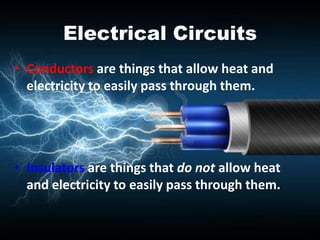
• Conductors are things that allow heat and
electricity to easily pass through them.

• Insulators are things that do not allow heat
and electricity to easily pass through them.
Electricity
• Electricity is the presence or movement of
electrons, which are tiny, negatively charged
particles that orbit an atom’s nucleus.

• Electricity is what we get when electrons move
from one place to another.
Where Is Electricity
• Electricity is present in lightning and in power
grids.

• When you plug an appliance into the wall,
electricity moves from a reserve in the wall to
the appliance, which makes it run.
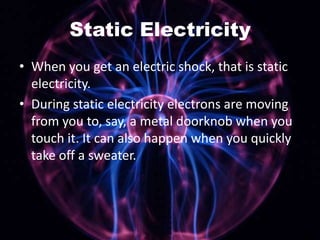
Static Electricity
• When you get an electric shock, that is static
electricity.
• During static electricity electrons are moving
from you to, say, a metal doorknob when you
touch it. It can also happen when you quickly
take off a sweater.
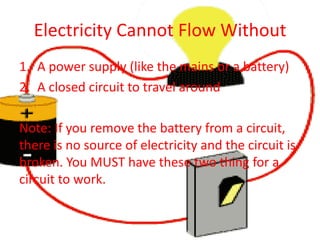
Electricity Cannot Flow Without
1. A power supply (like the mains or a battery)
2. A closed circuit to travel around
Note: If you remove the battery from a circuit,
there is no source of electricity and the circuit is
broken. You MUST have these two thing for a
circuit to work.
Helping Bulbs
• The bulb allows us to see whether the circuit
is correctly connected. If it is not, the bulb
goes off.

Note: There must be a closed circuit so the
electricity can flow.
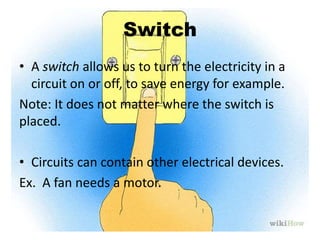
Switch
• A switch allows us to turn the electricity in a
circuit on or off, to save energy for example.
Note: It does not matter where the switch is
placed.
• Circuits can contain other electrical devices.
Ex. A fan needs a motor.
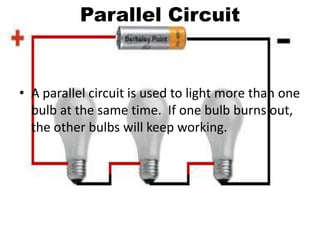
Parallel Circuit

• A parallel circuit is used to light more than one
bulb at the same time. If one bulb burns out,
the other bulbs will keep working.

Basic Electricity 4th grade level

  • 1.
  • 2.
    Electrical Circuits • Conductorsare things that allow heat and electricity to easily pass through them. • Insulators are things that do not allow heat and electricity to easily pass through them.
  • 3.
    Electricity • Electricity isthe presence or movement of electrons, which are tiny, negatively charged particles that orbit an atom’s nucleus. • Electricity is what we get when electrons move from one place to another.
  • 4.
    Where Is Electricity •Electricity is present in lightning and in power grids. • When you plug an appliance into the wall, electricity moves from a reserve in the wall to the appliance, which makes it run.
  • 5.
    Static Electricity • Whenyou get an electric shock, that is static electricity. • During static electricity electrons are moving from you to, say, a metal doorknob when you touch it. It can also happen when you quickly take off a sweater.
  • 6.
    Electricity Cannot FlowWithout 1. A power supply (like the mains or a battery) 2. A closed circuit to travel around Note: If you remove the battery from a circuit, there is no source of electricity and the circuit is broken. You MUST have these two thing for a circuit to work.
  • 7.
    Helping Bulbs • Thebulb allows us to see whether the circuit is correctly connected. If it is not, the bulb goes off. Note: There must be a closed circuit so the electricity can flow.
  • 8.
    Switch • A switchallows us to turn the electricity in a circuit on or off, to save energy for example. Note: It does not matter where the switch is placed. • Circuits can contain other electrical devices. Ex. A fan needs a motor.
  • 9.
    Parallel Circuit • Aparallel circuit is used to light more than one bulb at the same time. If one bulb burns out, the other bulbs will keep working.