ABDOMINAL WALL DEFECTS

          Presented by
   Dr: Adam Mohammed
          August 2012
Introduction
• 1634, Ambroise Paré first described an
  omphalocele.
• Calder described a child with gastroschisis.
OMPHALOCOELE


• It is a defect in abdominal wall musculature
  and skin with protrusion of abdominal
  viscera contained within a membranous sac.
Omphalocele

Abdominal wall defect
Incidence


•   Small omphalocoele 1:5000
•   Large omphalocoele 1:10000
•   Male to female ratio 1:1
•   Pacific Islanders have low risk for
    omphalocoele
Pathophysiology


• Failure of the midgut to return to abdomen
  by the 10th week of gestation
Clinical Findings
• Covered clinical
  defect of the umbilical
  ring
• Defect may vary from
  2-10 cm
• Sac is composed of
  amnion, Wharton’s
  jelly and peritoneum
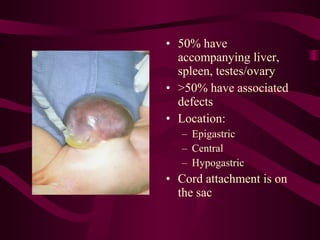
• 50% have
  accompanying liver,
  spleen, testes/ovary
• >50% have associated
  defects
• Location:
   – Epigastric
   – Central
   – Hypogastric
• Cord attachment is on
  the sac
• The sac may rupture in utero in 10-18%
   or from the delivery process in4%.
• The incidence of associated major
  congenital anomalies in up to 81%.
Defects of cranial fold
•   congenital heart disease
•    diaphragmatic hernia
•    ectopia cordis
•   sternal cleft,
Defects
               of caudad fold
•   imperforate anus
•   genitourinary malformations
•   bladder or cloacal exstrophy
•   colon atresia
•    sacral and vertebral anomalies, and
•   meningomyelocele.
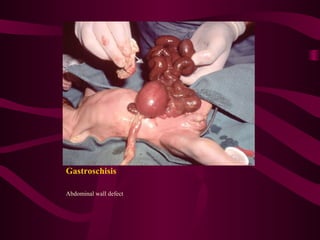
GASTROSCHISIS

• It is the defect in the abdominal wall was
  displaced to the right of the umbilicus and
  eviscerated bowel was not covered by a
  membrane.
Gastroschisis

Abdominal wall defect
Incidence


•   1:20,000-30,000
•   Sex ratio 1:1
•   10-15% have associated anomalies
•   40% are premature/SGA
Pathophysiology
• Abnormal involution of right umbilical vein
• Rupture of a small omphalocoele
• Failure of migration and fusion of the
  lateral folds of the embryonic disc on the 3 rd-
  4th week of gestation
Clinical Findings
• Defect to the right of
  an intact umbilical
  cord allowing
  extrusion of
  abdominal content
• Opening ≅ 5 cm
• No covering sac
• Bowels often
  thickened, matted and
  edematous
• 10-15% with intestinal
  atresia
• Evisceration of the bowel leads to
  malrotation.
• Constriction of the base may cause
  intestinal stenosis, atresia, and volvulus
• Undescended testicles
• preterm or small for gestational age (SGA)
Causes
• Folic acid deficiency
• hypoxia
• salicylates
Diagnosis
•   History : Prenatal U/S
•   Polyhydramnios
•   MSAFP
•   Amniocentesis
MANAGEMENT
• ABC
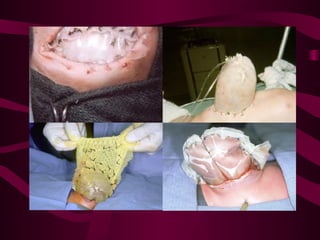
• Heat Management
  – Sterile wrap or sterile bowel bag
  – Radiant warmer
• Fluid Management
  – IV bolus 20 ml/kg LR/NS
  – D10¼NS 2-3 maintenance rate
• Nutrition
  – NPO and TPN (central venous line )
• Gastric Distention
  – OG/NG tube
  – urinary catheter
• Infection Control
  Broad-spectrum antibiotics
• Associated Defects
• Conservative treatment
  – Reduction by squeezing the sac
  – Painting sac with escharotic agent
     • 0.25% Silver nitrate
     • 0.25% Merbromin (Mercurochrome)
• Surgical Management
  – Skin Flaps
  – Primary Closure
  – Staged Closure
     • Staged repair using silo pouch
Skin Flaps
Primary Closure
• In 1967, Schuster technique
• A circumferential incision along the skin-
  omphalocele junction; the omphalocele
  membrane is left intact
• Teflon sheets
• DualMesh patch (Gore-Tex)
• AlloDerm patch (acellular human dermis)
Primary Closure
Staged Closure
In 1969, Allen and Wrenn adapted Schuster's
  technique to treat gastroschisis
Silo
Staged Closure
UMBILICAL HERNIA

• Defect in linea alba,
  subcutaneous tissue
  and skin covering the
  protruding bowel
• Frequent in premature
  infants
PRUNE BELLY SYNDROME

• Thin, flaccid abdominal wall
• Dilation of bladder, ureter and renal
  collecting system
• 1:30,000-50,000
• 95% are male
BLADDER EXTROPHY

• Defective enfolding of
  caudal folds
• 3.3 in 100,000 births
• Associated with
  prolapsed vagina or
  rectum, epispadias,
  bifid clitoris or penis
PENTALOGY OF CANTRELL

•   Omphalocoele
•   Anterior diaphragmatic hernia
•   Sternal cleft
•   Ectopia Cordis
•   Intracardiac defect
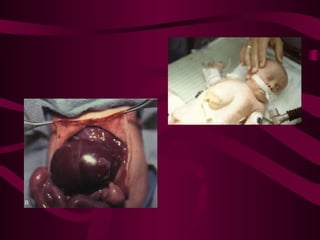
BECKWITH-WIEDEMANN
     SYNDROME

          • Macrosomia
          • Macroglossia
          • Organomegaly
          • Abdominal wall
            defects
          • Embryonal tumors
• Have coarse, rounded facial features
• hyperplasia of the pancreatic islet cells
  with hypoglycemia; visceromegaly
• genitourinary abnormalities
Omphalocoele Gastroschisis
Incidence        1:6,000-10,000   1:20,000-30,000
Delivery         Vaginal or CS    CS
Covering Sac     Present          Absent
Size of Defect   Small or large   Small
Cord Location    Onto the sac     On abdominal wall

Bowel            Normal           Edematous, matted
Omphalocoele Gastroschisis
Other Organs   Liver often out      Rare
Prematurity    10-20%               50-60%
IUGR           Less common          Common
NEC            If sac is ruptured   18%
Associated     >50%                 10-15%
Anomalies
Treatment      Often primary        Often staged
Prognosis      20%-70%              70-90%
Baby with an umbilical cord hernia.
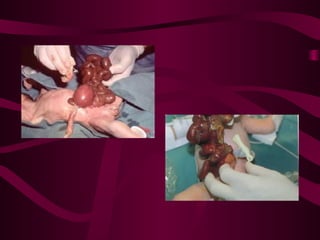
Baby with gastroschisis and associated intestinal atresia
Silo closure of a baby with gastroschisis.
Completed reduction of the bowel contained within the silo; the silo is
about to be removed and the abdominal wall closed.
Case A. Baby with a giant omphalocele.
Case A. Closure of the giant omphalocele using a synthetic patch
Case A. Tightening the abdominal wall closure
Case A. Flank flaps were used to close the giant omphalocele in the baby
whose patch became infected.
Case A. The flank wounds were skin grafted and closure of the giant
omphalocele obtained.
Baby with prune-belly syndrome.
Note the laxity of the abdominal wall in this baby with prune-belly
syndrome
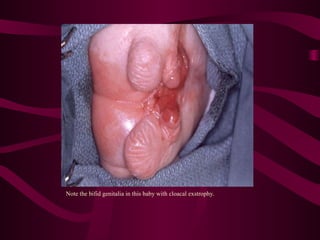
Baby with cloacal exstrophy.
Note the bifid genitalia in this baby with cloacal exstrophy.
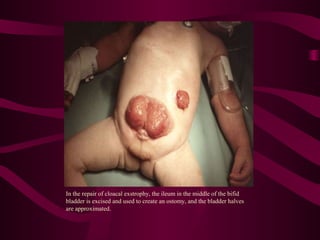
In the repair of cloacal exstrophy, the ileum in the middle of the bifid
bladder is excised and used to create an ostomy, and the bladder halves
are approximated.
Closure of the bladder exstrophy.
Baby with bladder exstrophy and epispadias; note the appearance of the
bladder mucosa, indicating chronic inflammation.
Another view demonstrating the epispadias shown in the previous image.
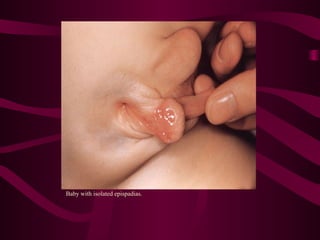
Baby with isolated epispadias.
Closure of a giant omphalocele with an AlloDerm patch
Two months after implantation: epithelialization of the AlloDerm patch.
Eight months after implantation: epithelization is nearly complete, but a
huge ventral hernia has developed
Baby with an omphalocele.
Complicated gastroschisis.
Following reduction of eviscerated viscera (and lysis of adhesions,
tubularization of the viable, mesenteric portion of the proximal jejunum).
THANKS

Abdominal wall-defects

  • 1.
    ABDOMINAL WALL DEFECTS Presented by Dr: Adam Mohammed August 2012
  • 2.
    Introduction • 1634, AmbroiseParé first described an omphalocele. • Calder described a child with gastroschisis.
  • 3.
    OMPHALOCOELE • It isa defect in abdominal wall musculature and skin with protrusion of abdominal viscera contained within a membranous sac.
  • 4.
  • 5.
    Incidence • Small omphalocoele 1:5000 • Large omphalocoele 1:10000 • Male to female ratio 1:1 • Pacific Islanders have low risk for omphalocoele
  • 6.
    Pathophysiology • Failure ofthe midgut to return to abdomen by the 10th week of gestation
  • 9.
    Clinical Findings • Coveredclinical defect of the umbilical ring • Defect may vary from 2-10 cm • Sac is composed of amnion, Wharton’s jelly and peritoneum
  • 10.
    • 50% have accompanying liver, spleen, testes/ovary • >50% have associated defects • Location: – Epigastric – Central – Hypogastric • Cord attachment is on the sac
  • 11.
    • The sacmay rupture in utero in 10-18% or from the delivery process in4%. • The incidence of associated major congenital anomalies in up to 81%.
  • 12.
    Defects of cranialfold • congenital heart disease • diaphragmatic hernia • ectopia cordis • sternal cleft,
  • 13.
    Defects of caudad fold • imperforate anus • genitourinary malformations • bladder or cloacal exstrophy • colon atresia • sacral and vertebral anomalies, and • meningomyelocele.
  • 15.
    GASTROSCHISIS • It isthe defect in the abdominal wall was displaced to the right of the umbilicus and eviscerated bowel was not covered by a membrane.
  • 16.
  • 17.
    Incidence • 1:20,000-30,000 • Sex ratio 1:1 • 10-15% have associated anomalies • 40% are premature/SGA
  • 18.
    Pathophysiology • Abnormal involutionof right umbilical vein • Rupture of a small omphalocoele • Failure of migration and fusion of the lateral folds of the embryonic disc on the 3 rd- 4th week of gestation
  • 20.
    Clinical Findings • Defectto the right of an intact umbilical cord allowing extrusion of abdominal content • Opening ≅ 5 cm • No covering sac
  • 21.
    • Bowels often thickened, matted and edematous • 10-15% with intestinal atresia
  • 22.
    • Evisceration ofthe bowel leads to malrotation. • Constriction of the base may cause intestinal stenosis, atresia, and volvulus • Undescended testicles • preterm or small for gestational age (SGA)
  • 24.
    Causes • Folic aciddeficiency • hypoxia • salicylates
  • 25.
    Diagnosis • History : Prenatal U/S • Polyhydramnios • MSAFP • Amniocentesis
  • 26.
    MANAGEMENT • ABC • HeatManagement – Sterile wrap or sterile bowel bag – Radiant warmer • Fluid Management – IV bolus 20 ml/kg LR/NS – D10¼NS 2-3 maintenance rate
  • 27.
    • Nutrition – NPO and TPN (central venous line ) • Gastric Distention – OG/NG tube – urinary catheter • Infection Control Broad-spectrum antibiotics • Associated Defects
  • 28.
    • Conservative treatment – Reduction by squeezing the sac – Painting sac with escharotic agent • 0.25% Silver nitrate • 0.25% Merbromin (Mercurochrome)
  • 30.
    • Surgical Management – Skin Flaps – Primary Closure – Staged Closure • Staged repair using silo pouch
  • 31.
  • 32.
    Primary Closure • In1967, Schuster technique • A circumferential incision along the skin- omphalocele junction; the omphalocele membrane is left intact • Teflon sheets • DualMesh patch (Gore-Tex) • AlloDerm patch (acellular human dermis)
  • 33.
  • 37.
    Staged Closure In 1969,Allen and Wrenn adapted Schuster's technique to treat gastroschisis Silo
  • 38.
  • 43.
    UMBILICAL HERNIA • Defectin linea alba, subcutaneous tissue and skin covering the protruding bowel • Frequent in premature infants
  • 44.
    PRUNE BELLY SYNDROME •Thin, flaccid abdominal wall • Dilation of bladder, ureter and renal collecting system • 1:30,000-50,000 • 95% are male
  • 46.
    BLADDER EXTROPHY • Defectiveenfolding of caudal folds • 3.3 in 100,000 births • Associated with prolapsed vagina or rectum, epispadias, bifid clitoris or penis
  • 47.
    PENTALOGY OF CANTRELL • Omphalocoele • Anterior diaphragmatic hernia • Sternal cleft • Ectopia Cordis • Intracardiac defect
  • 49.
    BECKWITH-WIEDEMANN SYNDROME • Macrosomia • Macroglossia • Organomegaly • Abdominal wall defects • Embryonal tumors
  • 50.
    • Have coarse,rounded facial features • hyperplasia of the pancreatic islet cells with hypoglycemia; visceromegaly • genitourinary abnormalities
  • 51.
    Omphalocoele Gastroschisis Incidence 1:6,000-10,000 1:20,000-30,000 Delivery Vaginal or CS CS Covering Sac Present Absent Size of Defect Small or large Small Cord Location Onto the sac On abdominal wall Bowel Normal Edematous, matted
  • 52.
    Omphalocoele Gastroschisis Other Organs Liver often out Rare Prematurity 10-20% 50-60% IUGR Less common Common NEC If sac is ruptured 18% Associated >50% 10-15% Anomalies Treatment Often primary Often staged Prognosis 20%-70% 70-90%
  • 53.
    Baby with anumbilical cord hernia.
  • 54.
    Baby with gastroschisisand associated intestinal atresia
  • 55.
    Silo closure ofa baby with gastroschisis.
  • 56.
    Completed reduction ofthe bowel contained within the silo; the silo is about to be removed and the abdominal wall closed.
  • 57.
    Case A. Babywith a giant omphalocele.
  • 58.
    Case A. Closureof the giant omphalocele using a synthetic patch
  • 59.
    Case A. Tighteningthe abdominal wall closure
  • 60.
    Case A. Flankflaps were used to close the giant omphalocele in the baby whose patch became infected.
  • 61.
    Case A. Theflank wounds were skin grafted and closure of the giant omphalocele obtained.
  • 62.
  • 63.
    Note the laxityof the abdominal wall in this baby with prune-belly syndrome
  • 64.
  • 65.
    Note the bifidgenitalia in this baby with cloacal exstrophy.
  • 66.
    In the repairof cloacal exstrophy, the ileum in the middle of the bifid bladder is excised and used to create an ostomy, and the bladder halves are approximated.
  • 67.
    Closure of thebladder exstrophy.
  • 68.
    Baby with bladderexstrophy and epispadias; note the appearance of the bladder mucosa, indicating chronic inflammation.
  • 69.
    Another view demonstratingthe epispadias shown in the previous image.
  • 70.
    Baby with isolatedepispadias.
  • 71.
    Closure of agiant omphalocele with an AlloDerm patch
  • 72.
    Two months afterimplantation: epithelialization of the AlloDerm patch.
  • 73.
    Eight months afterimplantation: epithelization is nearly complete, but a huge ventral hernia has developed
  • 74.
    Baby with anomphalocele.
  • 75.
  • 76.
    Following reduction ofeviscerated viscera (and lysis of adhesions, tubularization of the viable, mesenteric portion of the proximal jejunum).
  • 78.