Laboratory-based testing
of competitive cyclists
Andrew R. Coggan, Ph.D.
Cardiovascular Imaging Laboratory
Washington University School of Medicine
St. Louis, MO 63021
Laboratory-based testing
• What is it?
– For purposes of this seminar, anything done indoors!

• Why should you do it (compared to using a field test)?
– Controlled environment
– Submaximal testing possible
– Can obtain greater insight into athlete’s strengths and weaknesses
and/or effectiveness of training program
– Not necessarily more accurate/precise

• Why should you not do it?
– Cost
– Convenience (may interfere with routine training)
– Psychological factors

• When should you do it?
– Depends on many factors, but frequent testing not necessarily better

• How do you do it?
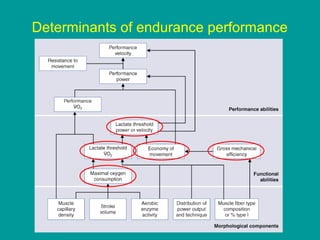
Determinants of endurance performance
Maximal oxygen consumption (VO2max)
• What is it?
– The highest rate of oxygen uptake (VO2) achievable during exercise
that utilizes a large muscle mass (e.g., running).

• Why is it important?
– VO2max is the best overall measure of cardiovascular fitness and
sets the upper limit to the production of energy (ATP) via aerobic
metabolism (i.e., mitochondrial respiration). As such, having a high
VO2max is a necessary but not a sufficient condition to be an elite
endurance athlete.

• How do you measure it?
– By using a “metabolic cart” (gas analyzers, flow measuring device)
to quantify respiratory gas exchange (VO2, CO2 production (VCO2))
across the lungs/at the mouth during an incremental exercise test.

• Related concepts
– VO2peak, RER
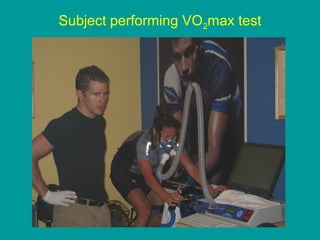
Subject performing VO2max test
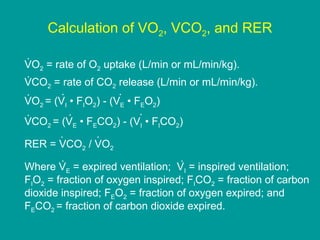
Calculation of VO2, VCO2, and RER
.
VO2 = rate of O2 uptake (L/min or mL/min/kg).
.
VCO2 = rate of CO2 release (L/min or mL/min/kg).
.
.
.
VO2 = (VI • FIO2) - (VE • FEO2)
.
.
.
VCO2 = (VE • FECO2) - (VI • FICO2)
.
.
RER = VCO2 / VO2
.
.
Where VE = expired ventilation; VI = inspired ventilation;
FIO2 = fraction of oxygen inspired; FICO2 = fraction of carbon
dioxide inspired; FEO2 = fraction of oxygen expired; and
FECO2 = fraction of carbon dioxide expired.
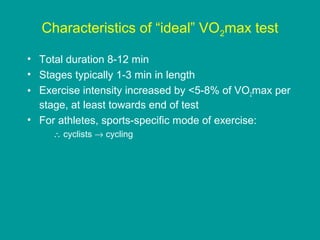
Characteristics of “ideal” VO2max test
• Total duration 8-12 min
• Stages typically 1-3 min in length
• Exercise intensity increased by <5-8% of VO2max per
stage, at least towards end of test
• For athletes, sports-specific mode of exercise:
∴ cyclists → cycling
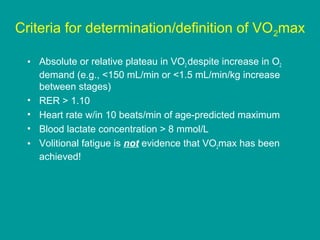
Criteria for determination/definition of VO 2max
• Absolute or relative plateau in VO2 despite increase in O2
demand (e.g., <150 mL/min or <1.5 mL/min/kg increase
between stages)
• RER > 1.10
• Heart rate w/in 10 beats/min of age-predicted maximum
• Blood lactate concentration > 8 mmol/L
• Volitional fatigue is not evidence that VO2max has been
achieved!
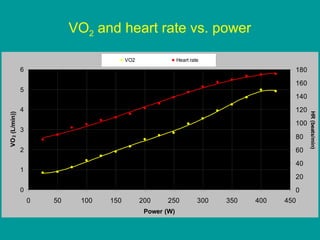
VO2 and heart rate vs. power
VO2

Heart rate

180

6

160
140
120

4

100

3

80
60

2

40

1

20
0

0

0

50

100

150

200

250

Power (W)

300

350

400

450

HR (beats/min)

VO 2 (L/min))

5
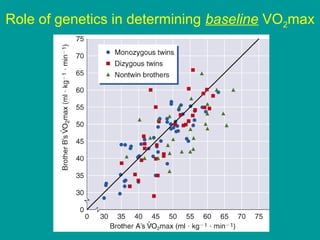
Role of genetics in determining baseline VO2max
Role of genetics in determining change in
VO2max with training
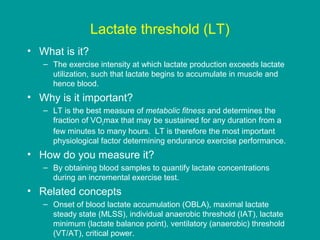
Lactate threshold (LT)
• What is it?
– The exercise intensity at which lactate production exceeds lactate
utilization, such that lactate begins to accumulate in muscle and
hence blood.

• Why is it important?
– LT is the best measure of metabolic fitness and determines the
fraction of VO2max that may be sustained for any duration from a
few minutes to many hours. LT is therefore the most important
physiological factor determining endurance exercise performance.

• How do you measure it?
– By obtaining blood samples to quantify lactate concentrations
during an incremental exercise test.

• Related concepts
– Onset of blood lactate accumulation (OBLA), maximal lactate
steady state (MLSS), individual anaerobic threshold (IAT), lactate
minimum (lactate balance point), ventilatory (anaerobic) threshold
(VT/AT), critical power.
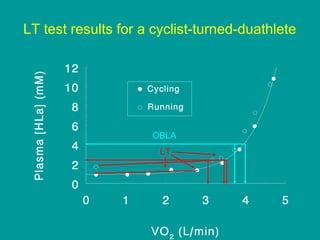
LT test results for a cyclist-turned-duathlete

OBLA
LT
Blood [lactate] as a function of time during
exercise at a constant power
Subject BL
6

Blood HLa (mmol/L)

5
4
245 W
275 W
310 W
325 W

Time to fatigue @ 310 W: 58 min
3
2
1
0
0

2

4

6
Time (min)

8

10
Blood [lactate] as a function of time during
exercise at a constant power
Subject AC
6

Blood HLa (mmol/L)

5

Time to fatigue @ 325 W: 75 min

4

260 W
295 W
310 W
345 W

3
2
1
0
0

2

4

6
Time (min)

8

10
Blood [lactate] as a function of time during
exercise at a constant power
Subject GC
6

Blood HLa (mmol/L)

5
4

210 W
245 W
275 W
310 W

Time to fatigue @ 310 W: 22 min
3
2
1
0
0

2

4

6
Time (min)

8

10
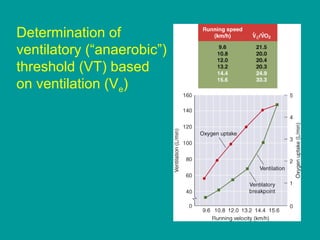
Determination of
ventilatory (“anaerobic”)
threshold (VT) based
on ventilation (Ve)
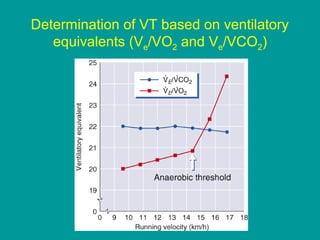
Determination of VT based on ventilatory
equivalents (Ve/VO2 and Ve/VCO2)
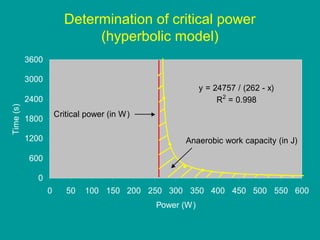
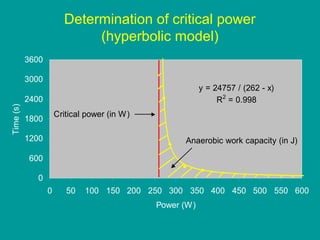
Determination of critical power
(hyperbolic model)
3600
3000

y = 24757 / (262 - x)
R2 = 0.998

Time (s)

2400
Critical power (in W)

1800
1200

Anaerobic work capacity (in J)

600
0
0

50

100 150 200 250 300 350 400 450 500 550 600
Power (W )
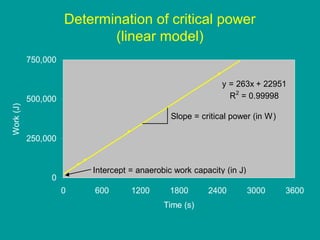
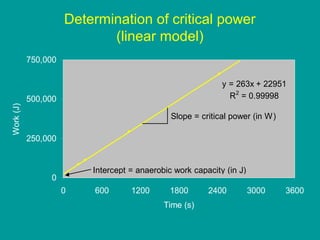
Determination of critical power
(linear model)

Work (J)

750,000
y = 263x + 22951
R2 = 0.99998

500,000

Slope = critical power (in W)
250,000

Intercept = anaerobic work capacity (in J)

0
0

600

1200

1800
Time (s)

2400

3000

3600
Gross efficiency (GE)
• What is it?
– The ratio of work out/energy in x 100%.

• Why is it important?
– Gross efficiency determines the power output corresponding to a
exercise at a given percentage of VO2max and/or LT.

• How do you measure it?
– By quantifying energy production via indirect calorimetry
(respiratory gas exchange) in relation to power output on a cycle
ergometer.

• Related concepts
– Net efficiency, delta efficiency, economy,
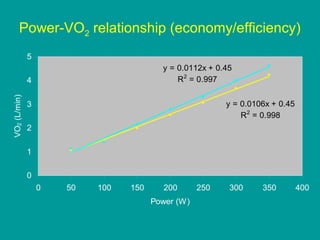
Power-VO2 relationship (economy/efficiency)
5
y = 0.0112x + 0.45
R2 = 0.997

VO2 (L/min)

4

y = 0.0106x + 0.45
R2 = 0.998

3
2
1
0
0

50

100

150

200
Power (W)

250

300

350

400
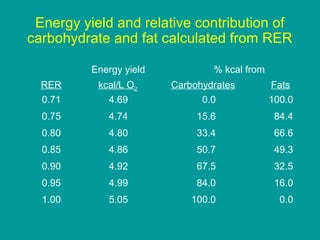
Energy yield and relative contribution of
carbohydrate and fat calculated from RER
Energy yield

% kcal from

RER

kcal/L O2

Carbohydrates

Fats

0.71

4.69

0.0

100.0

0.75

4.74

15.6

84.4

0.80

4.80

33.4

66.6

0.85

4.86

50.7

49.3

0.90

4.92

67.5

32.5

0.95

4.99

84.0

16.0

1.00

5.05

100.0

0.0
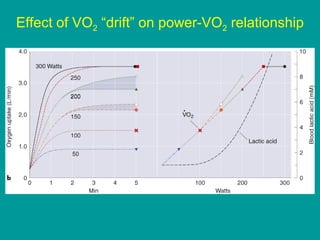
Effect of VO2 “drift” on power-VO2 relationship
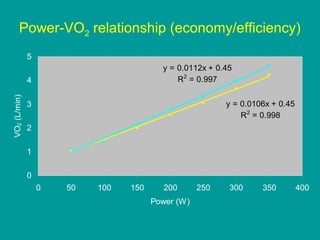
Power-VO2 relationship (economy/efficiency)
5
y = 0.0112x + 0.45
R2 = 0.997

VO2 (L/min)

4

y = 0.0106x + 0.45
R2 = 0.998

3
2
1
0
0

50

100

150

200
Power (W)

250

300

350

400
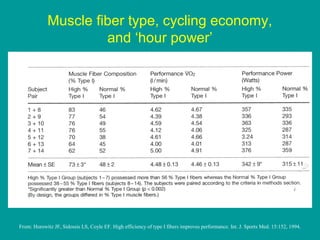
Muscle fiber type, cycling economy,
and ‘hour power’

From: Horowitz JF, Sidossis LS, Coyle EF. High efficiency of type I fibers improves performance. Int. J. Sports Med. 15:152, 1994.
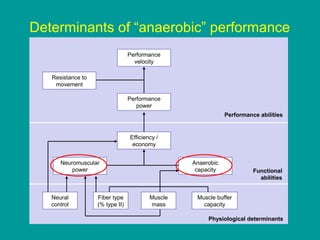
Determinants of “anaerobic” performance
Performance
velocity
Resistance to
movement
Performance
power
Performance abilities

Efficiency /
economy
Neuromuscular
power

Neural
control

Fiber type
(% type II)

Anaerobic
capacity

Muscle
mass

Functional
abilities

Muscle buffer
capacity
Physiological determinants
Neuromuscular power
• What is it?
– Maximum power developed by muscle in unfatigued state – limited
by rate of energy utilization (i.e., rate of ATP hydrolysis), not energy
production.

• Why is it important?
– High power obviously critical to achieve high speed/rapid
acceleration (e.g., sprinting, standing start).

• How do you measure it?
– No gold standard exists, but inertial load method is probably the
most convenient and accurate approach.

• Related concepts
– Wingate peak power
Anaerobic capacity
• What is it?
– The maximum amount of work (not the rate of doing such work, i.e,
power) that can be performed using ATP produced via anaerobic
metabolism.

• Why is it important?
– Sustained efforts at supramaximal (I.e., requiring >100% of
VO2max) intensities obviously critical in many races/race situations
(e.g., pursuit, bridging gaps, shorter hills).

• How do you measure it?
– Again, no true gold standard exists, but maximal accumulated O2
deficit (MAOD) probably comes closest. MAOD is determined by
measuring the difference between O2 demand and O2 uptake during
exercise to fatigue at 110% of VO2max.

• Related concepts
– Wingate average power, anaerobic work capacity (AWC)
determined using critical power approach.
The classic Wingate test
1. Warm-up at a moderate intensity
for 3-5 min.
2. Pedal Monark ergometer “all out”
against no resistance.
3. Within 3 s, apply braking force of
0.075 kg/kg body mass and start
timing.
4. Record number of pedal
revolutions completed every 5 s
for 30 s.
5. Warm down for at least 2 min.
6. Optional: go puke in wastebasket!
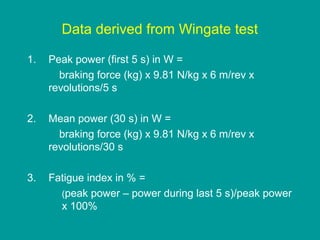
Data derived from Wingate test
1.

Peak power (first 5 s) in W =
braking force (kg) x 9.81 N/kg x 6 m/rev x
revolutions/5 s

2.

Mean power (30 s) in W =
braking force (kg) x 9.81 N/kg x 6 m/rev x
revolutions/30 s

3.

Fatigue index in % =
(peak power – power during last 5 s)/peak power
x 100%
Normal values and percentile rankings for mean
power during a Wingate test
Maud & Schultz, Research Quarterly. Vol 60 pp 144-149. 1989
Males (N=60) and Females (N=69)
Percentile Rank
95
90
85
80
75
70
65
60
55
50
45
40
35
30
25
20
15
10
5
Mean
Minmum
Maximum
SD

Watts
Male
676.6
661.8
630.5
617.9
604.3
600.0
591.7
576.8
574.5
564.6
552.8
547.6
534.6
529.7
520.6
496.1
484.6
470.9
453.2
562.7
441.3
711.0
66.5

Female
483.0
469.9
437.0
419.4
413.5
409.7
402.2
391.4
386.0
381.1
376.9
366.9
360.5
353.2
346.8
336.5
320.3
306.1
286.5
380.8
235.4
528.6
56.4

W•kgBW-1
Male
Female
8.63
7.52
8.24
7.31
8.09
7.08
8.01
6.95
7.96
6.93
7.91
6.77
7.70
6.65
7.59
6.59
7.46
6.51
7.44
6.39
7.26
6.20
7.14
6.15
7.08
6.13
7.00
6.03
6.79
5.94
6.59
5.71
6.39
5.56
5.98
5.25
5.56
5.07
7.28
6.35
4.63
4.53
9.07
8.11
.88
.73
Advantages and disadvantages of Wingate test
• Advantages
– Simple
– Common
– Relevant

• Disadvantages
– Strenuous
– Not a ‘pure’ test of anything:
• Typically underestimates
true neuromuscular power
• Does not really measure
anaerobic capacity
• Aerobic contribution
significant in endurance
trained cyclists
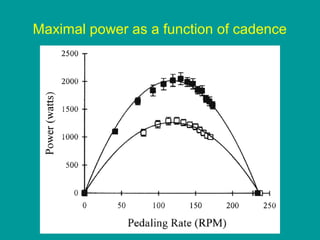
Maximal power as a function of cadence
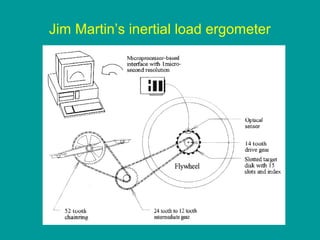
Jim Martin’s inertial load ergometer
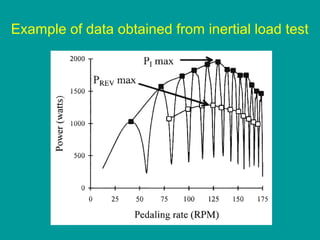
Example of data obtained from inertial load test
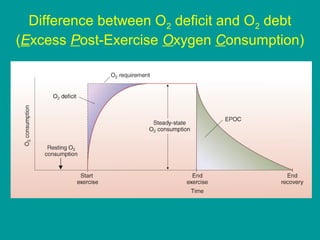
Difference between O2 deficit and O2 debt
(Excess Post-Exercise Oxygen Consumption)
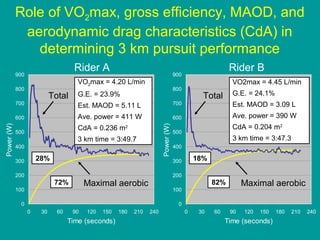
Role of VO2max, gross efficiency, MAOD, and
aerodynamic drag characteristics (CdA) in
determining 3 km pursuit performance
Rider A

900

Total

VO2max = 4.45 L/min
800

G.E. = 23.9%
Est. MAOD = 5.11 L
Ave. power = 411 W

600

600

CdA = 0.236 m2

500

3 km time = 3:49.7
400

28%

300
200

G.E. = 24.1%

Total

700

Power (W)

700

Power (W)

900

VO2max = 4.20 L/min

800

Rider B

Ave. power = 390 W
CdA = 0.204 m2

500

3 km time = 3:47.3

400

18%

300
200

Maximal aerobic

72%

100

Est. MAOD = 3.09 L

Maximal aerobic

82%

100

0

0
0

30

60

90

120

150

Time (seconds)

180

210

240

0

30

60

90

120

150

Time (seconds)

180

210

240
Determination of critical power
(hyperbolic model)
3600
3000

y = 24757 / (262 - x)
R2 = 0.998

Time (s)

2400
Critical power (in W)

1800
1200

Anaerobic work capacity (in J)

600
0
0

50

100 150 200 250 300 350 400 450 500 550 600
Power (W )
Determination of critical power
(linear model)

Work (J)

750,000
y = 263x + 22951
R2 = 0.99998

500,000

Slope = critical power (in W)
250,000

Intercept = anaerobic work capacity (in J)

0
0

600

1200

1800
Time (s)

2400

3000

3600

Laboratory based testing

  • 1.
    Laboratory-based testing of competitivecyclists Andrew R. Coggan, Ph.D. Cardiovascular Imaging Laboratory Washington University School of Medicine St. Louis, MO 63021
  • 2.
    Laboratory-based testing • Whatis it? – For purposes of this seminar, anything done indoors! • Why should you do it (compared to using a field test)? – Controlled environment – Submaximal testing possible – Can obtain greater insight into athlete’s strengths and weaknesses and/or effectiveness of training program – Not necessarily more accurate/precise • Why should you not do it? – Cost – Convenience (may interfere with routine training) – Psychological factors • When should you do it? – Depends on many factors, but frequent testing not necessarily better • How do you do it?
  • 3.
  • 4.
    Maximal oxygen consumption(VO2max) • What is it? – The highest rate of oxygen uptake (VO2) achievable during exercise that utilizes a large muscle mass (e.g., running). • Why is it important? – VO2max is the best overall measure of cardiovascular fitness and sets the upper limit to the production of energy (ATP) via aerobic metabolism (i.e., mitochondrial respiration). As such, having a high VO2max is a necessary but not a sufficient condition to be an elite endurance athlete. • How do you measure it? – By using a “metabolic cart” (gas analyzers, flow measuring device) to quantify respiratory gas exchange (VO2, CO2 production (VCO2)) across the lungs/at the mouth during an incremental exercise test. • Related concepts – VO2peak, RER
  • 5.
  • 6.
    Calculation of VO2,VCO2, and RER . VO2 = rate of O2 uptake (L/min or mL/min/kg). . VCO2 = rate of CO2 release (L/min or mL/min/kg). . . . VO2 = (VI • FIO2) - (VE • FEO2) . . . VCO2 = (VE • FECO2) - (VI • FICO2) . . RER = VCO2 / VO2 . . Where VE = expired ventilation; VI = inspired ventilation; FIO2 = fraction of oxygen inspired; FICO2 = fraction of carbon dioxide inspired; FEO2 = fraction of oxygen expired; and FECO2 = fraction of carbon dioxide expired.
  • 7.
    Characteristics of “ideal”VO2max test • Total duration 8-12 min • Stages typically 1-3 min in length • Exercise intensity increased by <5-8% of VO2max per stage, at least towards end of test • For athletes, sports-specific mode of exercise: ∴ cyclists → cycling
  • 8.
    Criteria for determination/definitionof VO 2max • Absolute or relative plateau in VO2 despite increase in O2 demand (e.g., <150 mL/min or <1.5 mL/min/kg increase between stages) • RER > 1.10 • Heart rate w/in 10 beats/min of age-predicted maximum • Blood lactate concentration > 8 mmol/L • Volitional fatigue is not evidence that VO2max has been achieved!
  • 9.
    VO2 and heartrate vs. power VO2 Heart rate 180 6 160 140 120 4 100 3 80 60 2 40 1 20 0 0 0 50 100 150 200 250 Power (W) 300 350 400 450 HR (beats/min) VO 2 (L/min)) 5
  • 10.
    Role of geneticsin determining baseline VO2max
  • 11.
    Role of geneticsin determining change in VO2max with training
  • 12.
    Lactate threshold (LT) •What is it? – The exercise intensity at which lactate production exceeds lactate utilization, such that lactate begins to accumulate in muscle and hence blood. • Why is it important? – LT is the best measure of metabolic fitness and determines the fraction of VO2max that may be sustained for any duration from a few minutes to many hours. LT is therefore the most important physiological factor determining endurance exercise performance. • How do you measure it? – By obtaining blood samples to quantify lactate concentrations during an incremental exercise test. • Related concepts – Onset of blood lactate accumulation (OBLA), maximal lactate steady state (MLSS), individual anaerobic threshold (IAT), lactate minimum (lactate balance point), ventilatory (anaerobic) threshold (VT/AT), critical power.
  • 13.
    LT test resultsfor a cyclist-turned-duathlete OBLA LT
  • 14.
    Blood [lactate] asa function of time during exercise at a constant power Subject BL 6 Blood HLa (mmol/L) 5 4 245 W 275 W 310 W 325 W Time to fatigue @ 310 W: 58 min 3 2 1 0 0 2 4 6 Time (min) 8 10
  • 15.
    Blood [lactate] asa function of time during exercise at a constant power Subject AC 6 Blood HLa (mmol/L) 5 Time to fatigue @ 325 W: 75 min 4 260 W 295 W 310 W 345 W 3 2 1 0 0 2 4 6 Time (min) 8 10
  • 16.
    Blood [lactate] asa function of time during exercise at a constant power Subject GC 6 Blood HLa (mmol/L) 5 4 210 W 245 W 275 W 310 W Time to fatigue @ 310 W: 22 min 3 2 1 0 0 2 4 6 Time (min) 8 10
  • 17.
  • 18.
    Determination of VTbased on ventilatory equivalents (Ve/VO2 and Ve/VCO2)
  • 19.
    Determination of criticalpower (hyperbolic model) 3600 3000 y = 24757 / (262 - x) R2 = 0.998 Time (s) 2400 Critical power (in W) 1800 1200 Anaerobic work capacity (in J) 600 0 0 50 100 150 200 250 300 350 400 450 500 550 600 Power (W )
  • 20.
    Determination of criticalpower (linear model) Work (J) 750,000 y = 263x + 22951 R2 = 0.99998 500,000 Slope = critical power (in W) 250,000 Intercept = anaerobic work capacity (in J) 0 0 600 1200 1800 Time (s) 2400 3000 3600
  • 21.
    Gross efficiency (GE) •What is it? – The ratio of work out/energy in x 100%. • Why is it important? – Gross efficiency determines the power output corresponding to a exercise at a given percentage of VO2max and/or LT. • How do you measure it? – By quantifying energy production via indirect calorimetry (respiratory gas exchange) in relation to power output on a cycle ergometer. • Related concepts – Net efficiency, delta efficiency, economy,
  • 22.
    Power-VO2 relationship (economy/efficiency) 5 y= 0.0112x + 0.45 R2 = 0.997 VO2 (L/min) 4 y = 0.0106x + 0.45 R2 = 0.998 3 2 1 0 0 50 100 150 200 Power (W) 250 300 350 400
  • 23.
    Energy yield andrelative contribution of carbohydrate and fat calculated from RER Energy yield % kcal from RER kcal/L O2 Carbohydrates Fats 0.71 4.69 0.0 100.0 0.75 4.74 15.6 84.4 0.80 4.80 33.4 66.6 0.85 4.86 50.7 49.3 0.90 4.92 67.5 32.5 0.95 4.99 84.0 16.0 1.00 5.05 100.0 0.0
  • 24.
    Effect of VO2“drift” on power-VO2 relationship
  • 25.
    Power-VO2 relationship (economy/efficiency) 5 y= 0.0112x + 0.45 R2 = 0.997 VO2 (L/min) 4 y = 0.0106x + 0.45 R2 = 0.998 3 2 1 0 0 50 100 150 200 Power (W) 250 300 350 400
  • 26.
    Muscle fiber type,cycling economy, and ‘hour power’ From: Horowitz JF, Sidossis LS, Coyle EF. High efficiency of type I fibers improves performance. Int. J. Sports Med. 15:152, 1994.
  • 27.
    Determinants of “anaerobic”performance Performance velocity Resistance to movement Performance power Performance abilities Efficiency / economy Neuromuscular power Neural control Fiber type (% type II) Anaerobic capacity Muscle mass Functional abilities Muscle buffer capacity Physiological determinants
  • 28.
    Neuromuscular power • Whatis it? – Maximum power developed by muscle in unfatigued state – limited by rate of energy utilization (i.e., rate of ATP hydrolysis), not energy production. • Why is it important? – High power obviously critical to achieve high speed/rapid acceleration (e.g., sprinting, standing start). • How do you measure it? – No gold standard exists, but inertial load method is probably the most convenient and accurate approach. • Related concepts – Wingate peak power
  • 29.
    Anaerobic capacity • Whatis it? – The maximum amount of work (not the rate of doing such work, i.e, power) that can be performed using ATP produced via anaerobic metabolism. • Why is it important? – Sustained efforts at supramaximal (I.e., requiring >100% of VO2max) intensities obviously critical in many races/race situations (e.g., pursuit, bridging gaps, shorter hills). • How do you measure it? – Again, no true gold standard exists, but maximal accumulated O2 deficit (MAOD) probably comes closest. MAOD is determined by measuring the difference between O2 demand and O2 uptake during exercise to fatigue at 110% of VO2max. • Related concepts – Wingate average power, anaerobic work capacity (AWC) determined using critical power approach.
  • 30.
    The classic Wingatetest 1. Warm-up at a moderate intensity for 3-5 min. 2. Pedal Monark ergometer “all out” against no resistance. 3. Within 3 s, apply braking force of 0.075 kg/kg body mass and start timing. 4. Record number of pedal revolutions completed every 5 s for 30 s. 5. Warm down for at least 2 min. 6. Optional: go puke in wastebasket!
  • 31.
    Data derived fromWingate test 1. Peak power (first 5 s) in W = braking force (kg) x 9.81 N/kg x 6 m/rev x revolutions/5 s 2. Mean power (30 s) in W = braking force (kg) x 9.81 N/kg x 6 m/rev x revolutions/30 s 3. Fatigue index in % = (peak power – power during last 5 s)/peak power x 100%
  • 32.
    Normal values andpercentile rankings for mean power during a Wingate test Maud & Schultz, Research Quarterly. Vol 60 pp 144-149. 1989 Males (N=60) and Females (N=69) Percentile Rank 95 90 85 80 75 70 65 60 55 50 45 40 35 30 25 20 15 10 5 Mean Minmum Maximum SD Watts Male 676.6 661.8 630.5 617.9 604.3 600.0 591.7 576.8 574.5 564.6 552.8 547.6 534.6 529.7 520.6 496.1 484.6 470.9 453.2 562.7 441.3 711.0 66.5 Female 483.0 469.9 437.0 419.4 413.5 409.7 402.2 391.4 386.0 381.1 376.9 366.9 360.5 353.2 346.8 336.5 320.3 306.1 286.5 380.8 235.4 528.6 56.4 W•kgBW-1 Male Female 8.63 7.52 8.24 7.31 8.09 7.08 8.01 6.95 7.96 6.93 7.91 6.77 7.70 6.65 7.59 6.59 7.46 6.51 7.44 6.39 7.26 6.20 7.14 6.15 7.08 6.13 7.00 6.03 6.79 5.94 6.59 5.71 6.39 5.56 5.98 5.25 5.56 5.07 7.28 6.35 4.63 4.53 9.07 8.11 .88 .73
  • 33.
    Advantages and disadvantagesof Wingate test • Advantages – Simple – Common – Relevant • Disadvantages – Strenuous – Not a ‘pure’ test of anything: • Typically underestimates true neuromuscular power • Does not really measure anaerobic capacity • Aerobic contribution significant in endurance trained cyclists
  • 34.
    Maximal power asa function of cadence
  • 35.
  • 36.
    Example of dataobtained from inertial load test
  • 37.
    Difference between O2deficit and O2 debt (Excess Post-Exercise Oxygen Consumption)
  • 38.
    Role of VO2max,gross efficiency, MAOD, and aerodynamic drag characteristics (CdA) in determining 3 km pursuit performance Rider A 900 Total VO2max = 4.45 L/min 800 G.E. = 23.9% Est. MAOD = 5.11 L Ave. power = 411 W 600 600 CdA = 0.236 m2 500 3 km time = 3:49.7 400 28% 300 200 G.E. = 24.1% Total 700 Power (W) 700 Power (W) 900 VO2max = 4.20 L/min 800 Rider B Ave. power = 390 W CdA = 0.204 m2 500 3 km time = 3:47.3 400 18% 300 200 Maximal aerobic 72% 100 Est. MAOD = 3.09 L Maximal aerobic 82% 100 0 0 0 30 60 90 120 150 Time (seconds) 180 210 240 0 30 60 90 120 150 Time (seconds) 180 210 240
  • 39.
    Determination of criticalpower (hyperbolic model) 3600 3000 y = 24757 / (262 - x) R2 = 0.998 Time (s) 2400 Critical power (in W) 1800 1200 Anaerobic work capacity (in J) 600 0 0 50 100 150 200 250 300 350 400 450 500 550 600 Power (W )
  • 40.
    Determination of criticalpower (linear model) Work (J) 750,000 y = 263x + 22951 R2 = 0.99998 500,000 Slope = critical power (in W) 250,000 Intercept = anaerobic work capacity (in J) 0 0 600 1200 1800 Time (s) 2400 3000 3600