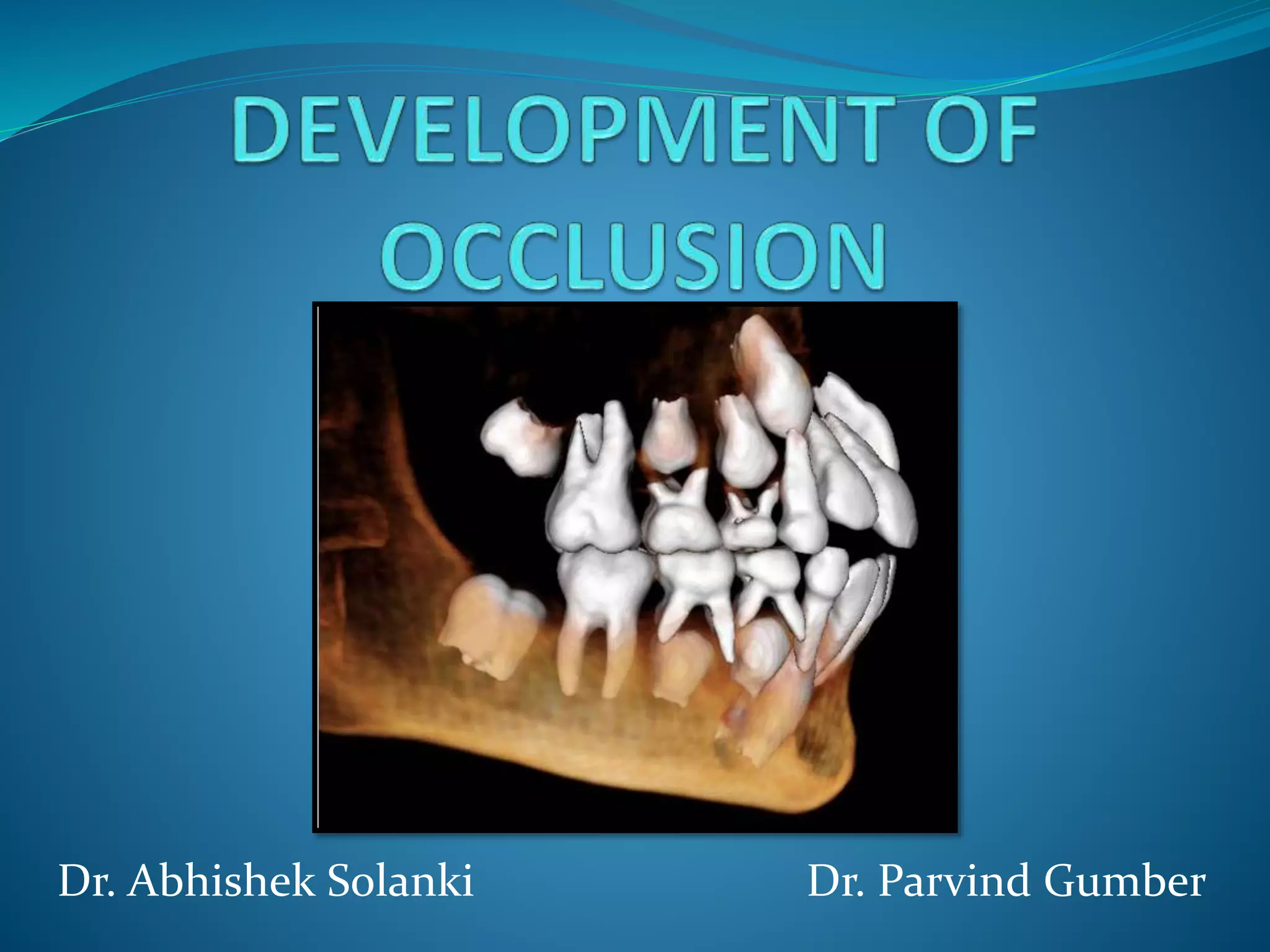
Dr. Abhishek Solanki Dr. Parvind Gumber
INTRODUCTION
 The term occlusion has both static and dynamic aspects
 Static refers to form, alignment and articulation of teeth
within & between dental arches and relationship of teeth
to their supporting structures
 It may be defined also as the contact relationship of the
teeth in function or parafunction
IDEAL OCCLUSION:
 Pre-conceived theoretical concept of occlusal structural &
functional relationships that include idealized principles
and characteristics that an occlusion should be
NORMAL OCCLUSION:
 It is class I relationship of maxillary & mandibular 1st
molars in centric occlusion
PHYSIOLOGIC OCCLUSION:
 Occlusion that deviates in one or more ways from ideal
yet it is well adapted to that particular environment is
esthetic & shows no pathologic manifestations
FUNCTIONAL OCCLUSION:
 An arrangement of teeth which will provide highest
efficiency during excursive movements of mandible which
is necessary during function
BALANCED OCCLUSION:
 An occlusion in which balance & equal contacts are
maintained throughout entire arch during all excursions of
mandible
 Others : Therapeutic occlusion, Traumatic Occlusion,
Centric Occlusion etc.
PERIODS OF OCCLUSAL DEVELOPMENT:
 PRE-DENTAL PERIOD
 DECIDUOUS DENTITION PERIOD
 MIXED DENTITION PERIOD
 PERMANENT DENTITION PERIOD
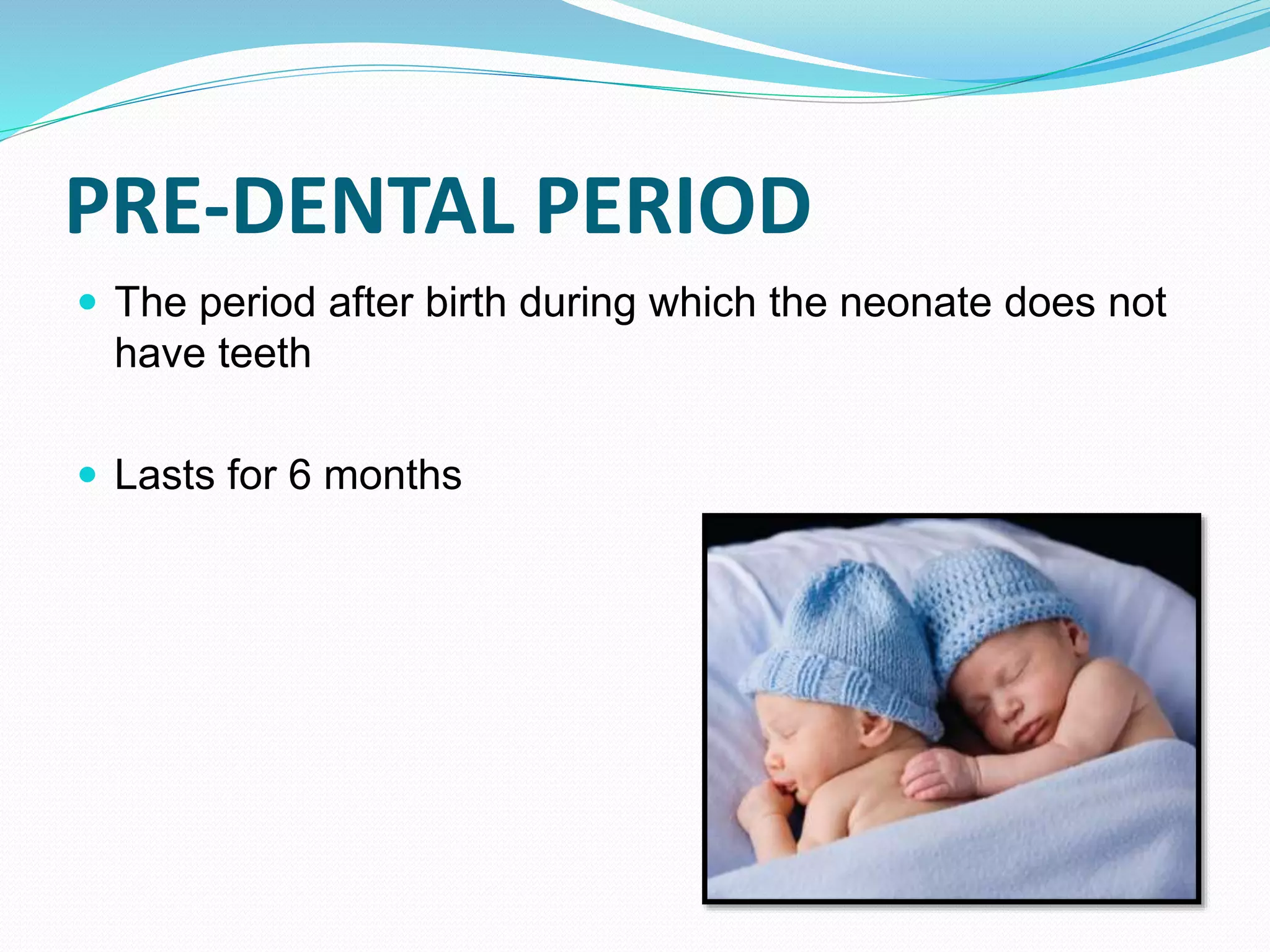
PRE-DENTAL PERIOD
 The period after birth during which the neonate does not
have teeth
 Lasts for 6 months
GUM PADS
 Alveolar processes at the time of birth
 Pink, firm and are covered by a dense layer of fibrous
periosteum
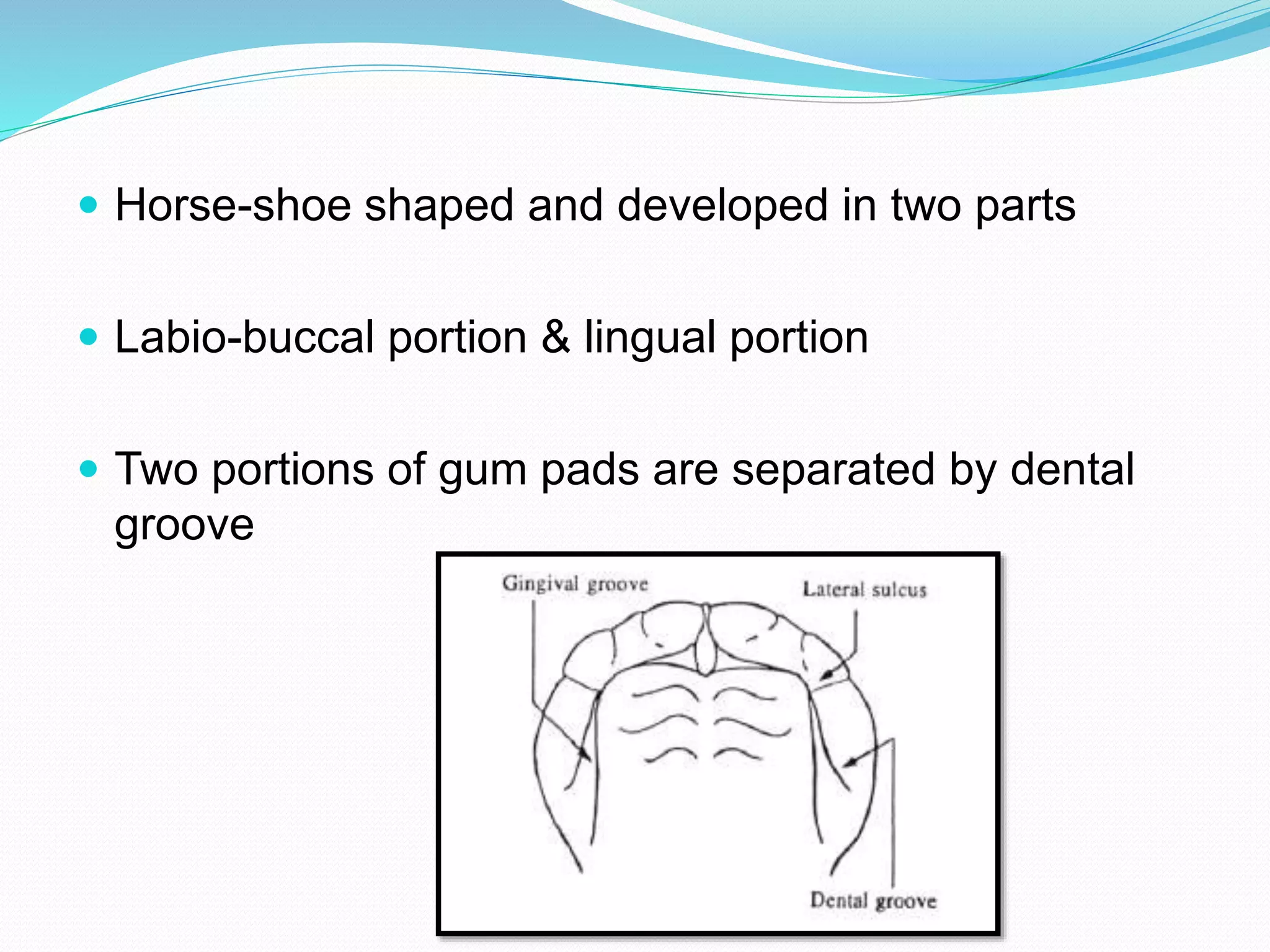
 Horse-shoe shaped and developed in two parts
 Labio-buccal portion & lingual portion
 Two portions of gum pads are separated by dental
groove
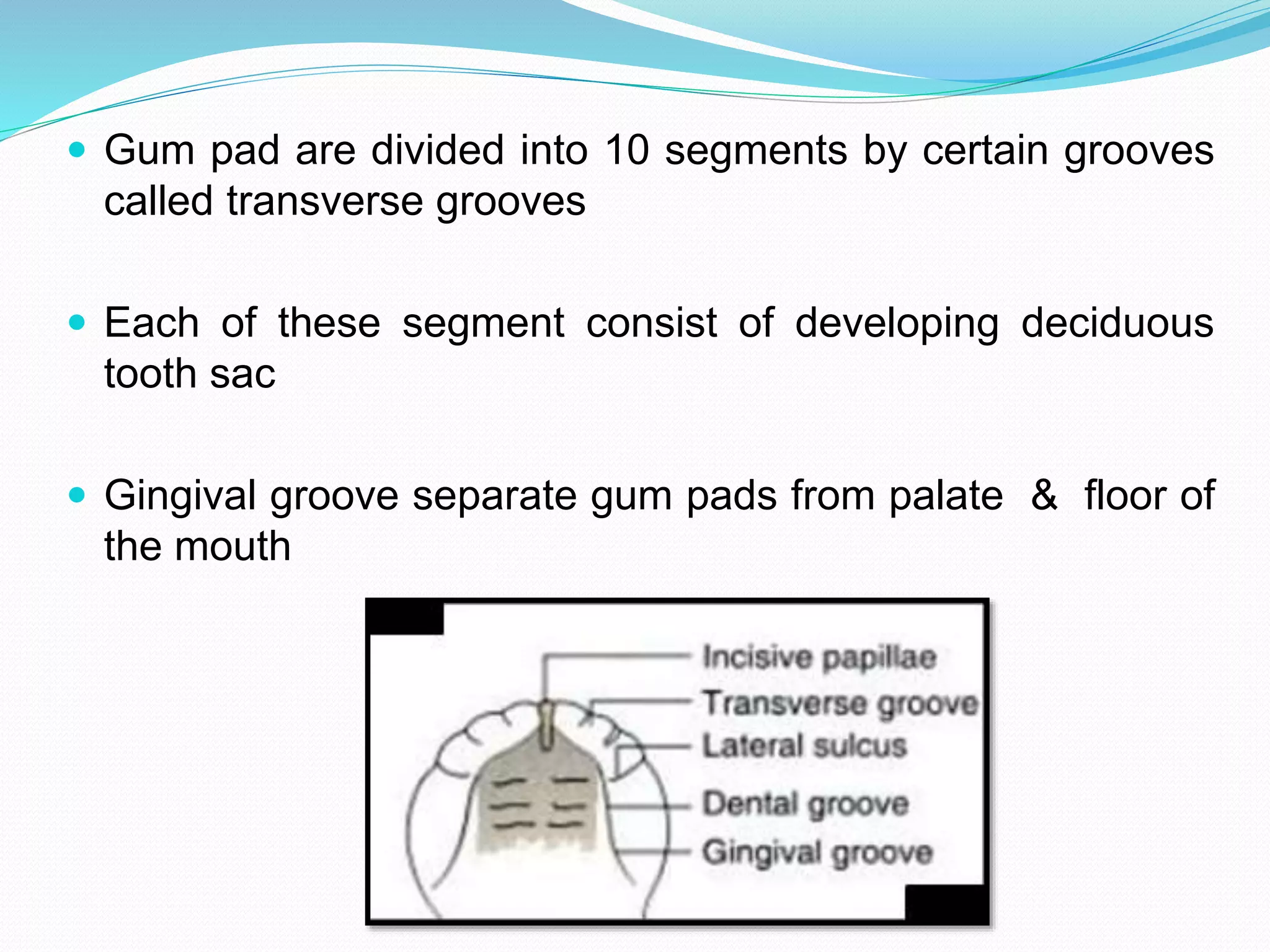
 Gum pad are divided into 10 segments by certain grooves
called transverse grooves
 Each of these segment consist of developing deciduous
tooth sac
 Gingival groove separate gum pads from palate & floor of
the mouth
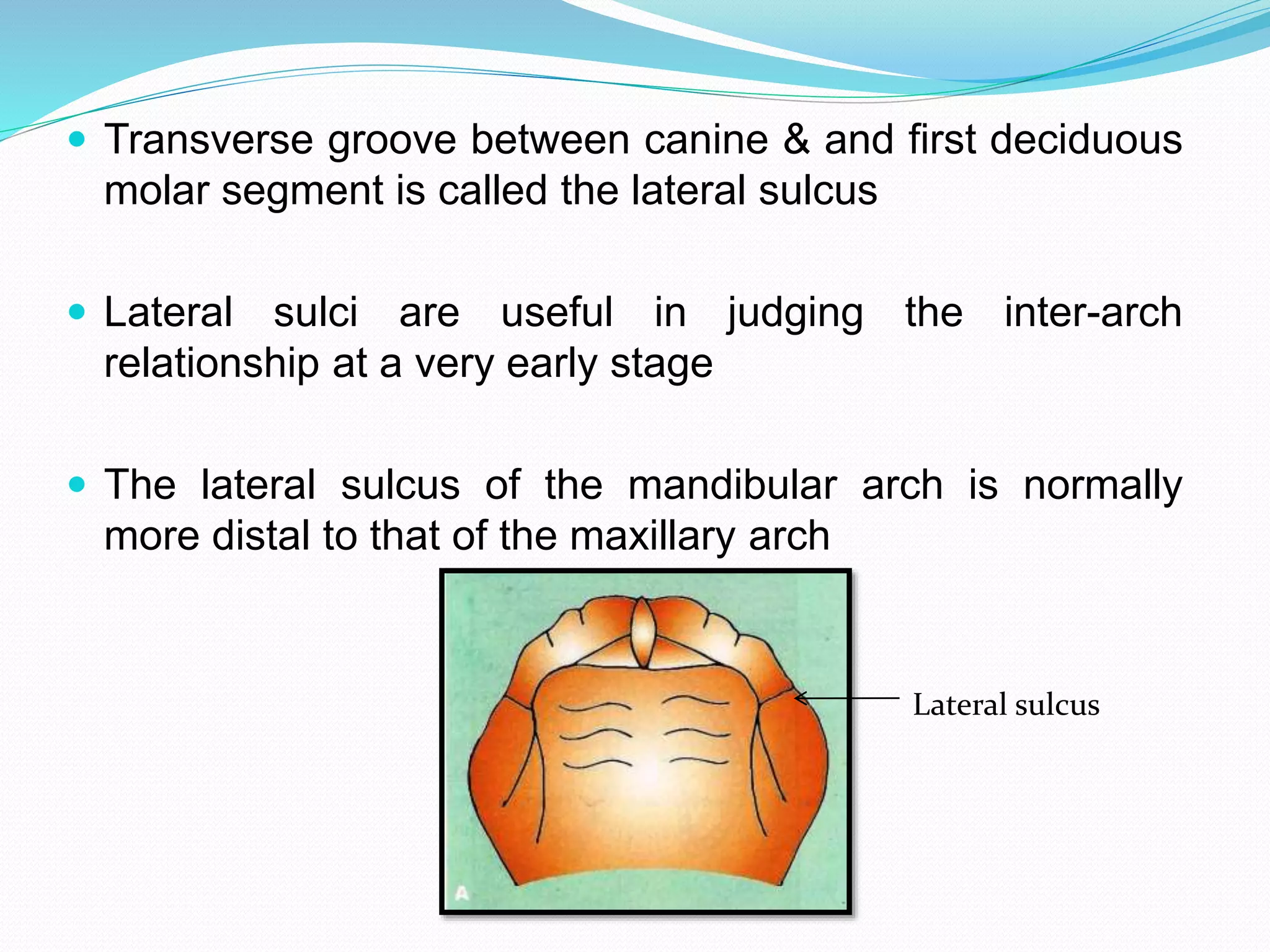
 Transverse groove between canine & and first deciduous
molar segment is called the lateral sulcus
 Lateral sulci are useful in judging the inter-arch
relationship at a very early stage
 The lateral sulcus of the mandibular arch is normally
more distal to that of the maxillary arch
Lateral sulcus
 The upper and lower gum pads are almost similar to
each other
 The upper gum pad is both wider as well as longer than
the mandibular gum pad
 Thus when upper and lower gum pads are approximated,
there is a complete overjet all around
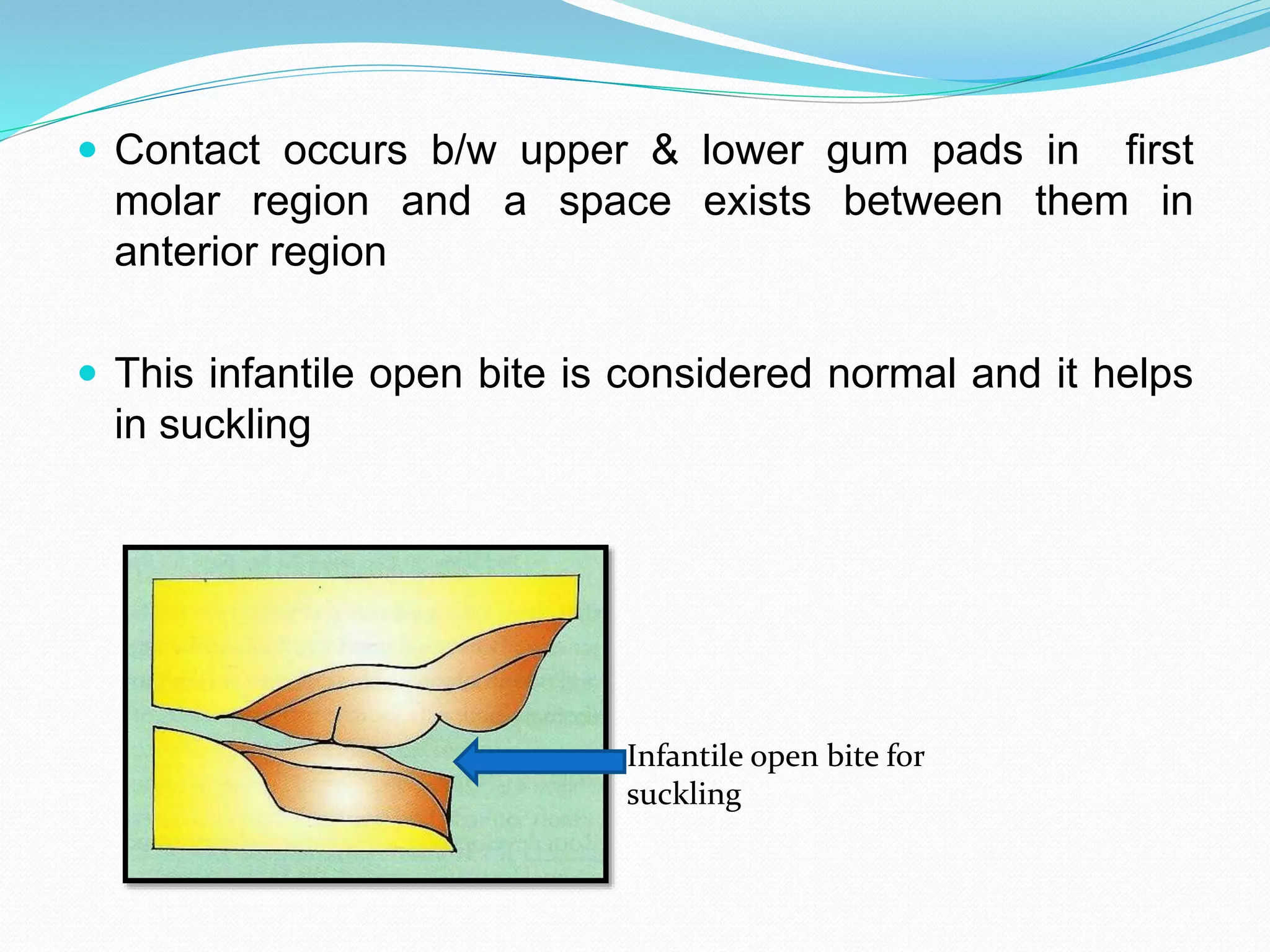
 Contact occurs b/w upper & lower gum pads in first
molar region and a space exists between them in
anterior region
 This infantile open bite is considered normal and it helps
in suckling
Infantile open bite for
suckling
Status of dentition
 Neonate is without teeth for about 6 months of life
 At birth gum pads are not sufficiently wide to
accommodate developing incisors, which are crowded in
their crypts
 During 1st year of life gum pads grow rapidly permitting
incisors to erupt in good alignment
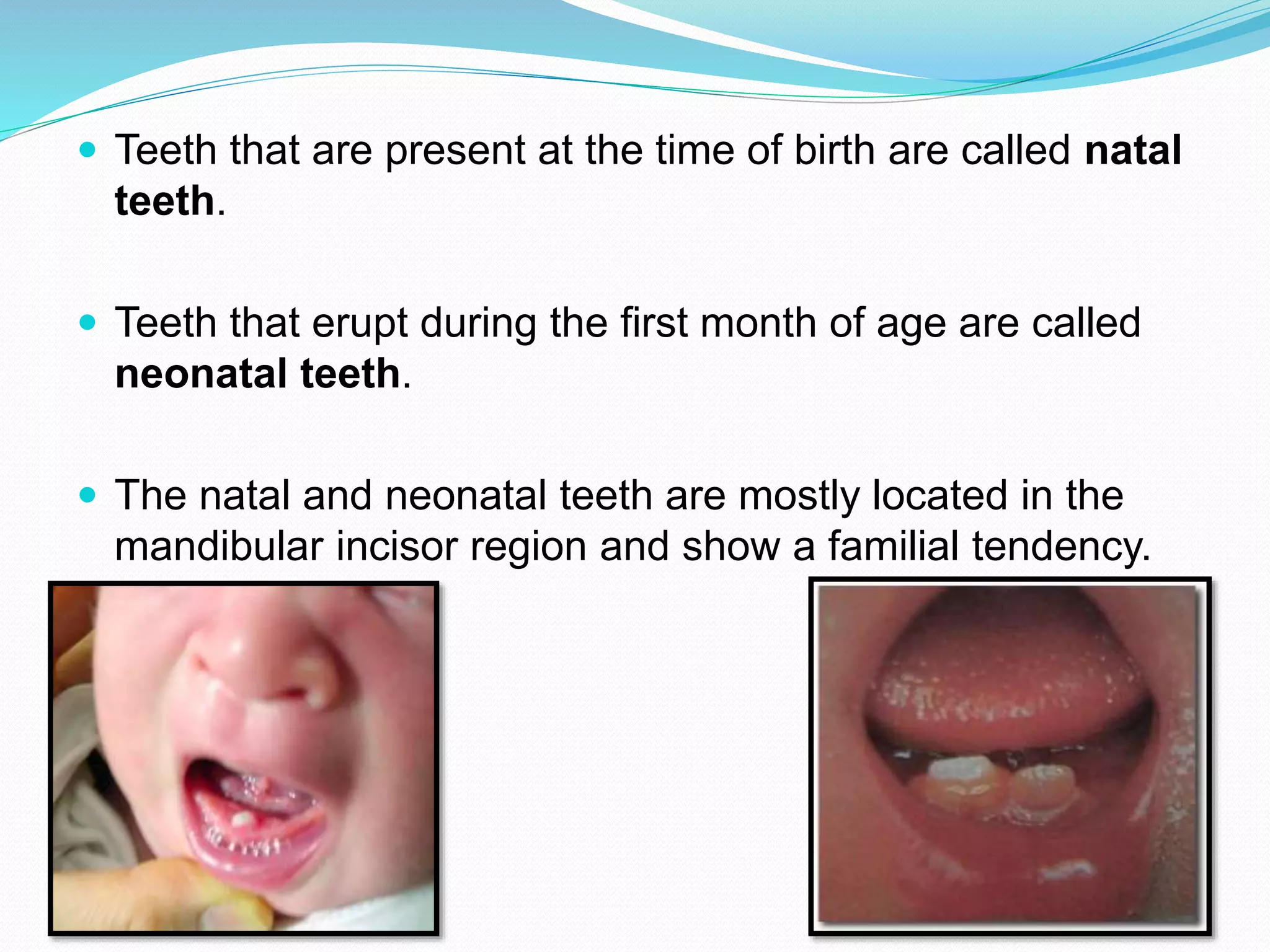
 Teeth that are present at the time of birth are called natal
teeth.
 Teeth that erupt during the first month of age are called
neonatal teeth.
 The natal and neonatal teeth are mostly located in the
mandibular incisor region and show a familial tendency.
DECIDUOUS DENTITION PERIOD
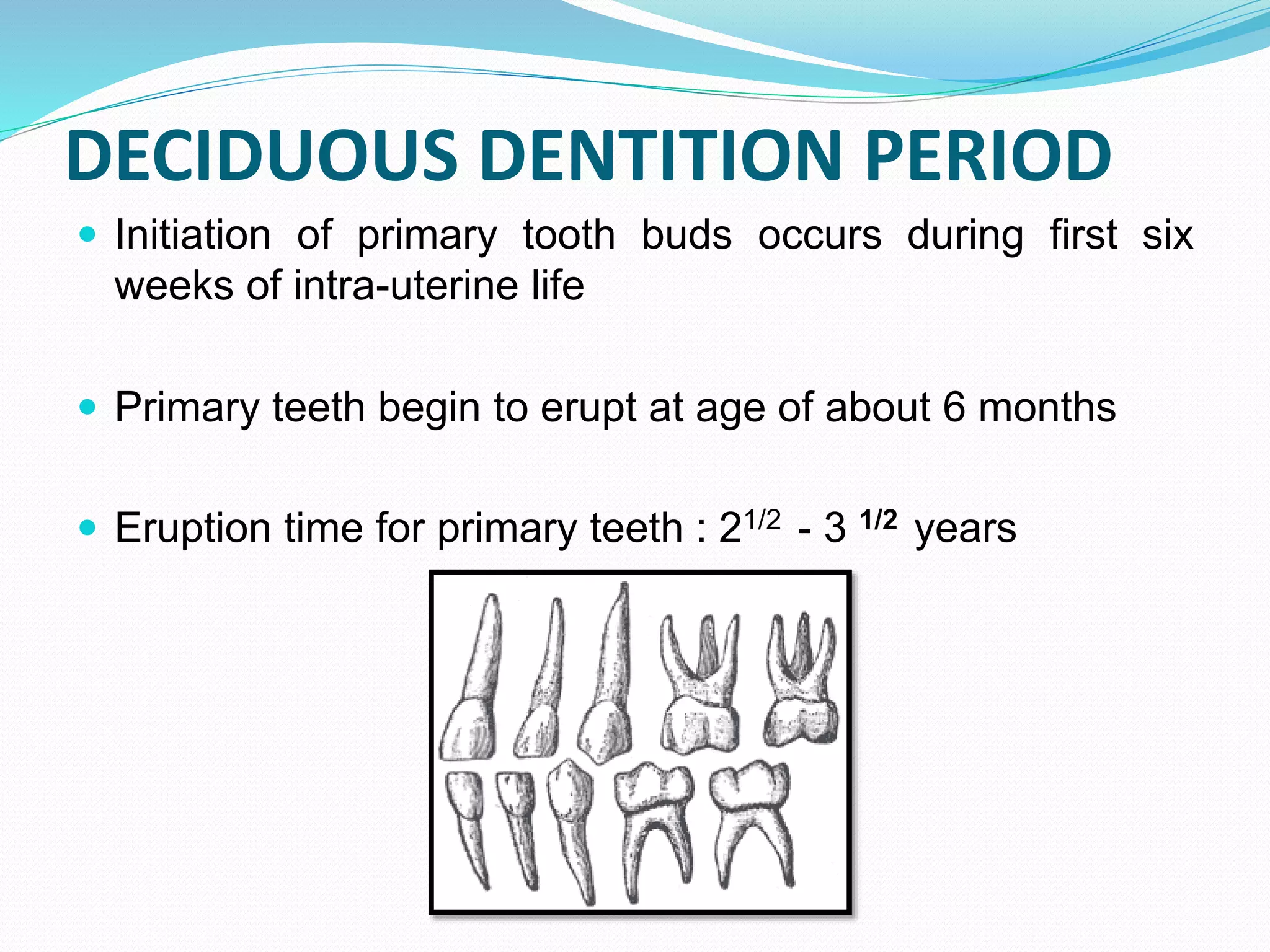
 Initiation of primary tooth buds occurs during first six
weeks of intra-uterine life
 Primary teeth begin to erupt at age of about 6 months
 Eruption time for primary teeth : 21/2 - 3 1/2 years
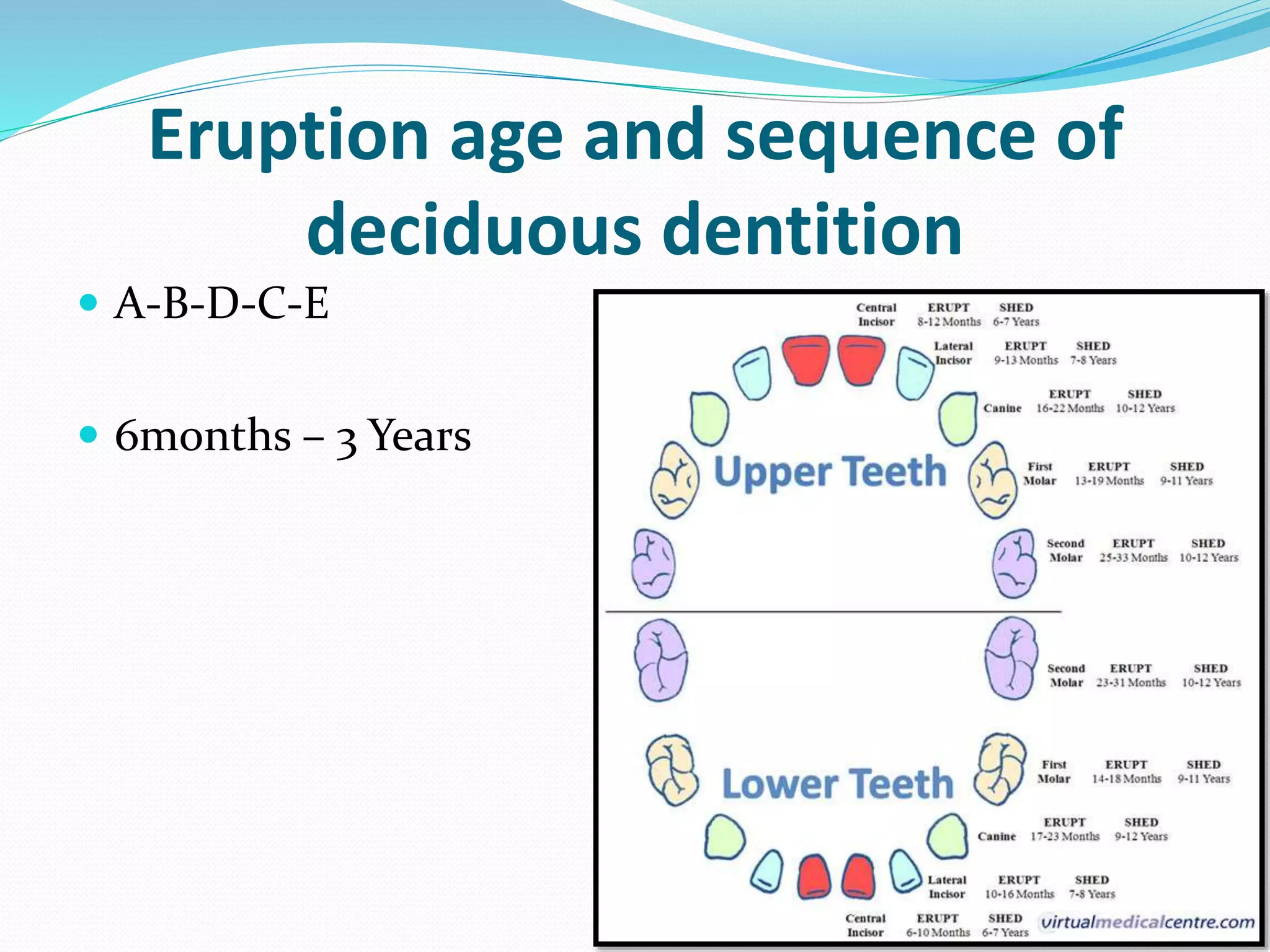
Eruption age and sequence of
deciduous dentition
 A-B-D-C-E
 6months – 3 Years
ERUPTION SEQUENCE
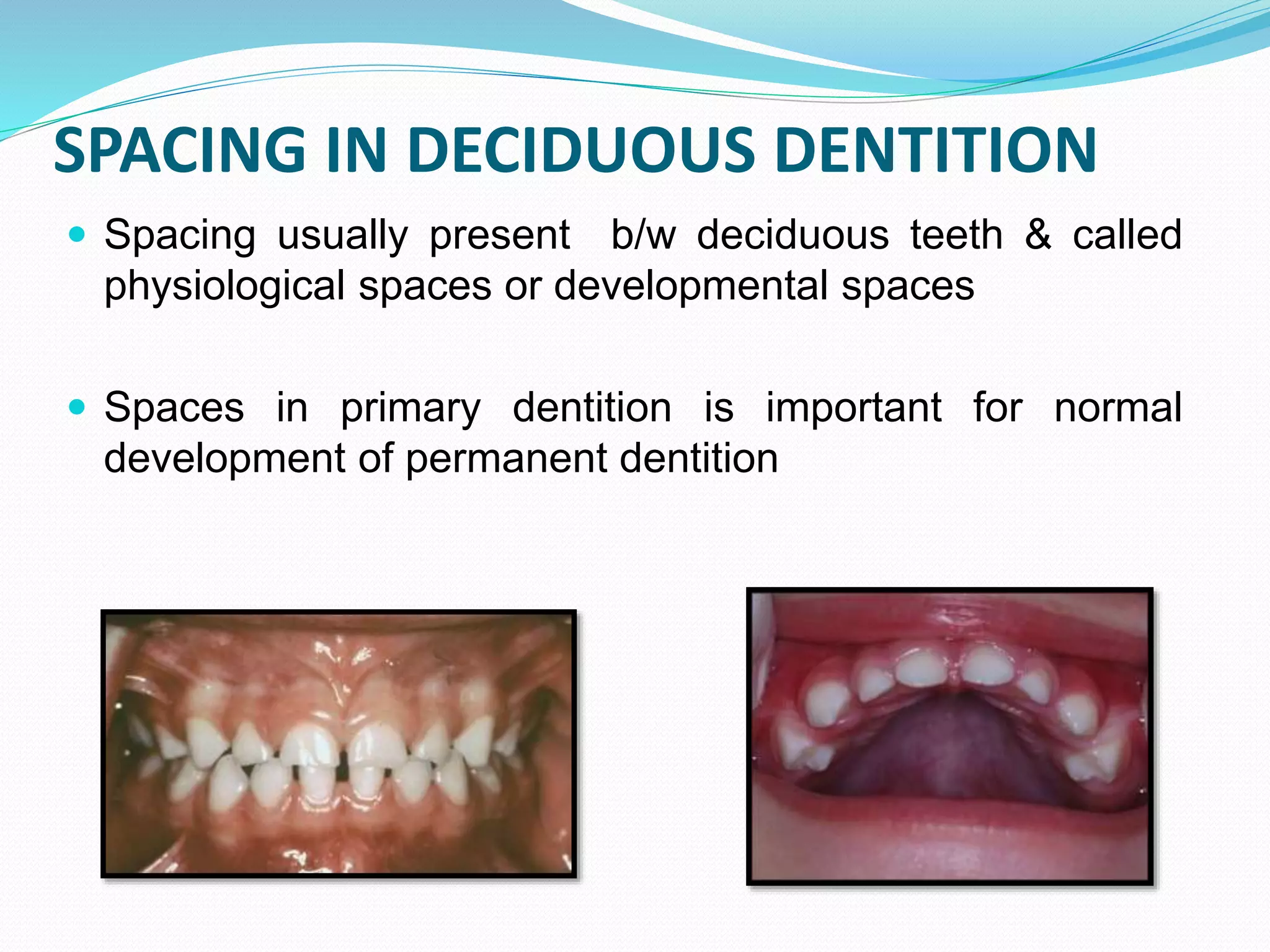
SPACING IN DECIDUOUS DENTITION
 Spacing usually present b/w deciduous teeth & called
physiological spaces or developmental spaces
 Spaces in primary dentition is important for normal
development of permanent dentition
 Absence of spaces in primary dentition can cause
crowding (when the larger permanent teeth erupt)
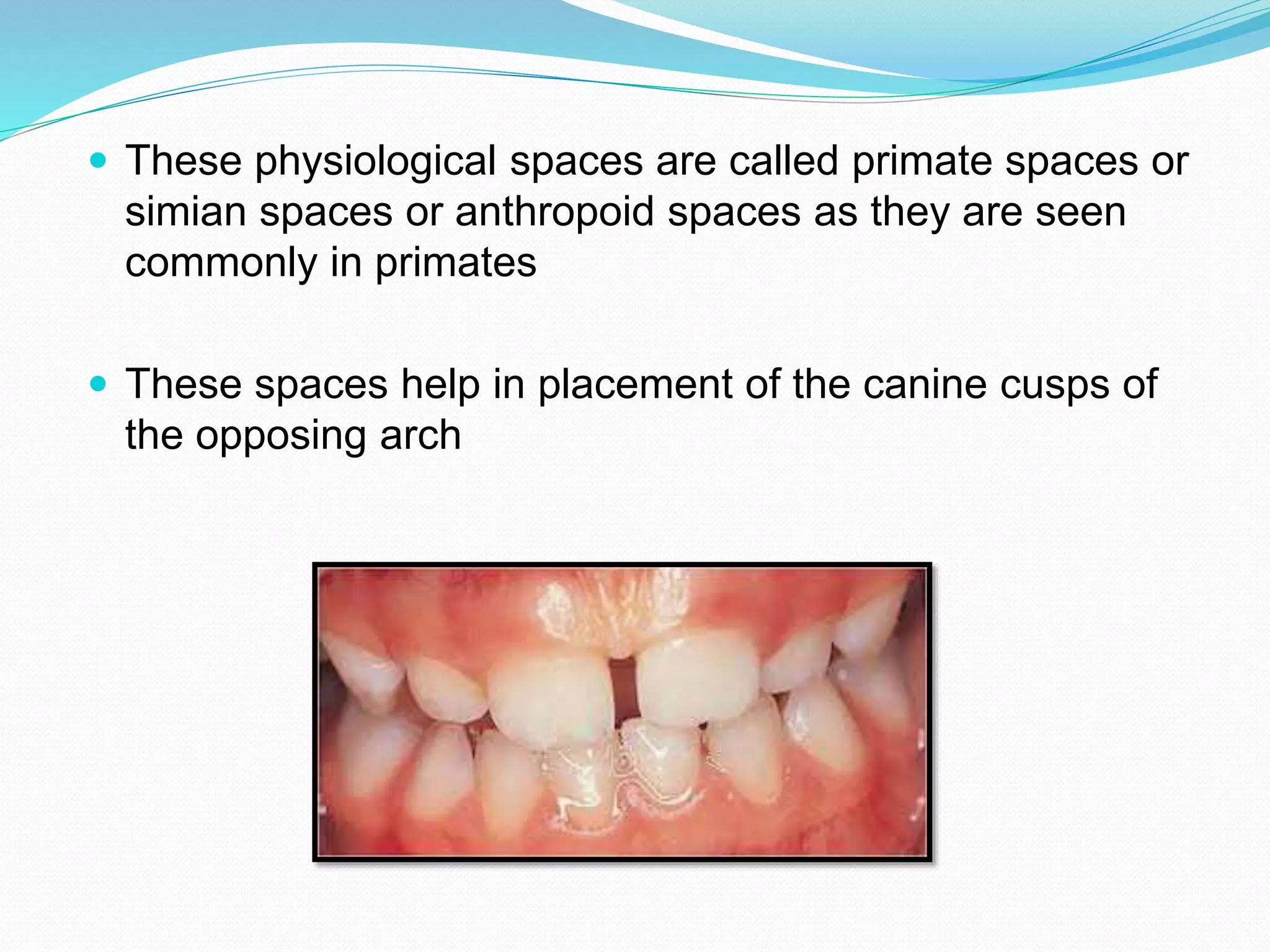
 Spacing invariably is seen mesial to maxillary canines &
distal to mandibular canines
 These physiological spaces are called primate spaces or
simian spaces or anthropoid spaces as they are seen
commonly in primates
 These spaces help in placement of the canine cusps of
the opposing arch
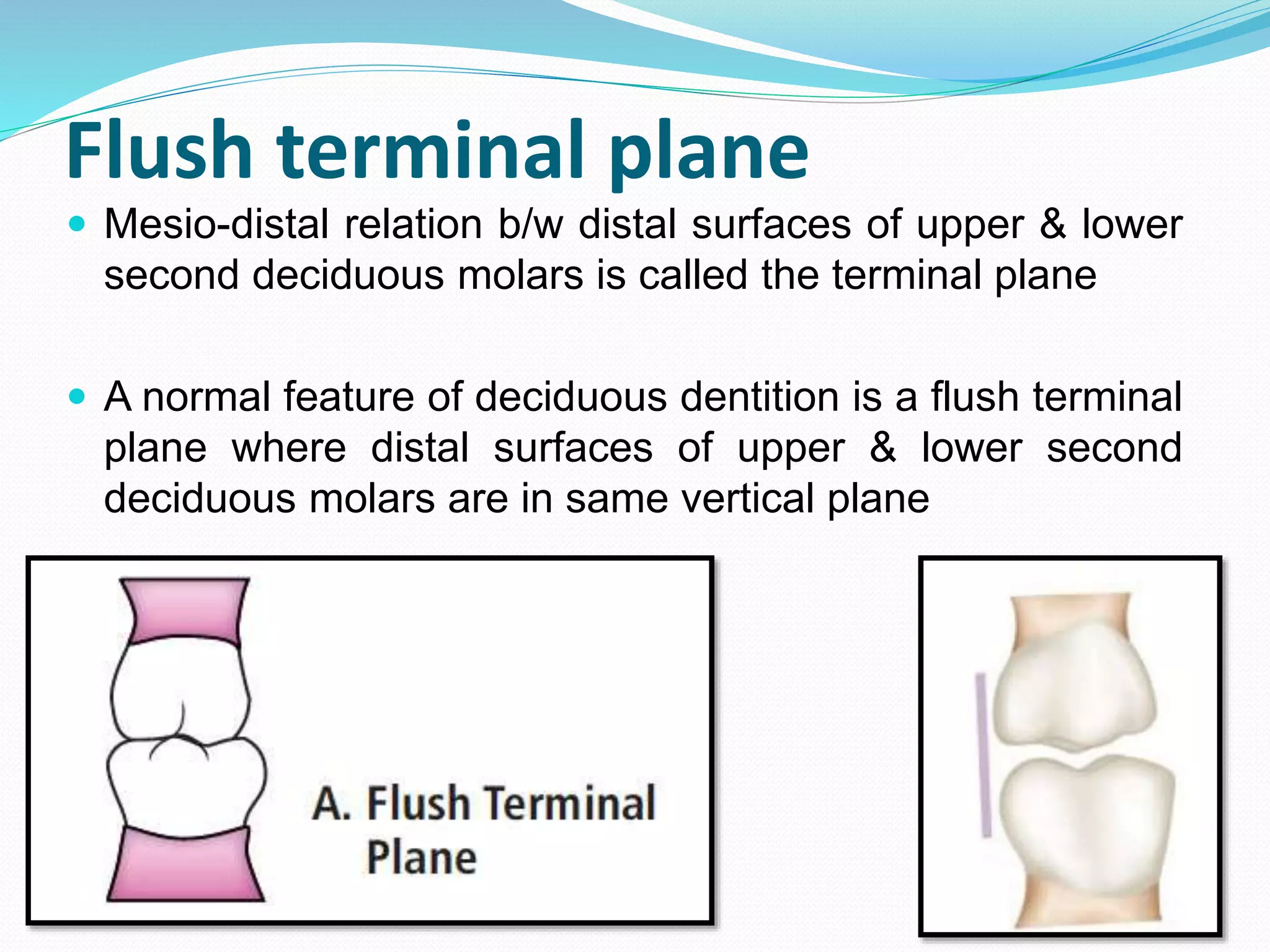
Flush terminal plane
 Mesio-distal relation b/w distal surfaces of upper & lower
second deciduous molars is called the terminal plane
 A normal feature of deciduous dentition is a flush terminal
plane where distal surfaces of upper & lower second
deciduous molars are in same vertical plane
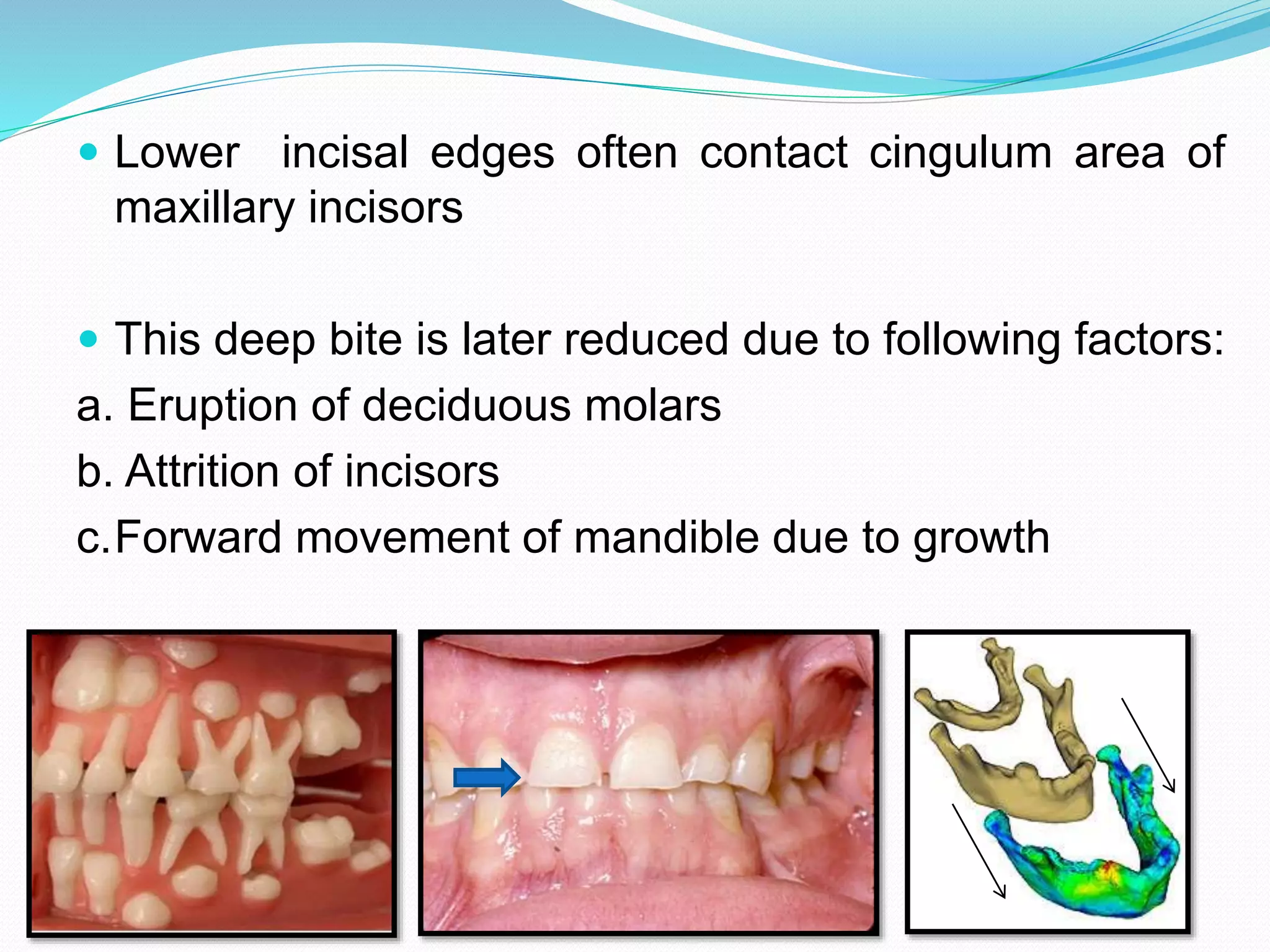
Deep bite
 A deep bite may occur in initial stages of development
 Deep bite is accentuated by fact that deciduous incisors
are more upright than their successors
 Lower incisal edges often contact cingulum area of
maxillary incisors
 This deep bite is later reduced due to following factors:
a. Eruption of deciduous molars
b. Attrition of incisors
c.Forward movement of mandible due to growth
MIXED DENTITION PERIOD
 Mixed dentition period begins at approximately 6 years of
age with eruption of 1st permanent molars
 During mixed dentition period, deciduous teeth along with
some permanent teeth are present in oral cavity
 Mixed dentition period classified into three phases:
 1st transitional period
 Inter-transitional period
 2nd transitional period
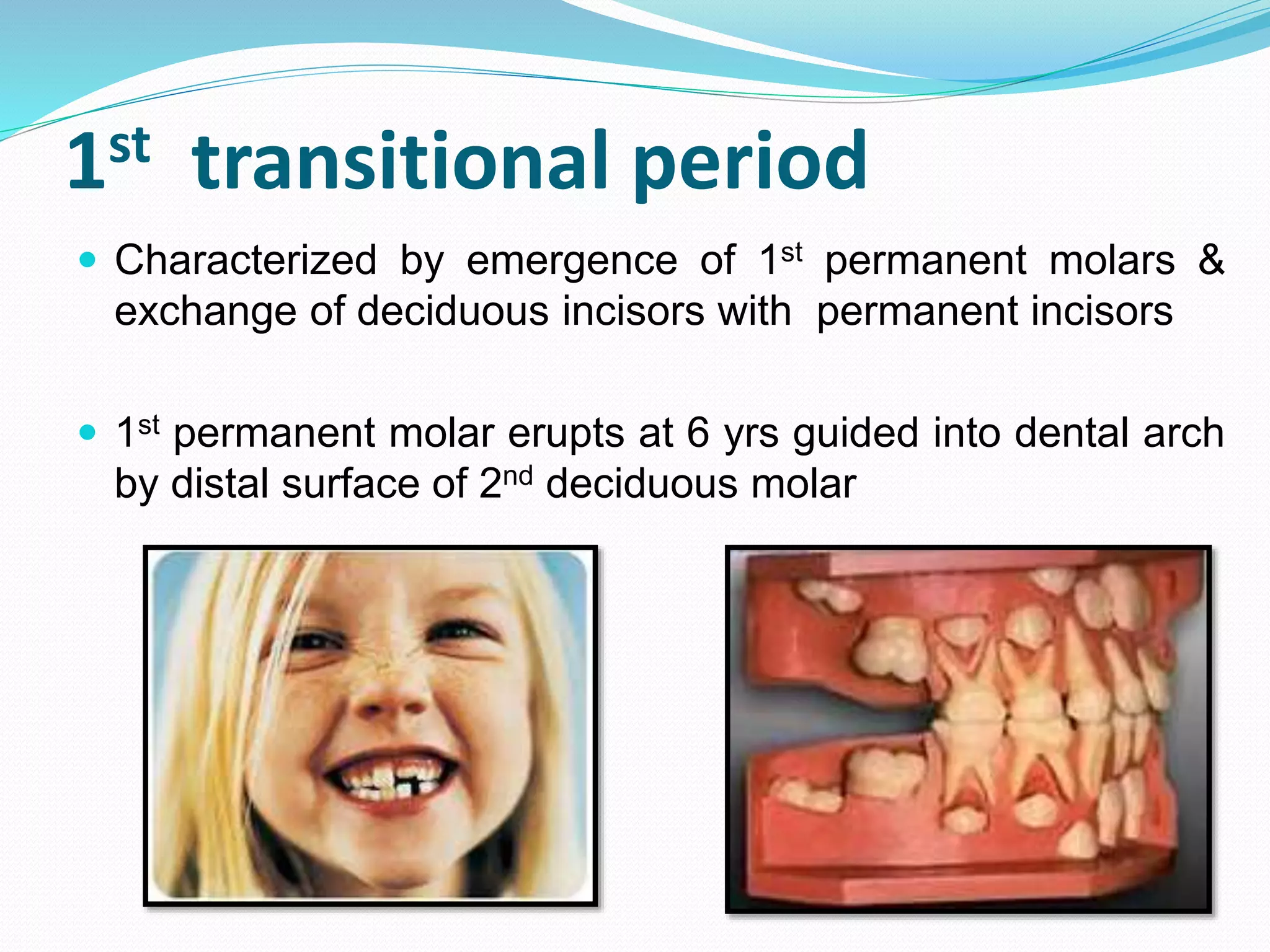
1st transitional period
 Characterized by emergence of 1st permanent molars &
exchange of deciduous incisors with permanent incisors
 1st permanent molar erupts at 6 yrs guided into dental arch
by distal surface of 2nd deciduous molar
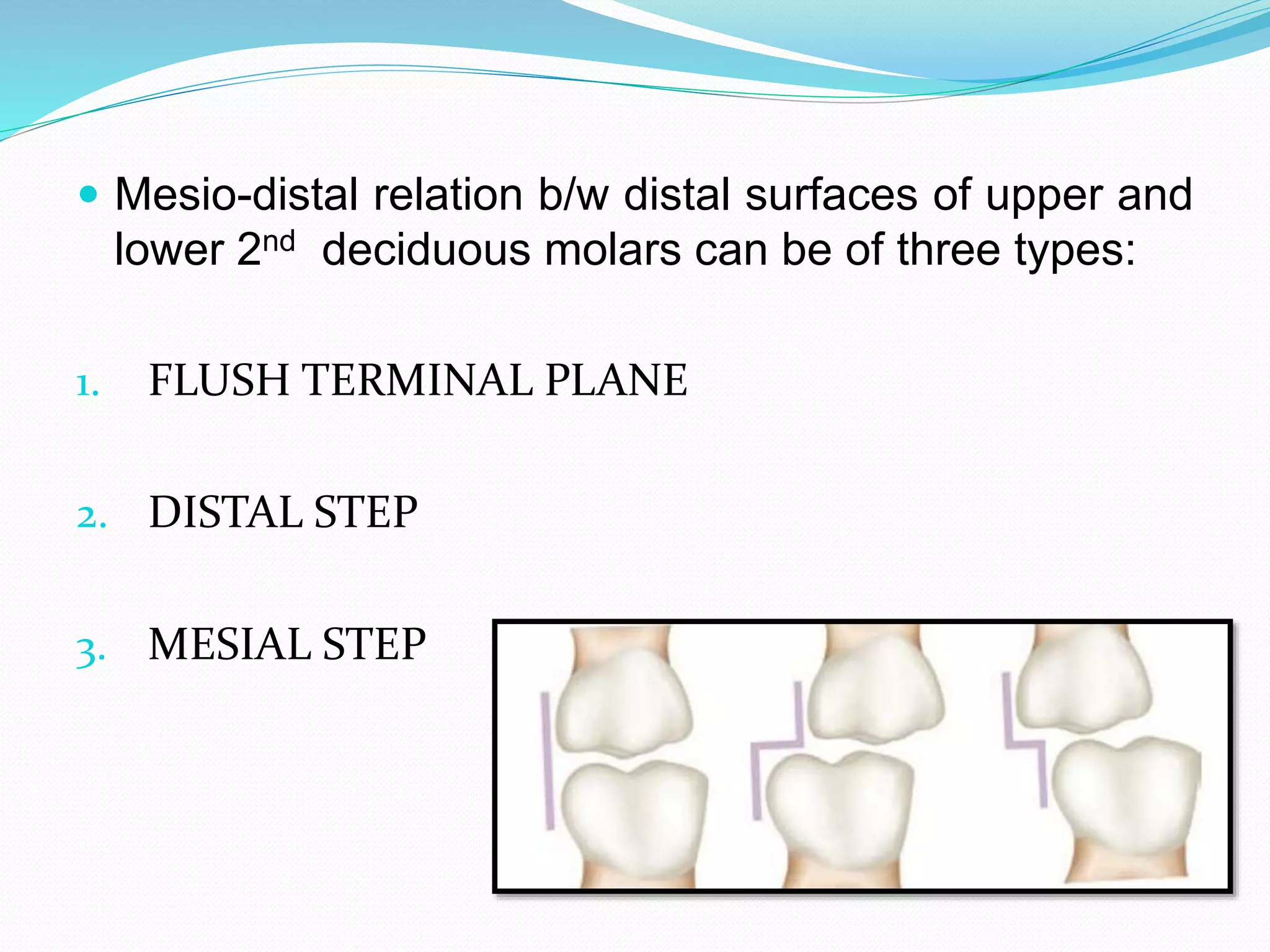
 Mesio-distal relation b/w distal surfaces of upper and
lower 2nd deciduous molars can be of three types:
1. FLUSH TERMINAL PLANE
2. DISTAL STEP
3. MESIAL STEP
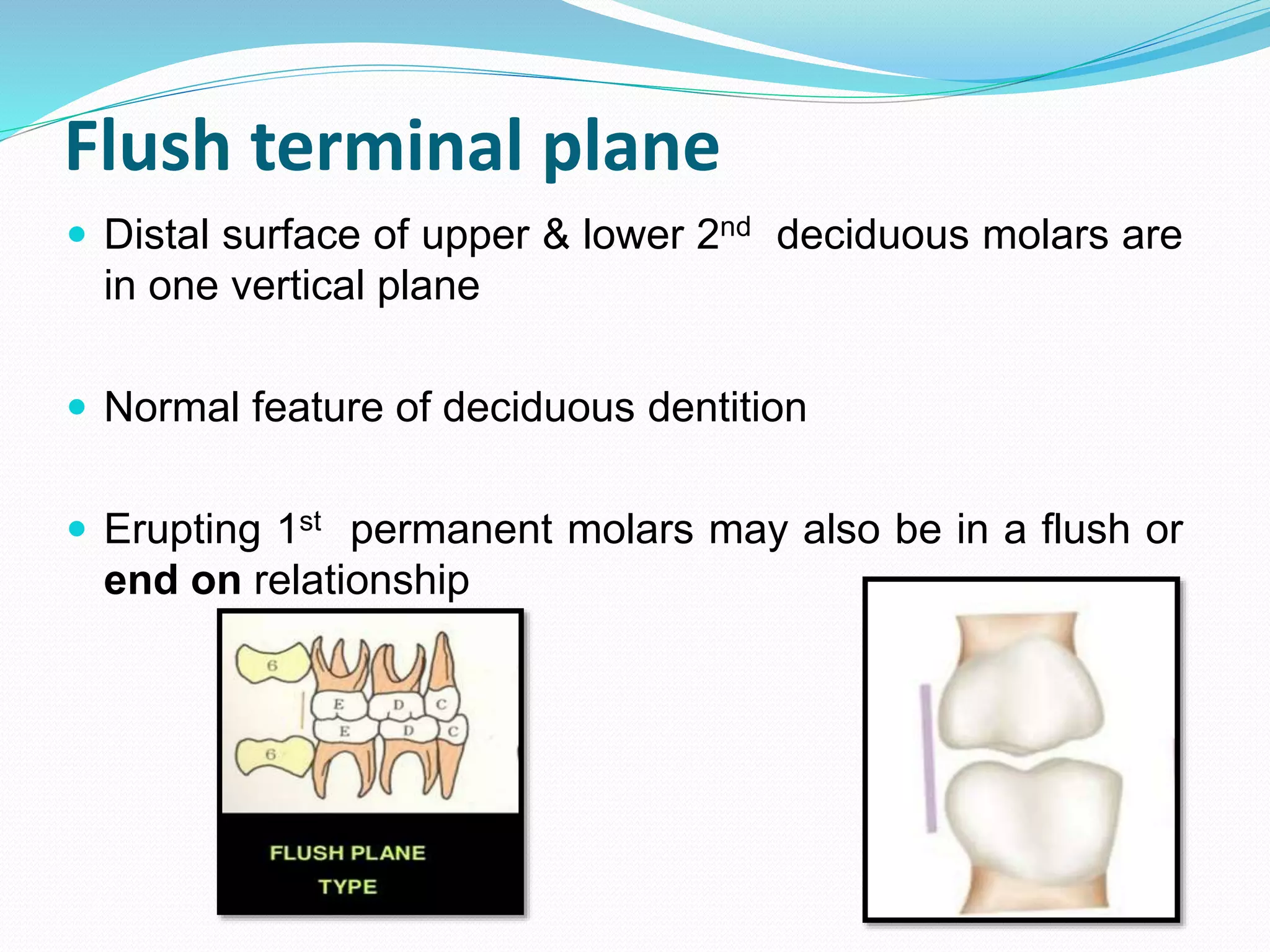
Flush terminal plane
 Distal surface of upper & lower 2nd deciduous molars are
in one vertical plane
 Normal feature of deciduous dentition
 Erupting 1st permanent molars may also be in a flush or
end on relationship
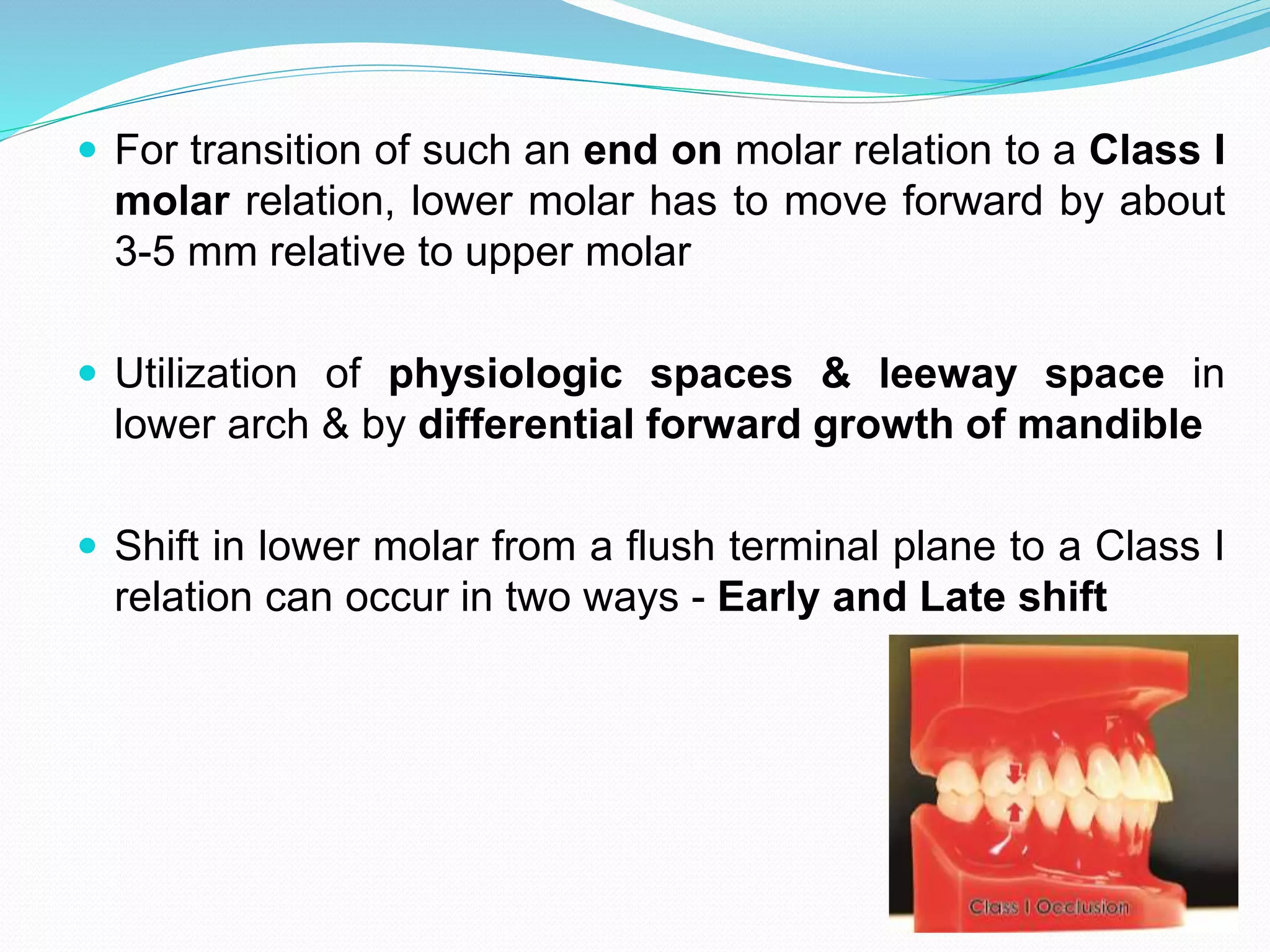
 For transition of such an end on molar relation to a Class I
molar relation, lower molar has to move forward by about
3-5 mm relative to upper molar
 Utilization of physiologic spaces & leeway space in
lower arch & by differential forward growth of mandible
 Shift in lower molar from a flush terminal plane to a Class I
relation can occur in two ways - Early and Late shift
Early shift
 Early shift occurs during early mixed dentition period
 Eruptive force of 1st permanent molar is sufficient to push
deciduous 1st & 2nd molars forward in arch to close primate
space & establish a Class I molar relationship
 Since this occurs early in mixed dentition period it is called
early shift
Late shift
 Many children lack primate space & thus erupting
permanent molars are unable to move forward to establish
Class I relationship
 In these cases, when deciduous second molars exfoliate
permanent 1st molars drift mesialy utilizing leeway space
 This occurs in late mixed dentition period & is thus called
late shift
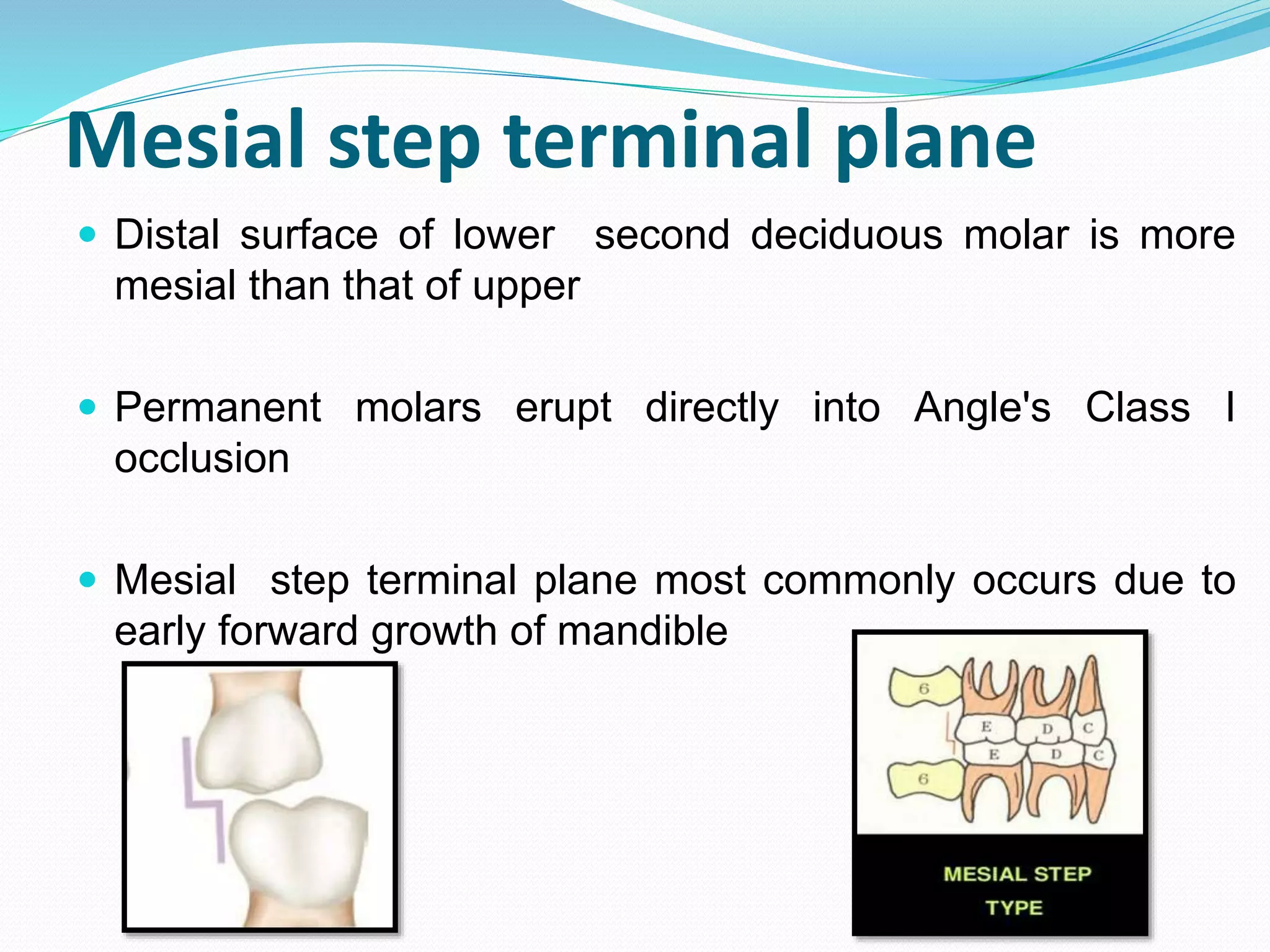
Mesial step terminal plane
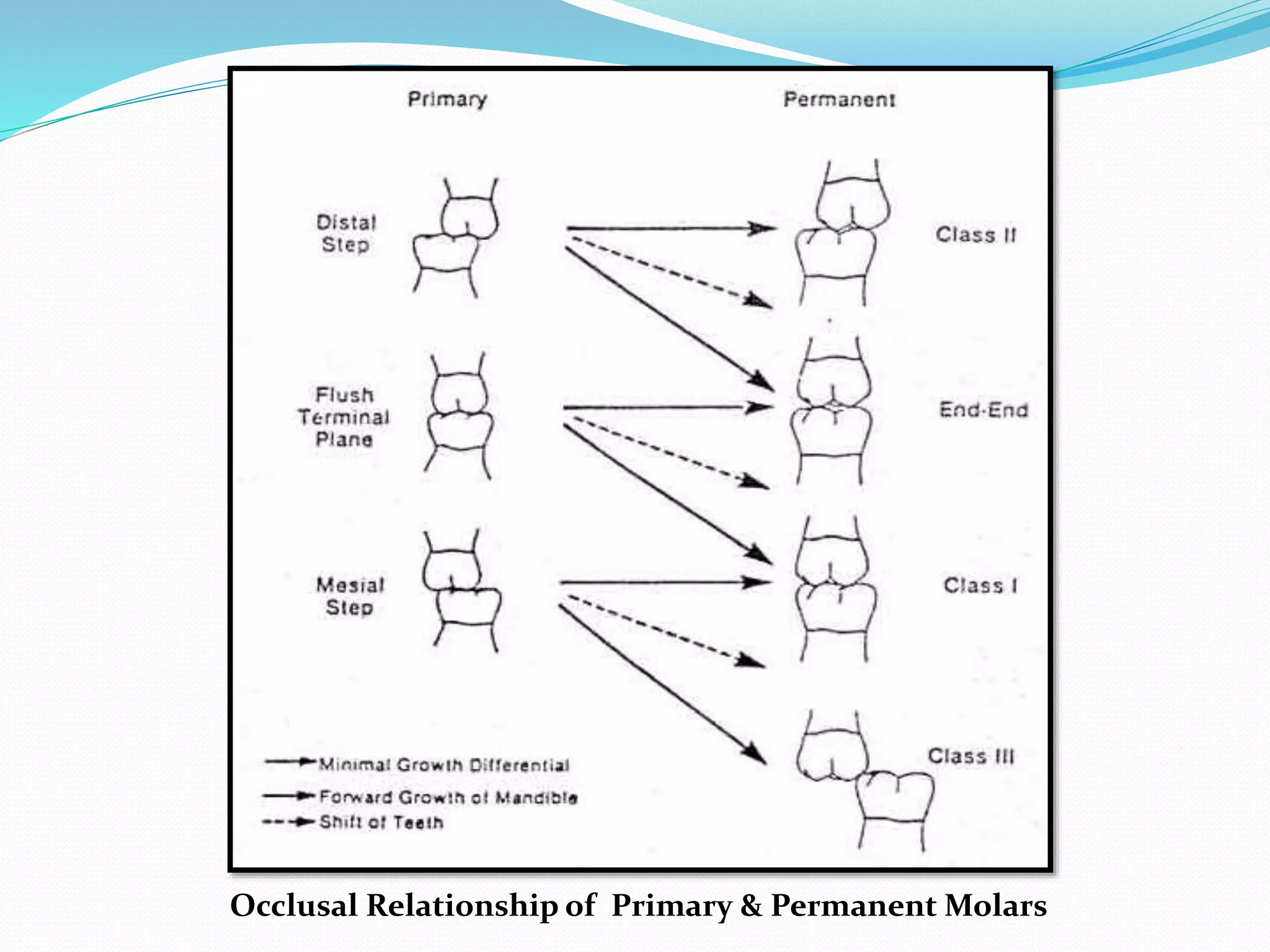
 Distal surface of lower second deciduous molar is more
mesial than that of upper
 Permanent molars erupt directly into Angle's Class I
occlusion
 Mesial step terminal plane most commonly occurs due to
early forward growth of mandible
 If differential growth of mandible in a forward direction
persists, it can lead to Angle's Class III molar relation
 If forward mandibular growth is minimal, it can establish a
Class I molar relationship
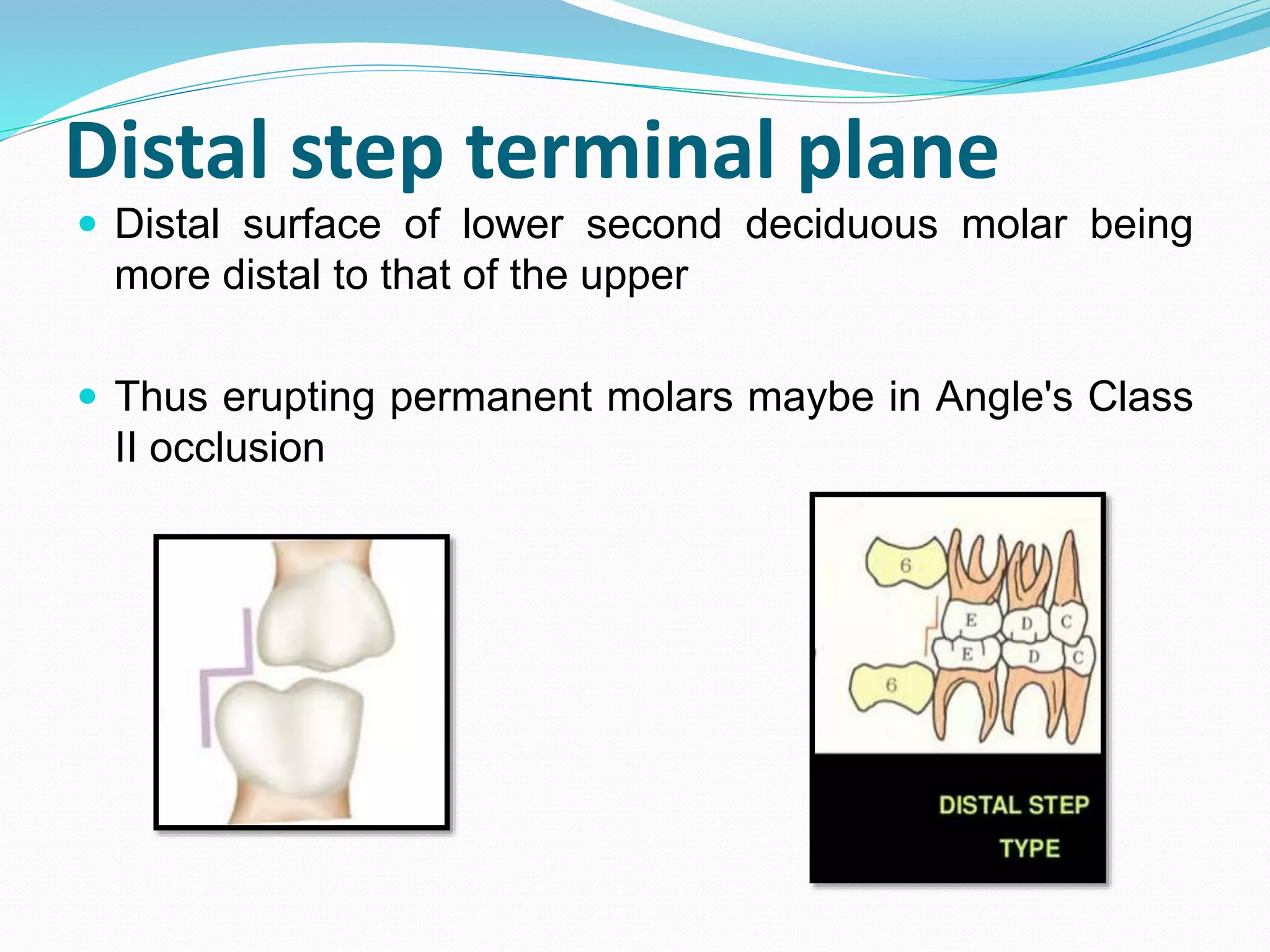
Distal step terminal plane
 Distal surface of lower second deciduous molar being
more distal to that of the upper
 Thus erupting permanent molars maybe in Angle's Class
II occlusion
Occlusal Relationship of Primary & Permanent Molars
Exchange of incisors:
 During first transitional period deciduous incisors are
replaced by permanent incisors
 Mandibular central incisors : 1st to erupt
 Permanent incisors > deciduous incisors
 This difference b/w amount of space needed for
accommodation of incisors & amount of space available
for this is called Incisal liability
 Incisal liability (maxillary arch ) : about 7 mm
 Incisal liability (mandibular arch ) : about 5 mm
 The incisal liability is overcome by the following factors:
A. Utilization of interdental spaces seen in primary
dentition:
 Physiologic or developmental spaces that exist in primary
dentition are utilized to partly account for
incisal liability
 Permanent incisors are much more easily
accommodated in normal alignment in cases exhibiting
adequate inter-dental spaces than in an arch that has no
space
B. Increase in inter - canine width:
 During transition from primary incisors to permanent
incisors, increase in inter-canine width of both maxillary &
mandibular arches takes place
 This is an important factor that allows much larger
permanent incisors to be accommodated in arch
previously occupied by the deciduous incisors
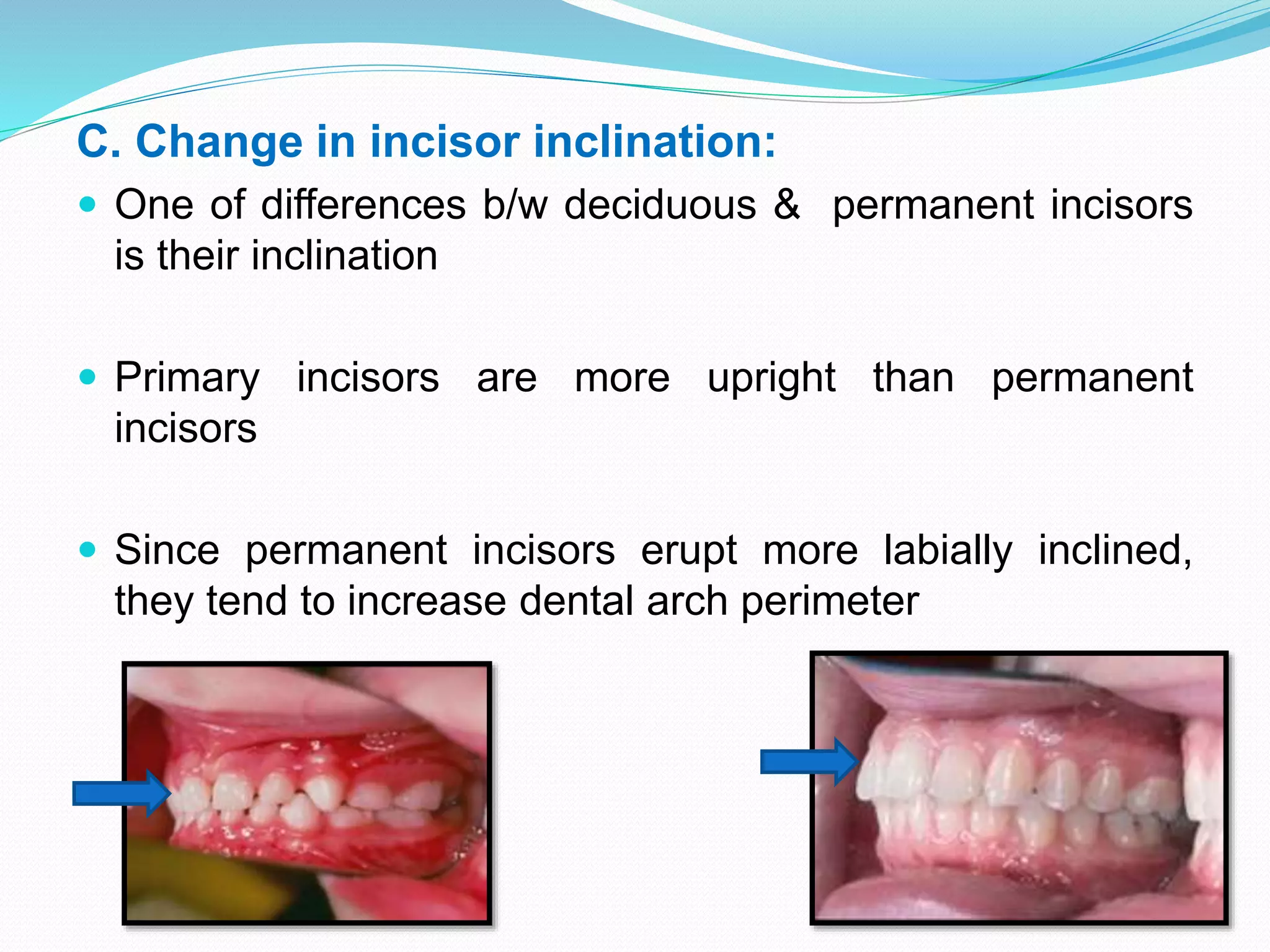
C. Change in incisor inclination:
 One of differences b/w deciduous & permanent incisors
is their inclination
 Primary incisors are more upright than permanent
incisors
 Since permanent incisors erupt more labially inclined,
they tend to increase dental arch perimeter
A. Primary incisors are more
upright in alignment than
permanent incisors
B. Permanent incisors are
more labialy inclined
PRIMARY
DENTITION PERMANENT
DENTITION
Inter - transitional period
 In this period the maxillary and mandibular arches consist
of sets of deciduous and permanent teeth.
 Between permanent incisors and first permanent molars
are deciduous molars and canines.
 This phase during the mixed dentition period is relatively
stable and no change occurs.
2nd transitional period
 2nd transitional period is characterized by replacement of
deciduous molars & canines by premolars & permanent
cuspids respectively
 Combined mesio-distal width of permanent canines &
premolars is usually less than that of deciduous canines
and molars & this Surplus space is called leeway space
of Nance
 Leeway space (mandibular arch) : about 3.4mm (1.7mm
on each side of the arch)
 Leeway space (maxillary arch) : about 1.8mm (0.9 mm
on each side of the arch)
 Excess space available after exchange of deciduous
molars & canines is utilized for mesial drift of mandibular
molars to establish Class I molar relation
Ugly duckling stage
 Sometimes a transient or self correcting malocclusion is
seen in maxillary incisor region b/w 8-9 years of age
 This is a particular situation seen during eruption of
permanent canines
 As developing permanent canines erupt, they displace
roots of lateral incisors on to roots of central incisors,
which also get displaced mesialy
 A resultant distal divergence of crowns of two central
incisors causes a midline spacing
 Described by Broadbent ( hence also known as
Broadbent phenomenon) as ugly duckling stage as
children tend to look ugly during this phase of
development
 This condition usually corrects by itself when canines
erupt & pressure is transferred from roots to coronal area
of incisors
PERMANENT DENTITION PERIOD
 Permanent dentition forms within jaws soon after birth,
except for cusps of first permanent molars, which form
before birth
 Permanent incisors develop lingual or palatal to deciduous
incisors and move labially as they erupt
 Premolars develop below diverging roots of deciduous
molars
 Eruption sequence of permanent dentition may exhibit
variation:
6-1-2-4-3-5-7 or 6-1-2-3-4-5-7
 In mandibular arch sequence is:
6-1-2-3-4-5-7 or 6-1-2-4-3-5-7
Occlusal Curvatures & Axial Position
a. Curve of Spee
b. Curve of Wilson
c. Sphere of Monson
d. Axial position
Curve of Spee
 The curvature which begins at the tip of canines & follows
buccal cusp tips of premolars & molars posteriorly, when
viewed from their facial aspect
 Two dimensional and curves upward from anterior to
posterior
 Inclination of some of individual posterior teeth must be
offset from vertical long axis of body, if their occlusal
surfaces are to conform to this curve
 Maxillary molar roots are inclined mesialy & mandibular
molar roots distally
Curve of Wilson
 Medio-lateral curvature of occlusal plane of posterior
teeth
 Two dimensional, at right angle to Curve of Spee
 Purpose of this arc in occlusal curvature is to
complement paths of condyles during movements of
mandible
 Crowns of mandibular posterior teeth must incline to
lingual, while crowns of maxillary posterior teeth must
incline toward buccal
 This curve becomes deeper posteriorly, so that molars
inclination is greater than that of premolars
 Because of this curve & associated tooth inclinations,
buccal cusps of mandibular molars & lingual cusps of
maxillary molars usually appear to be longer
Sphere of Monson
 Compensating Occlusal Curvature
 Three dimensional curvature of the occlusal plane, which
is the combination of the Curve of Spee and the Curve of
Wilson
 This curvature is in form of a portion of a ball, or sphere
 This curvature is concave for mandibular arch & convex
for the maxillary arch
Axial Position
 Inclination of a tooth from a vertical axis
 Normally described in mesio-distal & facio-lingual directions
 It is normally described in terms of root's inclination, which
means that crown is normally inclined in opposite direction
 These inclinations are necessary for proper occlusal &
incisal function of teeth
 As these axial positions are described, it should be of value
to relate them to individual tooth's functions, as well as its
inclination relative to Curves of Spee and Wilson
Axial Positions of teeth
TEETH DIRECTION INCLINATION (ROOT)
ANT. MAXILLARY TEETH FACIOLINGUAL LINGUAL
ANT. MAXILLARY TEETH MESIODISTAL INCISORS : MESIAL
CANINE : DISTAL
TEETH DIRECTION INCLINATION
(ROOTS)
MAXILLARY
PREMOLARS
FACIOLINGUAL LINGUAL
MAXILLARY
PREMOLARS
MESIODISTAL DISTAL
MAXILLARY MOLARS FACIOLINGUAL LINGUAL
MAXILLARY MOLARS MESIODISTAL MESIAL
TEETH DIRECTION INCLINATION
MANDIBULAR INCISOR &
CANINES
FACIOLINGUAL LINGUAL (ROOT)
MANDIBULAR INCISOR MESIODISTALLY MESIAL (ROOT)
MANDIBULAR CANINES MESIODISTALLY DISTAL (ROOT)
TEETH DIRECTION INCLINATION
MANDIBULAR
PREMOLAR
MESIODISTALLY DISTAL (ROOT)
MANDIBULAR
PREMOLAR 1st
FACIOLINGUAL LINGUAL (ROOT)
MANDIBULAR
PREMOLAR 2nd
FACIOLINGUAL BUCCAL (ROOT)
MANDIBULAR MOLAR MD & FL DISTAL & BUCCAL
MD : Mesio-distal
FL: Facio-lingual
References
 CONCISE DENTAL ANATOMY & MORPHOLOGY : JAMES L
FULLER
 DENTAL ANATOMY, PHYSIOLOGY & OCCLUSION: WHEELER’S
 TEXTBOOK OF DENTAL ANATOMY, PHYSIOLOGY &
OCCLUSION: RASHMI GS (PHULARI)
 MOYERS RE: HANDBOOK OF ORTHODONTICS
 ORTHODONTICS - THE ART & SCIENCE : S.I. BHALAJHI
 INTERNET
THANK YOU

Development of Occlusion

  • 1.
    Dr. Abhishek SolankiDr. Parvind Gumber
  • 2.
    INTRODUCTION  The termocclusion has both static and dynamic aspects  Static refers to form, alignment and articulation of teeth within & between dental arches and relationship of teeth to their supporting structures  It may be defined also as the contact relationship of the teeth in function or parafunction
  • 3.
    IDEAL OCCLUSION:  Pre-conceivedtheoretical concept of occlusal structural & functional relationships that include idealized principles and characteristics that an occlusion should be NORMAL OCCLUSION:  It is class I relationship of maxillary & mandibular 1st molars in centric occlusion PHYSIOLOGIC OCCLUSION:  Occlusion that deviates in one or more ways from ideal yet it is well adapted to that particular environment is esthetic & shows no pathologic manifestations
  • 4.
    FUNCTIONAL OCCLUSION:  Anarrangement of teeth which will provide highest efficiency during excursive movements of mandible which is necessary during function BALANCED OCCLUSION:  An occlusion in which balance & equal contacts are maintained throughout entire arch during all excursions of mandible  Others : Therapeutic occlusion, Traumatic Occlusion, Centric Occlusion etc.
  • 5.
    PERIODS OF OCCLUSALDEVELOPMENT:  PRE-DENTAL PERIOD  DECIDUOUS DENTITION PERIOD  MIXED DENTITION PERIOD  PERMANENT DENTITION PERIOD
  • 6.
    PRE-DENTAL PERIOD  Theperiod after birth during which the neonate does not have teeth  Lasts for 6 months
  • 7.
    GUM PADS  Alveolarprocesses at the time of birth  Pink, firm and are covered by a dense layer of fibrous periosteum
  • 8.
     Horse-shoe shapedand developed in two parts  Labio-buccal portion & lingual portion  Two portions of gum pads are separated by dental groove
  • 9.
     Gum padare divided into 10 segments by certain grooves called transverse grooves  Each of these segment consist of developing deciduous tooth sac  Gingival groove separate gum pads from palate & floor of the mouth
  • 10.
     Transverse groovebetween canine & and first deciduous molar segment is called the lateral sulcus  Lateral sulci are useful in judging the inter-arch relationship at a very early stage  The lateral sulcus of the mandibular arch is normally more distal to that of the maxillary arch Lateral sulcus
  • 11.
     The upperand lower gum pads are almost similar to each other  The upper gum pad is both wider as well as longer than the mandibular gum pad  Thus when upper and lower gum pads are approximated, there is a complete overjet all around
  • 12.
     Contact occursb/w upper & lower gum pads in first molar region and a space exists between them in anterior region  This infantile open bite is considered normal and it helps in suckling Infantile open bite for suckling
  • 13.
    Status of dentition Neonate is without teeth for about 6 months of life  At birth gum pads are not sufficiently wide to accommodate developing incisors, which are crowded in their crypts  During 1st year of life gum pads grow rapidly permitting incisors to erupt in good alignment
  • 14.
     Teeth thatare present at the time of birth are called natal teeth.  Teeth that erupt during the first month of age are called neonatal teeth.  The natal and neonatal teeth are mostly located in the mandibular incisor region and show a familial tendency.
  • 15.
    DECIDUOUS DENTITION PERIOD Initiation of primary tooth buds occurs during first six weeks of intra-uterine life  Primary teeth begin to erupt at age of about 6 months  Eruption time for primary teeth : 21/2 - 3 1/2 years
  • 16.
    Eruption age andsequence of deciduous dentition  A-B-D-C-E  6months – 3 Years
  • 17.
  • 18.
    SPACING IN DECIDUOUSDENTITION  Spacing usually present b/w deciduous teeth & called physiological spaces or developmental spaces  Spaces in primary dentition is important for normal development of permanent dentition
  • 19.
     Absence ofspaces in primary dentition can cause crowding (when the larger permanent teeth erupt)  Spacing invariably is seen mesial to maxillary canines & distal to mandibular canines
  • 20.
     These physiologicalspaces are called primate spaces or simian spaces or anthropoid spaces as they are seen commonly in primates  These spaces help in placement of the canine cusps of the opposing arch
  • 21.
    Flush terminal plane Mesio-distal relation b/w distal surfaces of upper & lower second deciduous molars is called the terminal plane  A normal feature of deciduous dentition is a flush terminal plane where distal surfaces of upper & lower second deciduous molars are in same vertical plane
  • 22.
    Deep bite  Adeep bite may occur in initial stages of development  Deep bite is accentuated by fact that deciduous incisors are more upright than their successors
  • 23.
     Lower incisaledges often contact cingulum area of maxillary incisors  This deep bite is later reduced due to following factors: a. Eruption of deciduous molars b. Attrition of incisors c.Forward movement of mandible due to growth
  • 24.
    MIXED DENTITION PERIOD Mixed dentition period begins at approximately 6 years of age with eruption of 1st permanent molars  During mixed dentition period, deciduous teeth along with some permanent teeth are present in oral cavity
  • 25.
     Mixed dentitionperiod classified into three phases:  1st transitional period  Inter-transitional period  2nd transitional period
  • 26.
    1st transitional period Characterized by emergence of 1st permanent molars & exchange of deciduous incisors with permanent incisors  1st permanent molar erupts at 6 yrs guided into dental arch by distal surface of 2nd deciduous molar
  • 27.
     Mesio-distal relationb/w distal surfaces of upper and lower 2nd deciduous molars can be of three types: 1. FLUSH TERMINAL PLANE 2. DISTAL STEP 3. MESIAL STEP
  • 28.
    Flush terminal plane Distal surface of upper & lower 2nd deciduous molars are in one vertical plane  Normal feature of deciduous dentition  Erupting 1st permanent molars may also be in a flush or end on relationship
  • 29.
     For transitionof such an end on molar relation to a Class I molar relation, lower molar has to move forward by about 3-5 mm relative to upper molar  Utilization of physiologic spaces & leeway space in lower arch & by differential forward growth of mandible  Shift in lower molar from a flush terminal plane to a Class I relation can occur in two ways - Early and Late shift
  • 30.
    Early shift  Earlyshift occurs during early mixed dentition period  Eruptive force of 1st permanent molar is sufficient to push deciduous 1st & 2nd molars forward in arch to close primate space & establish a Class I molar relationship  Since this occurs early in mixed dentition period it is called early shift
  • 31.
    Late shift  Manychildren lack primate space & thus erupting permanent molars are unable to move forward to establish Class I relationship  In these cases, when deciduous second molars exfoliate permanent 1st molars drift mesialy utilizing leeway space  This occurs in late mixed dentition period & is thus called late shift
  • 32.
    Mesial step terminalplane  Distal surface of lower second deciduous molar is more mesial than that of upper  Permanent molars erupt directly into Angle's Class I occlusion  Mesial step terminal plane most commonly occurs due to early forward growth of mandible
  • 33.
     If differentialgrowth of mandible in a forward direction persists, it can lead to Angle's Class III molar relation  If forward mandibular growth is minimal, it can establish a Class I molar relationship
  • 34.
    Distal step terminalplane  Distal surface of lower second deciduous molar being more distal to that of the upper  Thus erupting permanent molars maybe in Angle's Class II occlusion
  • 35.
    Occlusal Relationship ofPrimary & Permanent Molars
  • 36.
    Exchange of incisors: During first transitional period deciduous incisors are replaced by permanent incisors  Mandibular central incisors : 1st to erupt  Permanent incisors > deciduous incisors
  • 37.
     This differenceb/w amount of space needed for accommodation of incisors & amount of space available for this is called Incisal liability  Incisal liability (maxillary arch ) : about 7 mm  Incisal liability (mandibular arch ) : about 5 mm
  • 38.
     The incisalliability is overcome by the following factors: A. Utilization of interdental spaces seen in primary dentition:  Physiologic or developmental spaces that exist in primary dentition are utilized to partly account for incisal liability  Permanent incisors are much more easily accommodated in normal alignment in cases exhibiting adequate inter-dental spaces than in an arch that has no space
  • 39.
    B. Increase ininter - canine width:  During transition from primary incisors to permanent incisors, increase in inter-canine width of both maxillary & mandibular arches takes place  This is an important factor that allows much larger permanent incisors to be accommodated in arch previously occupied by the deciduous incisors
  • 40.
    C. Change inincisor inclination:  One of differences b/w deciduous & permanent incisors is their inclination  Primary incisors are more upright than permanent incisors  Since permanent incisors erupt more labially inclined, they tend to increase dental arch perimeter
  • 41.
    A. Primary incisorsare more upright in alignment than permanent incisors B. Permanent incisors are more labialy inclined
  • 42.
  • 43.
    Inter - transitionalperiod  In this period the maxillary and mandibular arches consist of sets of deciduous and permanent teeth.  Between permanent incisors and first permanent molars are deciduous molars and canines.  This phase during the mixed dentition period is relatively stable and no change occurs.
  • 44.
    2nd transitional period 2nd transitional period is characterized by replacement of deciduous molars & canines by premolars & permanent cuspids respectively  Combined mesio-distal width of permanent canines & premolars is usually less than that of deciduous canines and molars & this Surplus space is called leeway space of Nance
  • 45.
     Leeway space(mandibular arch) : about 3.4mm (1.7mm on each side of the arch)  Leeway space (maxillary arch) : about 1.8mm (0.9 mm on each side of the arch)  Excess space available after exchange of deciduous molars & canines is utilized for mesial drift of mandibular molars to establish Class I molar relation
  • 46.
    Ugly duckling stage Sometimes a transient or self correcting malocclusion is seen in maxillary incisor region b/w 8-9 years of age  This is a particular situation seen during eruption of permanent canines
  • 47.
     As developingpermanent canines erupt, they displace roots of lateral incisors on to roots of central incisors, which also get displaced mesialy  A resultant distal divergence of crowns of two central incisors causes a midline spacing
  • 48.
     Described byBroadbent ( hence also known as Broadbent phenomenon) as ugly duckling stage as children tend to look ugly during this phase of development  This condition usually corrects by itself when canines erupt & pressure is transferred from roots to coronal area of incisors
  • 49.
    PERMANENT DENTITION PERIOD Permanent dentition forms within jaws soon after birth, except for cusps of first permanent molars, which form before birth  Permanent incisors develop lingual or palatal to deciduous incisors and move labially as they erupt  Premolars develop below diverging roots of deciduous molars
  • 50.
     Eruption sequenceof permanent dentition may exhibit variation: 6-1-2-4-3-5-7 or 6-1-2-3-4-5-7  In mandibular arch sequence is: 6-1-2-3-4-5-7 or 6-1-2-4-3-5-7
  • 51.
    Occlusal Curvatures &Axial Position a. Curve of Spee b. Curve of Wilson c. Sphere of Monson d. Axial position
  • 52.
    Curve of Spee The curvature which begins at the tip of canines & follows buccal cusp tips of premolars & molars posteriorly, when viewed from their facial aspect  Two dimensional and curves upward from anterior to posterior
  • 53.
     Inclination ofsome of individual posterior teeth must be offset from vertical long axis of body, if their occlusal surfaces are to conform to this curve  Maxillary molar roots are inclined mesialy & mandibular molar roots distally
  • 54.
    Curve of Wilson Medio-lateral curvature of occlusal plane of posterior teeth  Two dimensional, at right angle to Curve of Spee  Purpose of this arc in occlusal curvature is to complement paths of condyles during movements of mandible
  • 55.
     Crowns ofmandibular posterior teeth must incline to lingual, while crowns of maxillary posterior teeth must incline toward buccal  This curve becomes deeper posteriorly, so that molars inclination is greater than that of premolars  Because of this curve & associated tooth inclinations, buccal cusps of mandibular molars & lingual cusps of maxillary molars usually appear to be longer
  • 56.
    Sphere of Monson Compensating Occlusal Curvature  Three dimensional curvature of the occlusal plane, which is the combination of the Curve of Spee and the Curve of Wilson  This curvature is in form of a portion of a ball, or sphere  This curvature is concave for mandibular arch & convex for the maxillary arch
  • 57.
    Axial Position  Inclinationof a tooth from a vertical axis  Normally described in mesio-distal & facio-lingual directions  It is normally described in terms of root's inclination, which means that crown is normally inclined in opposite direction
  • 58.
     These inclinationsare necessary for proper occlusal & incisal function of teeth  As these axial positions are described, it should be of value to relate them to individual tooth's functions, as well as its inclination relative to Curves of Spee and Wilson
  • 59.
    Axial Positions ofteeth TEETH DIRECTION INCLINATION (ROOT) ANT. MAXILLARY TEETH FACIOLINGUAL LINGUAL ANT. MAXILLARY TEETH MESIODISTAL INCISORS : MESIAL CANINE : DISTAL
  • 60.
    TEETH DIRECTION INCLINATION (ROOTS) MAXILLARY PREMOLARS FACIOLINGUALLINGUAL MAXILLARY PREMOLARS MESIODISTAL DISTAL MAXILLARY MOLARS FACIOLINGUAL LINGUAL MAXILLARY MOLARS MESIODISTAL MESIAL
  • 61.
    TEETH DIRECTION INCLINATION MANDIBULARINCISOR & CANINES FACIOLINGUAL LINGUAL (ROOT) MANDIBULAR INCISOR MESIODISTALLY MESIAL (ROOT) MANDIBULAR CANINES MESIODISTALLY DISTAL (ROOT)
  • 62.
    TEETH DIRECTION INCLINATION MANDIBULAR PREMOLAR MESIODISTALLYDISTAL (ROOT) MANDIBULAR PREMOLAR 1st FACIOLINGUAL LINGUAL (ROOT) MANDIBULAR PREMOLAR 2nd FACIOLINGUAL BUCCAL (ROOT) MANDIBULAR MOLAR MD & FL DISTAL & BUCCAL MD : Mesio-distal FL: Facio-lingual
  • 63.
    References  CONCISE DENTALANATOMY & MORPHOLOGY : JAMES L FULLER  DENTAL ANATOMY, PHYSIOLOGY & OCCLUSION: WHEELER’S  TEXTBOOK OF DENTAL ANATOMY, PHYSIOLOGY & OCCLUSION: RASHMI GS (PHULARI)  MOYERS RE: HANDBOOK OF ORTHODONTICS  ORTHODONTICS - THE ART & SCIENCE : S.I. BHALAJHI  INTERNET
  • 64.