Articulators
The non-adjustable
articulator
Semi-adjustable
articulator
Fully adjustable
articulator
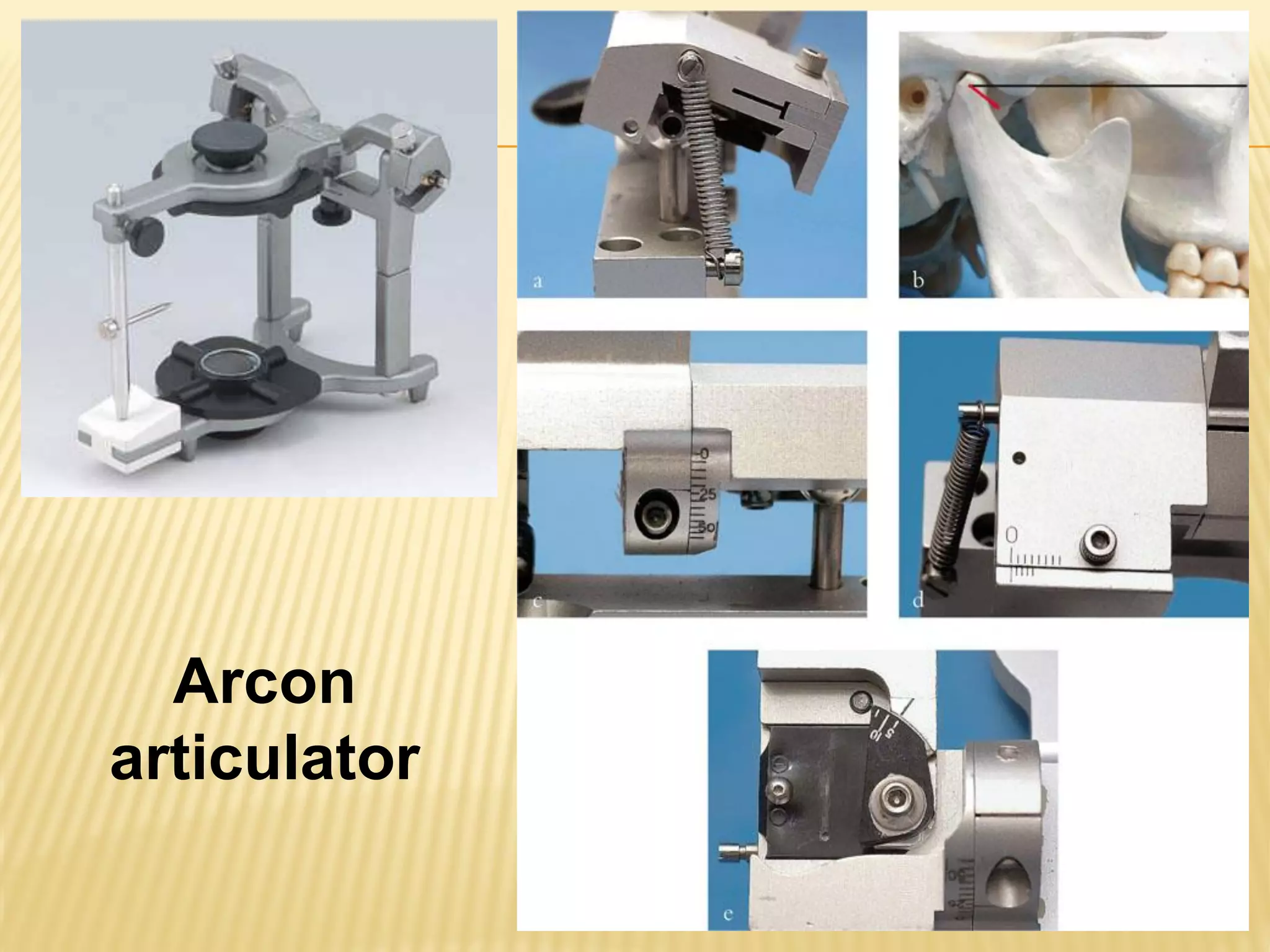
Arcon
Non-
Arcon
Mean
Value
Hinge
Panto-
graphic
tracing
Sterio-
graphic
Non
Adjustable
Articulators
Hinge articulator
Mean Value
articulator
Semi
Adjustable
Articulators
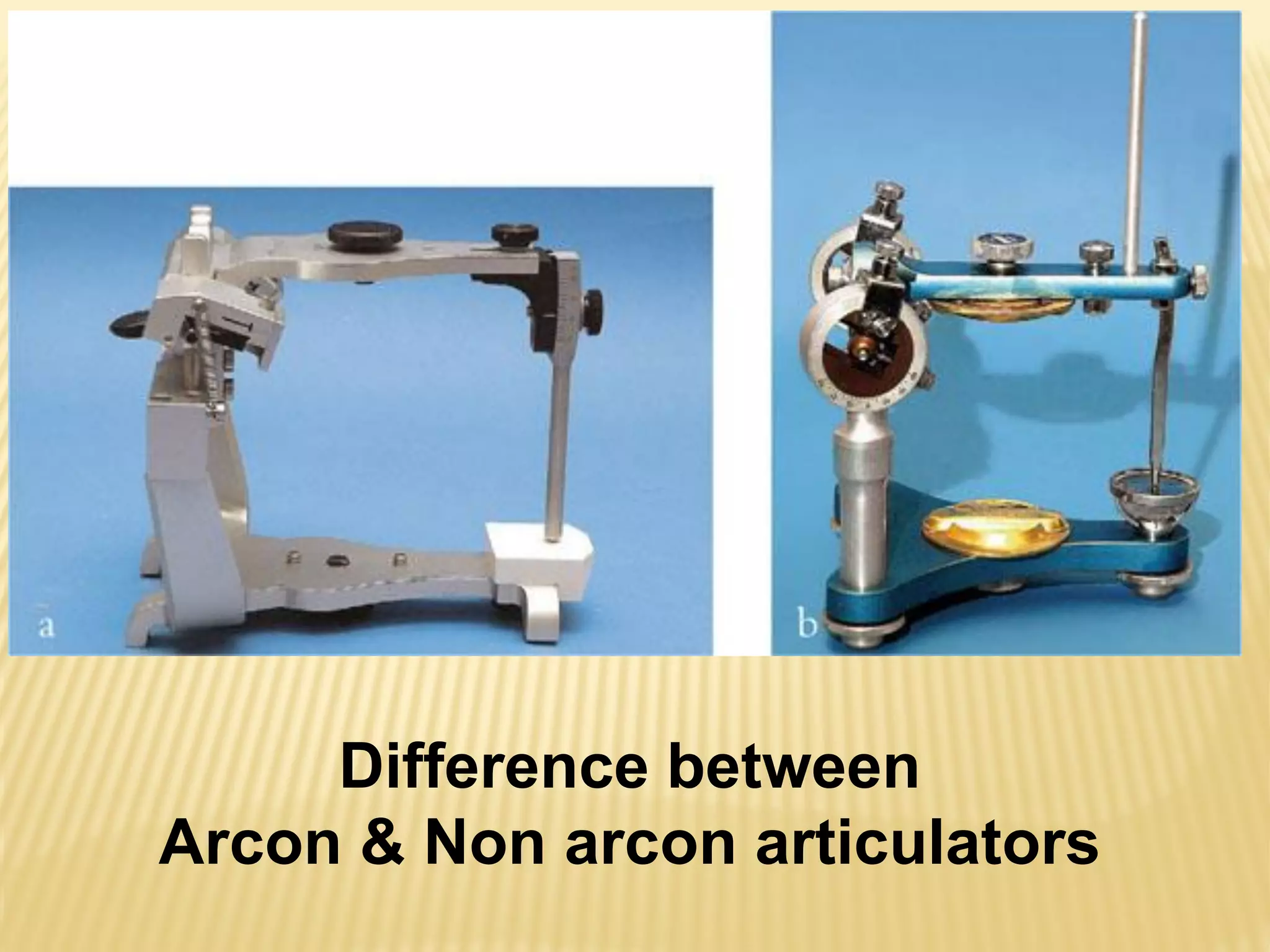
Some of semi-adjustable articulators (for
example, the Hanau H series, the
Dentatus, and the Gysi) have the
condyles attached to the upper
member of the instrument (non-arcon),
whereas others have the condyle
attached to the lower member as
occurs in nature (arcon)
Arcon
articulator
Non Arcon
articulator
Difference between
Arcon & Non arcon articulators
Fully
Adjustable
Articulators
Fully adjustable
articulator
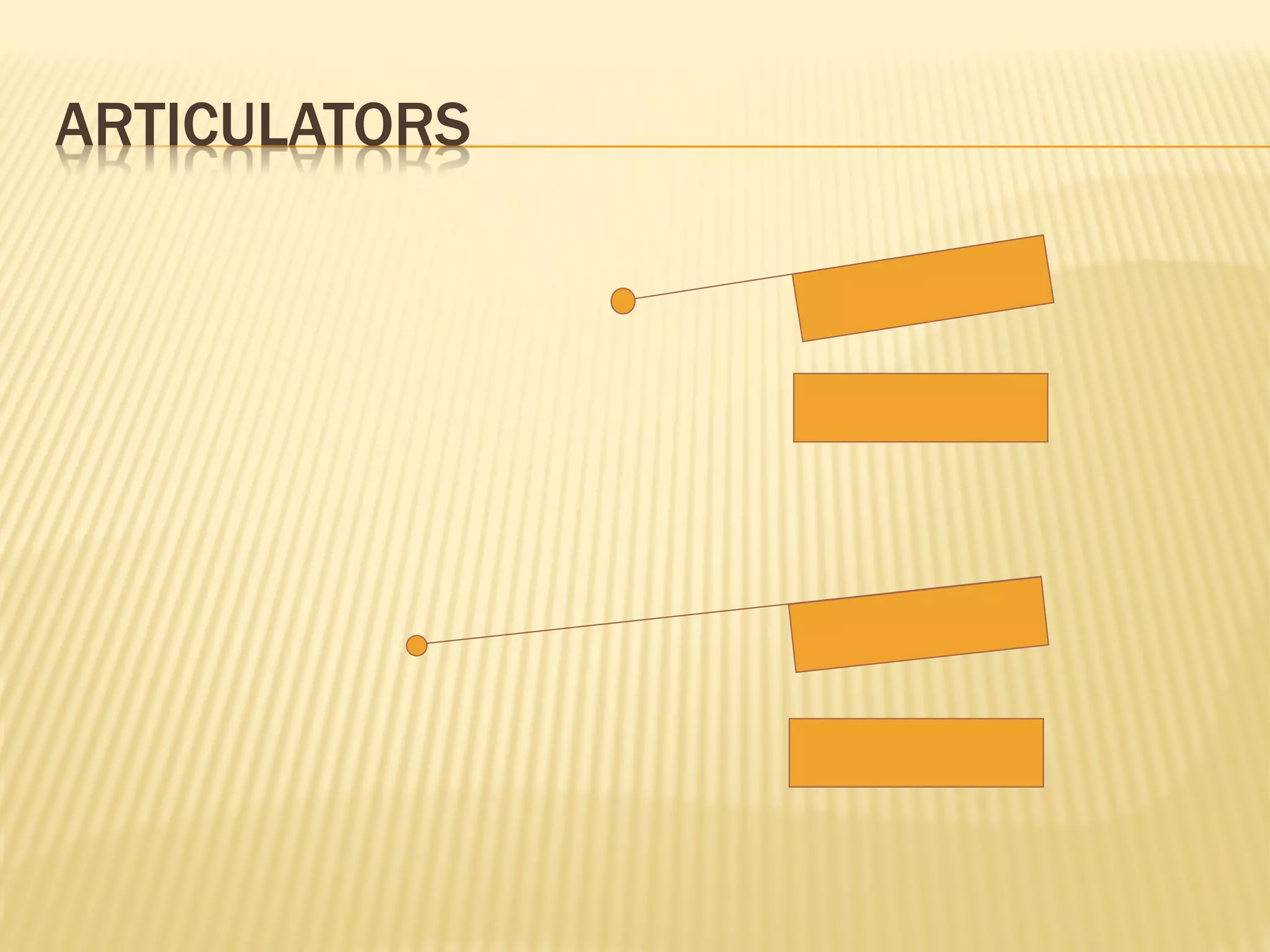
WHAT IF PATIENT DOESN’T MATCH
ARTICULATOR WHEN MEASURE THE DISTANCE
BETWEEN CONDYLER AXIS AND 2 JAWS?
Articulator
Patient
ARTICULATORS
ARTICULATORS
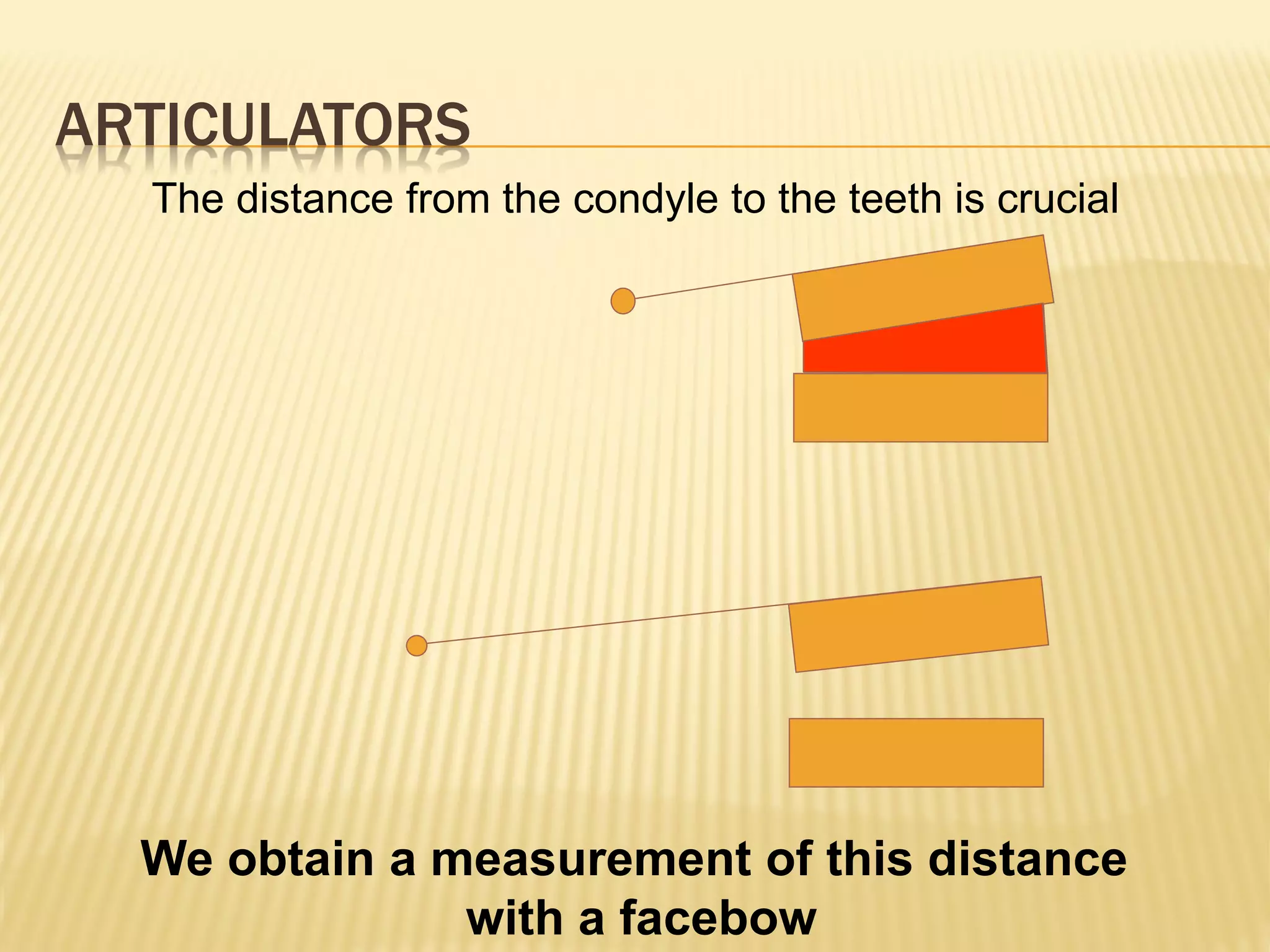
The distance from the condyle to the teeth is crucial
We obtain a measurement of this distance
with a facebow
It should be remembered that when lateral and
protrusive records are used to adjust a semi-
adjustable articulators, the settings will be accurate
at which the records werefor only those positions
but the pathways between these positions willmade,
(as the static relation differ from the dynamicnot be
relation).
RECORDS NEEDED FOR MOUNTING ON
A SEMI-ADJUSTABLE ARTICULATOR:
I-Face Bow record or by Bonwill triangle
II-Centric relation record
III-Eccentric relation records
a-Protrusive Record
b-Lateral Excursion Records ??
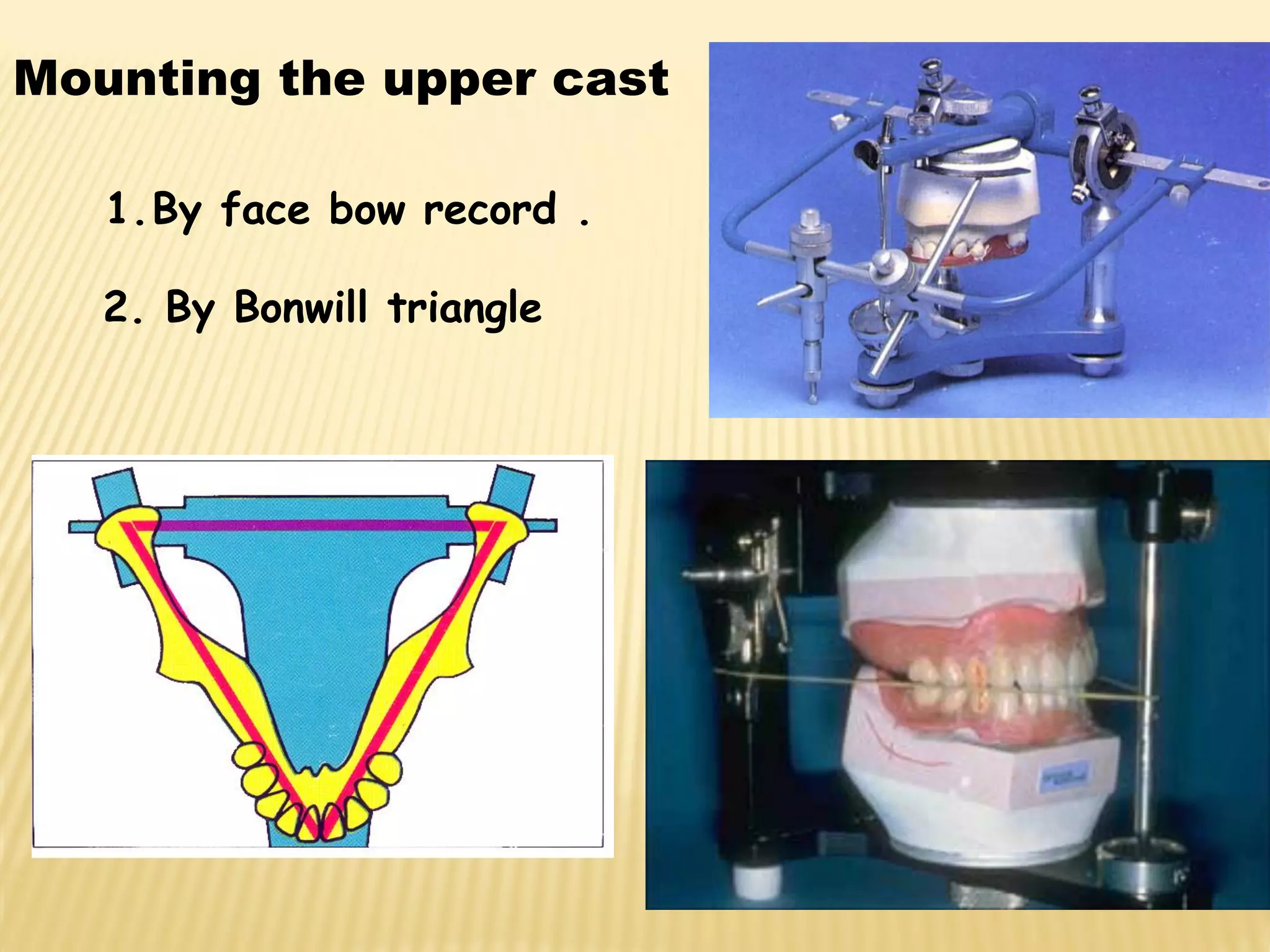
Mounting the upper cast
1.By face bow record .
2. By Bonwill triangle
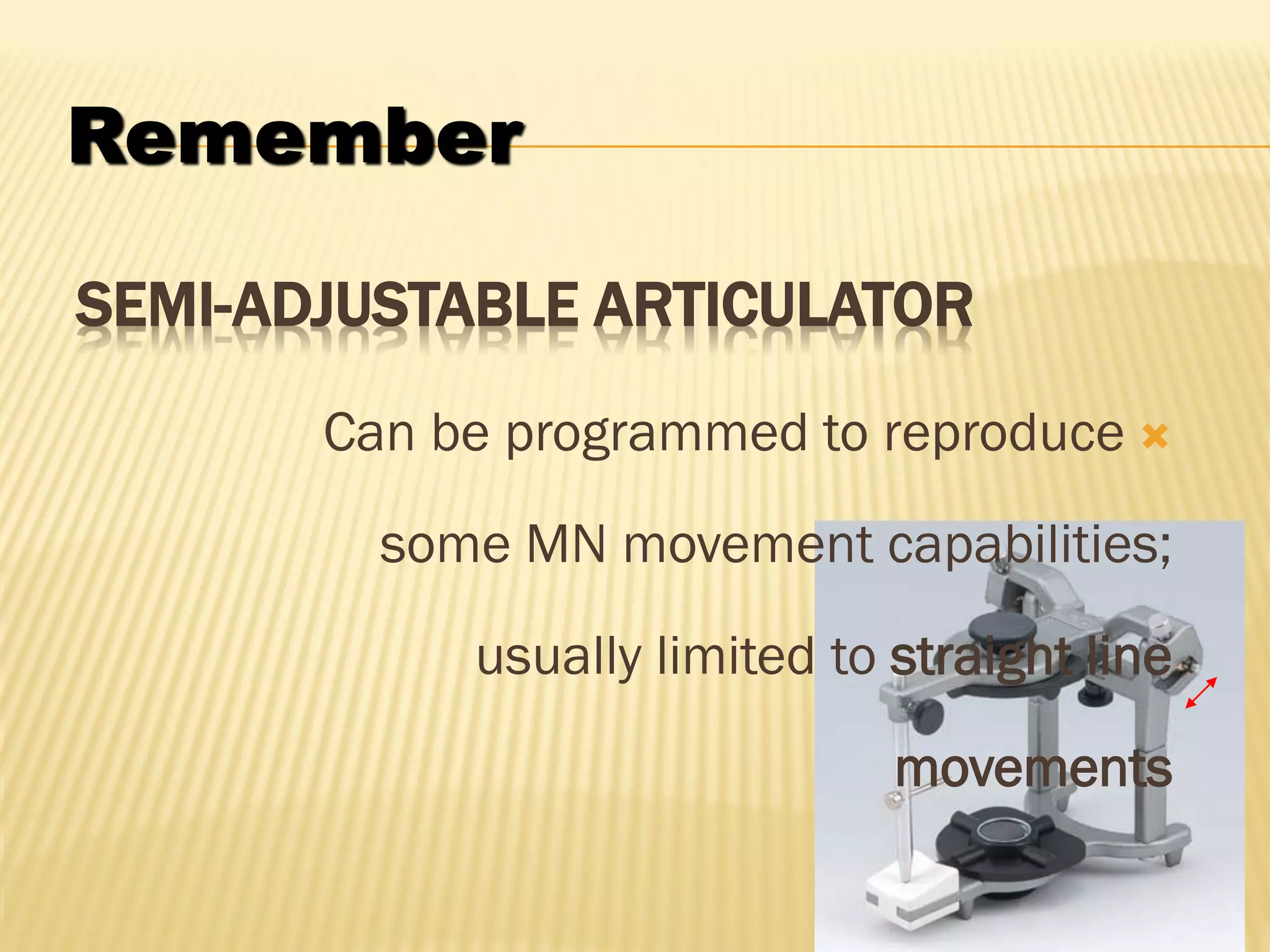
SEMI-ADJUSTABLE ARTICULATOR
Can be programmed to reproduce
some MN movement capabilities;
usually limited to straight line
movements
Remember
SEMI-ADJUST. ARTICULATOR MECHANICS
Maxillary Cast: related with face-bow.
Mandibular Cast: related with interocclusal
record or “hand articulate”. This relates the
mandibular cast to the maxillary cast.
Excursive Guidance: set incisal guide table
and condylar guidance.
Remember
FULLY-ADJUSTABLE ARTICULATOR
An articulator that allows replication of three
dimensional movement of recorded
mandibular motions:
Adjustable Articulator :-Fully
This type of articulators can accept the
following records:
Face-bow record
Interocclusal record
Protrusive record
Lateral records
Can also utilize more complex types of
face-bow and lateral records.
ADJUSTABLE ARTICULATOR-FULLY
• It is the most accurate instrument.
• It is designed to reproduce the entire character of the
mand. border movements, including: immediate and
progressive lateral translation, and the curvature and
direction of the condylar inclination.
• Intercondylar distance is completely adjustable.
The tracing of condyle path way is accomplished by
helping of a pantographic tracer.
 The techniques required for its use demand a high
degree of skill & are time consuming to
accomplish.
 This type of instrument is expensive.
 For these reasons, they are used primarily for
extensive treatment, requiring the reconstruction of
an entire occlusion.
 Unavoidable errors that occur in recording the
angulation of the condyle paths on using such
instruments make their value doubtful.
Limitations of Fully adjustable
condylar path articulators
ARTICULATORS OF THE FULLY
ADJUSTABLE TYPE INCLUDE
 The Stuart instrument
 The Gnatholator
 The Denar D5A
 H.O.Beck and Coworkers have developed an
experimental articulator that takes the factor of
time into account by correlating the time of
movement in each of the three planes of the
skull.
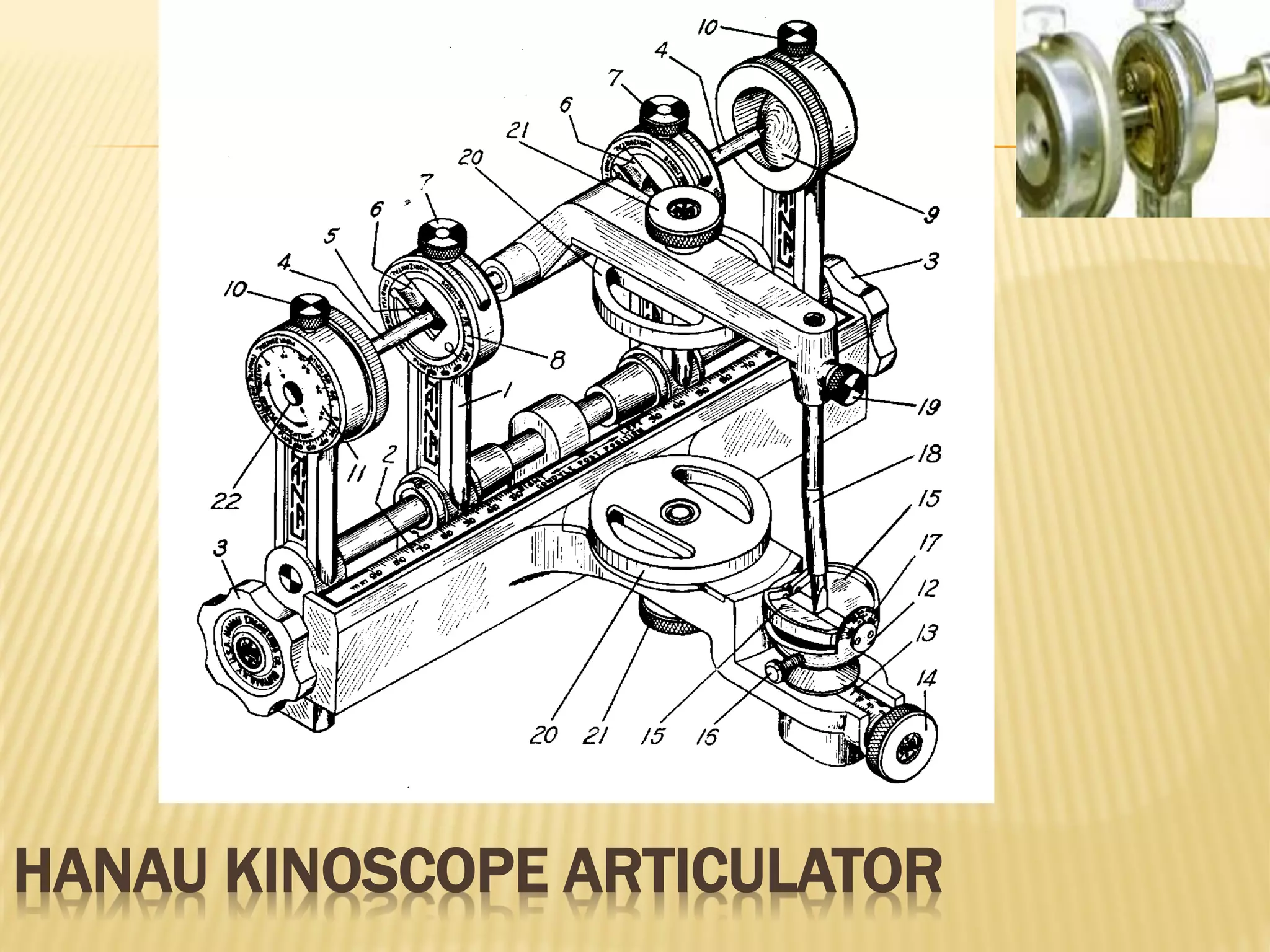
HANAU KINOSCOPE ARTICULATOR
STANSBERY TRIPOD.
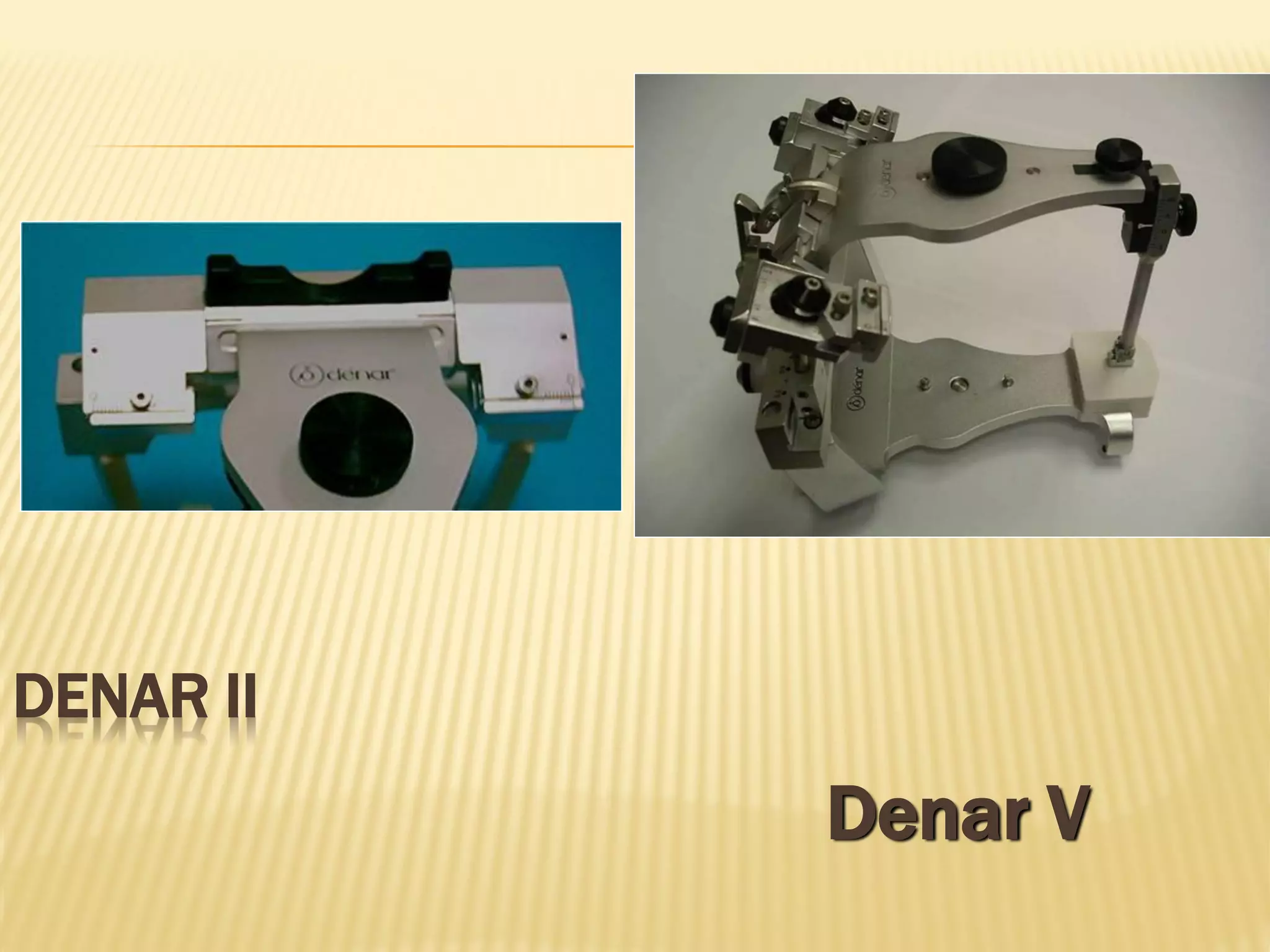
DENAR II
Denar V
FULLY ADJUSTABLE
H.O.BECK EXPERIMENTAL
ARTICULATOR
CLASS IV: FULLY ADJUSTABLE (
PROTAR 9 )
 This class of articulators accepts registration of all anatomic
determinant of occlusal morphology, and most closely simulates
the movement directed by these controls.
 This class will accept a “hinge axis” kinematic transfer bow.
 The incisal guidance can closely simulate the paths of natural
dentition.
 This class is fully utilized in extensive restorative procedures, as
well as adjunct to diagnostic determinations of TMJ dysfunction.
FULLY ADJUSTABLE ARTICULATORS
(PROTAR 9)
RECORDS NEEDED FOR MOUNTING ON A
FULLY ADJUSTABLE ARTICULATOR
 Centric Relation Record
Hinge axis location and Face bow
record
Pantographic tracings
Stereographs
RECORDS NEEDED FOR MOUNTING ON
A FULLY ADJUSTABLE ARTICULATOR
A- Hinge axis location and Face bow
record
Face bow record has to be made in relation to the
actual terminal hinge axis. This should first be
located using a Kinematic face bow.
B- CENTRIC RELATION
RECORD:
 Since the use of such an articulator would
be limited to those cases that need full
reconstruction and rehabilitation 
 It can be done by
But it prefers more sophisticated methods,
such as:
- Electronic recording techniques
- Intraoral gothic arc registration
Classic centric records
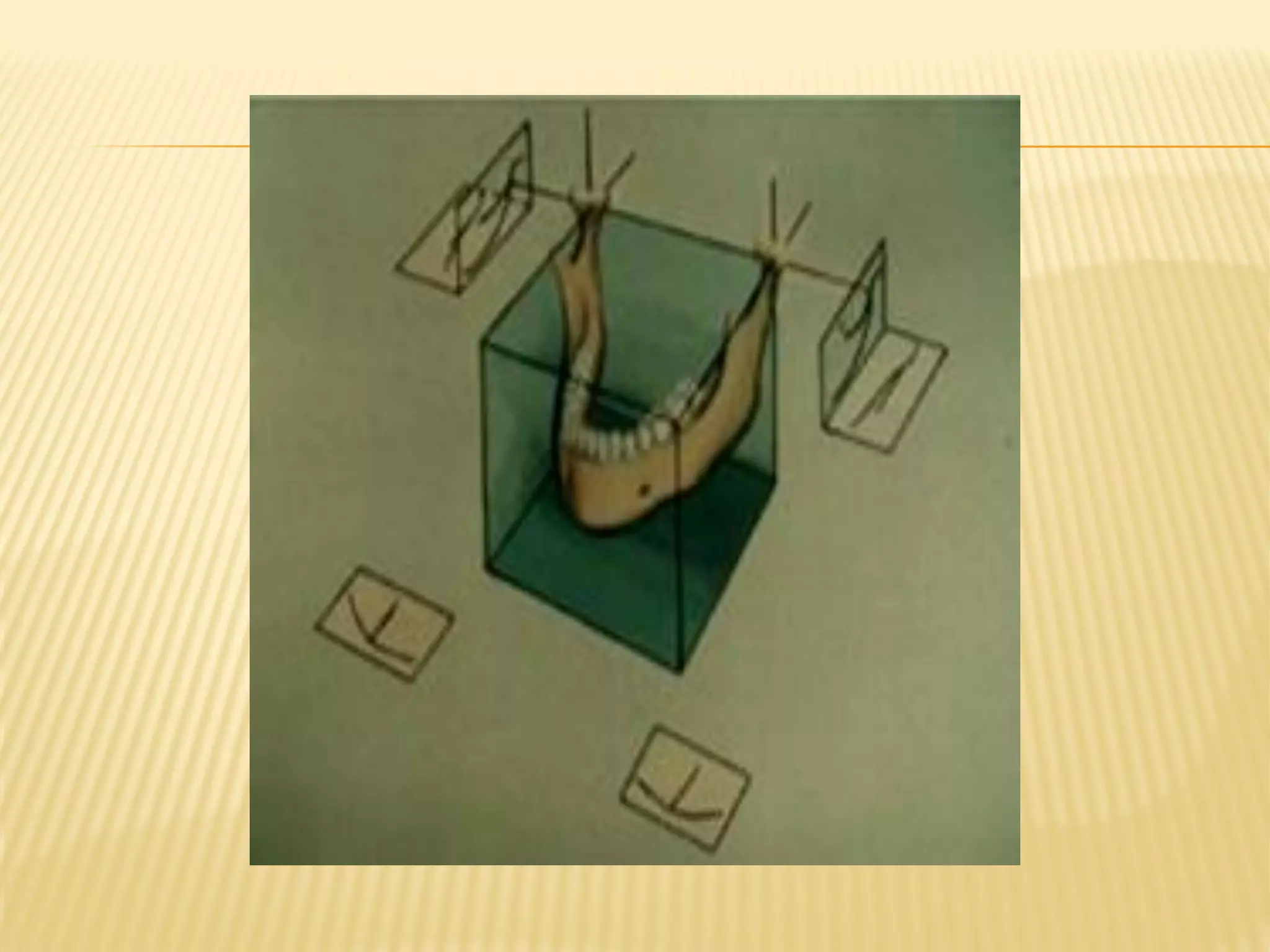
C- PANTOGRAPHIC TRACINGS
Tracing the exact movements made by the
mandible to register the exact direction and path
and amount of those movements.
A pantographic tracing is made by the use of
the pantograph, to record lateral and protrusive
excursions
THE PANTOGRAPH
 Consists of two
facebows, one affixed
to the maxilla while
the other to the
mandible, with the use
of clutches that are
attached to the teeth.
The tracings are made by styli attached to one member and
small tables upon which the tracings are drawn attached to
the other member, opposite the styli. There are posterior
vertical and horizontal tables on both right and left sides.
The patient is instructed to move his mandible through
protrusive, right and left lateral excursion movements, while
the styli scribe on their opposing tables the paths followed by
the condyles in those movements.
When the pantograph is attached to the articulator, adjustments and
alterations are made to the movements of the articulator follows the
same paths that was scribed by the styli on their tables, that is
following the paths of the condyles in their movements.
Computerized systems have also been developed. A print out is
obtained and used to program the articulator. The computerized
systems closely resembles the manual pantograph and are much
more economical as regards time, as the transfer stage is eliminated.
PANTOGRAPHIC RECORDING
For fully adjustable articulator
Computerized systems
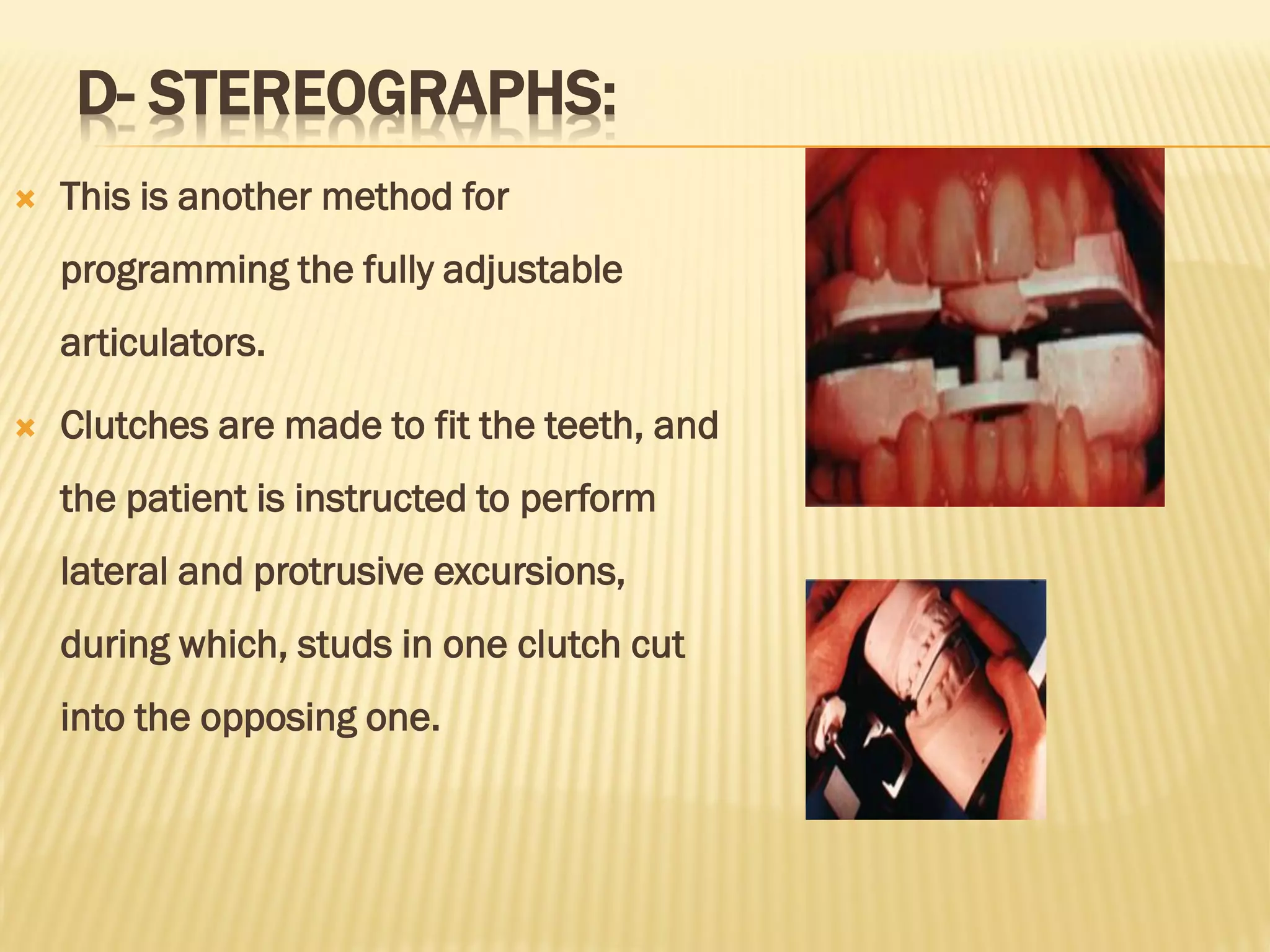
D- STEREOGRAPHS:
 This is another method for
programming the fully adjustable
articulators.
 Clutches are made to fit the teeth, and
the patient is instructed to perform
lateral and protrusive excursions,
during which, studs in one clutch cut
into the opposing one.
For programming the articulator, the clutches
are transferred to it, and it is moved to follow
along the paths formed by the cut out areas.
The condyles of the articulator are made to
mold auto-polymerizing resin, previously
placed in the articulator fossae. This enables
the original jaw movements to be reproduced
when the clutches are removed.
SUMMARY
 The choice of articulator depends upon such factors
as;
 Intended use - Skill of the technician
 Availability of equipment - Expense
 Patient's occlusion - Skill of the operator
 The more closely the articulator matches the patients
anatomy, usually the better the outcome and the less
adjustment is required at chairside on fitting prostheses.
Types of Articulators

Types of Articulators

  • 3.
  • 4.
  • 5.
  • 6.
  • 7.
    Some of semi-adjustablearticulators (for example, the Hanau H series, the Dentatus, and the Gysi) have the condyles attached to the upper member of the instrument (non-arcon), whereas others have the condyle attached to the lower member as occurs in nature (arcon)
  • 8.
  • 9.
  • 10.
    Difference between Arcon &Non arcon articulators
  • 11.
  • 12.
  • 14.
    WHAT IF PATIENTDOESN’T MATCH ARTICULATOR WHEN MEASURE THE DISTANCE BETWEEN CONDYLER AXIS AND 2 JAWS? Articulator Patient
  • 15.
  • 16.
    ARTICULATORS The distance fromthe condyle to the teeth is crucial We obtain a measurement of this distance with a facebow
  • 17.
    It should beremembered that when lateral and protrusive records are used to adjust a semi- adjustable articulators, the settings will be accurate at which the records werefor only those positions but the pathways between these positions willmade, (as the static relation differ from the dynamicnot be relation).
  • 18.
    RECORDS NEEDED FORMOUNTING ON A SEMI-ADJUSTABLE ARTICULATOR: I-Face Bow record or by Bonwill triangle II-Centric relation record III-Eccentric relation records a-Protrusive Record b-Lateral Excursion Records ??
  • 19.
    Mounting the uppercast 1.By face bow record . 2. By Bonwill triangle
  • 20.
    SEMI-ADJUSTABLE ARTICULATOR Can beprogrammed to reproduce some MN movement capabilities; usually limited to straight line movements Remember
  • 21.
    SEMI-ADJUST. ARTICULATOR MECHANICS MaxillaryCast: related with face-bow. Mandibular Cast: related with interocclusal record or “hand articulate”. This relates the mandibular cast to the maxillary cast. Excursive Guidance: set incisal guide table and condylar guidance. Remember
  • 23.
    FULLY-ADJUSTABLE ARTICULATOR An articulatorthat allows replication of three dimensional movement of recorded mandibular motions:
  • 24.
    Adjustable Articulator :-Fully Thistype of articulators can accept the following records: Face-bow record Interocclusal record Protrusive record Lateral records Can also utilize more complex types of face-bow and lateral records.
  • 25.
    ADJUSTABLE ARTICULATOR-FULLY • Itis the most accurate instrument. • It is designed to reproduce the entire character of the mand. border movements, including: immediate and progressive lateral translation, and the curvature and direction of the condylar inclination. • Intercondylar distance is completely adjustable. The tracing of condyle path way is accomplished by helping of a pantographic tracer.
  • 26.
     The techniquesrequired for its use demand a high degree of skill & are time consuming to accomplish.  This type of instrument is expensive.  For these reasons, they are used primarily for extensive treatment, requiring the reconstruction of an entire occlusion.  Unavoidable errors that occur in recording the angulation of the condyle paths on using such instruments make their value doubtful. Limitations of Fully adjustable condylar path articulators
  • 27.
    ARTICULATORS OF THEFULLY ADJUSTABLE TYPE INCLUDE  The Stuart instrument  The Gnatholator  The Denar D5A  H.O.Beck and Coworkers have developed an experimental articulator that takes the factor of time into account by correlating the time of movement in each of the three planes of the skull.
  • 28.
  • 29.
  • 30.
  • 31.
  • 32.
    CLASS IV: FULLYADJUSTABLE ( PROTAR 9 )  This class of articulators accepts registration of all anatomic determinant of occlusal morphology, and most closely simulates the movement directed by these controls.  This class will accept a “hinge axis” kinematic transfer bow.  The incisal guidance can closely simulate the paths of natural dentition.  This class is fully utilized in extensive restorative procedures, as well as adjunct to diagnostic determinations of TMJ dysfunction.
  • 33.
  • 34.
    RECORDS NEEDED FORMOUNTING ON A FULLY ADJUSTABLE ARTICULATOR  Centric Relation Record Hinge axis location and Face bow record Pantographic tracings Stereographs
  • 35.
    RECORDS NEEDED FORMOUNTING ON A FULLY ADJUSTABLE ARTICULATOR A- Hinge axis location and Face bow record Face bow record has to be made in relation to the actual terminal hinge axis. This should first be located using a Kinematic face bow.
  • 36.
    B- CENTRIC RELATION RECORD: Since the use of such an articulator would be limited to those cases that need full reconstruction and rehabilitation   It can be done by But it prefers more sophisticated methods, such as: - Electronic recording techniques - Intraoral gothic arc registration Classic centric records
  • 37.
    C- PANTOGRAPHIC TRACINGS Tracingthe exact movements made by the mandible to register the exact direction and path and amount of those movements. A pantographic tracing is made by the use of the pantograph, to record lateral and protrusive excursions
  • 38.
    THE PANTOGRAPH  Consistsof two facebows, one affixed to the maxilla while the other to the mandible, with the use of clutches that are attached to the teeth.
  • 39.
    The tracings aremade by styli attached to one member and small tables upon which the tracings are drawn attached to the other member, opposite the styli. There are posterior vertical and horizontal tables on both right and left sides. The patient is instructed to move his mandible through protrusive, right and left lateral excursion movements, while the styli scribe on their opposing tables the paths followed by the condyles in those movements.
  • 40.
    When the pantographis attached to the articulator, adjustments and alterations are made to the movements of the articulator follows the same paths that was scribed by the styli on their tables, that is following the paths of the condyles in their movements. Computerized systems have also been developed. A print out is obtained and used to program the articulator. The computerized systems closely resembles the manual pantograph and are much more economical as regards time, as the transfer stage is eliminated.
  • 42.
    PANTOGRAPHIC RECORDING For fullyadjustable articulator
  • 43.
  • 44.
    D- STEREOGRAPHS:  Thisis another method for programming the fully adjustable articulators.  Clutches are made to fit the teeth, and the patient is instructed to perform lateral and protrusive excursions, during which, studs in one clutch cut into the opposing one.
  • 45.
    For programming thearticulator, the clutches are transferred to it, and it is moved to follow along the paths formed by the cut out areas. The condyles of the articulator are made to mold auto-polymerizing resin, previously placed in the articulator fossae. This enables the original jaw movements to be reproduced when the clutches are removed.
  • 46.
    SUMMARY  The choiceof articulator depends upon such factors as;  Intended use - Skill of the technician  Availability of equipment - Expense  Patient's occlusion - Skill of the operator  The more closely the articulator matches the patients anatomy, usually the better the outcome and the less adjustment is required at chairside on fitting prostheses.