TrafficCongestion
Traffic Congestion:
“Congestion is a condition where demand
for road space exceeds supply”
 Many people considers congestion a significant
problem
 Typical urban residents spends more than 10 hours a
week driving of which 1-3 hours occurs in congestion
conditions
 Reduces travel speeds, requires more driver effort.
 It is a major source of frustration for busy, productive
people.
 Conventional planning considers congestion a major
problem and congestion reduction a dominant planning
objective.
Traffic Problem in Pakistan:
 Traffic problem in Pakistan is getting worse with every
coming day especially in big cities like Karachi,
Rawalpindi, Islamabad, Quetta, Peshawar and
Hyderabad.
 Govt is doing very little efforts to avoid traffic jams and
other traffic problems
 Small roads
 Rapid growth of the population
 More women drivers and young drivers
 Broken roads – as people don’t like to move from the
broken part so traffic increases
 The increase in the number of trucks and commercial
vehicles - these vehicles move very slowly, sometimes
stopping to unload goods, and blocking traffic.
Social:
 Reduction in transport speeds
 Reduced travel speeds
 Infrastructure overload
Environmental:
 The impact of exhaust emissions on human health
 Depletion of ozone layer
 Traffic noise
Economic:
 Time losses cause direct economic losses
EFFECTS
• Road Infrastructure
• Urban Planning and Design
• Supply and Demand
• Traffic management
COUNTER-MEASURES
Grade Separation
Using bridges or tunnel freeing movement from
having to stop for other crossing movement.
Ramp Signaling
Drip-feeding merging traffic via traffic signal onto a
congested motorway-type roadway.
Reducing Junction
By reducing junction of road.
Reversible Lanes
Where certain section of highway operates in
opposite direction on different times of day to match the demand.
Separate lane for specific user group.
Road Infrastructure
“Congestion can be reduced by either
increasing road capacity (supply) or
by reducing traffic (demand).”
Increased supply can include:
 Removing Bridge Supports:
Adding more capacity (more lanes at the
expense of hard shoulder or safety zones, or by
removing local obstacles like bridge supports and
widening tunnels)
 Adding more lanes:
Adding more capacity over the whole of a route
(generally by adding more lanes)
 Creating new routes:
Adding more capacity by adding more routes to
important destinations
Supply and Demand
Reduction of Demand Include:
 Parking restriction
Making motor vehicle use less attractive by increasing
the monetary and non-monetary costs of parking. Introducing
greater competition for limited city or road space.
 Road pricing
Charging money for access onto a road/specific area
at certain times, congestion levels or for certain road users.
 Telecommuting
Encouraged through legislation and subsidies.
 Online shopping promotion
It reduces the additional shopping trip.
 City planning and urban design practices can have a huge
impact on levels of future traffic congestion, though they are
of limited relevance for short-term change.
 Grid plans including fused grid road network geometry, rather
than tree-like network topology which reduce local traffic, but
increase total distances driven and discourage walking by
reducing connectivity.
 Transit-oriented development are residential and commercial
areas designed to maximize access to public transport by
providing a transit station or stop (train station ,metro
station, tram stop, or bus stop).
Urban Planning & Design
 Traffic reporting via radio, GPS and mobile apps, to
advise road users.
 Traffic counter to provide real-time traffic counts.
 Parking guideline and information systems providing
dynamic advice to motorists about free parking.
 Identify “pedestrian only” zones.
 Building new infrastructure.
 One way streets to speed traffic flow.
 Proper channelizing of traffic at school opening and
closing time.
 Educating people.
Traffic management
Issues in Implementation:
 Longer time span to eradicate
 Difficult to rebuild infrastructure
 Huge cost required to educate people
 No any regulatory body
 Required educated vigilant workforce

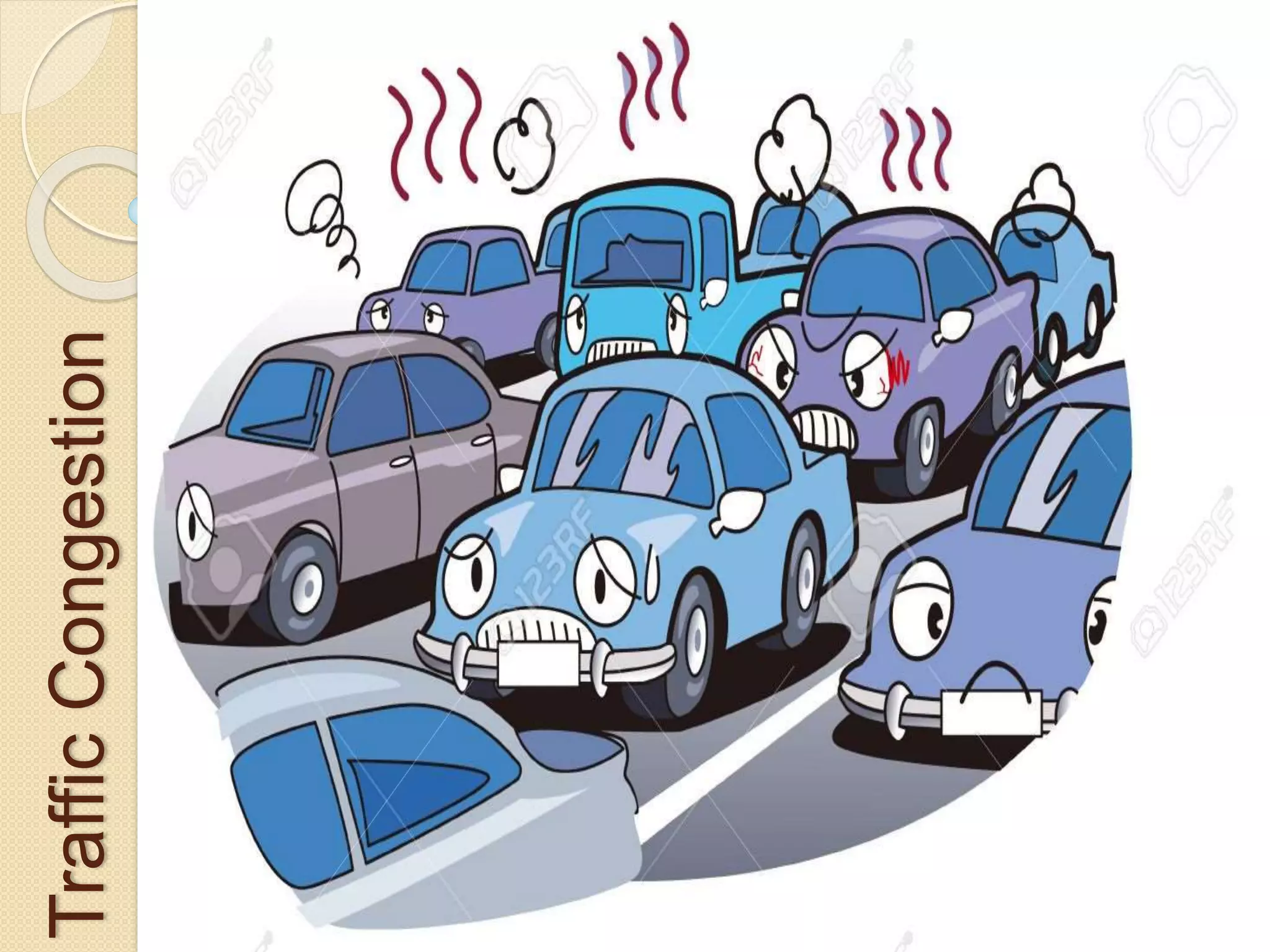
Traffic Congestion

  • 1.
  • 2.
    Traffic Congestion: “Congestion isa condition where demand for road space exceeds supply”  Many people considers congestion a significant problem  Typical urban residents spends more than 10 hours a week driving of which 1-3 hours occurs in congestion conditions  Reduces travel speeds, requires more driver effort.  It is a major source of frustration for busy, productive people.  Conventional planning considers congestion a major problem and congestion reduction a dominant planning objective.
  • 3.
    Traffic Problem inPakistan:  Traffic problem in Pakistan is getting worse with every coming day especially in big cities like Karachi, Rawalpindi, Islamabad, Quetta, Peshawar and Hyderabad.  Govt is doing very little efforts to avoid traffic jams and other traffic problems  Small roads  Rapid growth of the population  More women drivers and young drivers  Broken roads – as people don’t like to move from the broken part so traffic increases  The increase in the number of trucks and commercial vehicles - these vehicles move very slowly, sometimes stopping to unload goods, and blocking traffic.
  • 4.
    Social:  Reduction intransport speeds  Reduced travel speeds  Infrastructure overload Environmental:  The impact of exhaust emissions on human health  Depletion of ozone layer  Traffic noise Economic:  Time losses cause direct economic losses EFFECTS
  • 5.
    • Road Infrastructure •Urban Planning and Design • Supply and Demand • Traffic management COUNTER-MEASURES
  • 6.
    Grade Separation Using bridgesor tunnel freeing movement from having to stop for other crossing movement. Ramp Signaling Drip-feeding merging traffic via traffic signal onto a congested motorway-type roadway. Reducing Junction By reducing junction of road. Reversible Lanes Where certain section of highway operates in opposite direction on different times of day to match the demand. Separate lane for specific user group. Road Infrastructure
  • 7.
    “Congestion can bereduced by either increasing road capacity (supply) or by reducing traffic (demand).” Increased supply can include:  Removing Bridge Supports: Adding more capacity (more lanes at the expense of hard shoulder or safety zones, or by removing local obstacles like bridge supports and widening tunnels)  Adding more lanes: Adding more capacity over the whole of a route (generally by adding more lanes)  Creating new routes: Adding more capacity by adding more routes to important destinations Supply and Demand
  • 8.
    Reduction of DemandInclude:  Parking restriction Making motor vehicle use less attractive by increasing the monetary and non-monetary costs of parking. Introducing greater competition for limited city or road space.  Road pricing Charging money for access onto a road/specific area at certain times, congestion levels or for certain road users.  Telecommuting Encouraged through legislation and subsidies.  Online shopping promotion It reduces the additional shopping trip.
  • 9.
     City planningand urban design practices can have a huge impact on levels of future traffic congestion, though they are of limited relevance for short-term change.  Grid plans including fused grid road network geometry, rather than tree-like network topology which reduce local traffic, but increase total distances driven and discourage walking by reducing connectivity.  Transit-oriented development are residential and commercial areas designed to maximize access to public transport by providing a transit station or stop (train station ,metro station, tram stop, or bus stop). Urban Planning & Design
  • 10.
     Traffic reportingvia radio, GPS and mobile apps, to advise road users.  Traffic counter to provide real-time traffic counts.  Parking guideline and information systems providing dynamic advice to motorists about free parking.  Identify “pedestrian only” zones.  Building new infrastructure.  One way streets to speed traffic flow.  Proper channelizing of traffic at school opening and closing time.  Educating people. Traffic management
  • 11.
    Issues in Implementation: Longer time span to eradicate  Difficult to rebuild infrastructure  Huge cost required to educate people  No any regulatory body  Required educated vigilant workforce