MULTIPLE PERSONALITY DISORDER
From: Zaeem Daniyal
MULTIPLE PERSONALITY DISORDER
Contents
 Definition
 Causes
 Symptoms
 Facts
 Treatment
 Quiz
DEFINITION
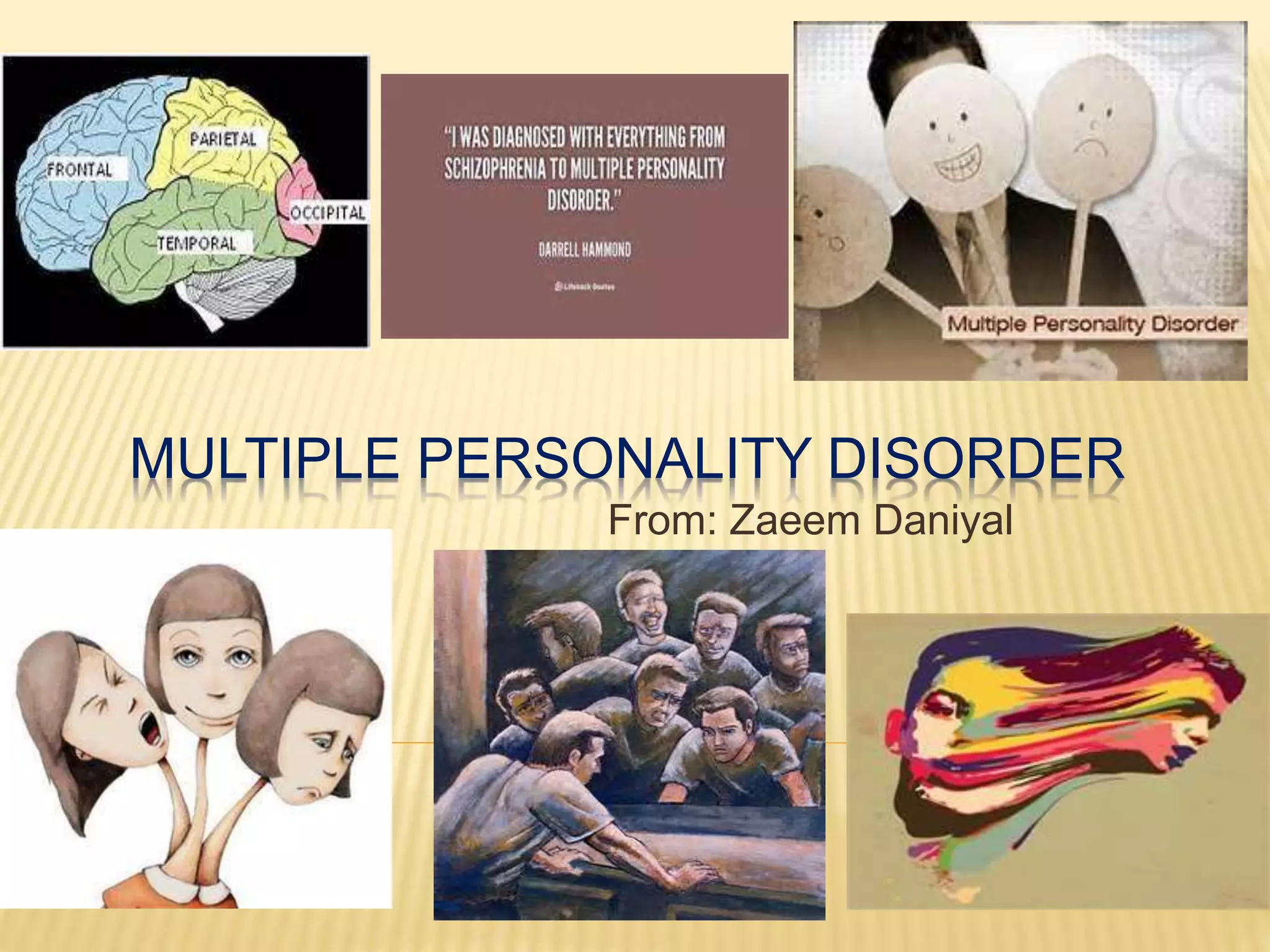
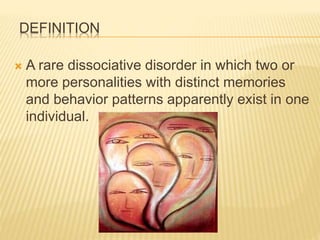
 A rare dissociative disorder in which two or
more personalities with distinct memories
and behavior patterns apparently exist in one
individual.
CAUSES
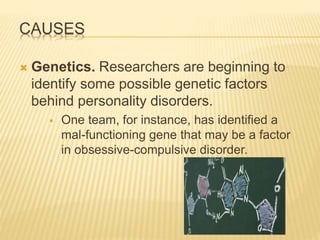
 Genetics. Researchers are beginning to
identify some possible genetic factors
behind personality disorders.
 One team, for instance, has identified a
mal-functioning gene that may be a factor
in obsessive-compulsive disorder.
Childhood trauma:
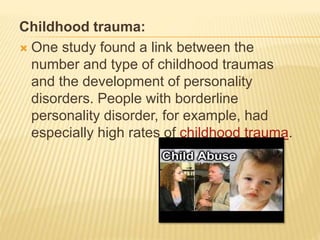
 One study found a link between the
number and type of childhood traumas
and the development of personality
disorders. People with borderline
personality disorder, for example, had
especially high rates of childhood trauma.
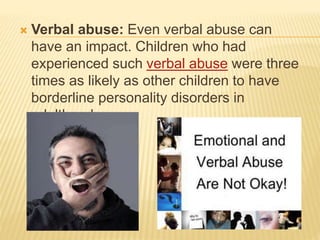
 Verbal abuse: Even verbal abuse can
have an impact. Children who had
experienced such verbal abuse were three
times as likely as other children to have
borderline personality disorders in
adulthood.
High reactivity:
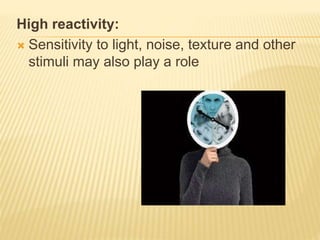
 Sensitivity to light, noise, texture and other
stimuli may also play a role
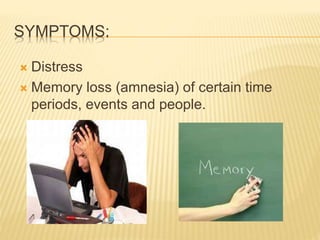
SYMPTOMS:
 Distress
 Memory loss (amnesia) of certain time
periods, events and people.
 Mental health problems, including
depression and anxiety
 A sense of being detached from yourself
(depersonalization)
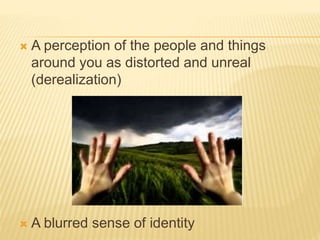
 A perception of the people and things
around you as distorted and unreal
(derealization)
 A blurred sense of identity
 Inability to recall specific incidents
 Having problems with a “split” personality
 Unable to keep a sense of time- a person
may lose track of time while transitioning
between different “identities”.
FACTS
 Given a diagnostic category in the Diagnostic
and Statistical Manual of Mental Disorders
(DSM) in 1980.
 Arises from continued and repeated sexual
and/or physical abuse beginning in early
childhood.
 People with DID have been shown to be
highly susceptible to dissociation, of above
average intelligence, and highly creative.
 Four times as many women are diagnosed as
men.
 The average person diagnosed with DID spends
7 years in the mental health system before
being properly diagnosed, due to misdiagnosis
and lack of training on the part of therapists to
spot the disorder.
 Co-consciousness refers to the level of shared
awareness of existence and behavior between
the host personality and the alters
Facts
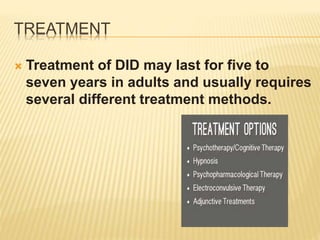
 Treatment of DID may last for five to
seven years in adults and usually requires
several different treatment methods.
TREATMENT
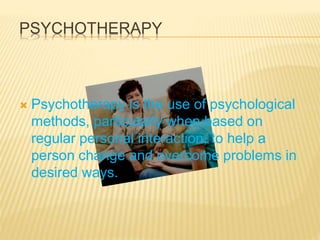
 Psychotherapy is the use of psychological
methods, particularly when based on
regular personal interaction, to help a
person change and overcome problems in
desired ways.
PSYCHOTHERAPY
MEDICATIONS
 Some doctors will prescribe tranquilizers or
antidepressants for DID patients because their
alter personalities may have anxiety or mood
disorders.
 Doctors keep medications to a minimum
because these patients can easily become
psychologically dependent on drugs.
HYPNOSIS
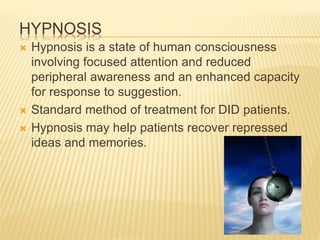
 Hypnosis is a state of human consciousness
involving focused attention and reduced
peripheral awareness and an enhanced capacity
for response to suggestion.
 Standard method of treatment for DID patients.
 Hypnosis may help patients recover repressed
ideas and memories.
Peers:
 Certain factors can help prevent children
from developing personality disorders.
Even a single strong relationship with
a relative, teacher or friend can offset
negative influences, say psychologists.
QUIZ
True/False
1. Dissociative Identity Disorder is directly
related to Schizophrenia.
True/False
1) Dissociative Identity Disorder is directly
related to Schizophrenia.
False: Schizophrenia is mainly characterized by
hearing or seeing things that aren't real
(hallucinations) and thinking or believing things
with no basis in reality (delusions).
QUIZ
QUIZ
True/False
2) One of the symptoms of DID is known as
an “alter”.
QUIZ
True/False
2) One of the symptoms of DID is known as
an “alter”.
True
QUIZ
True/False
3) Every one of us has experienced some mild
form of dissociation.
QUIZ
True/False
3) Every one of us has experienced some mild
form of dissociation.
True
QUIZ
Multiple Choice
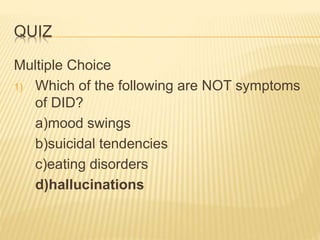
1) Which of the following are NOT symptoms
of DID?
a)mood swings
b)suicidal tendencies
c)eating disorders
d)hallucinations
QUIZ
Multiple Choice
1) Which of the following are NOT symptoms
of DID?
a)mood swings
b)suicidal tendencies
c)eating disorders
d)hallucinations
QUIZ
Multiple Choice
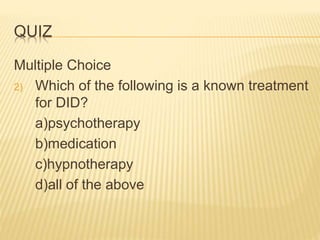
2) Which of the following is a known treatment
for DID?
a)psychotherapy
b)medication
c)hypnotherapy
d)all of the above
QUIZ
Multiple Choice
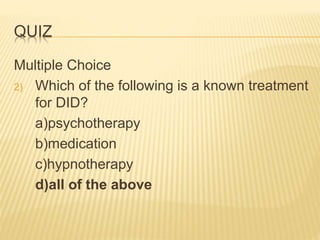
2) Which of the following is a known treatment
for DID?
a)psychotherapy
b)medication
c)hypnotherapy
d)all of the above
QUIZ
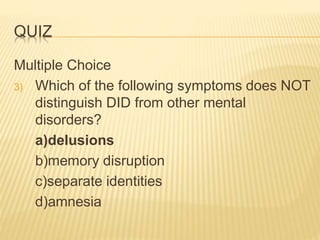
Multiple Choice
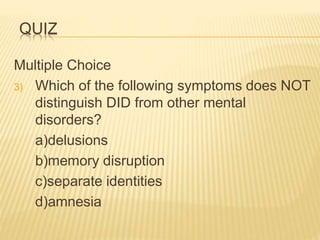
3) Which of the following symptoms does NOT
distinguish DID from other mental
disorders?
a)delusions
b)memory disruption
c)separate identities
d)amnesia
QUIZ
Multiple Choice
3) Which of the following symptoms does NOT
distinguish DID from other mental
disorders?
a)delusions
b)memory disruption
c)separate identities
d)amnesia
SOURCES
 Acocella, Joan. Creating Hysteria: Women and
Multiple Personality Disorder. San Francisco, CA:
Jossey-Bass Publishers, 1999.
 Alderman, Tracy, and Karen Marshall. Amongst
Ourselves, A Self-Help Guide to Living with
Dissociative Identity Disorder. Oakland, CA: New
Harbinger Publications, 1998.
 American Psychiatric Association. Diagnostic and
Statistical Manual of Mental Disorders. 4th edition,
text revised. Washington, DC: American Psychiatric
Association, 2000.
 Saks, Elyn R., with Stephen H. Behnke. Jekyll on
Trial, Multipersonality Disorder and Criminal Law.
New York, NY: New York University Press, 1997.
Multiple personality disorder

Multiple personality disorder

  • 1.
  • 2.
    MULTIPLE PERSONALITY DISORDER Contents Definition  Causes  Symptoms  Facts  Treatment  Quiz
  • 3.
    DEFINITION  A raredissociative disorder in which two or more personalities with distinct memories and behavior patterns apparently exist in one individual.
  • 4.
    CAUSES  Genetics. Researchersare beginning to identify some possible genetic factors behind personality disorders.  One team, for instance, has identified a mal-functioning gene that may be a factor in obsessive-compulsive disorder.
  • 5.
    Childhood trauma:  Onestudy found a link between the number and type of childhood traumas and the development of personality disorders. People with borderline personality disorder, for example, had especially high rates of childhood trauma.
  • 6.
     Verbal abuse:Even verbal abuse can have an impact. Children who had experienced such verbal abuse were three times as likely as other children to have borderline personality disorders in adulthood.
  • 7.
    High reactivity:  Sensitivityto light, noise, texture and other stimuli may also play a role
  • 8.
    SYMPTOMS:  Distress  Memoryloss (amnesia) of certain time periods, events and people.
  • 9.
     Mental healthproblems, including depression and anxiety  A sense of being detached from yourself (depersonalization)
  • 10.
     A perceptionof the people and things around you as distorted and unreal (derealization)  A blurred sense of identity
  • 11.
     Inability torecall specific incidents  Having problems with a “split” personality  Unable to keep a sense of time- a person may lose track of time while transitioning between different “identities”.
  • 12.
    FACTS  Given adiagnostic category in the Diagnostic and Statistical Manual of Mental Disorders (DSM) in 1980.  Arises from continued and repeated sexual and/or physical abuse beginning in early childhood.  People with DID have been shown to be highly susceptible to dissociation, of above average intelligence, and highly creative.
  • 13.
     Four timesas many women are diagnosed as men.  The average person diagnosed with DID spends 7 years in the mental health system before being properly diagnosed, due to misdiagnosis and lack of training on the part of therapists to spot the disorder.  Co-consciousness refers to the level of shared awareness of existence and behavior between the host personality and the alters Facts
  • 14.
     Treatment ofDID may last for five to seven years in adults and usually requires several different treatment methods. TREATMENT
  • 15.
     Psychotherapy isthe use of psychological methods, particularly when based on regular personal interaction, to help a person change and overcome problems in desired ways. PSYCHOTHERAPY
  • 16.
    MEDICATIONS  Some doctorswill prescribe tranquilizers or antidepressants for DID patients because their alter personalities may have anxiety or mood disorders.  Doctors keep medications to a minimum because these patients can easily become psychologically dependent on drugs.
  • 17.
    HYPNOSIS  Hypnosis isa state of human consciousness involving focused attention and reduced peripheral awareness and an enhanced capacity for response to suggestion.  Standard method of treatment for DID patients.  Hypnosis may help patients recover repressed ideas and memories.
  • 18.
    Peers:  Certain factorscan help prevent children from developing personality disorders. Even a single strong relationship with a relative, teacher or friend can offset negative influences, say psychologists.
  • 19.
    QUIZ True/False 1. Dissociative IdentityDisorder is directly related to Schizophrenia.
  • 20.
    True/False 1) Dissociative IdentityDisorder is directly related to Schizophrenia. False: Schizophrenia is mainly characterized by hearing or seeing things that aren't real (hallucinations) and thinking or believing things with no basis in reality (delusions). QUIZ
  • 21.
    QUIZ True/False 2) One ofthe symptoms of DID is known as an “alter”.
  • 22.
    QUIZ True/False 2) One ofthe symptoms of DID is known as an “alter”. True
  • 23.
    QUIZ True/False 3) Every oneof us has experienced some mild form of dissociation.
  • 24.
    QUIZ True/False 3) Every oneof us has experienced some mild form of dissociation. True
  • 25.
    QUIZ Multiple Choice 1) Whichof the following are NOT symptoms of DID? a)mood swings b)suicidal tendencies c)eating disorders d)hallucinations
  • 26.
    QUIZ Multiple Choice 1) Whichof the following are NOT symptoms of DID? a)mood swings b)suicidal tendencies c)eating disorders d)hallucinations
  • 27.
    QUIZ Multiple Choice 2) Whichof the following is a known treatment for DID? a)psychotherapy b)medication c)hypnotherapy d)all of the above
  • 28.
    QUIZ Multiple Choice 2) Whichof the following is a known treatment for DID? a)psychotherapy b)medication c)hypnotherapy d)all of the above
  • 29.
    QUIZ Multiple Choice 3) Whichof the following symptoms does NOT distinguish DID from other mental disorders? a)delusions b)memory disruption c)separate identities d)amnesia
  • 30.
    QUIZ Multiple Choice 3) Whichof the following symptoms does NOT distinguish DID from other mental disorders? a)delusions b)memory disruption c)separate identities d)amnesia
  • 31.
    SOURCES  Acocella, Joan.Creating Hysteria: Women and Multiple Personality Disorder. San Francisco, CA: Jossey-Bass Publishers, 1999.  Alderman, Tracy, and Karen Marshall. Amongst Ourselves, A Self-Help Guide to Living with Dissociative Identity Disorder. Oakland, CA: New Harbinger Publications, 1998.  American Psychiatric Association. Diagnostic and Statistical Manual of Mental Disorders. 4th edition, text revised. Washington, DC: American Psychiatric Association, 2000.  Saks, Elyn R., with Stephen H. Behnke. Jekyll on Trial, Multipersonality Disorder and Criminal Law. New York, NY: New York University Press, 1997.