Dissociative Identity Disorder
(Multiple Personality Disorder)
Kernifer Deserve
Rosario de Sala Diaz
Laisha
Jamie Johnson

Adalberto Toledo
Alton St, Rose
DID: Reality or Fantasy?
There exists much skepticism
about DID since:
1.
DID became diagnosed in
large numbers after the
release of the movies The
Three Faces of Eve
starring Joanne Woodward
and Sybil starring Sally
Field.
2.
DID is a uniquely North
American phenomenon.
Very few European,
psychiatrists believe in its
existence.
3.
There is no way to
absolutely prove it exists.
4.
The symptoms are
relatively easy to fake.
Everyone Dissociates









Daydreaming is the mild end of
dissociation.
Getting lost in memories is
another mild form of
dissociation.
This is known as short,
situation-dependent
dissociation.
People with personality
disorders (eg. borderline
personality disorder) may
experience some degree of
dissociation when triggered.
Extremely prolonged and
frequent dissociative states
result in profound disturbances
in self, occasionally leading to
the formation of alters.
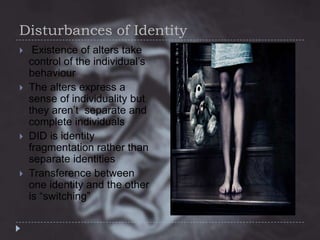
Disturbances of Identity








Existence of alters take
control of the individual’s
behaviour
The alters express a
sense of individuality but
they aren’t separate and
complete individuals
DID is identity
fragmentation rather than
separate identities
Transference between
one identity and the other
is “switching”
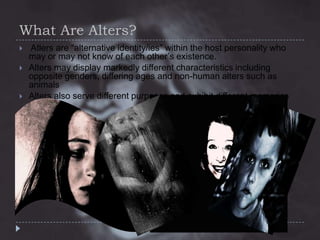
What Are Alters?





Atlers are “alternative identity/ies” within the host personality who
may or may not know of each other’s existence.
Alters may display markedly different characteristics including
opposite genders, differing ages and non-human alters such as
animals
Alters also serve different purposes and exhibit different memories
Impact of Dissociation on Developmental
Processes in Children








Interference in:
self-agency (authorship
of
one’s own behaviour)
self-coherence (unified
sense of self)
self-affectivity (ability to
freely express
appropriate
emotion)
self-continuity (integrated
self)
Effects of Pathological Dissociation
Dissociative symptoms
including flashbacks,
switching, hallucinations
and amnesias disrupt the
individual’s self-agency and
coherence.

The individual cannot
consolidate altered states
into a unified self.
The formation of a stable
self fails to materialize and
DID occurs.
Dissociative Disorders
Dissociative Amnesia and Dissociative Fugue
• Fugue: Patient wanders away from home and is unable to recall her/his past,
generally following a stressful event.
• Amnesia: Patient is unable to remember important aspects of her/his life
which are associated with trauma.

Depersonalization Disorder
• Feelings of detachment or estrangement from oneself.
• Patient reports feeling as if she/he lives in a dream and is watching her/his life
as if it was onscreen or in a dream.

Dissociative Identity Disorder (Multiple Personality Disorder)
• Patient must exhibit two or more existing personalities (alters) with differing
appearances, functions and memories.
• DID is often the result of severe childhood sexual abuse.
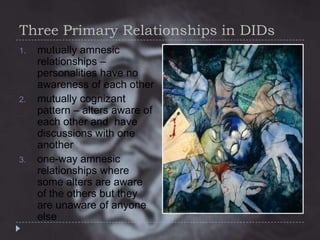
Three Primary Relationships in DIDs
1.

2.

3.

mutually amnesic
relationships –
personalities have no
awareness of each other
mutually cognizant
pattern – alters aware of
each other and have
discussions with one
another
one-way amnesic
relationships where
some alters are aware
of the others but they
are unaware of anyone
else
The Case for DID









Awareness of DID may account for increased diagnoses, rather than
misdiagnoses
Manufacturing false memories has never been proven, particularly those
related to sexual trauma. There is no evidence to show that DID can be
induced in therapy.
DID is more likely to occur in people with first-degree relatives who also
have DID
Various studies have revealed depersonalization episodes in people who
have survived life-threatening experiences, such as concentration camps
In the 1920s there was a sharp increase in schizophrenia diagnoses and a
marked decline in DID diagnoses, suggesting that DID patients were
misdiagnosed as schizophrenics.
Consolidation of identity is a normal developmental part of childhood, unless
this process is disrupted by severe forms of trauma including abuse, or other
developmental issues
Misdiagnosis of DID
Average misdiagnosis occurs from a period of 5 – 7 years per patient. Sometimes
clinicians refute the existence of DID and DID symptoms may closely mimic the
symptoms of schizophrenia and other illnesses

Schizophrenia

Dissociative Identity
Disorder
DID Screening Tools
Testing methods for DID
include:
 Dissociative Experience
Scale
 Dissociation
Questionnaire
 Questionnaire of
Experiences of
Dissociation
 Informal office interviews
that reveal if a patient is
at risk of developing DID
DID and Self-Harm






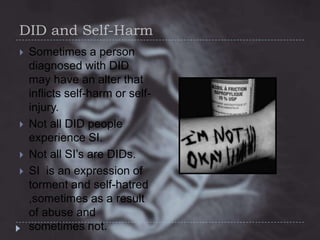
Sometimes a person
diagnosed with DID
may have an alter that
inflicts self-harm or selfinjury.
Not all DID people
experience SI.
Not all SI’s are DIDs.
SI is an expression of
torment and self-hatred
,sometimes as a result
of abuse and
sometimes not.
Causes of Abuse







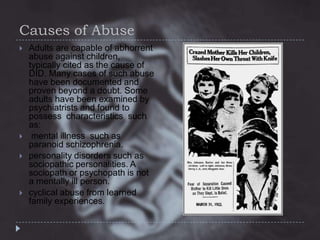
Adults are capable of abhorrent
abuse against children,
typically cited as the cause of
DID. Many cases of such abuse
have been documented and
proven beyond a doubt. Some
adults have been examined by
psychiatrists and found to
possess characteristics such
as:
mental illness such as
paranoid schizophrenia.
personality disorders such as
sociopathic personalities. A
sociopath or psychopath is not
a mentally ill person.
cyclical abuse from learned
family experiences.
Popular Portrayals of DID
Sybil (Shirley Ardell Mason)


The strange case of Shirley
Ardell Mason (Sybil) has been
a topic of debate for decades.
Dr. Cornelia Wilbur is accused
of manufacturing Sybil`s DID in
therapy. A colleague of Dr.
Wilbur`s alleged Wilbur
admitted that to get Sybil
published the publisher insisted
Wilbur use the expression
``multiple personality`.
Although the sexual and
physical abuse Sybil suffered at
her mother`s hands to some
extent is likely true, a historian
named Peter J. Swales, who
first identified Mason as Sybil,
claimed that ``there is evidence
that [the worst abuse] could not
have happened."
The Three Faces of Eve


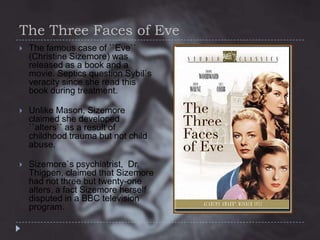
The famous case of ``Eve``
(Christine Sizemore) was
released as a book and a
movie. Septics question Sybil`s
veracity since she read this
book during treatment.



Unlike Mason, Sizemore
claimed she developed
``alters`` as a result of
childhood trauma but not child
abuse.



Sizemore`s psychiatrist, Dr.
Thigpen, claimed that Sizemore
had not three but twenty-one
alters, a fact Sizemore herself
disputed in a BBC television
program.
Reported Incidence of DID Worldwide Prior to
and After 1976 (particularly in North America)


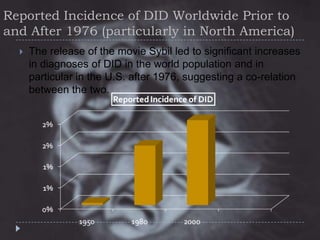
The release of the movie Sybil led to significant increases
in diagnoses of DID in the world population and in
particular in the U.S. after 1976, suggesting a co-relation
between the two.
The Argument Against the Authenticity of Sybil
and MPD








Dr. Herbert Spiegel, a leading American psychiatrist, worked
with Sybil for four years and didn’t believe she had DID.
Sybil’s treatment sessions reveal “fraudulent construction of a
multiple personality”.
Sybil’s documented childhood doesn’t match her actual
childhood.
Iatrogenesis (patient harm caused by treating physician) is
suspected to cause DID symptoms in psychiatric patients.
Before Sybil’s publication fewer than 200 DID reported cases
existed in world history.

After the movie’s release thousands of cases were
reported.
Multiple Refutes DID Symptoms
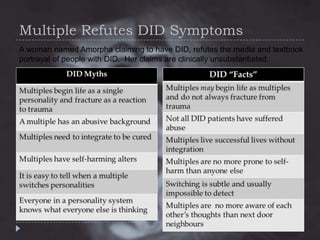
A woman named Amorpha claiming to have DID, refutes the media and textbook
portrayal of people with DID. Her claims are clinically unsubstantiated.
DID and Visual Arts


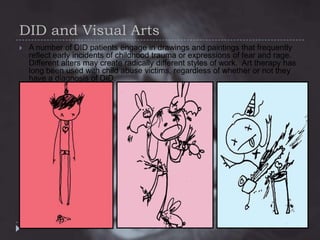
A number of DID patients engage in drawings and paintings that frequently
reflect early incidents of childhood trauma or expressions of fear and rage.
Different alters may create radically different styles of work. Art therapy has
long been used with child abuse victims, regardless of whether or not they
have a diagnosis of DID.
DID and Visual Arts


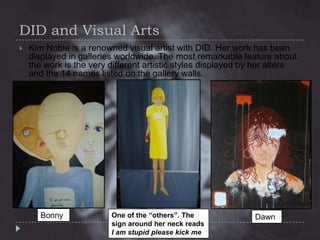
Kim Noble is a renowned visual artist with DID. Her work has been
displayed in galleries worldwide. The most remarkable feature about
the work is the very different artistic styles displayed by her alters
and the 14 names listed on the gallery walls.

Bonny

One of the “others”. The
sign around her neck reads
I am stupid please kick me

Dawn
Integration










DID defines a single
person with separately
functioning parts of the
mind
Integrated functioning of
the mind is the usual goal
of therapy
Urging alters to create
names when they have
none is counterproductive
The therapist must avoid
choosing “favourites”
among the alters
An increased sense of
connectedness is usually
beneficial to the DID
patient
Pam: A Case Study
1.
2.
3.
4.

5.
6.

7.

At the age of 26 while hospitalized Pam entered
therapy with a doctor named Ross.
Pam manifested several alters
Many of Pam’s alters initially emerged through
intravenous sodium amytal.
Ultimately Pam revealed 335 alters to Ross.

Under Ross’s care Pam was able to function as
an outpatient.
Pam reported her mother’s suicide but an alter
named Bob admitted that he had fabricated the
story.
Ross stopped treating Pam when an aggressive
alter threatened to kill Ross.
Pam’s Treatment and Results
Terry: A Case Study
1.
2.

3.
4.
5.

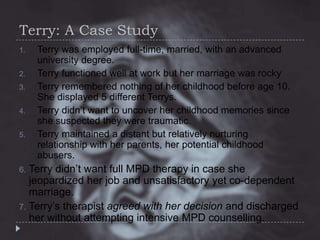
Terry was employed full-time, married, with an advanced
university degree.
Terry functioned well at work but her marriage was rocky
Terry remembered nothing of her childhood before age 10.
She displayed 5 different Terrys.
Terry didn’t want to uncover her childhood memories since
she suspected they were traumatic.
Terry maintained a distant but relatively nurturing
relationship with her parents, her potential childhood
abusers.

Terry didn’t want full MPD therapy in case she
jeopardized her job and unsatisfactory yet co-dependent
marriage.
7. Terry’s therapist agreed with her decision and discharged
her without attempting intensive MPD counselling.
6.
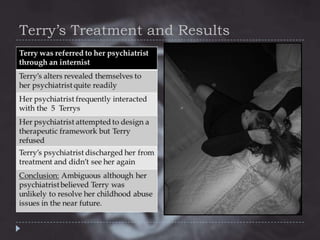
Terry’s Treatment and Results
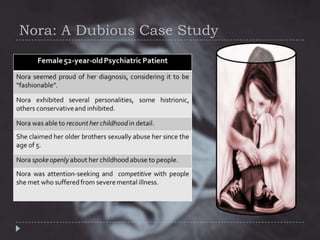
Nora: A Dubious Case Study
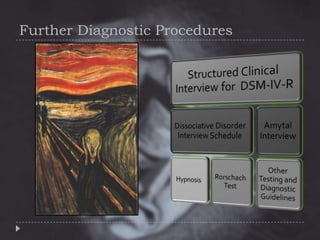
Further Diagnostic Procedures
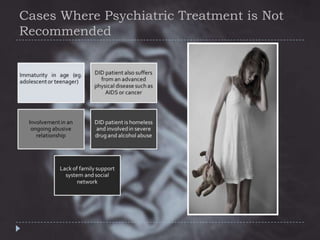
Cases Where Psychiatric Treatment is Not
Recommended
Dissociative Identity Disorder

Dissociative Identity Disorder

  • 1.
    Dissociative Identity Disorder (MultiplePersonality Disorder) Kernifer Deserve Rosario de Sala Diaz Laisha Jamie Johnson Adalberto Toledo Alton St, Rose
  • 2.
    DID: Reality orFantasy? There exists much skepticism about DID since: 1. DID became diagnosed in large numbers after the release of the movies The Three Faces of Eve starring Joanne Woodward and Sybil starring Sally Field. 2. DID is a uniquely North American phenomenon. Very few European, psychiatrists believe in its existence. 3. There is no way to absolutely prove it exists. 4. The symptoms are relatively easy to fake.
  • 3.
    Everyone Dissociates      Daydreaming isthe mild end of dissociation. Getting lost in memories is another mild form of dissociation. This is known as short, situation-dependent dissociation. People with personality disorders (eg. borderline personality disorder) may experience some degree of dissociation when triggered. Extremely prolonged and frequent dissociative states result in profound disturbances in self, occasionally leading to the formation of alters.
  • 6.
    Disturbances of Identity     Existenceof alters take control of the individual’s behaviour The alters express a sense of individuality but they aren’t separate and complete individuals DID is identity fragmentation rather than separate identities Transference between one identity and the other is “switching”
  • 7.
    What Are Alters?    Atlersare “alternative identity/ies” within the host personality who may or may not know of each other’s existence. Alters may display markedly different characteristics including opposite genders, differing ages and non-human alters such as animals Alters also serve different purposes and exhibit different memories
  • 8.
    Impact of Dissociationon Developmental Processes in Children      Interference in: self-agency (authorship of one’s own behaviour) self-coherence (unified sense of self) self-affectivity (ability to freely express appropriate emotion) self-continuity (integrated self)
  • 9.
    Effects of PathologicalDissociation Dissociative symptoms including flashbacks, switching, hallucinations and amnesias disrupt the individual’s self-agency and coherence. The individual cannot consolidate altered states into a unified self. The formation of a stable self fails to materialize and DID occurs.
  • 10.
    Dissociative Disorders Dissociative Amnesiaand Dissociative Fugue • Fugue: Patient wanders away from home and is unable to recall her/his past, generally following a stressful event. • Amnesia: Patient is unable to remember important aspects of her/his life which are associated with trauma. Depersonalization Disorder • Feelings of detachment or estrangement from oneself. • Patient reports feeling as if she/he lives in a dream and is watching her/his life as if it was onscreen or in a dream. Dissociative Identity Disorder (Multiple Personality Disorder) • Patient must exhibit two or more existing personalities (alters) with differing appearances, functions and memories. • DID is often the result of severe childhood sexual abuse.
  • 11.
    Three Primary Relationshipsin DIDs 1. 2. 3. mutually amnesic relationships – personalities have no awareness of each other mutually cognizant pattern – alters aware of each other and have discussions with one another one-way amnesic relationships where some alters are aware of the others but they are unaware of anyone else
  • 12.
    The Case forDID       Awareness of DID may account for increased diagnoses, rather than misdiagnoses Manufacturing false memories has never been proven, particularly those related to sexual trauma. There is no evidence to show that DID can be induced in therapy. DID is more likely to occur in people with first-degree relatives who also have DID Various studies have revealed depersonalization episodes in people who have survived life-threatening experiences, such as concentration camps In the 1920s there was a sharp increase in schizophrenia diagnoses and a marked decline in DID diagnoses, suggesting that DID patients were misdiagnosed as schizophrenics. Consolidation of identity is a normal developmental part of childhood, unless this process is disrupted by severe forms of trauma including abuse, or other developmental issues
  • 13.
    Misdiagnosis of DID Averagemisdiagnosis occurs from a period of 5 – 7 years per patient. Sometimes clinicians refute the existence of DID and DID symptoms may closely mimic the symptoms of schizophrenia and other illnesses Schizophrenia Dissociative Identity Disorder
  • 14.
    DID Screening Tools Testingmethods for DID include:  Dissociative Experience Scale  Dissociation Questionnaire  Questionnaire of Experiences of Dissociation  Informal office interviews that reveal if a patient is at risk of developing DID
  • 15.
    DID and Self-Harm     Sometimesa person diagnosed with DID may have an alter that inflicts self-harm or selfinjury. Not all DID people experience SI. Not all SI’s are DIDs. SI is an expression of torment and self-hatred ,sometimes as a result of abuse and sometimes not.
  • 16.
    Causes of Abuse     Adultsare capable of abhorrent abuse against children, typically cited as the cause of DID. Many cases of such abuse have been documented and proven beyond a doubt. Some adults have been examined by psychiatrists and found to possess characteristics such as: mental illness such as paranoid schizophrenia. personality disorders such as sociopathic personalities. A sociopath or psychopath is not a mentally ill person. cyclical abuse from learned family experiences.
  • 17.
  • 18.
    Sybil (Shirley ArdellMason)  The strange case of Shirley Ardell Mason (Sybil) has been a topic of debate for decades. Dr. Cornelia Wilbur is accused of manufacturing Sybil`s DID in therapy. A colleague of Dr. Wilbur`s alleged Wilbur admitted that to get Sybil published the publisher insisted Wilbur use the expression ``multiple personality`. Although the sexual and physical abuse Sybil suffered at her mother`s hands to some extent is likely true, a historian named Peter J. Swales, who first identified Mason as Sybil, claimed that ``there is evidence that [the worst abuse] could not have happened."
  • 19.
    The Three Facesof Eve  The famous case of ``Eve`` (Christine Sizemore) was released as a book and a movie. Septics question Sybil`s veracity since she read this book during treatment.  Unlike Mason, Sizemore claimed she developed ``alters`` as a result of childhood trauma but not child abuse.  Sizemore`s psychiatrist, Dr. Thigpen, claimed that Sizemore had not three but twenty-one alters, a fact Sizemore herself disputed in a BBC television program.
  • 20.
    Reported Incidence ofDID Worldwide Prior to and After 1976 (particularly in North America)  The release of the movie Sybil led to significant increases in diagnoses of DID in the world population and in particular in the U.S. after 1976, suggesting a co-relation between the two.
  • 21.
    The Argument Againstthe Authenticity of Sybil and MPD       Dr. Herbert Spiegel, a leading American psychiatrist, worked with Sybil for four years and didn’t believe she had DID. Sybil’s treatment sessions reveal “fraudulent construction of a multiple personality”. Sybil’s documented childhood doesn’t match her actual childhood. Iatrogenesis (patient harm caused by treating physician) is suspected to cause DID symptoms in psychiatric patients. Before Sybil’s publication fewer than 200 DID reported cases existed in world history. After the movie’s release thousands of cases were reported.
  • 22.
    Multiple Refutes DIDSymptoms A woman named Amorpha claiming to have DID, refutes the media and textbook portrayal of people with DID. Her claims are clinically unsubstantiated.
  • 23.
    DID and VisualArts  A number of DID patients engage in drawings and paintings that frequently reflect early incidents of childhood trauma or expressions of fear and rage. Different alters may create radically different styles of work. Art therapy has long been used with child abuse victims, regardless of whether or not they have a diagnosis of DID.
  • 24.
    DID and VisualArts  Kim Noble is a renowned visual artist with DID. Her work has been displayed in galleries worldwide. The most remarkable feature about the work is the very different artistic styles displayed by her alters and the 14 names listed on the gallery walls. Bonny One of the “others”. The sign around her neck reads I am stupid please kick me Dawn
  • 25.
    Integration      DID defines asingle person with separately functioning parts of the mind Integrated functioning of the mind is the usual goal of therapy Urging alters to create names when they have none is counterproductive The therapist must avoid choosing “favourites” among the alters An increased sense of connectedness is usually beneficial to the DID patient
  • 26.
    Pam: A CaseStudy 1. 2. 3. 4. 5. 6. 7. At the age of 26 while hospitalized Pam entered therapy with a doctor named Ross. Pam manifested several alters Many of Pam’s alters initially emerged through intravenous sodium amytal. Ultimately Pam revealed 335 alters to Ross. Under Ross’s care Pam was able to function as an outpatient. Pam reported her mother’s suicide but an alter named Bob admitted that he had fabricated the story. Ross stopped treating Pam when an aggressive alter threatened to kill Ross.
  • 27.
  • 28.
    Terry: A CaseStudy 1. 2. 3. 4. 5. Terry was employed full-time, married, with an advanced university degree. Terry functioned well at work but her marriage was rocky Terry remembered nothing of her childhood before age 10. She displayed 5 different Terrys. Terry didn’t want to uncover her childhood memories since she suspected they were traumatic. Terry maintained a distant but relatively nurturing relationship with her parents, her potential childhood abusers. Terry didn’t want full MPD therapy in case she jeopardized her job and unsatisfactory yet co-dependent marriage. 7. Terry’s therapist agreed with her decision and discharged her without attempting intensive MPD counselling. 6.
  • 29.
  • 30.
    Nora: A DubiousCase Study
  • 31.
  • 32.
    Cases Where PsychiatricTreatment is Not Recommended