Dissociative Identity
Disorder
Thomas Brown
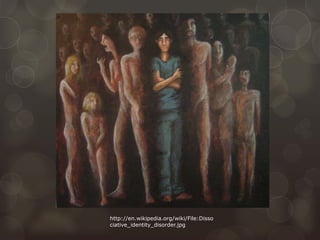
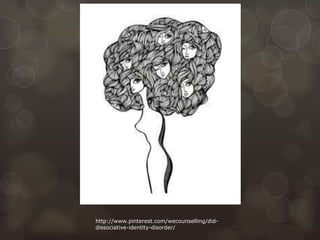
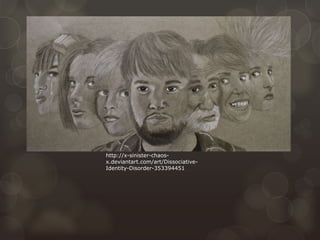
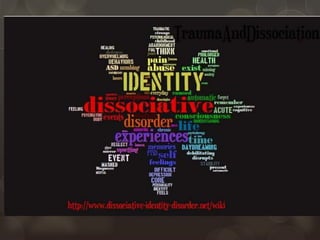
What is Dissociative Identity
Disorder?
 Severe type of dissociation, where there is a disconnect
between thoughts and reality.
 Characterized by a lack of connection in feelings,
thoughts, and sense of identity.
 Formerly called “multiple personality disorder” because
several distinct personalities will form, often without
knowledge of one another.
Causes
 DID is thought to stem from repeated and extremely
severe childhood abuse, often sexual and physical abuse
or emotional trauma.
 It is often considered a method of coping with trauma,
as events are so severe that one’s identity must split to
prevent events from entering awareness by the
conscious self.
 Affects women much more than men.
Number of Personalities
 Alternate personalities are often referred to as “alters.”
 One person may exhibit many alters or only a few; they
could have up to one hundred or as few as one.
 One cause of controversy about DID is that over the last
50 years the average number of personalities for people
suffering from DID has increased significantly.
 Right now the average number of alters is about 10,
according to the National Alliance on Mental Illness.
Differences between Alters
 Different alters may exhibit completely different
characteristics.
 They could display differences in mannerisms, age,
gender orientation, speech, thoughts, or dietary
preferences.
 They can also have physical differences; for example,
some alters may have allergies that others do not have,
or some may need glasses, while others may not.
Laundry List of Symptoms
 Anxiety
 Panic attacks
 Flashbacks
 Eating disorder
 Memory loss
 Confusion
 Delusions
 Headaches
 Disorientation
 Personality shifts
 Depression
 Suicidal
thoughts/tendencies
 Memory problems
beyond selective loss
 Drug or alcohol abuse
Treatment
 Treatment is somewhat subjective and not considered
scientifically sound by all experts.
 Therapist often uses a combination of hypnosis and
psychotherapy.
 There is an attempt to make contact with any self-
destructive or violent personalities and to alter their
behavior, and the therapist tries to find personalities that
have memory of the traumatic events that caused DID.
 Therapist also tries to help separate identities make
contact and eventually merge. This is the long term goal
of treatment.
Is Dissociative Identity Disorder
Real?
 There exists lots of controversy regarding whether or not
DID is a real disease.
 For example, the disorder has increased drastically in
prevalence over the last forty years without any
explanation for why this phenomenon occurred. When
the disorder entered the DSM in 1980, thousands of
cases popped up.
 Furthermore, the idea of repressed memories provides
controversy, as most psychologists believe that it is
impossible to remember events before the age of three,
which is when many DID sufferers report their abuse to
occur.
Is Dissociative Identity Disorder
Real? (2)
 It is quite difficult to prove whether or not this disorder
is real because it is so difficult to glimpse inside
someone’s mind and see what they are thinking.
 It is difficult to say for sure whether or not this condition
is real. Therapists and scientists who diagnose DID may
suffer from confirmation bias or purposely try to elicit
specific responses from patients.
 However, those who meet people suffering from DID will
often agree that they are extremely disturbed
individuals; whether or not they have multiple identities,
most of these individuals do have severe problems.
Famous Case: The Three Faces of
Eve
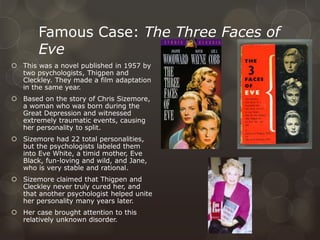
 This was a novel published in 1957 by
two psychologists, Thigpen and
Cleckley. They made a film adaptation
in the same year.
 Based on the story of Chris Sizemore,
a woman who was born during the
Great Depression and witnessed
extremely traumatic events, causing
her personality to split.
 Sizemore had 22 total personalities,
but the psychologists labeled them
into Eve White, a timid mother, Eve
Black, fun-loving and wild, and Jane,
who is very stable and rational.
 Sizemore claimed that Thigpen and
Cleckley never truly cured her, and
that another psychologist helped unite
her personality many years later.
 Her case brought attention to this
relatively unknown disorder.
Famous Case: Sybil
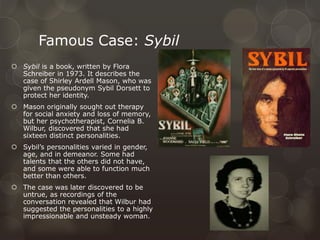
 Sybil is a book, written by Flora
Schreiber in 1973. It describes the
case of Shirley Ardell Mason, who was
given the pseudonym Sybil Dorsett to
protect her identity.
 Mason originally sought out therapy
for social anxiety and loss of memory,
but her psychotherapist, Cornelia B.
Wilbur, discovered that she had
sixteen distinct personalities.
 Sybil’s personalities varied in gender,
age, and in demeanor. Some had
talents that the others did not have,
and some were able to function much
better than others.
 The case was later discovered to be
untrue, as recordings of the
conversation revealed that Wilbur had
suggested the personalities to a highly
impressionable and unsteady woman.
Strange Case of Dr. Jekyll and
Mr. Hyde
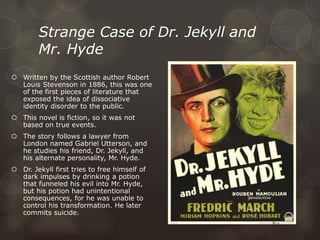
 Written by the Scottish author Robert
Louis Stevenson in 1886, this was one
of the first pieces of literature that
exposed the idea of dissociative
identity disorder to the public.
 This novel is fiction, so it was not
based on true events.
 The story follows a lawyer from
London named Gabriel Utterson, and
he studies his friend, Dr. Jekyll, and
his alternate personality, Mr. Hyde.
 Dr. Jekyll first tries to free himself of
dark impulses by drinking a potion
that funneled his evil into Mr. Hyde,
but his potion had unintentional
consequences, for he was unable to
control his transformation. He later
commits suicide.
http://en.wikipedia.org/wiki/File:Disso
ciative_identity_disorder.jpg
http://www.pinterest.com/wecounselling/did-
dissociative-identity-disorder/
http://x-sinister-chaos-
x.deviantart.com/art/Dissociative-
Identity-Disorder-353394451
http://sickuntodeath.deviantart.com/art/Dissociative-
Identity-Disorder-VII-394463044
http://www.nerdygaga.com/10562/rare-and-weird-
mental-disorder/
http://sevencounties.org/poc/view_doc.php?type=doc&i
d=24421&cn=41
http://www.pinterest.com/wecounselling/did-
dissociative-identity-disorder/
http://trauma.blog.yorku.ca/2012/09/understanding-
dissociative-identity-disorder-in-children/
http://www.buzzle.com/articles/multiple-personality-
disorder/
http://morganegesnouin.wordpress.com/

Dissociative identity disorder

  • 1.
  • 2.
    What is DissociativeIdentity Disorder?  Severe type of dissociation, where there is a disconnect between thoughts and reality.  Characterized by a lack of connection in feelings, thoughts, and sense of identity.  Formerly called “multiple personality disorder” because several distinct personalities will form, often without knowledge of one another.
  • 3.
    Causes  DID isthought to stem from repeated and extremely severe childhood abuse, often sexual and physical abuse or emotional trauma.  It is often considered a method of coping with trauma, as events are so severe that one’s identity must split to prevent events from entering awareness by the conscious self.  Affects women much more than men.
  • 4.
    Number of Personalities Alternate personalities are often referred to as “alters.”  One person may exhibit many alters or only a few; they could have up to one hundred or as few as one.  One cause of controversy about DID is that over the last 50 years the average number of personalities for people suffering from DID has increased significantly.  Right now the average number of alters is about 10, according to the National Alliance on Mental Illness.
  • 5.
    Differences between Alters Different alters may exhibit completely different characteristics.  They could display differences in mannerisms, age, gender orientation, speech, thoughts, or dietary preferences.  They can also have physical differences; for example, some alters may have allergies that others do not have, or some may need glasses, while others may not.
  • 6.
    Laundry List ofSymptoms  Anxiety  Panic attacks  Flashbacks  Eating disorder  Memory loss  Confusion  Delusions  Headaches  Disorientation  Personality shifts  Depression  Suicidal thoughts/tendencies  Memory problems beyond selective loss  Drug or alcohol abuse
  • 7.
    Treatment  Treatment issomewhat subjective and not considered scientifically sound by all experts.  Therapist often uses a combination of hypnosis and psychotherapy.  There is an attempt to make contact with any self- destructive or violent personalities and to alter their behavior, and the therapist tries to find personalities that have memory of the traumatic events that caused DID.  Therapist also tries to help separate identities make contact and eventually merge. This is the long term goal of treatment.
  • 8.
    Is Dissociative IdentityDisorder Real?  There exists lots of controversy regarding whether or not DID is a real disease.  For example, the disorder has increased drastically in prevalence over the last forty years without any explanation for why this phenomenon occurred. When the disorder entered the DSM in 1980, thousands of cases popped up.  Furthermore, the idea of repressed memories provides controversy, as most psychologists believe that it is impossible to remember events before the age of three, which is when many DID sufferers report their abuse to occur.
  • 9.
    Is Dissociative IdentityDisorder Real? (2)  It is quite difficult to prove whether or not this disorder is real because it is so difficult to glimpse inside someone’s mind and see what they are thinking.  It is difficult to say for sure whether or not this condition is real. Therapists and scientists who diagnose DID may suffer from confirmation bias or purposely try to elicit specific responses from patients.  However, those who meet people suffering from DID will often agree that they are extremely disturbed individuals; whether or not they have multiple identities, most of these individuals do have severe problems.
  • 10.
    Famous Case: TheThree Faces of Eve  This was a novel published in 1957 by two psychologists, Thigpen and Cleckley. They made a film adaptation in the same year.  Based on the story of Chris Sizemore, a woman who was born during the Great Depression and witnessed extremely traumatic events, causing her personality to split.  Sizemore had 22 total personalities, but the psychologists labeled them into Eve White, a timid mother, Eve Black, fun-loving and wild, and Jane, who is very stable and rational.  Sizemore claimed that Thigpen and Cleckley never truly cured her, and that another psychologist helped unite her personality many years later.  Her case brought attention to this relatively unknown disorder.
  • 11.
    Famous Case: Sybil Sybil is a book, written by Flora Schreiber in 1973. It describes the case of Shirley Ardell Mason, who was given the pseudonym Sybil Dorsett to protect her identity.  Mason originally sought out therapy for social anxiety and loss of memory, but her psychotherapist, Cornelia B. Wilbur, discovered that she had sixteen distinct personalities.  Sybil’s personalities varied in gender, age, and in demeanor. Some had talents that the others did not have, and some were able to function much better than others.  The case was later discovered to be untrue, as recordings of the conversation revealed that Wilbur had suggested the personalities to a highly impressionable and unsteady woman.
  • 12.
    Strange Case ofDr. Jekyll and Mr. Hyde  Written by the Scottish author Robert Louis Stevenson in 1886, this was one of the first pieces of literature that exposed the idea of dissociative identity disorder to the public.  This novel is fiction, so it was not based on true events.  The story follows a lawyer from London named Gabriel Utterson, and he studies his friend, Dr. Jekyll, and his alternate personality, Mr. Hyde.  Dr. Jekyll first tries to free himself of dark impulses by drinking a potion that funneled his evil into Mr. Hyde, but his potion had unintentional consequences, for he was unable to control his transformation. He later commits suicide.
  • 13.
  • 14.
  • 15.
  • 16.
  • 17.
  • 19.
  • 20.