
Maxwell Boltzmann Velocity Distribution
Vishwajeet Jadeja
MSc Statistics
Department of Statistics
The Maharaja Sayajirao University of Baroda
CONTENTS
• Introduction
• Derivation
• Conclusion
• Application (Example)
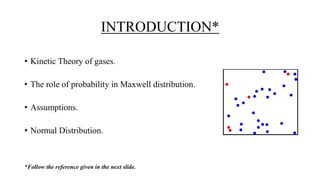
INTRODUCTION*
• Kinetic Theory of gases.
• The role of probability in Maxwell distribution.
• Assumptions.
• Normal Distribution.
*Follow the reference given in the next slide.
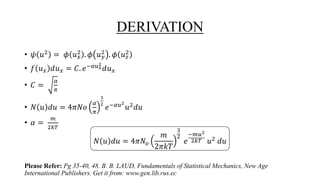
DERIVATION
• 𝜓 𝑢2
= 𝜙 𝑢 𝑥
2
. 𝜙 𝑢 𝑦
2
. 𝜙 𝑢 𝑧
2
• 𝑓 𝑢 𝑥 𝑑𝑢 𝑥 = 𝐶. 𝑒−𝛼𝑢 𝑥
2
𝑑𝑢 𝑥
• 𝐶 =
𝛼
𝜋
• 𝑁 𝑢 𝑑𝑢 = 4𝜋𝑁𝑜
𝛼
𝜋
3
2
𝑒−𝛼𝑢2
𝑢2 𝑑𝑢
• 𝛼 =
𝑚
2𝑘𝑇
𝑁 𝑢 𝑑𝑢 = 4𝜋𝑁𝑜
𝑚
2𝜋𝑘𝑇
3
2
𝑒
−𝑚𝑢2
2𝑘𝑇 𝑢2
𝑑𝑢
Please Refer: Pg 35-40, 48. B. B. LAUD, Fundamentals of Statistical Mechanics, New Age
International Publishers. Get it from: www.gen.lib.rus.ec
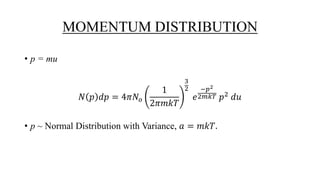
MOMENTUM DISTRIBUTION
• p = mu
𝑁 𝑝 𝑑𝑝 = 4𝜋𝑁𝑜
1
2𝜋𝑚𝑘𝑇
3
2
𝑒
−𝑝2
2𝑚𝑘𝑇 𝑝2 𝑑𝑢
• p ~ Normal Distribution with Variance, 𝑎 = 𝑚𝑘𝑇.
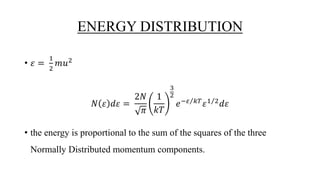
ENERGY DISTRIBUTION
• 𝜀 =
1
2
𝑚𝑢2
𝑁 𝜀 𝑑𝜀 =
2𝑁
𝜋
1
𝑘𝑇
3
2
𝑒−𝜀 𝑘𝑇
𝜀1 2
𝑑𝜀
• the energy is proportional to the sum of the squares of the three
Normally Distributed momentum components.
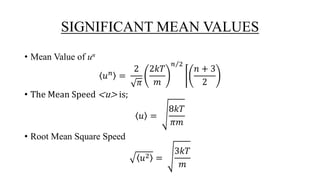
SIGNIFICANT MEAN VALUES
• Mean Value of un
𝑢 𝑛 =
2
𝜋
2𝑘𝑇
𝑚
𝑛 2
𝑛 + 3
2
• The Mean Speed <u> is;
𝑢 =
8𝑘𝑇
𝜋𝑚
• Root Mean Square Speed
𝑢2 =
3𝑘𝑇
𝑚
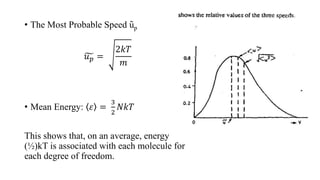
• The Most Probable Speed u͂ p
𝑢 𝑝 =
2𝑘𝑇
𝑚
• Mean Energy: 𝜀 =
3
2
𝑁𝑘𝑇
This shows that, on an average, energy
(½)kT is associated with each molecule for
each degree of freedom.
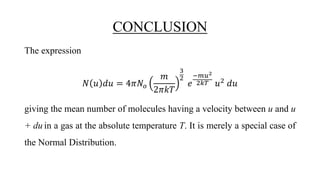
CONCLUSION
The expression
𝑁 𝑢 𝑑𝑢 = 4𝜋𝑁𝑜
𝑚
2𝜋𝑘𝑇
3
2
𝑒
−𝑚𝑢2
2𝑘𝑇 𝑢2
𝑑𝑢
giving the mean number of molecules having a velocity between u and u
+ du in a gas at the absolute temperature T. It is merely a special case of
the Normal Distribution.
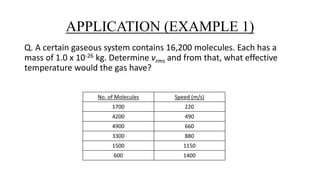
APPLICATION (EXAMPLE 1)
Q. A certain gaseous system contains 16,200 molecules. Each has a
mass of 1.0 x 10⁻²⁶ kg. Determine vrms and from that, what effective
temperature would the gas have?
No. of Molecules Speed (m/s)
1700 220
4200 490
4900 660
3300 880
1500 1150
600 1400
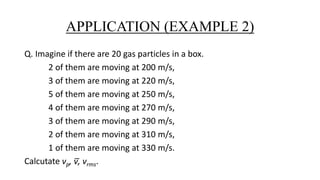
APPLICATION (EXAMPLE 2)
Q. Imagine if there are 20 gas particles in a box.
2 of them are moving at 200 m/s,
3 of them are moving at 220 m/s,
5 of them are moving at 250 m/s,
4 of them are moving at 270 m/s,
3 of them are moving at 290 m/s,
2 of them are moving at 310 m/s,
1 of them are moving at 330 m/s.
Calcutate vp, v̅, vrms.
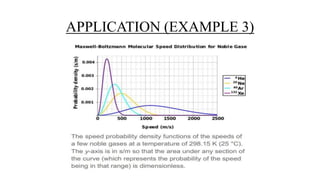
APPLICATION (EXAMPLE 3)
Thank You

Maxwell Boltzmann Velocity Distribution

  • 1.
    Maxwell Boltzmann VelocityDistribution Vishwajeet Jadeja MSc Statistics Department of Statistics The Maharaja Sayajirao University of Baroda
  • 2.
    CONTENTS • Introduction • Derivation •Conclusion • Application (Example)
  • 3.
    INTRODUCTION* • Kinetic Theoryof gases. • The role of probability in Maxwell distribution. • Assumptions. • Normal Distribution. *Follow the reference given in the next slide.
  • 4.
    DERIVATION • 𝜓 𝑢2 =𝜙 𝑢 𝑥 2 . 𝜙 𝑢 𝑦 2 . 𝜙 𝑢 𝑧 2 • 𝑓 𝑢 𝑥 𝑑𝑢 𝑥 = 𝐶. 𝑒−𝛼𝑢 𝑥 2 𝑑𝑢 𝑥 • 𝐶 = 𝛼 𝜋 • 𝑁 𝑢 𝑑𝑢 = 4𝜋𝑁𝑜 𝛼 𝜋 3 2 𝑒−𝛼𝑢2 𝑢2 𝑑𝑢 • 𝛼 = 𝑚 2𝑘𝑇 𝑁 𝑢 𝑑𝑢 = 4𝜋𝑁𝑜 𝑚 2𝜋𝑘𝑇 3 2 𝑒 −𝑚𝑢2 2𝑘𝑇 𝑢2 𝑑𝑢 Please Refer: Pg 35-40, 48. B. B. LAUD, Fundamentals of Statistical Mechanics, New Age International Publishers. Get it from: www.gen.lib.rus.ec
  • 5.
    MOMENTUM DISTRIBUTION • p= mu 𝑁 𝑝 𝑑𝑝 = 4𝜋𝑁𝑜 1 2𝜋𝑚𝑘𝑇 3 2 𝑒 −𝑝2 2𝑚𝑘𝑇 𝑝2 𝑑𝑢 • p ~ Normal Distribution with Variance, 𝑎 = 𝑚𝑘𝑇.
  • 6.
    ENERGY DISTRIBUTION • 𝜀= 1 2 𝑚𝑢2 𝑁 𝜀 𝑑𝜀 = 2𝑁 𝜋 1 𝑘𝑇 3 2 𝑒−𝜀 𝑘𝑇 𝜀1 2 𝑑𝜀 • the energy is proportional to the sum of the squares of the three Normally Distributed momentum components.
  • 7.
    SIGNIFICANT MEAN VALUES •Mean Value of un 𝑢 𝑛 = 2 𝜋 2𝑘𝑇 𝑚 𝑛 2 𝑛 + 3 2 • The Mean Speed <u> is; 𝑢 = 8𝑘𝑇 𝜋𝑚 • Root Mean Square Speed 𝑢2 = 3𝑘𝑇 𝑚
  • 8.
    • The MostProbable Speed u͂ p 𝑢 𝑝 = 2𝑘𝑇 𝑚 • Mean Energy: 𝜀 = 3 2 𝑁𝑘𝑇 This shows that, on an average, energy (½)kT is associated with each molecule for each degree of freedom.
  • 9.
    CONCLUSION The expression 𝑁 𝑢𝑑𝑢 = 4𝜋𝑁𝑜 𝑚 2𝜋𝑘𝑇 3 2 𝑒 −𝑚𝑢2 2𝑘𝑇 𝑢2 𝑑𝑢 giving the mean number of molecules having a velocity between u and u + du in a gas at the absolute temperature T. It is merely a special case of the Normal Distribution.
  • 10.
    APPLICATION (EXAMPLE 1) Q.A certain gaseous system contains 16,200 molecules. Each has a mass of 1.0 x 10⁻²⁶ kg. Determine vrms and from that, what effective temperature would the gas have? No. of Molecules Speed (m/s) 1700 220 4200 490 4900 660 3300 880 1500 1150 600 1400
  • 11.
    APPLICATION (EXAMPLE 2) Q.Imagine if there are 20 gas particles in a box. 2 of them are moving at 200 m/s, 3 of them are moving at 220 m/s, 5 of them are moving at 250 m/s, 4 of them are moving at 270 m/s, 3 of them are moving at 290 m/s, 2 of them are moving at 310 m/s, 1 of them are moving at 330 m/s. Calcutate vp, v̅, vrms.
  • 12.
  • 13.