11P13
Kinetic Theory of Gases
Learning Objectives
Equipartition law of Energy and Energy of Gases
Behaviour of Gases and Their Kinetics
11P13.1
Behaviour of Gases and Their Kinetics
Learning Objectives
Pressure Calculation Applied by Gas
Postulates of Kinetic Theory of Gases
Kinetic Interpretation of Temperature
Maxwell’s Speed Distribution Law
11P13.1
CV 1
Postulates of Kinetic Theory and Maxwell’s
Speed Distribution Law
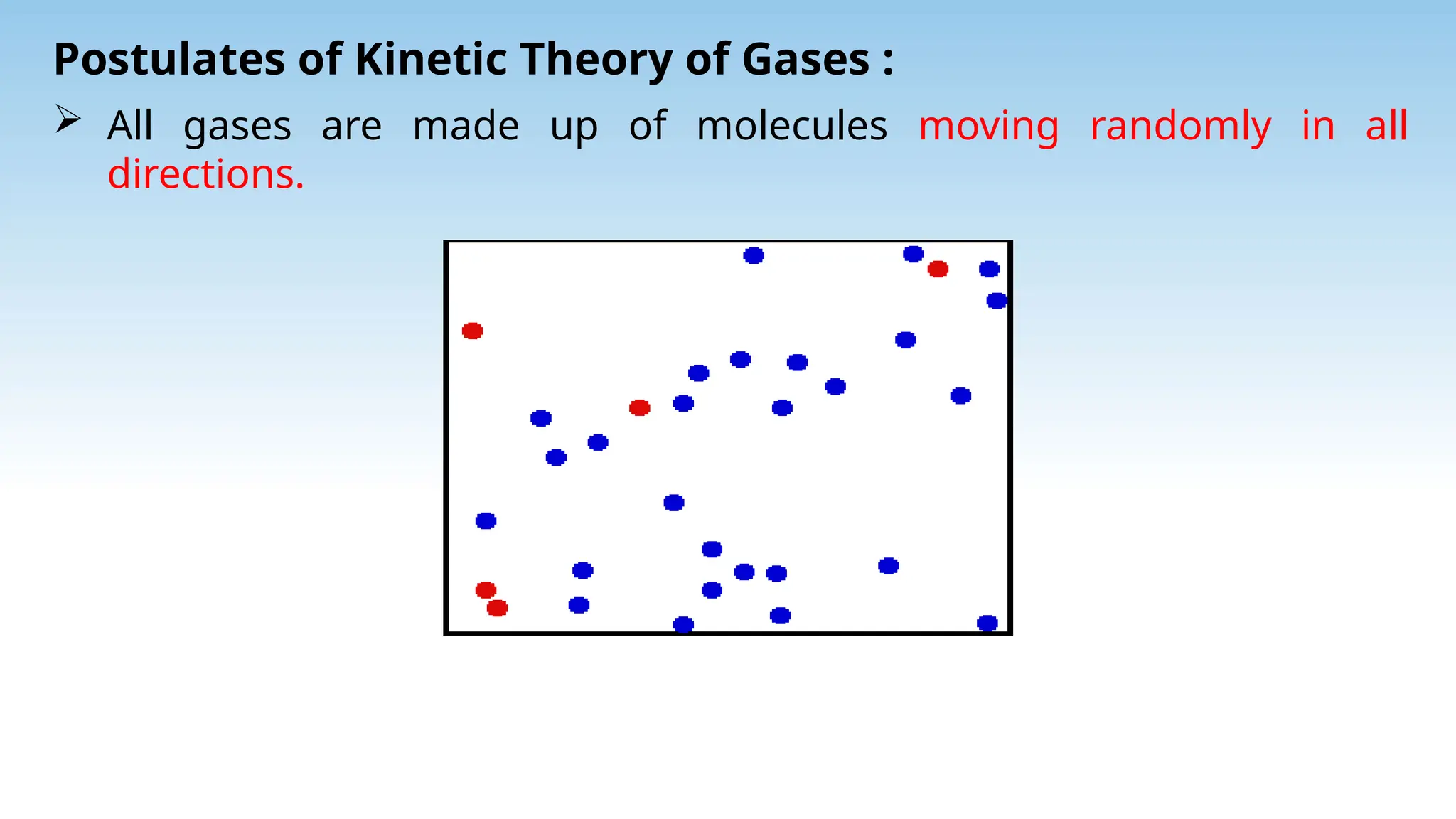
Postulates of Kinetic Theory of Gases :
 All gases are made up of molecules moving randomly in all
directions.
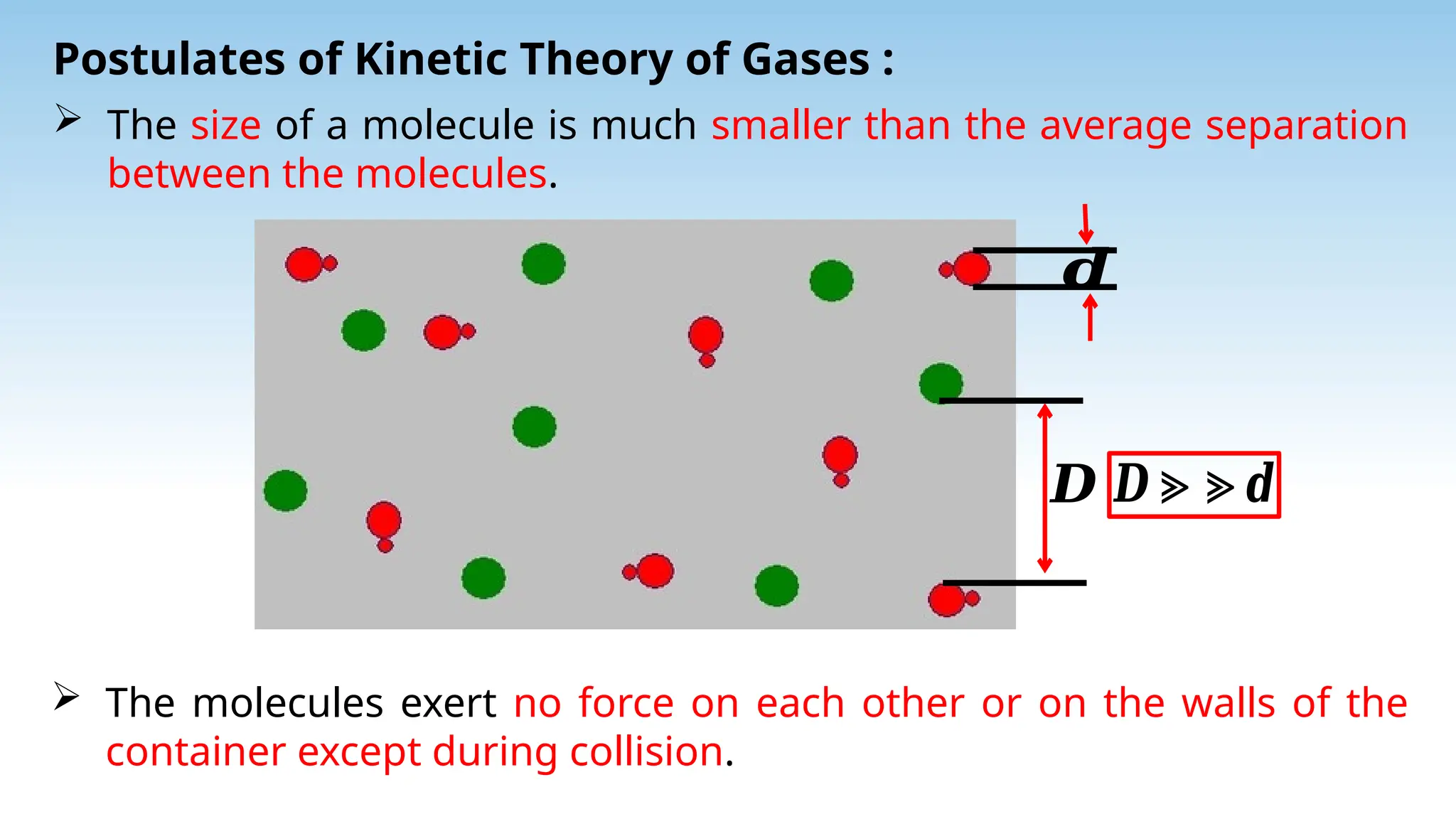
Postulates of Kinetic Theory of Gases :
 The size of a molecule is much smaller than the average separation
between the molecules.
 The molecules exert no force on each other or on the walls of the
container except during collision.
𝒅
𝑫 𝑫≫≫𝒅
Postulates of Kinetic Theory of Gases :
 All collisions between two molecules or between a molecule and a
wall are perfectly elastic. Also, the time spent during a collision is
negligibly small.
 The molecules obey Newton’s laws of motion.
𝒗
𝒗
Postulates of Kinetic Theory of Gases :
 When a gas is left for sufficient time, it comes to a steady state. The
density and distribution of molecules with different velocities are
independent of position, direction and time.
𝟒𝒎/ 𝒔
𝟏𝒎/ 𝒔
𝟐𝒎/ 𝒔
𝟑𝒎/ 𝒔
𝟏𝒎/𝒔𝟐𝒎/𝒔𝟑𝒎/𝒔 𝟒𝒎/𝒔
Number
of
Particles
𝟏
𝟐
𝟑
𝟒
Speed of Particles
Postulates of Kinetic Theory of Gases :
 When a gas is left for sufficient time, it comes to a steady state. The
density and distribution of molecules with different velocities are
independent of position, direction and time.
𝟒𝒎/ 𝒔
𝟏𝒎/ 𝒔
𝟐𝒎/ 𝒔
𝟑𝒎/ 𝒔
𝟏𝒎/𝒔𝟐𝒎/𝒔𝟑𝒎/𝒔 𝟒𝒎/𝒔
Number
of
Particles
𝟏
𝟐
𝟑
𝟒
Speed of Particles
Maxwell’s Speed Distribution Law :
In a given mass of gas, the velocities of all molecules are not the same,
even when the bulk parameters like pressure, volume and temperature
are fixed.
Collisions changes the direction and the speed of molecules.
Distributions are very important when we are dealing with system
containing large number of objects.
𝒅𝑵=𝟒 𝝅 𝑵 ( 𝒎
𝟐 𝝅 𝒌𝑻 )
𝟑/𝟐
𝒗
𝟐
𝒆
−𝒎𝒗
𝟐
/𝟐𝒌𝑻
𝒅𝒗
Equation of Maxwell’s Speed Distribution :
Number of molecules whose speed is between to
Maxwell’s Speed Distribution Law :
(𝒅𝑵
𝒅𝒗 )
𝒗 +𝒅𝒗
𝒗
Most Probable Speed
𝒗𝐌𝐏
It is the speed attained by maximum
number of gas molecules.
Area under graph Total Number of particles.
𝑑𝑁=4 𝜋 𝑁 ( 𝑚
2𝜋 𝑘𝑇 )
3/2
𝑣2
𝑒−𝑚𝑣
2
/2𝑘𝑇
𝑑𝑣
By solving given equation
𝒗𝐌𝐏=
√𝟐𝑹𝑻
𝑴𝒐
Most Probable Speed
𝒗
Maxwell’s Speed Distribution Law :
(𝒅𝑵
𝒅𝒗 )
𝒗
𝒗 +𝒅𝒗
𝒗
𝒗𝐌𝐏
𝒗𝐌𝐞𝐚𝐧=
√𝟖𝑹𝑻
𝝅 𝑴𝒐
For Average Speed
𝑣Mean=
∫𝑑𝑁 .𝑣
∫𝑑𝑁
Substituting values and solving,
𝒗𝐌𝐞𝐚𝐧
ConcepTest
Ready for a Challenge
Q. Calculate the value of most probable speed and average speed
for argon at
Sol.
𝑇=298 𝐾
𝑀 Ar=39.95𝑔𝑚𝑜𝑙−1
=39.95×10⁻³
𝑘𝑔𝑚𝑜𝑙−1
𝑣MP=352.18𝑚/𝑠
𝑣mean=397.49𝑚/𝑠
We also know
and
We know Pause the Video
(Time Duration : 2 Minutes)
11P13.1
CV 2
Pressure Calculation and Kinetic Interpretation
of Temperature
Some Definitions :
Root Mean Square Speed :
The RMS value of a set of values is the square root of the arithmetic
mean of the squares of the values.
𝑣rms=
√(𝑣1
2
+𝑣2
2
+𝑣3
2
+…+𝑣𝑛
2
)
𝑛
Translational Kinetic Energy of a Gas :
The total translational kinetic energy of all the molecules of the gas will
be equal to the summation of kinetic energy of all the molecules.
𝐾𝐸=∑
1
2
𝑚𝑣
2
𝒗 𝒙
𝒗 𝒚
Calculation of the pressure of an ideal gas :
𝒙
𝒚
𝒛
Ideal Gas
𝑳
𝒗 𝒛
We know,
⃗
𝐹=
𝑑 ⃗
𝑃
𝑑𝑡
=
Δ 𝑃
Δ 𝑡
𝐹=
(Δ 𝑃)
( Δ𝑡)
…(𝑖𝑖)
Pressure by gas on the wall
𝑝=
𝐹
𝐿
2
…( 𝑖)
Change in momentum of one
particle in one collision
Δ 𝑃=2𝑚𝑣𝑥
Time between two collision with wall
Δ 𝑡=
2 𝐿
𝑣𝑥
Calculation of the pressure of an ideal gas :
𝒙
𝒚
𝒛
Ideal Gas
𝑳
𝒗 𝒙
𝒗 𝒚
𝒗 𝒛
Total Force by all molecules
Total force by molecules in time
⇒
𝑚
𝐿
∑𝑣𝑥
2
…(𝑖𝑖𝑖)
𝐹 =
( Δ 𝑃)
( Δ𝑡)
=
2 𝑚𝑣𝑥
(2 𝐿
𝑣𝑥
)
⇒
𝑚𝑣𝑥
2
𝐿
From eq.
𝐹 𝑇 =
𝑚
𝐿
(𝑣𝑥1
2
+𝑣𝑥2
2
+𝑣𝑥3
2
+…+𝑣𝑥𝑛
2
)
Due to symmetry,
𝑣𝑥
2
=𝑣𝑦
2
=𝑣𝑧
2
…(𝑖𝑣)
Calculation of the pressure of an ideal gas :
For velocity of any particle
𝑣1
2
=𝑣𝑥1
2
+𝑣 𝑦1
2
+𝑣 𝑧1
2
∑𝑣2
=3∑𝑣𝑥
2
⇒
From eq.
∑𝑣𝑥
2
=
1
3
∑𝑣
2
𝑣2
2
=𝑣𝑥2
2
+𝑣 𝑦2
2
+𝑣𝑧2
2
𝑣3
2
=𝑣𝑥3
2
+𝑣𝑦 3
2
+𝑣𝑧3
2
∑𝑣2
=∑𝑣𝑥
2
+∑𝑣𝑦
2
+∑𝑣𝑧
2
𝒙
𝒚
𝒛
Ideal Gas
𝑳
𝒗 𝒙
𝒗 𝒚
𝒗 𝒛
Calculation of the pressure of an ideal gas :
From eq.,
Total Force in time
From eq.,
𝑝=
1
3 (𝑚
𝐿3 )∑𝑣
2
𝒙
𝒚
𝒛
Ideal Gas
𝑳
𝒗 𝒙
𝒗 𝒚
𝒗 𝒛
𝐹𝑇 =
1
3 (𝑚
𝐿 )∑𝑣2
Now multiplying and dividing
pressure by number of particles
𝑝=
1
3 (𝑚×𝑁
𝐿
3
× 𝑁 )∑ 𝑣
2
Calculation of the pressure of an ideal gas :
𝒙
𝒚
𝒛
Ideal Gas
𝑳
𝒗 𝒙
𝒗 𝒚
𝒗 𝒛
𝑚×𝑁=Total massof gas(𝑀)
𝐿3
=Total volume of gas(𝑉 )
𝑝=
1
3 (M
𝑉 )∑
𝑣2
𝑁
𝑝=
1
3
𝜌gas 𝑣rms
2
Root mean square speed
Kinetic Interpretation of Temperature :
According to KTG
We know
𝜌=
𝑀
𝑉
So from eq.
For 1 mole ideal gas
𝑃𝑉 =𝑅𝑇 …(𝑖𝑖𝑖)
Comparing eq. and
(𝑀
𝑅 ) Constant for a gas
¿
⇒
⇒
The temperature of a gas is due to its
motion and vibrations only.
i.e
.
As ⇒
𝑇
Translational Kinetic Energy of a Gas :
The total translational kinetic energy of all the molecules of the gas will
be equal to the summation of kinetic energy of all the molecules.
𝐾𝐸=∑
1
2
𝑚𝑣
2
𝐾 𝐸=
1
2
𝑀 𝑣rms
2
𝐾𝐸=
1
2
𝑚 𝑁 ∑
𝑣2
𝑁
𝐾 𝐸
𝑁
=
1
2 (𝑀
𝑁 )𝑣rms
2
So
Dividing and multiplying by
The average K.E of a molecule
𝐾 𝐸
𝑁
=
1
2
𝑚 𝑣rms
2
𝐾𝐸=
1
2
𝑚𝑁 𝑣rms
2
𝐾𝐸=
1
2
𝑀 𝑣rms
2
Translational Kinetic Energy of a Gas :
Multiplying and dividing
the above equation by
𝐾𝐸=
3
2
×
1
3
𝑀 𝑣rms
2
…(𝑖)
𝐾𝐸=
3
2
𝑝𝑉 …(𝑖𝑖)
We know,
𝑝=
1
3 (𝑀
𝑉 )𝑣rms
2
⇒
𝑝𝑉 =
1
3
𝑀 𝑣rms
2
⇒
For ideal gas
𝑝𝑉 =𝜇𝑅𝑇
For mole gas
𝑝𝑉 =𝑅𝑇
For molecule of gas
𝑝𝑉 =( 𝑅
𝑁 𝐴
)𝑇
𝑁 𝐴=Avagadro Number
From eq,
( 𝑅
𝑁 𝐴
)=𝐾𝐵=Boltzman Constant
𝑝𝑉 =𝐾𝐵 𝑇 …(𝑖𝑖𝑖)
From eq. and eq.
𝐾𝐸=
3
2
𝐾𝐵 𝑇
Root Mean Square Speed (RMS Speed) :
The square root of mean square speed is called root-mean-square
speed or rms speed.
It is denoted by the symbol
𝑝=
1
3 (M
𝑉 )𝑣rms
2
We know
𝑣rms
2
=
3 𝑝𝑉
𝑀
𝑣rms=
√3𝑝𝑉
𝑀
𝑀=Total mass of the gas taken
For ideal gas
𝑝𝑉 =𝜇𝑅𝑇
For molecule of gas
𝑝𝑉 =
( 𝑅
𝑁 𝐴
)𝑇
𝑁 𝐴=Avagadro Number
For mole gas
𝑝𝑉 =𝑅𝑇
For molecule of gas
𝑝𝑉 =𝑁( 𝑅
𝑁 𝐴
)𝑇 …(𝑖𝑖)
Comparing eq. and
1
3
× 𝑁 ×𝑚×𝑣rms
2
= 𝑁
( 𝑅
𝑁 𝐴
)𝑇
𝑣rms
2
=
3
𝑚 ( 𝑅
𝑁𝐴
)𝑇
⇒
𝑣rms
2
=
3
𝑚
𝐾 𝐵 𝑇
𝑣rms=
√3 𝐾𝐵 𝑇
𝑚
Dividing and multiplying by
within the square root.
𝑣rms=
√3𝐾𝐵 𝑇 𝑁𝐴
𝑚𝑁𝐴
𝑣rms=
√3
(𝐾¿¿𝐵𝑁𝐴)𝑇
𝑚𝑁𝐴
¿
Root Mean Square Speed (RMS Speed) :
⇒𝑣rms=
√3 𝑅𝑇
𝑀𝑜
We know ⇒
Root Mean Square Speed (RMS Speed) :
(𝒅𝑵
𝒅𝒗 )
𝒗
𝒗 +𝒅𝒗
𝒗
𝒗𝐌𝐏
Relation among
𝒗𝐫𝐦𝐬
𝒗𝐌𝐞𝐚𝐧
𝒗𝐌 𝑷 <𝒗𝐌 𝒆𝒂𝒏<𝒗𝐫𝐦𝐬
√𝟐𝑹𝑻
𝑴𝒐
<
√𝟖𝑹𝑻
𝝅 𝑴𝒐
<
√𝟑𝑹𝑻
𝑴𝒐
or
Boyle’s Law on the basis of Kinetic theory :
It states that the pressure of a given mass of an ideal gas is inversely
proportional to its volume at a constant temperature.
𝑷 ∝
𝟏
𝑽
( At Constant Temperature)
𝑝=
1
3
𝜌gas 𝑣rms
2
We know
𝑝=
1
3 (𝑀
𝑉 )𝑣rms
2
𝑝𝑉 =
1
3
𝑀 𝑣rms
2
…(𝑖)
𝑣rms
2
∝𝑇
We know for a given gas
i.e. for a given temperature
𝑣rms
2
=Constant
From eq.
𝑝𝑉 =Constant
𝑝∝
1
𝑉
⇒
ConcepTest
Ready for a Challenge
Sol. Pause the Video
(Time Duration : 2 Minutes)
Q. What will be the change in rms speed of gas on increasing
pressure ?
A) Increases B) Decreases
D) Can’t say
C) Remains constant
𝑣rms=
√3𝑝
𝜌
We know
Change in 𝑷 will cause chnage in 𝝆
i.e. If 𝑷increases⇒ 𝝆 increases
We can not comment on speed when pressure is changed.
Answer : C
Explanation :
11P12.3
PSV 1
Q. Calculate the rms speed of nitrogen at STP The density of
nitrogen in these conditions is .
Sol. At STP, Pressure=1.0×10⁵
𝑁 𝑚−2
𝑣rms=
√3𝑝𝑉
𝑀
We know,
𝑣rms=
√3×10
5
( 𝑀 /𝑉 )
𝑣rms=
√3×10⁵
𝜌
𝑣rms=
√3×10
5
1.25
𝑣rms=490𝑚/ 𝑠
ConcepTest
Ready for a Challenge
Q. Which of the following parameters is the same for molecules
of all gases at a given temperature ?
Sol.
Pause the Video
(Time Duration : 2 Minutes)
Answer : D
A) Mass B) Speed
C) Momentum D) Kinetic Energy
Explanation :
𝐾 𝐸=
3
2
𝐾 𝐵 𝑇
We know
If temperature is fixed
⇒𝐾𝐸=Constant
11P12.3
PSV 2
Q. The rms speed of oxygen at room temperature is about . What
will be the rms speed of hydrogen at the same temperature ?
Sol. We know,
𝑣rms=
√3 𝑅𝑇
𝑀𝑜
For same temperature,
𝑣rms ∝
1
√𝑀𝑜
For two different gases ,
(𝑣 ¿¿rms)𝑂2
(𝑣¿ ¿rms)𝐻 2
=
√𝑀𝐻2
𝑀𝑂 2
¿
¿
500
(𝑣¿¿ rms)𝐻 2
=
√ 2
32
¿
(𝑣¿¿rms)𝐻2
=2000𝑚/𝑠¿
ConcepTest
Ready for a Challenge
Q. Suppose a container is evacuated to leave just one molecule of
a gas in it. Let and represent the average speed and rms
speed of the gas.
Sol. Pause the Video
(Time Duration : 2 Minutes)
A) B)
C) D) is undefined
Answer : C
Explanation : If there is one molecule in the container then all the
velocities will be equal.
𝑣𝑎=𝑣rms
Summary :
 Pressure of an ideal gas is given by,
𝑝=
1
3
𝜌gas 𝑣rms
2
 Root mean square speed is given by,
𝑣rms=
√3𝑝𝑉
𝑀
=
√3𝑅𝑇
𝑀𝑜
 Translation kinetic energy of the gas is given by,
𝐾 . 𝐸=
3
2
𝑝𝑉=
3
2
𝐾 𝐵 𝑇
 The temperature of a gas is due to its motion
Summary :
 Most probable speed of the gas is given by,
𝒗𝐌𝐏=
√𝟐𝑹𝑻
𝑴𝒐
 Average speed of the gas is given by,
𝒗𝐌𝐞𝐚𝐧=
√𝟖𝑹𝑻
𝝅 𝑴𝒐
Reference Questions
NCERT : 13.1, 13.2, 13.3, 13.7, 13.8, 13.9.
Workbook : 1, 4, 5, 6, 7, 9, 10, 11, 12, 13, 15, 18, 19.
11P13.2
Degree of Freedom and Energy of Gases
Learning Objectives
Degree of Freedom
Law of Equipartition of Energy
Mean Free Path
Specific Heat Capacity of Gases
11P13.2
CV 1
Degree of Freedom and Equipartition Law
Degree of Freedom :
For Translatory Motion :
A particle moving in a
straight line along any one
of the axes has one degree
of freedom.
A particle moving in a
plane (X and Y axes) has
two degrees of freedom.
A particle moving in
space (X, Y and Z
axes) has three
degrees of freedom.
Simple pendulum
It is defined as the total number of independent variables required to
describe the position and configuration of the system.
Therefore a rigid body can have six degrees of freedom.
Three due to translatory motion.
Three due to rotatory motion.
A point mass can not undergo rotation, but only translatory motion.
A rigid body with finite mass has both rotatory and translatory motion.
The rotatory motion also can have three co-ordinates in space, like
translatory motion.
For Rotatory Motion :
Law of Equipartition of Energy :
It states that for a dynamical system in thermal equilibrium, the total
energy is equally distributed in all possible energy modes (degree of
freedom).
According to kinetic theory of gases,
The mean kinetic energy of a molecule of monoatomic gas
Since molecules move at random,
Law of Equipartition of Energy :
⇒
1
2
𝑚𝑣𝑥
2
+
1
2
𝑚𝑣𝑦
2
+
1
2
𝑚𝑣𝑧
2
=
3
2
𝐾𝐵 𝑇
∴
1
2
𝑚𝑣𝑥
2
=
1
2
𝑚𝑣𝑦
2
=
1
2
𝑚𝑣𝑧
2
⇒
1
2
𝑚𝑣𝑥
2
=
1
2
𝑚𝑣𝑦
2
=
1
2
𝑚𝑣𝑧
2
=
1
2
𝐾 𝐵 𝑇
Energy associated with each degree of freedom per molecule
¿
3
2
𝐾 𝐵 𝑇
¿
1
2
𝐾 𝐵 𝑇
Examples : Molecules of rare gases like helium, argon, etc.
Monoatomic molecule :
Since a monoatomic molecule consists of only a single atom of point
mass.
It has three degrees of freedom of translatory motion along the three
co-ordinate axes .
𝒛
𝒚
𝒙
Monoatomic molecule :
𝒛
𝒚
𝒙
𝒛
𝒚
𝒙
𝐸𝑡=
1
2
𝑚 𝑣𝑥
2
+
1
2
𝑚𝑣𝑦
2
+
1
2
𝑚𝑣𝑧
2
𝑈=𝑛× 𝑁𝐴 ×
3
2
𝐾𝐵 𝑇 ⇒ 𝑈=
3
2
𝑛𝑅𝑇(∵ 𝑁 𝐴× 𝐾𝐵=𝑅)
Internal energy of a monoatomic gas
So, average energy of molecule=𝟑×
1
2
𝐾𝐵 𝑇=
3
2
𝐾 𝐵 𝑇
Hence, a diatomic molecule has five degrees of freedom.
Diatomic molecule :
The diatomic molecule can rotate about any axis at right angles to its
own axis.
Hence it has two degrees of freedom of rotational motion in addition
to three degrees of freedom of translational motion along the three
axes.
Examples: molecules of , etc.
Diatomic molecule :
𝒛
𝒚
𝒙
𝒛
𝒚
𝒙
𝒛
𝒚
𝒙
𝒛
𝒚
𝒙
𝒛
𝒚
𝒙
𝐸=𝐸𝑡 +𝐸𝑟=
1
2
𝑚𝑣𝑥
2
+
1
2
𝑚𝑣𝑦
2
+
1
2
𝑚𝑣𝑧
2
+
1
2
𝐼𝑥 𝜔𝑥
2
+
1
2
𝐼𝑦 𝜔𝑦
2
Energy due to vibration
Potential energy of
two molecules
Kinetic energy
of vibration +¿
⇒ 𝐸𝑣 =
1
2
𝜇(𝑑𝑟
𝑑𝑡 )
2
+
1
2
𝑘𝑟
2
𝐸=
1
2
𝑚𝑣𝑥
2
+
1
2
𝑚𝑣𝑦
2
+
1
2
𝑚𝑣𝑧
2
+
1
2
𝐼𝑥 𝜔𝑥
2
+
1
2
𝐼 𝑦 𝜔𝑦
2
+
1
2
𝜇(𝑑𝑟
𝑑𝑡 )
2
+
1
2
𝑘𝑟
2
Total energy of the molecule
If Diatomic gas molecule have considerable vibration. Then,
A verage energy of molecule=𝟓×
1
2
𝐾𝐵 𝑇=
5
2
𝐾𝐵 𝑇
Diatomic molecule :
A verage energy of molecule=𝟕×
1
2
𝐾𝐵 𝑇=
7
2
𝐾𝐵 𝑇
For non-vibrating:
For vibrating:
Since degree of freedom
Examples: molecules of , etc.
Triatomic molecule (Linear Type) :
In the case of triatomic molecule of linear type, the center of mass lies
at the central atom.
It therefore behaves like a diatomic molecule with three degrees of
freedom of translation and two degrees of freedom of rotation, totally
it has five degrees of freedom.
Total energy (for non− vibrating)
So, average energy of a molecule=𝟓×
1
2
𝐾𝐵 𝑇=
5
2
𝐾 𝐵 𝑇
(𝐸)=𝐸𝑡 +𝐸𝑟 =
1
2
𝑚 𝑣𝑥
2
+
1
2
𝑚𝑣𝑦
2
+
1
2
𝑚𝑣𝑧
2
+
1
2
𝐼𝑥 𝜔𝑥
2
+
1
2
𝐼𝑦 𝜔𝑦
2
Triatomic molecule (Nonlinear Type) :
A triatomic non-linear molecule may rotate, about the three mutually
perpendicular axes. Therefore, it possesses three degrees of freedom
of rotation in addition to three degrees of freedom of translation along
the three co-ordinate axes.
Hence, it has six degrees of freedom.
Examples : molecules of , etc
(𝐸)=𝐸𝑡 +𝐸𝑟=
1
2
𝑚 𝑣𝑥
2
+
1
2
𝑚𝑣𝑦
2
+
1
2
𝑚𝑣𝑧
2
+
1
2
𝐼𝑥 𝜔𝑥
2
+
1
2
𝐼𝑦 𝜔𝑦
2
+
1
2
𝐼𝑧 𝜔𝑧
2
So, average energy of molecule=𝟔×
1
2
𝐾𝐵 𝑇 =3 𝐾𝐵 𝑇
Total energy (for non− vibrating)
11P13.2
PSV 1
Q.moles of a diatomic gas in a cylinder are at a temperature . Heat
is supplied to the cylinder such that the temperature remains
constant but moles of the diatomic gas get converted into
monatomic gas. What is the change in the total kinetic energy of
the gas?
𝑨¿
𝟓
𝟐
𝒏𝑹𝑻 𝑩¿
𝟏
𝟐
𝒏𝑹𝑻 𝑫 ¿
𝟑
𝟐
𝒏𝑹𝑻
Answer : D
Sol:
Number of moles in the final sample
Since the gas is changed to monoatomic gas
We have K.E. of the final sample
Hence, ¿3𝑛𝑅𝑇 –(3
2)𝑛𝑅𝑇
¿(3
2 )𝑛𝑅𝑇
11P13.2
CV 2
Specific Heat Capacities of Gases and Mean Free Path
Specific Heat Capacity of Gases :
Monoatomic Gases :
In monoatomic gas, molecules have three translational degrees of
freedom.
At temperature the average energy of a monoatomic gas is,
𝐾𝐸=
3
2
𝐾𝐵 𝑇
For one mole of such gas at constant volume, Internal Energy
𝑈=𝑁 𝐴×
3
2
𝐾𝐵 𝑇
{𝐾𝐵=
𝑅
𝑁 𝐴
}
𝑈=
3
2
𝑅𝑇
Specific Heat Capacity of Gases :
According to the first law of thermodynamics
Where
Δ 𝑄=Δ𝑈 +𝑊 …(𝑖)
Δ𝑄=𝜇.𝐶. Δ𝑇
From eq.
𝜇.𝐶 . Δ𝑇=Δ𝑈+𝑊 …(𝑖𝑖)
Δ𝑄=𝐻𝑒𝑎𝑡𝑡𝑟𝑎𝑛𝑠𝑓𝑒𝑟𝑡𝑜𝑜𝑟 𝑏𝑦 h
𝑡 𝑒𝑠𝑦𝑠𝑡𝑒𝑚
Δ𝑇= h
𝐶 𝑎𝑛𝑔𝑒𝑖𝑛𝑡𝑒𝑚𝑝𝑒𝑟𝑎𝑡𝑢𝑟𝑒𝑜𝑓 h
𝑡 𝑒𝑠𝑦𝑠𝑡𝑒𝑚
𝐶=𝑆𝑝𝑒𝑐𝑖𝑓𝑖𝑐 h𝑒𝑎𝑡𝑜𝑓 h
𝑡 𝑒𝑠𝑦𝑠𝑡𝑒𝑚
𝜇=𝑁𝑢𝑚𝑏𝑒𝑟 𝑜𝑓 𝑚𝑜𝑙𝑒𝑠𝑖𝑛 h
𝑡 𝑒𝑠𝑦𝑠𝑡𝑒𝑚
Specific Heat Capacity of Gases :
𝜇.𝐶𝑉 . Δ𝑇=Δ𝑈+𝑊 …(𝑖𝑖𝑖)
If heat transfer takes place at constant volume
Since the volume is constant
𝐶𝑉 =
3
2
𝑅
From eq.
Δ𝑉=0 ⇒𝑊=0
Δ 𝑈=𝜇.𝐶𝑉 . Δ𝑇 …(𝑖𝑣)
From eq.
⇒
For monoatomic gas
Internal Energy,
Δ 𝑈=
3
2
𝑅 Δ𝑇 …(𝑣)
Comparing eq.
𝜇.𝐶𝑉 . Δ 𝑇=
3
2
𝑅 Δ 𝑇
By the definition of molar
specific heat
𝜇=1𝑎𝑛𝑑 Δ𝑇=1℃
Specific Heat Capacity of Gases :
We know from 1st
law of thermodynamics
Δ 𝑄=Δ𝑈+𝑊
⇒𝜇.𝐶𝑃 . Δ𝑇=𝜇.𝐶𝑉 . Δ𝑇 +𝜇𝑅 Δ𝑇
For ideal gas heat transfer at constant pressure
Δ𝑄=𝜇.𝐶𝑃 . Δ𝑇 Δ𝑈=𝜇.𝐶𝑉 . Δ𝑇 𝑊=𝑝 Δ𝑉=𝜇𝑅Δ𝑇
𝐶𝑃 −𝐶𝑉 =𝑅
Substituting in 1st
law of thermodynamics
Where is gas constant.
We know for monoatomic gas is
𝐶𝑉 =
3
2
𝑅 ⇒
𝐶𝑃 −
3
2
𝑅=𝑅 𝐶𝑃=
5
2
𝑅
⇒
⇒
Specific Heat Capacity of Gases :
Ratio of and :
𝐶𝑃=
5
2
𝑅 𝐶𝑉 =
3
2
𝑅
We know
and
𝛾=
𝐶 𝑃
𝐶𝑉
=
(5
2
𝑅)
(3
2
𝑅)
𝛾=
𝐶𝑃
𝐶𝑉
=
5
3
=1.67
Specific Heat Capacity of Gases :
Diatomic Gases :
In case of diatomic gases, there are two possibilities :
i) Molecule is a Rigid Rotator :
In this scenario, the molecule will have five degrees of freedom.
Rotational
3 Translational
5 Degrees of Freedom
Specific Heat Capacity of Gases :
By the law of equipartition of energy
𝐾𝐵=
𝑅
𝑁𝐴
𝑈=
5
2
𝐾𝐵 𝑇
⇒ 𝑈=
5
2
𝑅𝑇 …(𝑖)
We know We know
Internal energy of a molecule of
diatomic gas
Internal energy at constant volume
𝑈=𝜇.𝐶𝑉 .𝑇 …(𝑖𝑖)
Comparing eq. and
𝜇.𝐶𝑉 .𝑇=
5
2
𝑅𝑇
By the definition of molar
specific heat
𝜇=1𝑎𝑛𝑑𝑇=1℃
𝐶𝑉 =
5
2
𝑅
𝐶𝑃 −𝐶𝑉 =𝑅
𝐶𝑃 −
5
2
𝑅=𝑅
⇒
𝐶𝑃=
7
2
𝑅
Specific Heat Capacity of Gases :
Ratio of and :
𝐶𝑃=
7
2
𝑅 𝐶𝑉 =
5
2
𝑅
We know
and
𝛾=
𝐶 𝑃
𝐶𝑉
=
(7
2
𝑅)
(5
2
𝑅)
𝛾=
𝐶𝑃
𝐶𝑉
=
7
5
=1.4
Specific Heat Capacity of Gases :
Where is gas constant.
ii) Molecule is not a Rigid Rotator :
In this scenario, the molecule will have two additional vibrational
degree of freedom.
So the internal energy can thus be calculated as
𝑈=
[(5
2)( 𝑅
𝑁 𝐴 )𝑇 +( 𝑅
𝑁 𝐴 )𝑇
]× 𝑁 𝐴
𝑈=
7
2
𝑅𝑇 …(𝑖)
𝑈=
[(5
2)( 𝑅
𝑁 𝐴 )𝑇 +2×
1
2 ( 𝑅
𝑁 𝐴 )𝑇
]× 𝑁 𝐴
Specific Heat Capacity of Gases :
Internal energy at constant volume
𝑈=𝜇.𝐶𝑉 .𝑇 …(𝑖𝑖)
Comparing eq. and
𝜇.𝐶𝑉 .𝑇=
7
2
𝑅𝑇
By the definition of molar specific heat
𝜇=1𝑎𝑛𝑑𝑇=1℃
𝐶𝑉 =
7
2
𝑅
We know
𝐶𝑃 −𝐶𝑉 =𝑅
𝐶𝑃 −
7
2
𝑅=𝑅
𝐶𝑃=
9
2
𝑅
⇒
Specific Heat Capacity of Gases :
Ratio of and :
𝐶𝑃=
9
2
𝑅 𝐶𝑉 =
7
2
𝑅
We know
and
𝛾 =
𝐶 𝑃
𝐶𝑉
=
(9
2
𝑅)
(7
2
𝑅)
𝛾=
𝐶𝑃
𝐶𝑉
=
9
7
=1.28
Specific Heat Capacity of Gases :
Polyatomic Gases :
The degrees of freedom of polyatomic gases are,
translational rotational vibrational
𝑈=(3+ 𝑓 ) 𝑅𝑇
Deploying the Law of Equipartition of Energy for calculation of internal
energy we get,
𝑈=
[(3
2)𝐾 𝐵𝑇+(3
2 )𝐾 𝐵𝑇+ 𝑓𝐾 𝐵𝑇
]×𝑁 𝐴
𝑈=
[3
2 ( 𝑅
𝑁 𝐴 )𝑇 +
3
2 ( 𝑅
𝑁 𝐴 )𝑇 + 𝑓 ( 𝑅
𝑁 𝐴 )𝑇
]×𝑁 𝐴
Specific Heat Capacity of Gases :
𝐶𝑃=(4+ 𝑓 ) 𝑅
The molar specific heat capacities of polyatomic gases using same
analysis done for monoatomic gases.
𝐶𝑉 =(3+ 𝑓 ) 𝑅
Ratio of
𝛾=
𝐶𝑃
𝐶𝑉
=
(4+ 𝑓 ) 𝑅
(3+ 𝑓 ) 𝑅
Specific Heat Capacity of Solids :
Let us consider a mole of solid having atoms
Each atom is oscillating along its mean position
Energy due to vibration
Potential energy of
two molecules
Kinetic energy
of vibration +¿
Hence, the average energy in three dimensions of the atom would be
𝑈=3×2×
1
2
𝐾 𝐵 𝑇 𝑈=3𝐾 𝐵𝑇
⇒
For one mole of solid
Specific Heat Capacity of Solids :
𝑈=3 𝐾𝐵 𝑇 ×𝑁 𝐴
𝑈=3 𝑅𝑇 …(𝑖)
⇒ {𝐾𝐵=
𝑅
𝑁 𝐴
}
In case of solids, volume change is negligible.
Δ 𝑄=Δ𝑈=𝜇.𝐶 .𝑇 …(𝑖𝑖)
From 1st
law of thermodynamics
Comparing eq. and
𝐶=3 𝑅
Specific Heat Capacity of Water :
And, following a similar calculation like solids
For the purpose of calculation of specific heat capacity, water is treated
as a solid.
A water molecule has three atoms.
( hydrogens and oxygen)
Hence, its internal energy would be
𝑈=(3×3 𝐾 𝐵 𝑇)× 𝑁 𝐴=9 𝐾𝐵 𝑁 𝐴 𝑇
⇒ 𝑈=9
( 𝑅
𝑁𝐴
)𝑇 ×𝑁 𝐴=9 𝑅𝑇
𝐶=9 𝑅
11P13.2
PSV 2
Q) One mole of an ideal monoatomic gas is mixed with 1 mole of
an ideal diatomic gas. What will be the molar specific heat of the
mixture at constant volume ? (Given )
A) 22 calorie B) 4 calorie C) 8 calorie D) 12 calorie
Sol: We know
𝐶𝑉 =
3
2
R (For a monoatomic gas)
(For a diatomic gas)
𝐶𝑉 =
5
2
R
Thus for the mixture
Average of both [(3
2 )𝑅+(5
2 )𝑅
]
2
𝐶𝑉 =2 𝑅 𝐶𝑉 =4𝐶𝑎𝑙𝑜𝑟𝑖𝑒
⇒ Answer : (B)
Mean Free Path :
Hence, a molecule follows a chain of zigzag paths. Each of these paths
is known as a free path which lies between two collisions.
The Kinetic theory of gases assumes that molecules are continuously
colliding with each other and they move with constant speeds and
in straight lines between two collisions.
Free path
Mean Free Path :
The average of the distances travelled by the molecule between all the
collisions is known as Mean Free Path.
The number of collisions increases if the gas is denser or the molecules
are large in size.
The mean free path
If the molecules of a gas are spheres having a diameter .
If we consider that one molecule is moving with an average speed and
the number of molecules per unit volume is Then ,
Summary :
Degree of Freedom defined as the total number of independent
variables required to describe the position and configuration of the
system.
Law of equipartition of energy states that for a dynamical system in
thermal equilibrium, the total energy is equally distributed in all
possible energy modes (degree of freedom).
The average of the distances travelled by the molecule between all the
collisions is known as Mean Free Path.
Energy associated with each degree of freedom per molecule is equal
to .
Reference Questions
NCERT – 13.4, 13.5 ,13.6, 13.10.
Workbook –2, 3, 8, 14, 16, 17, 20.

Kinetic theory of gases physics presentation.pptx

  • 1.
  • 2.
    Learning Objectives Equipartition lawof Energy and Energy of Gases Behaviour of Gases and Their Kinetics
  • 3.
    11P13.1 Behaviour of Gasesand Their Kinetics
  • 4.
    Learning Objectives Pressure CalculationApplied by Gas Postulates of Kinetic Theory of Gases Kinetic Interpretation of Temperature Maxwell’s Speed Distribution Law
  • 5.
    11P13.1 CV 1 Postulates ofKinetic Theory and Maxwell’s Speed Distribution Law
  • 6.
    Postulates of KineticTheory of Gases :  All gases are made up of molecules moving randomly in all directions.
  • 7.
    Postulates of KineticTheory of Gases :  The size of a molecule is much smaller than the average separation between the molecules.  The molecules exert no force on each other or on the walls of the container except during collision. 𝒅 𝑫 𝑫≫≫𝒅
  • 8.
    Postulates of KineticTheory of Gases :  All collisions between two molecules or between a molecule and a wall are perfectly elastic. Also, the time spent during a collision is negligibly small.  The molecules obey Newton’s laws of motion. 𝒗 𝒗
  • 9.
    Postulates of KineticTheory of Gases :  When a gas is left for sufficient time, it comes to a steady state. The density and distribution of molecules with different velocities are independent of position, direction and time. 𝟒𝒎/ 𝒔 𝟏𝒎/ 𝒔 𝟐𝒎/ 𝒔 𝟑𝒎/ 𝒔 𝟏𝒎/𝒔𝟐𝒎/𝒔𝟑𝒎/𝒔 𝟒𝒎/𝒔 Number of Particles 𝟏 𝟐 𝟑 𝟒 Speed of Particles
  • 10.
    Postulates of KineticTheory of Gases :  When a gas is left for sufficient time, it comes to a steady state. The density and distribution of molecules with different velocities are independent of position, direction and time. 𝟒𝒎/ 𝒔 𝟏𝒎/ 𝒔 𝟐𝒎/ 𝒔 𝟑𝒎/ 𝒔 𝟏𝒎/𝒔𝟐𝒎/𝒔𝟑𝒎/𝒔 𝟒𝒎/𝒔 Number of Particles 𝟏 𝟐 𝟑 𝟒 Speed of Particles
  • 11.
    Maxwell’s Speed DistributionLaw : In a given mass of gas, the velocities of all molecules are not the same, even when the bulk parameters like pressure, volume and temperature are fixed. Collisions changes the direction and the speed of molecules. Distributions are very important when we are dealing with system containing large number of objects. 𝒅𝑵=𝟒 𝝅 𝑵 ( 𝒎 𝟐 𝝅 𝒌𝑻 ) 𝟑/𝟐 𝒗 𝟐 𝒆 −𝒎𝒗 𝟐 /𝟐𝒌𝑻 𝒅𝒗 Equation of Maxwell’s Speed Distribution : Number of molecules whose speed is between to
  • 12.
    Maxwell’s Speed DistributionLaw : (𝒅𝑵 𝒅𝒗 ) 𝒗 +𝒅𝒗 𝒗 Most Probable Speed 𝒗𝐌𝐏 It is the speed attained by maximum number of gas molecules. Area under graph Total Number of particles. 𝑑𝑁=4 𝜋 𝑁 ( 𝑚 2𝜋 𝑘𝑇 ) 3/2 𝑣2 𝑒−𝑚𝑣 2 /2𝑘𝑇 𝑑𝑣 By solving given equation 𝒗𝐌𝐏= √𝟐𝑹𝑻 𝑴𝒐 Most Probable Speed 𝒗
  • 13.
    Maxwell’s Speed DistributionLaw : (𝒅𝑵 𝒅𝒗 ) 𝒗 𝒗 +𝒅𝒗 𝒗 𝒗𝐌𝐏 𝒗𝐌𝐞𝐚𝐧= √𝟖𝑹𝑻 𝝅 𝑴𝒐 For Average Speed 𝑣Mean= ∫𝑑𝑁 .𝑣 ∫𝑑𝑁 Substituting values and solving, 𝒗𝐌𝐞𝐚𝐧
  • 14.
  • 15.
    Q. Calculate thevalue of most probable speed and average speed for argon at Sol. 𝑇=298 𝐾 𝑀 Ar=39.95𝑔𝑚𝑜𝑙−1 =39.95×10⁻³ 𝑘𝑔𝑚𝑜𝑙−1 𝑣MP=352.18𝑚/𝑠 𝑣mean=397.49𝑚/𝑠 We also know and We know Pause the Video (Time Duration : 2 Minutes)
  • 16.
    11P13.1 CV 2 Pressure Calculationand Kinetic Interpretation of Temperature
  • 17.
    Some Definitions : RootMean Square Speed : The RMS value of a set of values is the square root of the arithmetic mean of the squares of the values. 𝑣rms= √(𝑣1 2 +𝑣2 2 +𝑣3 2 +…+𝑣𝑛 2 ) 𝑛 Translational Kinetic Energy of a Gas : The total translational kinetic energy of all the molecules of the gas will be equal to the summation of kinetic energy of all the molecules. 𝐾𝐸=∑ 1 2 𝑚𝑣 2
  • 18.
    𝒗 𝒙 𝒗 𝒚 Calculationof the pressure of an ideal gas : 𝒙 𝒚 𝒛 Ideal Gas 𝑳 𝒗 𝒛 We know, ⃗ 𝐹= 𝑑 ⃗ 𝑃 𝑑𝑡 = Δ 𝑃 Δ 𝑡 𝐹= (Δ 𝑃) ( Δ𝑡) …(𝑖𝑖) Pressure by gas on the wall 𝑝= 𝐹 𝐿 2 …( 𝑖) Change in momentum of one particle in one collision Δ 𝑃=2𝑚𝑣𝑥 Time between two collision with wall Δ 𝑡= 2 𝐿 𝑣𝑥
  • 19.
    Calculation of thepressure of an ideal gas : 𝒙 𝒚 𝒛 Ideal Gas 𝑳 𝒗 𝒙 𝒗 𝒚 𝒗 𝒛 Total Force by all molecules Total force by molecules in time ⇒ 𝑚 𝐿 ∑𝑣𝑥 2 …(𝑖𝑖𝑖) 𝐹 = ( Δ 𝑃) ( Δ𝑡) = 2 𝑚𝑣𝑥 (2 𝐿 𝑣𝑥 ) ⇒ 𝑚𝑣𝑥 2 𝐿 From eq. 𝐹 𝑇 = 𝑚 𝐿 (𝑣𝑥1 2 +𝑣𝑥2 2 +𝑣𝑥3 2 +…+𝑣𝑥𝑛 2 ) Due to symmetry, 𝑣𝑥 2 =𝑣𝑦 2 =𝑣𝑧 2 …(𝑖𝑣)
  • 20.
    Calculation of thepressure of an ideal gas : For velocity of any particle 𝑣1 2 =𝑣𝑥1 2 +𝑣 𝑦1 2 +𝑣 𝑧1 2 ∑𝑣2 =3∑𝑣𝑥 2 ⇒ From eq. ∑𝑣𝑥 2 = 1 3 ∑𝑣 2 𝑣2 2 =𝑣𝑥2 2 +𝑣 𝑦2 2 +𝑣𝑧2 2 𝑣3 2 =𝑣𝑥3 2 +𝑣𝑦 3 2 +𝑣𝑧3 2 ∑𝑣2 =∑𝑣𝑥 2 +∑𝑣𝑦 2 +∑𝑣𝑧 2 𝒙 𝒚 𝒛 Ideal Gas 𝑳 𝒗 𝒙 𝒗 𝒚 𝒗 𝒛
  • 21.
    Calculation of thepressure of an ideal gas : From eq., Total Force in time From eq., 𝑝= 1 3 (𝑚 𝐿3 )∑𝑣 2 𝒙 𝒚 𝒛 Ideal Gas 𝑳 𝒗 𝒙 𝒗 𝒚 𝒗 𝒛 𝐹𝑇 = 1 3 (𝑚 𝐿 )∑𝑣2 Now multiplying and dividing pressure by number of particles 𝑝= 1 3 (𝑚×𝑁 𝐿 3 × 𝑁 )∑ 𝑣 2
  • 22.
    Calculation of thepressure of an ideal gas : 𝒙 𝒚 𝒛 Ideal Gas 𝑳 𝒗 𝒙 𝒗 𝒚 𝒗 𝒛 𝑚×𝑁=Total massof gas(𝑀) 𝐿3 =Total volume of gas(𝑉 ) 𝑝= 1 3 (M 𝑉 )∑ 𝑣2 𝑁 𝑝= 1 3 𝜌gas 𝑣rms 2 Root mean square speed
  • 23.
    Kinetic Interpretation ofTemperature : According to KTG We know 𝜌= 𝑀 𝑉 So from eq. For 1 mole ideal gas 𝑃𝑉 =𝑅𝑇 …(𝑖𝑖𝑖) Comparing eq. and (𝑀 𝑅 ) Constant for a gas ¿ ⇒ ⇒ The temperature of a gas is due to its motion and vibrations only. i.e . As ⇒ 𝑇
  • 24.
    Translational Kinetic Energyof a Gas : The total translational kinetic energy of all the molecules of the gas will be equal to the summation of kinetic energy of all the molecules. 𝐾𝐸=∑ 1 2 𝑚𝑣 2 𝐾 𝐸= 1 2 𝑀 𝑣rms 2 𝐾𝐸= 1 2 𝑚 𝑁 ∑ 𝑣2 𝑁 𝐾 𝐸 𝑁 = 1 2 (𝑀 𝑁 )𝑣rms 2 So Dividing and multiplying by The average K.E of a molecule 𝐾 𝐸 𝑁 = 1 2 𝑚 𝑣rms 2 𝐾𝐸= 1 2 𝑚𝑁 𝑣rms 2 𝐾𝐸= 1 2 𝑀 𝑣rms 2
  • 25.
    Translational Kinetic Energyof a Gas : Multiplying and dividing the above equation by 𝐾𝐸= 3 2 × 1 3 𝑀 𝑣rms 2 …(𝑖) 𝐾𝐸= 3 2 𝑝𝑉 …(𝑖𝑖) We know, 𝑝= 1 3 (𝑀 𝑉 )𝑣rms 2 ⇒ 𝑝𝑉 = 1 3 𝑀 𝑣rms 2 ⇒ For ideal gas 𝑝𝑉 =𝜇𝑅𝑇 For mole gas 𝑝𝑉 =𝑅𝑇 For molecule of gas 𝑝𝑉 =( 𝑅 𝑁 𝐴 )𝑇 𝑁 𝐴=Avagadro Number From eq, ( 𝑅 𝑁 𝐴 )=𝐾𝐵=Boltzman Constant 𝑝𝑉 =𝐾𝐵 𝑇 …(𝑖𝑖𝑖) From eq. and eq. 𝐾𝐸= 3 2 𝐾𝐵 𝑇
  • 26.
    Root Mean SquareSpeed (RMS Speed) : The square root of mean square speed is called root-mean-square speed or rms speed. It is denoted by the symbol 𝑝= 1 3 (M 𝑉 )𝑣rms 2 We know 𝑣rms 2 = 3 𝑝𝑉 𝑀 𝑣rms= √3𝑝𝑉 𝑀 𝑀=Total mass of the gas taken For ideal gas 𝑝𝑉 =𝜇𝑅𝑇 For molecule of gas 𝑝𝑉 = ( 𝑅 𝑁 𝐴 )𝑇 𝑁 𝐴=Avagadro Number For mole gas 𝑝𝑉 =𝑅𝑇
  • 27.
    For molecule ofgas 𝑝𝑉 =𝑁( 𝑅 𝑁 𝐴 )𝑇 …(𝑖𝑖) Comparing eq. and 1 3 × 𝑁 ×𝑚×𝑣rms 2 = 𝑁 ( 𝑅 𝑁 𝐴 )𝑇 𝑣rms 2 = 3 𝑚 ( 𝑅 𝑁𝐴 )𝑇 ⇒ 𝑣rms 2 = 3 𝑚 𝐾 𝐵 𝑇 𝑣rms= √3 𝐾𝐵 𝑇 𝑚 Dividing and multiplying by within the square root. 𝑣rms= √3𝐾𝐵 𝑇 𝑁𝐴 𝑚𝑁𝐴 𝑣rms= √3 (𝐾¿¿𝐵𝑁𝐴)𝑇 𝑚𝑁𝐴 ¿ Root Mean Square Speed (RMS Speed) :
  • 28.
    ⇒𝑣rms= √3 𝑅𝑇 𝑀𝑜 We know⇒ Root Mean Square Speed (RMS Speed) :
  • 29.
    (𝒅𝑵 𝒅𝒗 ) 𝒗 𝒗 +𝒅𝒗 𝒗 𝒗𝐌𝐏 Relationamong 𝒗𝐫𝐦𝐬 𝒗𝐌𝐞𝐚𝐧 𝒗𝐌 𝑷 <𝒗𝐌 𝒆𝒂𝒏<𝒗𝐫𝐦𝐬 √𝟐𝑹𝑻 𝑴𝒐 < √𝟖𝑹𝑻 𝝅 𝑴𝒐 < √𝟑𝑹𝑻 𝑴𝒐 or
  • 30.
    Boyle’s Law onthe basis of Kinetic theory : It states that the pressure of a given mass of an ideal gas is inversely proportional to its volume at a constant temperature. 𝑷 ∝ 𝟏 𝑽 ( At Constant Temperature) 𝑝= 1 3 𝜌gas 𝑣rms 2 We know 𝑝= 1 3 (𝑀 𝑉 )𝑣rms 2 𝑝𝑉 = 1 3 𝑀 𝑣rms 2 …(𝑖) 𝑣rms 2 ∝𝑇 We know for a given gas i.e. for a given temperature 𝑣rms 2 =Constant From eq. 𝑝𝑉 =Constant 𝑝∝ 1 𝑉 ⇒
  • 31.
  • 32.
    Sol. Pause theVideo (Time Duration : 2 Minutes) Q. What will be the change in rms speed of gas on increasing pressure ? A) Increases B) Decreases D) Can’t say C) Remains constant 𝑣rms= √3𝑝 𝜌 We know Change in 𝑷 will cause chnage in 𝝆 i.e. If 𝑷increases⇒ 𝝆 increases We can not comment on speed when pressure is changed. Answer : C Explanation :
  • 33.
  • 34.
    Q. Calculate therms speed of nitrogen at STP The density of nitrogen in these conditions is . Sol. At STP, Pressure=1.0×10⁵ 𝑁 𝑚−2 𝑣rms= √3𝑝𝑉 𝑀 We know, 𝑣rms= √3×10 5 ( 𝑀 /𝑉 ) 𝑣rms= √3×10⁵ 𝜌 𝑣rms= √3×10 5 1.25 𝑣rms=490𝑚/ 𝑠
  • 35.
  • 36.
    Q. Which ofthe following parameters is the same for molecules of all gases at a given temperature ? Sol. Pause the Video (Time Duration : 2 Minutes) Answer : D A) Mass B) Speed C) Momentum D) Kinetic Energy Explanation : 𝐾 𝐸= 3 2 𝐾 𝐵 𝑇 We know If temperature is fixed ⇒𝐾𝐸=Constant
  • 37.
  • 38.
    Q. The rmsspeed of oxygen at room temperature is about . What will be the rms speed of hydrogen at the same temperature ? Sol. We know, 𝑣rms= √3 𝑅𝑇 𝑀𝑜 For same temperature, 𝑣rms ∝ 1 √𝑀𝑜 For two different gases , (𝑣 ¿¿rms)𝑂2 (𝑣¿ ¿rms)𝐻 2 = √𝑀𝐻2 𝑀𝑂 2 ¿ ¿ 500 (𝑣¿¿ rms)𝐻 2 = √ 2 32 ¿ (𝑣¿¿rms)𝐻2 =2000𝑚/𝑠¿
  • 39.
  • 40.
    Q. Suppose acontainer is evacuated to leave just one molecule of a gas in it. Let and represent the average speed and rms speed of the gas. Sol. Pause the Video (Time Duration : 2 Minutes) A) B) C) D) is undefined Answer : C Explanation : If there is one molecule in the container then all the velocities will be equal. 𝑣𝑎=𝑣rms
  • 41.
    Summary :  Pressureof an ideal gas is given by, 𝑝= 1 3 𝜌gas 𝑣rms 2  Root mean square speed is given by, 𝑣rms= √3𝑝𝑉 𝑀 = √3𝑅𝑇 𝑀𝑜  Translation kinetic energy of the gas is given by, 𝐾 . 𝐸= 3 2 𝑝𝑉= 3 2 𝐾 𝐵 𝑇  The temperature of a gas is due to its motion
  • 42.
    Summary :  Mostprobable speed of the gas is given by, 𝒗𝐌𝐏= √𝟐𝑹𝑻 𝑴𝒐  Average speed of the gas is given by, 𝒗𝐌𝐞𝐚𝐧= √𝟖𝑹𝑻 𝝅 𝑴𝒐
  • 43.
    Reference Questions NCERT :13.1, 13.2, 13.3, 13.7, 13.8, 13.9. Workbook : 1, 4, 5, 6, 7, 9, 10, 11, 12, 13, 15, 18, 19.
  • 44.
    11P13.2 Degree of Freedomand Energy of Gases
  • 45.
    Learning Objectives Degree ofFreedom Law of Equipartition of Energy Mean Free Path Specific Heat Capacity of Gases
  • 46.
    11P13.2 CV 1 Degree ofFreedom and Equipartition Law
  • 47.
    Degree of Freedom: For Translatory Motion : A particle moving in a straight line along any one of the axes has one degree of freedom. A particle moving in a plane (X and Y axes) has two degrees of freedom. A particle moving in space (X, Y and Z axes) has three degrees of freedom. Simple pendulum It is defined as the total number of independent variables required to describe the position and configuration of the system.
  • 48.
    Therefore a rigidbody can have six degrees of freedom. Three due to translatory motion. Three due to rotatory motion. A point mass can not undergo rotation, but only translatory motion. A rigid body with finite mass has both rotatory and translatory motion. The rotatory motion also can have three co-ordinates in space, like translatory motion. For Rotatory Motion :
  • 49.
    Law of Equipartitionof Energy : It states that for a dynamical system in thermal equilibrium, the total energy is equally distributed in all possible energy modes (degree of freedom).
  • 50.
    According to kinetictheory of gases, The mean kinetic energy of a molecule of monoatomic gas Since molecules move at random, Law of Equipartition of Energy : ⇒ 1 2 𝑚𝑣𝑥 2 + 1 2 𝑚𝑣𝑦 2 + 1 2 𝑚𝑣𝑧 2 = 3 2 𝐾𝐵 𝑇 ∴ 1 2 𝑚𝑣𝑥 2 = 1 2 𝑚𝑣𝑦 2 = 1 2 𝑚𝑣𝑧 2 ⇒ 1 2 𝑚𝑣𝑥 2 = 1 2 𝑚𝑣𝑦 2 = 1 2 𝑚𝑣𝑧 2 = 1 2 𝐾 𝐵 𝑇 Energy associated with each degree of freedom per molecule ¿ 3 2 𝐾 𝐵 𝑇 ¿ 1 2 𝐾 𝐵 𝑇
  • 51.
    Examples : Moleculesof rare gases like helium, argon, etc. Monoatomic molecule : Since a monoatomic molecule consists of only a single atom of point mass. It has three degrees of freedom of translatory motion along the three co-ordinate axes .
  • 52.
    𝒛 𝒚 𝒙 Monoatomic molecule : 𝒛 𝒚 𝒙 𝒛 𝒚 𝒙 𝐸𝑡= 1 2 𝑚𝑣𝑥 2 + 1 2 𝑚𝑣𝑦 2 + 1 2 𝑚𝑣𝑧 2 𝑈=𝑛× 𝑁𝐴 × 3 2 𝐾𝐵 𝑇 ⇒ 𝑈= 3 2 𝑛𝑅𝑇(∵ 𝑁 𝐴× 𝐾𝐵=𝑅) Internal energy of a monoatomic gas So, average energy of molecule=𝟑× 1 2 𝐾𝐵 𝑇= 3 2 𝐾 𝐵 𝑇
  • 53.
    Hence, a diatomicmolecule has five degrees of freedom. Diatomic molecule : The diatomic molecule can rotate about any axis at right angles to its own axis. Hence it has two degrees of freedom of rotational motion in addition to three degrees of freedom of translational motion along the three axes. Examples: molecules of , etc.
  • 54.
    Diatomic molecule : 𝒛 𝒚 𝒙 𝒛 𝒚 𝒙 𝒛 𝒚 𝒙 𝒛 𝒚 𝒙 𝒛 𝒚 𝒙 𝐸=𝐸𝑡+𝐸𝑟= 1 2 𝑚𝑣𝑥 2 + 1 2 𝑚𝑣𝑦 2 + 1 2 𝑚𝑣𝑧 2 + 1 2 𝐼𝑥 𝜔𝑥 2 + 1 2 𝐼𝑦 𝜔𝑦 2
  • 55.
    Energy due tovibration Potential energy of two molecules Kinetic energy of vibration +¿ ⇒ 𝐸𝑣 = 1 2 𝜇(𝑑𝑟 𝑑𝑡 ) 2 + 1 2 𝑘𝑟 2 𝐸= 1 2 𝑚𝑣𝑥 2 + 1 2 𝑚𝑣𝑦 2 + 1 2 𝑚𝑣𝑧 2 + 1 2 𝐼𝑥 𝜔𝑥 2 + 1 2 𝐼 𝑦 𝜔𝑦 2 + 1 2 𝜇(𝑑𝑟 𝑑𝑡 ) 2 + 1 2 𝑘𝑟 2 Total energy of the molecule If Diatomic gas molecule have considerable vibration. Then,
  • 56.
    A verage energyof molecule=𝟓× 1 2 𝐾𝐵 𝑇= 5 2 𝐾𝐵 𝑇 Diatomic molecule : A verage energy of molecule=𝟕× 1 2 𝐾𝐵 𝑇= 7 2 𝐾𝐵 𝑇 For non-vibrating: For vibrating: Since degree of freedom Since degree of freedom
  • 57.
    Examples: molecules of, etc. Triatomic molecule (Linear Type) : In the case of triatomic molecule of linear type, the center of mass lies at the central atom. It therefore behaves like a diatomic molecule with three degrees of freedom of translation and two degrees of freedom of rotation, totally it has five degrees of freedom. Total energy (for non− vibrating) So, average energy of a molecule=𝟓× 1 2 𝐾𝐵 𝑇= 5 2 𝐾 𝐵 𝑇 (𝐸)=𝐸𝑡 +𝐸𝑟 = 1 2 𝑚 𝑣𝑥 2 + 1 2 𝑚𝑣𝑦 2 + 1 2 𝑚𝑣𝑧 2 + 1 2 𝐼𝑥 𝜔𝑥 2 + 1 2 𝐼𝑦 𝜔𝑦 2
  • 58.
    Triatomic molecule (NonlinearType) : A triatomic non-linear molecule may rotate, about the three mutually perpendicular axes. Therefore, it possesses three degrees of freedom of rotation in addition to three degrees of freedom of translation along the three co-ordinate axes. Hence, it has six degrees of freedom. Examples : molecules of , etc (𝐸)=𝐸𝑡 +𝐸𝑟= 1 2 𝑚 𝑣𝑥 2 + 1 2 𝑚𝑣𝑦 2 + 1 2 𝑚𝑣𝑧 2 + 1 2 𝐼𝑥 𝜔𝑥 2 + 1 2 𝐼𝑦 𝜔𝑦 2 + 1 2 𝐼𝑧 𝜔𝑧 2 So, average energy of molecule=𝟔× 1 2 𝐾𝐵 𝑇 =3 𝐾𝐵 𝑇 Total energy (for non− vibrating)
  • 59.
  • 60.
    Q.moles of adiatomic gas in a cylinder are at a temperature . Heat is supplied to the cylinder such that the temperature remains constant but moles of the diatomic gas get converted into monatomic gas. What is the change in the total kinetic energy of the gas? 𝑨¿ 𝟓 𝟐 𝒏𝑹𝑻 𝑩¿ 𝟏 𝟐 𝒏𝑹𝑻 𝑫 ¿ 𝟑 𝟐 𝒏𝑹𝑻 Answer : D Sol: Number of moles in the final sample Since the gas is changed to monoatomic gas We have K.E. of the final sample Hence, ¿3𝑛𝑅𝑇 –(3 2)𝑛𝑅𝑇 ¿(3 2 )𝑛𝑅𝑇
  • 61.
    11P13.2 CV 2 Specific HeatCapacities of Gases and Mean Free Path
  • 62.
    Specific Heat Capacityof Gases : Monoatomic Gases : In monoatomic gas, molecules have three translational degrees of freedom. At temperature the average energy of a monoatomic gas is, 𝐾𝐸= 3 2 𝐾𝐵 𝑇 For one mole of such gas at constant volume, Internal Energy 𝑈=𝑁 𝐴× 3 2 𝐾𝐵 𝑇 {𝐾𝐵= 𝑅 𝑁 𝐴 } 𝑈= 3 2 𝑅𝑇
  • 63.
    Specific Heat Capacityof Gases : According to the first law of thermodynamics Where Δ 𝑄=Δ𝑈 +𝑊 …(𝑖) Δ𝑄=𝜇.𝐶. Δ𝑇 From eq. 𝜇.𝐶 . Δ𝑇=Δ𝑈+𝑊 …(𝑖𝑖) Δ𝑄=𝐻𝑒𝑎𝑡𝑡𝑟𝑎𝑛𝑠𝑓𝑒𝑟𝑡𝑜𝑜𝑟 𝑏𝑦 h 𝑡 𝑒𝑠𝑦𝑠𝑡𝑒𝑚 Δ𝑇= h 𝐶 𝑎𝑛𝑔𝑒𝑖𝑛𝑡𝑒𝑚𝑝𝑒𝑟𝑎𝑡𝑢𝑟𝑒𝑜𝑓 h 𝑡 𝑒𝑠𝑦𝑠𝑡𝑒𝑚 𝐶=𝑆𝑝𝑒𝑐𝑖𝑓𝑖𝑐 h𝑒𝑎𝑡𝑜𝑓 h 𝑡 𝑒𝑠𝑦𝑠𝑡𝑒𝑚 𝜇=𝑁𝑢𝑚𝑏𝑒𝑟 𝑜𝑓 𝑚𝑜𝑙𝑒𝑠𝑖𝑛 h 𝑡 𝑒𝑠𝑦𝑠𝑡𝑒𝑚
  • 64.
    Specific Heat Capacityof Gases : 𝜇.𝐶𝑉 . Δ𝑇=Δ𝑈+𝑊 …(𝑖𝑖𝑖) If heat transfer takes place at constant volume Since the volume is constant 𝐶𝑉 = 3 2 𝑅 From eq. Δ𝑉=0 ⇒𝑊=0 Δ 𝑈=𝜇.𝐶𝑉 . Δ𝑇 …(𝑖𝑣) From eq. ⇒ For monoatomic gas Internal Energy, Δ 𝑈= 3 2 𝑅 Δ𝑇 …(𝑣) Comparing eq. 𝜇.𝐶𝑉 . Δ 𝑇= 3 2 𝑅 Δ 𝑇 By the definition of molar specific heat 𝜇=1𝑎𝑛𝑑 Δ𝑇=1℃
  • 65.
    Specific Heat Capacityof Gases : We know from 1st law of thermodynamics Δ 𝑄=Δ𝑈+𝑊 ⇒𝜇.𝐶𝑃 . Δ𝑇=𝜇.𝐶𝑉 . Δ𝑇 +𝜇𝑅 Δ𝑇 For ideal gas heat transfer at constant pressure Δ𝑄=𝜇.𝐶𝑃 . Δ𝑇 Δ𝑈=𝜇.𝐶𝑉 . Δ𝑇 𝑊=𝑝 Δ𝑉=𝜇𝑅Δ𝑇 𝐶𝑃 −𝐶𝑉 =𝑅 Substituting in 1st law of thermodynamics Where is gas constant. We know for monoatomic gas is 𝐶𝑉 = 3 2 𝑅 ⇒ 𝐶𝑃 − 3 2 𝑅=𝑅 𝐶𝑃= 5 2 𝑅 ⇒ ⇒
  • 66.
    Specific Heat Capacityof Gases : Ratio of and : 𝐶𝑃= 5 2 𝑅 𝐶𝑉 = 3 2 𝑅 We know and 𝛾= 𝐶 𝑃 𝐶𝑉 = (5 2 𝑅) (3 2 𝑅) 𝛾= 𝐶𝑃 𝐶𝑉 = 5 3 =1.67
  • 67.
    Specific Heat Capacityof Gases : Diatomic Gases : In case of diatomic gases, there are two possibilities : i) Molecule is a Rigid Rotator : In this scenario, the molecule will have five degrees of freedom. Rotational 3 Translational 5 Degrees of Freedom
  • 68.
    Specific Heat Capacityof Gases : By the law of equipartition of energy 𝐾𝐵= 𝑅 𝑁𝐴 𝑈= 5 2 𝐾𝐵 𝑇 ⇒ 𝑈= 5 2 𝑅𝑇 …(𝑖) We know We know Internal energy of a molecule of diatomic gas Internal energy at constant volume 𝑈=𝜇.𝐶𝑉 .𝑇 …(𝑖𝑖) Comparing eq. and 𝜇.𝐶𝑉 .𝑇= 5 2 𝑅𝑇 By the definition of molar specific heat 𝜇=1𝑎𝑛𝑑𝑇=1℃ 𝐶𝑉 = 5 2 𝑅 𝐶𝑃 −𝐶𝑉 =𝑅 𝐶𝑃 − 5 2 𝑅=𝑅 ⇒ 𝐶𝑃= 7 2 𝑅
  • 69.
    Specific Heat Capacityof Gases : Ratio of and : 𝐶𝑃= 7 2 𝑅 𝐶𝑉 = 5 2 𝑅 We know and 𝛾= 𝐶 𝑃 𝐶𝑉 = (7 2 𝑅) (5 2 𝑅) 𝛾= 𝐶𝑃 𝐶𝑉 = 7 5 =1.4
  • 70.
    Specific Heat Capacityof Gases : Where is gas constant. ii) Molecule is not a Rigid Rotator : In this scenario, the molecule will have two additional vibrational degree of freedom. So the internal energy can thus be calculated as 𝑈= [(5 2)( 𝑅 𝑁 𝐴 )𝑇 +( 𝑅 𝑁 𝐴 )𝑇 ]× 𝑁 𝐴 𝑈= 7 2 𝑅𝑇 …(𝑖) 𝑈= [(5 2)( 𝑅 𝑁 𝐴 )𝑇 +2× 1 2 ( 𝑅 𝑁 𝐴 )𝑇 ]× 𝑁 𝐴
  • 71.
    Specific Heat Capacityof Gases : Internal energy at constant volume 𝑈=𝜇.𝐶𝑉 .𝑇 …(𝑖𝑖) Comparing eq. and 𝜇.𝐶𝑉 .𝑇= 7 2 𝑅𝑇 By the definition of molar specific heat 𝜇=1𝑎𝑛𝑑𝑇=1℃ 𝐶𝑉 = 7 2 𝑅 We know 𝐶𝑃 −𝐶𝑉 =𝑅 𝐶𝑃 − 7 2 𝑅=𝑅 𝐶𝑃= 9 2 𝑅 ⇒
  • 72.
    Specific Heat Capacityof Gases : Ratio of and : 𝐶𝑃= 9 2 𝑅 𝐶𝑉 = 7 2 𝑅 We know and 𝛾 = 𝐶 𝑃 𝐶𝑉 = (9 2 𝑅) (7 2 𝑅) 𝛾= 𝐶𝑃 𝐶𝑉 = 9 7 =1.28
  • 73.
    Specific Heat Capacityof Gases : Polyatomic Gases : The degrees of freedom of polyatomic gases are, translational rotational vibrational 𝑈=(3+ 𝑓 ) 𝑅𝑇 Deploying the Law of Equipartition of Energy for calculation of internal energy we get, 𝑈= [(3 2)𝐾 𝐵𝑇+(3 2 )𝐾 𝐵𝑇+ 𝑓𝐾 𝐵𝑇 ]×𝑁 𝐴 𝑈= [3 2 ( 𝑅 𝑁 𝐴 )𝑇 + 3 2 ( 𝑅 𝑁 𝐴 )𝑇 + 𝑓 ( 𝑅 𝑁 𝐴 )𝑇 ]×𝑁 𝐴
  • 74.
    Specific Heat Capacityof Gases : 𝐶𝑃=(4+ 𝑓 ) 𝑅 The molar specific heat capacities of polyatomic gases using same analysis done for monoatomic gases. 𝐶𝑉 =(3+ 𝑓 ) 𝑅 Ratio of 𝛾= 𝐶𝑃 𝐶𝑉 = (4+ 𝑓 ) 𝑅 (3+ 𝑓 ) 𝑅
  • 75.
    Specific Heat Capacityof Solids : Let us consider a mole of solid having atoms Each atom is oscillating along its mean position Energy due to vibration Potential energy of two molecules Kinetic energy of vibration +¿ Hence, the average energy in three dimensions of the atom would be 𝑈=3×2× 1 2 𝐾 𝐵 𝑇 𝑈=3𝐾 𝐵𝑇 ⇒
  • 76.
    For one moleof solid Specific Heat Capacity of Solids : 𝑈=3 𝐾𝐵 𝑇 ×𝑁 𝐴 𝑈=3 𝑅𝑇 …(𝑖) ⇒ {𝐾𝐵= 𝑅 𝑁 𝐴 } In case of solids, volume change is negligible. Δ 𝑄=Δ𝑈=𝜇.𝐶 .𝑇 …(𝑖𝑖) From 1st law of thermodynamics Comparing eq. and 𝐶=3 𝑅
  • 77.
    Specific Heat Capacityof Water : And, following a similar calculation like solids For the purpose of calculation of specific heat capacity, water is treated as a solid. A water molecule has three atoms. ( hydrogens and oxygen) Hence, its internal energy would be 𝑈=(3×3 𝐾 𝐵 𝑇)× 𝑁 𝐴=9 𝐾𝐵 𝑁 𝐴 𝑇 ⇒ 𝑈=9 ( 𝑅 𝑁𝐴 )𝑇 ×𝑁 𝐴=9 𝑅𝑇 𝐶=9 𝑅
  • 78.
  • 79.
    Q) One moleof an ideal monoatomic gas is mixed with 1 mole of an ideal diatomic gas. What will be the molar specific heat of the mixture at constant volume ? (Given ) A) 22 calorie B) 4 calorie C) 8 calorie D) 12 calorie Sol: We know 𝐶𝑉 = 3 2 R (For a monoatomic gas) (For a diatomic gas) 𝐶𝑉 = 5 2 R Thus for the mixture Average of both [(3 2 )𝑅+(5 2 )𝑅 ] 2 𝐶𝑉 =2 𝑅 𝐶𝑉 =4𝐶𝑎𝑙𝑜𝑟𝑖𝑒 ⇒ Answer : (B)
  • 80.
    Mean Free Path: Hence, a molecule follows a chain of zigzag paths. Each of these paths is known as a free path which lies between two collisions. The Kinetic theory of gases assumes that molecules are continuously colliding with each other and they move with constant speeds and in straight lines between two collisions. Free path
  • 81.
    Mean Free Path: The average of the distances travelled by the molecule between all the collisions is known as Mean Free Path. The number of collisions increases if the gas is denser or the molecules are large in size. The mean free path If the molecules of a gas are spheres having a diameter . If we consider that one molecule is moving with an average speed and the number of molecules per unit volume is Then ,
  • 82.
    Summary : Degree ofFreedom defined as the total number of independent variables required to describe the position and configuration of the system. Law of equipartition of energy states that for a dynamical system in thermal equilibrium, the total energy is equally distributed in all possible energy modes (degree of freedom). The average of the distances travelled by the molecule between all the collisions is known as Mean Free Path. Energy associated with each degree of freedom per molecule is equal to .
  • 83.
    Reference Questions NCERT –13.4, 13.5 ,13.6, 13.10. Workbook –2, 3, 8, 14, 16, 17, 20.

Editor's Notes

  • #47 1. Eg. Bob of an oscillating simple pendulum. 2. Eg. An ant that moves on a floor. 3. Eg. a bird that flies.
  • #50 the average kinetic energy corresponding to each degree of freedom is the same.