SURGE CONTROL FOR PARALLEL GAS COMPRESSOR OPERATIONS
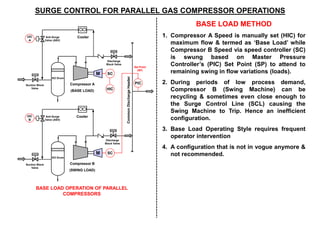
BASE LOAD OPERATION OF PARALLEL
COMPRESSORS
M
KO Drum
Suction Block
Valve
Anti-Surge
Valve (ASV)
Compressor A
(BASE LOAD)
CoolerUIC
A
SC
M
KO Drum
Suction Block
Valve
Anti-Surge
Valve (ASV)
Compressor B
(SWING LOAD)
CoolerUIC
B
SC
CommonDischargeHeader
PIC
HIC
Set Point
(SP)
BASE LOAD METHOD
1. Compressor A Speed is manually set (HIC) for
maximum flow & termed as ‘Base Load’ while
Compressor B Speed via speed controller (SC)
is swung based on Master Pressure
Controller’s (PIC) Set Point (SP) to attend to
remaining swing in flow variations (loads).
2. During periods of low process demand,
Compressor B (Swing Machine) can be
recycling & sometimes even close enough to
the Surge Control Line (SCL) causing the
Swing Machine to Trip. Hence an inefficient
configuration.
3. Base Load Operating Style requires frequent
operator intervention
4. A configuration that is not in vogue anymore &
not recommended.
Discharge
Block Valve
Discharge
Block Valve
SURGE CONTROL FOR PARALLEL GAS COMPRESSOR OPERATIONS
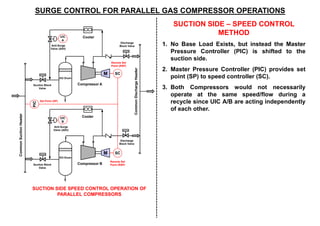
SUCTION SIDE SPEED CONTROL OPERATION OF
PARALLEL COMPRESSORS
M
KO Drum
Suction Block
Valve
Compressor A
Cooler
SC
M
KO Drum
Suction Block
Valve
Compressor B
Cooler
SC
CommonDischargeHeader
SUCTION SIDE – SPEED CONTROL
METHOD
1. No Base Load Exists, but instead the Master
Pressure Controller (PIC) is shifted to the
suction side.
2. Master Pressure Controller (PIC) provides set
point (SP) to speed controller (SC).
3. Both Compressors would not necessarily
operate at the same speed/flow during a
recycle since UIC A/B are acting independently
of each other.
PIC
Anti-Surge
Valve (ASV)
UIC
A
Anti-Surge
Valve (ASV)
UIC
B
Set Point (SP)
CommonSuctionHeader
Remote Set
Point (RSP)
Remote Set
Point (RSP)
Discharge
Block Valve
Discharge
Block Valve
SURGE CONTROL FOR PARALLEL GAS COMPRESSOR OPERATIONS
EQUAL FLOW BALANCE OPERATION OF
PARALLEL COMPRESSORS
M
KO Drum
Suction Block
Valve
Anti-Surge
Valve (ASV)
Compressor A
FT
CoolerUIC
A
SC
M
KO Drum
Suction Block
Valve
Anti-Surge
Valve (ASV)
Compressor B
FT
CoolerUIC
B
SC
CommonDischargeHeader
PIC
Set Point
(SP)
EQUAL FLOW BALANCE METHOD
1. The Master Pressure Controller (PIC) on the
common discharge header determines the total
load demand and alters Compressors A & B
speeds (SC). The individual flow control signal
to each speed controller is achieved by scaling
the total load demand (BIAS A & BIAS B) to the
individual flow controller (FC) on each
compressor.
2. Both Compressor Operations are independent
of the Anti-surge Valve (ASV) Operation.
3. Flow Balancing method requires additional
control elements thereby increasing CAPEX
costs.
4. Since Flow Element & Transmitter (FT) is
installed on the compressor discharge,
additional pressure drop occurs representing
energy losses & corresponding costs.
5. For the cascaded control used, PIC  FC 
SC, the inner loop (FC) must respond faster
than the PIC outer loop causing PIC to be
sluggish. The faster FC loop also means, the
compressor speed would increase faster than
required often reaching maximum speed &
hence does not offer the best control strategy.
FC
BIAS
A
BIAS
B
Remote Set
Point (RSP)
Remote Set
Point (RSP)
FC
Discharge
Block Valve
Discharge
Block Valve
SURGE CONTROL FOR PARALLEL GAS COMPRESSOR OPERATIONS
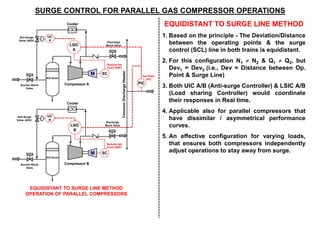
EQUIDISTANT TO SURGE LINE METHOD
OPERATION OF PARALLEL COMPRESSORS
M
KO Drum
Suction Block
Valve
Anti-Surge
Valve (ASV)
Compressor A
Cooler
UIC
A
SC
M
KO Drum
Suction Block
Valve
Compressor B
Cooler
SC
CommonDischargeHeader
PIC
Set Point
(SP)
EQUIDISTANT TO SURGE LINE METHOD
1. Based on the principle - The Deviation/Distance
between the operating points & the surge
control (SCL) line in both trains is equidistant.
2. For this configuration N1  N2 & Q1  Q2, but
Dev1 = Dev2 (i.e., Dev = Distance between Op.
Point & Surge Line)
3. Both UIC A/B (Anti-surge Controller) & LSIC A/B
(Load sharing Controller) would coordinate
their responses in Real time.
4. Applicable also for parallel compressors that
have dissimilar / asymmetrical performance
curves.
5. An effective configuration for varying loads,
that ensures both compressors independently
adjust operations to stay away from surge.
LSIC
A
Remote Set
Point (RSP)
Remote Set
Point (RSP)
Anti-Surge
Valve (ASV)
UIC
B
LSIC
B
Discharge
Block Valve
Discharge
Block Valve

Surge Control for Parallel Centrifugal Compressor Operations

  • 1.
    SURGE CONTROL FORPARALLEL GAS COMPRESSOR OPERATIONS BASE LOAD OPERATION OF PARALLEL COMPRESSORS M KO Drum Suction Block Valve Anti-Surge Valve (ASV) Compressor A (BASE LOAD) CoolerUIC A SC M KO Drum Suction Block Valve Anti-Surge Valve (ASV) Compressor B (SWING LOAD) CoolerUIC B SC CommonDischargeHeader PIC HIC Set Point (SP) BASE LOAD METHOD 1. Compressor A Speed is manually set (HIC) for maximum flow & termed as ‘Base Load’ while Compressor B Speed via speed controller (SC) is swung based on Master Pressure Controller’s (PIC) Set Point (SP) to attend to remaining swing in flow variations (loads). 2. During periods of low process demand, Compressor B (Swing Machine) can be recycling & sometimes even close enough to the Surge Control Line (SCL) causing the Swing Machine to Trip. Hence an inefficient configuration. 3. Base Load Operating Style requires frequent operator intervention 4. A configuration that is not in vogue anymore & not recommended. Discharge Block Valve Discharge Block Valve
  • 2.
    SURGE CONTROL FORPARALLEL GAS COMPRESSOR OPERATIONS SUCTION SIDE SPEED CONTROL OPERATION OF PARALLEL COMPRESSORS M KO Drum Suction Block Valve Compressor A Cooler SC M KO Drum Suction Block Valve Compressor B Cooler SC CommonDischargeHeader SUCTION SIDE – SPEED CONTROL METHOD 1. No Base Load Exists, but instead the Master Pressure Controller (PIC) is shifted to the suction side. 2. Master Pressure Controller (PIC) provides set point (SP) to speed controller (SC). 3. Both Compressors would not necessarily operate at the same speed/flow during a recycle since UIC A/B are acting independently of each other. PIC Anti-Surge Valve (ASV) UIC A Anti-Surge Valve (ASV) UIC B Set Point (SP) CommonSuctionHeader Remote Set Point (RSP) Remote Set Point (RSP) Discharge Block Valve Discharge Block Valve
  • 3.
    SURGE CONTROL FORPARALLEL GAS COMPRESSOR OPERATIONS EQUAL FLOW BALANCE OPERATION OF PARALLEL COMPRESSORS M KO Drum Suction Block Valve Anti-Surge Valve (ASV) Compressor A FT CoolerUIC A SC M KO Drum Suction Block Valve Anti-Surge Valve (ASV) Compressor B FT CoolerUIC B SC CommonDischargeHeader PIC Set Point (SP) EQUAL FLOW BALANCE METHOD 1. The Master Pressure Controller (PIC) on the common discharge header determines the total load demand and alters Compressors A & B speeds (SC). The individual flow control signal to each speed controller is achieved by scaling the total load demand (BIAS A & BIAS B) to the individual flow controller (FC) on each compressor. 2. Both Compressor Operations are independent of the Anti-surge Valve (ASV) Operation. 3. Flow Balancing method requires additional control elements thereby increasing CAPEX costs. 4. Since Flow Element & Transmitter (FT) is installed on the compressor discharge, additional pressure drop occurs representing energy losses & corresponding costs. 5. For the cascaded control used, PIC  FC  SC, the inner loop (FC) must respond faster than the PIC outer loop causing PIC to be sluggish. The faster FC loop also means, the compressor speed would increase faster than required often reaching maximum speed & hence does not offer the best control strategy. FC BIAS A BIAS B Remote Set Point (RSP) Remote Set Point (RSP) FC Discharge Block Valve Discharge Block Valve
  • 4.
    SURGE CONTROL FORPARALLEL GAS COMPRESSOR OPERATIONS EQUIDISTANT TO SURGE LINE METHOD OPERATION OF PARALLEL COMPRESSORS M KO Drum Suction Block Valve Anti-Surge Valve (ASV) Compressor A Cooler UIC A SC M KO Drum Suction Block Valve Compressor B Cooler SC CommonDischargeHeader PIC Set Point (SP) EQUIDISTANT TO SURGE LINE METHOD 1. Based on the principle - The Deviation/Distance between the operating points & the surge control (SCL) line in both trains is equidistant. 2. For this configuration N1  N2 & Q1  Q2, but Dev1 = Dev2 (i.e., Dev = Distance between Op. Point & Surge Line) 3. Both UIC A/B (Anti-surge Controller) & LSIC A/B (Load sharing Controller) would coordinate their responses in Real time. 4. Applicable also for parallel compressors that have dissimilar / asymmetrical performance curves. 5. An effective configuration for varying loads, that ensures both compressors independently adjust operations to stay away from surge. LSIC A Remote Set Point (RSP) Remote Set Point (RSP) Anti-Surge Valve (ASV) UIC B LSIC B Discharge Block Valve Discharge Block Valve