Beginner’s Guide
to
Centrifugal Compressor System
Design & Simulation
Vijay Sarathy J, M.E, C.Eng, MIChemE
 Centrifugal Compressor (CC) System Characteristics
 Centrifugal Compressor (CC) Drivers
 Typical Single Stage System
 Start-up Scenario
 Shutdown Scenario
 Emergency Shutdown (ESD) Scenario
 Centrifugal Compressor (CC) System Design Philosophy
 Anti-Surge System
 Recycle Arrangements
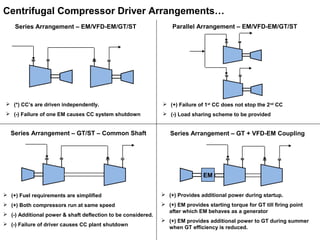
 CC Driver Arrangements
 General Notes
Contents…
Centrifugal Compressor (CC) System Characteristics…
 Compressor Maps dictate “behaviour” of the CC
 CC Maps are a plot between Polytropic Head (or pressure ratio) vs. Volumetric Flow
 Compressor to be operated always away from the surge line
 Absorbed power is the least at the surge line
 Range of CC operation is the enclosed region of the maps
beyond which guarantee is not provided by the manufacturer
 Typically operating point is maintained within 10% to 12% of the
surge line. This can be increased on a case to case basis.










−





×





−
×
××
=





 −
1
1
1
n
n
in
out
gas
inavg
p
P
P
n
n
MW
TRZ
H
ratioessure
P
P
KetemperaturInletT
onentPolytropicn
kgmolkgweightmolecularGasMW
factorilitycompressibAverageZ
KkgmolkJtConsGasR
kgFlowrateMassQ
kgkJHeadPolytropicH
in
out
in
gas
avg
in
p
Pr
,
exp
/,
/314.8,tan
sec/,
/,
=
=
=
=
=
=
=
=
inp QHPower ×=
Compressor to be operated within surge limits
Speed 4
Stone Wall
RegionSpeed 1
Speed 2
Speed 3
Actual Volumetric Flow [m3
/hr]
PolytropicHead[morkJ/kg]
Surge Line Surge Margin
Actual Volumetric Flow [m3
/hr]
Efficiency[%]
Speed 1 Speed 4
Speed 2 Speed 3
Centrifugal Compressor (CC) Drivers…
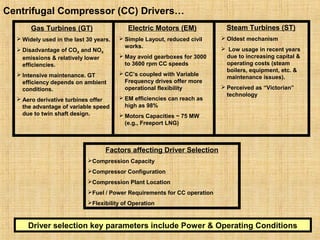
Driver selection key parameters include Power & Operating Conditions
Factors affecting Driver Selection
Compression Capacity
Compressor Configuration
Compression Plant Location
Fuel / Power Requirements for CC operation
Flexibility of Operation
Gas Turbines (GT)
 Widely used in the last 30 years.
 Disadvantage of COX and NOX
emissions & relatively lower
efficiencies.
 Intensive maintenance. GT
efficiency depends on ambient
conditions.
 Aero derivative turbines offer
the advantage of variable speed
due to twin shaft design.
Steam Turbines (ST)
 Oldest mechanism
 Low usage in recent years
due to increasing capital &
operating costs (steam
boilers, equipment, etc. &
maintenance issues).
 Perceived as “Victorian”
technology
Electric Motors (EM)
 Simple Layout, reduced civil
works.
 May avoid gearboxes for 3000
to 3600 rpm CC speeds
 CC’s coupled with Variable
Frequency drives offer more
operational flexibility
 EM efficiencies can reach as
high as 98%
 Motors Capacities ~ 75 MW
(e.g., Freeport LNG)
Typical Single Stage Centrifugal Compressor System…
One Stage CC System
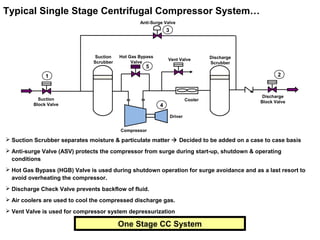
 Suction Scrubber separates moisture & particulate matter  Decided to be added on a case to case basis
 Anti-surge Valve (ASV) protects the compressor from surge during start-up, shutdown & operating
conditions
 Hot Gas Bypass (HGB) Valve is used during shutdown operation for surge avoidance and as a last resort to
avoid overheating the compressor.
 Discharge Check Valve prevents backflow of fluid.
 Air coolers are used to cool the compressed discharge gas.
 Vent Valve is used for compressor system depressurization
1 2
3
4
Suction
Scrubber
Discharge
Scrubber
CoolerSuction
Block Valve
Discharge
Block Valve
5
Anti-Surge Valve
Hot Gas Bypass
Valve
Vent Valve
Compressor
Driver
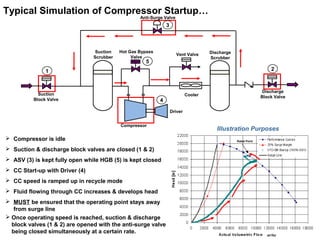
 Compressor is idle
 Suction & discharge block valves are closed (1 & 2)
 ASV (3) is kept fully open while HGB (5) is kept closed
 CC Start-up with Driver (4)
 CC speed is ramped up in recycle mode
 Fluid flowing through CC increases & develops head
 MUST be ensured that the operating point stays away
from surge line
Typical Simulation of Compressor Startup…
Illustration Purposes
 Once operating speed is reached, suction & discharge
block valves (1 & 2) are opened with the anti-surge valve
being closed simultaneously at a certain rate.
m3
/hr
Rated Point
1 2
3
4
Suction
Scrubber
Discharge
Scrubber
CoolerSuction
Block Valve
Discharge
Block Valve
5
Anti-Surge Valve
Hot Gas Bypass
Valve
Vent Valve
Compressor
Driver
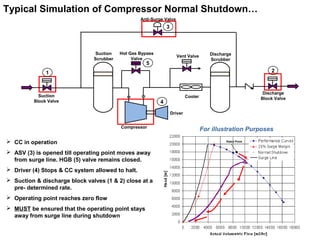
Typical Simulation of Compressor Normal Shutdown…
 CC in operation
 ASV (3) is opened till operating point moves away
from surge line. HGB (5) valve remains closed.
 Driver (4) Stops & CC system allowed to halt.
 Suction & discharge block valves (1 & 2) close at a
pre- determined rate.
 Operating point reaches zero flow
 MUST be ensured that the operating point stays
away from surge line during shutdown
For illustration Purposes
Rated Point
1 2
3
4
Suction
Scrubber
Discharge
Scrubber
CoolerSuction
Block Valve
Discharge
Block Valve
5
Anti-Surge Valve
Hot Gas Bypass
Valve
Vent Valve
Compressor
Driver
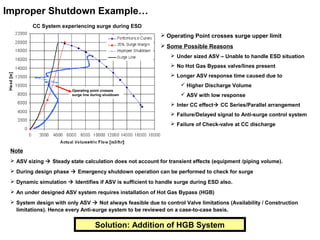
Improper Shutdown Example…
Operating point crosses
surge line during shutdown
CC System experiencing surge during ESD
 Operating Point crosses surge upper limit
 Some Possible Reasons
 Under sized ASV – Unable to handle ESD situation
 No Hot Gas Bypass valve/lines present
 Longer ASV response time caused due to
 Higher Discharge Volume
 ASV with low response
 Inter CC effect CC Series/Parallel arrangement
 Failure/Delayed signal to Anti-surge control system
 Failure of Check-valve at CC discharge
Solution: Addition of HGB System
Note
 ASV sizing  Steady state calculation does not account for transient effects (equipment /piping volume).
 During design phase  Emergency shutdown operation can be performed to check for surge
 Dynamic simulation  Identifies if ASV is sufficient to handle surge during ESD also.
 An under designed ASV system requires installation of Hot Gas Bypass (HGB)
 System design with only ASV  Not always feasible due to control Valve limitations (Availability / Construction
limitations). Hence every Anti-surge system to be reviewed on a case-to-case basis.
Typical Simulation of Compressor ESD with HGB…
 CC in operation
 Driver Trips (4) due to power failure
 Signal from DCS reaches ASV controller in about
300 msec.
 ASV (3) opens with an ideal time of 2 sec & HGB (5-
On-Off Valve) opens immediately (with lag)
 Suction & discharge block valves (1 & 2) close at a
pre- determined rate.
 Operating point reaches zero flow
 MUST be ensured that the operating point stays
away from surge line during shutdown
For illustration Purposes
0
Rated Point
1 2
3
4
Suction
Scrubber
Discharge
Scrubber
CoolerSuction
Block Valve
Discharge
Block Valve
5
Anti-Surge Valve
Hot Gas Bypass
Valve
Vent Valve
Compressor
Driver
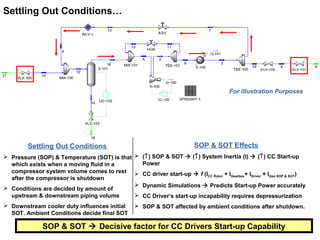
Settling Out Conditions…
Settling Out Conditions
 Pressure (SOP) & Temperature (SOT) is that
which exists when a moving fluid in a
compressor system volume comes to rest
after the compressor is shutdown
 Conditions are decided by amount of
upstream & downstream piping volume
 Downstream cooler duty influences initial
SOT. Ambient Conditions decide final SOT
SOP & SOT  Decisive factor for CC Drivers Start-up Capability
SOP & SOT Effects
 (↑) SOP & SOT  (↑) System Inertia (I)  (↑) CC Start-up
Power
 CC driver start-up  f (ICC Rotor + IGearbox+ IDriver + IGas SOP & SOT)
 Dynamic Simulations  Predicts Start-up Power accurately
 CC Driver’s start-up incapability requires depressurization
 SOP & SOT affected by ambient conditions after shutdown.
For illustration Purposes
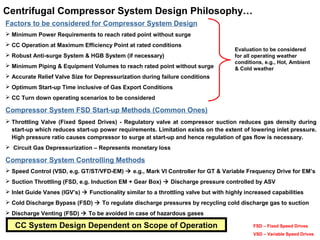
Factors to be considered for Compressor System Design
 Minimum Power Requirements to reach rated point without surge
 CC Operation at Maximum Efficiency Point at rated conditions
 Robust Anti-surge System & HGB System (if necessary)
 Minimum Piping & Equipment Volumes to reach rated point without surge
 Accurate Relief Valve Size for Depressurization during failure conditions
 Optimum Start-up Time inclusive of Gas Export Conditions
 CC Turn down operating scenarios to be considered
Compressor System FSD Start-up Methods (Common Ones)
 Throttling Valve (Fixed Speed Drives) - Regulatory valve at compressor suction reduces gas density during
start-up which reduces start-up power requirements. Limitation exists on the extent of lowering inlet pressure.
High pressure ratio causes compressor to surge at start-up and hence regulation of gas flow is necessary.
 Circuit Gas Depressurization – Represents monetary loss
Compressor System Controlling Methods
 Speed Control (VSD, e.g. GT/ST/VFD-EM)  e.g., Mark VI Controller for GT & Variable Frequency Drive for EM’s
 Suction Throttling (FSD, e.g. Induction EM + Gear Box)  Discharge pressure controlled by ASV
 Inlet Guide Vanes (IGV’s)  Functionality similar to a throttling valve but with highly increased capabilities
 Cold Discharge Bypass (FSD)  To regulate discharge pressures by recycling cold discharge gas to suction
 Discharge Venting (FSD)  To be avoided in case of hazardous gases
Centrifugal Compressor System Design Philosophy…
CC System Design Dependent on Scope of Operation
Evaluation to be considered
for all operating weather
conditions, e.g., Hot, Ambient
& Cold weather
FSD – Fixed Speed Drives
VSD – Variable Speed Drives
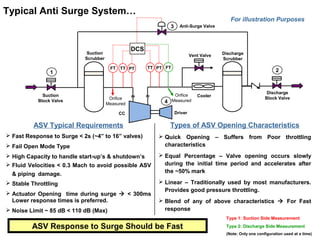
Typical Anti Surge System…
ASV Response to Surge Should be Fast
ASV Typical Requirements
 Fast Response to Surge < 2s (~4” to 16” valves)
 Fail Open Mode Type
 High Capacity to handle start-up’s & shutdown’s
 Fluid Velocities < 0.3 Mach to avoid possible ASV
& piping damage.
 Stable Throttling
 Actuator Opening time during surge  < 300ms
Lower response times is preferred.
 Noise Limit ~ 85 dB < 110 dB (Max)
Types of ASV Opening Characteristics
 Quick Opening – Suffers from Poor throttling
characteristics
 Equal Percentage – Valve opening occurs slowly
during the initial time period and accelerates after
the ~50% mark
 Linear – Traditionally used by most manufacturers.
Provides good pressure throttling.
 Blend of any of above characteristics  For Fast
response
1 2
3
4
Suction
Scrubber
Discharge
Scrubber
CoolerSuction
Block Valve
Discharge
Block Valve
Anti-Surge Valve
Vent Valve
CC Driver
DCS
FT TT PT TT PT
Orifice
Measured
FT
Orifice
Measured
Type 1: Suction Side Measurement
Type 2: Discharge Side Measurement
(Note: Only one configuration used at a time)
For illustration Purposes
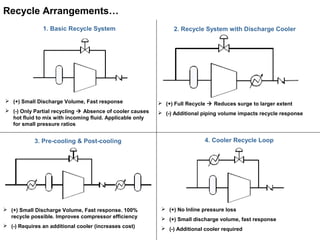
Recycle Arrangements…
 (+) Small Discharge Volume, Fast response
 (-) Only Partial recycling  Absence of cooler causes
hot fluid to mix with incoming fluid. Applicable only
for small pressure ratios
2. Recycle System with Discharge Cooler1. Basic Recycle System
 (+) Full Recycle  Reduces surge to larger extent
 (-) Additional piping volume impacts recycle response
3. Pre-cooling & Post-cooling
 (+) Small Discharge Volume, Fast response. 100%
recycle possible. Improves compressor efficiency
 (-) Requires an additional cooler (increases cost)
4. Cooler Recycle Loop
 (+) No Inline pressure loss
 (+) Small discharge volume, fast response
 (-) Additional cooler required
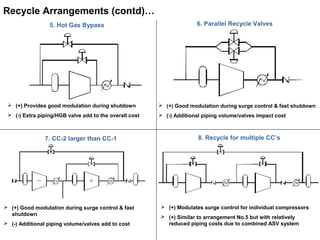
Recycle Arrangements (contd)…
 (+) Provides good modulation during shutdown
 (-) Extra piping/HGB valve add to the overall cost
6. Parallel Recycle Valves5. Hot Gas Bypass
 (+) Good modulation during surge control & fast shutdown
 (-) Additional piping volume/valves impact cost
7. CC-2 larger than CC-1
 (+) Good modulation during surge control & fast
shutdown
 (-) Additional piping volume/valves add to cost
8. Recycle for multiple CC’s
 (+) Modulates surge control for individual compressors
 (+) Similar to arrangement No.5 but with relatively
reduced piping costs due to combined ASV system
Centrifugal Compressor Driver Arrangements…
 (*) CC’s are driven independently.
 (-) Failure of one EM causes CC system shutdown
Parallel Arrangement – EM/VFD-EM/GT/STSeries Arrangement – EM/VFD-EM/GT/ST
 (+) Failure of 1st
CC does not stop the 2nd
CC
 (-) Load sharing scheme to be provided
Series Arrangement – GT/ST – Common Shaft
 (+) Fuel requirements are simplified
 (+) Both compressors run at same speed
 (-) Additional power & shaft deflection to be considered.
 (-) Failure of driver causes CC plant shutdown
Series Arrangement – GT + VFD-EM Coupling
 (+) Provides additional power during startup.
 (+) EM provides starting torque for GT till firing point
after which EM behaves as a generator
 (+) EM provides additional power to GT during summer
when GT efficiency is reduced.
EM
 Surge can occur not only during start-up or shutdown but also during Normal Operating Conditions when the
following can take place - Load changes, process upsets, gas MW changes, operator errors, driver problems,
cooler failure, etc.
 Seal Gas System selection to be made taking into consideration hydrate formation.
 Increase in Gas MW causes shifting of CC maps to shift towards upper diagonal region while decrease in Gas
MW causes the shift to take place towards lower diagonal side.
 Hot Gas Bypass systems are decided by performing a dynamic simulation to check for adequacy of ASV
provision. In case of inadequacy, HGB system is added.
 The ASV system should not be oversized as it can result in poor regulation. Additionally it would bring the CC
operating point to the stone wall region due to excessive flow
General Notes…
 GT + VFD-EM combination used for very large trains (e.g., LNG Applications)
 Inertial effects of driver rotor determines start-up time. Increase in rotor mass adds to the inertia.
 Anti-surge Line  As close as possible to the discharge piping. However this position is also dependent on
vibrational effects.
 A limit of 50% HGB line sizing on volumetric flow is recommended to avoid overheating of CC. Actual sizing
could be made lower.
 “Surge Avoidance for Compressor System”, Robert C. White, Rainer Kurz,
http://turbolab.tamu.edu/proc/turboproc/T35/16-WHITE.pdf
References…
Centrifugal Compressor System Design & Simulation

Centrifugal Compressor System Design & Simulation

  • 1.
    Beginner’s Guide to Centrifugal CompressorSystem Design & Simulation Vijay Sarathy J, M.E, C.Eng, MIChemE
  • 2.
     Centrifugal Compressor(CC) System Characteristics  Centrifugal Compressor (CC) Drivers  Typical Single Stage System  Start-up Scenario  Shutdown Scenario  Emergency Shutdown (ESD) Scenario  Centrifugal Compressor (CC) System Design Philosophy  Anti-Surge System  Recycle Arrangements  CC Driver Arrangements  General Notes Contents…
  • 3.
    Centrifugal Compressor (CC)System Characteristics…  Compressor Maps dictate “behaviour” of the CC  CC Maps are a plot between Polytropic Head (or pressure ratio) vs. Volumetric Flow  Compressor to be operated always away from the surge line  Absorbed power is the least at the surge line  Range of CC operation is the enclosed region of the maps beyond which guarantee is not provided by the manufacturer  Typically operating point is maintained within 10% to 12% of the surge line. This can be increased on a case to case basis.           −      ×      − × ×× =       − 1 1 1 n n in out gas inavg p P P n n MW TRZ H ratioessure P P KetemperaturInletT onentPolytropicn kgmolkgweightmolecularGasMW factorilitycompressibAverageZ KkgmolkJtConsGasR kgFlowrateMassQ kgkJHeadPolytropicH in out in gas avg in p Pr , exp /, /314.8,tan sec/, /, = = = = = = = = inp QHPower ×= Compressor to be operated within surge limits Speed 4 Stone Wall RegionSpeed 1 Speed 2 Speed 3 Actual Volumetric Flow [m3 /hr] PolytropicHead[morkJ/kg] Surge Line Surge Margin Actual Volumetric Flow [m3 /hr] Efficiency[%] Speed 1 Speed 4 Speed 2 Speed 3
  • 4.
    Centrifugal Compressor (CC)Drivers… Driver selection key parameters include Power & Operating Conditions Factors affecting Driver Selection Compression Capacity Compressor Configuration Compression Plant Location Fuel / Power Requirements for CC operation Flexibility of Operation Gas Turbines (GT)  Widely used in the last 30 years.  Disadvantage of COX and NOX emissions & relatively lower efficiencies.  Intensive maintenance. GT efficiency depends on ambient conditions.  Aero derivative turbines offer the advantage of variable speed due to twin shaft design. Steam Turbines (ST)  Oldest mechanism  Low usage in recent years due to increasing capital & operating costs (steam boilers, equipment, etc. & maintenance issues).  Perceived as “Victorian” technology Electric Motors (EM)  Simple Layout, reduced civil works.  May avoid gearboxes for 3000 to 3600 rpm CC speeds  CC’s coupled with Variable Frequency drives offer more operational flexibility  EM efficiencies can reach as high as 98%  Motors Capacities ~ 75 MW (e.g., Freeport LNG)
  • 5.
    Typical Single StageCentrifugal Compressor System… One Stage CC System  Suction Scrubber separates moisture & particulate matter  Decided to be added on a case to case basis  Anti-surge Valve (ASV) protects the compressor from surge during start-up, shutdown & operating conditions  Hot Gas Bypass (HGB) Valve is used during shutdown operation for surge avoidance and as a last resort to avoid overheating the compressor.  Discharge Check Valve prevents backflow of fluid.  Air coolers are used to cool the compressed discharge gas.  Vent Valve is used for compressor system depressurization 1 2 3 4 Suction Scrubber Discharge Scrubber CoolerSuction Block Valve Discharge Block Valve 5 Anti-Surge Valve Hot Gas Bypass Valve Vent Valve Compressor Driver
  • 6.
     Compressor isidle  Suction & discharge block valves are closed (1 & 2)  ASV (3) is kept fully open while HGB (5) is kept closed  CC Start-up with Driver (4)  CC speed is ramped up in recycle mode  Fluid flowing through CC increases & develops head  MUST be ensured that the operating point stays away from surge line Typical Simulation of Compressor Startup… Illustration Purposes  Once operating speed is reached, suction & discharge block valves (1 & 2) are opened with the anti-surge valve being closed simultaneously at a certain rate. m3 /hr Rated Point 1 2 3 4 Suction Scrubber Discharge Scrubber CoolerSuction Block Valve Discharge Block Valve 5 Anti-Surge Valve Hot Gas Bypass Valve Vent Valve Compressor Driver
  • 7.
    Typical Simulation ofCompressor Normal Shutdown…  CC in operation  ASV (3) is opened till operating point moves away from surge line. HGB (5) valve remains closed.  Driver (4) Stops & CC system allowed to halt.  Suction & discharge block valves (1 & 2) close at a pre- determined rate.  Operating point reaches zero flow  MUST be ensured that the operating point stays away from surge line during shutdown For illustration Purposes Rated Point 1 2 3 4 Suction Scrubber Discharge Scrubber CoolerSuction Block Valve Discharge Block Valve 5 Anti-Surge Valve Hot Gas Bypass Valve Vent Valve Compressor Driver
  • 8.
    Improper Shutdown Example… Operatingpoint crosses surge line during shutdown CC System experiencing surge during ESD  Operating Point crosses surge upper limit  Some Possible Reasons  Under sized ASV – Unable to handle ESD situation  No Hot Gas Bypass valve/lines present  Longer ASV response time caused due to  Higher Discharge Volume  ASV with low response  Inter CC effect CC Series/Parallel arrangement  Failure/Delayed signal to Anti-surge control system  Failure of Check-valve at CC discharge Solution: Addition of HGB System Note  ASV sizing  Steady state calculation does not account for transient effects (equipment /piping volume).  During design phase  Emergency shutdown operation can be performed to check for surge  Dynamic simulation  Identifies if ASV is sufficient to handle surge during ESD also.  An under designed ASV system requires installation of Hot Gas Bypass (HGB)  System design with only ASV  Not always feasible due to control Valve limitations (Availability / Construction limitations). Hence every Anti-surge system to be reviewed on a case-to-case basis.
  • 9.
    Typical Simulation ofCompressor ESD with HGB…  CC in operation  Driver Trips (4) due to power failure  Signal from DCS reaches ASV controller in about 300 msec.  ASV (3) opens with an ideal time of 2 sec & HGB (5- On-Off Valve) opens immediately (with lag)  Suction & discharge block valves (1 & 2) close at a pre- determined rate.  Operating point reaches zero flow  MUST be ensured that the operating point stays away from surge line during shutdown For illustration Purposes 0 Rated Point 1 2 3 4 Suction Scrubber Discharge Scrubber CoolerSuction Block Valve Discharge Block Valve 5 Anti-Surge Valve Hot Gas Bypass Valve Vent Valve Compressor Driver
  • 10.
    Settling Out Conditions… SettlingOut Conditions  Pressure (SOP) & Temperature (SOT) is that which exists when a moving fluid in a compressor system volume comes to rest after the compressor is shutdown  Conditions are decided by amount of upstream & downstream piping volume  Downstream cooler duty influences initial SOT. Ambient Conditions decide final SOT SOP & SOT  Decisive factor for CC Drivers Start-up Capability SOP & SOT Effects  (↑) SOP & SOT  (↑) System Inertia (I)  (↑) CC Start-up Power  CC driver start-up  f (ICC Rotor + IGearbox+ IDriver + IGas SOP & SOT)  Dynamic Simulations  Predicts Start-up Power accurately  CC Driver’s start-up incapability requires depressurization  SOP & SOT affected by ambient conditions after shutdown. For illustration Purposes
  • 11.
    Factors to beconsidered for Compressor System Design  Minimum Power Requirements to reach rated point without surge  CC Operation at Maximum Efficiency Point at rated conditions  Robust Anti-surge System & HGB System (if necessary)  Minimum Piping & Equipment Volumes to reach rated point without surge  Accurate Relief Valve Size for Depressurization during failure conditions  Optimum Start-up Time inclusive of Gas Export Conditions  CC Turn down operating scenarios to be considered Compressor System FSD Start-up Methods (Common Ones)  Throttling Valve (Fixed Speed Drives) - Regulatory valve at compressor suction reduces gas density during start-up which reduces start-up power requirements. Limitation exists on the extent of lowering inlet pressure. High pressure ratio causes compressor to surge at start-up and hence regulation of gas flow is necessary.  Circuit Gas Depressurization – Represents monetary loss Compressor System Controlling Methods  Speed Control (VSD, e.g. GT/ST/VFD-EM)  e.g., Mark VI Controller for GT & Variable Frequency Drive for EM’s  Suction Throttling (FSD, e.g. Induction EM + Gear Box)  Discharge pressure controlled by ASV  Inlet Guide Vanes (IGV’s)  Functionality similar to a throttling valve but with highly increased capabilities  Cold Discharge Bypass (FSD)  To regulate discharge pressures by recycling cold discharge gas to suction  Discharge Venting (FSD)  To be avoided in case of hazardous gases Centrifugal Compressor System Design Philosophy… CC System Design Dependent on Scope of Operation Evaluation to be considered for all operating weather conditions, e.g., Hot, Ambient & Cold weather FSD – Fixed Speed Drives VSD – Variable Speed Drives
  • 12.
    Typical Anti SurgeSystem… ASV Response to Surge Should be Fast ASV Typical Requirements  Fast Response to Surge < 2s (~4” to 16” valves)  Fail Open Mode Type  High Capacity to handle start-up’s & shutdown’s  Fluid Velocities < 0.3 Mach to avoid possible ASV & piping damage.  Stable Throttling  Actuator Opening time during surge  < 300ms Lower response times is preferred.  Noise Limit ~ 85 dB < 110 dB (Max) Types of ASV Opening Characteristics  Quick Opening – Suffers from Poor throttling characteristics  Equal Percentage – Valve opening occurs slowly during the initial time period and accelerates after the ~50% mark  Linear – Traditionally used by most manufacturers. Provides good pressure throttling.  Blend of any of above characteristics  For Fast response 1 2 3 4 Suction Scrubber Discharge Scrubber CoolerSuction Block Valve Discharge Block Valve Anti-Surge Valve Vent Valve CC Driver DCS FT TT PT TT PT Orifice Measured FT Orifice Measured Type 1: Suction Side Measurement Type 2: Discharge Side Measurement (Note: Only one configuration used at a time) For illustration Purposes
  • 13.
    Recycle Arrangements…  (+)Small Discharge Volume, Fast response  (-) Only Partial recycling  Absence of cooler causes hot fluid to mix with incoming fluid. Applicable only for small pressure ratios 2. Recycle System with Discharge Cooler1. Basic Recycle System  (+) Full Recycle  Reduces surge to larger extent  (-) Additional piping volume impacts recycle response 3. Pre-cooling & Post-cooling  (+) Small Discharge Volume, Fast response. 100% recycle possible. Improves compressor efficiency  (-) Requires an additional cooler (increases cost) 4. Cooler Recycle Loop  (+) No Inline pressure loss  (+) Small discharge volume, fast response  (-) Additional cooler required
  • 14.
    Recycle Arrangements (contd)… (+) Provides good modulation during shutdown  (-) Extra piping/HGB valve add to the overall cost 6. Parallel Recycle Valves5. Hot Gas Bypass  (+) Good modulation during surge control & fast shutdown  (-) Additional piping volume/valves impact cost 7. CC-2 larger than CC-1  (+) Good modulation during surge control & fast shutdown  (-) Additional piping volume/valves add to cost 8. Recycle for multiple CC’s  (+) Modulates surge control for individual compressors  (+) Similar to arrangement No.5 but with relatively reduced piping costs due to combined ASV system
  • 15.
    Centrifugal Compressor DriverArrangements…  (*) CC’s are driven independently.  (-) Failure of one EM causes CC system shutdown Parallel Arrangement – EM/VFD-EM/GT/STSeries Arrangement – EM/VFD-EM/GT/ST  (+) Failure of 1st CC does not stop the 2nd CC  (-) Load sharing scheme to be provided Series Arrangement – GT/ST – Common Shaft  (+) Fuel requirements are simplified  (+) Both compressors run at same speed  (-) Additional power & shaft deflection to be considered.  (-) Failure of driver causes CC plant shutdown Series Arrangement – GT + VFD-EM Coupling  (+) Provides additional power during startup.  (+) EM provides starting torque for GT till firing point after which EM behaves as a generator  (+) EM provides additional power to GT during summer when GT efficiency is reduced. EM
  • 16.
     Surge canoccur not only during start-up or shutdown but also during Normal Operating Conditions when the following can take place - Load changes, process upsets, gas MW changes, operator errors, driver problems, cooler failure, etc.  Seal Gas System selection to be made taking into consideration hydrate formation.  Increase in Gas MW causes shifting of CC maps to shift towards upper diagonal region while decrease in Gas MW causes the shift to take place towards lower diagonal side.  Hot Gas Bypass systems are decided by performing a dynamic simulation to check for adequacy of ASV provision. In case of inadequacy, HGB system is added.  The ASV system should not be oversized as it can result in poor regulation. Additionally it would bring the CC operating point to the stone wall region due to excessive flow General Notes…  GT + VFD-EM combination used for very large trains (e.g., LNG Applications)  Inertial effects of driver rotor determines start-up time. Increase in rotor mass adds to the inertia.  Anti-surge Line  As close as possible to the discharge piping. However this position is also dependent on vibrational effects.  A limit of 50% HGB line sizing on volumetric flow is recommended to avoid overheating of CC. Actual sizing could be made lower.  “Surge Avoidance for Compressor System”, Robert C. White, Rainer Kurz, http://turbolab.tamu.edu/proc/turboproc/T35/16-WHITE.pdf References…