Instruments for sustainable resource management in the UAE
Belgian Royal Trade Mission
Abu Dhabi, 26th March 2015
Christoph Vanderstricht
Partner, Specialist Advisory Services
Contents
1 Introduction. Situational analysis
2 In perspective: Sustainable resource management
3 EY Belgium footprint in the field
1. Introduction. Situational analysis
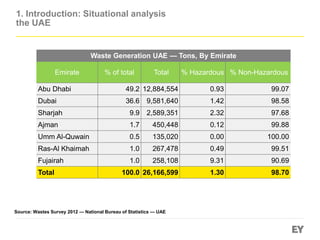
Waste Generation UAE — Tons, By Emirate
% Non-Hazardous% HazardousTotal% of totalEmirate
99.070.9312,884,55449.2Abu Dhabi
98.581.429,581,64036.6Dubai
97.682.322,589,3519.9Sharjah
99.880.12450,4481.7Ajman
100.000.00135,0200.5Umm Al-Quwain
99.510.49267,4781.0Ras-Al Khaimah
90.699.31258,1081.0Fujairah
98.701.3026,166,599100.0Total
Source: Wastes Survey 2012 — National Bureau of Statistics — UAE
1. Introduction: Situational analysis
the UAE
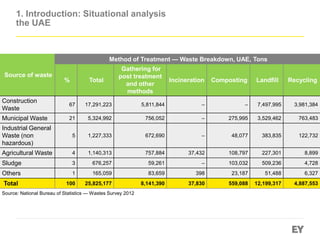
Method of Treatment — Waste Breakdown, UAE, Tons
Source of waste
RecyclingLandfillCompostingIncineration
Gathering for
post treatment
and other
methods
Total%
3,981,3847,497,995––5,811,84417,291,22367
Construction
Waste
763,4833,529,462275,995–756,0525,324,99221Municipal Waste
122,732383,83548,077–672,6901,227,3335
Industrial General
Waste (non
hazardous)
8,899227,301108,79737,432757,8841,140,3134Agricultural Waste
4,728509,236103,032–59,261676,2573Sludge
6,32751,48823,18739883,659165,0591Others
4,887,55312,199,317559,08837,8308,141,39025,825,177100Total
Source: National Bureau of Statistics — Wastes Survey 2012
1. Introduction: Situational analysis
the UAE
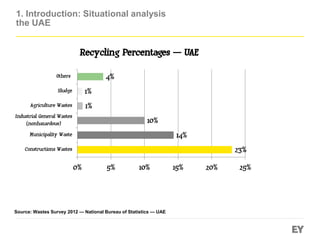
23%
14%
10%
1%
1%
4%
Constructions Wastes
Municipality Waste
Industrial General Wastes
(nonhazardous)
Agriculture Wastes
Sludge
Others
0% 5% 10% 15% 20% 25%
Recycling Percentages — UAE
Source: Wastes Survey 2012 — National Bureau of Statistics — UAE
1. Introduction: Situational analysis
the UAE
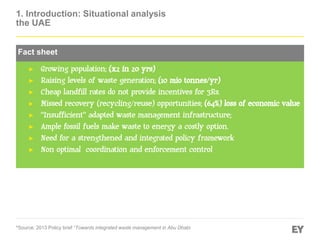
► Growing population; (x2 in 20 yrs)
► Raising levels of waste generation; (10 mio tonnes/yr)
► Cheap landfill rates do not provide incentives for 3Rs.
► Missed recovery (recycling/reuse) opportunities; (64%) loss of economic value
► “Insufficient” adapted waste management infrastructure;
► Ample fossil fuels make waste to energy a costly option.
► Need for a strengthened and integrated policy framework
► Non optimal coordination and enforcement control
*Source: 2013 Policy brief “Towards integrated waste management in Abu Dhabi
1. Introduction: Situational analysis
the UAE
Fact sheet
1. Introduction: Situational analysis
the UAE: overview of current actions
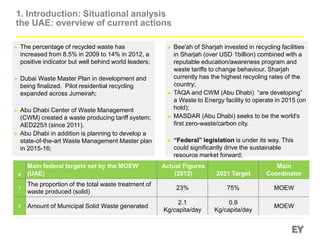
► The percentage of recycled waste has
increased from 8.5% in 2009 to 14% in 2012, a
positive indicator but well behind world leaders;
► Dubai Waste Master Plan in development and
being finalized. Pilot residential recycling
expanded across Jumeirah;
► Abu Dhabi Center of Waste Management
(CWM) created a waste producing tariff system;
AED225/t (since 2011).
► Abu Dhabi in addition is planning to develop a
state-of-the-art Waste Management Master plan
in 2015-16;
► Bee'ah of Sharjah invested in recycling facilities
in Sharjah (over USD 1billion) combined with a
reputable education/awareness program and
waste tariffs to change behaviour. Sharjah
currently has the highest recycling rates of the
country;
► TAQA and CWM (Abu Dhabi) “are developing”
a Waste to Energy facility to operate in 2015 (on
hold);
► MASDAR (Abu Dhabi) seeks to be the world's
first zero-waste/carbon city.
► “Federal” legislation is under its way. This
could significantly drive the sustainable
resource market forward;
#
Main federal targets set by the MOEW
(UAE)
Actual Figures
(2012) 2021 Target
Main
Coordinator
1
The proportion of the total waste treatment of
waste produced (solid)
23% 75% MOEW
2 Amount of Municipal Solid Waste generated
2.1
Kg/capita/day
0.9
Kg/capita/day
MOEW
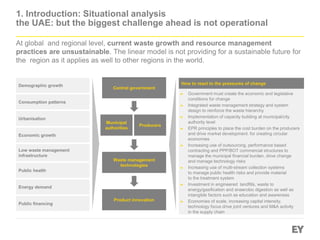
At global and regional level, current waste growth and resource management
practices are unsustainable. The linear model is not providing for a sustainable future for
the region as it applies as well to other regions in the world.
Demographic growth
Consumption patterns
Urbanisation
Economic growth
Low waste management
infrastructure
Public health
Energy demand
Public financing
Central government
Producers
Waste management
technologies
Product innovation
► Government must create the economic and legislative
conditions for change
► Integrated waste management strategy and system
design to reinforce the waste hierarchy
► Implementation of capacity building at municipal/city
authority level
► EPR principles to place the cost burden on the producers
and drive market development. for creating circular
economies
► Increasing use of outsourcing, performance based
contracting and PPP/BOT commercial structures to
manage the municipal financial burden, drive change
and manage technology risks
► Increasing use of multi-stream collection systems
to manage public health risks and provide material
to the treatment system
► Investment in engineered landfills, waste to
energy/gasification and anaerobic digestion as well as
intangible factors such as education and awareness
► Economies of scale, increasing capital intensity,
technology focus drive joint ventures and M&A activity
in the supply chain
How to react to the pressures of change
Municipal
authorities
1. Introduction: Situational analysis
the UAE: but the biggest challenge ahead is not operational
1. Introduction: Situational analysis
the UAE: but the biggest challenge ahead is not operational
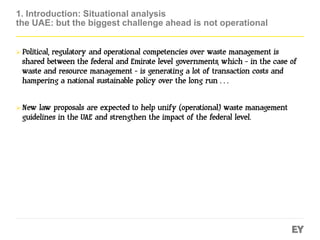
 Political, regulatory and operational competencies over waste management is
shared between the federal and Emirate level governments, which - in the case of
waste and resource management - is generating a lot of transaction costs and
hampering a national sustainable policy over the long run…
 New law proposals are expected to help unify (operational) waste management
guidelines in the UAE and strengthen the impact of the federal level.
2. In perspective: Sustainable Resource Management
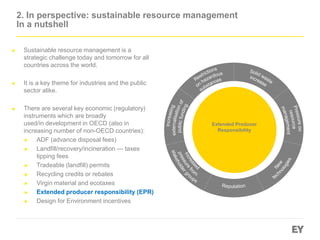
► Sustainable resource management is a
strategic challenge today and tomorrow for all
countries across the world.
► It is a key theme for industries and the public
sector alike.
► There are several key economic (regulatory)
instruments which are broadly
used/in development in OECD (also in
increasing number of non-OECD countries):
► ADF (advance disposal fees)
► Landfill/recovery/incineration — taxes
tipping fees
► Tradeable (landfill) permits
► Recycling credits or rebates
► Virgin material and ecotaxes
► Extended producer responsibility (EPR)
► Design for Environment incentives
Extended Producer
Responsibility
2. In perspective: sustainable resource management
In a nutshell
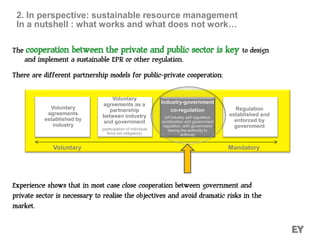
The cooperation between the private and public sector is key to design
and implement a sustainable EPR or other regulation.
There are different partnership models for public-private cooperation:
Experience shows that in most case close cooperation between government and
private sector is necessary to realise the objectives and avoid dramatic risks in the
market.
Industry-government
co-regulation
(of industry self regulation
combination and government
regulation, with government
having the authority to
enforce)
Voluntary
agreements
established by
industry
Voluntary
agreements as a
partnership
between industry
and government
(participation of individual
firms not obligatory)
Regulation
established and
enforced by
government
Voluntary Mandatory
2. In perspective: sustainable resource management
In a nutshell : what works and what does not work…
Extraction
Processing
Manufacturing
Sales
Use
Remanufacturing
Refurbishment
Recycling
Reuse
Repair
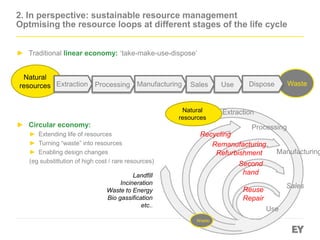
► Traditional linear economy: ‘take-make-use-dispose’
► Circular economy:
► Extending life of resources
► Turning “waste” into resources
► Enabling design changes
(eg substittution of high cost / rare resources)
Waste
Natural
resources Extraction Processing Manufacturing Sales Use Dispose
Natural
resources
Second
hand
Waste
Landfill
Incineration
Waste to Energy
Bio gassification
etc..
2. In perspective: sustainable resource management
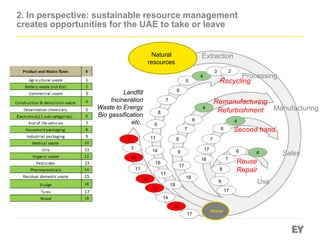
Optmising the resource loops at different stages of the life cycle
Extraction
Processing
Manufacturing
Sales
Use
Remanufacturing
Refurbishment
Recycling
Reuse
Repair
Natural
resources
Second hand
Landfill
Incineration
Waste to Energy
Bio gassification
etc..
Waste
18
18
1
12
10
15
14
16
17
14
4
3
5
6
7
8
9
9
9
8
8 7
7
7
6
6
6
11
4
4
4
13
17
17
11
3 2
18
17
2. In perspective: sustainable resource management
creates opportunities for the UAE to take or leave
17
Presentation title
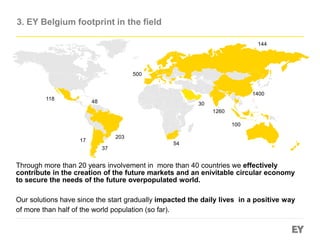
3. EY Belgium footprint in the field
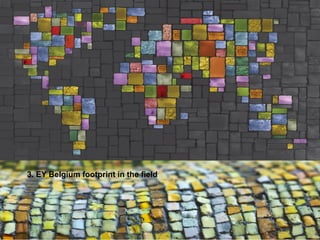
Through more than 20 years involvement in more than 40 countries we effectively
contribute in the creation of the future markets and an enivitable circular economy
to secure the needs of the future overpopulated world.
Our solutions have since the start gradually impacted the daily lives in a positive way
of more than half of the world population (so far).
118
203
37
17
48
500
54
144
30
1260
1400
100
1. Current situation: GCC
‫شكرا‬‫جزيال‬
Dank U Danke Shön Merci
Thank you
Your local contact for waste management
and circular economy challenges:
Walid Zabaneh
walid.zabaneh@sa.ey.com
Tel: +971505512097 (UAE)
Tel: +966558506351 (KSA)
3. EY Belgium footprint in the field
More information
Global:
Christoph Vanderstricht
christoph.vanderstricht@be.ey.com
Tel: +32477619252 (Belgium)
Tel: +56990408343 (Chile)
EY | Assurance | Tax | Transactions | Advisory
Disclaimer
This document contains technical advise that is based
on international experience, it is not meant to serve as a
binding guidance. EY takes no responsibility for the
accuracy of the forecasts presented in this document as
they intend to serve as a general direction only. The
information contained in this communication is intended
solely for the use of the individual or entity to whom it is
addressed and others authorized to receive it.
About EY
Ernst & Young is a global leader in assurance, tax,
transaction and advisory services. Worldwide, our
172,000 people are united by our shared values and an
unwavering commitment to quality. We make a
difference by helping our people, our clients and our
wider communities achieve their potential.
Christoph Vanderstricht
Christoph.vanderstricht@be.ey.com
Ernst&Young Specialist Advisory Services
Moutstraat 54, 9000 Gent (Belgium)
Tel.: +32 (0) 9 242 52 05
ey.com
© 2015 Ernst & Young Specialist Advisory Services
All Rights Reserved.
This publication contains information in summary form and is
therefore intended for general guidance only. It is not intended
to be a substitute for detailed research or the exercise of
professional judgment. Neither Ernst & Young LLP nor any other
member of the global Ernst & Young organization can accept
any responsibility for loss occasioned to any person acting or
refraining from action as a result of any material in this
publication. On any specific matter, reference should be made to
the appropriate advisor.

Presentation ey

  • 1.
    Instruments for sustainableresource management in the UAE Belgian Royal Trade Mission Abu Dhabi, 26th March 2015 Christoph Vanderstricht Partner, Specialist Advisory Services
  • 2.
    Contents 1 Introduction. Situationalanalysis 2 In perspective: Sustainable resource management 3 EY Belgium footprint in the field
  • 3.
  • 4.
    Waste Generation UAE— Tons, By Emirate % Non-Hazardous% HazardousTotal% of totalEmirate 99.070.9312,884,55449.2Abu Dhabi 98.581.429,581,64036.6Dubai 97.682.322,589,3519.9Sharjah 99.880.12450,4481.7Ajman 100.000.00135,0200.5Umm Al-Quwain 99.510.49267,4781.0Ras-Al Khaimah 90.699.31258,1081.0Fujairah 98.701.3026,166,599100.0Total Source: Wastes Survey 2012 — National Bureau of Statistics — UAE 1. Introduction: Situational analysis the UAE
  • 5.
    Method of Treatment— Waste Breakdown, UAE, Tons Source of waste RecyclingLandfillCompostingIncineration Gathering for post treatment and other methods Total% 3,981,3847,497,995––5,811,84417,291,22367 Construction Waste 763,4833,529,462275,995–756,0525,324,99221Municipal Waste 122,732383,83548,077–672,6901,227,3335 Industrial General Waste (non hazardous) 8,899227,301108,79737,432757,8841,140,3134Agricultural Waste 4,728509,236103,032–59,261676,2573Sludge 6,32751,48823,18739883,659165,0591Others 4,887,55312,199,317559,08837,8308,141,39025,825,177100Total Source: National Bureau of Statistics — Wastes Survey 2012 1. Introduction: Situational analysis the UAE
  • 6.
    23% 14% 10% 1% 1% 4% Constructions Wastes Municipality Waste IndustrialGeneral Wastes (nonhazardous) Agriculture Wastes Sludge Others 0% 5% 10% 15% 20% 25% Recycling Percentages — UAE Source: Wastes Survey 2012 — National Bureau of Statistics — UAE 1. Introduction: Situational analysis the UAE
  • 7.
    ► Growing population;(x2 in 20 yrs) ► Raising levels of waste generation; (10 mio tonnes/yr) ► Cheap landfill rates do not provide incentives for 3Rs. ► Missed recovery (recycling/reuse) opportunities; (64%) loss of economic value ► “Insufficient” adapted waste management infrastructure; ► Ample fossil fuels make waste to energy a costly option. ► Need for a strengthened and integrated policy framework ► Non optimal coordination and enforcement control *Source: 2013 Policy brief “Towards integrated waste management in Abu Dhabi 1. Introduction: Situational analysis the UAE Fact sheet
  • 8.
    1. Introduction: Situationalanalysis the UAE: overview of current actions ► The percentage of recycled waste has increased from 8.5% in 2009 to 14% in 2012, a positive indicator but well behind world leaders; ► Dubai Waste Master Plan in development and being finalized. Pilot residential recycling expanded across Jumeirah; ► Abu Dhabi Center of Waste Management (CWM) created a waste producing tariff system; AED225/t (since 2011). ► Abu Dhabi in addition is planning to develop a state-of-the-art Waste Management Master plan in 2015-16; ► Bee'ah of Sharjah invested in recycling facilities in Sharjah (over USD 1billion) combined with a reputable education/awareness program and waste tariffs to change behaviour. Sharjah currently has the highest recycling rates of the country; ► TAQA and CWM (Abu Dhabi) “are developing” a Waste to Energy facility to operate in 2015 (on hold); ► MASDAR (Abu Dhabi) seeks to be the world's first zero-waste/carbon city. ► “Federal” legislation is under its way. This could significantly drive the sustainable resource market forward; # Main federal targets set by the MOEW (UAE) Actual Figures (2012) 2021 Target Main Coordinator 1 The proportion of the total waste treatment of waste produced (solid) 23% 75% MOEW 2 Amount of Municipal Solid Waste generated 2.1 Kg/capita/day 0.9 Kg/capita/day MOEW
  • 9.
    At global andregional level, current waste growth and resource management practices are unsustainable. The linear model is not providing for a sustainable future for the region as it applies as well to other regions in the world. Demographic growth Consumption patterns Urbanisation Economic growth Low waste management infrastructure Public health Energy demand Public financing Central government Producers Waste management technologies Product innovation ► Government must create the economic and legislative conditions for change ► Integrated waste management strategy and system design to reinforce the waste hierarchy ► Implementation of capacity building at municipal/city authority level ► EPR principles to place the cost burden on the producers and drive market development. for creating circular economies ► Increasing use of outsourcing, performance based contracting and PPP/BOT commercial structures to manage the municipal financial burden, drive change and manage technology risks ► Increasing use of multi-stream collection systems to manage public health risks and provide material to the treatment system ► Investment in engineered landfills, waste to energy/gasification and anaerobic digestion as well as intangible factors such as education and awareness ► Economies of scale, increasing capital intensity, technology focus drive joint ventures and M&A activity in the supply chain How to react to the pressures of change Municipal authorities 1. Introduction: Situational analysis the UAE: but the biggest challenge ahead is not operational
  • 10.
    1. Introduction: Situationalanalysis the UAE: but the biggest challenge ahead is not operational  Political, regulatory and operational competencies over waste management is shared between the federal and Emirate level governments, which - in the case of waste and resource management - is generating a lot of transaction costs and hampering a national sustainable policy over the long run…  New law proposals are expected to help unify (operational) waste management guidelines in the UAE and strengthen the impact of the federal level.
  • 11.
    2. In perspective:Sustainable Resource Management
  • 12.
    ► Sustainable resourcemanagement is a strategic challenge today and tomorrow for all countries across the world. ► It is a key theme for industries and the public sector alike. ► There are several key economic (regulatory) instruments which are broadly used/in development in OECD (also in increasing number of non-OECD countries): ► ADF (advance disposal fees) ► Landfill/recovery/incineration — taxes tipping fees ► Tradeable (landfill) permits ► Recycling credits or rebates ► Virgin material and ecotaxes ► Extended producer responsibility (EPR) ► Design for Environment incentives Extended Producer Responsibility 2. In perspective: sustainable resource management In a nutshell
  • 13.
    The cooperation betweenthe private and public sector is key to design and implement a sustainable EPR or other regulation. There are different partnership models for public-private cooperation: Experience shows that in most case close cooperation between government and private sector is necessary to realise the objectives and avoid dramatic risks in the market. Industry-government co-regulation (of industry self regulation combination and government regulation, with government having the authority to enforce) Voluntary agreements established by industry Voluntary agreements as a partnership between industry and government (participation of individual firms not obligatory) Regulation established and enforced by government Voluntary Mandatory 2. In perspective: sustainable resource management In a nutshell : what works and what does not work…
  • 14.
    Extraction Processing Manufacturing Sales Use Remanufacturing Refurbishment Recycling Reuse Repair ► Traditional lineareconomy: ‘take-make-use-dispose’ ► Circular economy: ► Extending life of resources ► Turning “waste” into resources ► Enabling design changes (eg substittution of high cost / rare resources) Waste Natural resources Extraction Processing Manufacturing Sales Use Dispose Natural resources Second hand Waste Landfill Incineration Waste to Energy Bio gassification etc.. 2. In perspective: sustainable resource management Optmising the resource loops at different stages of the life cycle
  • 15.
    Extraction Processing Manufacturing Sales Use Remanufacturing Refurbishment Recycling Reuse Repair Natural resources Second hand Landfill Incineration Waste toEnergy Bio gassification etc.. Waste 18 18 1 12 10 15 14 16 17 14 4 3 5 6 7 8 9 9 9 8 8 7 7 7 6 6 6 11 4 4 4 13 17 17 11 3 2 18 17 2. In perspective: sustainable resource management creates opportunities for the UAE to take or leave 17
  • 16.
    Presentation title 3. EYBelgium footprint in the field
  • 17.
    3. EY Belgiumfootprint in the field Through more than 20 years involvement in more than 40 countries we effectively contribute in the creation of the future markets and an enivitable circular economy to secure the needs of the future overpopulated world. Our solutions have since the start gradually impacted the daily lives in a positive way of more than half of the world population (so far). 118 203 37 17 48 500 54 144 30 1260 1400 100
  • 18.
    1. Current situation:GCC ‫شكرا‬‫جزيال‬ Dank U Danke Shön Merci Thank you
  • 19.
    Your local contactfor waste management and circular economy challenges: Walid Zabaneh walid.zabaneh@sa.ey.com Tel: +971505512097 (UAE) Tel: +966558506351 (KSA) 3. EY Belgium footprint in the field More information Global: Christoph Vanderstricht christoph.vanderstricht@be.ey.com Tel: +32477619252 (Belgium) Tel: +56990408343 (Chile)
  • 20.
    EY | Assurance| Tax | Transactions | Advisory Disclaimer This document contains technical advise that is based on international experience, it is not meant to serve as a binding guidance. EY takes no responsibility for the accuracy of the forecasts presented in this document as they intend to serve as a general direction only. The information contained in this communication is intended solely for the use of the individual or entity to whom it is addressed and others authorized to receive it. About EY Ernst & Young is a global leader in assurance, tax, transaction and advisory services. Worldwide, our 172,000 people are united by our shared values and an unwavering commitment to quality. We make a difference by helping our people, our clients and our wider communities achieve their potential. Christoph Vanderstricht Christoph.vanderstricht@be.ey.com Ernst&Young Specialist Advisory Services Moutstraat 54, 9000 Gent (Belgium) Tel.: +32 (0) 9 242 52 05 ey.com © 2015 Ernst & Young Specialist Advisory Services All Rights Reserved. This publication contains information in summary form and is therefore intended for general guidance only. It is not intended to be a substitute for detailed research or the exercise of professional judgment. Neither Ernst & Young LLP nor any other member of the global Ernst & Young organization can accept any responsibility for loss occasioned to any person acting or refraining from action as a result of any material in this publication. On any specific matter, reference should be made to the appropriate advisor.