Rene Griessl
Bielefeld University
VEDLIoT – Accelerators for
Heterogenous Computing in AIoT
2
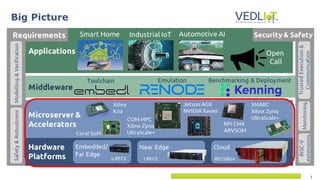
Big Picture
3
VEDLIoT Hardware Platform
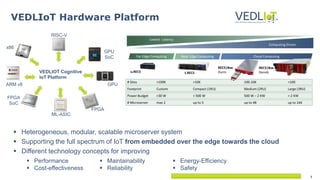
 Heterogeneous, modular, scalable microserver system
 Supporting the full spectrum of IoT from embedded over the edge towards the cloud
 Different technology concepts for improving
x86
GPU
ML-ASIC
ARM v8
GPU
SoC
FPGA
SoC
RISC-V
FPGA
VEDLIOT Cognitive
IoT Platform
 Performance
 Cost-effectiveness
 Maintainability
 Reliability
 Energy-Efficiency
 Safety
4
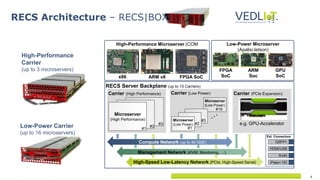
RECS Architecture – RECS|BOX
RECS Server Backplane (up to 15 Carriers)
Carrier (PCIe Expansion)
Carrier (High Performance)
e.g. GPU-Accelerator
Carrier (Low Power)
#3
#2
Microserver
(High Performance)
#1
Microserver
(Low Power)
#16
#3
#2
Microserver
(Low Power)
#1
High-Speed Low-Latency Network (PCIe, High-Speed Serial)
Compute Network (up to 40 GbE)
Management Network (KVM, Monitoring, …)
HDMI/USB
iPass+ HD
QSFP+
RJ45
Ext. Connectors
GPU
SoC
FPGA
SoC
ARM
Soc
Low-Power Microserver
(Apalis/Jetson)
x86 ARM v8
High-Performance Microserver (COM
Express)
FPGA SoC
High-Performance
Carrier
(up to 3 microservers)
Low-Power Carrier
(up to 16 microservers)
5
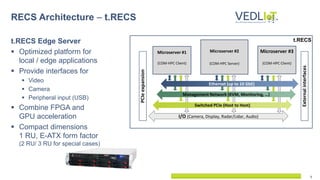
t.RECS
t.RECS Edge Server
 Optimized platform for
local / edge applications
 Provide interfaces for
 Video
 Camera
 Peripheral input (USB)
 Combine FPGA and
GPU acceleration
 Compact dimensions
1 RU, E-ATX form factor
(2 RU/ 3 RU for special cases)
RECS Architecture – t.RECS
Microserver #3
(COM-HPC Client)
Microserver #1
(COM-HPC Client)
Microserver #2
(COM-HPC Server)
Switched PCIe (Host to Host)
External
interfaces
PCIe
expansion
Ethernet (up to 10 GbE)
Management Network (KVM, Monitoring, …)
I/O (Camera, Display, Radar/Lidar, Audio)
6
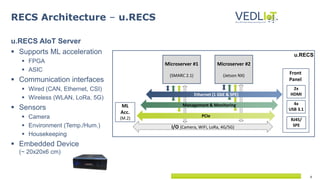
u.RECS
u.RECS AIoT Server
 Supports ML acceleration
 FPGA
 ASIC
 Communication interfaces
 Wired (CAN, Ethernet, CSI)
 Wireless (WLAN, LoRa, 5G)
 Sensors
 Camera
 Environment (Temp./Hum.)
 Housekeeping
 Embedded Device
(~ 20x20x6 cm)
RECS Architecture – u.RECS
PCIe
Ethernet (1 GbE & SPE)
Management & Monitoring
I/O (Camera, WiFi, LoRa, 4G/5G)
Microserver #1
(SMARC 2.1)
Microserver #2
(Jetson NX)
ML
Acc.
(M.2)
Front
Panel
2x
HDMI
RJ45/
SPE
4x
USB 3.1
7
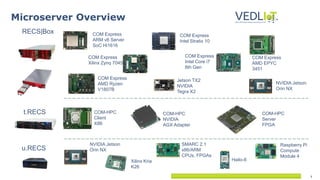
Microserver Overview
u.RECS
t.RECS
RECS|Box
Xilinx Kria
K26
NVIDIA Jetson
Orin NX
Hailo-8
SMARC 2.1
x86/ARM
CPUs, FPGAs
Raspberry Pi
Compute
Module 4
COM-HPC
Client
X86
COM-HPC
NVIDIA
AGX Adapter
COM-HPC
Server
FPGA
COM Express
ARM v8 Server
SoC Hi1616
COM Express
Xilinx Zynq 7045
COM Express
AMD Ryzen
V1807B
Jetson TX2
NVIDIA
Tegra X2
COM Express
Intel Stratix 10
COM Express
Intel Core i7
8th Gen
NVIDIA Jetson
Orin NX
COM Express
AMD EPYC
3451
8
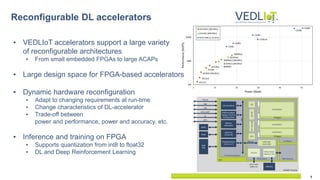
▪ VEDLIoT accelerators support a large variety
of reconfigurable architectures
▪ From small embedded FPGAs to large ACAPs
▪ Large design space for FPGA-based accelerators
▪ Dynamic hardware reconfiguration
▪ Adapt to changing requirements at run-time
▪ Change characteristics of DL-accelerator
▪ Trade-off between
power and performance, power and accuracy, etc.
▪ Inference and training on FPGA
▪ Supports quantization from int8 to float32
▪ DL and Deep Reinforcement Learning
Reconfigurable DL accelerators
9
 Peak performance values of specialized accelerators, provided by the vendors
(precisions varying from INT8 to FP32)
Peak Performance of DL Accelerators
Average efficiency at 1000 GOPS /W
[CELLRANGE]
[CELLRANGE]
[CELLRANGE]
[CELLRANGE]
[CELLRANGE]
[CELLRANGE]
[CELLRANGE]
[CELLRANGE]
[CELLRANGE]
[CELLRANGE]
[CELLRANGE]
[CELLRANGE]
[CELLRANGE]
[CELLRANGE]
[CELLRANGE]
[CELLRANGE]
[CELLRANGE]
[CELLRANGE]
[CELLRANGE]
[CELLRANGE]
[CELLRANGE]
[CELLRANGE]
[CELLRANGE]
[CELLRANGE]
[CELLRANGE]
[CELLRANGE]
[CELLRANGE]
[CELLRANGE]
[CELLRANGE]
[CELLRANGE]
[CELLRANGE]
[CELLRANGE]
[CELLRANGE]
[CELLRANGE]
[CELLRANGE]
[CELLRANGE]
[CELLRANGE]
[CELLRANGE]
[CELLRANGE]
[CELLRANGE]
1
10
100
1,000
10,000
100,000
1,000,000
10,000,000
0.01 0.1 1 10 100 1000
Performance
[GOPS]
Power [Watt]
ASIC
GPU
FPGA
Ultra Low Power
High Performance
Low Power
10
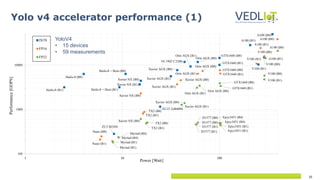
Yolo v4 accelerator performance (1)
YoloV4
• 15 devices
• 59 measurements
11
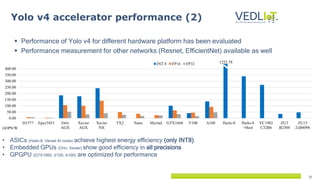
Yolo v4 accelerator performance (2)
 Performance of Yolo v4 for different hardware platform has been evaluated
 Performance measurement for other networks (Resnet, EfficientNet) available as well
• ASICs (Hailo-8, Versal AI cores) achieve highest energy efficiency (only INT8)
• Embedded GPUs (Orin, Xavier) show good efficiency in all precisions
• GPGPU (GTX1660, V100, A100) are optimized for performance
12
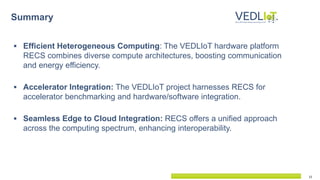
Summary
 Efficient Heterogeneous Computing: The VEDLIoT hardware platform
RECS combines diverse compute architectures, boosting communication
and energy efficiency.
 Accelerator Integration: The VEDLIoT project harnesses RECS for
accelerator benchmarking and hardware/software integration.
 Seamless Edge to Cloud Integration: RECS offers a unified approach
across the computing spectrum, enhancing interoperability.
13
14
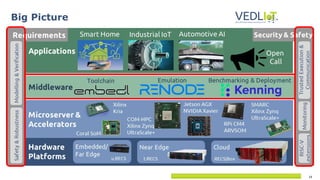
Big Picture
15
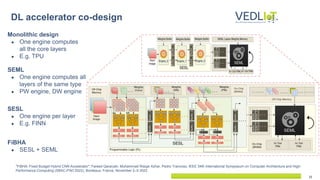
DL accelerator co-design
"FiBHA: Fixed Budget Hybrid CNN Accelerator", Fareed Qararyah, Muhammad Waqar Azhar, Pedro Trancoso, IEEE 34th International Symposium on Computer Architecture and High-
Performance Computing (SBAC-PAD 2022), Bordeaux, France, November 2–5 2022
Monolithic design
● One engine computes
all the core layers
● E.g. TPU
SEML
● One engine computes all
layers of the same type
● PW engine, DW engine
SESL
● One engine per layer
● E.g. FINN
FiBHA
● SESL + SEML
16
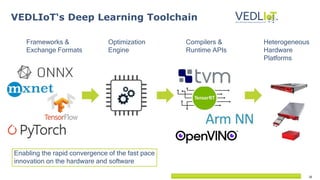
VEDLIoT‘s Deep Learning Toolchain
Enabling the rapid convergence of the fast pace
innovation on the hardware and software
Frameworks &
Exchange Formats
Optimization
Engine
Compilers &
Runtime APIs
Heterogeneous
Hardware
Platforms
17
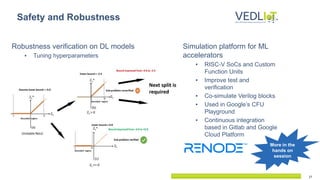
Simulation platform for ML
accelerators
▪ RISC-V SoCs and Custom
Function Units
▪ Improve test and
verification
▪ Co-simulate Verilog blocks
▪ Used in Google’s CFU
Playground
▪ Continuous integration
based in Gitlab and Google
Cloud Platform
Safety and Robustness
Robustness verification on DL models
▪ Tuning hyperparameters
More in the
hands on
session
18
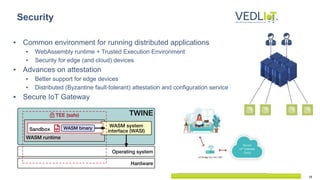
▪ Common environment for running distributed applications
▪ WebAssembly runtime + Trusted Execution Environment
▪ Security for edge (and cloud) devices
▪ Advances on attestation
▪ Better support for edge devices
▪ Distributed (Byzantine fault-tolerant) attestation and configuration service
▪ Secure IoT Gateway
Security
19
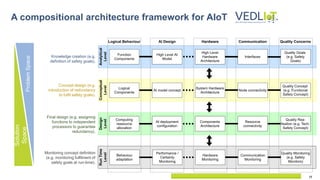
A compositional architecture framework for AIoT
Knowledge creation (e.g.
definition of safety goals).
Concept design (e.g.
introduction of redundancy
to fulfil safety goals).
Final design (e.g. assigning
functions to independent
processors to guarantee
redundancy).
Monitoring concept definition
(e.g. monitoring fulfilment of
safety goals at run-time).
Solution
Space
Problem
Space

VEDLIoT at FPL'23_Accelerators for Heterogenous Computing in AIoT

  • 1.
    Rene Griessl Bielefeld University VEDLIoT– Accelerators for Heterogenous Computing in AIoT
  • 2.
  • 3.
    3 VEDLIoT Hardware Platform Heterogeneous, modular, scalable microserver system  Supporting the full spectrum of IoT from embedded over the edge towards the cloud  Different technology concepts for improving x86 GPU ML-ASIC ARM v8 GPU SoC FPGA SoC RISC-V FPGA VEDLIOT Cognitive IoT Platform  Performance  Cost-effectiveness  Maintainability  Reliability  Energy-Efficiency  Safety
  • 4.
    4 RECS Architecture –RECS|BOX RECS Server Backplane (up to 15 Carriers) Carrier (PCIe Expansion) Carrier (High Performance) e.g. GPU-Accelerator Carrier (Low Power) #3 #2 Microserver (High Performance) #1 Microserver (Low Power) #16 #3 #2 Microserver (Low Power) #1 High-Speed Low-Latency Network (PCIe, High-Speed Serial) Compute Network (up to 40 GbE) Management Network (KVM, Monitoring, …) HDMI/USB iPass+ HD QSFP+ RJ45 Ext. Connectors GPU SoC FPGA SoC ARM Soc Low-Power Microserver (Apalis/Jetson) x86 ARM v8 High-Performance Microserver (COM Express) FPGA SoC High-Performance Carrier (up to 3 microservers) Low-Power Carrier (up to 16 microservers)
  • 5.
    5 t.RECS t.RECS Edge Server Optimized platform for local / edge applications  Provide interfaces for  Video  Camera  Peripheral input (USB)  Combine FPGA and GPU acceleration  Compact dimensions 1 RU, E-ATX form factor (2 RU/ 3 RU for special cases) RECS Architecture – t.RECS Microserver #3 (COM-HPC Client) Microserver #1 (COM-HPC Client) Microserver #2 (COM-HPC Server) Switched PCIe (Host to Host) External interfaces PCIe expansion Ethernet (up to 10 GbE) Management Network (KVM, Monitoring, …) I/O (Camera, Display, Radar/Lidar, Audio)
  • 6.
    6 u.RECS u.RECS AIoT Server Supports ML acceleration  FPGA  ASIC  Communication interfaces  Wired (CAN, Ethernet, CSI)  Wireless (WLAN, LoRa, 5G)  Sensors  Camera  Environment (Temp./Hum.)  Housekeeping  Embedded Device (~ 20x20x6 cm) RECS Architecture – u.RECS PCIe Ethernet (1 GbE & SPE) Management & Monitoring I/O (Camera, WiFi, LoRa, 4G/5G) Microserver #1 (SMARC 2.1) Microserver #2 (Jetson NX) ML Acc. (M.2) Front Panel 2x HDMI RJ45/ SPE 4x USB 3.1
  • 7.
    7 Microserver Overview u.RECS t.RECS RECS|Box Xilinx Kria K26 NVIDIAJetson Orin NX Hailo-8 SMARC 2.1 x86/ARM CPUs, FPGAs Raspberry Pi Compute Module 4 COM-HPC Client X86 COM-HPC NVIDIA AGX Adapter COM-HPC Server FPGA COM Express ARM v8 Server SoC Hi1616 COM Express Xilinx Zynq 7045 COM Express AMD Ryzen V1807B Jetson TX2 NVIDIA Tegra X2 COM Express Intel Stratix 10 COM Express Intel Core i7 8th Gen NVIDIA Jetson Orin NX COM Express AMD EPYC 3451
  • 8.
    8 ▪ VEDLIoT acceleratorssupport a large variety of reconfigurable architectures ▪ From small embedded FPGAs to large ACAPs ▪ Large design space for FPGA-based accelerators ▪ Dynamic hardware reconfiguration ▪ Adapt to changing requirements at run-time ▪ Change characteristics of DL-accelerator ▪ Trade-off between power and performance, power and accuracy, etc. ▪ Inference and training on FPGA ▪ Supports quantization from int8 to float32 ▪ DL and Deep Reinforcement Learning Reconfigurable DL accelerators
  • 9.
    9  Peak performancevalues of specialized accelerators, provided by the vendors (precisions varying from INT8 to FP32) Peak Performance of DL Accelerators Average efficiency at 1000 GOPS /W [CELLRANGE] [CELLRANGE] [CELLRANGE] [CELLRANGE] [CELLRANGE] [CELLRANGE] [CELLRANGE] [CELLRANGE] [CELLRANGE] [CELLRANGE] [CELLRANGE] [CELLRANGE] [CELLRANGE] [CELLRANGE] [CELLRANGE] [CELLRANGE] [CELLRANGE] [CELLRANGE] [CELLRANGE] [CELLRANGE] [CELLRANGE] [CELLRANGE] [CELLRANGE] [CELLRANGE] [CELLRANGE] [CELLRANGE] [CELLRANGE] [CELLRANGE] [CELLRANGE] [CELLRANGE] [CELLRANGE] [CELLRANGE] [CELLRANGE] [CELLRANGE] [CELLRANGE] [CELLRANGE] [CELLRANGE] [CELLRANGE] [CELLRANGE] [CELLRANGE] 1 10 100 1,000 10,000 100,000 1,000,000 10,000,000 0.01 0.1 1 10 100 1000 Performance [GOPS] Power [Watt] ASIC GPU FPGA Ultra Low Power High Performance Low Power
  • 10.
    10 Yolo v4 acceleratorperformance (1) YoloV4 • 15 devices • 59 measurements
  • 11.
    11 Yolo v4 acceleratorperformance (2)  Performance of Yolo v4 for different hardware platform has been evaluated  Performance measurement for other networks (Resnet, EfficientNet) available as well • ASICs (Hailo-8, Versal AI cores) achieve highest energy efficiency (only INT8) • Embedded GPUs (Orin, Xavier) show good efficiency in all precisions • GPGPU (GTX1660, V100, A100) are optimized for performance
  • 12.
    12 Summary  Efficient HeterogeneousComputing: The VEDLIoT hardware platform RECS combines diverse compute architectures, boosting communication and energy efficiency.  Accelerator Integration: The VEDLIoT project harnesses RECS for accelerator benchmarking and hardware/software integration.  Seamless Edge to Cloud Integration: RECS offers a unified approach across the computing spectrum, enhancing interoperability.
  • 13.
  • 14.
  • 15.
    15 DL accelerator co-design "FiBHA:Fixed Budget Hybrid CNN Accelerator", Fareed Qararyah, Muhammad Waqar Azhar, Pedro Trancoso, IEEE 34th International Symposium on Computer Architecture and High- Performance Computing (SBAC-PAD 2022), Bordeaux, France, November 2–5 2022 Monolithic design ● One engine computes all the core layers ● E.g. TPU SEML ● One engine computes all layers of the same type ● PW engine, DW engine SESL ● One engine per layer ● E.g. FINN FiBHA ● SESL + SEML
  • 16.
    16 VEDLIoT‘s Deep LearningToolchain Enabling the rapid convergence of the fast pace innovation on the hardware and software Frameworks & Exchange Formats Optimization Engine Compilers & Runtime APIs Heterogeneous Hardware Platforms
  • 17.
    17 Simulation platform forML accelerators ▪ RISC-V SoCs and Custom Function Units ▪ Improve test and verification ▪ Co-simulate Verilog blocks ▪ Used in Google’s CFU Playground ▪ Continuous integration based in Gitlab and Google Cloud Platform Safety and Robustness Robustness verification on DL models ▪ Tuning hyperparameters More in the hands on session
  • 18.
    18 ▪ Common environmentfor running distributed applications ▪ WebAssembly runtime + Trusted Execution Environment ▪ Security for edge (and cloud) devices ▪ Advances on attestation ▪ Better support for edge devices ▪ Distributed (Byzantine fault-tolerant) attestation and configuration service ▪ Secure IoT Gateway Security
  • 19.
    19 A compositional architectureframework for AIoT Knowledge creation (e.g. definition of safety goals). Concept design (e.g. introduction of redundancy to fulfil safety goals). Final design (e.g. assigning functions to independent processors to guarantee redundancy). Monitoring concept definition (e.g. monitoring fulfilment of safety goals at run-time). Solution Space Problem Space

Editor's Notes

  • #9 Focus on Xilinx DPU and then Different DPU (Deeplearning processing Unit) Configurations Different DPU Configurations DPU for UltraScale (Zynq Virtex Kintex) in Fabric DPU for HBM Alveo Cards DPU in Hardware for Versal
  • #10 Different clusters are forming
  • #11 Extensive Benchmarks on 15 devices generating 59 measurements
  • #12 Self measured effiency data using the RECS system Values lower due tue real world performance, not peak performance
  • #16 SEML: Seingle Engine Multi Layer SESL: Single Engine Single Layer Matching the hardware to the accelerator Net distributes compute single layer in single engine Consider memory, what does it need to access, does it need cache?
  • #17 Model Optimazation due tue pruning or precision changes to tailor it to the used accelerator and reduce content switching for example
  • #18 Emulation of the Rebustness models in Renode
  • #19 Using the WebAssembly runtime to have a capsuled deployment on different system Integration of remote attastion in WebAssembly Available on ARM, Jetson, everything that supports OpTee
  • #20 Requirements engineering Frameworf (RAF) for ML/AI systems and solutions giving guidance how to design a system to make it secure efficient and working good Challenging as ML cannot be proven formally Important to make sure ML/AI solutions are save to use in for example autonomous driving AIoT Artificial intelligence of things