Pedro Trancoso and Jens Hagemeyer
Chalmers University of Technology & Bielefeld University
VEDLIoT
Very Efficient Deep Learning in IoT
18 January 2021
Project Overview
2
FUTURE…
▪ Deep Learning: Solve more challenging & complex
problems
▪ Everywhere: transportation & industry & home
▪ Systems: Performance + security & privacy & robustness
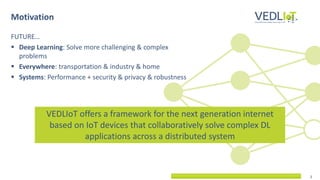
Motivation
VEDLIoT offers a framework for the next generation internet
based on IoT devices that collaboratively solve complex DL
applications across a distributed system
3
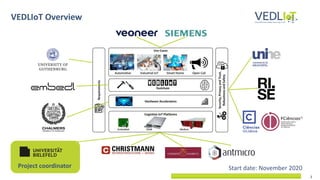
VEDLIoT Overview
Start date: November 2020
Project coordinator
4
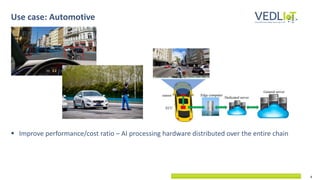
▪ Improve performance/cost ratio – AI processing hardware distributed over the entire chain
Use case: Automotive
5
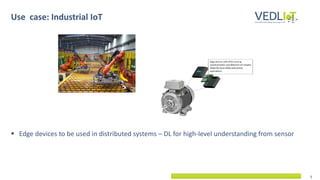
▪ Edge devices to be used in distributed systems – DL for high-level understanding from sensor
Use case: Industrial IoT
6
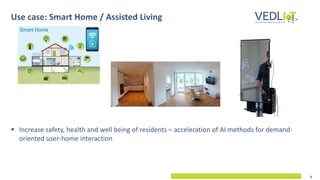
▪ Increase safety, health and well being of residents – acceleration of AI methods for demand-
oriented user-home interaction
Use case: Smart Home / Assisted Living
7
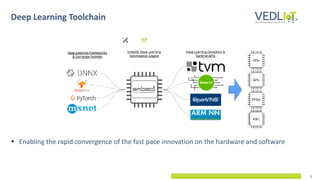
▪ Enabling the rapid convergence of the fast pace innovation on the hardware and software
Deep Learning Toolchain
8
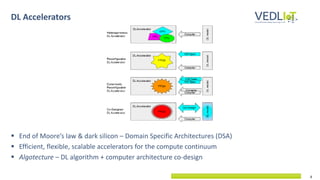
▪ End of Moore’s law & dark silicon – Domain Specific Architectures (DSA)
▪ Efficient, flexible, scalable accelerators for the compute continuum
▪ Algotecture – DL algorithm + computer architecture co-design
DL Accelerators
9
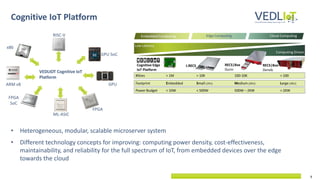
Cognitive IoT Platform
• Heterogeneous, modular, scalable microserver system
• Different technology concepts for improving: computing power density, cost-effectiveness,
maintainability, and reliability for the full spectrum of IoT, from embedded devices over the edge
towards the cloud
x86
GPU
ML-ASIC
ARM v8
GPU SoC
FPGA
SoC
RISC-V
FPGA
VEDLIOT Cognitive IoT
Platform
10
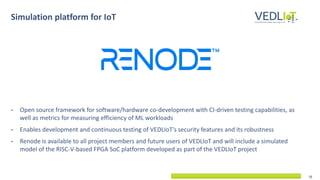
Simulation platform for IoT
• Open source framework for software/hardware co-development with CI-driven testing capabilities, as
well as metrics for measuring efficiency of ML workloads
• Enables development and continuous testing of VEDLIoT’s security features and its robustness
• Renode is available to all project members and future users of VEDLIoT and will include a simulated
model of the RISC-V-based FPGA SoC platform developed as part of the VEDLIoT project
11
Expected Impacts
• Scientific progress enabling novel, future semi-autonomous IoT applications
• Long-term evolution of next-generation IoT infrastructures and service platforms technologies –
hardware, platforms, tools, applications
• Human-centred IoT evolution (improving usability and user acceptance), through strengthened security
and user control
• Maintain an active ecosystem of all relevant IoT stakeholders
• Emerging or future standards and pre-normative activities
• Propose and mobilise key IoT players in security and privacy
12
12
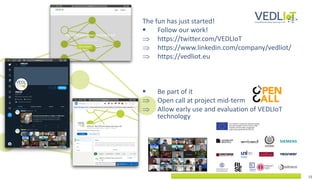
The fun has just started!
▪ Follow our work!
 https://twitter.com/VEDLIoT
 https://www.linkedin.com/company/vedliot/
 https://vedliot.eu
▪ Be part of it
 Open call at project mid-term
 Allow early use and evaluation of VEDLIoT
technology

AccML, co-located with HiPEAC 2021_Pedro Trancoso presentation

  • 1.
    Pedro Trancoso andJens Hagemeyer Chalmers University of Technology & Bielefeld University VEDLIoT Very Efficient Deep Learning in IoT 18 January 2021 Project Overview
  • 2.
    2 FUTURE… ▪ Deep Learning:Solve more challenging & complex problems ▪ Everywhere: transportation & industry & home ▪ Systems: Performance + security & privacy & robustness Motivation VEDLIoT offers a framework for the next generation internet based on IoT devices that collaboratively solve complex DL applications across a distributed system
  • 3.
    3 VEDLIoT Overview Start date:November 2020 Project coordinator
  • 4.
    4 ▪ Improve performance/costratio – AI processing hardware distributed over the entire chain Use case: Automotive
  • 5.
    5 ▪ Edge devicesto be used in distributed systems – DL for high-level understanding from sensor Use case: Industrial IoT
  • 6.
    6 ▪ Increase safety,health and well being of residents – acceleration of AI methods for demand- oriented user-home interaction Use case: Smart Home / Assisted Living
  • 7.
    7 ▪ Enabling therapid convergence of the fast pace innovation on the hardware and software Deep Learning Toolchain
  • 8.
    8 ▪ End ofMoore’s law & dark silicon – Domain Specific Architectures (DSA) ▪ Efficient, flexible, scalable accelerators for the compute continuum ▪ Algotecture – DL algorithm + computer architecture co-design DL Accelerators
  • 9.
    9 Cognitive IoT Platform •Heterogeneous, modular, scalable microserver system • Different technology concepts for improving: computing power density, cost-effectiveness, maintainability, and reliability for the full spectrum of IoT, from embedded devices over the edge towards the cloud x86 GPU ML-ASIC ARM v8 GPU SoC FPGA SoC RISC-V FPGA VEDLIOT Cognitive IoT Platform
  • 10.
    10 Simulation platform forIoT • Open source framework for software/hardware co-development with CI-driven testing capabilities, as well as metrics for measuring efficiency of ML workloads • Enables development and continuous testing of VEDLIoT’s security features and its robustness • Renode is available to all project members and future users of VEDLIoT and will include a simulated model of the RISC-V-based FPGA SoC platform developed as part of the VEDLIoT project
  • 11.
    11 Expected Impacts • Scientificprogress enabling novel, future semi-autonomous IoT applications • Long-term evolution of next-generation IoT infrastructures and service platforms technologies – hardware, platforms, tools, applications • Human-centred IoT evolution (improving usability and user acceptance), through strengthened security and user control • Maintain an active ecosystem of all relevant IoT stakeholders • Emerging or future standards and pre-normative activities • Propose and mobilise key IoT players in security and privacy
  • 12.
    12 12 The fun hasjust started! ▪ Follow our work!  https://twitter.com/VEDLIoT  https://www.linkedin.com/company/vedliot/  https://vedliot.eu ▪ Be part of it  Open call at project mid-term  Allow early use and evaluation of VEDLIoT technology