Jens Hagemeyer
Bielefeld University
NG-IoT Workshop on Standardization
VEDLIoT Overview and Standardization activities
2
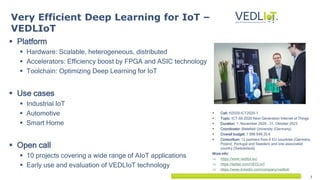
 Platform
 Hardware: Scalable, heterogeneous, distributed
 Accelerators: Efficiency boost by FPGA and ASIC technology
 Toolchain: Optimizing Deep Learning for IoT
 Use cases
 Industrial IoT
 Automotive
 Smart Home
 Open call
 10 projects covering a wide range of AIoT applications
 Early use and evaluation of VEDLIoT technology
Very Efficient Deep Learning for IoT –
VEDLIoT
 Call: H2020-ICT2020-1
 Topic: ICT-56-2020 Next Generation Internet of Things
 Duration: 1. November 2020 – 31. Oktober 2023
 Coordinator: Bielefeld University (Germany)
 Overall budget: 7 996 646.25 €
 Consortium: 12 partners from 4 EU countries (Germany,
Poland, Portugal and Sweden) and one associated
country (Switzerland).
More info:
 https://www.vedliot.eu/
 https://twitter.com/VEDLIoT
 https://www.linkedin.com/company/vedliot/
3
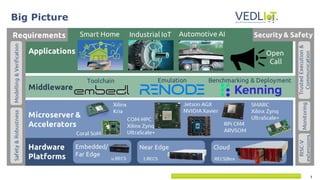
Big Picture
4
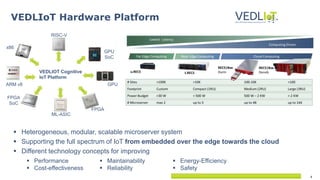
VEDLIoT Hardware Platform
 Heterogeneous, modular, scalable microserver system
 Supporting the full spectrum of IoT from embedded over the edge towards the cloud
 Different technology concepts for improving
x86
GPU
ML-ASIC
ARM v8
GPU
SoC
FPGA
SoC
RISC-V
FPGA
VEDLIOT Cognitive
IoT Platform
 Performance
 Cost-effectiveness
 Maintainability
 Reliability
 Energy-Efficiency
 Safety
5
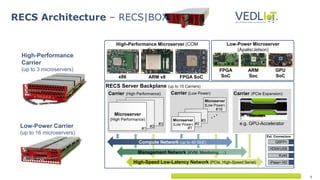
RECS Architecture – RECS|BOX
RECS Server Backplane (up to 15 Carriers)
Carrier (PCIe Expansion)
Carrier (High Performance)
e.g. GPU-Accelerator
Carrier (Low Power)
#3
#2
Microserver
(High Performance)
#1
Microserver
(Low Power)
#16
#3
#2
Microserver
(Low Power)
#1
High-Speed Low-Latency Network (PCIe, High-Speed Serial)
Compute Network (up to 40 GbE)
Management Network (KVM, Monitoring, …)
HDMI/USB
iPass+ HD
QSFP+
RJ45
Ext. Connectors
GPU
SoC
FPGA
SoC
ARM
Soc
Low-Power Microserver
(Apalis/Jetson)
x86 ARM v8
High-Performance Microserver (COM
Express)
FPGA SoC
High-Performance
Carrier
(up to 3 microservers)
Low-Power Carrier
(up to 16 microservers)
6
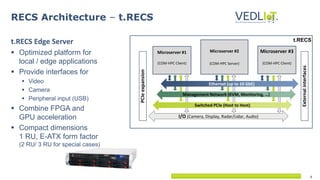
t.RECS
t.RECS Edge Server
 Optimized platform for
local / edge applications
 Provide interfaces for
 Video
 Camera
 Peripheral input (USB)
 Combine FPGA and
GPU acceleration
 Compact dimensions
1 RU, E-ATX form factor
(2 RU/ 3 RU for special cases)
RECS Architecture – t.RECS
Microserver #3
(COM-HPC Client)
Microserver #1
(COM-HPC Client)
Microserver #2
(COM-HPC Server)
Switched PCIe (Host to Host)
External
interfaces
PCIe
expansion
Ethernet (up to 10 GbE)
Management Network (KVM, Monitoring, …)
I/O (Camera, Display, Radar/Lidar, Audio)
7
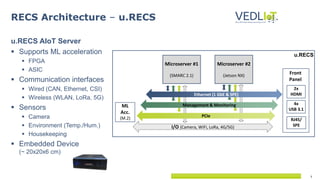
u.RECS
u.RECS AIoT Server
 Supports ML acceleration
 FPGA
 ASIC
 Communication interfaces
 Wired (CAN, Ethernet, CSI)
 Wireless (WLAN, LoRa, 5G)
 Sensors
 Camera
 Environment (Temp./Hum.)
 Housekeeping
 Embedded Device
(~ 20x20x6 cm)
RECS Architecture – u.RECS
PCIe
Ethernet (1 GbE & SPE)
Management & Monitoring
I/O (Camera, WiFi, LoRa, 4G/5G)
Microserver #1
(SMARC 2.1)
Microserver #2
(Jetson NX)
ML
Acc.
(M.2)
Front
Panel
2x
HDMI
RJ45/
SPE
4x
USB 3.1
8
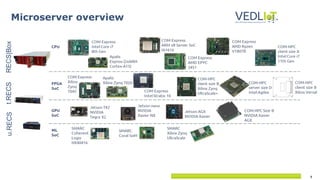
Microserver overview
t.RECS
RECS|Box
u.RECS
9
 Peak performance values of specialized accelerators, provided by the vendors
(precisions varying from INT8 to FP32)
Peak Performance of DL Accelerators
Average efficiency at 1000 GOPS /W
[CELLRANGE]
[CELLRANGE]
[CELLRANGE]
[CELLRANGE]
[CELLRANGE]
[CELLRANGE]
[CELLRANGE]
[CELLRANGE]
[CELLRANGE]
[CELLRANGE]
[CELLRANGE]
[CELLRANGE]
[CELLRANGE]
[CELLRANGE]
[CELLRANGE]
[CELLRANGE]
[CELLRANGE]
[CELLRANGE]
[CELLRANGE]
[CELLRANGE]
[CELLRANGE]
[CELLRANGE]
[CELLRANGE]
[CELLRANGE]
[CELLRANGE]
[CELLRANGE]
[CELLRANGE]
[CELLRANGE]
[CELLRANGE]
[CELLRANGE]
[CELLRANGE]
[CELLRANGE]
[CELLRANGE]
[CELLRANGE]
[CELLRANGE]
[CELLRANGE]
[CELLRANGE]
[CELLRANGE]
[CELLRANGE]
[CELLRANGE]
1
10
100
1,000
10,000
100,000
1,000,000
10,000,000
0.01 0.1 1 10 100 1000
Performance
[GOPS]
Power [Watt]
ASIC
GPU
FPGA
Ultra Low Power
High Performance
Low Power
10
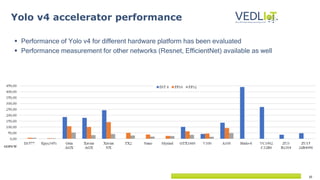
Yolo v4 accelerator performance
 Performance of Yolo v4 for different hardware platform has been evaluated
 Performance measurement for other networks (Resnet, EfficientNet) available as well
11
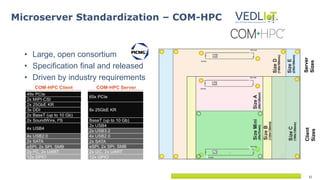
Microserver Standardization – COM-HPC
• Large, open consortium
• Specification final and released
• Driven by industry requirements
12
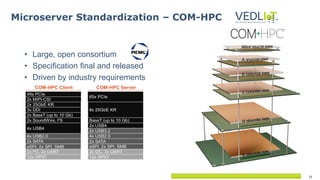
Microserver Standardization – COM-HPC
• Large, open consortium
• Specification final and released
• Driven by industry requirements
13
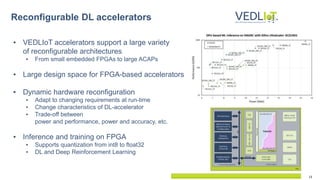
▪ VEDLIoT accelerators support a large variety
of reconfigurable architectures
▪ From small embedded FPGAs to large ACAPs
▪ Large design space for FPGA-based accelerators
▪ Dynamic hardware reconfiguration
▪ Adapt to changing requirements at run-time
▪ Change characteristics of DL-accelerator
▪ Trade-off between
power and performance, power and accuracy, etc.
▪ Inference and training on FPGA
▪ Supports quantization from int8 to float32
▪ DL and Deep Reinforcement Learning
Reconfigurable DL accelerators
14
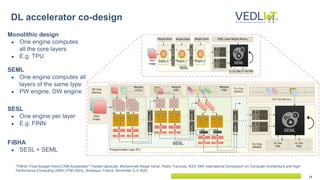
DL accelerator co-design
"FiBHA: Fixed Budget Hybrid CNN Accelerator", Fareed Qararyah, Muhammad Waqar Azhar, Pedro Trancoso, IEEE 34th International Symposium on Computer Architecture and High-
Performance Computing (SBAC-PAD 2022), Bordeaux, France, November 2–5 2022
Monolithic design
● One engine computes
all the core layers
● E.g. TPU
SEML
● One engine computes all
layers of the same type
● PW engine, DW engine
SESL
● One engine per layer
● E.g. FINN
FiBHA
● SESL + SEML
15
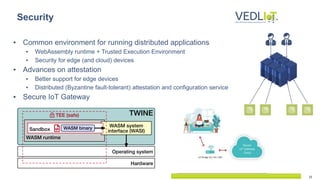
▪ Common environment for running distributed applications
▪ WebAssembly runtime + Trusted Execution Environment
▪ Security for edge (and cloud) devices
▪ Advances on attestation
▪ Better support for edge devices
▪ Distributed (Byzantine fault-tolerant) attestation and configuration service
▪ Secure IoT Gateway
Security
16
Simulation platform for ML accelerators
▪ RISC-V SoCs and Custom Function Units
▪ Improve test and verification
▪ Co-simulate Verilog blocks
▪ Used in Google’s CFU Playground
▪ Continuous integration based in Gitlab and Google Cloud
Platform
Safety and Robustness
17
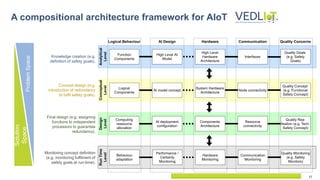
A compositional architecture framework for AIoT
Knowledge creation (e.g.
definition of safety goals).
Concept design (e.g.
introduction of redundancy
to fulfil safety goals).
Final design (e.g. assigning
functions to independent
processors to guarantee
redundancy).
Monitoring concept definition
(e.g. monitoring fulfilment of
safety goals at run-time).
Solution
Space
Problem
Space
18
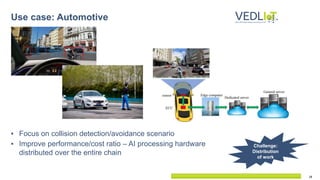
▪ Focus on collision detection/avoidance scenario
▪ Improve performance/cost ratio – AI processing hardware
distributed over the entire chain
Use case: Automotive
Challenge:
Distribution
of work
19
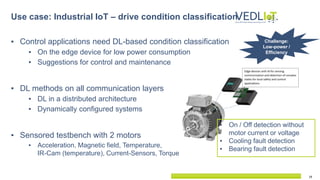
▪ Control applications need DL-based condition classification
▪ On the edge device for low power consumption
▪ Suggestions for control and maintenance
▪ DL methods on all communication layers
▪ DL in a distributed architecture
▪ Dynamically configured systems
▪ Sensored testbench with 2 motors
▪ Acceleration, Magnetic field, Temperature,
IR-Cam (temperature), Current-Sensors, Torque
Use case: Industrial IoT – drive condition classification
▪ On / Off detection without
motor current or voltage
▪ Cooling fault detection
▪ Bearing fault detection
Challenge:
Low-power /
Efficiency
20
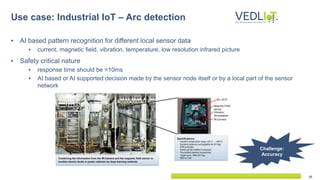
Use case: Industrial IoT – Arc detection
▪ AI based pattern recognition for different local sensor data
▪ current, magnetic field, vibration, temperature, low resolution infrared picture
▪ Safety critical nature
▪ response time should be <10ms
▪ AI based or AI supported decision made by the sensor node itself or by a local part of the sensor
network
Challenge:
Accuracy
21
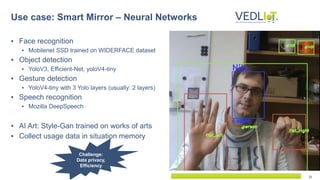
▪ Face recognition
▪ Mobilenet SSD trained on WIDERFACE dataset
▪ Object detection
▪ YoloV3, Efficient-Net, yoloV4-tiny
▪ Gesture detection
▪ YoloV4-tiny with 3 Yolo layers (usually: 2 layers)
▪ Speech recognition
▪ Mozilla DeepSpeech
▪ AI Art: Style-Gan trained on works of arts
▪ Collect usage data in situation memory
Use case: Smart Mirror – Neural Networks
Challenge:
Data privacy,
Efficiency
22
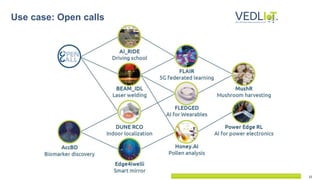
Use case: Open calls
23
Summary – Standardization in VEDLIoT
▪ Hardware/microserver form factors
▪ Active contribution to PICMG Standards COM-HPC and COM Express
(https://www.picmg.org/openstandards/com-hpc)
▪ Several Open Source contributions to large projects (https://vedliot.eu/open-source-software)
▪ Renode + Kenning – Emulator and Simulator for distributed IoT, Verilator support
▪ Memory Protection for RISC-V: RISC-V PMP
▪ TEEs support for WebAssembly: Integation for Trustzone (ARM) and SGX (Intel) into WebAssembly
▪ Recommendations: Design framework IoT and AI
▪ Compositional architecture framework for AIoT developled within VEDLIoT
▪ Can help system design to comply with regulatory constraints (e.g. EU AI Act)
24
Thank you for your
attention.
Contact
Jens Hagemeyer, Carola Haumann
Bielefeld University, Germany
chaumann@cor-lab.uni-bielefeld.de
jhagemey@cit-ec.uni-bielefeld.de

NGIoT standardisation workshops_Jens Hagemeyer presentation

  • 1.
    Jens Hagemeyer Bielefeld University NG-IoTWorkshop on Standardization VEDLIoT Overview and Standardization activities
  • 2.
    2  Platform  Hardware:Scalable, heterogeneous, distributed  Accelerators: Efficiency boost by FPGA and ASIC technology  Toolchain: Optimizing Deep Learning for IoT  Use cases  Industrial IoT  Automotive  Smart Home  Open call  10 projects covering a wide range of AIoT applications  Early use and evaluation of VEDLIoT technology Very Efficient Deep Learning for IoT – VEDLIoT  Call: H2020-ICT2020-1  Topic: ICT-56-2020 Next Generation Internet of Things  Duration: 1. November 2020 – 31. Oktober 2023  Coordinator: Bielefeld University (Germany)  Overall budget: 7 996 646.25 €  Consortium: 12 partners from 4 EU countries (Germany, Poland, Portugal and Sweden) and one associated country (Switzerland). More info:  https://www.vedliot.eu/  https://twitter.com/VEDLIoT  https://www.linkedin.com/company/vedliot/
  • 3.
  • 4.
    4 VEDLIoT Hardware Platform Heterogeneous, modular, scalable microserver system  Supporting the full spectrum of IoT from embedded over the edge towards the cloud  Different technology concepts for improving x86 GPU ML-ASIC ARM v8 GPU SoC FPGA SoC RISC-V FPGA VEDLIOT Cognitive IoT Platform  Performance  Cost-effectiveness  Maintainability  Reliability  Energy-Efficiency  Safety
  • 5.
    5 RECS Architecture –RECS|BOX RECS Server Backplane (up to 15 Carriers) Carrier (PCIe Expansion) Carrier (High Performance) e.g. GPU-Accelerator Carrier (Low Power) #3 #2 Microserver (High Performance) #1 Microserver (Low Power) #16 #3 #2 Microserver (Low Power) #1 High-Speed Low-Latency Network (PCIe, High-Speed Serial) Compute Network (up to 40 GbE) Management Network (KVM, Monitoring, …) HDMI/USB iPass+ HD QSFP+ RJ45 Ext. Connectors GPU SoC FPGA SoC ARM Soc Low-Power Microserver (Apalis/Jetson) x86 ARM v8 High-Performance Microserver (COM Express) FPGA SoC High-Performance Carrier (up to 3 microservers) Low-Power Carrier (up to 16 microservers)
  • 6.
    6 t.RECS t.RECS Edge Server Optimized platform for local / edge applications  Provide interfaces for  Video  Camera  Peripheral input (USB)  Combine FPGA and GPU acceleration  Compact dimensions 1 RU, E-ATX form factor (2 RU/ 3 RU for special cases) RECS Architecture – t.RECS Microserver #3 (COM-HPC Client) Microserver #1 (COM-HPC Client) Microserver #2 (COM-HPC Server) Switched PCIe (Host to Host) External interfaces PCIe expansion Ethernet (up to 10 GbE) Management Network (KVM, Monitoring, …) I/O (Camera, Display, Radar/Lidar, Audio)
  • 7.
    7 u.RECS u.RECS AIoT Server Supports ML acceleration  FPGA  ASIC  Communication interfaces  Wired (CAN, Ethernet, CSI)  Wireless (WLAN, LoRa, 5G)  Sensors  Camera  Environment (Temp./Hum.)  Housekeeping  Embedded Device (~ 20x20x6 cm) RECS Architecture – u.RECS PCIe Ethernet (1 GbE & SPE) Management & Monitoring I/O (Camera, WiFi, LoRa, 4G/5G) Microserver #1 (SMARC 2.1) Microserver #2 (Jetson NX) ML Acc. (M.2) Front Panel 2x HDMI RJ45/ SPE 4x USB 3.1
  • 8.
  • 9.
    9  Peak performancevalues of specialized accelerators, provided by the vendors (precisions varying from INT8 to FP32) Peak Performance of DL Accelerators Average efficiency at 1000 GOPS /W [CELLRANGE] [CELLRANGE] [CELLRANGE] [CELLRANGE] [CELLRANGE] [CELLRANGE] [CELLRANGE] [CELLRANGE] [CELLRANGE] [CELLRANGE] [CELLRANGE] [CELLRANGE] [CELLRANGE] [CELLRANGE] [CELLRANGE] [CELLRANGE] [CELLRANGE] [CELLRANGE] [CELLRANGE] [CELLRANGE] [CELLRANGE] [CELLRANGE] [CELLRANGE] [CELLRANGE] [CELLRANGE] [CELLRANGE] [CELLRANGE] [CELLRANGE] [CELLRANGE] [CELLRANGE] [CELLRANGE] [CELLRANGE] [CELLRANGE] [CELLRANGE] [CELLRANGE] [CELLRANGE] [CELLRANGE] [CELLRANGE] [CELLRANGE] [CELLRANGE] 1 10 100 1,000 10,000 100,000 1,000,000 10,000,000 0.01 0.1 1 10 100 1000 Performance [GOPS] Power [Watt] ASIC GPU FPGA Ultra Low Power High Performance Low Power
  • 10.
    10 Yolo v4 acceleratorperformance  Performance of Yolo v4 for different hardware platform has been evaluated  Performance measurement for other networks (Resnet, EfficientNet) available as well
  • 11.
    11 Microserver Standardization –COM-HPC • Large, open consortium • Specification final and released • Driven by industry requirements
  • 12.
    12 Microserver Standardization –COM-HPC • Large, open consortium • Specification final and released • Driven by industry requirements
  • 13.
    13 ▪ VEDLIoT acceleratorssupport a large variety of reconfigurable architectures ▪ From small embedded FPGAs to large ACAPs ▪ Large design space for FPGA-based accelerators ▪ Dynamic hardware reconfiguration ▪ Adapt to changing requirements at run-time ▪ Change characteristics of DL-accelerator ▪ Trade-off between power and performance, power and accuracy, etc. ▪ Inference and training on FPGA ▪ Supports quantization from int8 to float32 ▪ DL and Deep Reinforcement Learning Reconfigurable DL accelerators
  • 14.
    14 DL accelerator co-design "FiBHA:Fixed Budget Hybrid CNN Accelerator", Fareed Qararyah, Muhammad Waqar Azhar, Pedro Trancoso, IEEE 34th International Symposium on Computer Architecture and High- Performance Computing (SBAC-PAD 2022), Bordeaux, France, November 2–5 2022 Monolithic design ● One engine computes all the core layers ● E.g. TPU SEML ● One engine computes all layers of the same type ● PW engine, DW engine SESL ● One engine per layer ● E.g. FINN FiBHA ● SESL + SEML
  • 15.
    15 ▪ Common environmentfor running distributed applications ▪ WebAssembly runtime + Trusted Execution Environment ▪ Security for edge (and cloud) devices ▪ Advances on attestation ▪ Better support for edge devices ▪ Distributed (Byzantine fault-tolerant) attestation and configuration service ▪ Secure IoT Gateway Security
  • 16.
    16 Simulation platform forML accelerators ▪ RISC-V SoCs and Custom Function Units ▪ Improve test and verification ▪ Co-simulate Verilog blocks ▪ Used in Google’s CFU Playground ▪ Continuous integration based in Gitlab and Google Cloud Platform Safety and Robustness
  • 17.
    17 A compositional architectureframework for AIoT Knowledge creation (e.g. definition of safety goals). Concept design (e.g. introduction of redundancy to fulfil safety goals). Final design (e.g. assigning functions to independent processors to guarantee redundancy). Monitoring concept definition (e.g. monitoring fulfilment of safety goals at run-time). Solution Space Problem Space
  • 18.
    18 ▪ Focus oncollision detection/avoidance scenario ▪ Improve performance/cost ratio – AI processing hardware distributed over the entire chain Use case: Automotive Challenge: Distribution of work
  • 19.
    19 ▪ Control applicationsneed DL-based condition classification ▪ On the edge device for low power consumption ▪ Suggestions for control and maintenance ▪ DL methods on all communication layers ▪ DL in a distributed architecture ▪ Dynamically configured systems ▪ Sensored testbench with 2 motors ▪ Acceleration, Magnetic field, Temperature, IR-Cam (temperature), Current-Sensors, Torque Use case: Industrial IoT – drive condition classification ▪ On / Off detection without motor current or voltage ▪ Cooling fault detection ▪ Bearing fault detection Challenge: Low-power / Efficiency
  • 20.
    20 Use case: IndustrialIoT – Arc detection ▪ AI based pattern recognition for different local sensor data ▪ current, magnetic field, vibration, temperature, low resolution infrared picture ▪ Safety critical nature ▪ response time should be <10ms ▪ AI based or AI supported decision made by the sensor node itself or by a local part of the sensor network Challenge: Accuracy
  • 21.
    21 ▪ Face recognition ▪Mobilenet SSD trained on WIDERFACE dataset ▪ Object detection ▪ YoloV3, Efficient-Net, yoloV4-tiny ▪ Gesture detection ▪ YoloV4-tiny with 3 Yolo layers (usually: 2 layers) ▪ Speech recognition ▪ Mozilla DeepSpeech ▪ AI Art: Style-Gan trained on works of arts ▪ Collect usage data in situation memory Use case: Smart Mirror – Neural Networks Challenge: Data privacy, Efficiency
  • 22.
  • 23.
    23 Summary – Standardizationin VEDLIoT ▪ Hardware/microserver form factors ▪ Active contribution to PICMG Standards COM-HPC and COM Express (https://www.picmg.org/openstandards/com-hpc) ▪ Several Open Source contributions to large projects (https://vedliot.eu/open-source-software) ▪ Renode + Kenning – Emulator and Simulator for distributed IoT, Verilator support ▪ Memory Protection for RISC-V: RISC-V PMP ▪ TEEs support for WebAssembly: Integation for Trustzone (ARM) and SGX (Intel) into WebAssembly ▪ Recommendations: Design framework IoT and AI ▪ Compositional architecture framework for AIoT developled within VEDLIoT ▪ Can help system design to comply with regulatory constraints (e.g. EU AI Act)
  • 24.
    24 Thank you foryour attention. Contact Jens Hagemeyer, Carola Haumann Bielefeld University, Germany chaumann@cor-lab.uni-bielefeld.de jhagemey@cit-ec.uni-bielefeld.de