Pacific	Dialogue	on	Financial	Management	of	Climate	Risks	
Samoa,	26-28th June	2017
Reinsurance	&	the	Pacific	Region
ADDITIONAL	INFORMATION
Pacific	Dialogue	on	Financial	Management	of	Climate	Risks	
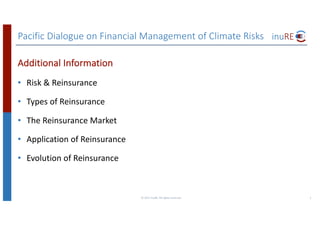
Additional	Information
• Risk	&	Reinsurance
• Types	of	Reinsurance
• The	Reinsurance	Market
• Application	of	Reinsurance
• Evolution	of	Reinsurance
©	2017	inuRE.	All	rights	reserved.	 1
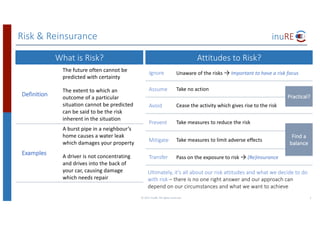
Risk	&	Reinsurance
What	is Risk?
Definition
The	future	often	cannot	be	
predicted	with	certainty	
The	extent	to	which	an	
outcome	of	a	particular	
situation	cannot	be	predicted	
can	be	said	to	be	the	risk	
inherent	in	the	situation
Examples
A	burst	pipe	in	a	neighbour’s	
home	causes	a	water	leak	
which	damages	your	property
A	driver	is	not	concentrating	
and	drives	into	the	back	of	
your	car,	causing	damage	
which	needs	repair
©	2017	inuRE.	All	rights	reserved.	 2
Attitudes	to	Risk?
Ignore	 Unaware	of	the	risks	→ Important	to	have	a	risk	focus
Assume Take	no	action
Avoid	 Cease	the	activity	which	gives	rise	to	the	risk
Prevent	 Take	measures	to	reduce	the	risk
Mitigate	 Take	measures	to	limit	adverse	effects
Transfer	 Pass	on	the	exposure	to	risk	→ (Re)insurance
Practical?
Find	a	
balance
Ultimately,	it’s	all	about	our	risk	attitudes	and	what	we	decide	to	do	
with	risk – there	is	no	one	right	answer	and	our	approach	can	
depend	on	our	circumstances	and	what	we	want	to	achieve
Risk	&	Reinsurance
• An	insurer’s	capital	must	be	appropriate	for	its	specific	
risk	profile	and	risk	appetite
• Risk	capital	acts	as	a	buffer	against	unexpected	losses
• It	is	important	to	match	capital	and	risks	assumed	
• If	a	mismatch	happens,	there	are	some	approaches	we	
can	take:
o Raise	capital
o Reduce	underwriting	and	investment	risks
Ø Buy	reinsurance
Ø Change	investment	policy
Ø Change	underwriting	guidelines
©	2017	inuRE.	All	rights	reserved.	 3
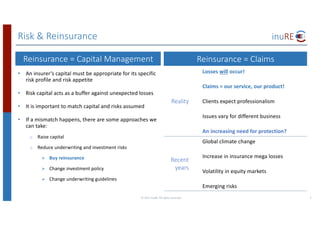
Reinsurance	=	Capital	Management Reinsurance	=	Claims
Reality
Losses	will occur!
Claims	=	our	service,	our	product!
Clients	expect	professionalism
Issues	vary	for	different	business
An	increasing	need	for	protection?
Recent	
years
Global	climate	change
Increase	in	insurance	mega	losses
Volatility	in	equity	markets
Emerging	risks
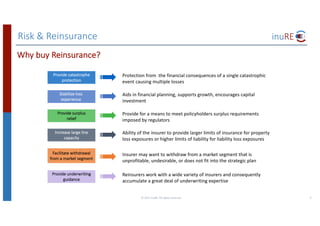
Stabilize	loss	
experience	
Facilitate	withdrawal	
from	a	market	segment	
Increase	large	line	
capacity
Provide	catastrophe	
protection
Provide	surplus	
relief
Provide	underwriting	
guidance
Ability	of	the	insurer	to	provide	larger	limits	of	insurance	for	property	
loss	exposures	or	higher	limits	of	liability	for	liability	loss	exposures	
Protection	from		the	financial	consequences	of	a	single	catastrophic	
event	causing	multiple	losses
Provide	for	a	means	to	meet	policyholders	surplus	requirements	
imposed	by	regulators
Insurer	may	want	to	withdraw	from	a	market	segment	that	is	
unprofitable,	undesirable,	or	does	not	fit	into	the	strategic	plan
Aids	in	financial	planning,	supports	growth,	encourages	capital	
investment	
Reinsurers	work	with	a	wide	variety	of	insurers	and	consequently	
accumulate	a	great	deal	of	underwriting	expertise
Risk	&	Reinsurance
©	2017	inuRE.	All	rights	reserved.	 4
Why	buy	Reinsurance?
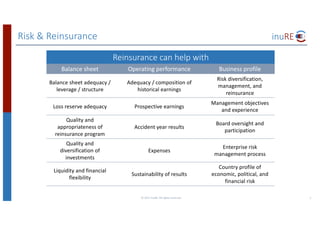
Reinsurance	can	help	with
Balance	sheet Operating	performance Business	profile
Balance	sheet	adequacy	/	
leverage	/	structure
Adequacy	/	composition	of	
historical	earnings
Risk	diversification,	
management,	and	
reinsurance
Loss	reserve	adequacy Prospective	earnings
Management	objectives	
and	experience
Quality	and	
appropriateness	of	
reinsurance	program
Accident	year	results
Board	oversight	and	
participation
Quality	and	
diversification	of	
investments
Expenses
Enterprise	risk	
management	process
Liquidity	and	financial	
flexibility
Sustainability	of	results
Country	profile	of	
economic,	political,	and	
financial	risk
Risk	&	Reinsurance
©	2017	inuRE.	All	rights	reserved.	 5
Types	of	Reinsurance
©	2017	inuRE.	All	rights	reserved.	 6
Types	of	Reinsurance
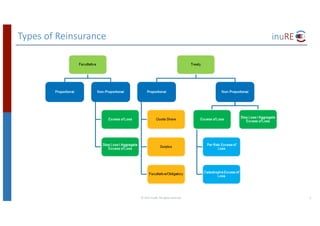
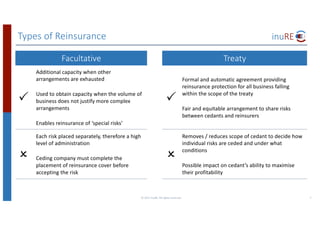
Facultative
P
Additional	capacity	when	other	
arrangements	are	exhausted
Used	to	obtain	capacity	when	the	volume	of	
business	does	not	justify	more	complex	
arrangements
Enables	reinsurance	of	‘special	risks’
O
Each	risk	placed	separately,	therefore	a	high	
level	of	administration
Ceding	company	must	complete	the	
placement	of	reinsurance	cover	before	
accepting	the	risk
©	2017	inuRE.	All	rights	reserved.	 7
Treaty
P
Formal	and	automatic	agreement	providing	
reinsurance	protection	for	all	business	falling	
within	the	scope	of	the	treaty
Fair	and	equitable	arrangement	to	share	risks	
between	cedants	and	reinsurers
O
Removes	/	reduces	scope	of	cedant	to	decide	how	
individual	risks	are	ceded	and	under	what	
conditions	
Possible	impact	on	cedant’s	ability	to	maximise	
their	profitability
Types	of	Reinsurance
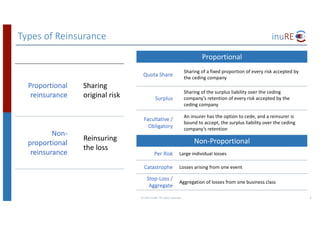
Proportional
Quota	Share
Sharing	of	a	fixed	proportion	of	every	risk	accepted	by	
the	ceding	company
Surplus
Sharing	of	the	surplus	liability	over	the	ceding	
company’s	retention	of	every	risk	accepted	by	the	
ceding	company
Facultative	/	
Obligatory
An	insurer	has	the	option	to	cede,	and	a	reinsurer	is	
bound	to	accept,	the	surplus	liability	over	the	ceding	
company’s	retention
Non-Proportional
Per	Risk Large	individual	losses
Catastrophe Losses	arising	from	one	event
Stop-Loss	/	
Aggregate
Aggregation	of	losses	from	one	business	class
©	2017	inuRE.	All	rights	reserved.	 8
Proportional	
reinsurance
Sharing	
original	risk
Non-
proportional	
reinsurance
Reinsuring	
the	loss
Types	of	Reinsurance
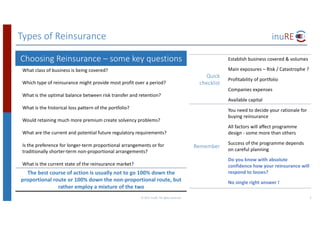
Choosing	Reinsurance	– some	key	questions
What	class	of	business	is	being	covered?	
Which	type	of	reinsurance	might	provide	most	profit	over	a	period?
What	is	the	optimal	balance	between	risk	transfer	and	retention?
What	is	the	historical	loss	pattern	of	the	portfolio?
Would	retaining	much	more	premium	create	solvency	problems?
What	are	the	current	and	potential	future	regulatory	requirements?
Is	the	preference	for	longer-term	proportional	arrangements	or	for	
traditionally	shorter-term	non-proportional	arrangements?
What	is	the	current	state	of	the	reinsurance	market?
The	best	course	of	action	is	usually	not	to	go	100%	down	the	
proportional	route	or	100%	down	the	non-proportional	route,	but	
rather	employ	a	mixture	of	the	two
©	2017	inuRE.	All	rights	reserved.	 9
Quick	
checklist
Establish	business	covered	&	volumes
Main	exposures	– Risk	/	Catastrophe	?
Profitability	of	portfolio
Companies	expenses
Available	capital
Remember
You	need	to	decide	your	rationale	for	
buying	reinsurance
All	factors	will	affect	programme	
design	- some	more	than	others
Success	of	the	programme	depends	
on	careful	planning
Do	you	know	with	absolute	
confidence	how	your	reinsurance	will	
respond	to	losses?
No	single	right	answer	!
The	Reinsurance	Market
©	2017	inuRE.	All	rights	reserved.	 10
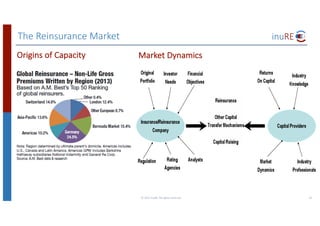
Market	DynamicsOrigins	of	Capacity
The	Reinsurance	Market
©	2017	inuRE.	All	rights	reserved.	 11
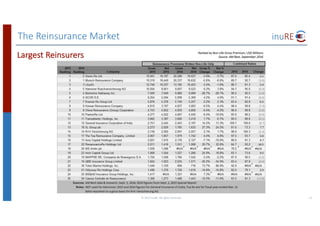
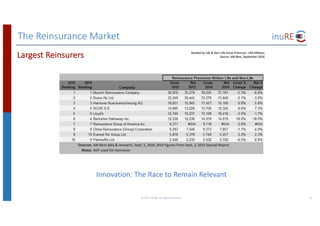
Largest	Reinsurers Ranked	by	Non-Life	Gross	Premium,	USD	Millions
Source:	AM	Best,	September	2016
The	Reinsurance	Market
©	2017	inuRE.	All	rights	reserved.	 12
Largest	Reinsurers Ranked	by	Life	&	Non-Life	Gross	Premium,	USD	Millions
Source:	AM	Best,	September	2016
Innovation:	The	Race	to	Remain	Relevant
The	Reinsurance	Market
©	2017	inuRE.	All	rights	reserved.	 13
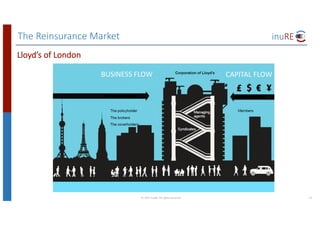
Lloyd’s	of	London
BUSINESS	FLOW CAPITAL	FLOW
The	Reinsurance	Market
©	2017	inuRE.	All	rights	reserved.	 14
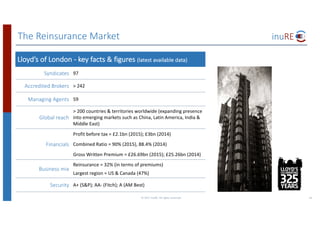
Lloyd’s	of	London	- key	facts	&	figures	(latest	available	data)
Syndicates 97
Accredited	Brokers >	242
Managing	Agents 59
Global	reach
>	200	countries	&	territories	worldwide	(expanding	presence	
into	emerging	markets	such	as	China,	Latin	America,	India	&	
Middle	East)
Financials
Profit	before	tax	=	£2.1bn	(2015);	£3bn	(2014)
Combined	Ratio	=	90%	(2015),	88.4%	(2014)
Gross	Written	Premium	=	£26.69bn	(2015);	£25.26bn	(2014)	
Business	mix
Reinsurance	=	32%	(in	terms	of	premiums)
Largest	region	=	US	&	Canada	(47%)
Security A+	(S&P);	AA- (Fitch);	A	(AM	Best)
The	Reinsurance	Market
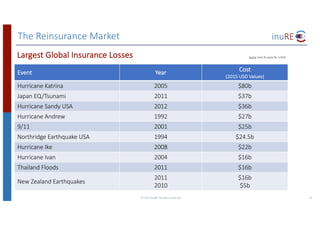
Event Year Cost	
(2015	USD	Values)
Hurricane	Katrina 2005 $80b
Japan	EQ/Tsunami 2011 $37b
Hurricane	Sandy	USA 2012 $36b
Hurricane	Andrew	 1992 $27b
9/11 2001 $25b
Northridge	Earthquake	USA 1994 $24.5b
Hurricane	Ike 2008 $22b
Hurricane	Ivan 2004 $16b
Thailand	Floods 2011 $16b
New	Zealand	Earthquakes
2011
2010
$16b
$5b
©	2017	inuRE.	All	rights	reserved.	 15
Largest	Global	Insurance	Losses Source:	Swiss	Re	sigma	No.	1/2016
The	Reinsurance	Market
©	2017	inuRE.	All	rights	reserved.	 16
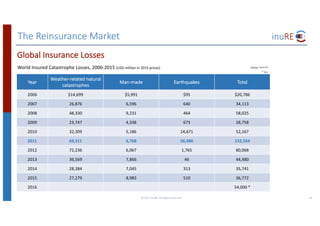
Global	Insurance	Losses
World	Insured	Catastrophe	Losses,	2006-2015	(USD	million	in	2015	prices) Source:	Swiss	Re
*	Aon
Year
Weather-related	natural	
catastrophes
Man-made Earthquakes Total
2006 $14,699	 $5,991	 $95	 $20,786	
2007 26,876 6,596 640 34,113
2008 48,330 9,231 464 58,025
2009 23,747 4,338 673 28,758
2010 32,309 5,186 14,671 52,167
2011 69,311 6,768 56,486 132,564
2012 72,236 6,067 1,765 80,068
2013 36,569 7,866 46 44,480
2014 28,384 7,045 313 35,741
2015 27,279 8,983 510 36,772
2016 54,000	*
The	Reinsurance	Market
©	2017	inuRE.	All	rights	reserved.	 17
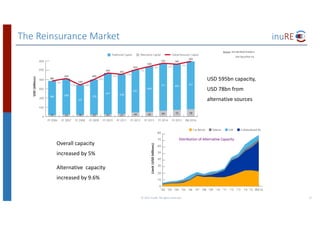
Aon Benfield estimates that global reinsurer capital rose by
5.3 percent to a new high of USD595 billion over the nine months
to September 30, 2016. This calculation is a broad measure of
the capital available for insurers to trade risk with and includes
both traditional and alternative forms of reinsurer capital.
Equity capital available to support reinsurance underwriting
is at peak levels and debt continues to be available on
very favorable terms. As a result, ample capacity currently
exists to meet expected reinsurance demand.
Exhibit 1: Change in global reinsurer capital
USD(billions)
Alternative CapitalTraditional Capital Global Reinsurer Capital
0
100
200
300
400
500
600
9M 2016FY 2015FY 2014FY 2013FY 2012FY 2011FY 2010FY 2009FY 2008FY 2007FY 2006
17
368
385
22
388
410
6%
-17% 18%
18%
-3%
11%
7%
6% -2% 5%
19
321
340
22
378
400
23
447
470
27
428
455
44
461
505
50
490
540
64
511
575
72
493
565
78
517
595
Source: Aon Benfield Analytics
Source:	Aon	Benfield	Analytics
Aon	Securities	Inc.
Alternative capital focuses on collateralized reinsurance
Insurance risk continues to attract capital market investors.
Expected returns have declined, but remain attractive relative
to other available opportunities, and low correlation with other
asset classes (except in the most extreme scenarios) remains a
key consideration.
Alternative capital rose by 9. percent to USD78 billion over the
nine months to September 30, 2016, principally reflecting
additional deployment into collateralized reinsurance structures.
Certain maturing catastrophe bonds did not renew during 2016
and, as a result, new issuance fell to USD6.0 billion, from USD6.9
billion in 2015.
Exhibit 3: Alternative capital deployment
0
10
20
30
40
50
60
70
80
9M'16'15'14'13'12'11'10'09'08'07'06'05'04'03'02
SidecarCat Bonds Collateralized Re
Valuation: Price to Book
ILW
Limit(USDbillions)
Source: Aon Securities, Inc.
USD	595bn	capacity,	
USD	78bn	from	
alternative	sources	
Overall	capacity	
increased	by	5%
Alternative		capacity	
increased	by	9.6%
Distribution	of	Alternative	Capacity
The	Reinsurance	Market
©	2017	inuRE.	All	rights	reserved.	 18
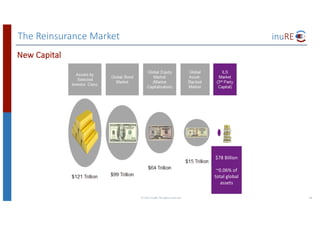
$78	Billion
~0.06%	of	
total	global	
assets
New	Capital
The	Reinsurance	Market
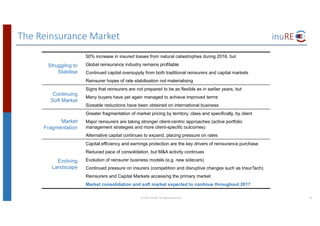
Struggling to
Stabilise
50% increase in insured losses from natural catastrophes during 2016, but
Global reinsurance industry remains profitable
Continued capital oversupply from both traditional reinsurers and capital markets
Reinsurer hopes of rate stabilisation not materialising
Continuing
Soft Market
Signs that reinsurers are not prepared to be as flexible as in earlier years, but
Many buyers have yet again managed to achieve improved terms
Sizeable reductions have been obtained on international business
Market
Fragmentation
Greater fragmentation of market pricing by territory, class and specifically, by client
Major reinsurers are taking stronger client-centric approaches (active portfolio
management strategies and more client-specific outcomes)
Alternative capital continues to expand, placing pressure on rates
Evolving
Landscape
Capital efficiency and earnings protection are the key drivers of reinsurance purchase
Reduced pace of consolidation, but M&A activity continues
Evolution of reinsurer business models (e.g. new sidecars)
Continued pressure on insurers (competition and disruptive changes such as InsurTech)
Reinsurers and Capital Markets accessing the primary market
Market consolidation and soft market expected to continue throughout 2017
©	2017	inuRE.	All	rights	reserved.	 19
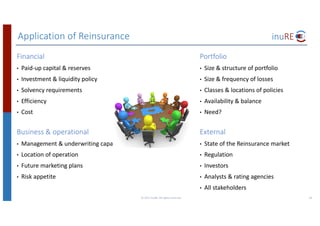
Application	of	Reinsurance
Financial
• Paid-up	capital	&	reserves
• Investment	&	liquidity	policy
• Solvency	requirements
• Efficiency
• Cost
Business	&	operational
• Management	&	underwriting	capability
• Location	of	operation
• Future	marketing	plans
• Risk	appetite
©	2017	inuRE.	All	rights	reserved.	 20
Portfolio
• Size	&	structure	of	portfolio
• Size	&	frequency	of	losses
• Classes	&	locations	of	policies
• Availability	&	balance
• Need?
External
• State	of	the	Reinsurance	market
• Regulation
• Investors
• Analysts	&	rating	agencies
• All	stakeholders
Application	of	Reinsurance
Question: which	types	of	reinsurance	are	best	for	your	organisation?
The	core	factors	influencing	the	choice	of	reinsurance	will	include:
Efficiency: which	types	of	reinsurance	can	best	help	you	to	meet	your	business	objectives?	
Exposures: which	types	of	reinsurance	can	best	protect	you	against	potential	losses	(needs	to	be	constantly	
monitored	as	our	understanding	of	exposure	potential	is	always	improving)
Availability: for	which	types	of	reinsurance	is	the	best	support	and	pricing	available	(this	constantly	changes	in	a	
dynamic	market)
Answer: You	might	use	a	combination	of	different	types	of	reinsurance
Using	a	combination	of	different	types	of	reinsurance	might	help	you	to	achieve	a	balance	approach
©	2017	inuRE.	All	rights	reserved.	 21
Application	of	Reinsurance
©	2017	inuRE.	All	rights	reserved.	 22
Aim	to	achieve	the	desired	and	required	balance	between	risk	retention	and	transfer:
Not	enough	reinsurance	vs.	too	much	reinsurance,	driven	by	-
– Attitudes	to	risk
– Internal	capital	requirements	(how	much	capital	are	you	prepared	to	put	at	risk?)
– Regulatory	requirements
What	is	the	cost	and	availability	of	different	types	of	reinsurance?
– What	price	are	you	prepared	to	pay	for	reinsurance?
– What	terms	and	conditions	are	acceptable?
Which	is	the	most	efficient	combination	of	reinsurances	to	help	you	to	achieve	your	business	objectives?
– What	is	the	scope	and	nature	of	your	portfolio	and	exposures?
– Analytical	modelling	with	respect	to	agreed	parameters	(e.g.	return	periods,	solvency,	underwriting	
result,	profitability,	capital	allocation)
Application	of	Reinsurance
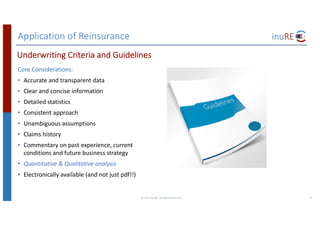
Core	Considerations:
• Accurate	and	transparent	data
• Clear	and	concise	information
• Detailed	statistics
• Consistent	approach
• Unambiguous	assumptions	
• Claims	history	
• Commentary	on	past	experience,	current	
conditions	and	future	business	strategy
• Quantitative	&	Qualitative	analysis
• Electronically	available	(and	not	just	pdf!!)
©	2017	inuRE.	All	rights	reserved.	 23
Underwriting	Criteria	and	Guidelines
Application	of	Reinsurance
Qualitative	factors:
• Client	business	strategy	and	positioning
• Underwriting	and	structural	changes
• Management	integrity	and	mutual	trust
• Above	or	below	average	historical	
performance
• Original	policy	terms	and	conditions
• Client	/	reinsurer	relationship
©	2017	inuRE.	All	rights	reserved.	 24
Underwriting	Criteria	and	Guidelines
Quantitative	analysis:
• Probabilistic	vs.	Deterministic	models
• Bespoke	models	vs.	3rd	party	Vendor	models
• Actual	experience	vs.	modelled	output
• Uncertainty	factors	(standard	deviation)
• Benchmarking
• “Unmodellable”	events	and	territories	– terrorism	(bio-chem),	
strikes,	riots	and	civil	commotion,	ice	storm,	volcanic	ash?
Application	of	Reinsurance
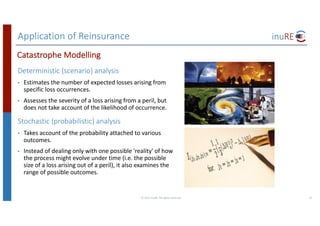
Deterministic	(scenario)	analysis
• Estimates	the	number	of	expected	losses	arising	from	
specific	loss	occurrences.
• Assesses	the	severity	of	a	loss	arising	from	a	peril,	but	
does	not	take	account	of	the	likelihood	of	occurrence.
Stochastic	(probabilistic)	analysis
• Takes	account	of	the	probability	attached	to	various	
outcomes.
• Instead	of	dealing	only	with	one	possible	'reality'	of	how	
the	process	might	evolve	under	time	(i.e.	the	possible	
size	of	a	loss	arising	out	of	a	peril),	it	also	examines	the	
range	of	possible	outcomes.
©	2017	inuRE.	All	rights	reserved.	 25
Catastrophe	Modelling
Application	of	Reinsurance
©	2017	inuRE.	All	rights	reserved.	 26
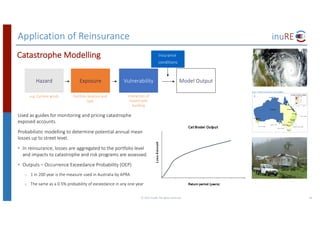
Hazard VulnerabilityExposure
e.g.	Cyclone	winds Portfolio	location	and	
type
Interaction	of	
hazard	with	
building
Model	Output
Insurance	
conditions
Used	as	guides	for	monitoring	and	pricing	catastrophe	
exposed	accounts.
Probabilistic	modelling	to	determine	potential	annual	mean	
losses	up	to	street	level.
• In	reinsurance,	losses	are	aggregated	to	the	portfolio	level	
and	impacts	to	catastrophe	and	risk	programs	are	assessed.
• Outputs	– Occurrence	Exceedance	Probability	(OEP)
o 1	in	200	year	is	the	measure	used	in	Australia	by	APRA
o The	same	as	a	0.5%	probability	of	exceedance	in	any	one	year
Catastrophe	Modelling
Application	of	Reinsurance
©	2017	inuRE.	All	rights	reserved.	 27
Some	Criteria:
• Solvency	&	rating
• Reputation
• Consistency
• User	friendliness
• Prices,	terms	and	conditions
• Claims	paying	willingness	and	ability
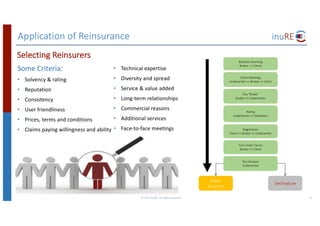
Selecting	Reinsurers
Business	Sourcing
Broker		>>	Client
Client	Meetings
Underwriter	>>	Broker	>>	Client
The	“Broke”
Broker	>>	Underwriter
Rating
Underwriter	>>	Modellers
Negotiation
Client	>>	Broker	>>	Underwriter
Firm	Order	Terms
Broker	>>	Client
The	Decision
Underwriter
Policy	
Issuance
Declinature
• Technical	expertise
• Diversity	and	spread
• Service	&	value	added
• Long-term	relationships	
• Commercial	reasons
• Additional	services
• Face-to-face	meetings
Application	of	Reinsurance
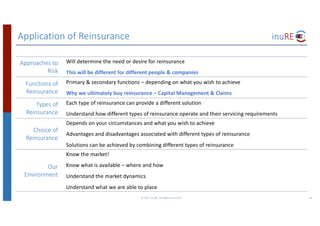
Approaches	to	
Risk
Will	determine	the	need	or	desire	for	reinsurance
This	will	be	different	for	different	people	&	companies
Functions	of	
Reinsurance
Primary	&	secondary	functions	– depending	on	what	you	wish	to	achieve
Why	we	ultimately	buy	reinsurance	– Capital	Management	&	Claims
Types	of	
Reinsurance
Each	type	of	reinsurance	can	provide	a	different	solution
Understand	how	different	types	of	reinsurance	operate	and	their	servicing	requirements
Choice	of	
Reinsurance
Depends	on	your	circumstances	and	what	you	wish	to	achieve
Advantages	and	disadvantages	associated	with	different	types	of	reinsurance
Solutions	can	be	achieved	by	combining	different	types	of	reinsurance
Our	
Environment
Know	the	market!
Know	what	is	available	– where	and	how
Understand	the	market	dynamics
Understand	what	we	are	able	to	place
©	2017	inuRE.	All	rights	reserved.	 28
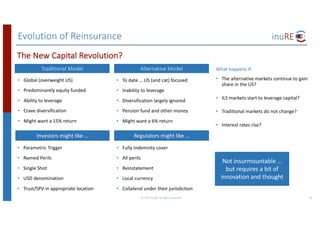
Evolution	of	Reinsurance
• Global	(overweight	US)
• Predominantly	equity	funded
• Ability	to	leverage
• Crave	diversification
• Might	want	a	15%	return
©	2017	inuRE.	All	rights	reserved.	 29
• To	date	…	US	(and	cat)	focused
• Inability	to	leverage
• Diversification	largely	ignored
• Pension	fund	and	other	money
• Might	want	a	6%	return
Traditional	Model Alternative	Model What	happens	if:
• The	alternative	markets	continue	to	gain	
share	in	the	US?
• ILS	markets	start	to	leverage	capital?
• Traditional	markets	do	not	change?
• Interest	rates	rise?
The	New	Capital	Revolution?
• Parametric	Trigger
• Named	Perils
• Single	Shot
• USD	denomination
• Trust/SPV	in	appropriate	location
Investors	might	like	… Regulators	might	like	…
• Fully	indemnity	cover
• All	perils
• Reinstatement
• Local	currency
• Collateral	under	their	jurisdiction
Not	insurmountable	…	
but	requires	a	bit	of	
innovation	and	thought
Evolution	of	Reinsurance
©	2017	inuRE.	All	rights	reserved.	 30
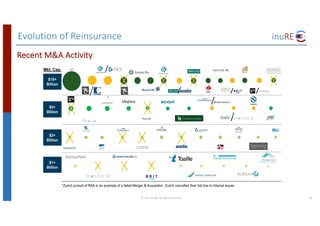
Recent	M&A	Activity
*Zurich pursuit of RSA is an example of a failed Merger & Acquisition. Zurich cancelled their bid due to internal issues
$10+
Billion
$5+
Billion
$2+
Billion
$1+
Billion
Mkt. Cap.
0
0
Evolution	of	Reinsurance
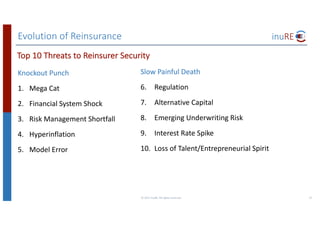
Knockout	Punch
1. Mega	Cat
2. Financial	System	Shock
3. Risk	Management	Shortfall
4. Hyperinflation
5. Model	Error
©	2017	inuRE.	All	rights	reserved.	 31
Top	10	Threats	to	Reinsurer	Security
Slow	Painful	Death
6. Regulation
7. Alternative	Capital
8. Emerging	Underwriting	Risk
9. Interest	Rate	Spike
10. Loss	of	Talent/Entrepreneurial	Spirit
Evolution	of	Reinsurance
©	2017	inuRE.	All	rights	reserved.	 32
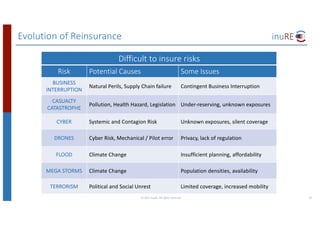
Difficult	to	insure	risks
Risk Potential	Causes Some	Issues
BUSINESS	
INTERRUPTION
Natural	Perils,	Supply	Chain failure Contingent	Business Interruption
CASUALTY	
CATASTROPHE
Pollution, Health	Hazard,	Legislation Under-reserving, unknown	exposures
CYBER Systemic	and	Contagion	Risk Unknown exposures,	silent	coverage
DRONES Cyber	Risk,	Mechanical	/	Pilot	error Privacy, lack	of	regulation
FLOOD Climate	Change Insufficient	planning, affordability
MEGA	STORMS Climate	Change Population densities,	availability
TERRORISM Political and	Social	Unrest Limited	coverage,	increased	mobility
Evolution	of	Reinsurance
©	2017	inuRE.	All	rights	reserved.	 33
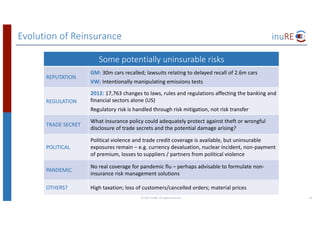
Some potentially	uninsurable	risks
REPUTATION
GM:	30m cars	recalled;	lawsuits	relating to	delayed	recall	of	2.6m	cars
VW:	Intentionally	manipulating	emissions	tests
REGULATION
2012:	17,763	changes	to	laws,	rules	and	regulations	affecting	the	banking	and	
financial	sectors	alone	(US)
Regulatory	risk	is	handled	through	risk	mitigation,	not	risk	transfer
TRADE	SECRET
What	insurance	policy could	adequately	protect against	theft	or	wrongful	
disclosure	of	trade	secrets	and	the	potential	damage	arising?
POLITICAL
Political	violence	and	trade	credit	coverage	is	available,	but	uninsurable	
exposures	remain – e.g.	currency	devaluation,	nuclear	incident,	non-payment	
of	premium,	losses	to	suppliers	/	partners	from	political	violence
PANDEMIC
No	real	coverage for	pandemic	flu	– perhaps	advisable	to	formulate	non-
insurance	risk	management	solutions
OTHERS? High	taxation; loss	of	customers/cancelled	orders;	material	prices
Evolution	of	Reinsurance
©	2017	inuRE.	All	rights	reserved.	 34
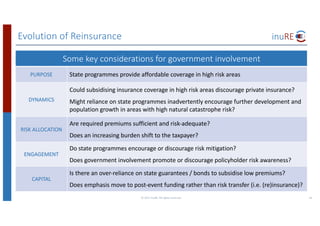
Some key	considerations	for	government	involvement
PURPOSE State	programmes	provide	affordable coverage	in	high	risk	areas
DYNAMICS
Could	subsidising insurance	coverage	in	high	risk	areas	discourage	private	insurance?	
Might	reliance	on	state	programmes	inadvertently	encourage	further	development	and	
population	growth	in	areas	with	high	natural	catastrophe	risk?
RISK	ALLOCATION
Are	required	premiums	sufficient and	risk-adequate?
Does	an	increasing	burden	shift	to	the	taxpayer?
ENGAGEMENT
Do	state	programmes	encourage	or	discourage risk	mitigation?	
Does	government	involvement	promote	or	discourage	policyholder	risk	awareness?
CAPITAL
Is	there	an	over-reliance on	state	guarantees	/	bonds	to	subsidise	low	premiums?	
Does	emphasis	move	to	post-event	funding	rather	than	risk	transfer	(i.e.	(re)insurance)?
Evolution	of	Reinsurance
©	2017	inuRE.	All	rights	reserved.	 35
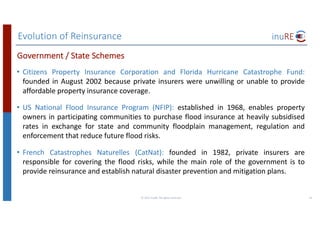
• Citizens Property Insurance Corporation and Florida Hurricane Catastrophe Fund:
founded in August 2002 because private insurers were unwilling or unable to provide
affordable property insurance coverage.
• US National Flood Insurance Program (NFIP): established in 1968, enables property
owners in participating communities to purchase flood insurance at heavily subsidised
rates in exchange for state and community floodplain management, regulation and
enforcement that reduce future flood risks.
• French Catastrophes Naturelles (CatNat): founded in 1982, private insurers are
responsible for covering the flood risks, while the main role of the government is to
provide reinsurance and establish natural disaster prevention and mitigation plans.
Government	/	State	Schemes
Evolution	of	Reinsurance
©	2017	inuRE.	All	rights	reserved.	 36
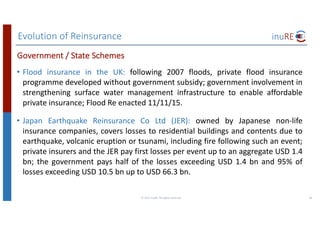
• Flood insurance in the UK: following 2007 floods, private flood insurance
programme developed without government subsidy; government involvement in
strengthening surface water management infrastructure to enable affordable
private insurance; Flood Re enacted 11/11/15.
• Japan Earthquake Reinsurance Co Ltd (JER): owned by Japanese non-life
insurance companies, covers losses to residential buildings and contents due to
earthquake, volcanic eruption or tsunami, including fire following such an event;
private insurers and the JER pay first losses per event up to an aggregate USD 1.4
bn; the government pays half of the losses exceeding USD 1.4 bn and 95% of
losses exceeding USD 10.5 bn up to USD 66.3 bn.
Government	/	State	Schemes
Evolution	of	Reinsurance
©	2017	inuRE.	All	rights	reserved.	 37
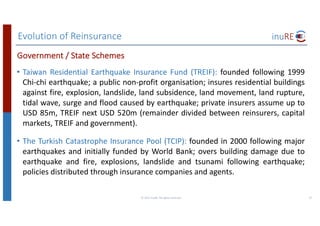
• Taiwan Residential Earthquake Insurance Fund (TREIF): founded following 1999
Chi-chi earthquake; a public non-profit organisation; insures residential buildings
against fire, explosion, landslide, land subsidence, land movement, land rupture,
tidal wave, surge and flood caused by earthquake; private insurers assume up to
USD 85m, TREIF next USD 520m (remainder divided between reinsurers, capital
markets, TREIF and government).
• The Turkish Catastrophe Insurance Pool (TCIP): founded in 2000 following major
earthquakes and initially funded by World Bank; overs building damage due to
earthquake and fire, explosions, landslide and tsunami following earthquake;
policies distributed through insurance companies and agents.
Government	/	State	Schemes
Evolution	of	Reinsurance
©	2017	inuRE.	All	rights	reserved.	 38
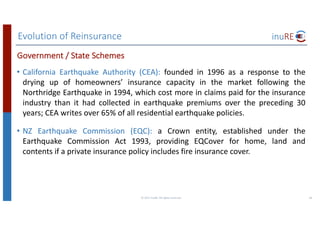
• California Earthquake Authority (CEA): founded in 1996 as a response to the
drying up of homeowners’ insurance capacity in the market following the
Northridge Earthquake in 1994, which cost more in claims paid for the insurance
industry than it had collected in earthquake premiums over the preceding 30
years; CEA writes over 65% of all residential earthquake policies.
• NZ Earthquake Commission (EQC): a Crown entity, established under the
Earthquake Commission Act 1993, providing EQCover for home, land and
contents if a private insurance policy includes fire insurance cover.
Government	/	State	Schemes
Evolution	of	Reinsurance
©	2017	inuRE.	All	rights	reserved.	 39
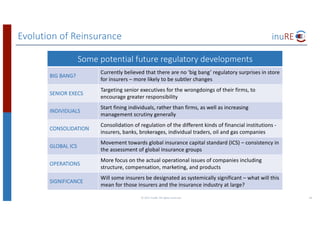
Some	potential future	regulatory	developments
BIG	BANG?
Currently believed	that	there	are	no	‘big	bang’	regulatory	surprises	in	store	
for	insurers	– more	likely	to	be	subtler	changes
SENIOR	EXECS
Targeting	senior	executives	for	the	wrongdoings	of	their	firms,	to	
encourage	greater	responsibility
INDIVIDUALS
Start	fining	individuals,	rather	than	firms,	as	well	as	increasing
management	scrutiny	generally
CONSOLIDATION
Consolidation	of	regulation	of	the	different	kinds	of	financial	institutions	-
insurers,	banks,	brokerages,	individual	traders,	oil	and	gas	companies
GLOBAL	ICS
Movement	towards global	insurance	capital	standard	(ICS)	– consistency	in	
the	assessment	of	global	insurance	groups
OPERATIONS
More	focus	on	the	actual	operational issues	of	companies	including	
structure,	compensation,	marketing,	and products
SIGNIFICANCE
Will some	insurers	be	designated	as	systemically	significant – what	will	this	
mean	for	those	insurers	and	the	insurance	industry	at large?
Evolution	of	Reinsurance
©	2017	inuRE.	All	rights	reserved.	 40
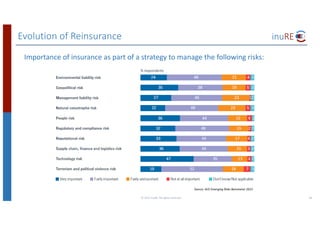
Importance	of	insurance	as	part	of	a	strategy	to	manage	the	following	risks:
Source:	ACE	Emerging	Risks	Barometer	2015
Evolution	of	Reinsurance
©	2017	inuRE.	All	rights	reserved.	 41
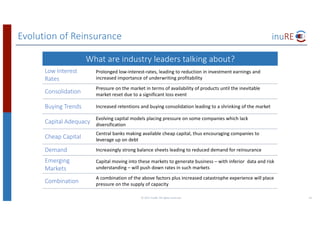
What	are	industry leaders	talking	about?
Low	Interest	
Rates
Prolonged	low-interest-rates, leading	to	reduction	in	investment	earnings	and	
increased	importance	of	underwriting	profitability
Consolidation
Pressure	on	the	market	in	terms	of	availability	of	products	until	the	inevitable	
market	reset	due	to	a	significant	loss	event
Buying	Trends Increased	retentions and	buying	consolidation	leading	to	a	shrinking	of	the	market
Capital	Adequacy
Evolving capital	models	placing	pressure	on	some	companies	which	lack	
diversification
Cheap	Capital
Central	banks	making	available	cheap	capital, thus	encouraging	companies	to	
leverage	up	on	debt
Demand Increasingly	strong	balance sheets	leading	to	reduced	demand	for	reinsurance
Emerging	
Markets
Capital	moving	into	these	markets	to	generate	business	– with	inferior	 data	and	risk	
understanding	– will	push	down	rates	in	such	markets
Combination
A	combination	of	the above	factors	plus	increased	catastrophe	experience	will	place	
pressure	on	the	supply	of	capacity
Evolution	of	Reinsurance
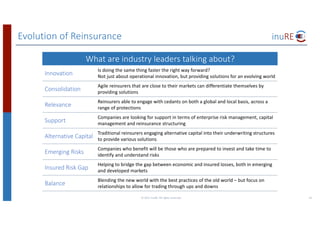
What	are	industry leaders	talking	about?
Innovation
Is	doing	the	same	thing	faster the	right	way	forward?	
Not	just	about	operational	innovation,	but	providing	solutions	for	an	evolving	world
Consolidation
Agile	reinsurers	that	are	close	to	their	markets	can	differentiate	themselves	by	
providing	solutions
Relevance
Reinsurers	able	to	engage with	cedants	on	both	a	global	and	local	basis,	across	a	
range	of	protections
Support
Companies	are	looking	for	support	in	terms of	enterprise	risk	management,	capital	
management and	reinsurance	structuring
Alternative	Capital
Traditional reinsurers	engaging	alternative	capital	into	their	underwriting	structures	
to	provide	various	solutions
Emerging	Risks
Companies who	benefit	will	be	those	who	are	prepared	to	invest	and	take	time	to	
identify	and	understand	risks
Insured	Risk	Gap
Helping to	bridge	the	gap	between	economic	and	insured	losses,	both	in	emerging	
and	developed	markets
Balance
Blending	the	new	world	with	the	best	practices of	the	old	world	– but	focus	on	
relationships	to	allow	for	trading	through	ups	and	downs
©	2017	inuRE.	All	rights	reserved.	 42
Evolution	of	Reinsurance
©	2017	inuRE.	All	rights	reserved.	 43
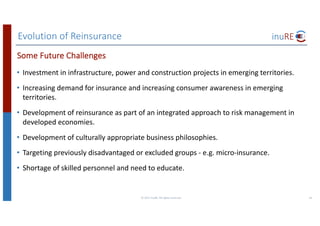
• Investment	in	infrastructure,	power	and	construction	projects	in	emerging	territories.
• Increasing	demand	for	insurance	and	increasing	consumer	awareness	in	emerging	
territories.
• Development	of	reinsurance	as	part	of	an	integrated	approach	to	risk	management	in	
developed	economies.
• Development	of	culturally	appropriate	business	philosophies.
• Targeting	previously	disadvantaged	or	excluded	groups	- e.g.	micro-insurance.
• Shortage	of	skilled	personnel	and	need	to	educate.
Some	Future	Challenges
Sources	&	Acknowledgements
44©	2017	inuRE.	All	rights	reserved.	
§ DLA	Piper:	IUA	Market	Briefing	(March	2013)
§ https://agenda.weforum.org/2014/10/regulations-global-insurance-industry-systemic-risk/
§ https://crawford.anu.edu.au/sites/default/files/events/attachments/201607/pacific_islands_climate_change_insurance_facility_anu.pdf
§ KPMG:	Evolving	Insurance	Regulation	(April		2015)
§ Lloyd’s	of	London
§ “Making	a	Market	for	Acts	of	God:	The	practice	of	risk-trading	in	the	global	reinsurance	industry”	(Paula	Jarzabkowski)
§ Munich	Re
§ OCHA
§ Swiss	Re
§ The	United	Nations	Office	for	Disaster	Risk	Reduction	(UNIISDR)
§ The	World	Economic	Forum:	Global	Risks	2015	report
§ Willis	Re
§ www.carriermanagement.com
§ www.ey.com/GL/en/Industries/Financial-Services/Insurance/Business-Pulse--top-10-risks-and-opportunities-2013-15
§ www.riskandinsurance.com/top-five-uninsurable-risks/
§ www.standardandpoors.com/ratingsdirect
§ www.strategic-risk-global.com
Disclaimer
45©	2017	inuRE.	All	rights	reserved.	
This analysis has been prepared by inuRE Reinsurance Training & Solutions (“inuRE”) on condition that it shall be treated as strictly confidential and shall not be communicated in whole, in part, or in
summary to any third party without written consent from inuRE.
inuRE has relied upon data from public and/or other sources when preparing this analysis. No attempt has been made to verify independently the accuracy of this data. inuRE does not represent or
otherwise guarantee the accuracy or completeness of such data nor assume responsibility for the result of any error or omission in the data or other materials gathered from any source in the preparation
of this analysis. inuRE shall have no liability in connection with any results, including, without limitation, those arising from based upon or in connection with errors, omissions, inaccuracies, or inadequacies
associated with the data or arising from, based upon or in connection with any methodologies used or applied by inuRE in producing this analysis or any results contained herein. inuRE expressly disclaims
any and all liability arising from, based upon or in connection with this analysis. inuRE assumes no duty in contract, tort or otherwise to any party arising from, based upon or in connection with this analysis,
and no party should expect inuRE to owe it any such duty.
There are many uncertainties inherent in this analysis including, but not limited to, issues such as limitations in the available data, reliance on client data and outside data sources, the underlying volatility of
loss and other random processes, uncertainties that characterize the application of professional judgment in estimates and assumptions, etc. Ultimate losses, liabilities and claims depend upon future
contingent events, including but not limited to unanticipated changes in inflation, laws, and regulations. As a result of these uncertainties, the actual outcomes could vary significantly from inuRE’s
estimates in either direction. inuRE makes no representation about and does not guarantee the outcome, results, success, or profitability of any insurance or reinsurance program or venture, whether or
not the analyses or conclusions contained herein apply to such program or venture.
inuRE does not recommend making decisions based solely on the information contained in this analysis. Rather, this analysis should be viewed as a supplement to other information, including specific
business practice, claims experience, and financial situation. Independent professional advisors should be consulted with respect to the issues and conclusions presented herein and their possible
application. inuRE makes no representation or warranty as to the accuracy or completeness of this document and its contents.
This analysis is not intended to be a complete actuarial communication, and as such is not intended to be relied upon.
inuRE does not provide legal, accounting, or tax advice. This analysis does not constitute, is not intended to provide, and should not be construed as such advice. Qualified advisers should be consulted in
these areas.
inuRE makes no representation, does not guarantee and assumes no liability for the accuracy or completeness of, or any results obtained by application of, this analysis and conclusions provided herein.
Where data is supplied by way of CD or other electronic format, inuRE accepts no liability for any loss or damage caused to the Recipient directly or indirectly through use of any such CD or other electronic
format, even where caused by negligence. Without limitation, inuRE shall not be liable for: loss or corruption of data, damage to any computer or communications system, indirect or consequential losses.
The Recipient should take proper precautions to prevent loss or damage – including the use of a virus checker.
This limitation of liability does not apply to losses or damage caused by death, personal injury, dishonesty or any other liability which cannot be excluded by law.
Acceptance of this document shall be deemed agreement to the above.

‘Reinsurance & the Pacific Region – additional information’