Enterprise Governance, Risk and Compliance 
Athens 12 November 2014 
Living and Working in a Riskier World 
Julia Graham 
President of FERMA
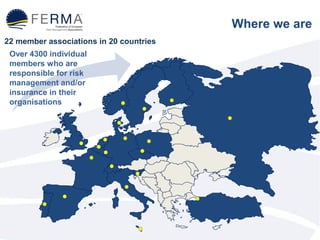
Where we are 
22 member associations in 20 countries 
Over 4300 individual 
members who are 
responsible for risk 
management and/or 
insurance in their 
organisations
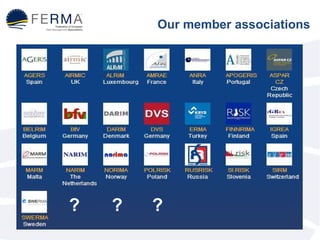
Our member associations 
? ? ?
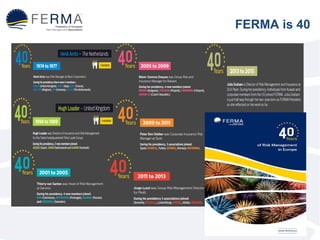
FERMA is 40
Our focus
World Economic Forum – Global Risk Report 2014 
The 10 risks of highest concern to respondents are: 
1. Fiscal crises in key economies 
2. Structurally high unemployment/underemployment 
3. Water crises 
4. Severe income disparity 
5. Failure of climate change mitigation and adaptation 
6. Greater incidence of extreme weather events 
7. Global governance failure 
8. Food crises 
9. Failure of a major financial mechanism/institution 
10. Profound political and social instability 
Source: World Economic Forum, Global Risks 2014
Which of these risks appear on corporate risk maps? 
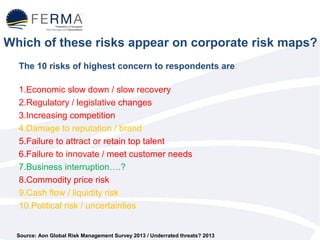
The 10 risks of highest concern to respondents are: 
1.Economic slow down / slow recovery 
2.Regulatory / legislative changes 
3.Increasing competition 
4.Damage to reputation / brand 
5.Failure to attract or retain top talent 
6.Failure to innovate / meet customer needs 
7.Business interruption 
8.Commodity price risk 
9.Cash flow / liquidity risk 
10.Political risk / uncertainties 
Source: Aon Global Risk Management Survey 2013 / Underrated threats? 2013
Which of these risks appear on corporate risk maps? 
The 10 risks of highest concern to respondents are: 
1.Economic slow down / slow recovery 
2.Regulatory / legislative changes 
3.Increasing competition 
4.Damage to reputation / brand 
5.Failure to attract or retain top talent 
6.Failure to innovate / meet customer needs 
7.Business interruption….? 
8.Commodity price risk 
9.Cash flow / liquidity risk 
10.Political risk / uncertainties 
Source: Aon Global Risk Management Survey 2013 / Underrated threats? 2013
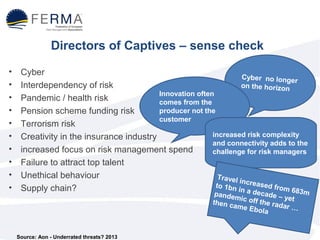
Directors of Captives – sense check 
• Cyber 
• Interdependency of risk 
• Pandemic / health risk 
• Pension scheme funding risk 
• Terrorism risk 
• Creativity in the insurance industry 
• increased focus on risk management spend 
• Failure to attract top talent 
• Unethical behaviour 
• Supply chain? 
Source: Aon - Underrated threats? 2013 
Cyber no longer 
on the horizon 
Innovation often 
comes from the 
producer not the 
customer 
increased risk complexity 
and connectivity adds to the 
challenge for risk managers 
Travel increased from 683m 
to 1bn in a decade – yet 
pandemic off the radar … 
then came Ebola
No risk is an island 
10
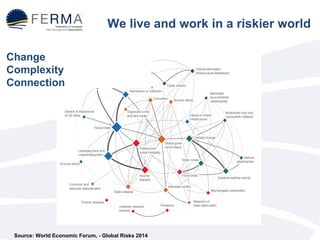
We live and work in a riskier world 
Graphic to be 
replaced 
Change 
Complexity 
Connection 
Source: World Economic Forum, - Global Risks 2014
Global risks are beyond normal Board activities 
• Corporate risk maps tend to focus on risk where the company 
has some control 
• These risks are big and catastrophic 
• It is not clear how Boards should tackle these risks 
• Do they have the know-how? 
• Yet the Board is best placed to manage them
Managing Global Risks 
• Focus on impacts, outcomes and consequences for your 
operations, not the risks themselves 
• Check critical dependencies 
• Check and reinforce contingency planning and crisis 
management capabilities 
• Improve your risk radar throughout your extended network 
• Focus on agility
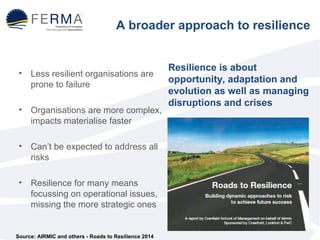
A broader approach to resilience 
Resilience is about 
opportunity, adaptation and 
evolution as well as managing 
disruptions and crises 
• Less resilient organisations are 
prone to failure 
• Organisations are more complex, 
impacts materialise faster 
• Can’t be expected to address all 
risks 
• Resilience for many means 
focussing on operational issues, 
missing the more strategic ones 
Source: AIRMIC and others - Roads to Resilience 2014
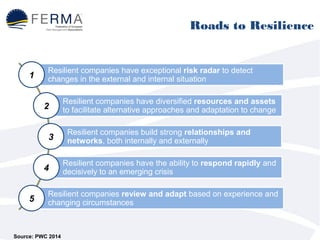
Roads to Resilience 
Resilient companies have exceptional risk radar to detect 
changes 1 in the external and internal situation 
Resilient companies have diversified resources and assets 
2 to facilitate alternative approaches and adaptation to change 
Resilient companies build strong relationships and 
3 networks, both internally and externally 
Resilient companies have the ability to respond rapidly and 
4 decisively to an emerging crisis 
Resilient companies review and adapt based on experience and 
5 changing circumstances 
Source: PWC 2014
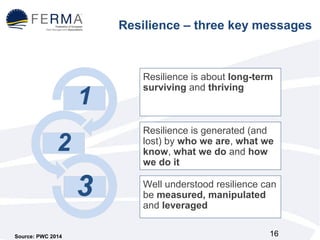
Resilience – three key messages 
Resilience is about long-term 
surviving and thriving 
Resilience is generated (and 
lost) by who we are, what we 
know, what we do and how 
we do it 
Well understood resilience can 
be measured, manipulated 
and leveraged 
16 
Source: PWC 2014
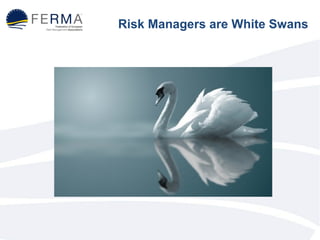
Risk Managers are White Swans
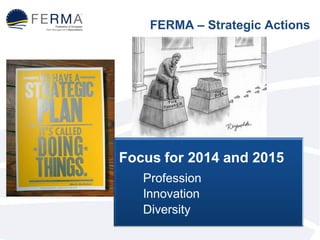
FERMA – Strategic Actions
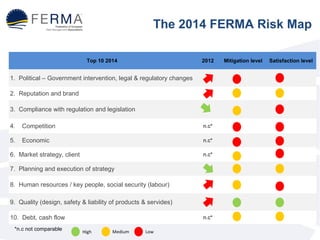
The 2014 FERMA Risk Map 
Top 10 2014 2012 Mitigation level Satisfaction level 
1. Political – Government intervention, legal & regulatory changes 
2. Reputation and brand 
3. Compliance with regulation and legislation 
4. Competition n.c* 
5. Economic n.c* 
6. Market strategy, client n.c* 
7. Planning and execution of strategy 
8. Human resources / key people, social security (labour) 
9. Quality (design, safety & liability of products & servides) 
10. Debt, cash flow n.c* 
*n.c not comparable High Medium Low
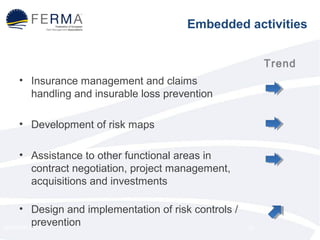
Embedded activities 
• Insurance management and claims 
handling and insurable loss prevention 
• Development of risk maps 
• Assistance to other functional areas in 
contract negotiation, project management, 
acquisitions and investments 
• Design and implementation of risk controls / 
prevention 
SEMINAR 2014 20 
Trend
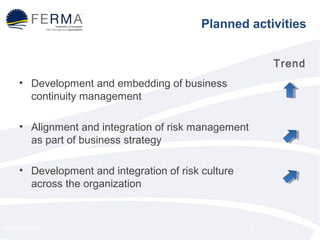
Planned activities 
• Development and embedding of business 
continuity management 
• Alignment and integration of risk management 
as part of business strategy 
• Development and integration of risk culture 
across the organization 
SEMINAR 2014 21 
Trend
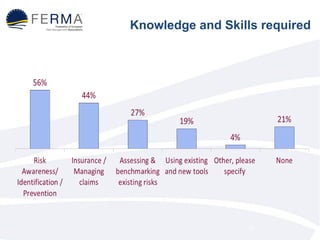
Knowledge and Skills required 
22
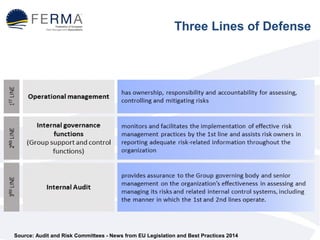
Three Lines of Defense 
Source: Audit and Risk Committees - News from EU Legislation and Best Practices 2014
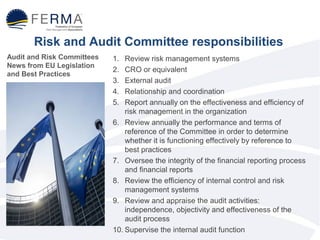
Risk and Audit Committee responsibilities 
1. Review risk management systems 
2. CRO or equivalent 
3. External audit 
4. Relationship and coordination 
5. Report annually on the effectiveness and efficiency of 
risk management in the organization 
6. Review annually the performance and terms of 
reference of the Committee in order to determine 
whether it is functioning effectively by reference to 
best practices 
7. Oversee the integrity of the financial reporting process 
and financial reports 
8. Review the efficiency of internal control and risk 
management systems 
9. Review and appraise the audit activities: 
independence, objectivity and effectiveness of the 
audit process 
10. Supervise the internal audit function 
Audit and Risk Committees 
News from EU Legislation 
and Best Practices
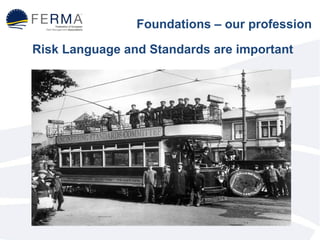
Foundations – our profession 
Risk Language and Standards are important
Many use COSO ERM and ISO 31000 
COSO ISO 31000 
Lengthy vs. Short 
Focused on ERM vs. General approach to managing risk 
One cube vs. Framework and process 
Skewed to negative vs. Risk can be positive or negative 
Risk already exists vs. Risk tied to achieving objectives 
Risk & opportunities vs. Opportunities also source of risk 
More sequential process vs. More iterative process 
… Concepts not aligned
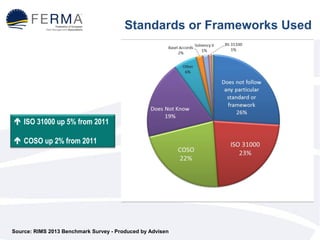
Standards or Frameworks Used 
ISO 31000 up 5% from 2011 
COSO up 2% from 2011 
Source: RIMS 2013 Benchmark Survey - Produced by Advisen
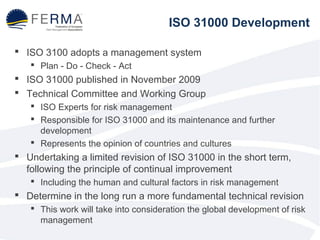
ISO 31000 Development 
 ISO 3100 adopts a management system 
 Plan - Do - Check - Act 
 ISO 31000 published in November 2009 
 Technical Committee and Working Group 
 ISO Experts for risk management 
 Responsible for ISO 31000 and its maintenance and further 
development 
 Represents the opinion of countries and cultures 
 Undertaking a limited revision of ISO 31000 in the short term, 
following the principle of continual improvement 
 Including the human and cultural factors in risk management 
 Determine in the long run a more fundamental technical revision 
 This work will take into consideration the global development of risk 
management
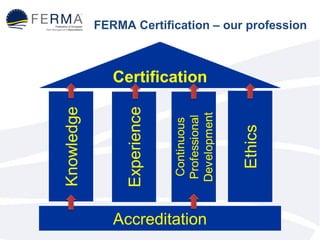
FERMA Certification – our profession
Innovation – our needs 
• A frequently used word at cocktail parties 
• Innovation is not invention 
• We live and work in a riskier world 
• Organizations need solutions for the conventional and unconventional 
• Are insurers up to the challenge? 
• Are brokers up to the challenge? 
• Are we up to the challenge? 
"It’s about the people you have, how you are 
led, and how much you get it" 
Steve Jobs
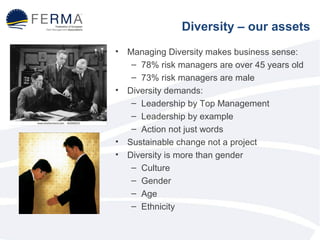
• Managing Diversity makes business sense: 
– 78% risk managers are over 45 years old 
– 73% risk managers are male 
• Diversity demands: 
– Leadership by Top Management 
– Leadership by example 
– Action not just words 
• Sustainable change not a project 
• Diversity is more than gender 
– Culture 
– Gender 
– Age 
– Ethnicity 
Diversity – our assets
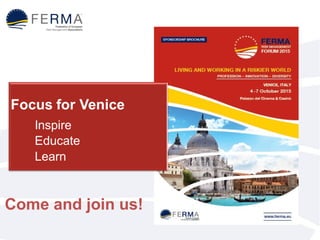
Come and join us!
Any Questions? 
33

FERMA presentation at Athens conference

  • 1.
    Enterprise Governance, Riskand Compliance Athens 12 November 2014 Living and Working in a Riskier World Julia Graham President of FERMA
  • 2.
    Where we are 22 member associations in 20 countries Over 4300 individual members who are responsible for risk management and/or insurance in their organisations
  • 3.
  • 4.
  • 5.
  • 6.
    World Economic Forum– Global Risk Report 2014 The 10 risks of highest concern to respondents are: 1. Fiscal crises in key economies 2. Structurally high unemployment/underemployment 3. Water crises 4. Severe income disparity 5. Failure of climate change mitigation and adaptation 6. Greater incidence of extreme weather events 7. Global governance failure 8. Food crises 9. Failure of a major financial mechanism/institution 10. Profound political and social instability Source: World Economic Forum, Global Risks 2014
  • 7.
    Which of theserisks appear on corporate risk maps? The 10 risks of highest concern to respondents are: 1.Economic slow down / slow recovery 2.Regulatory / legislative changes 3.Increasing competition 4.Damage to reputation / brand 5.Failure to attract or retain top talent 6.Failure to innovate / meet customer needs 7.Business interruption 8.Commodity price risk 9.Cash flow / liquidity risk 10.Political risk / uncertainties Source: Aon Global Risk Management Survey 2013 / Underrated threats? 2013
  • 8.
    Which of theserisks appear on corporate risk maps? The 10 risks of highest concern to respondents are: 1.Economic slow down / slow recovery 2.Regulatory / legislative changes 3.Increasing competition 4.Damage to reputation / brand 5.Failure to attract or retain top talent 6.Failure to innovate / meet customer needs 7.Business interruption….? 8.Commodity price risk 9.Cash flow / liquidity risk 10.Political risk / uncertainties Source: Aon Global Risk Management Survey 2013 / Underrated threats? 2013
  • 9.
    Directors of Captives– sense check • Cyber • Interdependency of risk • Pandemic / health risk • Pension scheme funding risk • Terrorism risk • Creativity in the insurance industry • increased focus on risk management spend • Failure to attract top talent • Unethical behaviour • Supply chain? Source: Aon - Underrated threats? 2013 Cyber no longer on the horizon Innovation often comes from the producer not the customer increased risk complexity and connectivity adds to the challenge for risk managers Travel increased from 683m to 1bn in a decade – yet pandemic off the radar … then came Ebola
  • 10.
    No risk isan island 10
  • 11.
    We live andwork in a riskier world Graphic to be replaced Change Complexity Connection Source: World Economic Forum, - Global Risks 2014
  • 12.
    Global risks arebeyond normal Board activities • Corporate risk maps tend to focus on risk where the company has some control • These risks are big and catastrophic • It is not clear how Boards should tackle these risks • Do they have the know-how? • Yet the Board is best placed to manage them
  • 13.
    Managing Global Risks • Focus on impacts, outcomes and consequences for your operations, not the risks themselves • Check critical dependencies • Check and reinforce contingency planning and crisis management capabilities • Improve your risk radar throughout your extended network • Focus on agility
  • 14.
    A broader approachto resilience Resilience is about opportunity, adaptation and evolution as well as managing disruptions and crises • Less resilient organisations are prone to failure • Organisations are more complex, impacts materialise faster • Can’t be expected to address all risks • Resilience for many means focussing on operational issues, missing the more strategic ones Source: AIRMIC and others - Roads to Resilience 2014
  • 15.
    Roads to Resilience Resilient companies have exceptional risk radar to detect changes 1 in the external and internal situation Resilient companies have diversified resources and assets 2 to facilitate alternative approaches and adaptation to change Resilient companies build strong relationships and 3 networks, both internally and externally Resilient companies have the ability to respond rapidly and 4 decisively to an emerging crisis Resilient companies review and adapt based on experience and 5 changing circumstances Source: PWC 2014
  • 16.
    Resilience – threekey messages Resilience is about long-term surviving and thriving Resilience is generated (and lost) by who we are, what we know, what we do and how we do it Well understood resilience can be measured, manipulated and leveraged 16 Source: PWC 2014
  • 17.
    Risk Managers areWhite Swans
  • 18.
  • 19.
    The 2014 FERMARisk Map Top 10 2014 2012 Mitigation level Satisfaction level 1. Political – Government intervention, legal & regulatory changes 2. Reputation and brand 3. Compliance with regulation and legislation 4. Competition n.c* 5. Economic n.c* 6. Market strategy, client n.c* 7. Planning and execution of strategy 8. Human resources / key people, social security (labour) 9. Quality (design, safety & liability of products & servides) 10. Debt, cash flow n.c* *n.c not comparable High Medium Low
  • 20.
    Embedded activities •Insurance management and claims handling and insurable loss prevention • Development of risk maps • Assistance to other functional areas in contract negotiation, project management, acquisitions and investments • Design and implementation of risk controls / prevention SEMINAR 2014 20 Trend
  • 21.
    Planned activities •Development and embedding of business continuity management • Alignment and integration of risk management as part of business strategy • Development and integration of risk culture across the organization SEMINAR 2014 21 Trend
  • 22.
  • 23.
    Three Lines ofDefense Source: Audit and Risk Committees - News from EU Legislation and Best Practices 2014
  • 24.
    Risk and AuditCommittee responsibilities 1. Review risk management systems 2. CRO or equivalent 3. External audit 4. Relationship and coordination 5. Report annually on the effectiveness and efficiency of risk management in the organization 6. Review annually the performance and terms of reference of the Committee in order to determine whether it is functioning effectively by reference to best practices 7. Oversee the integrity of the financial reporting process and financial reports 8. Review the efficiency of internal control and risk management systems 9. Review and appraise the audit activities: independence, objectivity and effectiveness of the audit process 10. Supervise the internal audit function Audit and Risk Committees News from EU Legislation and Best Practices
  • 25.
    Foundations – ourprofession Risk Language and Standards are important
  • 26.
    Many use COSOERM and ISO 31000 COSO ISO 31000 Lengthy vs. Short Focused on ERM vs. General approach to managing risk One cube vs. Framework and process Skewed to negative vs. Risk can be positive or negative Risk already exists vs. Risk tied to achieving objectives Risk & opportunities vs. Opportunities also source of risk More sequential process vs. More iterative process … Concepts not aligned
  • 27.
    Standards or FrameworksUsed ISO 31000 up 5% from 2011 COSO up 2% from 2011 Source: RIMS 2013 Benchmark Survey - Produced by Advisen
  • 28.
    ISO 31000 Development  ISO 3100 adopts a management system  Plan - Do - Check - Act  ISO 31000 published in November 2009  Technical Committee and Working Group  ISO Experts for risk management  Responsible for ISO 31000 and its maintenance and further development  Represents the opinion of countries and cultures  Undertaking a limited revision of ISO 31000 in the short term, following the principle of continual improvement  Including the human and cultural factors in risk management  Determine in the long run a more fundamental technical revision  This work will take into consideration the global development of risk management
  • 29.
  • 30.
    Innovation – ourneeds • A frequently used word at cocktail parties • Innovation is not invention • We live and work in a riskier world • Organizations need solutions for the conventional and unconventional • Are insurers up to the challenge? • Are brokers up to the challenge? • Are we up to the challenge? "It’s about the people you have, how you are led, and how much you get it" Steve Jobs
  • 31.
    • Managing Diversitymakes business sense: – 78% risk managers are over 45 years old – 73% risk managers are male • Diversity demands: – Leadership by Top Management – Leadership by example – Action not just words • Sustainable change not a project • Diversity is more than gender – Culture – Gender – Age – Ethnicity Diversity – our assets
  • 32.
  • 33.

Editor's Notes

  • #3 4 permanent staff in Brussels. Close relationship with the European Institutions and major representations of the insurance industry in Brussels.
  • #18 Be Like A Swan. Stay calm on the surface – keep everything running smoothly and delivering services to the level expected To do this – you need to paddle like hell underneath Partner and fee earners may not always see – or recognise – how hard we're working, but I can assure you, they'll soon notice it if we stop paddling fast enough to deliver the services required to keep the business afloat. So if no one else says thanks for everything you do – on behalf of the firm – thank you!
  • #19 It’s great to have a good strategy, but it’s nothing if we don’t implement it. So what happens next? What do we do with the Strategic Framework?
  • #30 IMPLEMENTATION PROCESSES: business model, legal structure, certification & accreditation processes, administrative structure