Wind TurbinesBy: Ahmed Yehya Mohamed MohamedSameh MohamedMohamed MahmoudMoustafaMina FaragAdlyMohamed Anwar
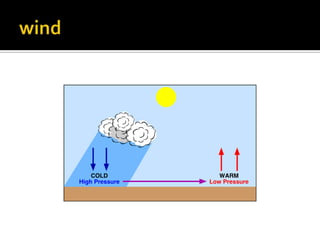
wind
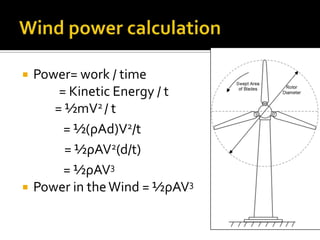
Wind power calculationPower= work / time             = Kinetic Energy / t             = ½mV2 / t                = ½(ρAd)V2/t = ½ρAV2(d/t)                = ½ρAV3Power in the Wind = ½ρAV3
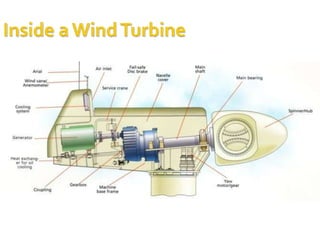
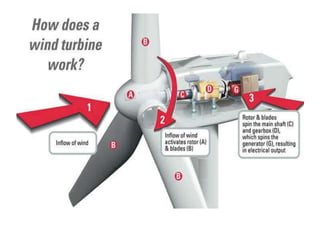
Inside a Wind Turbine
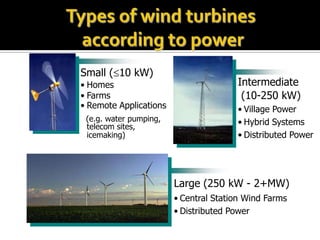
Types of wind turbines according to powerSmall (10 kW)Homes
Farms
Remote Applications(e.g. water pumping, telecom sites, icemaking)Intermediate (10-250 kW)Village Power
Hybrid Systems
Distributed PowerLarge (250 kW - 2+MW)Central Station Wind Farms
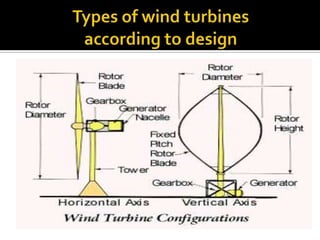
Distributed PowerTypes of wind turbinesaccording to design
Horizontal axis turbinesadvantagesVariable blade pitch, which gives the turbine blades the optimum angle of attackThe tall tower base allows access to stronger wind in sites with wind shear.High efficiency, since the blades always move perpendicularly to the wind, receiving power through the whole rotation.disadvantagesTall towers and blades up to 90 meters long are difficult to transport. Transportation can now cost 20% of equipment costs.Tall HAWTs are difficult to install, needing very tall and expensive cranes and skilled operatorsMassive tower construction is required to support the heavy blades, gearbox, and generator
Vertical Axis TurbinesAdvantagesOmnidirectionalAccepts wind from any angleComponents can be mounted at ground levelEase of serviceLighter weight towersCan theoretically use less materials to capture the same amount of windDisadvantagesRotors generally near ground where wind poorerCentrifugal force stresses bladesPoor self-starting capabilitiesRequires support at top of turbine rotorRequires entire rotor to be removed to replace bearingsOverall poor performance and reliabilityHave never been commercially successful
Vertical Axis TurbinesadvantagesOmnidirectionalAccepts wind from any angleComponents can be mounted at ground levelEase of serviceLighter weight towersCan theoretically use less materials to capture the same amount of windDisadvantagesRotors generally near ground where wind poorerCentrifugal force stresses bladesPoor self-starting capabilitiesRequires support at top of turbine rotorRequires entire rotor to be removed to replace bearingsOverall poor performance and reliabilityHave never been commercially successful
Classification according to number of blades
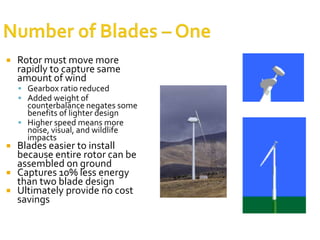
Number of Blades – OneRotor must move more rapidly to capture same amount of windGearbox ratio reducedAdded weight of counterbalance negates some benefits of lighter designHigher speed means more noise, visual, and wildlife impactsBlades easier to install because entire rotor can be assembled on groundCaptures 10% less energy than two blade designUltimately provide no cost savings
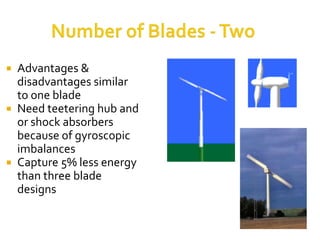
Number of Blades - TwoAdvantages & disadvantages similar to one bladeNeed teetering hub and or shock absorbers because of gyroscopic imbalancesCapture 5% less energy than three blade designs
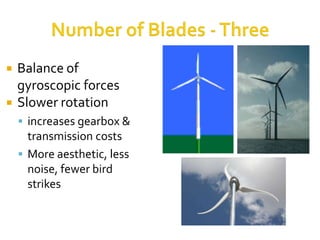
Number of Blades - ThreeBalance of gyroscopic forcesSlower rotationincreases gearbox & transmission costsMore aesthetic, less noise, fewer bird strikes
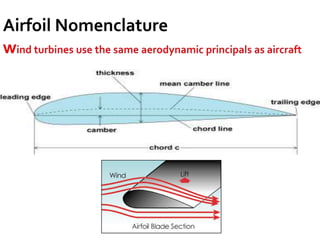
Airfoil Nomenclaturewind turbines use the same aerodynamic principals as aircraft
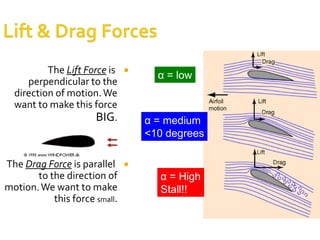
Lift & Drag ForcesThe Lift Force is perpendicular to the direction of motion. We want to make this force BIG.The Drag Force is parallel to the direction of motion. We want to make this force small.α = lowα = medium<10 degreesα = HighStall!!
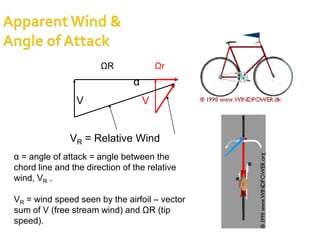
ΩRΩrαVVVR = Relative WindApparent Wind & Angle of Attackα = angle of attack = angle between the chord line and the direction of the relative wind, VR .VR = wind speed seen by the airfoil – vector sum of V (free stream wind) and ΩR (tip speed).
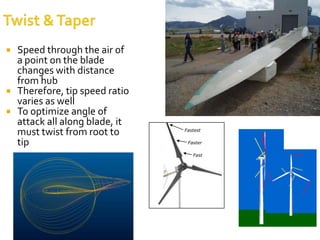
Twist & TaperSpeed through the air of a point on the blade changes with distance from hubTherefore, tip speed ratio varies as wellTo optimize angle of attack all along blade, it must twist from root to tipFastestFasterFast
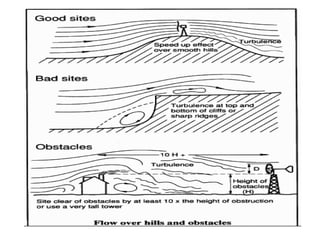
Wind turbines sites

Wind Turbine

  • 1.
    Wind TurbinesBy: AhmedYehya Mohamed MohamedSameh MohamedMohamed MahmoudMoustafaMina FaragAdlyMohamed Anwar
  • 2.
  • 3.
    Wind power calculationPower=work / time = Kinetic Energy / t = ½mV2 / t = ½(ρAd)V2/t = ½ρAV2(d/t) = ½ρAV3Power in the Wind = ½ρAV3
  • 4.
  • 6.
    Types of windturbines according to powerSmall (10 kW)Homes
  • 7.
  • 8.
    Remote Applications(e.g. waterpumping, telecom sites, icemaking)Intermediate (10-250 kW)Village Power
  • 9.
  • 10.
    Distributed PowerLarge (250kW - 2+MW)Central Station Wind Farms
  • 11.
    Distributed PowerTypes ofwind turbinesaccording to design
  • 12.
    Horizontal axis turbinesadvantagesVariableblade pitch, which gives the turbine blades the optimum angle of attackThe tall tower base allows access to stronger wind in sites with wind shear.High efficiency, since the blades always move perpendicularly to the wind, receiving power through the whole rotation.disadvantagesTall towers and blades up to 90 meters long are difficult to transport. Transportation can now cost 20% of equipment costs.Tall HAWTs are difficult to install, needing very tall and expensive cranes and skilled operatorsMassive tower construction is required to support the heavy blades, gearbox, and generator
  • 13.
    Vertical Axis TurbinesAdvantagesOmnidirectionalAcceptswind from any angleComponents can be mounted at ground levelEase of serviceLighter weight towersCan theoretically use less materials to capture the same amount of windDisadvantagesRotors generally near ground where wind poorerCentrifugal force stresses bladesPoor self-starting capabilitiesRequires support at top of turbine rotorRequires entire rotor to be removed to replace bearingsOverall poor performance and reliabilityHave never been commercially successful
  • 14.
    Vertical Axis TurbinesadvantagesOmnidirectionalAcceptswind from any angleComponents can be mounted at ground levelEase of serviceLighter weight towersCan theoretically use less materials to capture the same amount of windDisadvantagesRotors generally near ground where wind poorerCentrifugal force stresses bladesPoor self-starting capabilitiesRequires support at top of turbine rotorRequires entire rotor to be removed to replace bearingsOverall poor performance and reliabilityHave never been commercially successful
  • 15.
  • 16.
    Number of Blades– OneRotor must move more rapidly to capture same amount of windGearbox ratio reducedAdded weight of counterbalance negates some benefits of lighter designHigher speed means more noise, visual, and wildlife impactsBlades easier to install because entire rotor can be assembled on groundCaptures 10% less energy than two blade designUltimately provide no cost savings
  • 17.
    Number of Blades- TwoAdvantages & disadvantages similar to one bladeNeed teetering hub and or shock absorbers because of gyroscopic imbalancesCapture 5% less energy than three blade designs
  • 18.
    Number of Blades- ThreeBalance of gyroscopic forcesSlower rotationincreases gearbox & transmission costsMore aesthetic, less noise, fewer bird strikes
  • 19.
    Airfoil Nomenclaturewind turbinesuse the same aerodynamic principals as aircraft
  • 20.
    Lift & DragForcesThe Lift Force is perpendicular to the direction of motion. We want to make this force BIG.The Drag Force is parallel to the direction of motion. We want to make this force small.α = lowα = medium<10 degreesα = HighStall!!
  • 21.
    ΩRΩrαVVVR = RelativeWindApparent Wind & Angle of Attackα = angle of attack = angle between the chord line and the direction of the relative wind, VR .VR = wind speed seen by the airfoil – vector sum of V (free stream wind) and ΩR (tip speed).
  • 22.
    Twist & TaperSpeedthrough the air of a point on the blade changes with distance from hubTherefore, tip speed ratio varies as wellTo optimize angle of attack all along blade, it must twist from root to tipFastestFasterFast
  • 23.