Heading heading heading
DateTransnet Freight Rail
Ms Nisha Jones General Manager Commercial
4 February 2016
PAGE
CONTENTS
1
• TFR Rail market share
• Integrated Rail System
• Development & Rail migration
• Bimodal Video
• Transnet Infrastructure Investments
• Infrastructure development for Economic Growth
• Terminals, HUBS and CUF
• Road to Rail journey progress
• Express Train
• Value Chain co-ordination
• Volume Growth since MDS implementation
• Rail addressable market share
• Collaborate to to leverage best of Transport System
Advantages
• Benefits of Road+ Rail
• Corridor Developments
PAGE
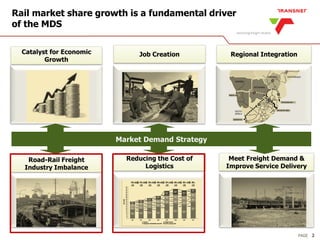
Rail market share growth is a fundamental driver
of the MDS
2
Job Creation
Reducing the Cost of
Logistics
Catalyst for Economic
Growth
Road-Rail Freight
Industry Imbalance
Meet Freight Demand &
Improve Service Delivery
Regional Integration
Market Demand Strategy
2
PAGE
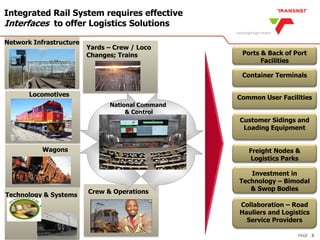
Integrated Rail System requires effective
Interfaces to offer Logistics Solutions
3
Locomotives
Network Infrastructure
Wagons
Crew & Operations
Yards – Crew / Loco
Changes; Trains
National Command
& Control
Customer Sidings and
Loading Equipment
Common User Facilities
Container Terminals
Ports & Back of Port
Facilities
Freight Nodes &
Logistics Parks
Collaboration – Road
Hauliers and Logistics
Service Providers
Technology & Systems
Investment in
Technology – Bimodal
& Swop Bodies
PAGE
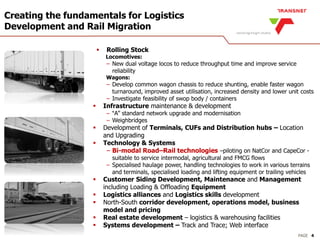
Creating the fundamentals for Logistics
Development and Rail Migration
 Rolling Stock
Locomotives:
− New dual voltage locos to reduce throughput time and improve service
reliability
Wagons:
− Develop common wagon chassis to reduce shunting, enable faster wagon
turnaround, improved asset utilisation, increased density and lower unit costs
− Investigate feasibility of swop body / containers
 Infrastructure maintenance & development
− “A” standard network upgrade and modernisation
− Weighbridges
 Development of Terminals, CUFs and Distribution hubs – Location
and Upgrading
 Technology & Systems
− Bi-modal Road–Rail technologies –piloting on NatCor and CapeCor -
suitable to service intermodal, agricultural and FMCG flows
− Specialised haulage power, handling technologies to work in various terrains
and terminals, specialised loading and lifting equipment or trailing vehicles
 Customer Siding Development, Maintenance and Management
including Loading & Offloading Equipment
 Logistics alliances and Logistics skills development
 North-South corridor development, operations model, business
model and pricing
 Real estate development – logistics & warehousing facilities
 Systems development – Track and Trace; Web interface
4
PAGE
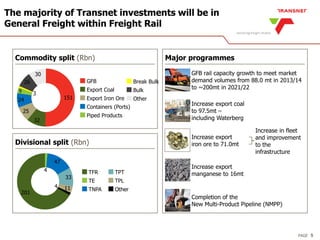
The majority of Transnet investments will be in
General Freight within Freight Rail
Commodity split (Rbn)
Divisional split (Rbn)
Major programmes
GFB rail capacity growth to meet market
demand volumes from 88.0 mt in 2013/14
to ~200mt in 2021/22
Completion of the
New Multi-Product Pipeline (NMPP)
Increase export coal
to 97.5mt –
including Waterberg
Increase export
iron ore to 71.0mt
Increase export
manganese to 16mt
Increase in fleet
and improvement
to the
infrastructure
24
25
32
151
30
3
26
9
Containers (Ports)
Export Iron Ore
Export Coal
GFB
Bulk
Piped Products
Break Bulk
Other
4 11
33
47
4
201
Other
TPL
TPT
TNPA
TE
TFR
Other
5
PAGE
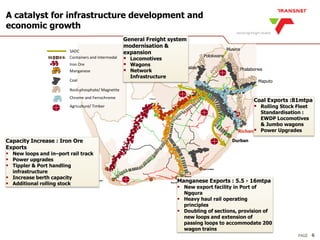
A catalyst for infrastructure development and
economic growth
6
Sishen
Saldanha
Cape Town
East London
Port Elizabeth
Hotazel
Musina
Kimberley
Polokwane
De Aar
Ngqura
Ermelo
Lephalale
Durban
Richards Bay
Johannesburg
SADC
Containers and Intermodal
Iron Ore
Manganese
Coal
Agriculture/ Timber
Rock-phosphate/ Magnetite
Chrome and Ferrochrome
Phalaborwa
Maputo
Coal Exports :81mtpa
 Rolling Stock Fleet
Standardisation :
EWDP Locomotives
& Jumbo wagons
 Power Upgrades
Capacity Increase : Iron Ore
Exports
 New loops and in–port rail track
 Power upgrades
 Tippler & Port handling
infrastructure
 Increase berth capacity
 Additional rolling stock
Manganese Exports : 5.5 - 16mtpa
 New export facility in Port of
Ngqura
 Heavy haul rail operating
principles
 Doubling of sections, provision of
new loops and extension of
passing loops to accommodate 200
wagon trains
General Freight system
modernisation &
expansion
 Locomotives
 Wagons
 Network
Infrastructure
6
PAGE
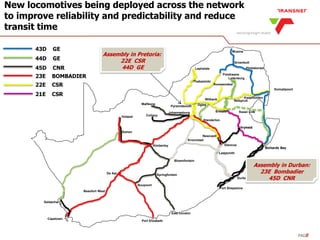
New locomotives being deployed across the network
to improve reliability and predictability and reduce
transit time
Witbank
Richards Bay
Vryheid
Ermelo
Pyramidsouth
Johannesburg
45D CNR
23E BOMBADIER
Phalaborwa
Komatipoort
Groenbult
Musina
Polokwane
Thabazimbi
Lephalale
Kaapmuiden
Nelspruit
Ladysmith
Glencoe
Durban
Kroonstad
Bloemfontein
Kimberley
Sishen
Hotazel
Saldanha
Capetown
Port Elizabeth
East London
Springfontein
Noupoort
De Aar
Beaufort West
Standerton
Swazi Link
Mafikeng
Port Shepstone
22E CSR
Newcastle
21E CSR
Roossenekal
Lydenburg
Ogies
Coligny
44D GE
7
43D GE
Assembly in Durban:
23E Bombadier
45D CNR
Assembly in Pretoria:
22E CSR
44D GE
PAGE
BelconCape Town
Port Elizabeth
Ngqura
Cato Ridge/Umlaas Rd
Harrismith
Mahikeng Pyramid
Sentrarand
Tambo SpringsVaal
Phalaborwa
Musina
Polokwane
Airport Dig Out
DCT (New)
Bloemfontein
Waterberg
Coalfields
Coalfields
Koppies
Kascon/City Deep
Richards Bay
Maputo
Saldanha
Sishen
Hotazel
Lohatla
8
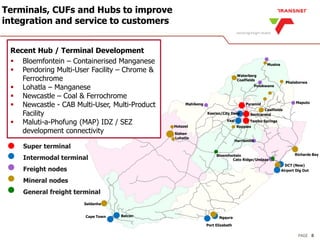
Terminals, CUFs and Hubs to improve
integration and service to customers
Recent Hub / Terminal Development
 Bloemfontein – Containerised Manganese
 Pendoring Multi-User Facility – Chrome &
Ferrochrome
 Lohatla – Manganese
 Newcastle – Coal & Ferrochrome
 Newcastle - CAB Multi-User, Multi-Product
Facility
 Maluti-a-Phofung (MAP) IDZ / SEZ
development connectivity
Super terminal
Intermodal terminal
Freight nodes
Mineral nodes
General freight terminal
PAGE
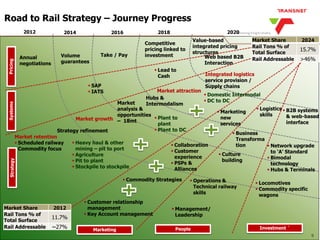
Road to Rail Strategy – Journey Progress
9
Market retention
 Scheduled railway
 Commodity focus
2012 2014 2016 2018 2020
StrategySystemsPricing
Investment `Marketing People
Market Share 2012
Rail Tons % of
Total Surface
11.7%
Rail Addressable ~27%
Market growth
Hubs &
Intermodalism
Market attraction
Integrated logistics
service provision /
Supply chains
 Locomotives
 Commodity specific
wagons
 Network upgrade
to ‘A’ Standard
 Bimodal
technology
 Hubs & Terminals
 B2B systems
& web-based
interface
 Customer relationship
management
 Key Account management
 Collaboration
 Customer
experience
 PSPs &
Alliances
 Marketing
new
services
 Management/
Leadership
 Operations &
Technical railway
skills
 Culture
building
 Business
Transforma
tion
Strategy refinement
Market
analysis &
opportunities
– 18mt
 Heavy haul & other
mining – pit to port
 Agriculture
 Pit to plant
 Stockpile to stockpile
 Plant to
plant
 Plant to DC
 Domestic Intermodal
 DC to DC
 SAP
 IATS
 Lead to
Cash
Web based B2B
Interaction
Annual
negotiations
Volume
guarantees
Take / Pay
Competitive
pricing linked to
investment
Value-based
integrated pricing
structures
 Logistics
skills
 Commodity Strategies
Market Share 2024
Rail Tons % of
Total Surface
15.7%
Rail Addressable >46%
PAGE
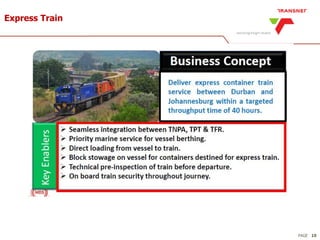
Express Train
10
PAGE
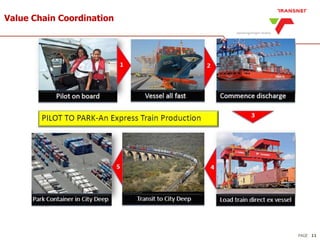
Value Chain Coordination
11
PAGE
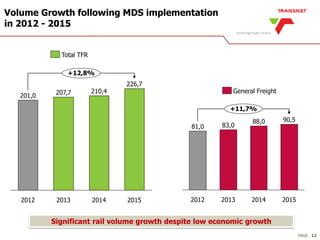
Volume Growth following MDS implementation
in 2012 - 2015
12
+11,7%
2014
88,0
2013
83,0
2012
81,0
2015
90,5
General Freight
Significant rail volume growth despite low economic growth
201,0
2015
226,7
+12,8%
2014
210,4
2013
207,7
2012
Total TFR
PAGE 13
94 95 90 87 88 86 84 83 84 78 72 74 81 83 88
21 24 26 28 30 30 32 37 45 46
52 56
64
67 65
64 66 67 69 67 63 62 62 62
68
69 68
0
20
40
60
80
100
120
140
160
180
200
220
20
25
30
35
40
45
50
55
60
65
70
179
2009
177
2008
179
2007
180
2006
182
2005
181
208
181
27
2003
176
25
2002
181
2001
185
2000 2014
210
54
201320122004
201
2011
182
2010
179
Export Iron Ore
Export Coal
RAMS Tons
General FreightRAMS TonKm
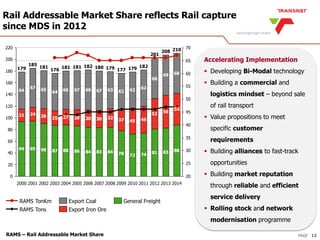
Rail Addressable Market Share reflects Rail capture
since MDS in 2012
Accelerating Implementation
 Developing Bi-Modal technology
 Building a commercial and
logistics mindset – beyond sale
of rail transport
 Value propositions to meet
specific customer
requirements
 Building alliances to fast-track
opportunities
 Building market reputation
through reliable and efficient
service delivery
 Rolling stock and network
modernisation programme
RAMS – Rail Addressable Market Share
PAGE
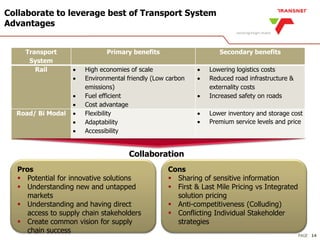
Collaborate to leverage best of Transport System
Advantages
14
Transport
System
Primary benefits Secondary benefits
Rail  High economies of scale
 Environmental friendly (Low carbon
emissions)
 Fuel efficient
 Cost advantage
 Lowering logistics costs
 Reduced road infrastructure &
externality costs
 Increased safety on roads
Road/ Bi Modal  Flexibility
 Adaptability
 Accessibility
 Lower inventory and storage cost
 Premium service levels and price
Pros
 Potential for innovative solutions
 Understanding new and untapped
markets
 Understanding and having direct
access to supply chain stakeholders
 Create common vision for supply
chain success
Cons
 Sharing of sensitive information
 First & Last Mile Pricing vs Integrated
solution pricing
 Anti-competitiveness (Colluding)
 Conflicting Individual Stakeholder
strategies
Collaboration
PAGE
Benefits
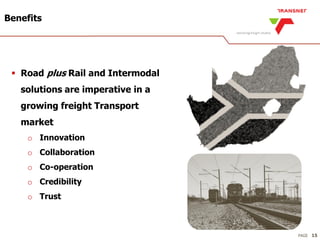
 Road plus Rail and Intermodal
solutions are imperative in a
growing freight Transport
market
o Innovation
o Collaboration
o Co-operation
o Credibility
o Trust
15
PAGE 16
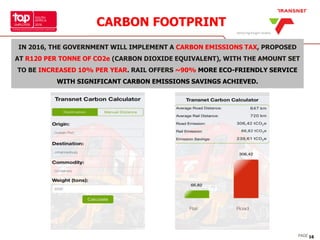
CARBON FOOTPRINT
IN 2016, THE GOVERNMENT WILL IMPLEMENT A CARBON EMISSIONS TAX, PROPOSED
AT R120 PER TONNE OF CO2e (CARBON DIOXIDE EQUIVALENT), WITH THE AMOUNT SET
TO BE INCREASED 10% PER YEAR. RAIL OFFERS ~90% MORE ECO-FRIENDLY SERVICE
WITH SIGNIFICANT CARBON EMISSIONS SAVINGS ACHIEVED.
PAGE
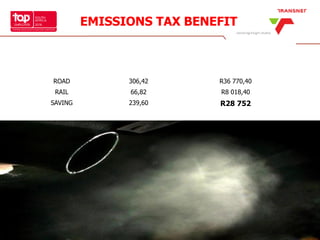
EMISSIONS TAX BENEFIT
EXAMPLE BASED ON 100 TEUS MOVED FROM DURBAN PORT- JOHANNESBURG
TONNES OF CO2
EMISSIONS
EMISSIONS TAX
ROAD 306,42 R36 770,40
RAIL 66,82 R8 018,40
SAVING 239,60 R28 752
PAGE
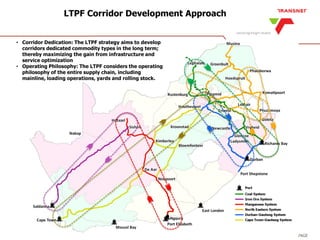
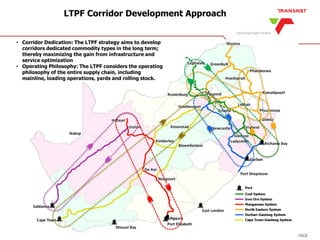
LTPF Corridor Development Approach
• Corridor Dedication: The LTPF strategy aims to develop
corridors dedicated commodity types in the long term;
thereby maximizing the gain from infrastructure and
service optimization
• Operating Philosophy: The LTPF considers the operating
philosophy of the entire supply chain, including
mainline, loading operations, yards and rolling stock.
PAGE
LTPF Corridor Development Approach
• Corridor Dedication: The LTPF strategy aims to develop
corridors dedicated commodity types in the long term;
thereby maximizing the gain from infrastructure and
service optimization
• Operating Philosophy: The LTPF considers the operating
philosophy of the entire supply chain, including
mainline, loading operations, yards and rolling stock.
PAGE
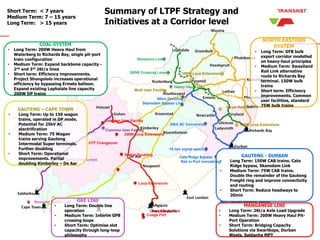
Summary of LTPF Strategy and
Initiatives at a Corridor level
Create Long Loops
Remodel Salkor Yard
OTF Changeover
Partial Doubling
Common User Facility
Heavy Haul Line
Botswana Link
Swazi Rail Link
150W Loop Extensions
Cato Ridge Bypass
Compilation Yard
Coega Port
25kV AC Conversion
150W Loop Extensions
Common User Facility
GAUTENG - DURBAN
• Long Term: 150W CAB trains. Cato
Ridge bypass, Skansdam Link
• Medium Term: 75W CAB trains.
Double the remainder of the Gauteng
Freight ring and improve connectivity
and routing
• Short Term: Reduce headways to
20min
GAUTENG – CAPE TOWN
• Long Term: Up to 150 wagon
trains, operated in DP mode.
Potential for 25kV AC
electrification
• Medium Term: 75 Wagon
trains serving Gauteng
Intermodal Super terminals.
Further doubling
• Short Term: Operational
improvements. Partial
doubling Kimberley – De Aar
NORTH EASTERN
SYSTEM
• Long Term: GFB bulk
export corridor modelled
on heavy-haul principles
• Medium Term: Swaziland
Rail Link alternative
route to Richards Bay
terminal. 150W bulk
trains
• Short term: Efficiency
improvements. Common
user facilities, standard
75W bulk trains
COAL SYSTEM
• Long Term: 200W Heavy Haul from
Waterberg to Richards Bay, single pit-port
train configuration
• Medium Term: Expand backbone capacity -
2nd and 3rd 26t/a lines
• Short term: Efficiency improvements.
Project Shongololo increases operational
efficiency by bypassing Ermelo balloon.
Expand existing Lephalale line capacity
200W DP trains
ORE LINE
• Long Term: Double line
operation
• Medium Term: Interim GFB
crossing loops
• Short Term: Optimise slot
capacity through long-loop
philosophy
MANGANESE LINE
• Long Term: 26t/a Axle Load Upgrade
• Medium Term: 200W Heavy Haul Pit-
Port Operation
• Short Term: Bridging Capacity
Solutions via Swartkops, Durban
Wests, Saldanha MPT
Skansdam Bypass Link
40km Doubling
15 min signal spacing
200W Loop Extensions
Loop Extensions
200W Crossing Loops
Multi User Facility
Rail in Port remodeling
Short Term: < 7 years
Medium Term: 7 – 15 years
Long Term: > 15 years
PAGE
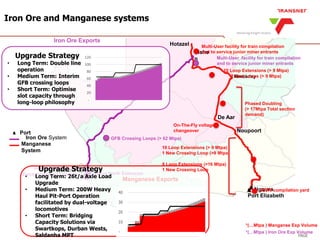
Iron Ore and Manganese systems
Sishe
n
De Aar
Noupoort
Kimberley
Hotazel
Ngqura
Port Elizabeth
Mossel Bay
Saldanh
a
Port
Iron Ore System
Manganese
System
Multi-User facility for train compilation
and to service junior miner entrants
Multi-User facility for train compilation
and to service junior miner entrants
Upgrade Strategy
• Long Term: Double line
operation
• Medium Term: Interim
GFB crossing loops
• Short Term: Optimise
slot capacity through
long-loop philosophy Phased Doubling
(> 17Mtpa Total section
demand)
10 Loop Extensions (> 9 Mtpa)
1 New Crossing Loop (>9 Mtpa)
10 Loop Extensions (> 9 Mtpa)
Iron Ore Exports
Manganese Exports
On-The-Fly voltage
changeover
Salkor North Extension
Salkor Yard Remodeling
200W compilation yard
Electrification to Tipplers
Upgrade Strategy
• Long Term: 26t/a Axle Load
Upgrade
• Medium Term: 200W Heavy
Haul Pit-Port Operation
facilitated by dual-voltage
locomotives
• Short Term: Bridging
Capacity Solutions via
Swartkops, Durban Wests,
Saldanha MPT
-
10
20
30
40
-
20
40
60
80
100
120
2 New Loops (> 9 Mtpa)
GFB Crossing Loops (> 62 Mtpa)
8 Loop Extensions (>16 Mtpa)
1 New Crossing Loop
*(…Mtpa ) Manganse Exp Volume
*(…Mtpa ) Iron Ore Exp Volume
PAGE
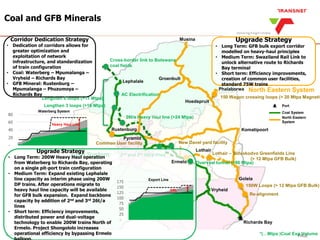
Coal and GFB Minerals
Richards Bay
Port
Coal System
North Eastern
System
26t/a Heavy Haul line (>24 Mtpa)
Corridor Dedication Strategy
• Dedication of corridors allows for
greater optimization and
exploitation of network
infrastructure, and standardization
of train configuration
• Coal: Waterberg – Mpumalanga –
Vryheid – Richards Bay
• GFB Mineral: Rustenburg –
Mpumalanga – Phuzumoya –
Richards Bay
Upgrade Strategy
• Long Term: GFB bulk export corridor
modelled on heavy-haul principles
• Medium Term: Swaziland Rail Link to
unlock alternative route to Richards
Bay terminal
• Short term: Efficiency improvements,
creation of common user facilities,
standard 75W trains
Cross-border link to Botswana
coal fields
Coal System
AC Electrification
Common User facility
150 Wagon crossing loops (> 20 Mtpa Magnetit
150W Loops (> 12 Mtpa GFB Bulk)
Re-alignment
New Davel yard facility
Lengthen 6 loops (>11 Mtpa)
2nd and 3rd 26t/a lines Lothair – Sidvokodvo Greenfields Line
(> 12 Mtpa GFB Bulk)
Upgrade Strategy
• Long Term: 200W Heavy Haul operation
from Waterberg to Richards Bay, operating
on a single pit-port train configuration
• Medium Term: Expand existing Lephalale
line capacity as interim phase using 200W
DP trains. After operations migrate to
heavy haul line capacity will be available
for GFB bulk expansion. Expand backbone
capacity by addition of 2nd and 3rd 26t/a
lines
• Short term: Efficiency improvements,
distributed power and dual-voltage
technology to enable 200W trains North of
Ermelo. Project Shongololo increases
operational efficiency by bypassing Ermelo
Pyramid
Golela
Ermelo
Lothair
Vryheid
Hoedspruit
KomatipoortRustenburg
Phalaborwa
Lephalale
Groenbult
Musina
-
20
40
60
80
-
25
50
75
100
125
150
175
Waterberg System
Export Line
Lengthen 3 loops (>16 Mtpa)
Overvaal tunnel (>90 Mtpa)
SRL
Heavy Haul Line
*(…Mtpa )Coal Exp Volume
North Eastern System
PAGE
Durban-Gauteng System
Cape Town-Gauteng System
Port
General freight
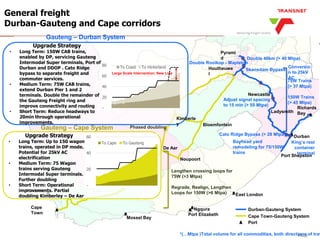
Durban-Gauteng and Cape corridors
Durban
East London
Ngqura
Port Elizabeth
Mossel Bay
Cape
Town
Saldanh
a
Port Shepston
Richards
Bay
Upgrade Strategy
• Long Term: 150W CAB trains,
enabled by DP, servicing Gauteng
Intermodal Super terminals, Port of
Durban and DDOP . Cato Ridge
bypass to separate freight and
commuter services.
• Medium Term: 75W CAB trains,
extend Durban Pier 1 and 2
terminals. Double the remainder of
the Gauteng Freight ring and
improve connectivity and routing
• Short Term: Reduce headways to
20min through operational
improvements.
Gauteng – Durban System
Double 40km (> 40 Mtpa)
Skansdam Bypass
Double Rooikop - Mapleton
Cato Ridge Bypass (> 28 Mtpa)
Bayhead yard
remodeling for 75/150W
trains
Conversio
n to 25kV
AC
Phased doubling
Lengthen crossing loops for
75W (>3 Mtpa)
Regrade, Realign, Lengthen
Loops for 150W (>6 Mtpa)
Adjust signal spacing
to 15 min (> 55 Mtpa)
Upgrade Strategy
• Long Term: Up to 150 wagon
trains, operated in DP mode.
Potential for 25kV AC
electrification
• Medium Term: 75 Wagon
trains serving Gauteng
Intermodal Super terminals.
Further doubling
• Short Term: Operational
improvements. Partial
doubling Kimberley – De Aar
King’s rest
container
terminal
Gauteng – Cape System
Pyrami
d
Kimberle
y
Newcastle
Ladysmith
Houtheuwe
l
Bloemfontein
Noupoort
De Aar
-
20
40
60
80 To Coast To Hinterland
Large Scale Intervention: New Line
-
20
40
60
To Cape To Gauteng
75W Trains
(> 37 Mtpa)
150W Trains
(> 45 Mtpa)
*(…Mtpa )Total volume for all commodities, both directions of trav
PAGE
Remodel Salkor Yard
OTF Changeover
Common User Facility
Overvaal
Tunnel
Double Bleskop - Norite
Compilation Yard
Common User Facility
Multi User Facility
Rail in Port remodeling
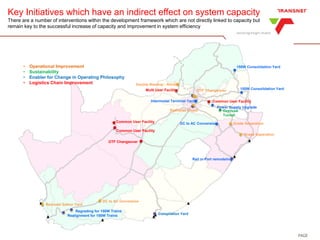
Key Initiatives which have an indirect effect on system capacity
There are a number of interventions within the development framework which are not directly linked to capacity but
remain key to the successful increase of capacity and improvement in system efficiency
• Operational Improvement
• Sustainability
• Enabler for Change in Operating Philosophy
• Logistics Chain Improvement
Intermodal Terminal Yards
OTF Changeover
Common User Facility
Grade Separation
Grade Separation
Rietvallei Chord
Regrading for 150W Trains
Realignment for 150W Trains
DC to AC conversion
150W Consolidation Yard
Power Supply Upgrade
DC to AC Conversion
PAGE
MDS Driving Volumes Back to Rail
NATCOR/N3 Corridor
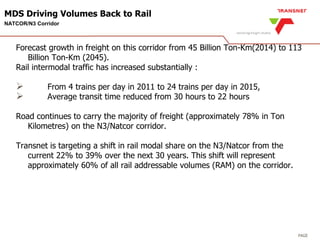
Forecast growth in freight on this corridor from 45 Billion Ton-Km(2014) to 113
Billion Ton-Km (2045).
Rail intermodal traffic has increased substantially :
 From 4 trains per day in 2011 to 24 trains per day in 2015,
 Average transit time reduced from 30 hours to 22 hours
Road continues to carry the majority of freight (approximately 78% in Ton
Kilometres) on the N3/Natcor corridor.
Transnet is targeting a shift in rail modal share on the N3/Natcor from the
current 22% to 39% over the next 30 years. This shift will represent
approximately 60% of all rail addressable volumes (RAM) on the corridor.
PAGE
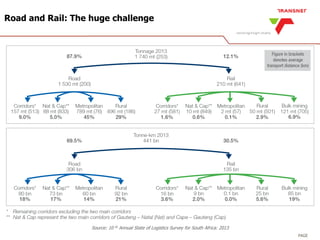
Road and Rail: The huge challenge
Source: 10 th Annual State of Logistics Survey for South Africa: 2013
PAGE
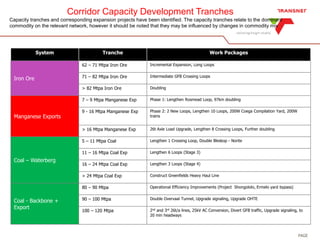
Corridor Capacity Development Tranches
Capacity tranches and corresponding expansion projects have been identified. The capacity tranches relate to the dominant
commodity on the relevant network, however it should be noted that they may be influenced by changes in commodity mix
System Tranche Work Packages
Iron Ore
62 – 71 Mtpa Iron Ore Incremental Expansion, Long Loops
71 – 82 Mtpa Iron Ore Intermediate GFB Crossing Loops
> 82 Mtpa Iron Ore Doubling
Manganese Exports
7 – 9 Mtpa Manganese Exp Phase 1: Lengthen Rosmead Loop, 97km doubling
9 - 16 Mtpa Manganese Exp Phase 2: 2 New Loops, Lengthen 10 Loops, 200W Coega Compilation Yard, 200W
trains
> 16 Mtpa Manganese Exp 26t Axle Load Upgrade, Lengthen 8 Crossing Loops, Further doubling
Coal – Waterberg
5 – 11 Mtpa Coal Lengthen 1 Crossing Loop, Double Bleskop - Norite
11 – 16 Mtpa Coal Exp Lengthen 6 Loops (Stage 3)
16 – 24 Mtpa Coal Exp Lengthen 3 Loops (Stage 4)
> 24 Mtpa Coal Exp Construct Greenfields Heavy Haul Line
Coal - Backbone +
Export
80 – 90 Mtpa Operational Efficiency Improvements (Project Shongololo, Ermelo yard bypass)
90 – 100 Mtpa Double Overvaal Tunnel, Upgrade signaling, Upgrade OHTE
100 – 120 Mtpa 2nd and 3rd 26t/a lines, 25kV AC Conversion, Divert GFB traffic, Upgrade signaling, to
20 min headways
PAGE
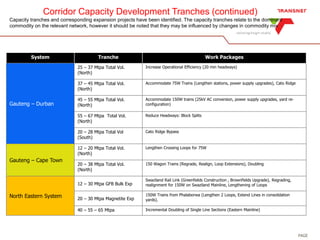
Corridor Capacity Development Tranches (continued)
Capacity tranches and corresponding expansion projects have been identified. The capacity tranches relate to the dominant
commodity on the relevant network, however it should be noted that they may be influenced by changes in commodity mix
System Tranche Work Packages
Gauteng – Durban
25 – 37 Mtpa Total Vol.
(North)
Increase Operational Efficiency (20 min headways)
37 – 45 Mtpa Total Vol.
(North)
Accommodate 75W Trains (Lengthen stations, power supply upgrades), Cato Ridge
45 – 55 Mtpa Total Vol.
(North)
Accommodate 150W trains (25kV AC conversion, power supply upgrades, yard re-
configuration)
55 – 67 Mtpa Total Vol.
(North)
Reduce Headways: Block Splits
20 – 28 Mtpa Total Vol
(South)
Cato Ridge Bypass
Gauteng – Cape Town
12 – 20 Mtpa Total Vol.
(North)
Lengthen Crossing Loops for 75W
20 – 38 Mtpa Total Vol.
(North)
150 Wagon Trains (Regrade, Realign, Loop Extensions), Doubling
North Eastern System
12 – 30 Mtpa GFB Bulk Exp
Swaziland Rail Link (Greenfields Construction , Brownfields Upgrade), Regrading,
realignment for 150W on Swaziland Mainline, Lengthening of Loops
20 – 30 Mtpa Magnetite Exp
150W Trains from Phalaborwa (Lengthen 2 Loops, Extend Lines in consolidation
yards).
40 – 55 – 65 Mtpa Incremental Doubling of Single Line Sections (Eastern Mainline)
Heading heading heading
Date
Thank You……

Transnet freight rail corridor development programme and road to rail strategy

  • 1.
    Heading heading heading DateTransnetFreight Rail Ms Nisha Jones General Manager Commercial 4 February 2016
  • 2.
    PAGE CONTENTS 1 • TFR Railmarket share • Integrated Rail System • Development & Rail migration • Bimodal Video • Transnet Infrastructure Investments • Infrastructure development for Economic Growth • Terminals, HUBS and CUF • Road to Rail journey progress • Express Train • Value Chain co-ordination • Volume Growth since MDS implementation • Rail addressable market share • Collaborate to to leverage best of Transport System Advantages • Benefits of Road+ Rail • Corridor Developments
  • 3.
    PAGE Rail market sharegrowth is a fundamental driver of the MDS 2 Job Creation Reducing the Cost of Logistics Catalyst for Economic Growth Road-Rail Freight Industry Imbalance Meet Freight Demand & Improve Service Delivery Regional Integration Market Demand Strategy 2
  • 4.
    PAGE Integrated Rail Systemrequires effective Interfaces to offer Logistics Solutions 3 Locomotives Network Infrastructure Wagons Crew & Operations Yards – Crew / Loco Changes; Trains National Command & Control Customer Sidings and Loading Equipment Common User Facilities Container Terminals Ports & Back of Port Facilities Freight Nodes & Logistics Parks Collaboration – Road Hauliers and Logistics Service Providers Technology & Systems Investment in Technology – Bimodal & Swop Bodies
  • 5.
    PAGE Creating the fundamentalsfor Logistics Development and Rail Migration  Rolling Stock Locomotives: − New dual voltage locos to reduce throughput time and improve service reliability Wagons: − Develop common wagon chassis to reduce shunting, enable faster wagon turnaround, improved asset utilisation, increased density and lower unit costs − Investigate feasibility of swop body / containers  Infrastructure maintenance & development − “A” standard network upgrade and modernisation − Weighbridges  Development of Terminals, CUFs and Distribution hubs – Location and Upgrading  Technology & Systems − Bi-modal Road–Rail technologies –piloting on NatCor and CapeCor - suitable to service intermodal, agricultural and FMCG flows − Specialised haulage power, handling technologies to work in various terrains and terminals, specialised loading and lifting equipment or trailing vehicles  Customer Siding Development, Maintenance and Management including Loading & Offloading Equipment  Logistics alliances and Logistics skills development  North-South corridor development, operations model, business model and pricing  Real estate development – logistics & warehousing facilities  Systems development – Track and Trace; Web interface 4
  • 6.
    PAGE The majority ofTransnet investments will be in General Freight within Freight Rail Commodity split (Rbn) Divisional split (Rbn) Major programmes GFB rail capacity growth to meet market demand volumes from 88.0 mt in 2013/14 to ~200mt in 2021/22 Completion of the New Multi-Product Pipeline (NMPP) Increase export coal to 97.5mt – including Waterberg Increase export iron ore to 71.0mt Increase export manganese to 16mt Increase in fleet and improvement to the infrastructure 24 25 32 151 30 3 26 9 Containers (Ports) Export Iron Ore Export Coal GFB Bulk Piped Products Break Bulk Other 4 11 33 47 4 201 Other TPL TPT TNPA TE TFR Other 5
  • 7.
    PAGE A catalyst forinfrastructure development and economic growth 6 Sishen Saldanha Cape Town East London Port Elizabeth Hotazel Musina Kimberley Polokwane De Aar Ngqura Ermelo Lephalale Durban Richards Bay Johannesburg SADC Containers and Intermodal Iron Ore Manganese Coal Agriculture/ Timber Rock-phosphate/ Magnetite Chrome and Ferrochrome Phalaborwa Maputo Coal Exports :81mtpa  Rolling Stock Fleet Standardisation : EWDP Locomotives & Jumbo wagons  Power Upgrades Capacity Increase : Iron Ore Exports  New loops and in–port rail track  Power upgrades  Tippler & Port handling infrastructure  Increase berth capacity  Additional rolling stock Manganese Exports : 5.5 - 16mtpa  New export facility in Port of Ngqura  Heavy haul rail operating principles  Doubling of sections, provision of new loops and extension of passing loops to accommodate 200 wagon trains General Freight system modernisation & expansion  Locomotives  Wagons  Network Infrastructure 6
  • 8.
    PAGE New locomotives beingdeployed across the network to improve reliability and predictability and reduce transit time Witbank Richards Bay Vryheid Ermelo Pyramidsouth Johannesburg 45D CNR 23E BOMBADIER Phalaborwa Komatipoort Groenbult Musina Polokwane Thabazimbi Lephalale Kaapmuiden Nelspruit Ladysmith Glencoe Durban Kroonstad Bloemfontein Kimberley Sishen Hotazel Saldanha Capetown Port Elizabeth East London Springfontein Noupoort De Aar Beaufort West Standerton Swazi Link Mafikeng Port Shepstone 22E CSR Newcastle 21E CSR Roossenekal Lydenburg Ogies Coligny 44D GE 7 43D GE Assembly in Durban: 23E Bombadier 45D CNR Assembly in Pretoria: 22E CSR 44D GE
  • 9.
    PAGE BelconCape Town Port Elizabeth Ngqura CatoRidge/Umlaas Rd Harrismith Mahikeng Pyramid Sentrarand Tambo SpringsVaal Phalaborwa Musina Polokwane Airport Dig Out DCT (New) Bloemfontein Waterberg Coalfields Coalfields Koppies Kascon/City Deep Richards Bay Maputo Saldanha Sishen Hotazel Lohatla 8 Terminals, CUFs and Hubs to improve integration and service to customers Recent Hub / Terminal Development  Bloemfontein – Containerised Manganese  Pendoring Multi-User Facility – Chrome & Ferrochrome  Lohatla – Manganese  Newcastle – Coal & Ferrochrome  Newcastle - CAB Multi-User, Multi-Product Facility  Maluti-a-Phofung (MAP) IDZ / SEZ development connectivity Super terminal Intermodal terminal Freight nodes Mineral nodes General freight terminal
  • 10.
    PAGE Road to RailStrategy – Journey Progress 9 Market retention  Scheduled railway  Commodity focus 2012 2014 2016 2018 2020 StrategySystemsPricing Investment `Marketing People Market Share 2012 Rail Tons % of Total Surface 11.7% Rail Addressable ~27% Market growth Hubs & Intermodalism Market attraction Integrated logistics service provision / Supply chains  Locomotives  Commodity specific wagons  Network upgrade to ‘A’ Standard  Bimodal technology  Hubs & Terminals  B2B systems & web-based interface  Customer relationship management  Key Account management  Collaboration  Customer experience  PSPs & Alliances  Marketing new services  Management/ Leadership  Operations & Technical railway skills  Culture building  Business Transforma tion Strategy refinement Market analysis & opportunities – 18mt  Heavy haul & other mining – pit to port  Agriculture  Pit to plant  Stockpile to stockpile  Plant to plant  Plant to DC  Domestic Intermodal  DC to DC  SAP  IATS  Lead to Cash Web based B2B Interaction Annual negotiations Volume guarantees Take / Pay Competitive pricing linked to investment Value-based integrated pricing structures  Logistics skills  Commodity Strategies Market Share 2024 Rail Tons % of Total Surface 15.7% Rail Addressable >46%
  • 11.
  • 12.
  • 13.
    PAGE Volume Growth followingMDS implementation in 2012 - 2015 12 +11,7% 2014 88,0 2013 83,0 2012 81,0 2015 90,5 General Freight Significant rail volume growth despite low economic growth 201,0 2015 226,7 +12,8% 2014 210,4 2013 207,7 2012 Total TFR
  • 14.
    PAGE 13 94 9590 87 88 86 84 83 84 78 72 74 81 83 88 21 24 26 28 30 30 32 37 45 46 52 56 64 67 65 64 66 67 69 67 63 62 62 62 68 69 68 0 20 40 60 80 100 120 140 160 180 200 220 20 25 30 35 40 45 50 55 60 65 70 179 2009 177 2008 179 2007 180 2006 182 2005 181 208 181 27 2003 176 25 2002 181 2001 185 2000 2014 210 54 201320122004 201 2011 182 2010 179 Export Iron Ore Export Coal RAMS Tons General FreightRAMS TonKm Rail Addressable Market Share reflects Rail capture since MDS in 2012 Accelerating Implementation  Developing Bi-Modal technology  Building a commercial and logistics mindset – beyond sale of rail transport  Value propositions to meet specific customer requirements  Building alliances to fast-track opportunities  Building market reputation through reliable and efficient service delivery  Rolling stock and network modernisation programme RAMS – Rail Addressable Market Share
  • 15.
    PAGE Collaborate to leveragebest of Transport System Advantages 14 Transport System Primary benefits Secondary benefits Rail  High economies of scale  Environmental friendly (Low carbon emissions)  Fuel efficient  Cost advantage  Lowering logistics costs  Reduced road infrastructure & externality costs  Increased safety on roads Road/ Bi Modal  Flexibility  Adaptability  Accessibility  Lower inventory and storage cost  Premium service levels and price Pros  Potential for innovative solutions  Understanding new and untapped markets  Understanding and having direct access to supply chain stakeholders  Create common vision for supply chain success Cons  Sharing of sensitive information  First & Last Mile Pricing vs Integrated solution pricing  Anti-competitiveness (Colluding)  Conflicting Individual Stakeholder strategies Collaboration
  • 16.
    PAGE Benefits  Road plusRail and Intermodal solutions are imperative in a growing freight Transport market o Innovation o Collaboration o Co-operation o Credibility o Trust 15
  • 17.
    PAGE 16 CARBON FOOTPRINT IN2016, THE GOVERNMENT WILL IMPLEMENT A CARBON EMISSIONS TAX, PROPOSED AT R120 PER TONNE OF CO2e (CARBON DIOXIDE EQUIVALENT), WITH THE AMOUNT SET TO BE INCREASED 10% PER YEAR. RAIL OFFERS ~90% MORE ECO-FRIENDLY SERVICE WITH SIGNIFICANT CARBON EMISSIONS SAVINGS ACHIEVED.
  • 18.
    PAGE EMISSIONS TAX BENEFIT EXAMPLEBASED ON 100 TEUS MOVED FROM DURBAN PORT- JOHANNESBURG TONNES OF CO2 EMISSIONS EMISSIONS TAX ROAD 306,42 R36 770,40 RAIL 66,82 R8 018,40 SAVING 239,60 R28 752
  • 19.
    PAGE LTPF Corridor DevelopmentApproach • Corridor Dedication: The LTPF strategy aims to develop corridors dedicated commodity types in the long term; thereby maximizing the gain from infrastructure and service optimization • Operating Philosophy: The LTPF considers the operating philosophy of the entire supply chain, including mainline, loading operations, yards and rolling stock.
  • 20.
    PAGE LTPF Corridor DevelopmentApproach • Corridor Dedication: The LTPF strategy aims to develop corridors dedicated commodity types in the long term; thereby maximizing the gain from infrastructure and service optimization • Operating Philosophy: The LTPF considers the operating philosophy of the entire supply chain, including mainline, loading operations, yards and rolling stock.
  • 21.
    PAGE Summary of LTPFStrategy and Initiatives at a Corridor level Create Long Loops Remodel Salkor Yard OTF Changeover Partial Doubling Common User Facility Heavy Haul Line Botswana Link Swazi Rail Link 150W Loop Extensions Cato Ridge Bypass Compilation Yard Coega Port 25kV AC Conversion 150W Loop Extensions Common User Facility GAUTENG - DURBAN • Long Term: 150W CAB trains. Cato Ridge bypass, Skansdam Link • Medium Term: 75W CAB trains. Double the remainder of the Gauteng Freight ring and improve connectivity and routing • Short Term: Reduce headways to 20min GAUTENG – CAPE TOWN • Long Term: Up to 150 wagon trains, operated in DP mode. Potential for 25kV AC electrification • Medium Term: 75 Wagon trains serving Gauteng Intermodal Super terminals. Further doubling • Short Term: Operational improvements. Partial doubling Kimberley – De Aar NORTH EASTERN SYSTEM • Long Term: GFB bulk export corridor modelled on heavy-haul principles • Medium Term: Swaziland Rail Link alternative route to Richards Bay terminal. 150W bulk trains • Short term: Efficiency improvements. Common user facilities, standard 75W bulk trains COAL SYSTEM • Long Term: 200W Heavy Haul from Waterberg to Richards Bay, single pit-port train configuration • Medium Term: Expand backbone capacity - 2nd and 3rd 26t/a lines • Short term: Efficiency improvements. Project Shongololo increases operational efficiency by bypassing Ermelo balloon. Expand existing Lephalale line capacity 200W DP trains ORE LINE • Long Term: Double line operation • Medium Term: Interim GFB crossing loops • Short Term: Optimise slot capacity through long-loop philosophy MANGANESE LINE • Long Term: 26t/a Axle Load Upgrade • Medium Term: 200W Heavy Haul Pit- Port Operation • Short Term: Bridging Capacity Solutions via Swartkops, Durban Wests, Saldanha MPT Skansdam Bypass Link 40km Doubling 15 min signal spacing 200W Loop Extensions Loop Extensions 200W Crossing Loops Multi User Facility Rail in Port remodeling Short Term: < 7 years Medium Term: 7 – 15 years Long Term: > 15 years
  • 22.
    PAGE Iron Ore andManganese systems Sishe n De Aar Noupoort Kimberley Hotazel Ngqura Port Elizabeth Mossel Bay Saldanh a Port Iron Ore System Manganese System Multi-User facility for train compilation and to service junior miner entrants Multi-User facility for train compilation and to service junior miner entrants Upgrade Strategy • Long Term: Double line operation • Medium Term: Interim GFB crossing loops • Short Term: Optimise slot capacity through long-loop philosophy Phased Doubling (> 17Mtpa Total section demand) 10 Loop Extensions (> 9 Mtpa) 1 New Crossing Loop (>9 Mtpa) 10 Loop Extensions (> 9 Mtpa) Iron Ore Exports Manganese Exports On-The-Fly voltage changeover Salkor North Extension Salkor Yard Remodeling 200W compilation yard Electrification to Tipplers Upgrade Strategy • Long Term: 26t/a Axle Load Upgrade • Medium Term: 200W Heavy Haul Pit-Port Operation facilitated by dual-voltage locomotives • Short Term: Bridging Capacity Solutions via Swartkops, Durban Wests, Saldanha MPT - 10 20 30 40 - 20 40 60 80 100 120 2 New Loops (> 9 Mtpa) GFB Crossing Loops (> 62 Mtpa) 8 Loop Extensions (>16 Mtpa) 1 New Crossing Loop *(…Mtpa ) Manganse Exp Volume *(…Mtpa ) Iron Ore Exp Volume
  • 23.
    PAGE Coal and GFBMinerals Richards Bay Port Coal System North Eastern System 26t/a Heavy Haul line (>24 Mtpa) Corridor Dedication Strategy • Dedication of corridors allows for greater optimization and exploitation of network infrastructure, and standardization of train configuration • Coal: Waterberg – Mpumalanga – Vryheid – Richards Bay • GFB Mineral: Rustenburg – Mpumalanga – Phuzumoya – Richards Bay Upgrade Strategy • Long Term: GFB bulk export corridor modelled on heavy-haul principles • Medium Term: Swaziland Rail Link to unlock alternative route to Richards Bay terminal • Short term: Efficiency improvements, creation of common user facilities, standard 75W trains Cross-border link to Botswana coal fields Coal System AC Electrification Common User facility 150 Wagon crossing loops (> 20 Mtpa Magnetit 150W Loops (> 12 Mtpa GFB Bulk) Re-alignment New Davel yard facility Lengthen 6 loops (>11 Mtpa) 2nd and 3rd 26t/a lines Lothair – Sidvokodvo Greenfields Line (> 12 Mtpa GFB Bulk) Upgrade Strategy • Long Term: 200W Heavy Haul operation from Waterberg to Richards Bay, operating on a single pit-port train configuration • Medium Term: Expand existing Lephalale line capacity as interim phase using 200W DP trains. After operations migrate to heavy haul line capacity will be available for GFB bulk expansion. Expand backbone capacity by addition of 2nd and 3rd 26t/a lines • Short term: Efficiency improvements, distributed power and dual-voltage technology to enable 200W trains North of Ermelo. Project Shongololo increases operational efficiency by bypassing Ermelo Pyramid Golela Ermelo Lothair Vryheid Hoedspruit KomatipoortRustenburg Phalaborwa Lephalale Groenbult Musina - 20 40 60 80 - 25 50 75 100 125 150 175 Waterberg System Export Line Lengthen 3 loops (>16 Mtpa) Overvaal tunnel (>90 Mtpa) SRL Heavy Haul Line *(…Mtpa )Coal Exp Volume North Eastern System
  • 24.
    PAGE Durban-Gauteng System Cape Town-GautengSystem Port General freight Durban-Gauteng and Cape corridors Durban East London Ngqura Port Elizabeth Mossel Bay Cape Town Saldanh a Port Shepston Richards Bay Upgrade Strategy • Long Term: 150W CAB trains, enabled by DP, servicing Gauteng Intermodal Super terminals, Port of Durban and DDOP . Cato Ridge bypass to separate freight and commuter services. • Medium Term: 75W CAB trains, extend Durban Pier 1 and 2 terminals. Double the remainder of the Gauteng Freight ring and improve connectivity and routing • Short Term: Reduce headways to 20min through operational improvements. Gauteng – Durban System Double 40km (> 40 Mtpa) Skansdam Bypass Double Rooikop - Mapleton Cato Ridge Bypass (> 28 Mtpa) Bayhead yard remodeling for 75/150W trains Conversio n to 25kV AC Phased doubling Lengthen crossing loops for 75W (>3 Mtpa) Regrade, Realign, Lengthen Loops for 150W (>6 Mtpa) Adjust signal spacing to 15 min (> 55 Mtpa) Upgrade Strategy • Long Term: Up to 150 wagon trains, operated in DP mode. Potential for 25kV AC electrification • Medium Term: 75 Wagon trains serving Gauteng Intermodal Super terminals. Further doubling • Short Term: Operational improvements. Partial doubling Kimberley – De Aar King’s rest container terminal Gauteng – Cape System Pyrami d Kimberle y Newcastle Ladysmith Houtheuwe l Bloemfontein Noupoort De Aar - 20 40 60 80 To Coast To Hinterland Large Scale Intervention: New Line - 20 40 60 To Cape To Gauteng 75W Trains (> 37 Mtpa) 150W Trains (> 45 Mtpa) *(…Mtpa )Total volume for all commodities, both directions of trav
  • 25.
    PAGE Remodel Salkor Yard OTFChangeover Common User Facility Overvaal Tunnel Double Bleskop - Norite Compilation Yard Common User Facility Multi User Facility Rail in Port remodeling Key Initiatives which have an indirect effect on system capacity There are a number of interventions within the development framework which are not directly linked to capacity but remain key to the successful increase of capacity and improvement in system efficiency • Operational Improvement • Sustainability • Enabler for Change in Operating Philosophy • Logistics Chain Improvement Intermodal Terminal Yards OTF Changeover Common User Facility Grade Separation Grade Separation Rietvallei Chord Regrading for 150W Trains Realignment for 150W Trains DC to AC conversion 150W Consolidation Yard 150W Consolidation Yard Power Supply Upgrade DC to AC Conversion
  • 26.
    PAGE MDS Driving VolumesBack to Rail NATCOR/N3 Corridor Forecast growth in freight on this corridor from 45 Billion Ton-Km(2014) to 113 Billion Ton-Km (2045). Rail intermodal traffic has increased substantially :  From 4 trains per day in 2011 to 24 trains per day in 2015,  Average transit time reduced from 30 hours to 22 hours Road continues to carry the majority of freight (approximately 78% in Ton Kilometres) on the N3/Natcor corridor. Transnet is targeting a shift in rail modal share on the N3/Natcor from the current 22% to 39% over the next 30 years. This shift will represent approximately 60% of all rail addressable volumes (RAM) on the corridor.
  • 27.
    PAGE Road and Rail:The huge challenge Source: 10 th Annual State of Logistics Survey for South Africa: 2013
  • 28.
    PAGE Corridor Capacity DevelopmentTranches Capacity tranches and corresponding expansion projects have been identified. The capacity tranches relate to the dominant commodity on the relevant network, however it should be noted that they may be influenced by changes in commodity mix System Tranche Work Packages Iron Ore 62 – 71 Mtpa Iron Ore Incremental Expansion, Long Loops 71 – 82 Mtpa Iron Ore Intermediate GFB Crossing Loops > 82 Mtpa Iron Ore Doubling Manganese Exports 7 – 9 Mtpa Manganese Exp Phase 1: Lengthen Rosmead Loop, 97km doubling 9 - 16 Mtpa Manganese Exp Phase 2: 2 New Loops, Lengthen 10 Loops, 200W Coega Compilation Yard, 200W trains > 16 Mtpa Manganese Exp 26t Axle Load Upgrade, Lengthen 8 Crossing Loops, Further doubling Coal – Waterberg 5 – 11 Mtpa Coal Lengthen 1 Crossing Loop, Double Bleskop - Norite 11 – 16 Mtpa Coal Exp Lengthen 6 Loops (Stage 3) 16 – 24 Mtpa Coal Exp Lengthen 3 Loops (Stage 4) > 24 Mtpa Coal Exp Construct Greenfields Heavy Haul Line Coal - Backbone + Export 80 – 90 Mtpa Operational Efficiency Improvements (Project Shongololo, Ermelo yard bypass) 90 – 100 Mtpa Double Overvaal Tunnel, Upgrade signaling, Upgrade OHTE 100 – 120 Mtpa 2nd and 3rd 26t/a lines, 25kV AC Conversion, Divert GFB traffic, Upgrade signaling, to 20 min headways
  • 29.
    PAGE Corridor Capacity DevelopmentTranches (continued) Capacity tranches and corresponding expansion projects have been identified. The capacity tranches relate to the dominant commodity on the relevant network, however it should be noted that they may be influenced by changes in commodity mix System Tranche Work Packages Gauteng – Durban 25 – 37 Mtpa Total Vol. (North) Increase Operational Efficiency (20 min headways) 37 – 45 Mtpa Total Vol. (North) Accommodate 75W Trains (Lengthen stations, power supply upgrades), Cato Ridge 45 – 55 Mtpa Total Vol. (North) Accommodate 150W trains (25kV AC conversion, power supply upgrades, yard re- configuration) 55 – 67 Mtpa Total Vol. (North) Reduce Headways: Block Splits 20 – 28 Mtpa Total Vol (South) Cato Ridge Bypass Gauteng – Cape Town 12 – 20 Mtpa Total Vol. (North) Lengthen Crossing Loops for 75W 20 – 38 Mtpa Total Vol. (North) 150 Wagon Trains (Regrade, Realign, Loop Extensions), Doubling North Eastern System 12 – 30 Mtpa GFB Bulk Exp Swaziland Rail Link (Greenfields Construction , Brownfields Upgrade), Regrading, realignment for 150W on Swaziland Mainline, Lengthening of Loops 20 – 30 Mtpa Magnetite Exp 150W Trains from Phalaborwa (Lengthen 2 Loops, Extend Lines in consolidation yards). 40 – 55 – 65 Mtpa Incremental Doubling of Single Line Sections (Eastern Mainline)
  • 30.