Click to edit Master title styleKPMC
engineers a sustainable
future through innovation
Synchronising Road and Rail to move Africa
into the 21st century.
Mike Daniel
KPMC Managing Director
Resolving Conflict
• For years road hauliers and railroads have
competed for the same business.
• Inefficiencies, high costs and high demand
dictate a re-evaluation of the synergies
• Moving freight from road to rail and rail to
road has never been easier and more cost
effective
• Increase profits by focusing on strengths of
road and rail.
Why Road Transport?
ROAD HAULIER STRENGTHS
• Understanding the client’s requirements
• Just-in-time deliveries
• Flexibility of routes
• Low capital cost
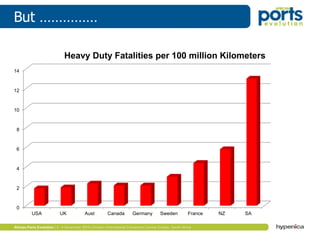
But ……………
0
2
4
6
8
10
12
14
USA UK Aust Canada Germany Sweden France NZ SA
Heavy Duty Fatalities per 100 million Kilometers
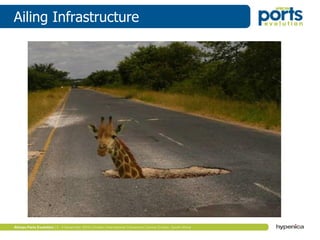
Ailing Infrastructure
Moving Africa: Unsustainable Road Freight Transport
Inefficiencies and lack of investment in Rail meant that
Road Freight Transport stepped up to the plate to
keep SADC economies rolling. Whilst this was a
solution, the increase of road freight is
unsustainable. Without a change in mindset, the
following is applicable.
• SADC freight system is characterised by a high systems cost
and low levels of long-term sustainability
• Resource constraints result in a gradually deteriorating and
eventually financially unsustainable system.
• Road freight, in particular, creates several unsustainable
externality costs such as pollution, high non-user costs for
road infrastructure, insurance to benefits accident victims
and overloading, creating additional maintenance costs for
the roads.
Why Rail?
RAILROAD STRENGTHS
• Fuel efficiencies: Rail can move 1mt of freight for
176km on 1lt of fuel (diesel) – road equivalent = 46- 56km
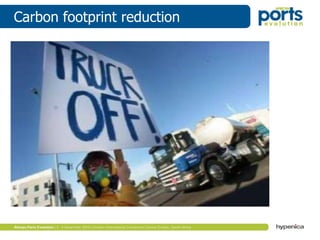
• Carbon footprint reduction – 3.8 X less carbon
produced
• Reduction of highway carnage – SA is
unfortunately a world leader in deaths by highway freight
vehicles.
• Reduce cost of road infrastructure - no need to
ban trucks from roads if certain freight or route sections are
moved to rail
Carbon footprint reduction
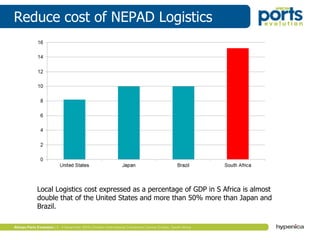
Reduce cost of NEPAD Logistics
Local Logistics cost expressed as a percentage of GDP in S Africa is almost
double that of the United States and more than 50% more than Japan and
Brazil.
Indian Railways
• “From bankruptcy to Billions” - by Sudhir Kumar and
Shagun Mehrotra
• Virtually bankrupt – couldn’t make debt
payments to government
• Turnaround focused on:
• Asset upgrades and asset utilization
• Market-based competitive pricing
• Improved length, density and frequency of trains
(longer, heavier, faster)
• In 10 years, achieved USD $6 Billion Surplus
Co-operation between Road and Rail to get Africa running!
• Focus on specific links in the supply chain
• Prepare Africa for economic upswing and to meet
global requirements
• Job sustainability
• Increase profitability without increasing tariffs.
• Complementary services to accommodate limited
infrastructure
Moving Africa: Issues
Strategic Issues Identified:
• Export Competitiveness: Lack of alignment for
exports
• Barriers to cross-border SADC traffic
• System Sustainability: High systems cost of
domestic freight
• Sustainability of freight industry – barely coping
under current economic conditions.
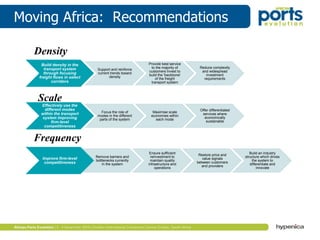
Moving Africa: Recommendations
Build density in the
transport system
through focusing
freight flows in select
corridors
Support and reinforce
current trends toward
density
Provide best service
to the majority of
customers Invest to
build the 'backbone'
of the freight
transport system
Reduce complexity
and widespread
investment
requirements
Effectively use the
different modes
within the transport
system improving
firm-level
competitiveness
Focus the role of
modes in the different
parts of the system
Maximise scale
economies within
each mode
Offer differentiated
services where
economically
sustainable
Improve firm-level
competitiveness
Remove barriers and
bottlenecks currently
in the system
Ensure sufficient
reinvestment to
maintain quality
infrastructure and
operations
Restore price and
value signals
between customers
and providers
Build an industry
structure which drives
the system to
differentiate and
innovate
Density
Scale
Frequency
Accelerating Transnet
• NDOT and Transnet already have the
strategy that focuses on density, scale and
frequency.
• A key question: How can this be achieved
considering real limitations on capital,
infrastructure and rolling stock?
• One answer: Apply bimodal technology to
move bulk, Truck Load traffic off the road.
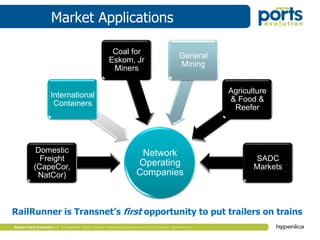
Market Applications
Network
Operating
Companies
Domestic
Freight
(CapeCor,
NatCor)
International
Containers
Coal for
Eskom, Jr
Miners
General
Mining
Agriculture
& Food &
Reefer
SADC
Markets
RailRunner is Transnet’s first opportunity to put trailers on trains
Bi Modal Benefits
• Lower terminal cost. “Terminal Anywhere”
®™system removes major barriers for
extending or expanding intermodal network.
Simpler terminal easier to operate. No heavy
lifting equipment.
• Intermodal trains can be assembled and
disassembled “under the wire”. No
requirement for additional traction and
expensive switching, in order to lift off
containers.
• Getting more trucks off more roads. Faster.
Easier. And at less expense.
Bimodal Benefits
• Empowering enterprise to take ownership of their
specific link in each supply chain
• Improved border transportation for entire trains
• Flexibility to cope with interruption in
infrastructure
• Cost reduction through fuel efficiency
• Prevention of road fatalities
• Expansion of the network to include remote
farming and mining communities
• The ability to meet increases in demand relatively
quickly
Scale, Density and Frequency
• Scale: Lowering the terminal investment barrier
facilitates scaling train operations whether in
existing or new lanes
• Density: Bi-Modal advantages in both high weight and
high cube freight offers competitive density
operations.
• Speed: Eliminating separate locos for terminal
operations to avoid overhead wire enables faster
terminal response and higher overall asset turns.
Bi-Modal design offers capability of higher train
speeds for faster rail operations.
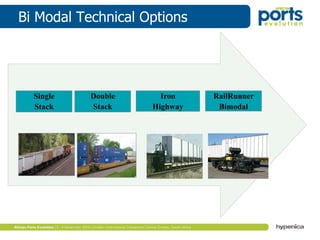
Bi Modal Technical Options
Single
Stack
Double
Stack
Iron
Highway
RailRunner
Bimodal
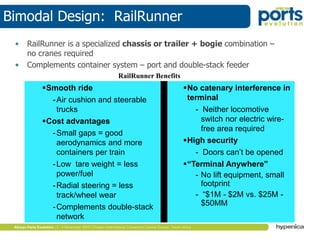
Bimodal Design: RailRunner
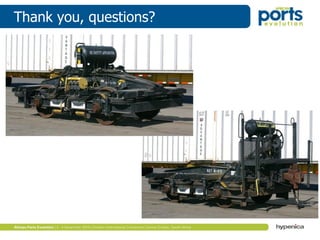
• RailRunner is a specialized chassis or trailer + bogie combination –
no cranes required
• Complements container system – port and double-stack feeder
RailRunner Benefits
Smooth ride
-Air cushion and steerable
trucks
Cost advantages
-Small gaps = good
aerodynamics and more
containers per train
-Low tare weight = less
power/fuel
-Radial steering = less
track/wheel wear
-Complements double-stack
network
No catenary interference in
terminal
- Neither locomotive
switch nor electric wire-
free area required
High security
- Doors can’t be opened
“Terminal Anywhere”
- No lift equipment, small
footprint
- “$1M - $2M vs. $25M -
$50MM
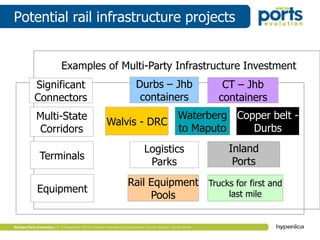
Potential rail infrastructure projects
Walvis - DRC
Copper belt -
Durbs
Logistics
Parks
Durbs – Jhb
containers
Waterberg
to Maputo
Inland
Ports
Terminals
Significant
Connectors
Multi-State
Corridors
CT – Jhb
containers
Equipment
Trucks for first and
last mile
Rail Equipment
Pools
Examples of Multi-Party Infrastructure Investment
Opportunities for All
A change of mind-set by role-players is required and
it is preferable to become part of the overall
solution in order to control the future of your
business.
There are opportunities for all as well as new
opportunities for SME owners and BEE operators.
Two Societal Objectives
• Improve Transnet Freight Rail, á la “Indian
Rail”.
• Bi-Modal can provide scale, density and
speed
• Reduce the carnage to citizens and the
destruction of highway infrastructure
• The SA Government is considering placing
bans on trucks to preserve our infrastructure
CONCLUSION
The time has come ……….
 For co-operation between rail and road
 For co-operation between SOC’s and private
enterprise
 To focus on efficiencies
 To become more competitive
 To be ready to meet the global demands
Thank you, questions?

Sustainable future through innovation

  • 2.
    Click to editMaster title styleKPMC engineers a sustainable future through innovation Synchronising Road and Rail to move Africa into the 21st century. Mike Daniel KPMC Managing Director
  • 3.
    Resolving Conflict • Foryears road hauliers and railroads have competed for the same business. • Inefficiencies, high costs and high demand dictate a re-evaluation of the synergies • Moving freight from road to rail and rail to road has never been easier and more cost effective • Increase profits by focusing on strengths of road and rail.
  • 4.
    Why Road Transport? ROADHAULIER STRENGTHS • Understanding the client’s requirements • Just-in-time deliveries • Flexibility of routes • Low capital cost
  • 5.
    But …………… 0 2 4 6 8 10 12 14 USA UKAust Canada Germany Sweden France NZ SA Heavy Duty Fatalities per 100 million Kilometers
  • 6.
  • 7.
    Moving Africa: UnsustainableRoad Freight Transport Inefficiencies and lack of investment in Rail meant that Road Freight Transport stepped up to the plate to keep SADC economies rolling. Whilst this was a solution, the increase of road freight is unsustainable. Without a change in mindset, the following is applicable. • SADC freight system is characterised by a high systems cost and low levels of long-term sustainability • Resource constraints result in a gradually deteriorating and eventually financially unsustainable system. • Road freight, in particular, creates several unsustainable externality costs such as pollution, high non-user costs for road infrastructure, insurance to benefits accident victims and overloading, creating additional maintenance costs for the roads.
  • 8.
    Why Rail? RAILROAD STRENGTHS •Fuel efficiencies: Rail can move 1mt of freight for 176km on 1lt of fuel (diesel) – road equivalent = 46- 56km • Carbon footprint reduction – 3.8 X less carbon produced • Reduction of highway carnage – SA is unfortunately a world leader in deaths by highway freight vehicles. • Reduce cost of road infrastructure - no need to ban trucks from roads if certain freight or route sections are moved to rail
  • 9.
  • 10.
    Reduce cost ofNEPAD Logistics Local Logistics cost expressed as a percentage of GDP in S Africa is almost double that of the United States and more than 50% more than Japan and Brazil.
  • 11.
    Indian Railways • “Frombankruptcy to Billions” - by Sudhir Kumar and Shagun Mehrotra • Virtually bankrupt – couldn’t make debt payments to government • Turnaround focused on: • Asset upgrades and asset utilization • Market-based competitive pricing • Improved length, density and frequency of trains (longer, heavier, faster) • In 10 years, achieved USD $6 Billion Surplus
  • 12.
    Co-operation between Roadand Rail to get Africa running! • Focus on specific links in the supply chain • Prepare Africa for economic upswing and to meet global requirements • Job sustainability • Increase profitability without increasing tariffs. • Complementary services to accommodate limited infrastructure
  • 13.
    Moving Africa: Issues StrategicIssues Identified: • Export Competitiveness: Lack of alignment for exports • Barriers to cross-border SADC traffic • System Sustainability: High systems cost of domestic freight • Sustainability of freight industry – barely coping under current economic conditions.
  • 14.
    Moving Africa: Recommendations Builddensity in the transport system through focusing freight flows in select corridors Support and reinforce current trends toward density Provide best service to the majority of customers Invest to build the 'backbone' of the freight transport system Reduce complexity and widespread investment requirements Effectively use the different modes within the transport system improving firm-level competitiveness Focus the role of modes in the different parts of the system Maximise scale economies within each mode Offer differentiated services where economically sustainable Improve firm-level competitiveness Remove barriers and bottlenecks currently in the system Ensure sufficient reinvestment to maintain quality infrastructure and operations Restore price and value signals between customers and providers Build an industry structure which drives the system to differentiate and innovate Density Scale Frequency
  • 15.
    Accelerating Transnet • NDOTand Transnet already have the strategy that focuses on density, scale and frequency. • A key question: How can this be achieved considering real limitations on capital, infrastructure and rolling stock? • One answer: Apply bimodal technology to move bulk, Truck Load traffic off the road.
  • 16.
    Market Applications Network Operating Companies Domestic Freight (CapeCor, NatCor) International Containers Coal for Eskom,Jr Miners General Mining Agriculture & Food & Reefer SADC Markets RailRunner is Transnet’s first opportunity to put trailers on trains
  • 17.
    Bi Modal Benefits •Lower terminal cost. “Terminal Anywhere” ®™system removes major barriers for extending or expanding intermodal network. Simpler terminal easier to operate. No heavy lifting equipment. • Intermodal trains can be assembled and disassembled “under the wire”. No requirement for additional traction and expensive switching, in order to lift off containers. • Getting more trucks off more roads. Faster. Easier. And at less expense.
  • 18.
    Bimodal Benefits • Empoweringenterprise to take ownership of their specific link in each supply chain • Improved border transportation for entire trains • Flexibility to cope with interruption in infrastructure • Cost reduction through fuel efficiency • Prevention of road fatalities • Expansion of the network to include remote farming and mining communities • The ability to meet increases in demand relatively quickly
  • 19.
    Scale, Density andFrequency • Scale: Lowering the terminal investment barrier facilitates scaling train operations whether in existing or new lanes • Density: Bi-Modal advantages in both high weight and high cube freight offers competitive density operations. • Speed: Eliminating separate locos for terminal operations to avoid overhead wire enables faster terminal response and higher overall asset turns. Bi-Modal design offers capability of higher train speeds for faster rail operations.
  • 20.
    Bi Modal TechnicalOptions Single Stack Double Stack Iron Highway RailRunner Bimodal
  • 21.
    Bimodal Design: RailRunner •RailRunner is a specialized chassis or trailer + bogie combination – no cranes required • Complements container system – port and double-stack feeder RailRunner Benefits Smooth ride -Air cushion and steerable trucks Cost advantages -Small gaps = good aerodynamics and more containers per train -Low tare weight = less power/fuel -Radial steering = less track/wheel wear -Complements double-stack network No catenary interference in terminal - Neither locomotive switch nor electric wire- free area required High security - Doors can’t be opened “Terminal Anywhere” - No lift equipment, small footprint - “$1M - $2M vs. $25M - $50MM
  • 22.
    Potential rail infrastructureprojects Walvis - DRC Copper belt - Durbs Logistics Parks Durbs – Jhb containers Waterberg to Maputo Inland Ports Terminals Significant Connectors Multi-State Corridors CT – Jhb containers Equipment Trucks for first and last mile Rail Equipment Pools Examples of Multi-Party Infrastructure Investment
  • 23.
    Opportunities for All Achange of mind-set by role-players is required and it is preferable to become part of the overall solution in order to control the future of your business. There are opportunities for all as well as new opportunities for SME owners and BEE operators.
  • 24.
    Two Societal Objectives •Improve Transnet Freight Rail, á la “Indian Rail”. • Bi-Modal can provide scale, density and speed • Reduce the carnage to citizens and the destruction of highway infrastructure • The SA Government is considering placing bans on trucks to preserve our infrastructure
  • 25.
    CONCLUSION The time hascome ……….  For co-operation between rail and road  For co-operation between SOC’s and private enterprise  To focus on efficiencies  To become more competitive  To be ready to meet the global demands
  • 26.