Tools and Techniques
for Commissioning and
Maintaining PV Systems
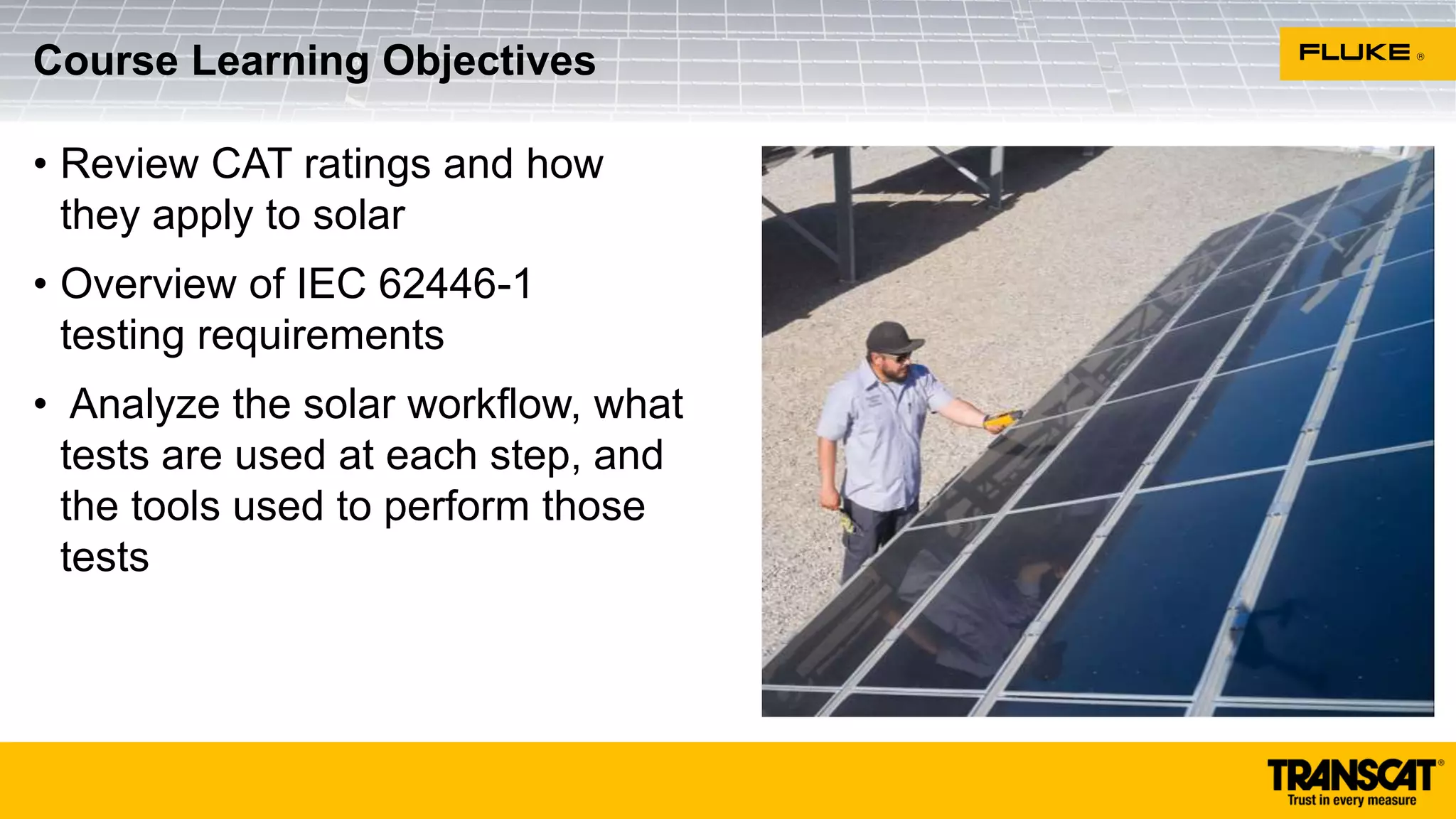
• Review CAT ratings and how
they apply to solar
• Overview of IEC 62446-1
testing requirements
• Analyze the solar workflow, what
tests are used at each step, and
the tools used to perform those
tests
Course Learning Objectives
• What causes a transient?
• Motor or another inductive load switching off
• Equipment malfunction
• Utility load switching
• Adjustable speed drives
• Lightning strike
• Transients
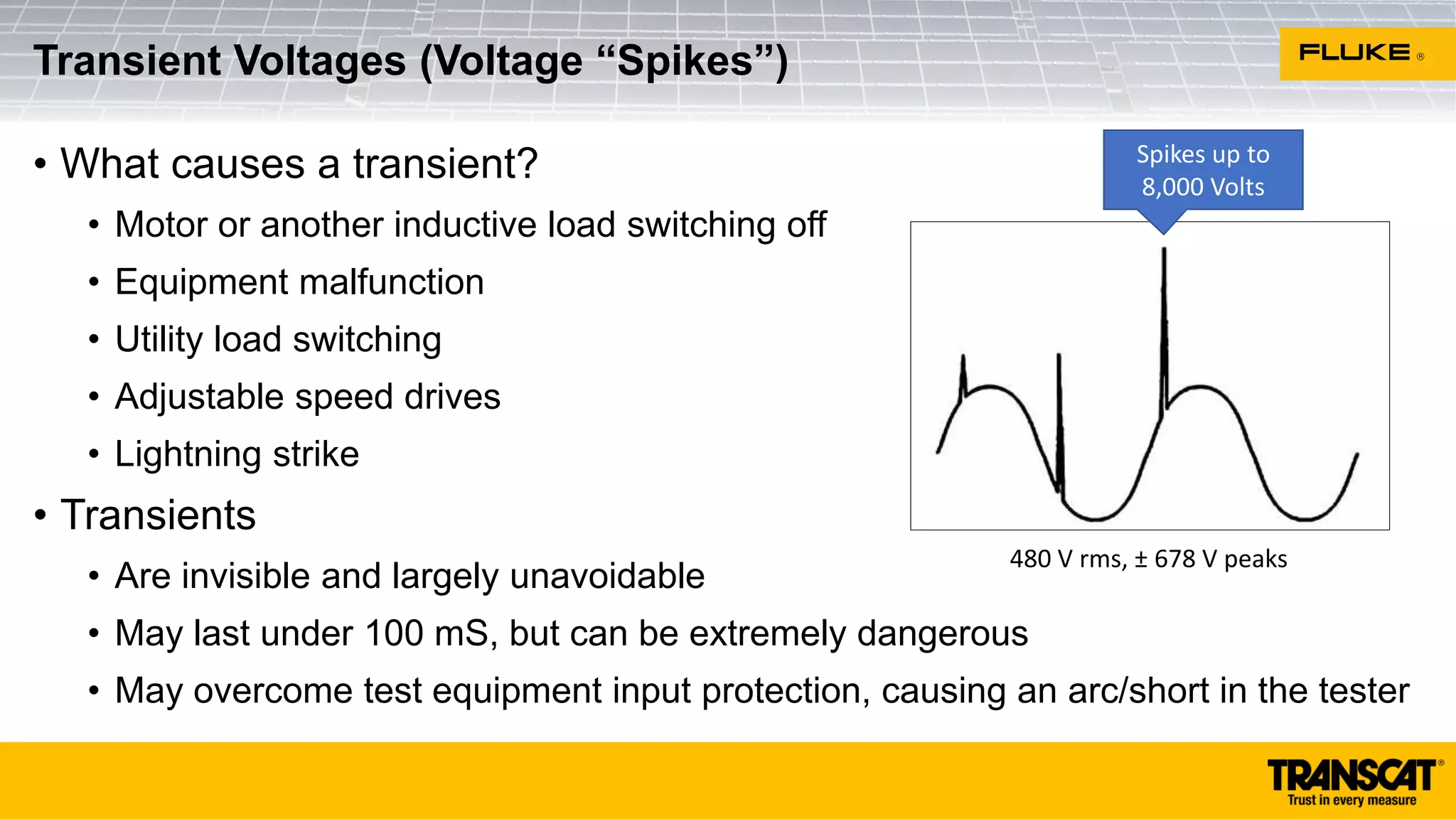
• Are invisible and largely unavoidable
• May last under 100 mS, but can be extremely dangerous
• May overcome test equipment input protection, causing an arc/short in the tester
Transient Voltages (Voltage “Spikes”)
480 V rms, ± 678 V peaks
Spikes up to
8,000 Volts
• Understanding Overvoltage Installation Category
(CAT I to IV) is key when choosing test tools
• Solar arrays are permanently wired electrical
installations (IEC 61730-1)
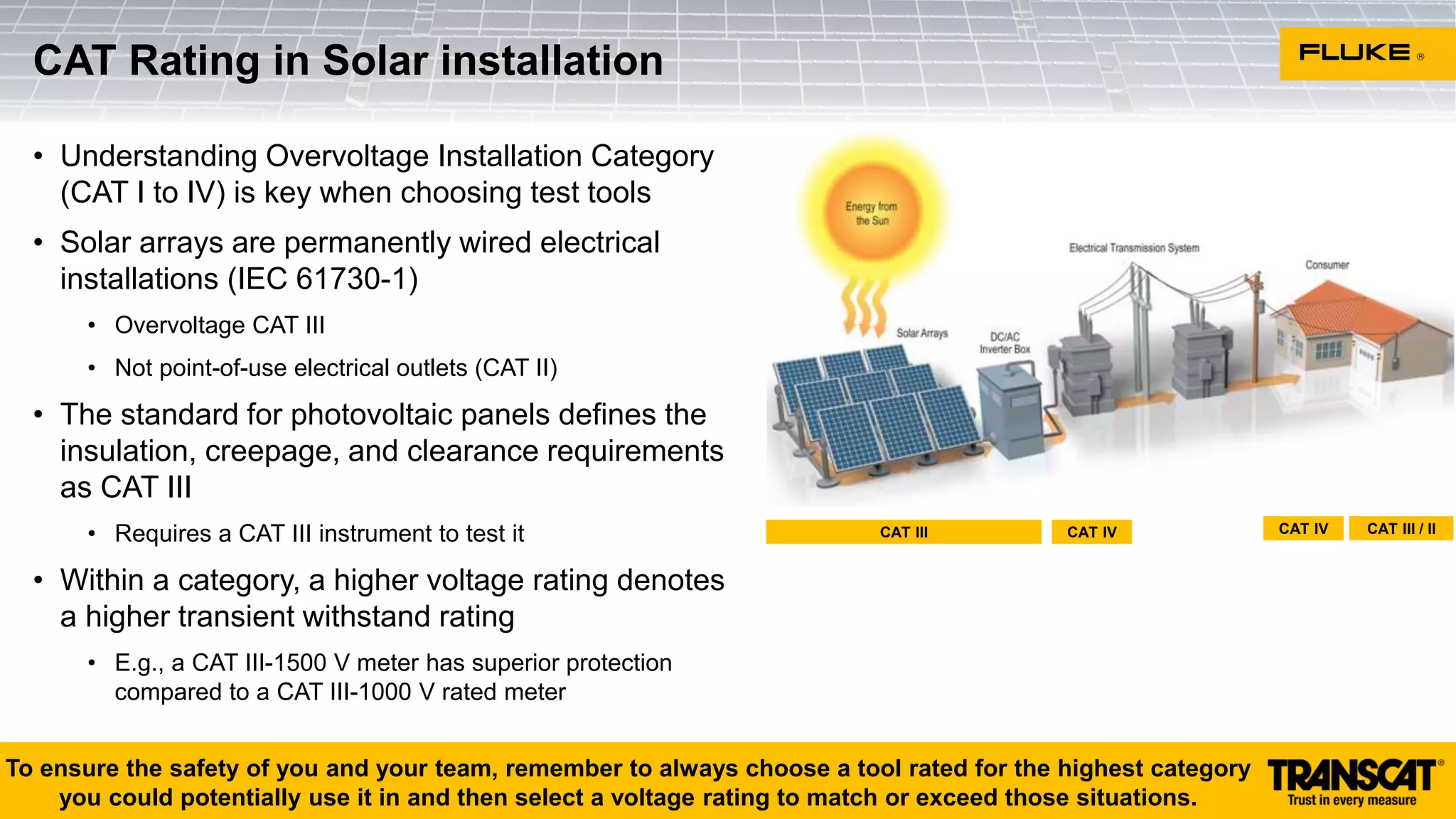
• Overvoltage CAT III
• Not point-of-use electrical outlets (CAT II)
• The standard for photovoltaic panels defines the
insulation, creepage, and clearance requirements
as CAT III
• Requires a CAT III instrument to test it
• Within a category, a higher voltage rating denotes
a higher transient withstand rating
• E.g., a CAT III-1500 V meter has superior protection
compared to a CAT III-1000 V rated meter
CAT Rating in Solar installation
CAT III CAT IV CAT IV CAT III / II
To ensure the safety of you and your team, remember to always choose a tool rated for the highest category
you could potentially use it in and then select a voltage rating to match or exceed those situations.
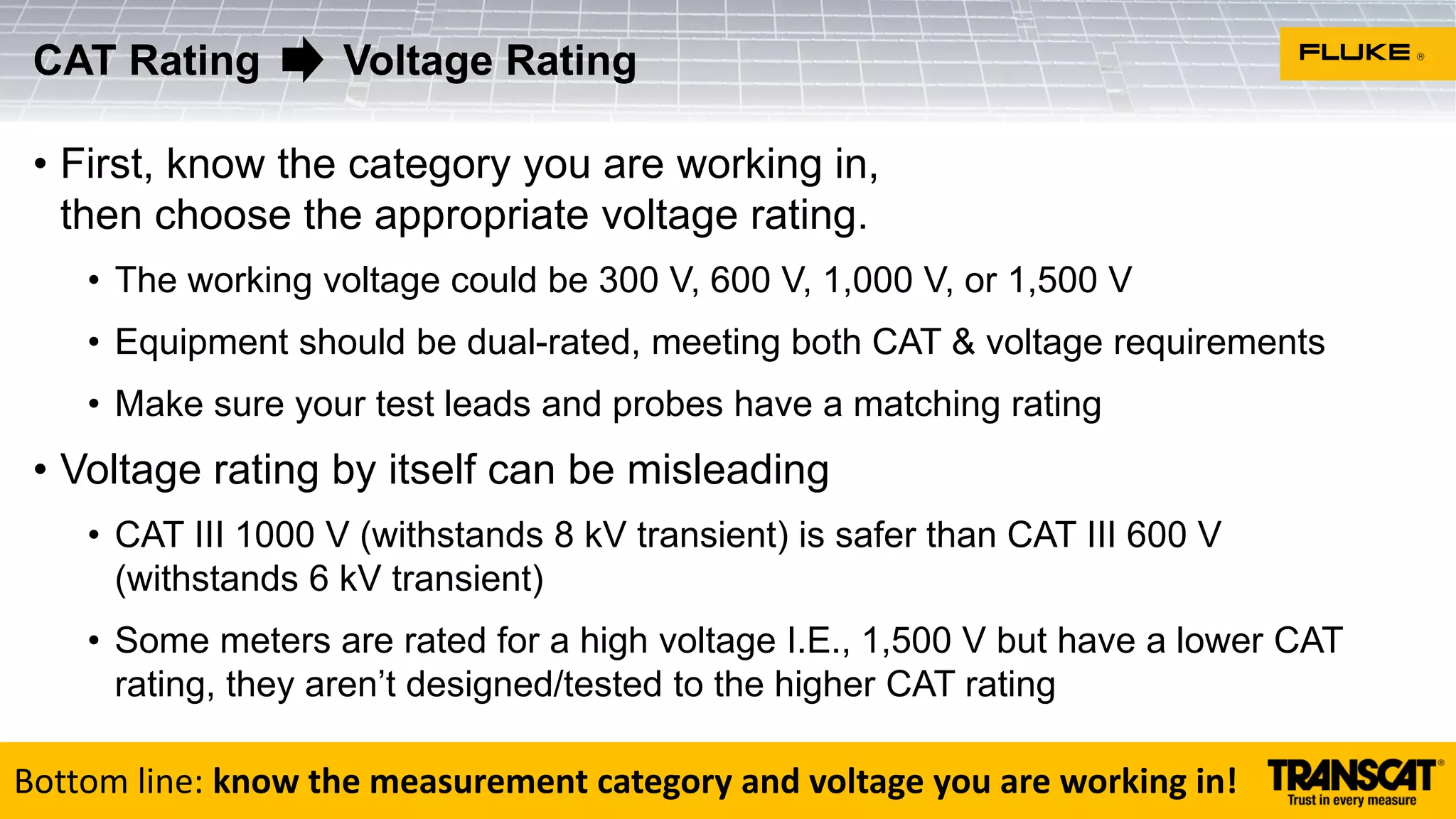
• First, know the category you are working in,
then choose the appropriate voltage rating.
• The working voltage could be 300 V, 600 V, 1,000 V, or 1,500 V
• Equipment should be dual-rated, meeting both CAT & voltage requirements
• Make sure your test leads and probes have a matching rating
• Voltage rating by itself can be misleading
• CAT III 1000 V (withstands 8 kV transient) is safer than CAT III 600 V
(withstands 6 kV transient)
• Some meters are rated for a high voltage I.E., 1,500 V but have a lower CAT
rating, they aren’t designed/tested to the higher CAT rating
CAT Rating Voltage Rating
Bottom line: know the measurement category and voltage you are working in!
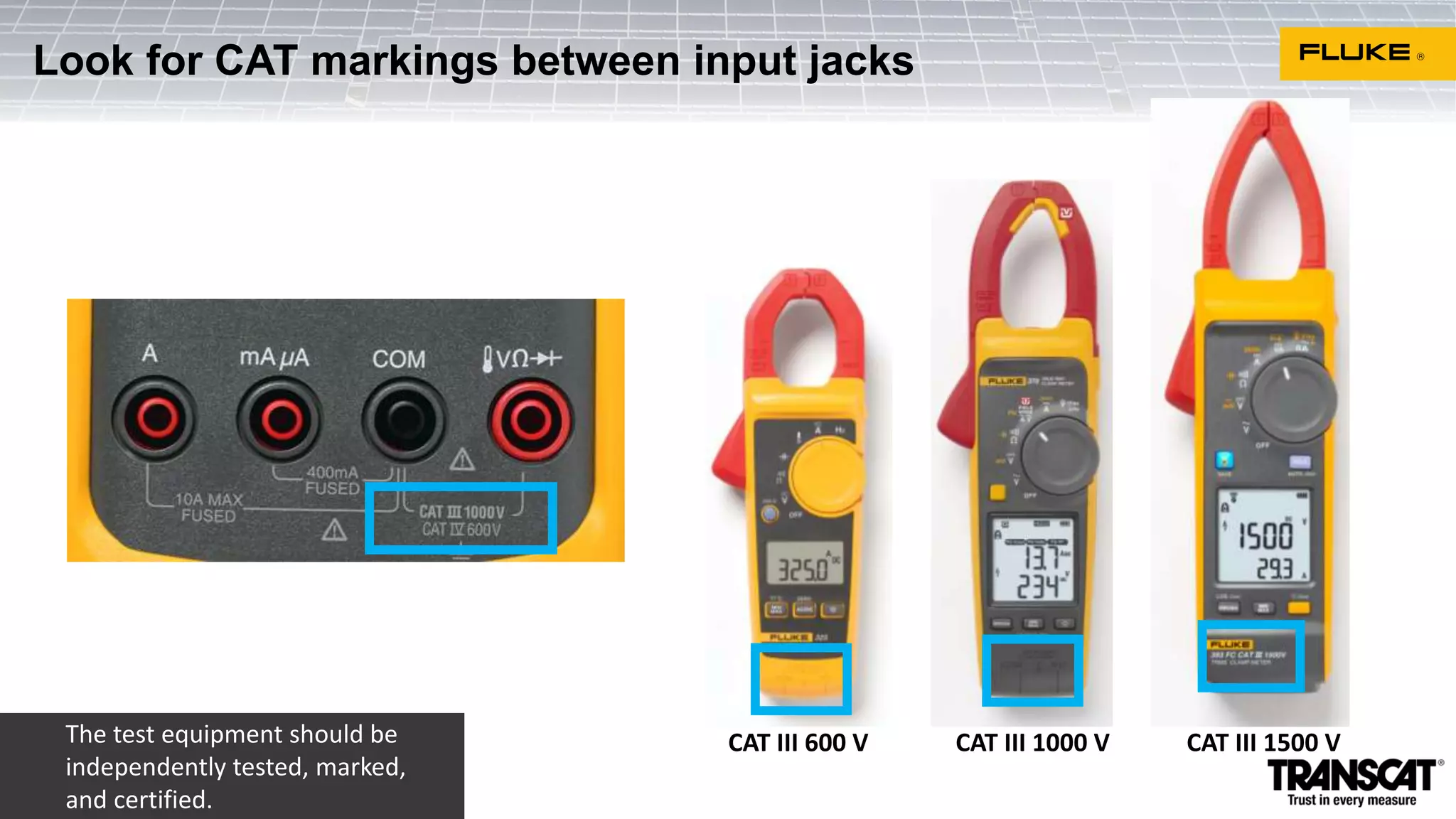
Look for CAT markings between input jacks
The test equipment should be
independently tested, marked,
and certified.
CAT III 1500 V
CAT III 1000 V
CAT III 600 V
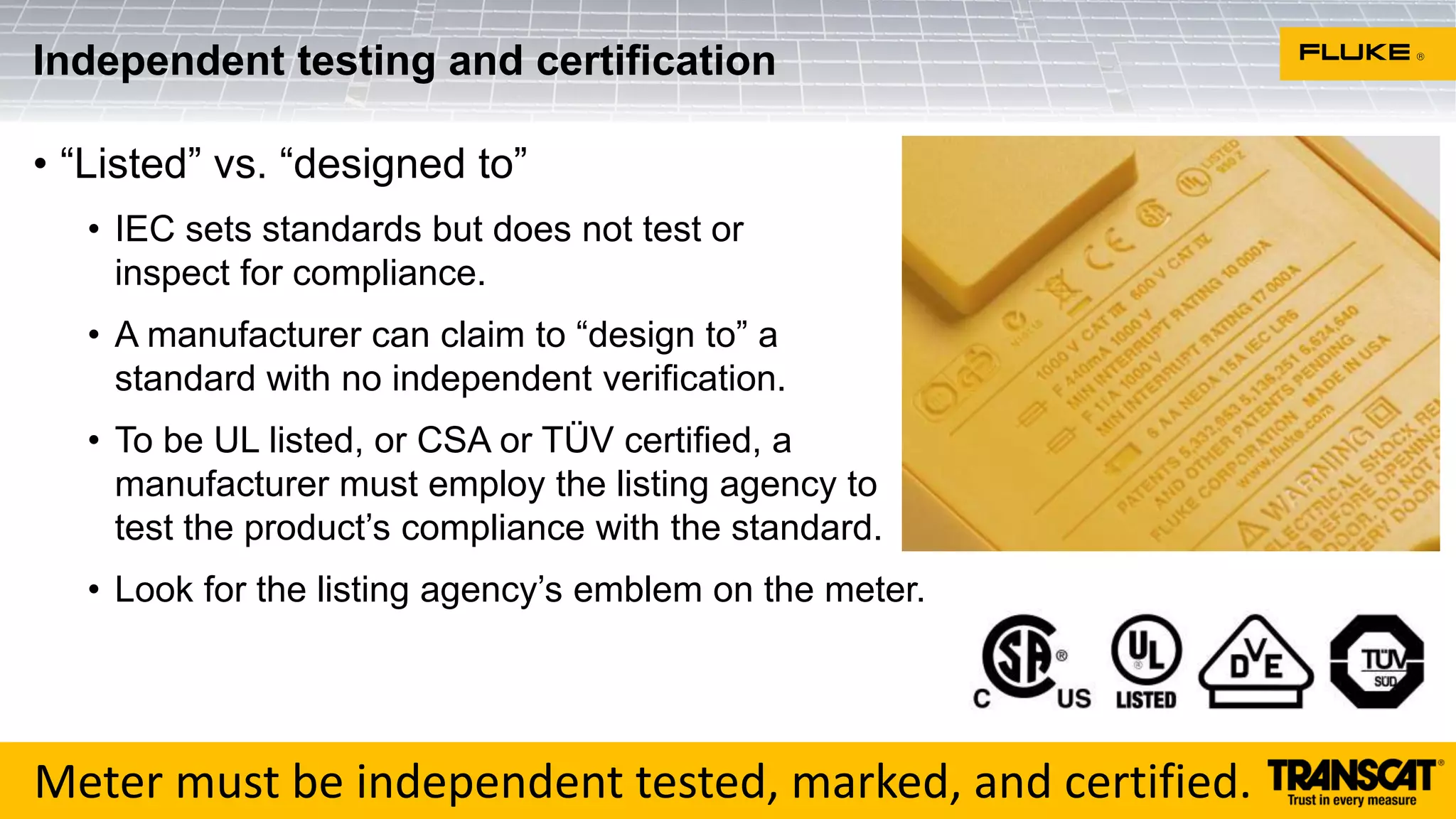
• “Listed” vs. “designed to”
• IEC sets standards but does not test or
inspect for compliance.
• A manufacturer can claim to “design to” a
standard with no independent verification.
• To be UL listed, or CSA or TÜV certified, a
manufacturer must employ the listing agency to
test the product’s compliance with the standard.
• Look for the listing agency’s emblem on the meter.
Independent testing and certification
Meter must be independent tested, marked, and certified.
When installing, commissioning, and executing maintenance on PV systems,
technicians verify safety and performance per IEC 62446-1 standards
Safety
IEC 62446-1 requires that the AC circuits are tested first, then the following six
DC circuit tests need to be performed, preferably in this order:
1) Test continuity of equipment and system grounding conductors
2) Test polarity of all DC cables
3) Test open-circuit voltage [Voc] for each PV source circuit
4) Test short-circuit current [Isc] for each PV source circuit
5) Test functionality of major system components
6) Test the insulation resistance of the DC circuit conductors
Performance
7) I-V Curve tracing and associated software analysis
IEC Testing Requirements for PV Systems
Utilities & 3rd
Party Service
Techs
PV Installers &
Maintenance Techs
Safety and Performance testing during installation, commissioning and
maintenance ensures safety, reliability and longevity of PV installations
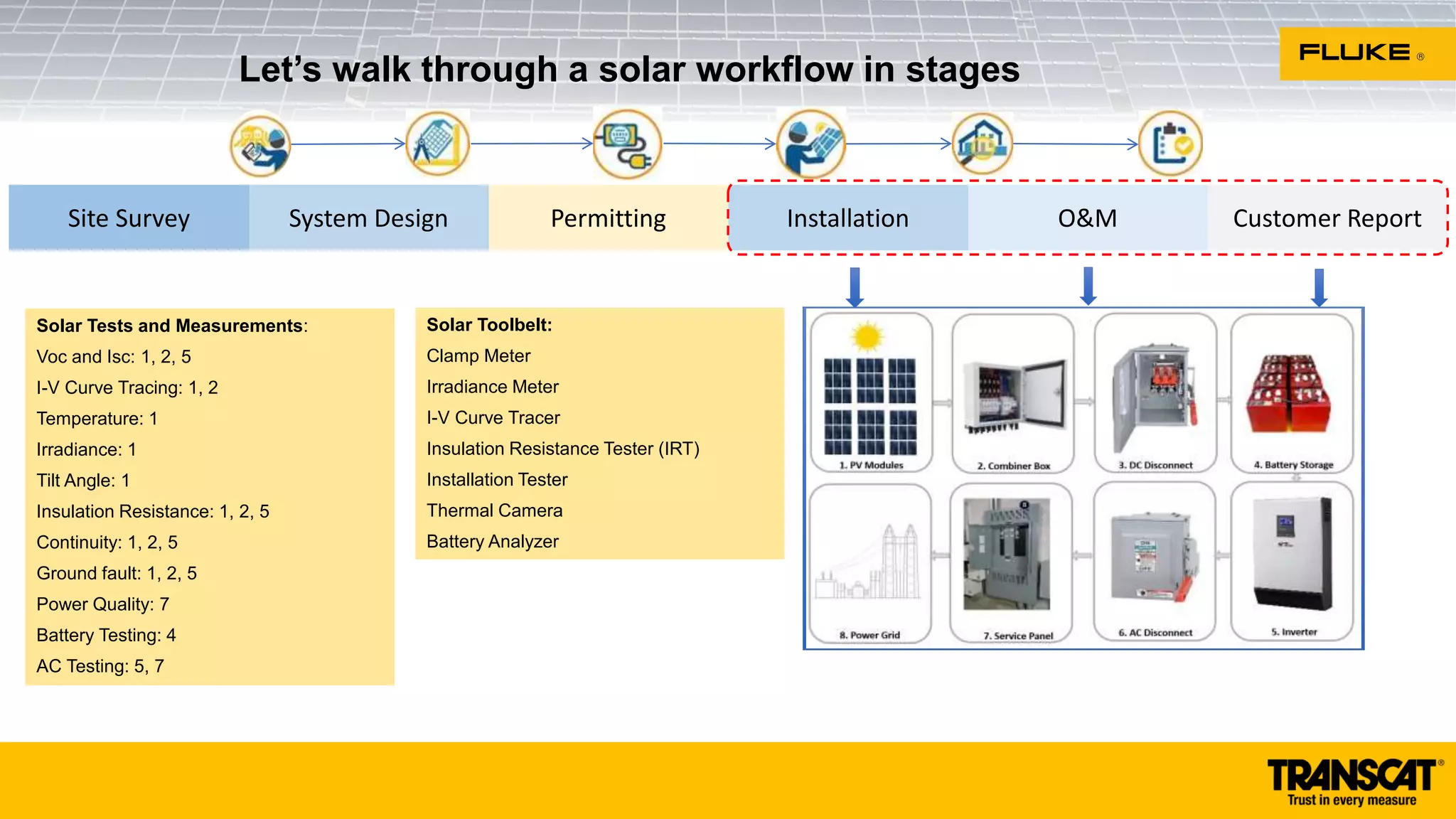
Let’s walk through a solar workflow in stages
Customer Report
O&M
Installation
Permitting
System Design
Site Survey
Solar Tests and Measurements:
Voc and Isc: 1, 2, 5
I-V Curve Tracing: 1, 2
Temperature: 1
Irradiance: 1
Tilt Angle: 1
Insulation Resistance: 1, 2, 5
Continuity: 1, 2, 5
Ground fault: 1, 2, 5
Power Quality: 7
Battery Testing: 4
AC Testing: 5, 7
Solar Toolbelt:
Clamp Meter
Irradiance Meter
I-V Curve Tracer
Insulation Resistance Tester (IRT)
Installation Tester
Thermal Camera
Battery Analyzer
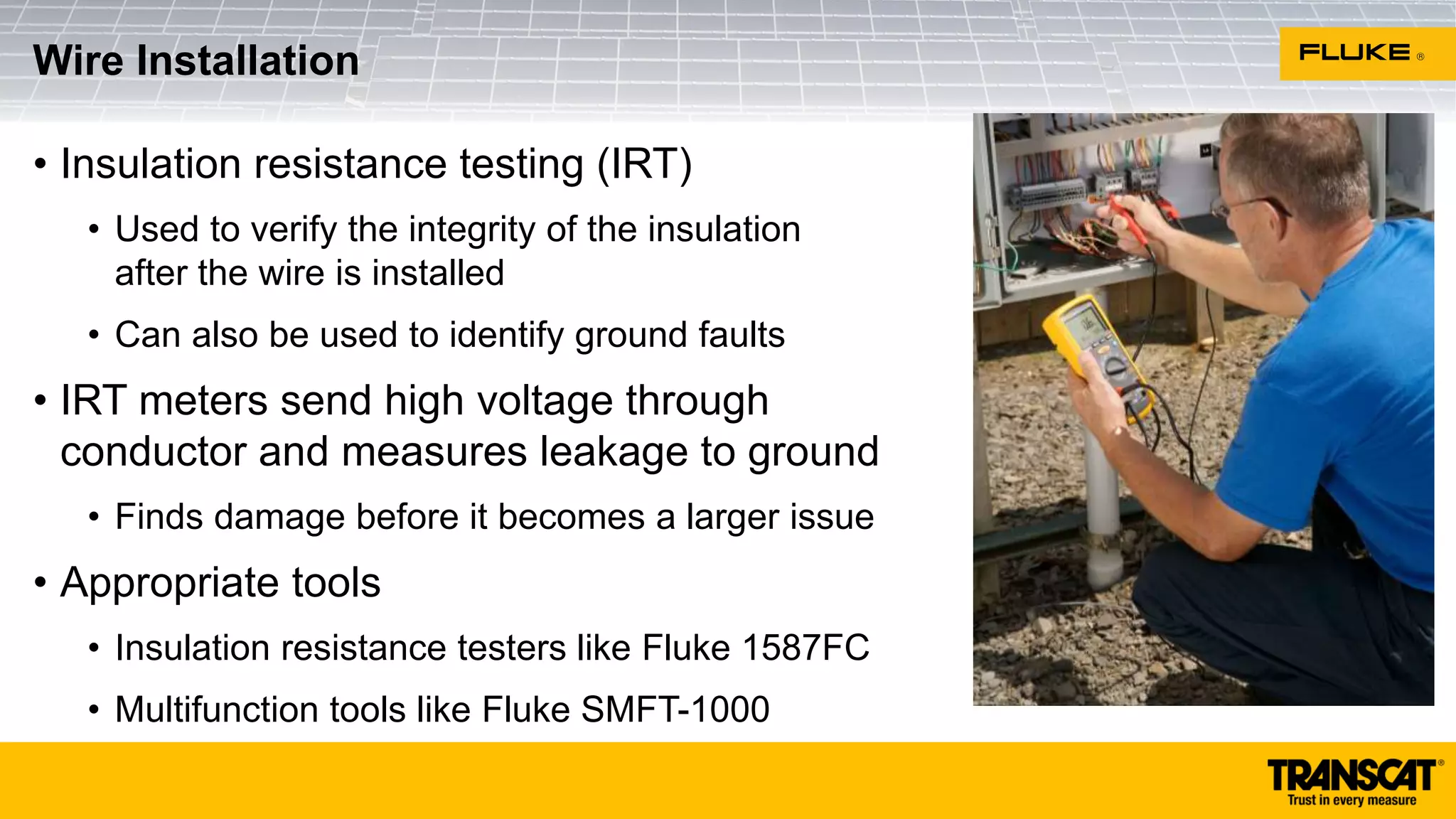
• Insulation resistance testing (IRT)
• Used to verify the integrity of the insulation
after the wire is installed
• Can also be used to identify ground faults
• IRT meters send high voltage through
conductor and measures leakage to ground
• Finds damage before it becomes a larger issue
• Appropriate tools
• Insulation resistance testers like Fluke 1587FC
• Multifunction tools like Fluke SMFT-1000
Wire Installation
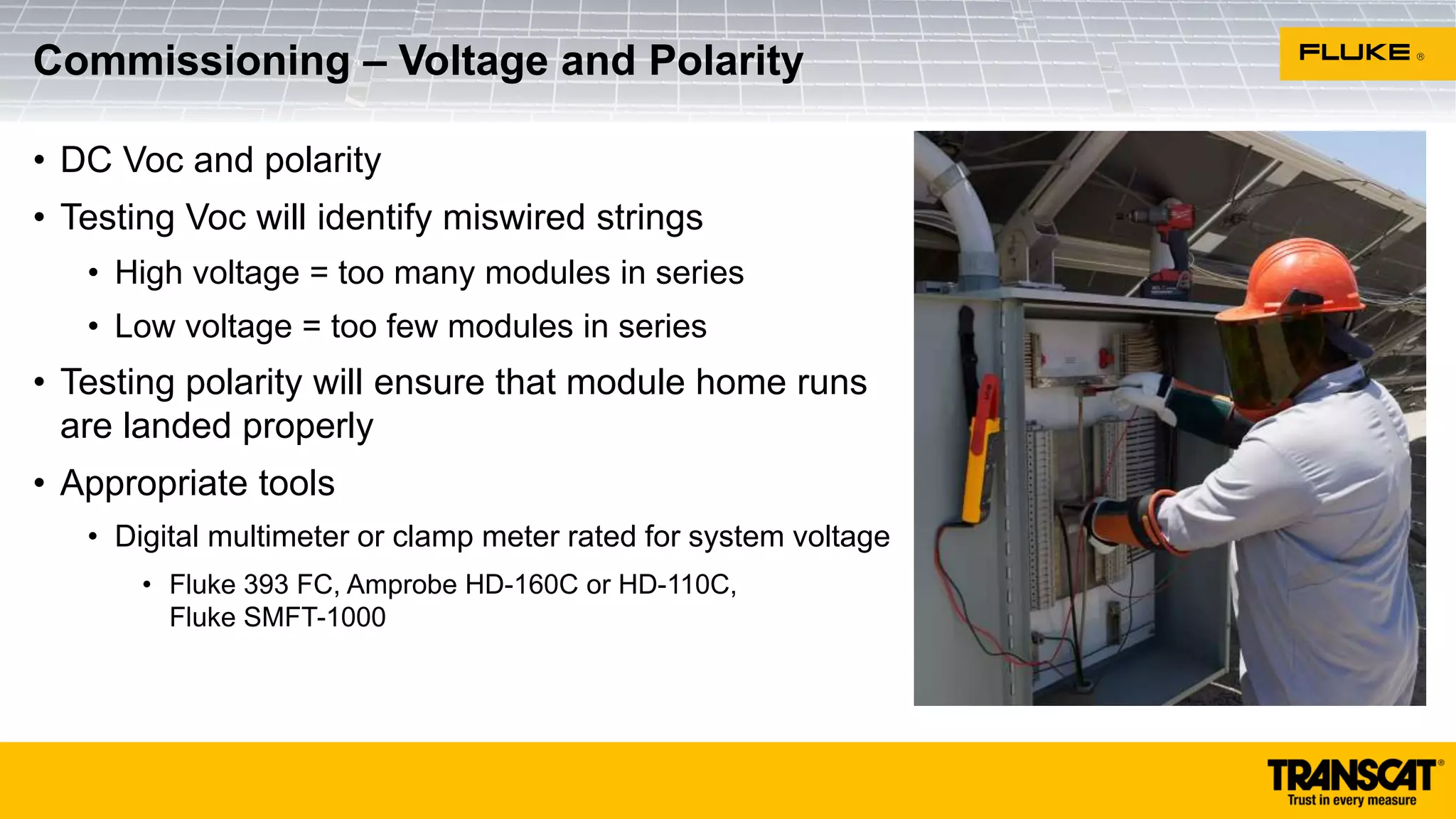
• DC Voc and polarity
• Testing Voc will identify miswired strings
• High voltage = too many modules in series
• Low voltage = too few modules in series
• Testing polarity will ensure that module home runs
are landed properly
• Appropriate tools
• Digital multimeter or clamp meter rated for system voltage
• Fluke 393 FC, Amprobe HD-160C or HD-110C,
Fluke SMFT-1000
Commissioning – Voltage and Polarity
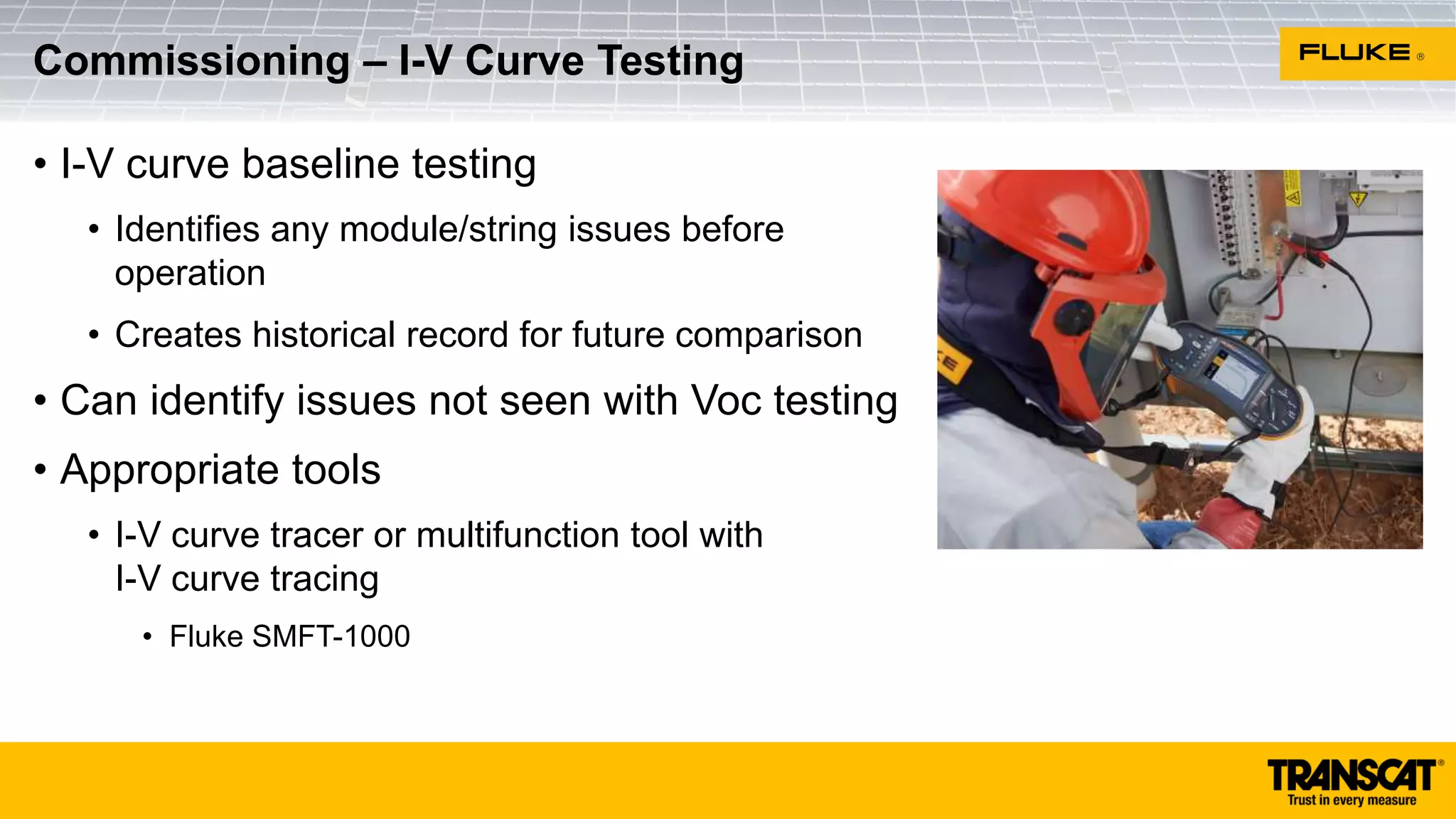
• I-V curve baseline testing
• Identifies any module/string issues before
operation
• Creates historical record for future comparison
• Can identify issues not seen with Voc testing
• Appropriate tools
• I-V curve tracer or multifunction tool with
I-V curve tracing
• Fluke SMFT-1000
Commissioning – I-V Curve Testing
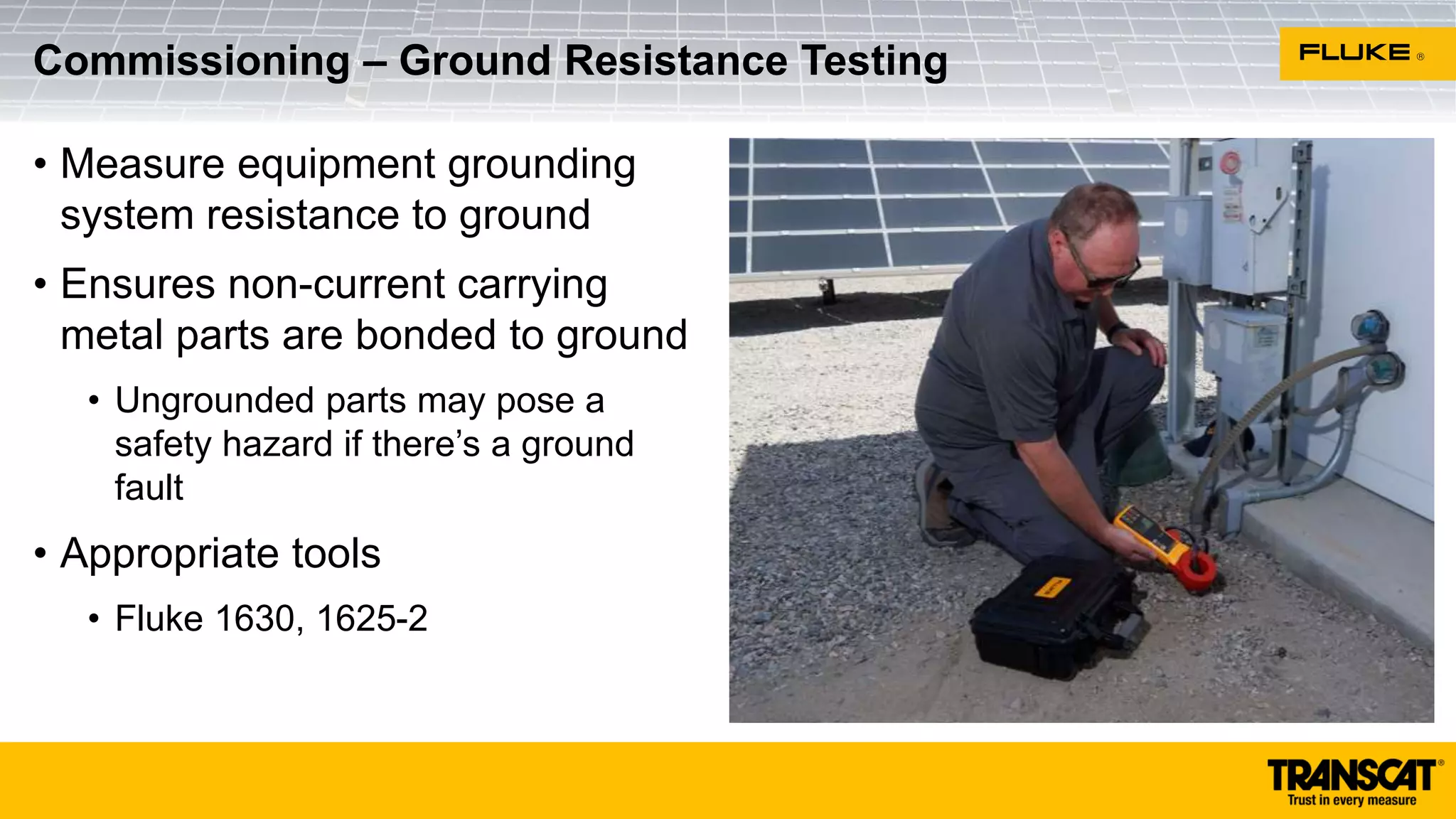
• Measure equipment grounding
system resistance to ground
• Ensures non-current carrying
metal parts are bonded to ground
• Ungrounded parts may pose a
safety hazard if there’s a ground
fault
• Appropriate tools
• Fluke 1630, 1625-2
Commissioning – Ground Resistance Testing
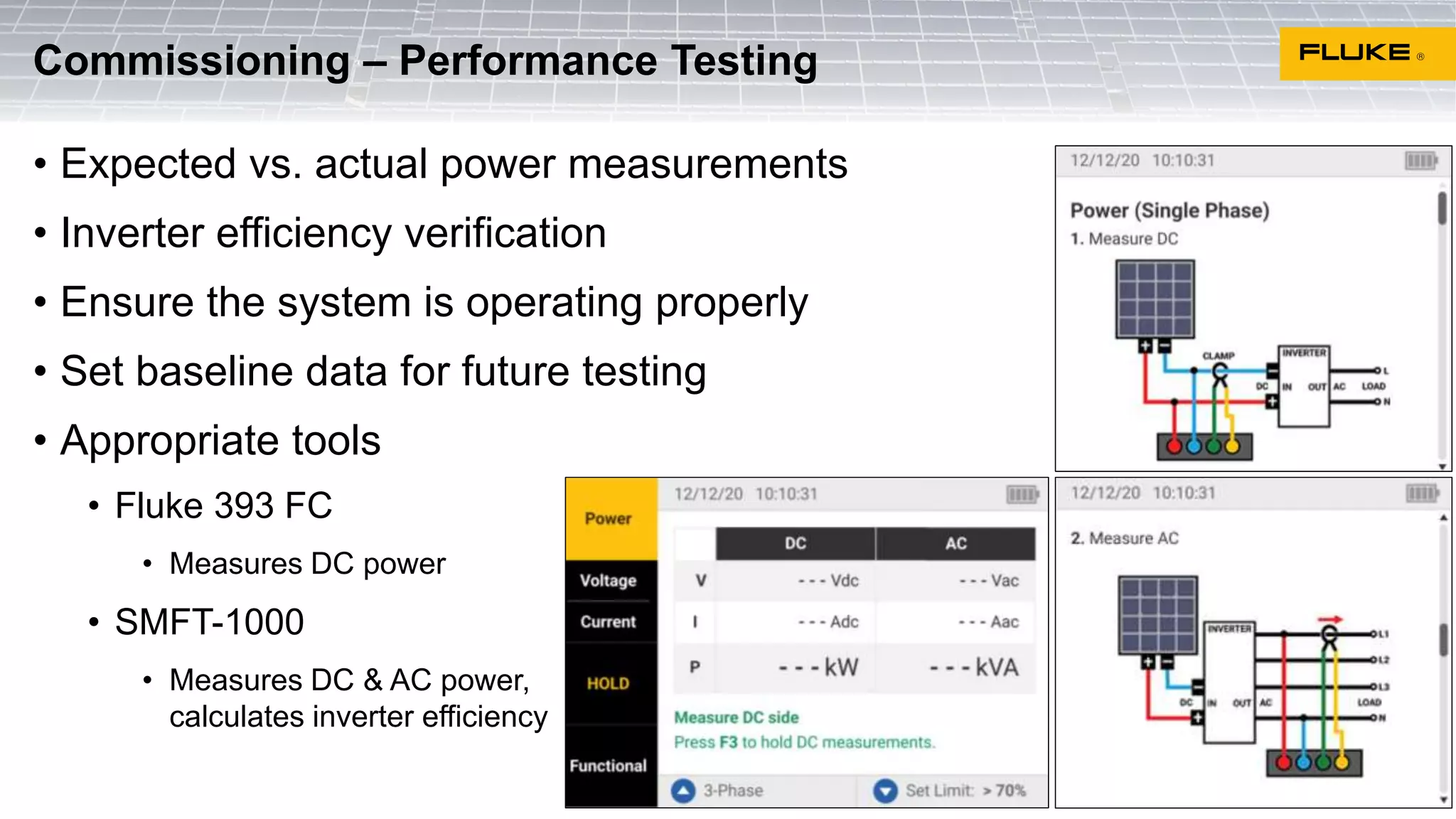
• Expected vs. actual power measurements
• Inverter efficiency verification
• Ensure the system is operating properly
• Set baseline data for future testing
• Appropriate tools
• Fluke 393 FC
• Measures DC power
• SMFT-1000
• Measures DC & AC power,
calculates inverter efficiency
Commissioning – Performance Testing
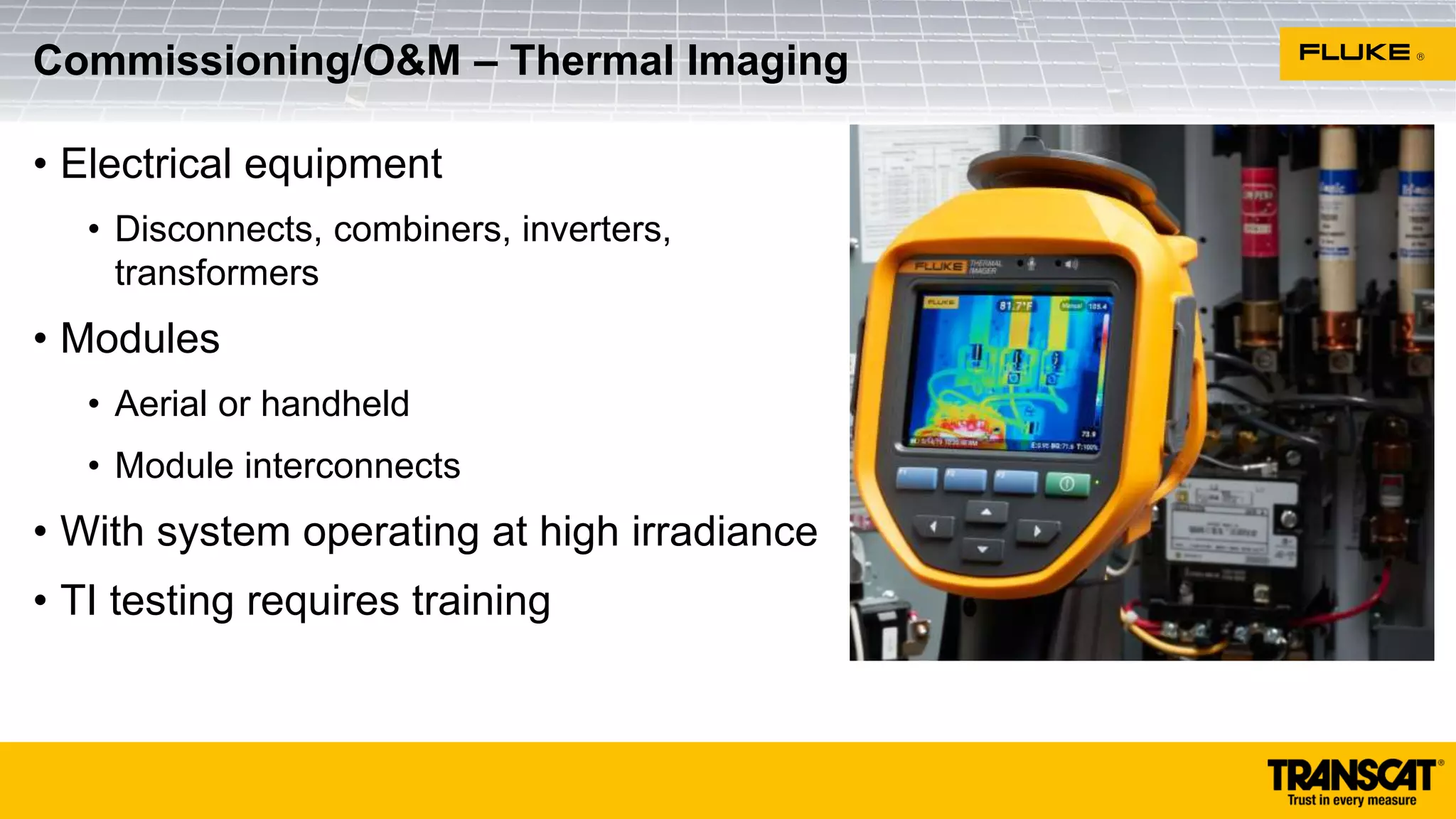
• Electrical equipment
• Disconnects, combiners, inverters,
transformers
• Modules
• Aerial or handheld
• Module interconnects
• With system operating at high irradiance
• TI testing requires training
Commissioning/O&M – Thermal Imaging
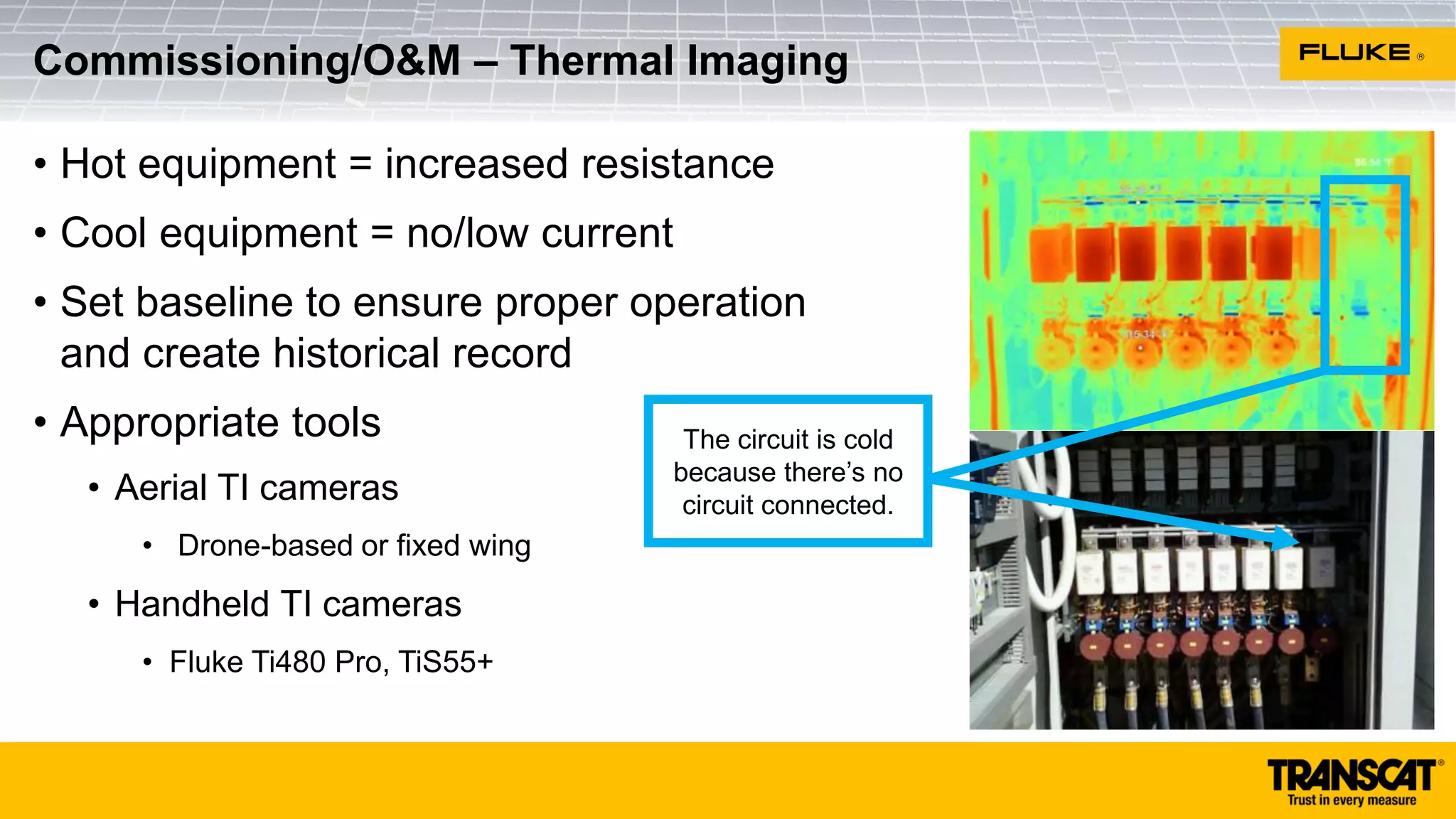
• Hot equipment = increased resistance
• Cool equipment = no/low current
• Set baseline to ensure proper operation
and create historical record
• Appropriate tools
• Aerial TI cameras
• Drone-based or fixed wing
• Handheld TI cameras
• Fluke Ti480 Pro, TiS55+
Commissioning/O&M – Thermal Imaging
The circuit is cold
because there’s no
circuit connected.
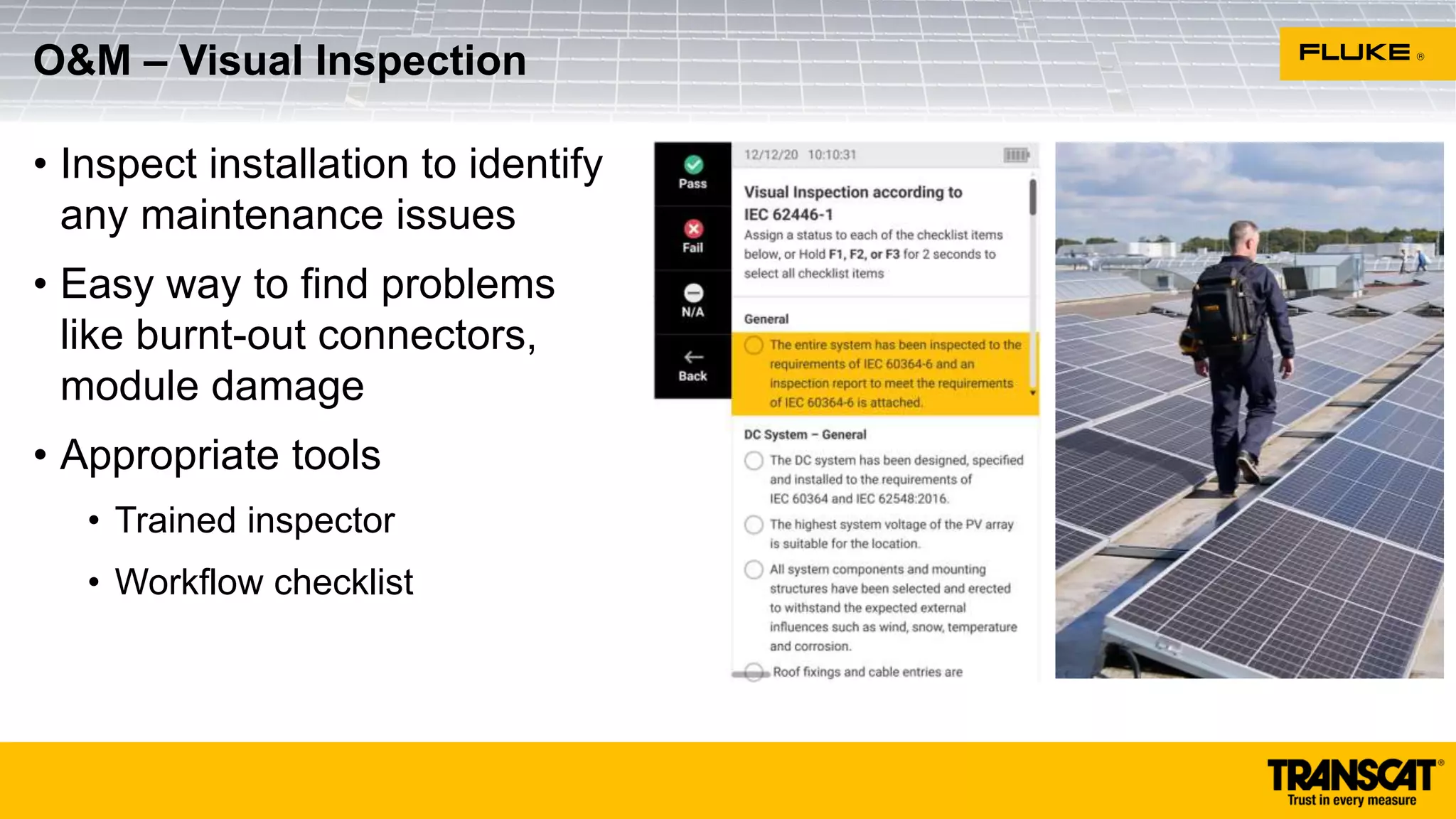
• Inspect installation to identify
any maintenance issues
• Easy way to find problems
like burnt-out connectors,
module damage
• Appropriate tools
• Trained inspector
• Workflow checklist
O&M – Visual Inspection
• DC voltage and current
• AC voltage and current
• Fuse continuity
• Thermal imaging
• Torque terminals
• Inverter efficiency
• AC power quality
• Voltage, frequency, harmonics
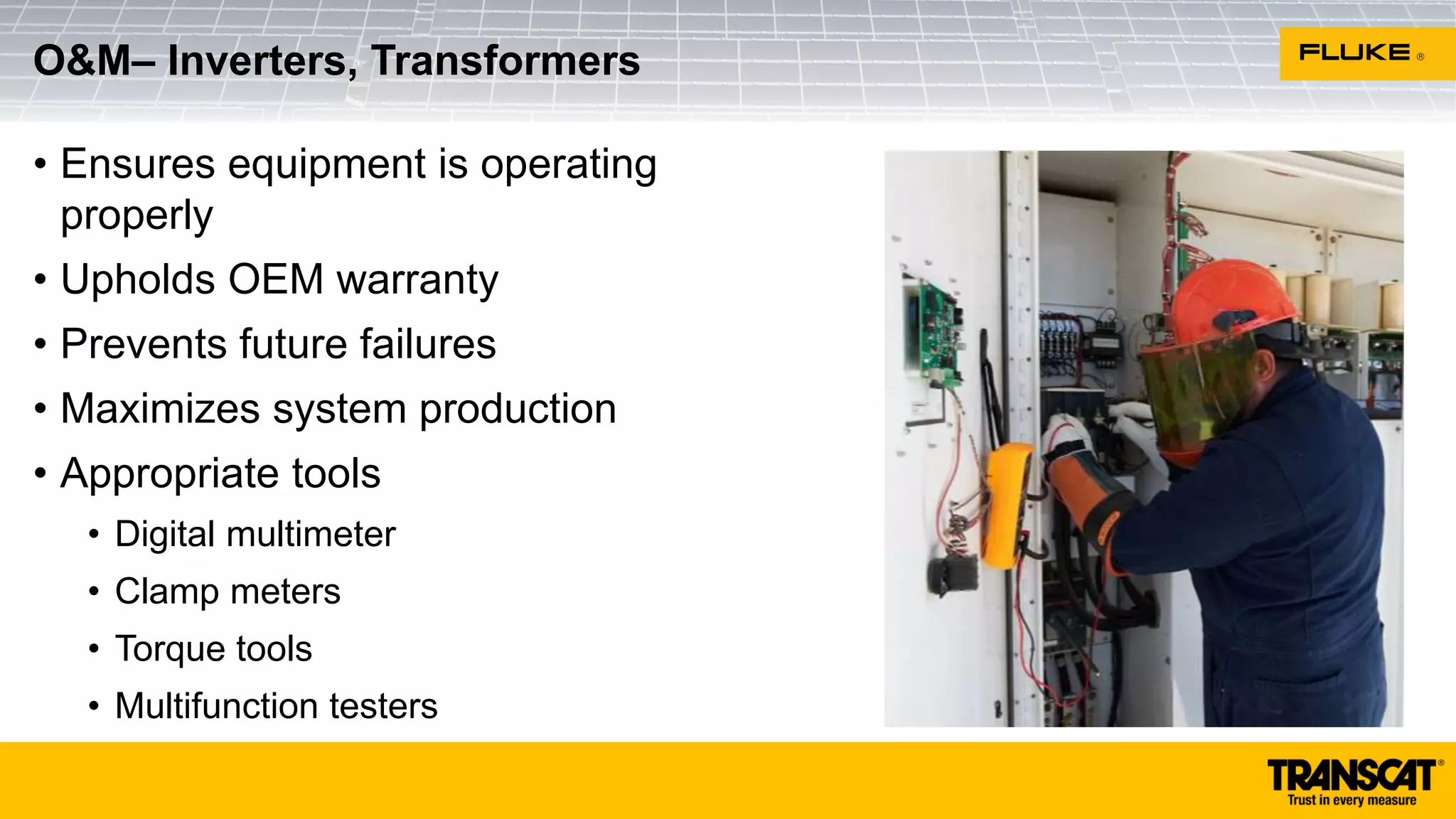
O&M– Inverters, Transformers
• Ensures equipment is operating
properly
• Upholds OEM warranty
• Prevents future failures
• Maximizes system production
• Appropriate tools
• Digital multimeter
• Clamp meters
• Torque tools
• Multifunction testers
O&M– Inverters, Transformers
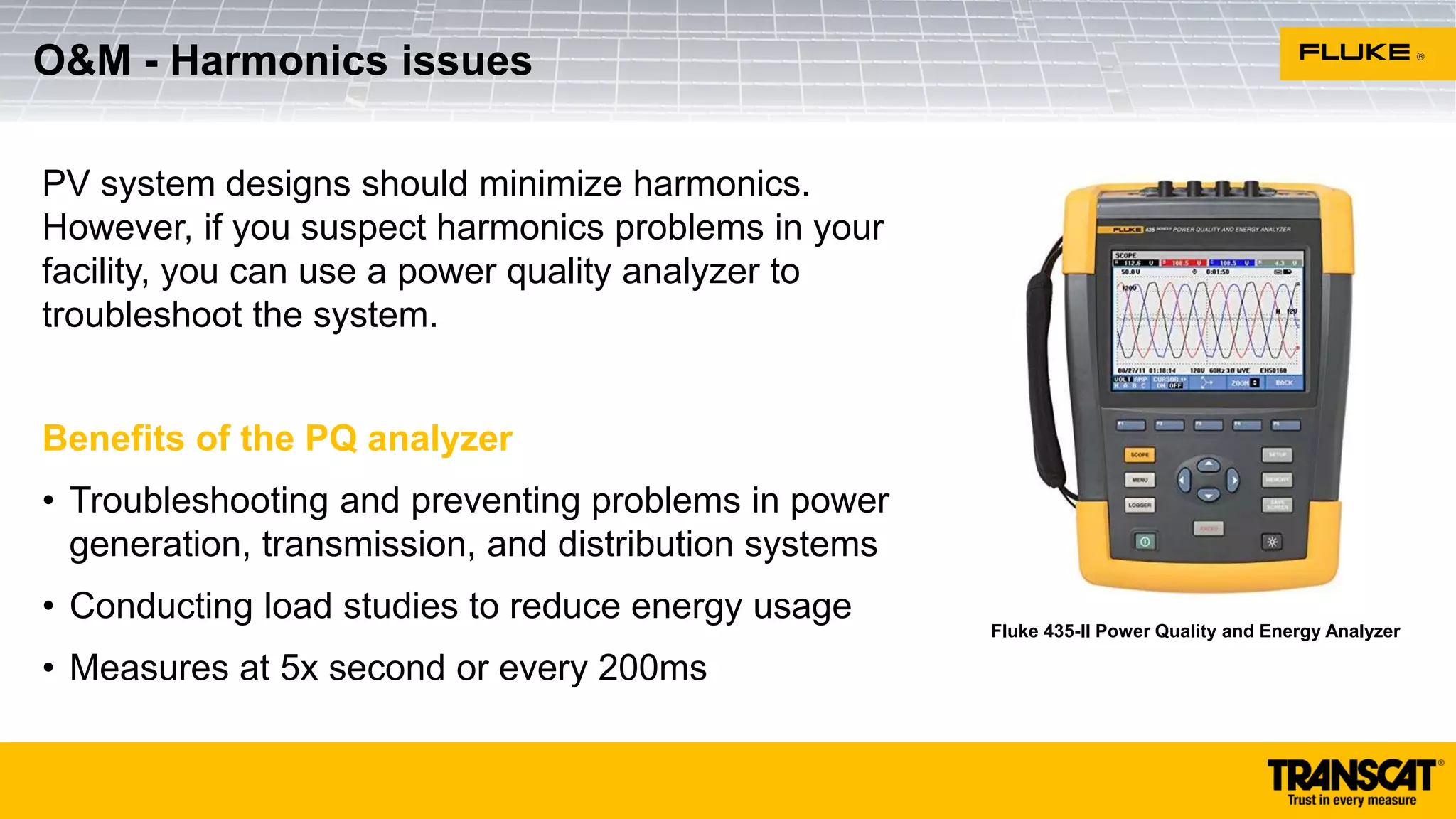
O&M - Harmonics issues
PV system designs should minimize harmonics.
However, if you suspect harmonics problems in your
facility, you can use a power quality analyzer to
troubleshoot the system.
Benefits of the PQ analyzer
• Troubleshooting and preventing problems in power
generation, transmission, and distribution systems
• Conducting load studies to reduce energy usage
• Measures at 5x second or every 200ms
Fluke 435-II Power Quality and Energy Analyzer
• Visually inspect array for any obvious
damage or accidental disconnections
• Damaged modules
• Compromised insulation
• Loose or damaged connectors
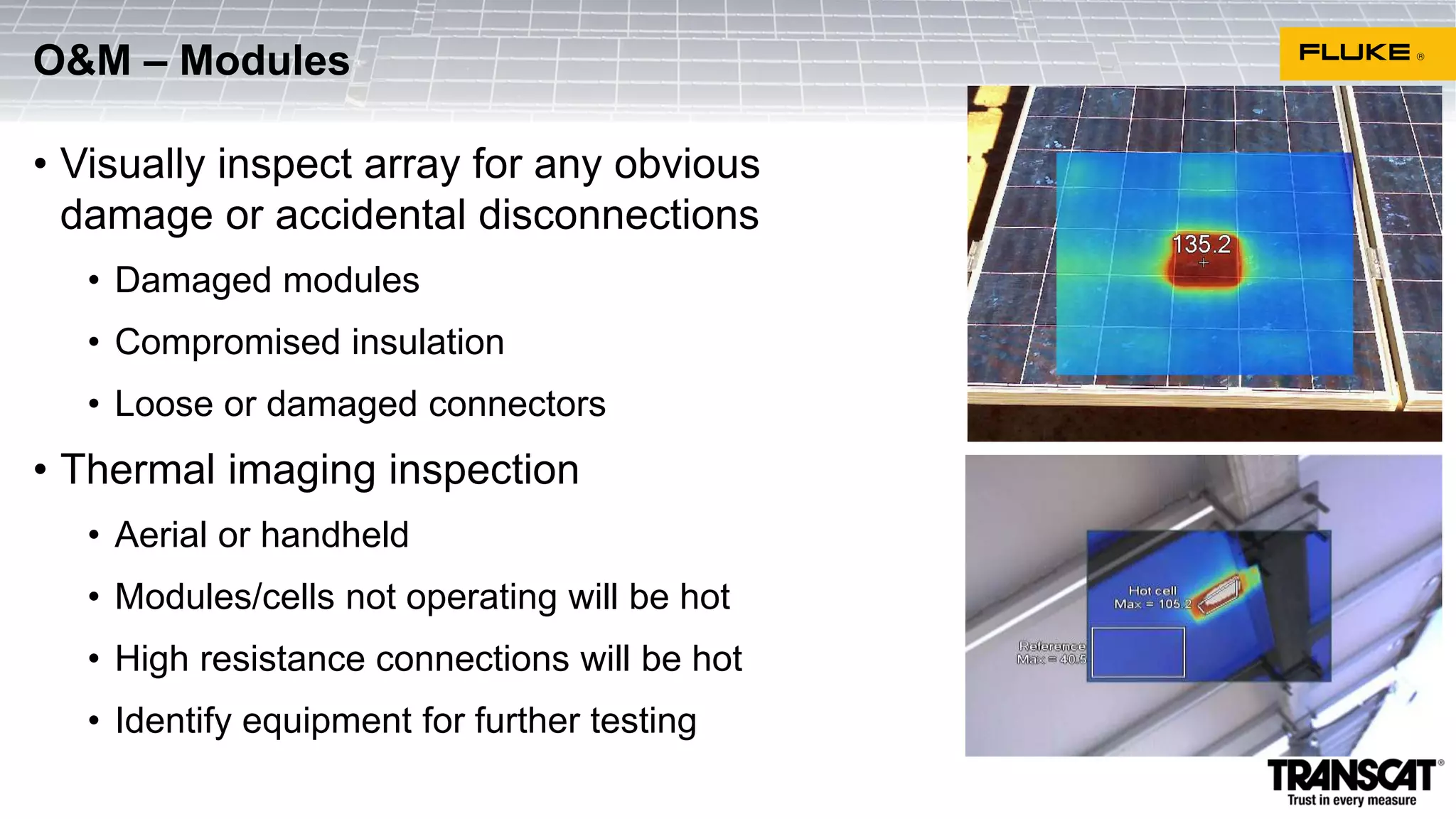
• Thermal imaging inspection
• Aerial or handheld
• Modules/cells not operating will be hot
• High resistance connections will be hot
• Identify equipment for further testing
O&M – Modules
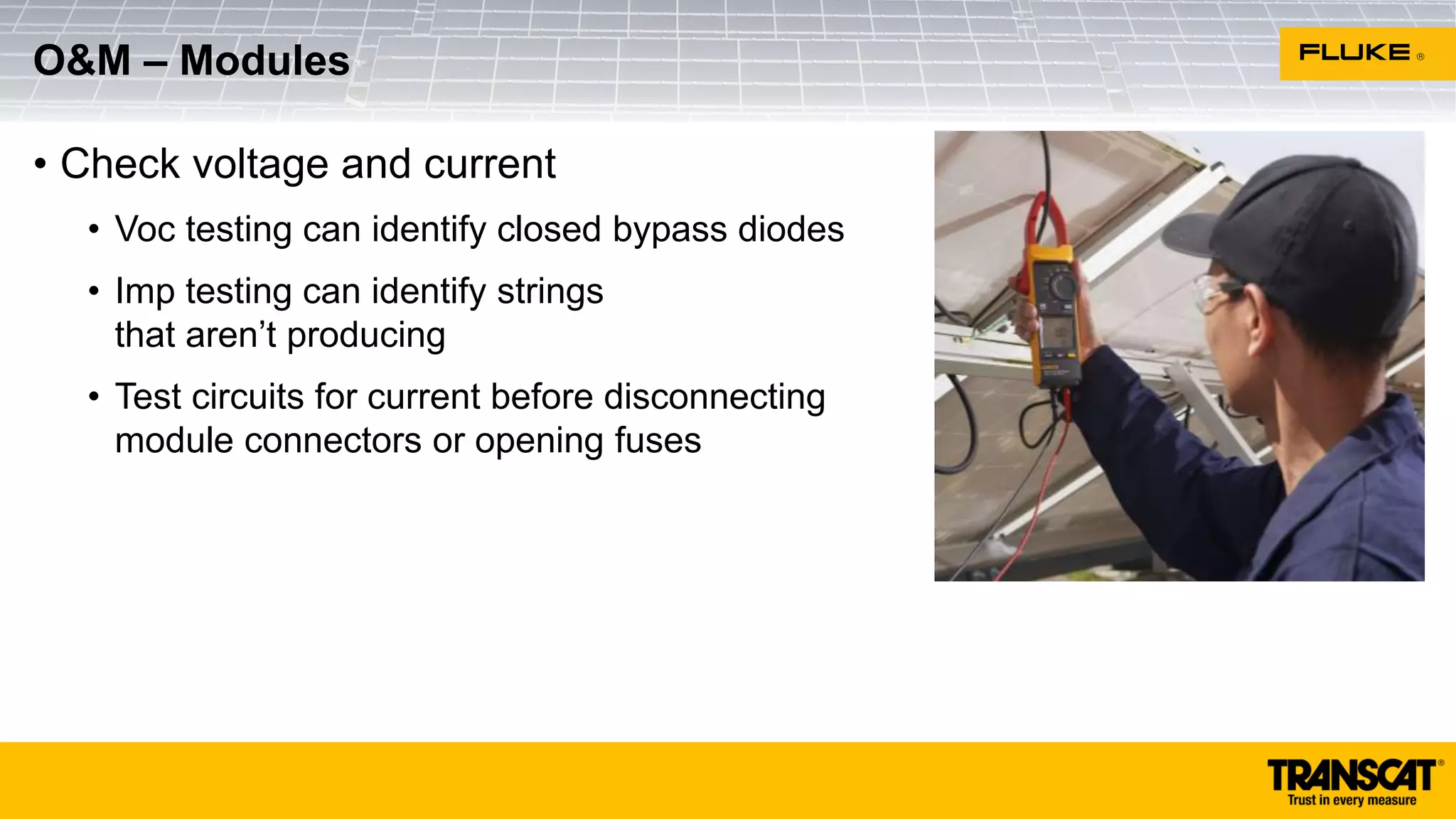
• Check voltage and current
• Voc testing can identify closed bypass diodes
• Imp testing can identify strings
that aren’t producing
• Test circuits for current before disconnecting
module connectors or opening fuses
O&M – Modules
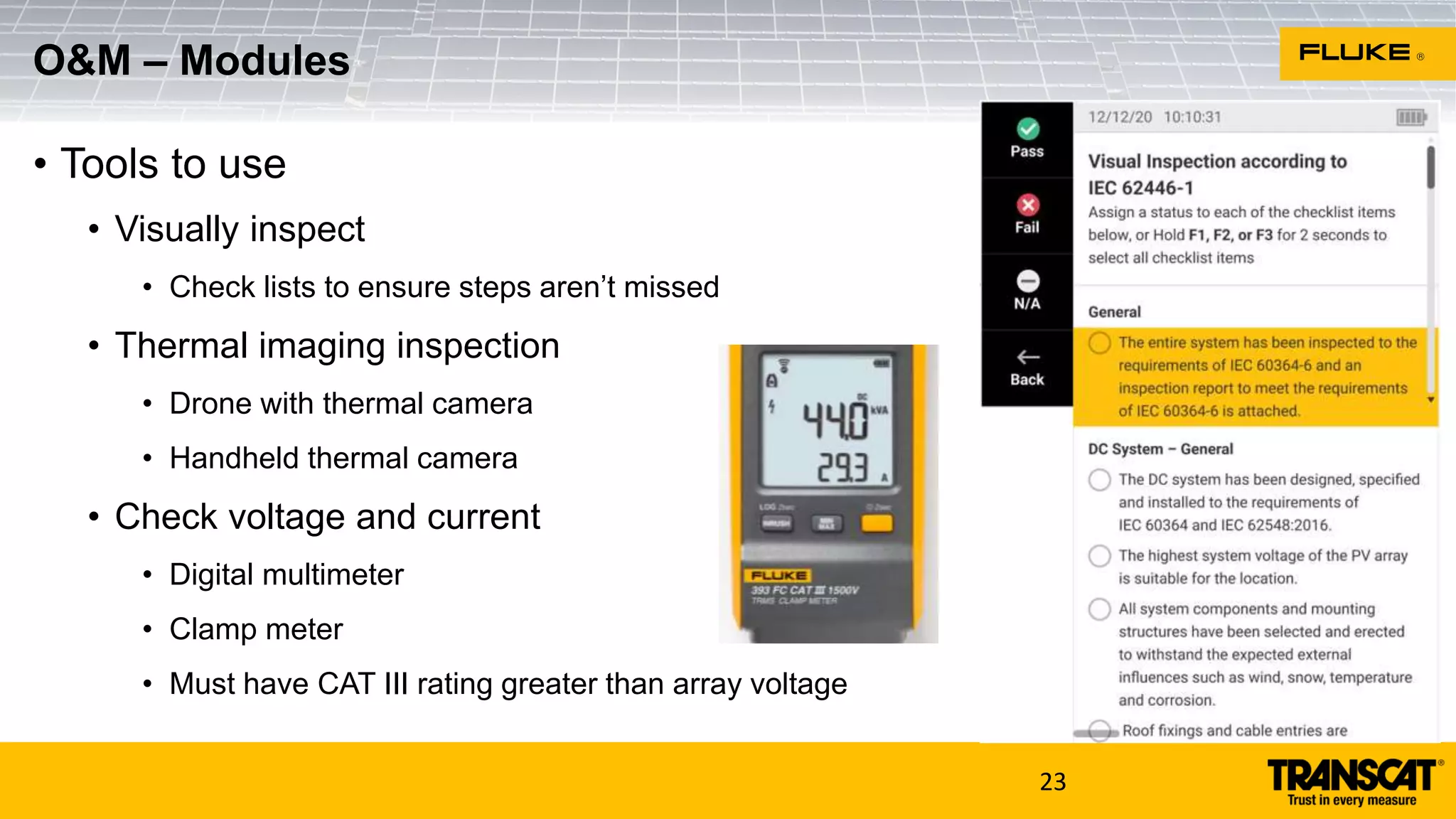
• Tools to use
• Visually inspect
• Check lists to ensure steps aren’t missed
• Thermal imaging inspection
• Drone with thermal camera
• Handheld thermal camera
• Check voltage and current
• Digital multimeter
• Clamp meter
• Must have CAT III rating greater than array voltage
23
O&M – Modules
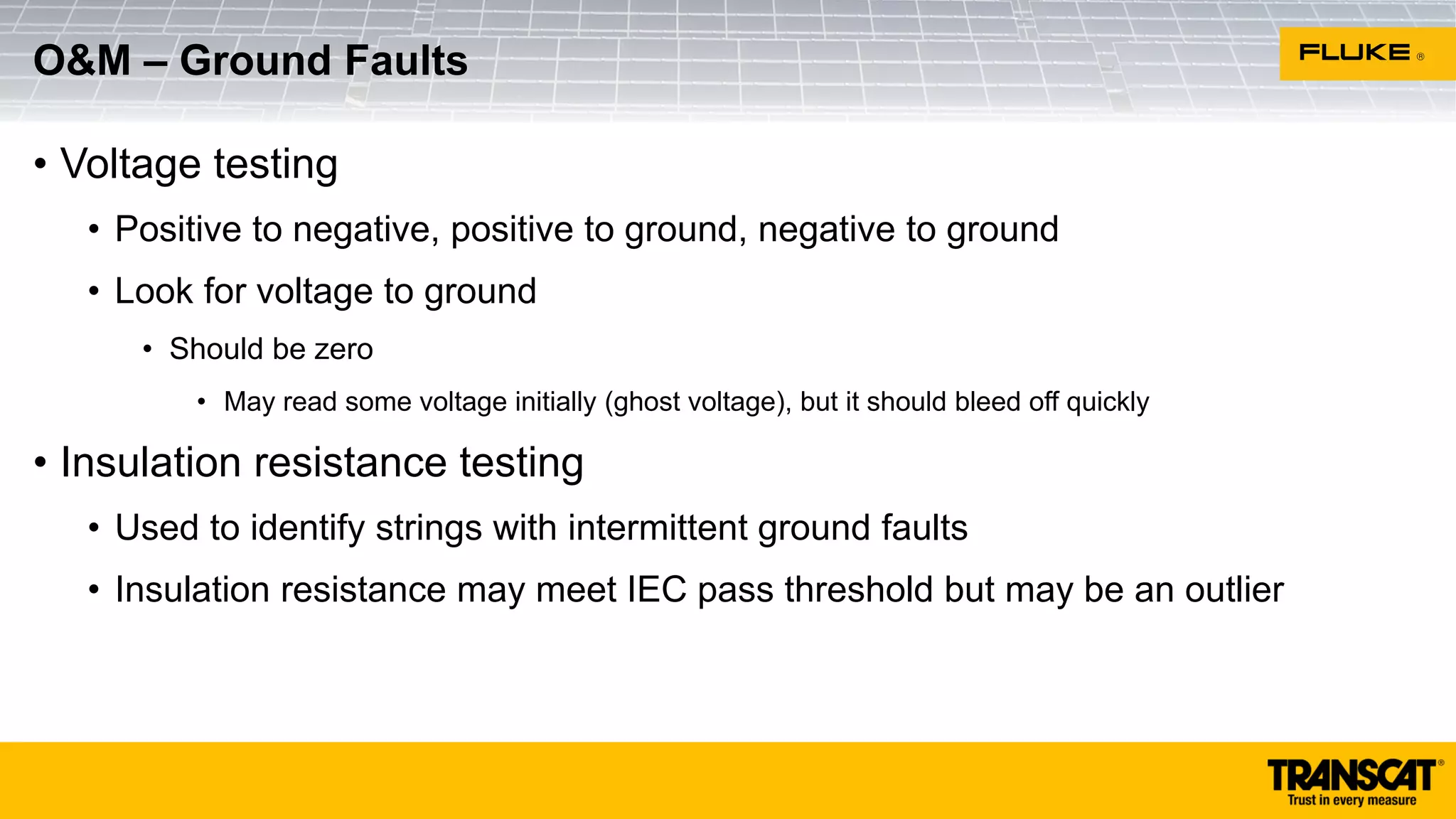
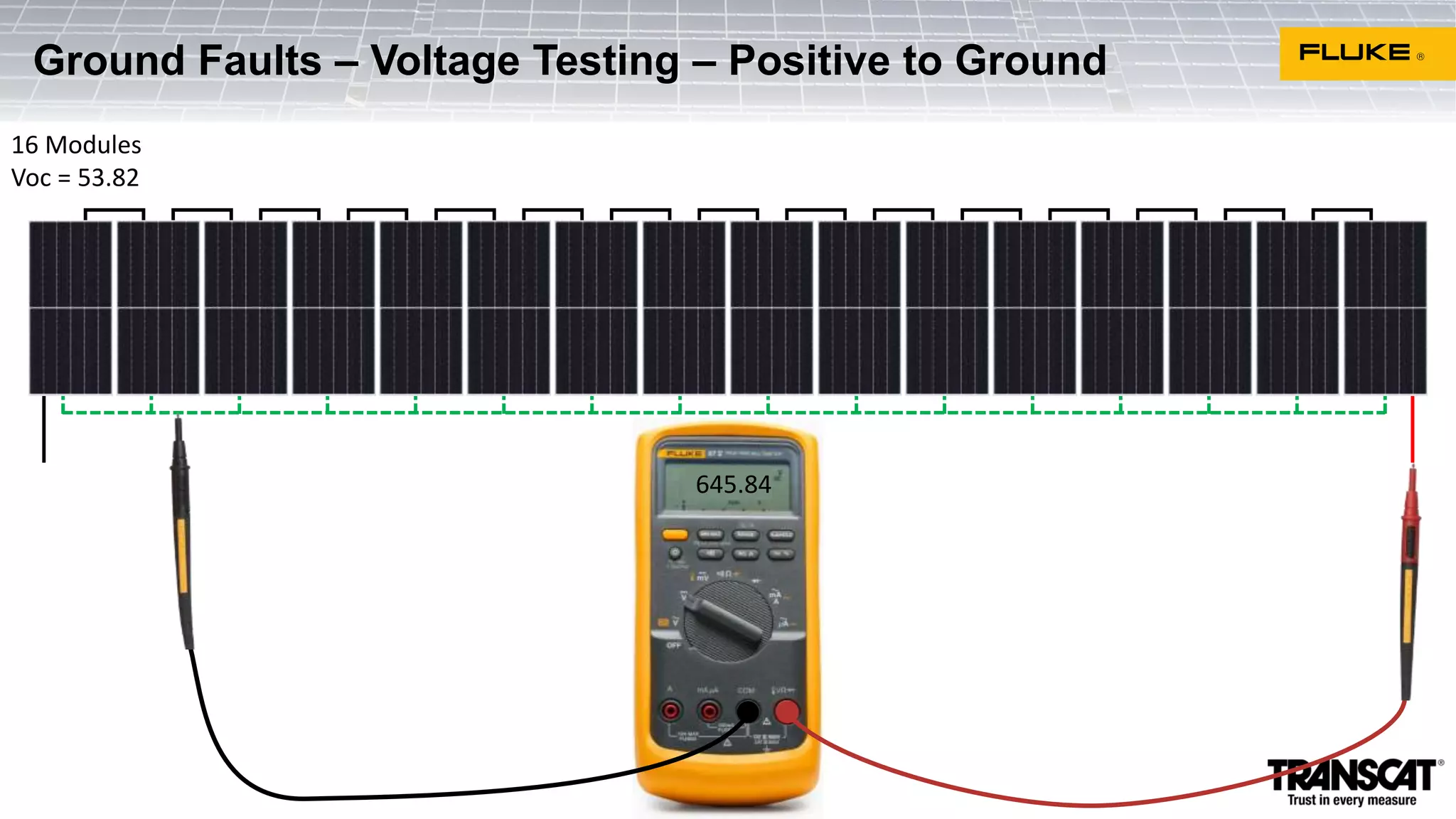
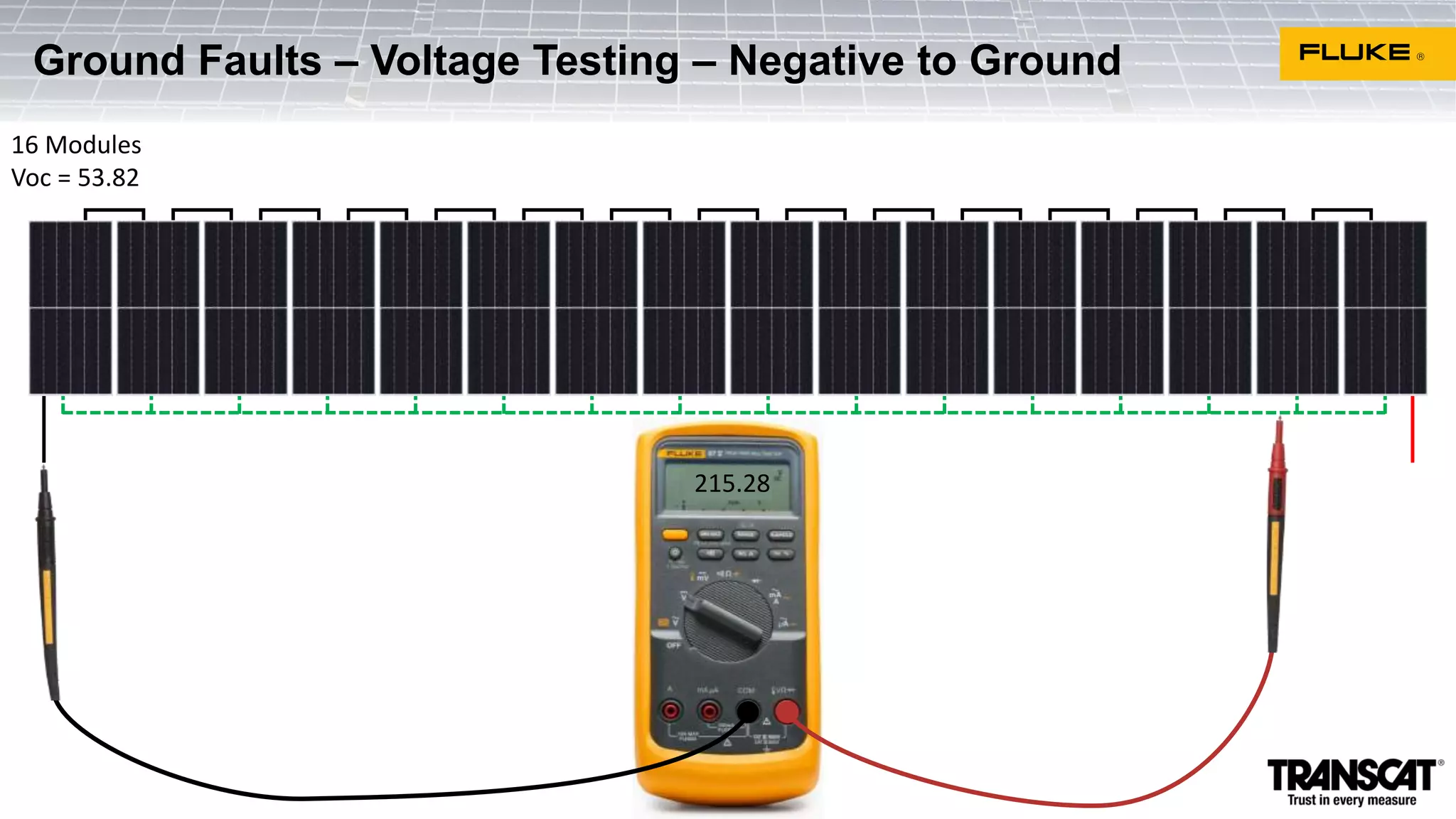
• Voltage testing
• Positive to negative, positive to ground, negative to ground
• Look for voltage to ground
• Should be zero
• May read some voltage initially (ghost voltage), but it should bleed off quickly
• Insulation resistance testing
• Used to identify strings with intermittent ground faults
• Insulation resistance may meet IEC pass threshold but may be an outlier
O&M – Ground Faults
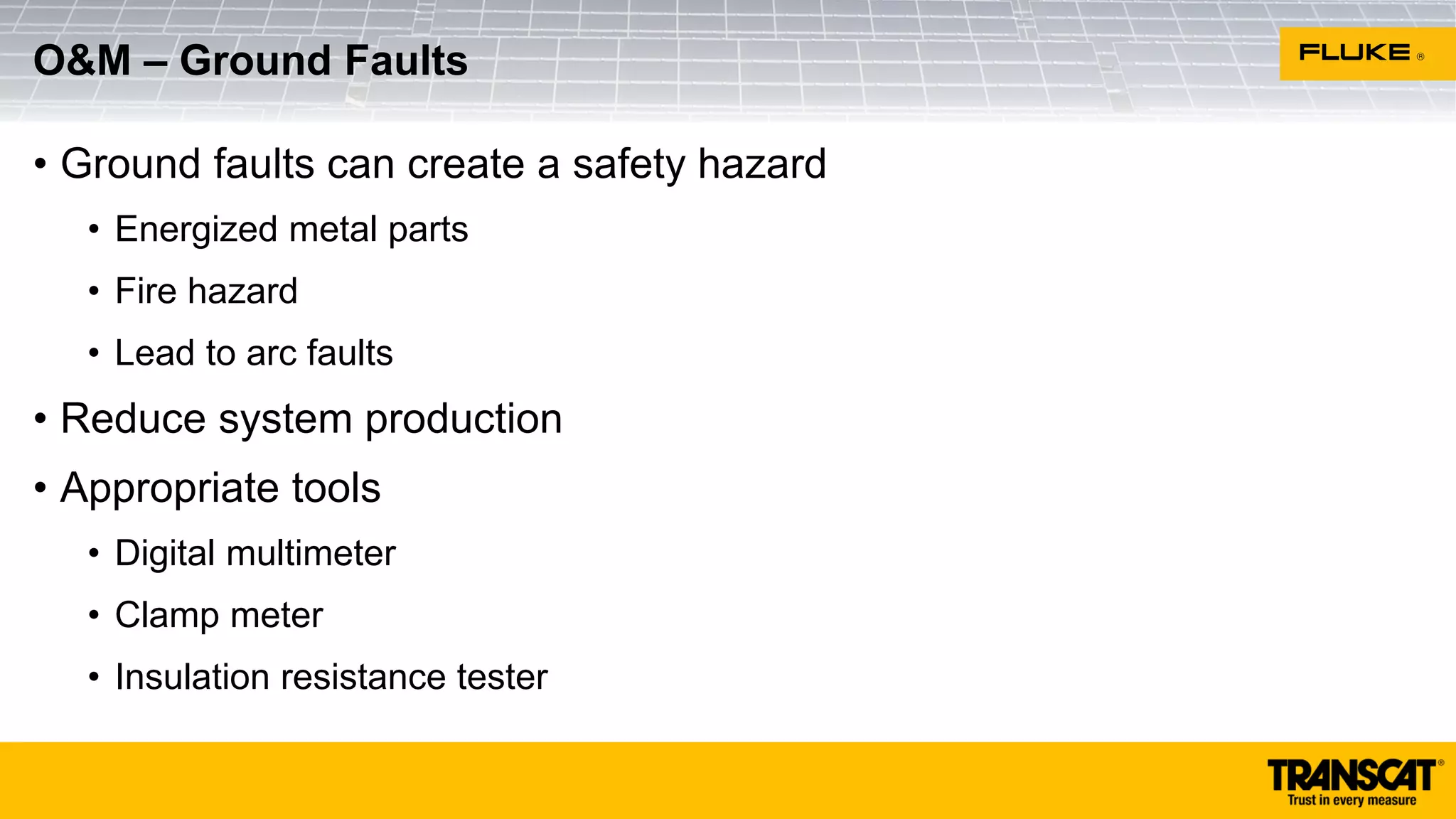
• Ground faults can create a safety hazard
• Energized metal parts
• Fire hazard
• Lead to arc faults
• Reduce system production
• Appropriate tools
• Digital multimeter
• Clamp meter
• Insulation resistance tester
O&M – Ground Faults
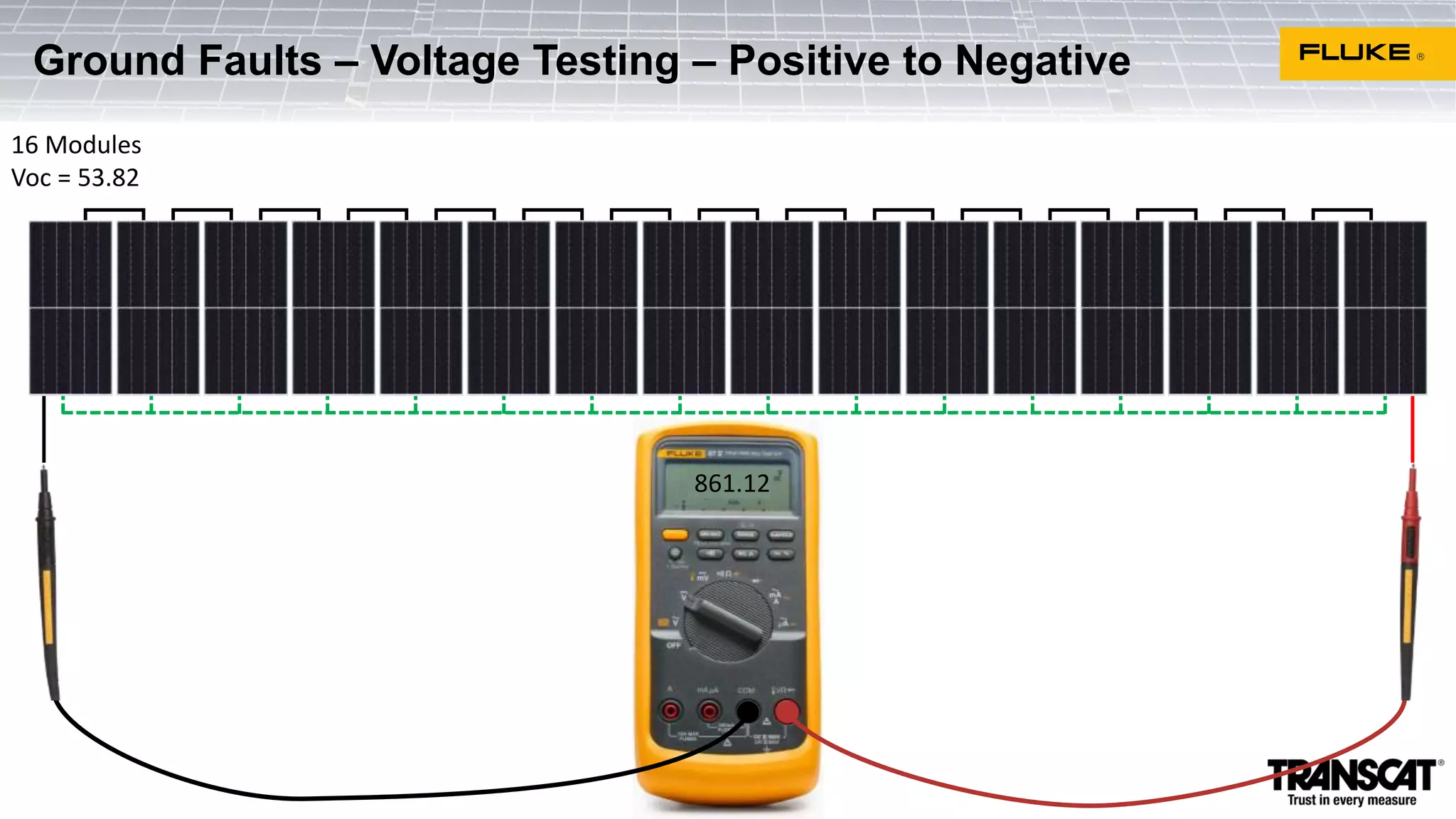
Ground Faults – Voltage Testing – Positive to Negative
16 Modules
Voc = 53.82
861.12
Ground Faults – Voltage Testing – Positive to Ground
16 Modules
Voc = 53.82
645.84
Ground Faults – Voltage Testing – Negative to Ground
16 Modules
Voc = 53.82
215.28
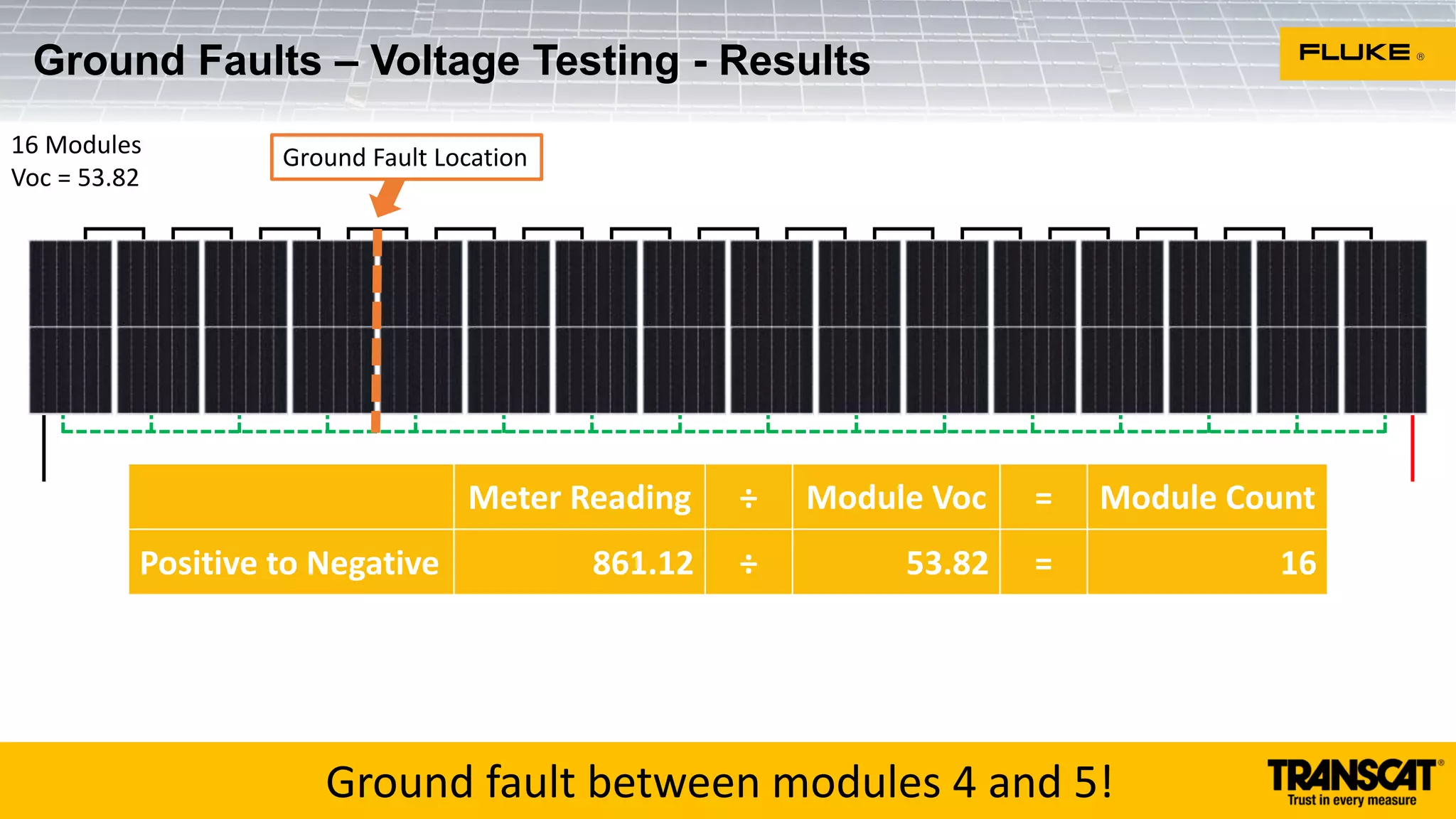
Meter Reading ÷ Module Voc = Module Count
Positive to Negative 861.12 ÷ 53.82 = 16
Positive to Ground 645.84 ÷ 53.82 = 12
Negative to Ground 215.28 ÷ 53.82 = 4
Ground Faults – Voltage Testing - Results
16 Modules
Voc = 53.82
Ground fault between modules 4 and 5!
Ground Fault Location
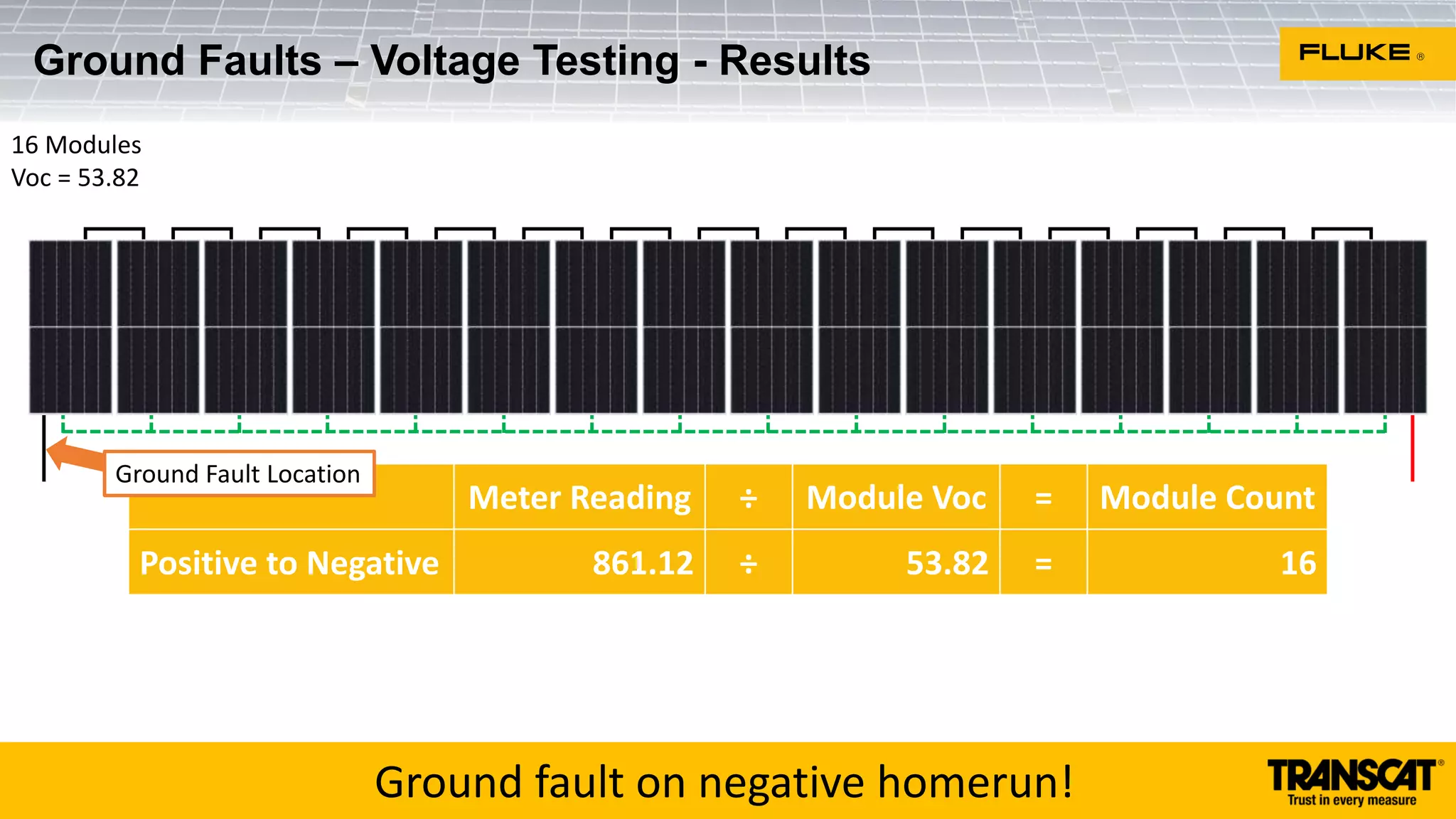
Meter Reading ÷ Module Voc = Module Count
Positive to Negative 861.12 ÷ 53.82 = 16
Positive to Ground 0 ÷ 53.82 = 0
Negative to Ground 861.12 ÷ 53.82 = 16
Ground Faults – Voltage Testing - Results
16 Modules
Voc = 53.82
Ground fault on negative homerun!
Ground Fault Location
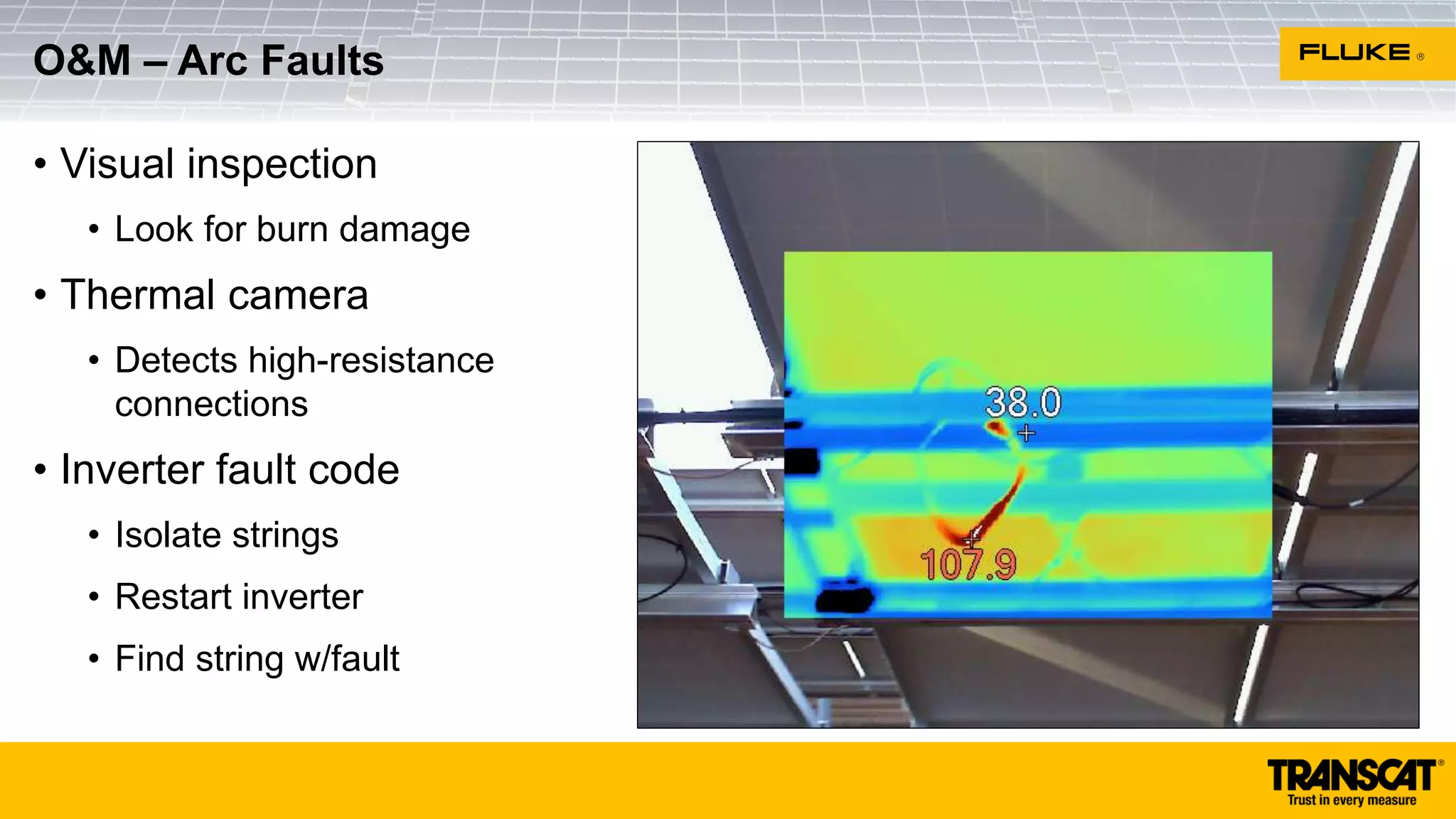
• Visual inspection
• Look for burn damage
• Thermal camera
• Detects high-resistance
connections
• Inverter fault code
• Isolate strings
• Restart inverter
• Find string w/fault
O&M – Arc Faults
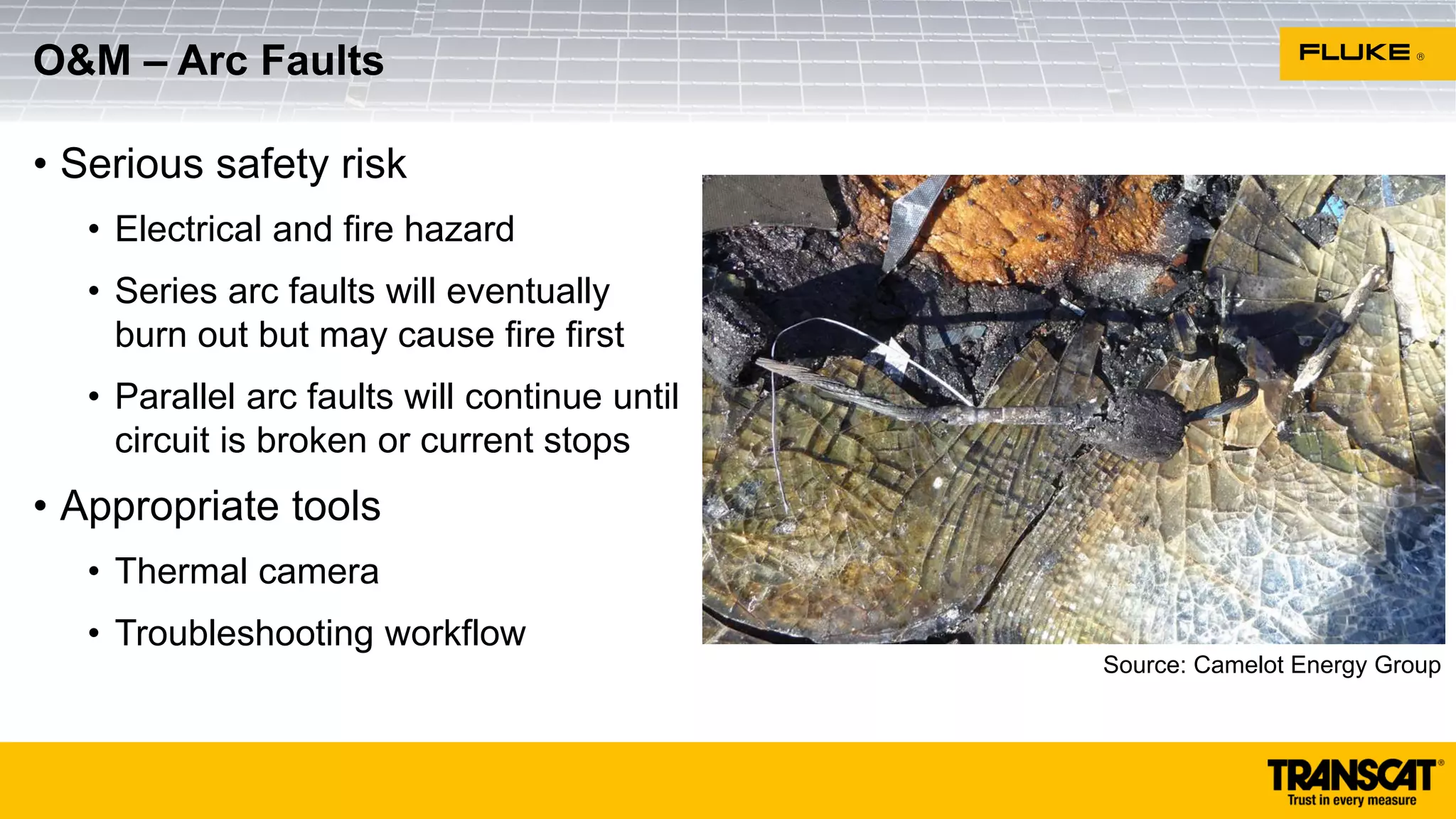
• Serious safety risk
• Electrical and fire hazard
• Series arc faults will eventually
burn out but may cause fire first
• Parallel arc faults will continue until
circuit is broken or current stops
• Appropriate tools
• Thermal camera
• Troubleshooting workflow
O&M – Arc Faults
Source: Camelot Energy Group
• Test data needs to be
recorded for future reference
• Data must be easy to record,
catalog, retrieve, and accurate
• Workflows ensure consistent
results especially for new
technicians
Documentation
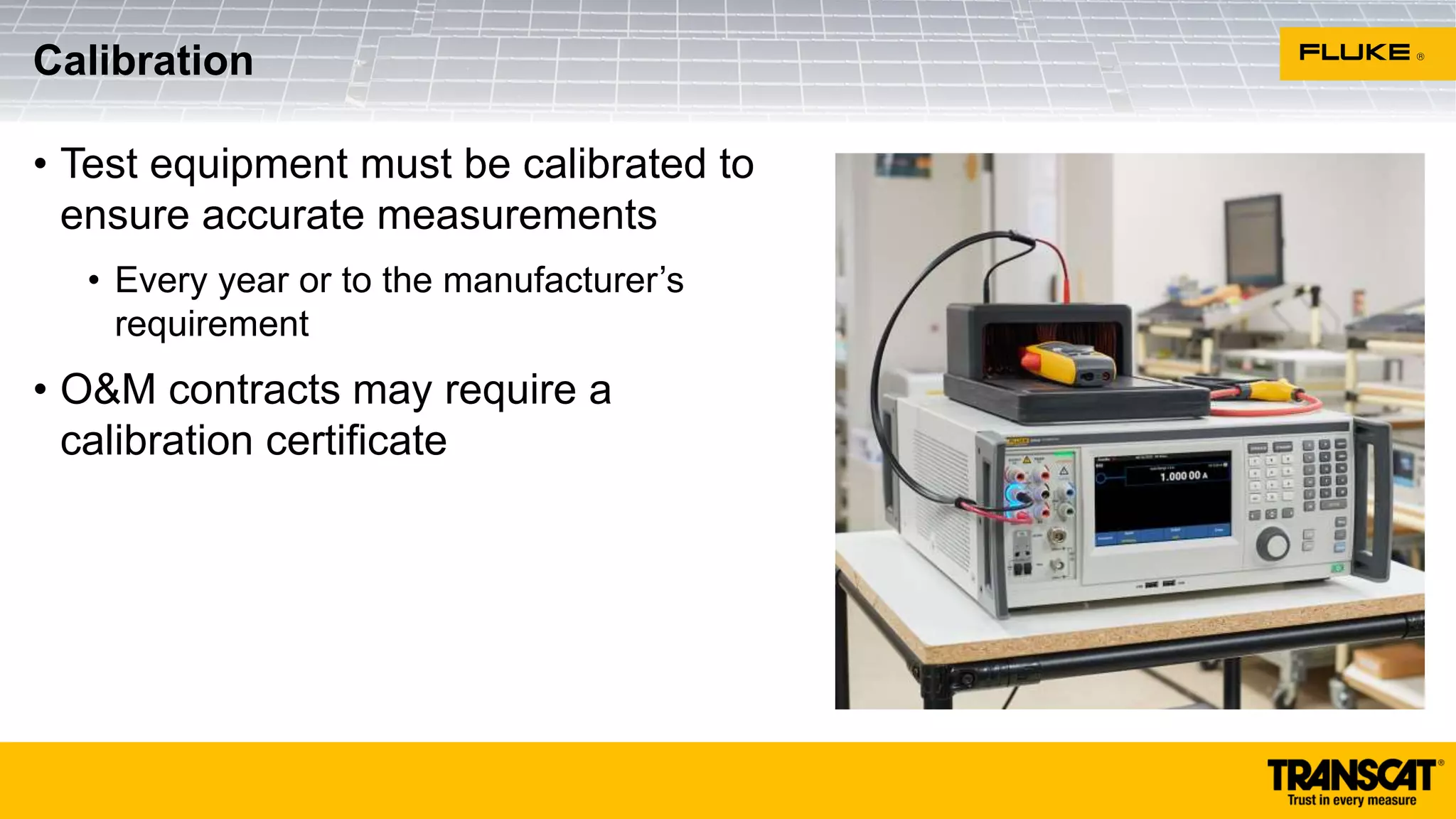
Calibration
• Test equipment must be calibrated to
ensure accurate measurements
• Every year or to the manufacturer’s
requirement
• O&M contracts may require a
calibration certificate
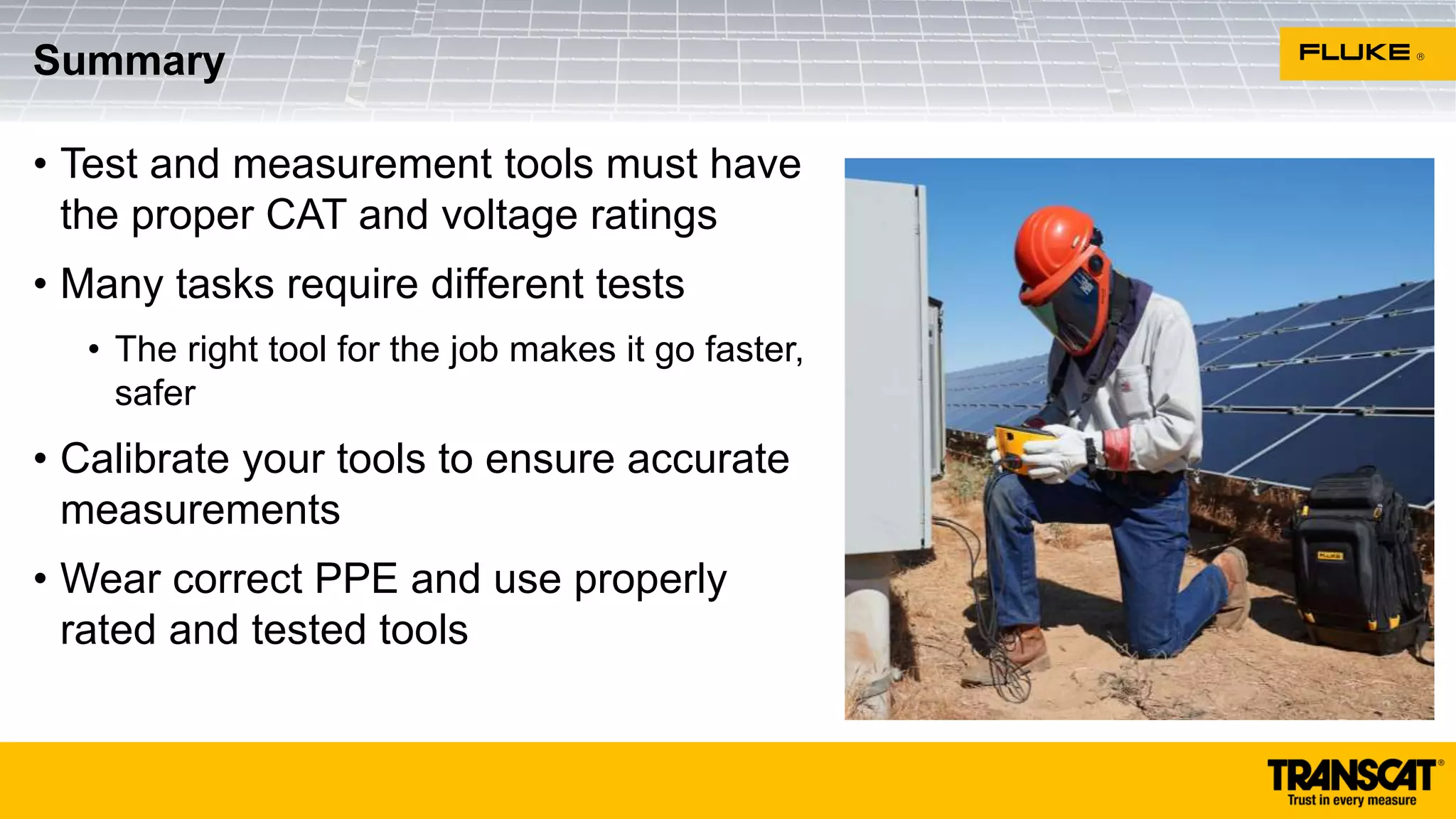
• Test and measurement tools must have
the proper CAT and voltage ratings
• Many tasks require different tests
• The right tool for the job makes it go faster,
safer
• Calibrate your tools to ensure accurate
measurements
• Wear correct PPE and use properly
rated and tested tools
Summary
Q&A Time
For more information:
solar.fluke.com
will.white@fluke.com
Thanks for joining us.
Questions?
Email Katarina Ost katarina.ost@transcat.com
For related product information, go to:
www.transcat.com/brand/fluke-store

Tools and Techniques for Commissioning and Maintaining PV Systems

  • 1.
    Tools and Techniques forCommissioning and Maintaining PV Systems
  • 2.
    • Review CATratings and how they apply to solar • Overview of IEC 62446-1 testing requirements • Analyze the solar workflow, what tests are used at each step, and the tools used to perform those tests Course Learning Objectives
  • 3.
    • What causesa transient? • Motor or another inductive load switching off • Equipment malfunction • Utility load switching • Adjustable speed drives • Lightning strike • Transients • Are invisible and largely unavoidable • May last under 100 mS, but can be extremely dangerous • May overcome test equipment input protection, causing an arc/short in the tester Transient Voltages (Voltage “Spikes”) 480 V rms, ± 678 V peaks Spikes up to 8,000 Volts
  • 4.
    • Understanding OvervoltageInstallation Category (CAT I to IV) is key when choosing test tools • Solar arrays are permanently wired electrical installations (IEC 61730-1) • Overvoltage CAT III • Not point-of-use electrical outlets (CAT II) • The standard for photovoltaic panels defines the insulation, creepage, and clearance requirements as CAT III • Requires a CAT III instrument to test it • Within a category, a higher voltage rating denotes a higher transient withstand rating • E.g., a CAT III-1500 V meter has superior protection compared to a CAT III-1000 V rated meter CAT Rating in Solar installation CAT III CAT IV CAT IV CAT III / II To ensure the safety of you and your team, remember to always choose a tool rated for the highest category you could potentially use it in and then select a voltage rating to match or exceed those situations.
  • 5.
    • First, knowthe category you are working in, then choose the appropriate voltage rating. • The working voltage could be 300 V, 600 V, 1,000 V, or 1,500 V • Equipment should be dual-rated, meeting both CAT & voltage requirements • Make sure your test leads and probes have a matching rating • Voltage rating by itself can be misleading • CAT III 1000 V (withstands 8 kV transient) is safer than CAT III 600 V (withstands 6 kV transient) • Some meters are rated for a high voltage I.E., 1,500 V but have a lower CAT rating, they aren’t designed/tested to the higher CAT rating CAT Rating Voltage Rating Bottom line: know the measurement category and voltage you are working in!
  • 6.
    Look for CATmarkings between input jacks The test equipment should be independently tested, marked, and certified. CAT III 1500 V CAT III 1000 V CAT III 600 V
  • 7.
    • “Listed” vs.“designed to” • IEC sets standards but does not test or inspect for compliance. • A manufacturer can claim to “design to” a standard with no independent verification. • To be UL listed, or CSA or TÜV certified, a manufacturer must employ the listing agency to test the product’s compliance with the standard. • Look for the listing agency’s emblem on the meter. Independent testing and certification Meter must be independent tested, marked, and certified.
  • 8.
    When installing, commissioning,and executing maintenance on PV systems, technicians verify safety and performance per IEC 62446-1 standards Safety IEC 62446-1 requires that the AC circuits are tested first, then the following six DC circuit tests need to be performed, preferably in this order: 1) Test continuity of equipment and system grounding conductors 2) Test polarity of all DC cables 3) Test open-circuit voltage [Voc] for each PV source circuit 4) Test short-circuit current [Isc] for each PV source circuit 5) Test functionality of major system components 6) Test the insulation resistance of the DC circuit conductors Performance 7) I-V Curve tracing and associated software analysis IEC Testing Requirements for PV Systems Utilities & 3rd Party Service Techs PV Installers & Maintenance Techs Safety and Performance testing during installation, commissioning and maintenance ensures safety, reliability and longevity of PV installations
  • 9.
    Let’s walk througha solar workflow in stages Customer Report O&M Installation Permitting System Design Site Survey Solar Tests and Measurements: Voc and Isc: 1, 2, 5 I-V Curve Tracing: 1, 2 Temperature: 1 Irradiance: 1 Tilt Angle: 1 Insulation Resistance: 1, 2, 5 Continuity: 1, 2, 5 Ground fault: 1, 2, 5 Power Quality: 7 Battery Testing: 4 AC Testing: 5, 7 Solar Toolbelt: Clamp Meter Irradiance Meter I-V Curve Tracer Insulation Resistance Tester (IRT) Installation Tester Thermal Camera Battery Analyzer
  • 10.
    • Insulation resistancetesting (IRT) • Used to verify the integrity of the insulation after the wire is installed • Can also be used to identify ground faults • IRT meters send high voltage through conductor and measures leakage to ground • Finds damage before it becomes a larger issue • Appropriate tools • Insulation resistance testers like Fluke 1587FC • Multifunction tools like Fluke SMFT-1000 Wire Installation
  • 11.
    • DC Vocand polarity • Testing Voc will identify miswired strings • High voltage = too many modules in series • Low voltage = too few modules in series • Testing polarity will ensure that module home runs are landed properly • Appropriate tools • Digital multimeter or clamp meter rated for system voltage • Fluke 393 FC, Amprobe HD-160C or HD-110C, Fluke SMFT-1000 Commissioning – Voltage and Polarity
  • 12.
    • I-V curvebaseline testing • Identifies any module/string issues before operation • Creates historical record for future comparison • Can identify issues not seen with Voc testing • Appropriate tools • I-V curve tracer or multifunction tool with I-V curve tracing • Fluke SMFT-1000 Commissioning – I-V Curve Testing
  • 13.
    • Measure equipmentgrounding system resistance to ground • Ensures non-current carrying metal parts are bonded to ground • Ungrounded parts may pose a safety hazard if there’s a ground fault • Appropriate tools • Fluke 1630, 1625-2 Commissioning – Ground Resistance Testing
  • 14.
    • Expected vs.actual power measurements • Inverter efficiency verification • Ensure the system is operating properly • Set baseline data for future testing • Appropriate tools • Fluke 393 FC • Measures DC power • SMFT-1000 • Measures DC & AC power, calculates inverter efficiency Commissioning – Performance Testing
  • 15.
    • Electrical equipment •Disconnects, combiners, inverters, transformers • Modules • Aerial or handheld • Module interconnects • With system operating at high irradiance • TI testing requires training Commissioning/O&M – Thermal Imaging
  • 16.
    • Hot equipment= increased resistance • Cool equipment = no/low current • Set baseline to ensure proper operation and create historical record • Appropriate tools • Aerial TI cameras • Drone-based or fixed wing • Handheld TI cameras • Fluke Ti480 Pro, TiS55+ Commissioning/O&M – Thermal Imaging The circuit is cold because there’s no circuit connected.
  • 17.
    • Inspect installationto identify any maintenance issues • Easy way to find problems like burnt-out connectors, module damage • Appropriate tools • Trained inspector • Workflow checklist O&M – Visual Inspection
  • 18.
    • DC voltageand current • AC voltage and current • Fuse continuity • Thermal imaging • Torque terminals • Inverter efficiency • AC power quality • Voltage, frequency, harmonics O&M– Inverters, Transformers
  • 19.
    • Ensures equipmentis operating properly • Upholds OEM warranty • Prevents future failures • Maximizes system production • Appropriate tools • Digital multimeter • Clamp meters • Torque tools • Multifunction testers O&M– Inverters, Transformers
  • 20.
    O&M - Harmonicsissues PV system designs should minimize harmonics. However, if you suspect harmonics problems in your facility, you can use a power quality analyzer to troubleshoot the system. Benefits of the PQ analyzer • Troubleshooting and preventing problems in power generation, transmission, and distribution systems • Conducting load studies to reduce energy usage • Measures at 5x second or every 200ms Fluke 435-II Power Quality and Energy Analyzer
  • 21.
    • Visually inspectarray for any obvious damage or accidental disconnections • Damaged modules • Compromised insulation • Loose or damaged connectors • Thermal imaging inspection • Aerial or handheld • Modules/cells not operating will be hot • High resistance connections will be hot • Identify equipment for further testing O&M – Modules
  • 22.
    • Check voltageand current • Voc testing can identify closed bypass diodes • Imp testing can identify strings that aren’t producing • Test circuits for current before disconnecting module connectors or opening fuses O&M – Modules
  • 23.
    • Tools touse • Visually inspect • Check lists to ensure steps aren’t missed • Thermal imaging inspection • Drone with thermal camera • Handheld thermal camera • Check voltage and current • Digital multimeter • Clamp meter • Must have CAT III rating greater than array voltage 23 O&M – Modules
  • 24.
    • Voltage testing •Positive to negative, positive to ground, negative to ground • Look for voltage to ground • Should be zero • May read some voltage initially (ghost voltage), but it should bleed off quickly • Insulation resistance testing • Used to identify strings with intermittent ground faults • Insulation resistance may meet IEC pass threshold but may be an outlier O&M – Ground Faults
  • 25.
    • Ground faultscan create a safety hazard • Energized metal parts • Fire hazard • Lead to arc faults • Reduce system production • Appropriate tools • Digital multimeter • Clamp meter • Insulation resistance tester O&M – Ground Faults
  • 26.
    Ground Faults –Voltage Testing – Positive to Negative 16 Modules Voc = 53.82 861.12
  • 27.
    Ground Faults –Voltage Testing – Positive to Ground 16 Modules Voc = 53.82 645.84
  • 28.
    Ground Faults –Voltage Testing – Negative to Ground 16 Modules Voc = 53.82 215.28
  • 29.
    Meter Reading ÷Module Voc = Module Count Positive to Negative 861.12 ÷ 53.82 = 16 Positive to Ground 645.84 ÷ 53.82 = 12 Negative to Ground 215.28 ÷ 53.82 = 4 Ground Faults – Voltage Testing - Results 16 Modules Voc = 53.82 Ground fault between modules 4 and 5! Ground Fault Location
  • 30.
    Meter Reading ÷Module Voc = Module Count Positive to Negative 861.12 ÷ 53.82 = 16 Positive to Ground 0 ÷ 53.82 = 0 Negative to Ground 861.12 ÷ 53.82 = 16 Ground Faults – Voltage Testing - Results 16 Modules Voc = 53.82 Ground fault on negative homerun! Ground Fault Location
  • 31.
    • Visual inspection •Look for burn damage • Thermal camera • Detects high-resistance connections • Inverter fault code • Isolate strings • Restart inverter • Find string w/fault O&M – Arc Faults
  • 32.
    • Serious safetyrisk • Electrical and fire hazard • Series arc faults will eventually burn out but may cause fire first • Parallel arc faults will continue until circuit is broken or current stops • Appropriate tools • Thermal camera • Troubleshooting workflow O&M – Arc Faults Source: Camelot Energy Group
  • 33.
    • Test dataneeds to be recorded for future reference • Data must be easy to record, catalog, retrieve, and accurate • Workflows ensure consistent results especially for new technicians Documentation
  • 34.
    Calibration • Test equipmentmust be calibrated to ensure accurate measurements • Every year or to the manufacturer’s requirement • O&M contracts may require a calibration certificate
  • 35.
    • Test andmeasurement tools must have the proper CAT and voltage ratings • Many tasks require different tests • The right tool for the job makes it go faster, safer • Calibrate your tools to ensure accurate measurements • Wear correct PPE and use properly rated and tested tools Summary
  • 36.
    Q&A Time For moreinformation: solar.fluke.com will.white@fluke.com Thanks for joining us.
  • 37.
    Questions? Email Katarina Ostkatarina.ost@transcat.com For related product information, go to: www.transcat.com/brand/fluke-store

Editor's Notes

  • #5 The voltage rating alone will not tell you how well that meter was designed to survive high transient impulses. The most important single concept to understand about the standards is the Overvoltage Installation Category In DC systems: Fault current is not infinite, not very high – That’s why CAT III and not CAT IV
  • #21 Need to find a good way to summarize and end