This document outlines the laws of badminton based on a technical course for umpires held in Perlis, Malaysia. It discusses definitions related to matches, scoring, equipment including shuttles, rackets and clothing. The laws cover various aspects of play including serving, singles and doubles play, faults, lets, misconduct and the roles of officials. Key points covered include the dimensions and markings of the court, specifications for shuttles, rackets and clothing, as well as the rules regarding scoring, serving, line calls and line judge duties.
DEFINITIONS
• PlayerAny person playing Badminton.
• Match The basic contest in Badminton
between opposing sides each of
one or two players.
• Singles A match where there is one
player on each of the
opposing sides.
• Doubles A match where there are
two players on each of the
opposing sides.
4.
DEFINITIONS
• Servingside - The side having the
right to serve.
• Receiving side - The side opposing the
serving side.
• Rally - A sequence of one or
more strokes starting
with the service, until
the shuttle ceases to
be in play.
• Stroke - A movement of
the player’s racket with an
intention to hit the shuttle.
5.
L1. COURT ANDCOURT EQUIPMENT
• Rectangle - lines 40 mm wide
• The lines - white or yellow.
• All the lines - part of the area.
Post
Diagram A.
Post
• 1.55 metres – not extended into the court.
• on the doubles side lines
6.
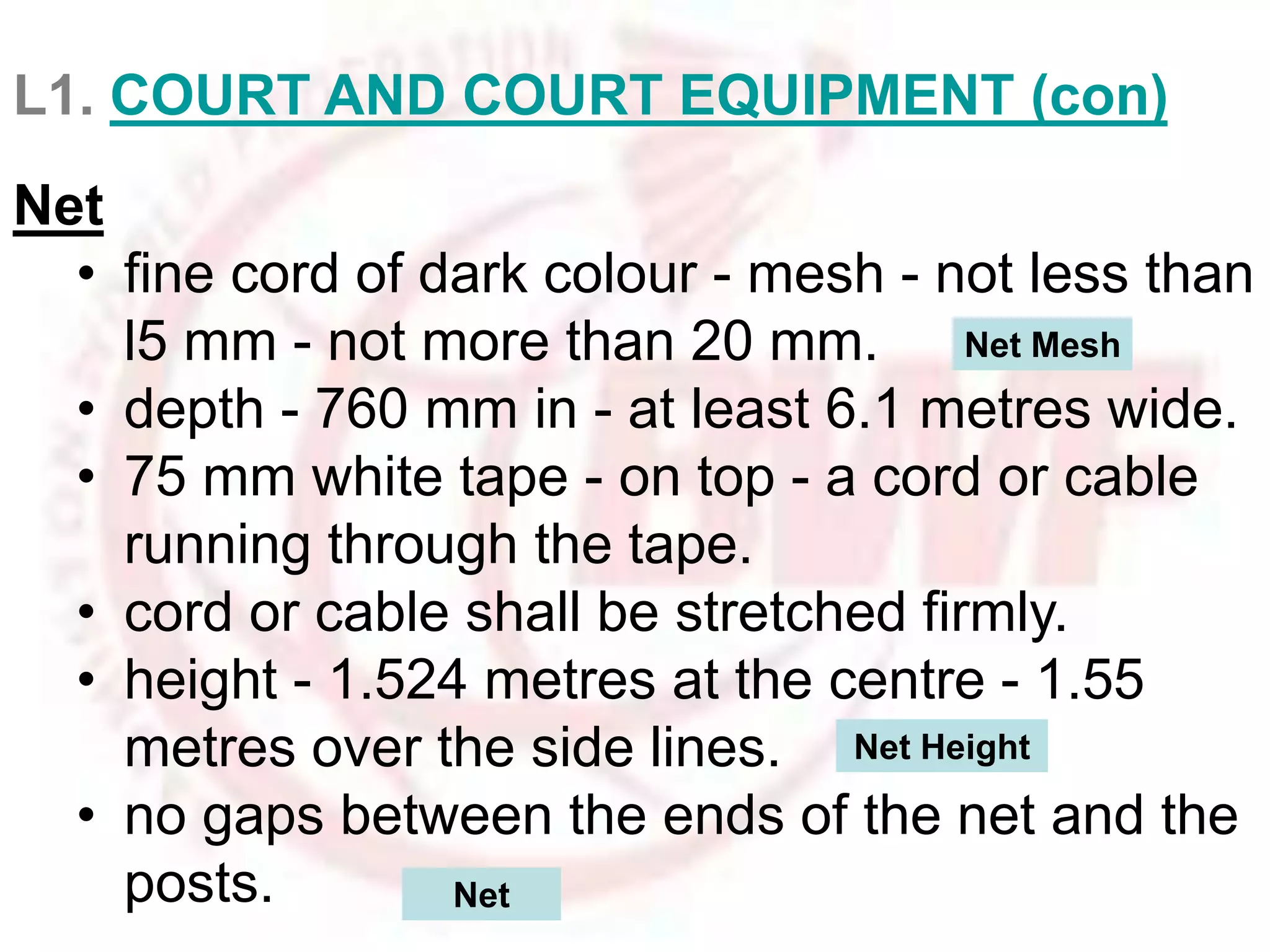
L1. COURT ANDCOURT EQUIPMENT (con)
Net
• fine cord of dark colour - mesh - not less than
l5 mm - not more than 20 mm.
Net Mesh
• depth - 760 mm in - at least 6.1 metres wide.
• 75 mm white tape - on top - a cord or cable
running through the tape.
• cord or cable shall be stretched firmly.
• height - 1.524 metres at the centre - 1.55
metres over the side lines.
Net Height
• no gaps between the ends of the net and the
posts. Net
7.
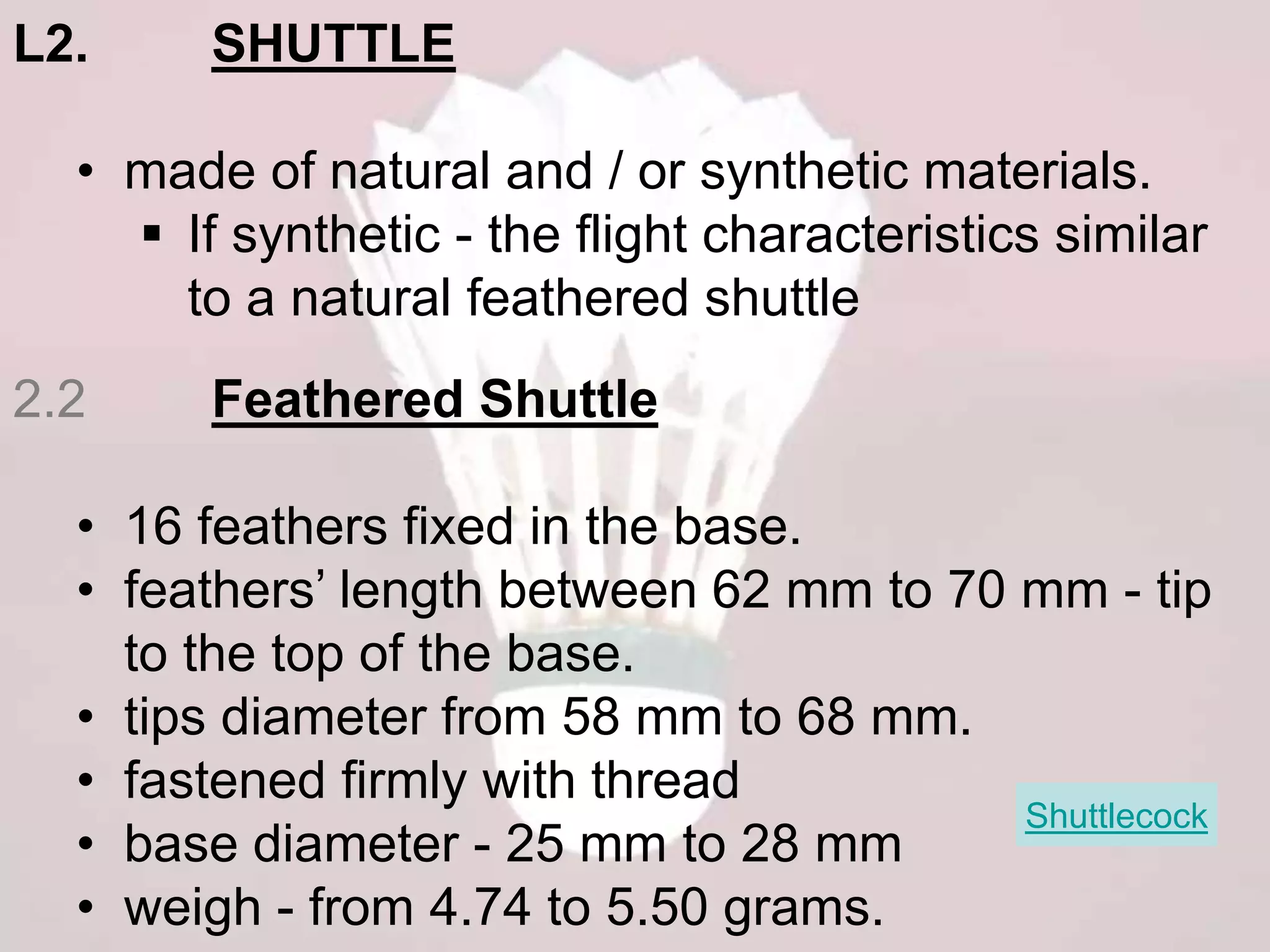
L2. SHUTTLE
•made of natural and / or synthetic materials.
If synthetic - the flight characteristics similar
to a natural feathered shuttle
2.2 Feathered Shuttle
• 16 feathers fixed in the base.
• feathers’ length between 62 mm to 70 mm - tip
to the top of the base.
• tips diameter from 58 mm to 68 mm.
• fastened firmly with thread
Shuttlecock
• base diameter - 25 mm to 28 mm
• weigh - from 4.74 to 5.50 grams.
8.
2.3 Non-Feathered Shuttle
• synthetic materials - simulation of
feathers’ shuttlecock
• base diameter - 25 mm to 28 mm
• a variation of up to 10 per cent in
measurements and weight shall be
acceptable.
Shuttlecock
9.
L3. TESTING ASHUTTLE FOR SPEED
• use a full underhand stroke which makes
contact with the shuttle over the back
boundary line. The shuttle shall be hit at an
upward angle and in a direction parallel to
the side lines.
• will land not less than 530 mm and not
more than 990 mm short of the other back
boundary line
Diagram B
10.
L4. RACKET
•a frame not exceeding 680 mm in
(length) and 230 mm (width)
4.1
Frame
(680mm)
4.1.2
string area
4.1.3
head
4.1.4
shaft
4.1.1
handle
4.1.5
throat
(230mm)
11.
L4. RACKET (con)
4.2 The stringed area:
• the stringing pattern shall be generally
uniform and
• shall not exceed 280 mm and 220 mm in
overall width.
4.3 The racket:
• free of attached objects
• free of any device
12.
L5. EQUIPMENT COMPLIANCE
• BWF shall rule on any question of whether
any racket, shuttle or equipment or any
prototype used in the playing of Badminton
complies with the specifications.
L6. TOSS
• to serve or receive first;
• to start play at one end of the court or the
other.
• The side losing the toss shall then exercise
the remaining choice.
13.
L7. SCORING SYSTEM
• the best of three games
• the side which first scores 21 points, won
the game (except extended game)
• the side winning a rally shall add a point to
its score.
• if 20-all, the side which gains a two point
lead first, shall win that game.
• if becomes 29-all, the side scoring the 30th
point shall win that game.
• the side winning a game shall serve first in
the next game.
14.
L8. CHANGE OFENDS
• at the end of the first game;
• at the end of the second game
• in the third game when a side first scores
11 points.
• if the ends are not changed - it shall be
done so as soon as the mistake is
discovered.
the existing score shall stand.
15.
L9. SERVICE
9.1In a correct service:
• no delay - once the server and the receiver
are ready
• stand diagonally - without touching the
boundary lines
• some parts of both feet remain in contact
with the surface - in a stationary position
• hit the base of the shuttle;
• shuttle below the server’s waist at the
instant of being hit
• shuttle passes over the net
• the server shall not miss the shuttle.
16.
L9. SERVICE (con)
• the shaft of the server’s racket - pointing in a
downward direction;
• continuous forward movement of the server’s
racket
• start of the service - first forward movement of the
server’s racket head
• service is delivered when the shuttle is hit by the
server’s racket or,
the server misses the shuttle.
• shall not serve before the receiver is ready.
considered ready if a return of the service is
attempted.
• the partners may take up any positions
17.
L10. SINGLES
10.1Serving and receiving courts
• even number of points - serve and receive
in the right service courts
• odd number of points - serve from and
receive in the left service courts
18.
L10. SINGLES (con)
10.2 Order of play and position on court
• in a rally, the shuttle may be hit by the
server and the receiver alternately
10.3 Scoring and serving
• if the server wins a rally, the server shall
score a point.
the server shall then serve again
• if the receiver wins a rally, the receiver
shall score a point
the receiver shall then become the
new server.
19.
L11. DOUBLES
11.1Serving and receiving courts
• even number of points - serve from the right
service court
• odd number of points - serve from the left
service court
• the player of the receiving side who served
last shall stay in the same service court
from where he served last
20.
L11. DOUBLES (con)
• the player of the receiving side standing in
the diagonally opposite service court to the
server shall be the receiver.
• the players shall not change their respective
service courts until they win a point when
their side is serving.
• Service in any turn of serving shall be
delivered from the service court
corresponding to the serving side’s score
21.
11.2 Order ofplay and position on court
• in a rally (after service), the shuttle may be hit
by either player of the serving side and either
player of the receiving side alternately
11.3 Scoring and serving
• if the serving side wins a rally, the serving side
shall score a point.
the server shall then serve again from the
alternate service court.
• if the receiving side wins a rally, the receiving
side shall score a point.
the receiving side shall then become the
new serving side.
22.
11.4 Sequence ofserving
In any game, the right to serve shall pass
consecutively:
• from the initial server who started the game from
the right service court
• to the partner of the initial receiver. The service
shall be delivered from the left service court.
• to the partner of the initial server
• to the initial receiver,
• to the initial server and so on.
Sequence of Serving
• 11.5 - no player shall serve or receive out of turn, or
receive two consecutive services
• 11.6 next game
• either player may serve first (winning side)
• either player may receive first (losing side)
23.
L12. SERVICE COURTERRORS
A service court error has been made
when a player:
• has served or received out of turn; or
• has served or received from the wrong
service court;
If a service court error is discovered, the
error shall be corrected and the existing
score shall stand.
24.
L13. FAULTS
Itshall be a ‘fault’:
• if a service is not correct (Law 9.1);
• if, in service, the shuttle:
is caught on the net and remains
suspended on its top;
after passing over the net, is caught in
the net; or
• is hit by the receiver’s partner;
Law 9.1
25.
L13. FAULTS (con)
13.3 if in play, the shuttle:
• lands outside the boundaries of the court
• passes through or under the net;
• fails to pass over the net;
• touches the ceiling or side walls;
• touches the person or dress of a player;
• touches any other object or person outside
the court;
(make bye-laws dealing with cases in which a
shuttle touches an obstruction).
26.
L13. FAULTS (con)
• is caught and held on the racket and then
slung during the execution of a stroke
(slung stroke);
• is hit twice in two stroke (one stroke - not
‘fault’);
• is hit by a player and the player’s partner
successively; or
• touches a player’s racket and does not
travel towards the opponent’s court;
27.
L13. FAULTS (con)
13.4 if, in play, a player:
• touches the net or its supports with racket,
person or dress
• invades an opponent’s court over the net
(except follow through)
• obstructs an opponent, (from making a follow
through)
• invades an opponent’s court under the net
with racket or person
• deliberately distracts an opponent –
(shouting or making gestures)
• if a player is guilty - under Law 16;
28.
L14. LETS
•14.1 ‘Let’ – umpire to call
• 14.2 It shall be a ‘let”, if:
• the server serves before the receiver is ready
(Law 9.5);
• during service, the receiver and the server are
both faulted;
• during play, the shuttle is:
caught on the net (suspended on its top)
is caught in the net (after passing over the
net);
on the net
in the net
• The shuttle completely disintegrated Disintegrated
29.
L14. LETS (con)
• play is disrupted or
the opposing side is distracted by a
coach;
• a line judge is unsighted; or
• any unforeseen or accidental situation has
occurred.
• If ‘let’ - the last service not counted –
reserved
30.
L15. SHUTTLE NOTIN PLAY
A shuttle is not in play when:
• strikes the net / post - starts falling down
the striker’s side
• hits the surface; or
• a ‘fault’ or a ‘let’ has occurred.
31.
L16. CONTINUOUS PLAY,MISCONDUCT &
PENALTIES
• 16.1 continuous play from the first service until
the match is concluded,
16.2 Intervals:
• at 11 points - not exceeding 60 seconds
• between the game - not exceeding 120
seconds
(For a televised match, the Referee may decide as
in Law 16.2 are mandatory and of fixed duration).
32.
L16. CONTINUOUS PLAY,MISCONDUCT &
PENALTIES (con)
• 16.3 Suspension of play
• Umpire to suspend
• Referee may instruct the umpire to suspend
play.
• the existing score stand.
• 16.4 Delay in play
• no delay to enable a player to recover
strength or wind or to receive advice.
• The umpire to judge of any delay
33.
16.5 Advice andleaving the court
• shuttle not in play - a player permitted to
receive advice
• leave the court - the umpire’s permission,
except during the intervals
• A player shall not:
deliberately cause delay in, or suspension
of, play;
deliberately modify or damage the shuttle;
behave in an offensive manner; or
be guilty of misconduct not otherwise
covered by the Laws of Badminton.
34.
• 16.7 Administrationof breach
• administer MISCONDUCT - by:
issuing a warning (yellow card);
faulting - (red card), if previously warned.
(two faults - considered to be a
persistent offence);
• Serious cases (flagrant / persistent offences)
faulting (red card) and immediately report
to the Referee,
• The Referee, has the power to disqualify
35.
L17. OFFICIALS ANDAPPEALS
• The Referee - overall in charge of the
tournament
• The umpire - in charge of the match, the
court and its immediate surrounds.
• The umpire report to the Referee.
• The service judge - call fault (service
faults (Law 9.1).
• A line judge to call ‘in’ or ‘out’
• An official’s decision shall be final on all
points of fact; but
• the umpire shall overrule the decision of
the line judge.
36.
L17. OFFICIALS ANDAPPEALS (con)
• 17.6 An umpire shall:
• uphold and enforce the Laws – call a
‘fault’ or a ‘let’
• give a decision on any appeal - before the
next service
• players and spectators kept informed
(score)
• appoint or replace line judges - appoint or
replace a service judge
37.
L17. OFFICIALS ANDAPPEALS (con)
• 17.6 An umpire shall:
• arrange official’s duties – (if not enough
court official)
• give decision for unsighted line judge -
call ‘let’
• record and report to the Referee all
matters relating to Law 16
• unsatisfied appeals (point of law) – call
Referee (before the next service)
38.
• General Information
• Clothing
• Anything worn or carried by a player during play – pullovers, shirts, shirts, skirts, socks, shoes, headbands, towers, wristbands, bandages and medical
supports.
• All clothing worn by players shall be acceptable badminton sport clothing – not acceptable to tape / pin over advertising or any other way to modify.
• Advertising apply only to clothing worn during play
• Any colour
• All IBF team event – to wear team colour
• Doubles partners wear same colour (recommended) – same colour for quarter final onwards (mandatory)
• Opposing side wear different colour (recommended)
• Olympic – partners wear same colour –opposing side different colour (mandatory)
• Lettering
– Roman alphabet – capital letters – single colour contrasting shirt’s colour
– Height – 6 cm to 10 cm
– Horizontal or as close to horizontal
– Advert lettering – any alphabet
• Lettering sequence
– Player name
– Country / association name
– Advert
•
Advertising
• Shirt
– Left sleeve, right sleeve, left collar, right collar, front of shirt
– Each advert – 20 cm2 or less
– Not more than three – one per location
– A band of uniform advert – not exceeding 6-10 cm – any angle – front / back of shirt or both
• Each sock and each shoe – two advert – (each advert - 20 cm2 or less)
• Each other clothing – one advert – (20 cm2 or less)
• Referee’s decision – final – at each event
• Specification
• Height
– 12 m. (minimum) – Olympic Games, World Championships, World Junior Championships, World Junior Team Championships, World Senior Championships,
Sudirman Cup, Thomas / Uber Cup (final stage)
– 12 m. (9 m. is minimum) all other International events
– Free from obstructions
• Flooring
– Wooden sprung floor with
– Non-slip court mats
– 2 m. (at least) – clear space surrounding
– 2 m. (at least) – between two court
• Back background – no white colour
• minimum lighting 1000 Lux (for TV – 1800 – 2000 Lux)
• No daylight or sunlight