Terry Taewoong Um (terry.t.um@gmail.com)
University of Waterloo
Department of Electrical & Computer Engineering
Terry T. Um
ON HUMAN MOTION PREDICTION
USING RNNS (2017)
1
MOTIVATION TO CHOOSE THIS PAPER
Terry Taewoong Um (terry.t.um@gmail.com)
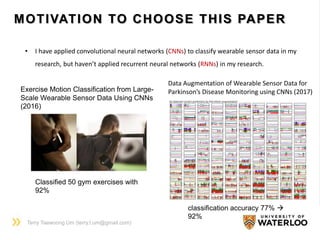
• I have applied convolutional neural networks (CNNs) to classify wearable sensor data in my
research, but haven’t applied recurrent neural networks (RNNs) in my research.
Exercise Motion Classification from Large-
Scale Wearable Sensor Data Using CNNs
(2016)
Classified 50 gym exercises with
92%
Data Augmentation of Wearable Sensor Data for
Parkinson’s Disease Monitoring using CNNs (2017)
classification accuracy 77% 
92%
2 baseline papers
MOTION FORECASTING
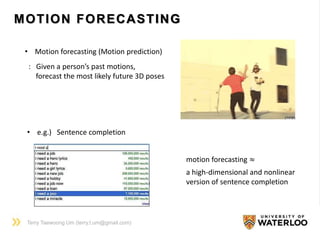
• Motion forecasting (Motion prediction)
: Given a person’s past motions,
forecast the most likely future 3D poses
Terry Taewoong Um (terry.t.um@gmail.com)
• e.g.) Sentence completion
motion forecasting ≈
a high-dimensional and nonlinear
version of sentence completion
BACKGROUND: RNN
Terry Taewoong Um (terry.t.um@gmail.com)
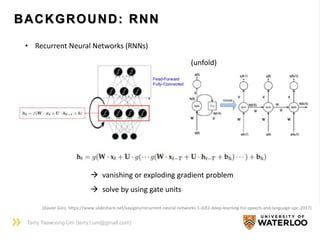
• Recurrent Neural Networks (RNNs)
(unfold)
 vanishing or exploding gradient problem
 solve by using gate units
(Xavier Giro, https://www.slideshare.net/xavigiro/recurrent-neural-networks-1-d2l2-deep-learning-for-speech-and-language-upc-2017)
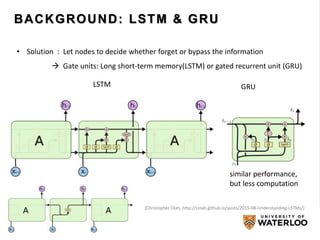
BACKGROUND: LSTM & GRU
Terry Taewoong Um (terry.t.um@gmail.com)
• Solution : Let nodes to decide whether forget or bypass the information
 Gate units: Long short-term memory(LSTM) or gated recurrent unit (GRU)
(Christopher Olah, http://colah.github.io/posts/2015-08-Understanding-LSTMs/)
LSTM GRU
similar performance,
but less computation
BACKGROUND: RNN
Terry Taewoong Um (terry.t.um@gmail.com)
(Andrej Karpathy, http://karpathy.github.io/2015/05/21/rnn-effectiveness/)
SEQUENCE GENERATION
(Andrej Karpathy, http://karpathy.github.io/2015/05/21/rnn-effectiveness/)
SEQUENCE GENERATION
(Andrej Karpathy, http://karpathy.github.io/2015/05/21/rnn-effectiveness/)
SIMPLEST APPROACH
Terry Taewoong Um (terry.t.um@gmail.com)
• Just apply a LSTM to joint angle data
(2015)
ERD
Encoder-Recurrent-Decoder
LSTM
https://www.youtube.com/wat
ch?v=CvaKD1NGcBk
[Result]
Contribution :
It’s the first LSTM work with
skeleton data
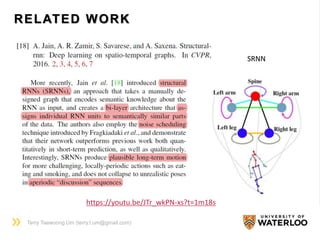
RELATED WORK
ERD
Terry Taewoong Um (terry.t.um@gmail.com)
RELATED WORK
https://youtu.be/JTr_wkPN-xs?t=1m18s
SRNN
Terry Taewoong Um (terry.t.um@gmail.com)
C.F.) HIERARCHICAL RNN
MHAD dataset (11 actions)
HDM05 dataset (65 actions)
MSR-Action3D dataset (20 actions)
(2016)
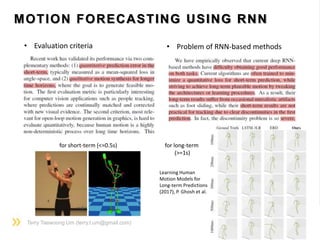
MOTION FORECASTING USING RNN
Terry Taewoong Um (terry.t.um@gmail.com)
• Evaluation criteria • Problem of RNN-based methods
for short-term (<=0.5s) for long-term
(>=1s)
Learning Human
Motion Models for
Long-term Predictions
(2017), P. Ghosh et al.
WHAT’S THE PROBLEMS?
Other problems:
- Model is so complicated that large data is needed
- Action-specific network : use a certain-action data
Terry Taewoong Um (terry.t.um@gmail.com)
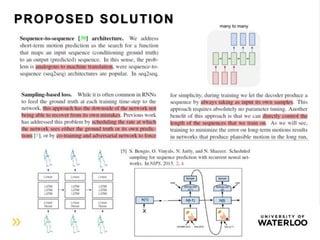
PROPOSED SOLUTION
PROPOSED SOLUTION
(from K. He’s ResNet
tutorial at ICML2016)
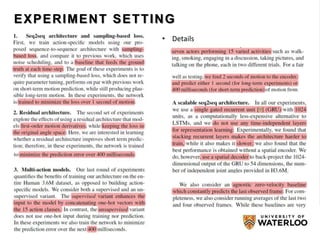
EXPERIMENT SETTING
Terry Taewoong Um (terry.t.um@gmail.com)
• Details
RESULTS
(SA : single action data, MA: multiple action data)
RESULTS
• Zero-velocity shows a good performance
• Sampling-based loss gives plausible motion generation
+ no noise scheduling is needed
• Residual connection improves the performance
• Using single action data < Using all action data (data quality < data quantity)
• Aperiodic motions are hard to model with RNNs
• Action labels helps the learning process
• Small loss != good qualitative long-term motion  need to propose a new loss
• Unsupervised approach gives a comparative result
• This research area hasn’t been matured, so, we have a chance .
Terry Taewoong Um (terry.t.um@gmail.com)
Idea:
(for t+1 prediction)
Rather than residual input 𝑋𝑡
residual input 𝑋𝑡 + 𝑋𝑡 𝑑𝑡, or
explicitly exploiting 𝑋 and 𝑋
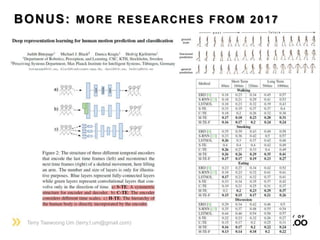
BONUS: MORE RESEARCHES FROM 2017
Terry Taewoong Um (terry.t.um@gmail.com)
BONUS: MORE RESEARCHES FROM 2017
Terry Taewoong Um (terry.t.um@gmail.com)
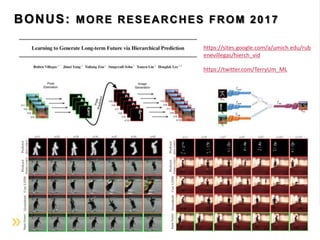
BONUS: MORE RESEARCHES FROM 2017
Terry Taewoong Um (terry.t.um@gmail.com)
https://sites.google.com/a/umich.edu/rub
enevillegas/hierch_vid
https://twitter.com/TerryUm_ML

Human Motion Forecasting (Generation) with RNNs

  • 1.
    Terry Taewoong Um(terry.t.um@gmail.com) University of Waterloo Department of Electrical & Computer Engineering Terry T. Um ON HUMAN MOTION PREDICTION USING RNNS (2017) 1
  • 2.
    MOTIVATION TO CHOOSETHIS PAPER Terry Taewoong Um (terry.t.um@gmail.com) • I have applied convolutional neural networks (CNNs) to classify wearable sensor data in my research, but haven’t applied recurrent neural networks (RNNs) in my research. Exercise Motion Classification from Large- Scale Wearable Sensor Data Using CNNs (2016) Classified 50 gym exercises with 92% Data Augmentation of Wearable Sensor Data for Parkinson’s Disease Monitoring using CNNs (2017) classification accuracy 77%  92%
  • 3.
  • 4.
    MOTION FORECASTING • Motionforecasting (Motion prediction) : Given a person’s past motions, forecast the most likely future 3D poses Terry Taewoong Um (terry.t.um@gmail.com) • e.g.) Sentence completion motion forecasting ≈ a high-dimensional and nonlinear version of sentence completion
  • 5.
    BACKGROUND: RNN Terry TaewoongUm (terry.t.um@gmail.com) • Recurrent Neural Networks (RNNs) (unfold)  vanishing or exploding gradient problem  solve by using gate units (Xavier Giro, https://www.slideshare.net/xavigiro/recurrent-neural-networks-1-d2l2-deep-learning-for-speech-and-language-upc-2017)
  • 6.
    BACKGROUND: LSTM &GRU Terry Taewoong Um (terry.t.um@gmail.com) • Solution : Let nodes to decide whether forget or bypass the information  Gate units: Long short-term memory(LSTM) or gated recurrent unit (GRU) (Christopher Olah, http://colah.github.io/posts/2015-08-Understanding-LSTMs/) LSTM GRU similar performance, but less computation
  • 7.
    BACKGROUND: RNN Terry TaewoongUm (terry.t.um@gmail.com) (Andrej Karpathy, http://karpathy.github.io/2015/05/21/rnn-effectiveness/)
  • 8.
    SEQUENCE GENERATION (Andrej Karpathy,http://karpathy.github.io/2015/05/21/rnn-effectiveness/)
  • 9.
    SEQUENCE GENERATION (Andrej Karpathy,http://karpathy.github.io/2015/05/21/rnn-effectiveness/)
  • 10.
    SIMPLEST APPROACH Terry TaewoongUm (terry.t.um@gmail.com) • Just apply a LSTM to joint angle data (2015) ERD Encoder-Recurrent-Decoder LSTM https://www.youtube.com/wat ch?v=CvaKD1NGcBk [Result] Contribution : It’s the first LSTM work with skeleton data
  • 11.
    RELATED WORK ERD Terry TaewoongUm (terry.t.um@gmail.com)
  • 12.
  • 13.
    C.F.) HIERARCHICAL RNN MHADdataset (11 actions) HDM05 dataset (65 actions) MSR-Action3D dataset (20 actions) (2016)
  • 14.
    MOTION FORECASTING USINGRNN Terry Taewoong Um (terry.t.um@gmail.com) • Evaluation criteria • Problem of RNN-based methods for short-term (<=0.5s) for long-term (>=1s) Learning Human Motion Models for Long-term Predictions (2017), P. Ghosh et al.
  • 15.
    WHAT’S THE PROBLEMS? Otherproblems: - Model is so complicated that large data is needed - Action-specific network : use a certain-action data Terry Taewoong Um (terry.t.um@gmail.com)
  • 16.
  • 17.
    PROPOSED SOLUTION (from K.He’s ResNet tutorial at ICML2016)
  • 18.
    EXPERIMENT SETTING Terry TaewoongUm (terry.t.um@gmail.com) • Details
  • 19.
    RESULTS (SA : singleaction data, MA: multiple action data)
  • 20.
    RESULTS • Zero-velocity showsa good performance • Sampling-based loss gives plausible motion generation + no noise scheduling is needed • Residual connection improves the performance • Using single action data < Using all action data (data quality < data quantity) • Aperiodic motions are hard to model with RNNs • Action labels helps the learning process • Small loss != good qualitative long-term motion  need to propose a new loss • Unsupervised approach gives a comparative result • This research area hasn’t been matured, so, we have a chance . Terry Taewoong Um (terry.t.um@gmail.com) Idea: (for t+1 prediction) Rather than residual input 𝑋𝑡 residual input 𝑋𝑡 + 𝑋𝑡 𝑑𝑡, or explicitly exploiting 𝑋 and 𝑋
  • 21.
    BONUS: MORE RESEARCHESFROM 2017 Terry Taewoong Um (terry.t.um@gmail.com)
  • 22.
    BONUS: MORE RESEARCHESFROM 2017 Terry Taewoong Um (terry.t.um@gmail.com)
  • 23.
    BONUS: MORE RESEARCHESFROM 2017 Terry Taewoong Um (terry.t.um@gmail.com) https://sites.google.com/a/umich.edu/rub enevillegas/hierch_vid https://twitter.com/TerryUm_ML