4.1
Chapter 4
Digital Transmission
Copyright © The McGraw-Hill Companies, Inc. Permission required for reproduction or display.
4.2
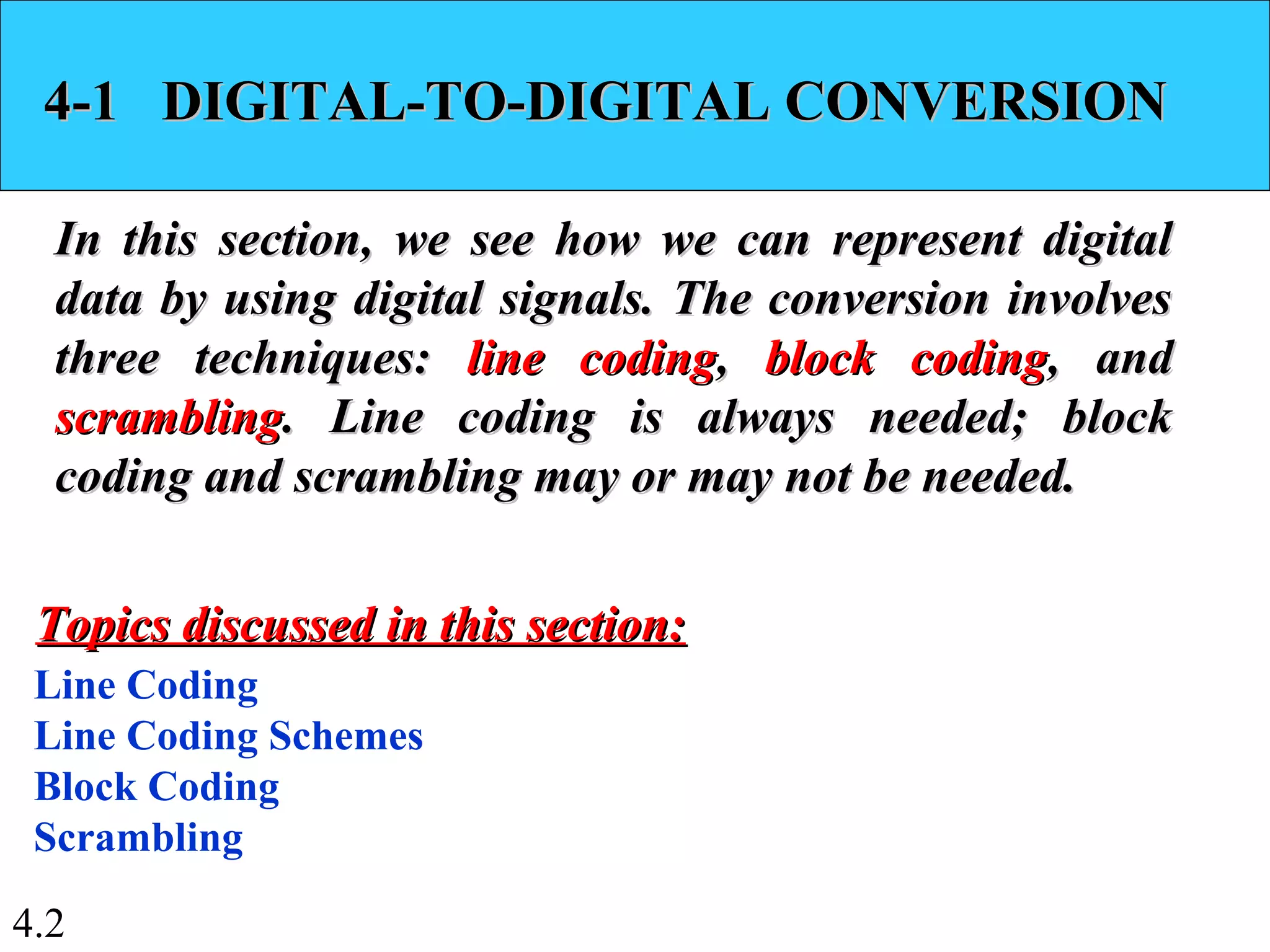
4-1 DIGITAL-TO-DIGITAL CONVERSION4-1 DIGITAL-TO-DIGITAL CONVERSION
In this section, we see how we can represent digitalIn this section, we see how we can represent digital
data by using digital signals. The conversion involvesdata by using digital signals. The conversion involves
three techniques:three techniques: line codingline coding,, block codingblock coding, and, and
scramblingscrambling. Line coding is always needed; block. Line coding is always needed; block
coding and scrambling may or may not be needed.coding and scrambling may or may not be needed.
Line Coding
Line Coding Schemes
Block Coding
Scrambling
Topics discussed in this section:Topics discussed in this section:
4.3
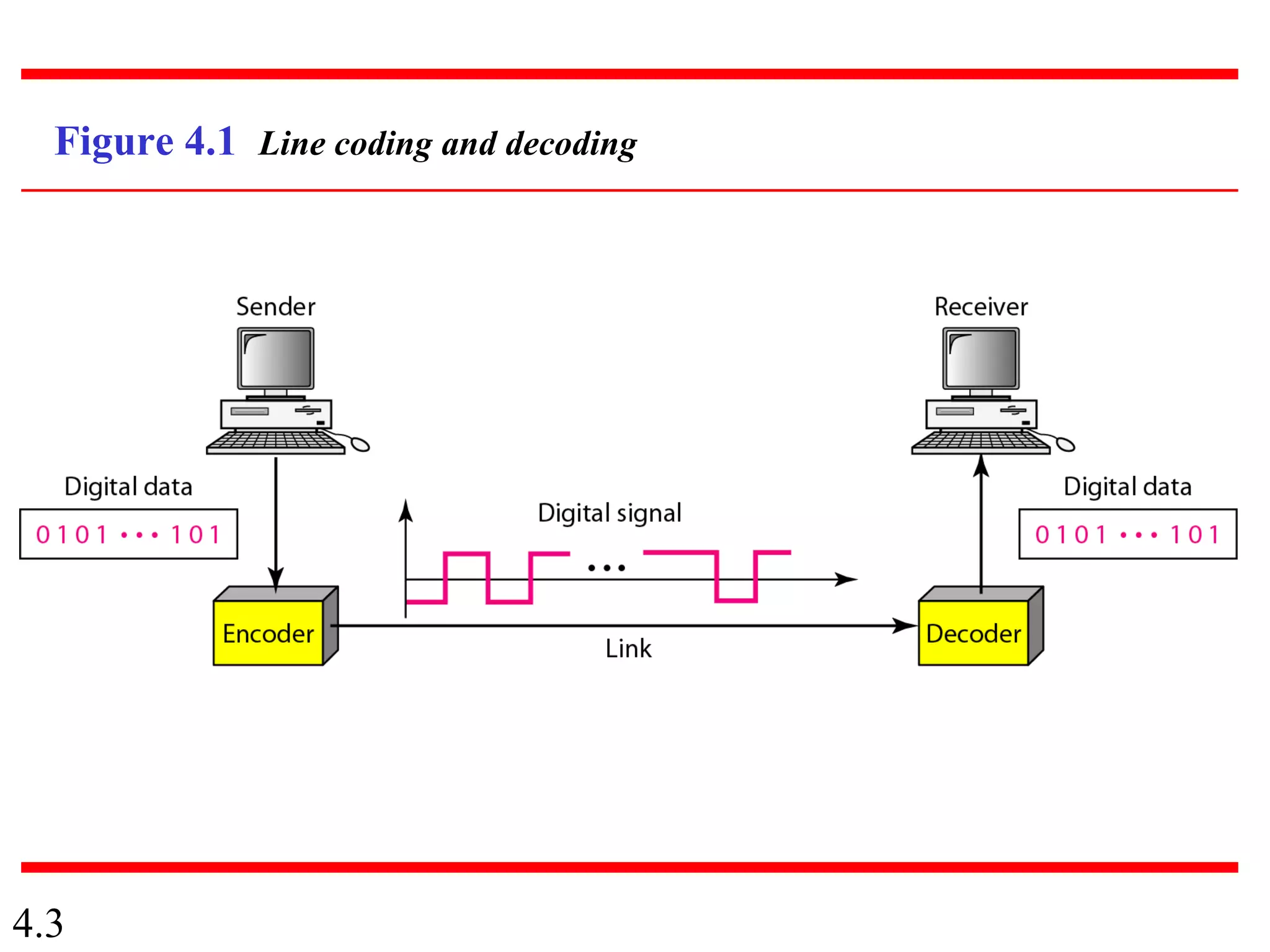
Figure 4.1 Line coding and decoding
4.4
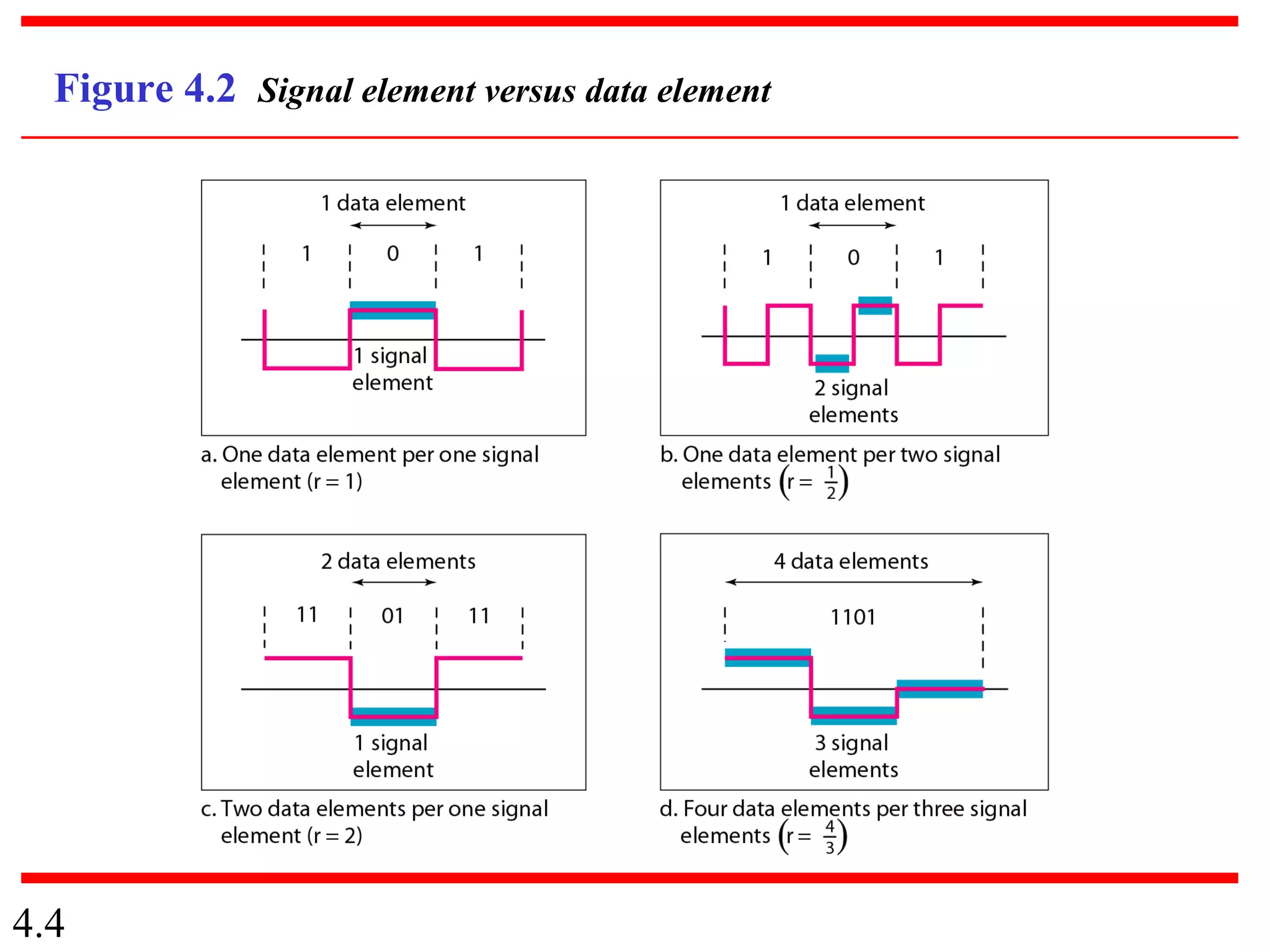
Figure 4.2 Signal element versus data element
4.5
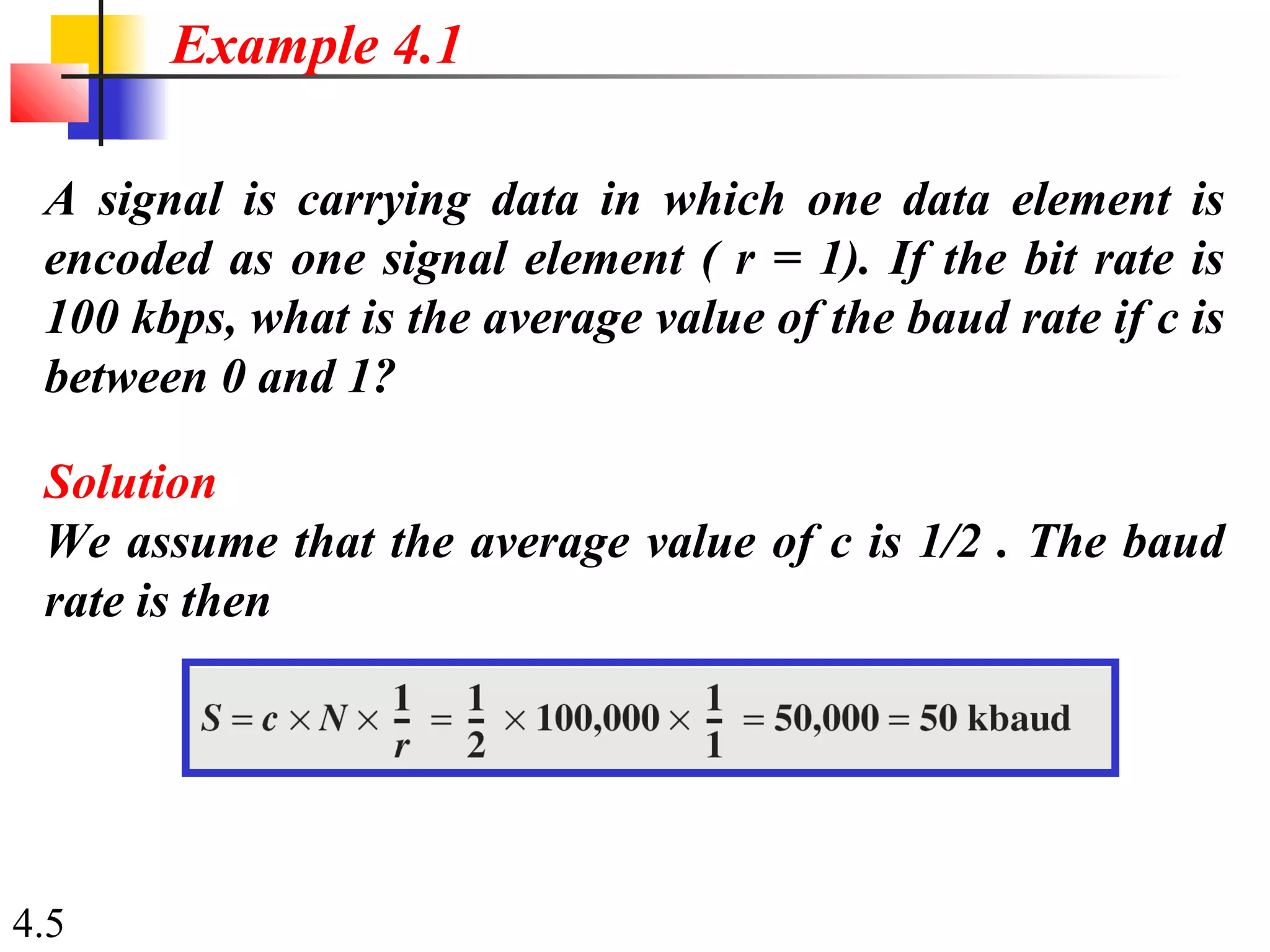
A signal is carrying data in which one data element is
encoded as one signal element ( r = 1). If the bit rate is
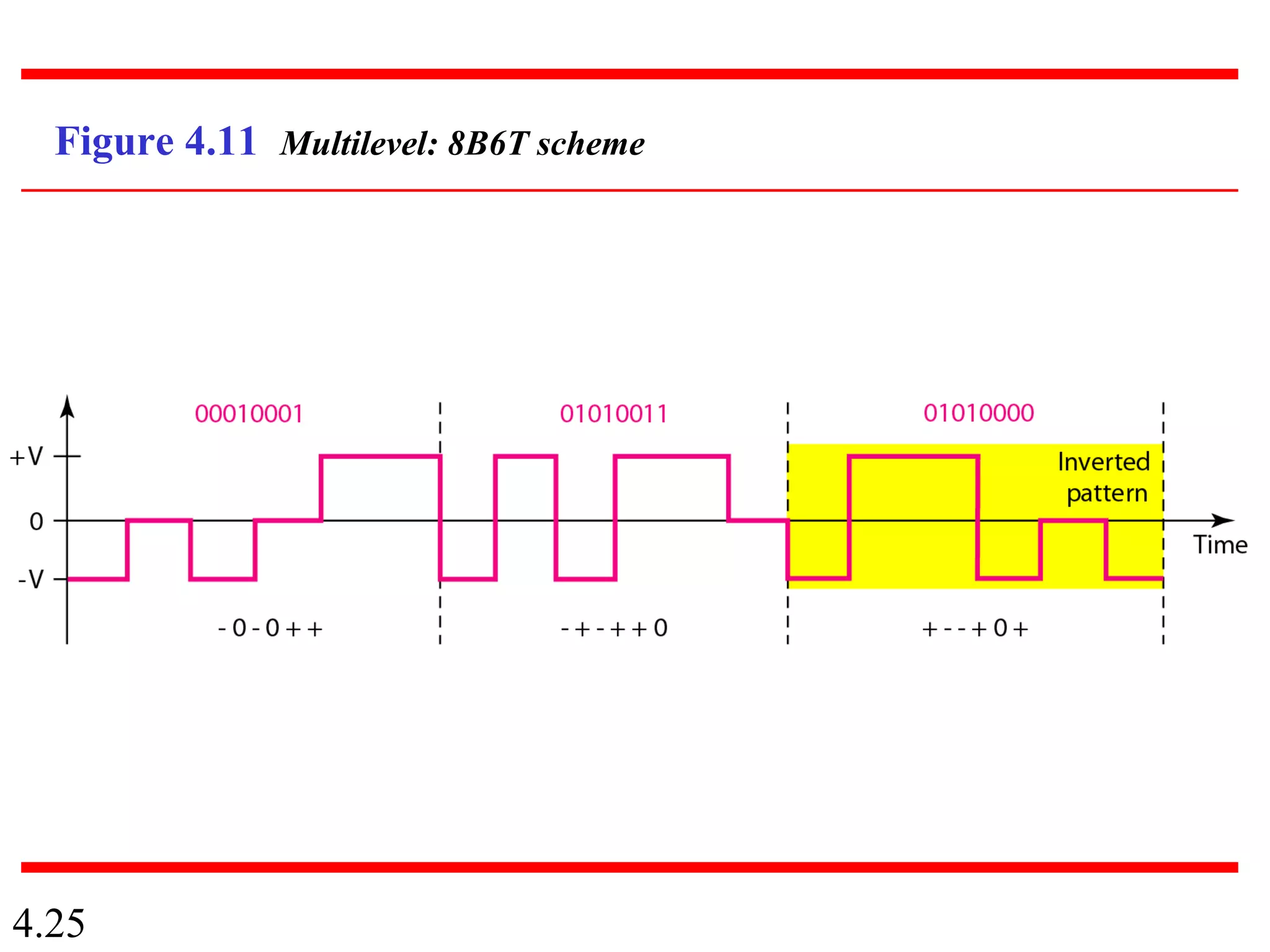
100 kbps, what is the average value of the baud rate if c is
between 0 and 1?
Solution
We assume that the average value of c is 1/2 . The baud
rate is then
Example 4.1
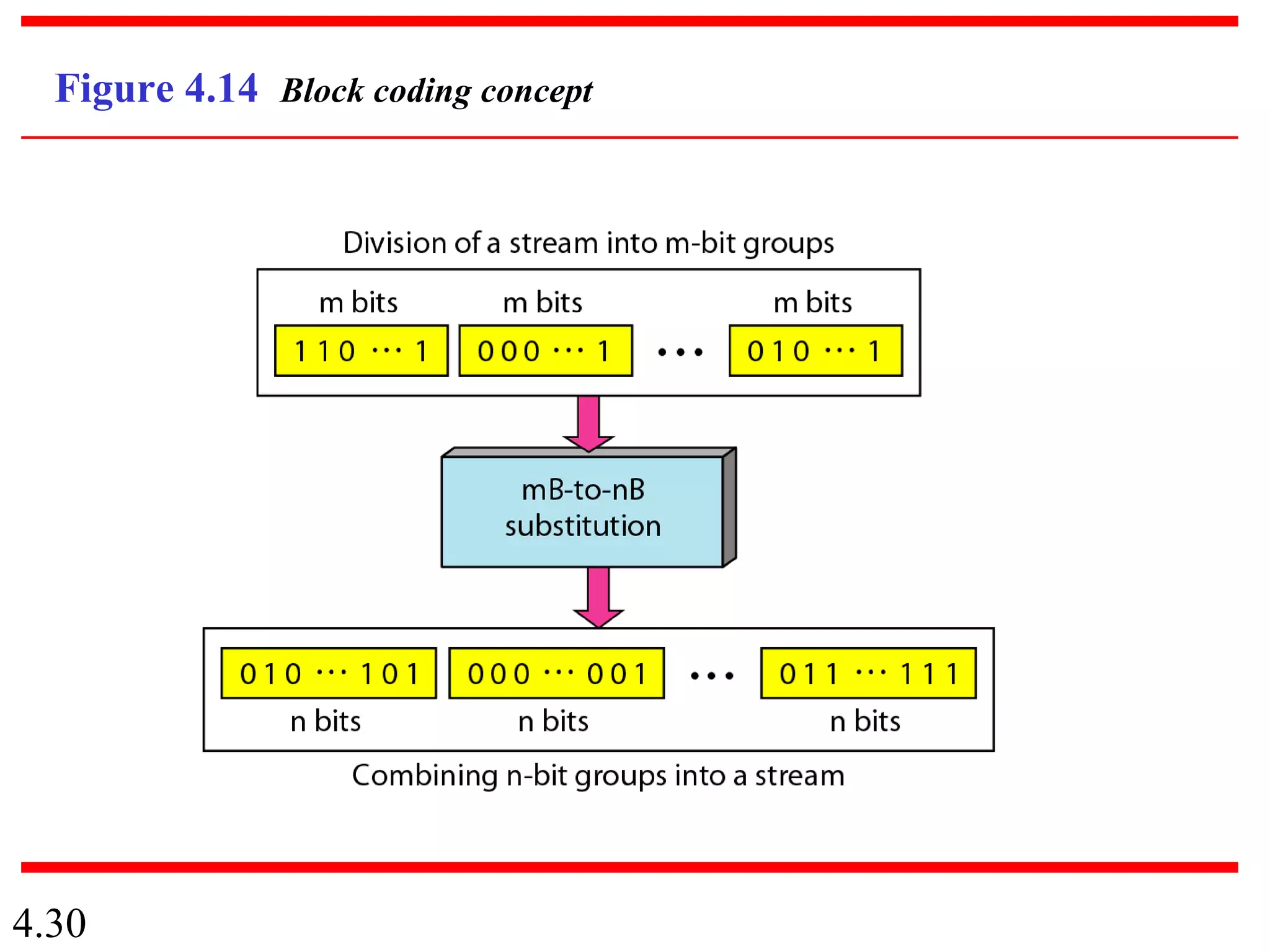
4.6
Although the actual bandwidth of a
digital signal is infinite, the effective
bandwidth is finite.
Note
4.7
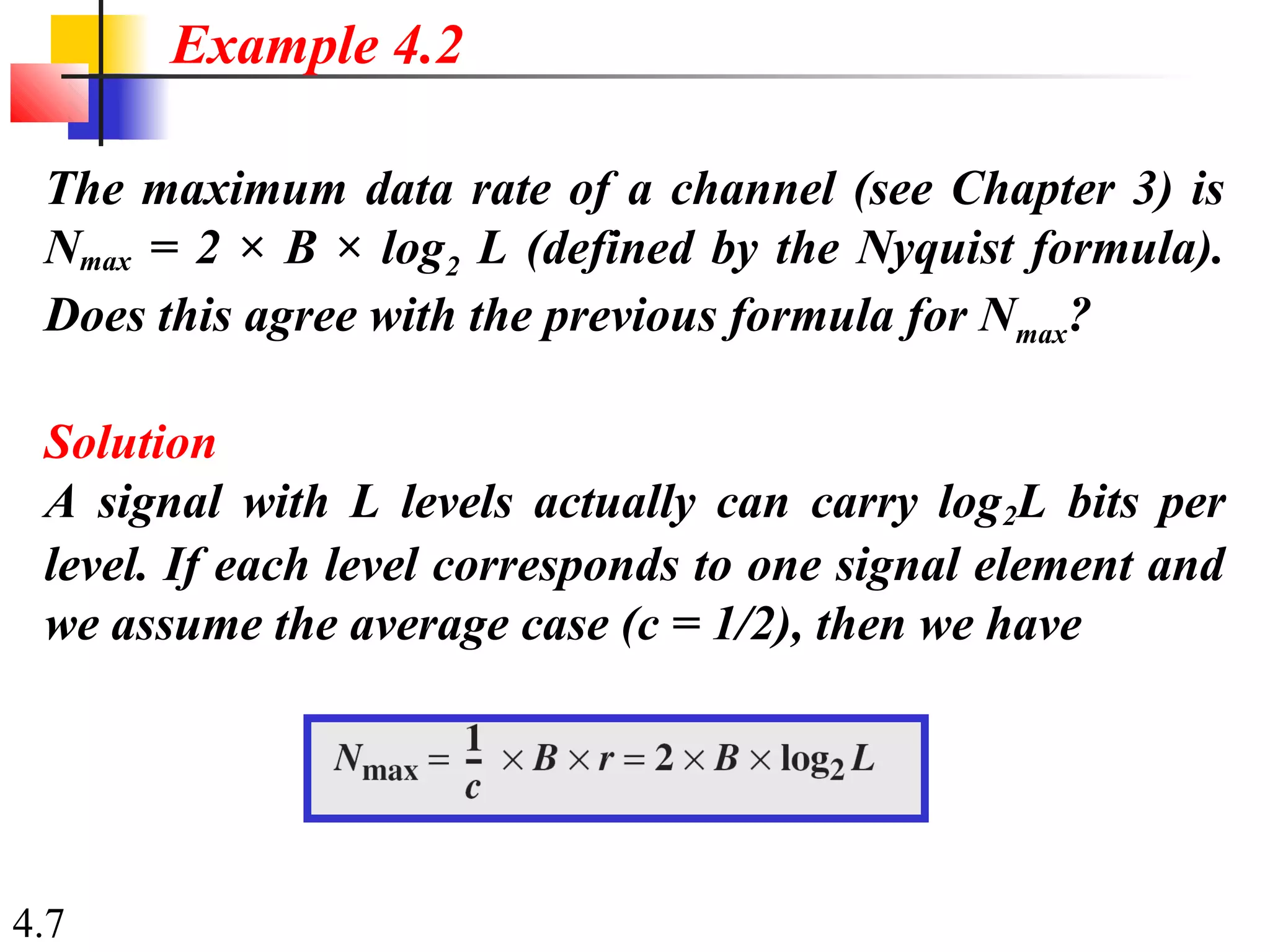
The maximum data rate of a channel (see Chapter 3) is
Nmax = 2 × B × log2 L (defined by the Nyquist formula).
Does this agree with the previous formula for Nmax?
Solution
A signal with L levels actually can carry log2L bits per
level. If each level corresponds to one signal element and
we assume the average case (c = 1/2), then we have
Example 4.2
4.8
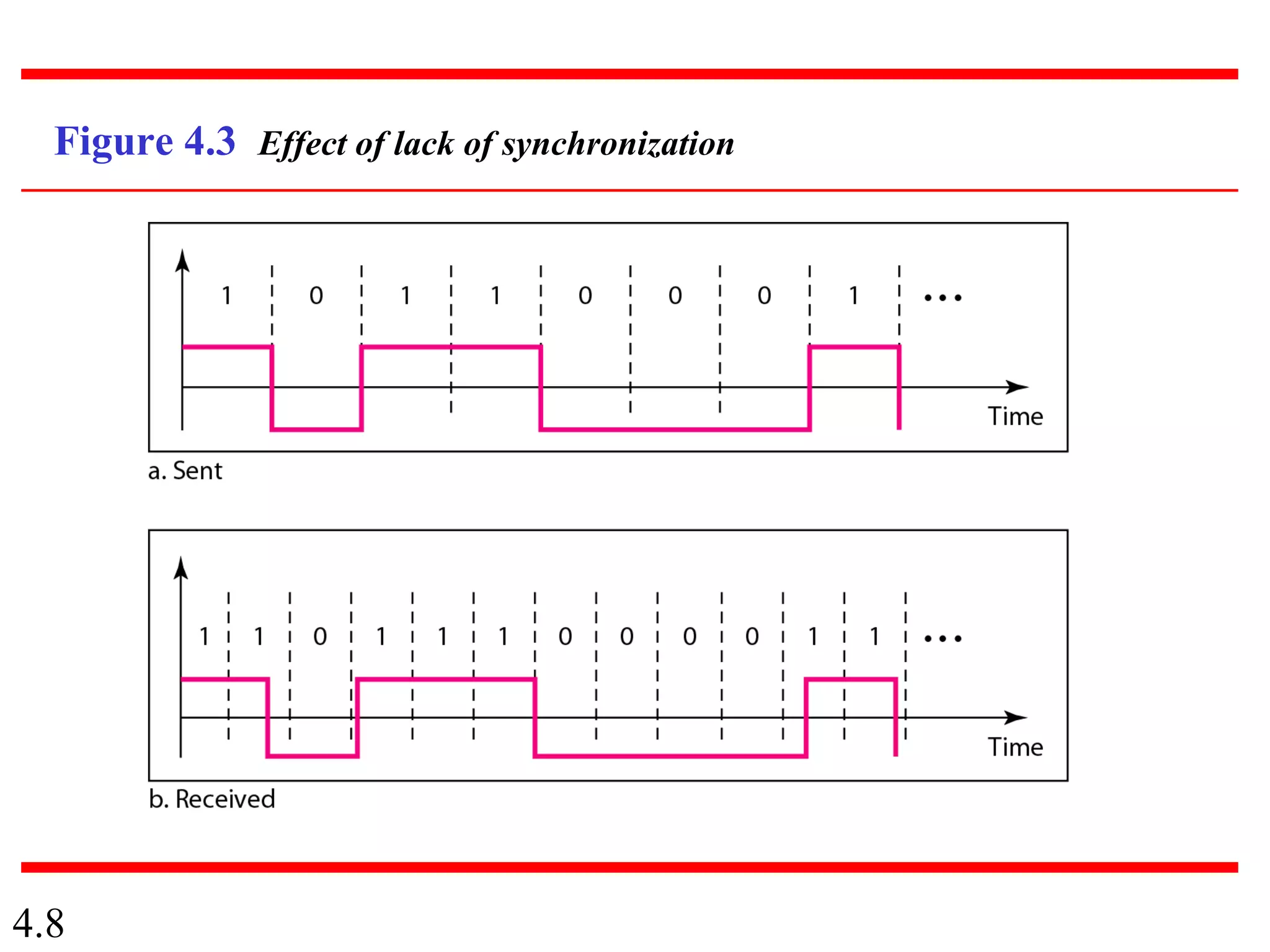
Figure 4.3 Effect of lack of synchronization
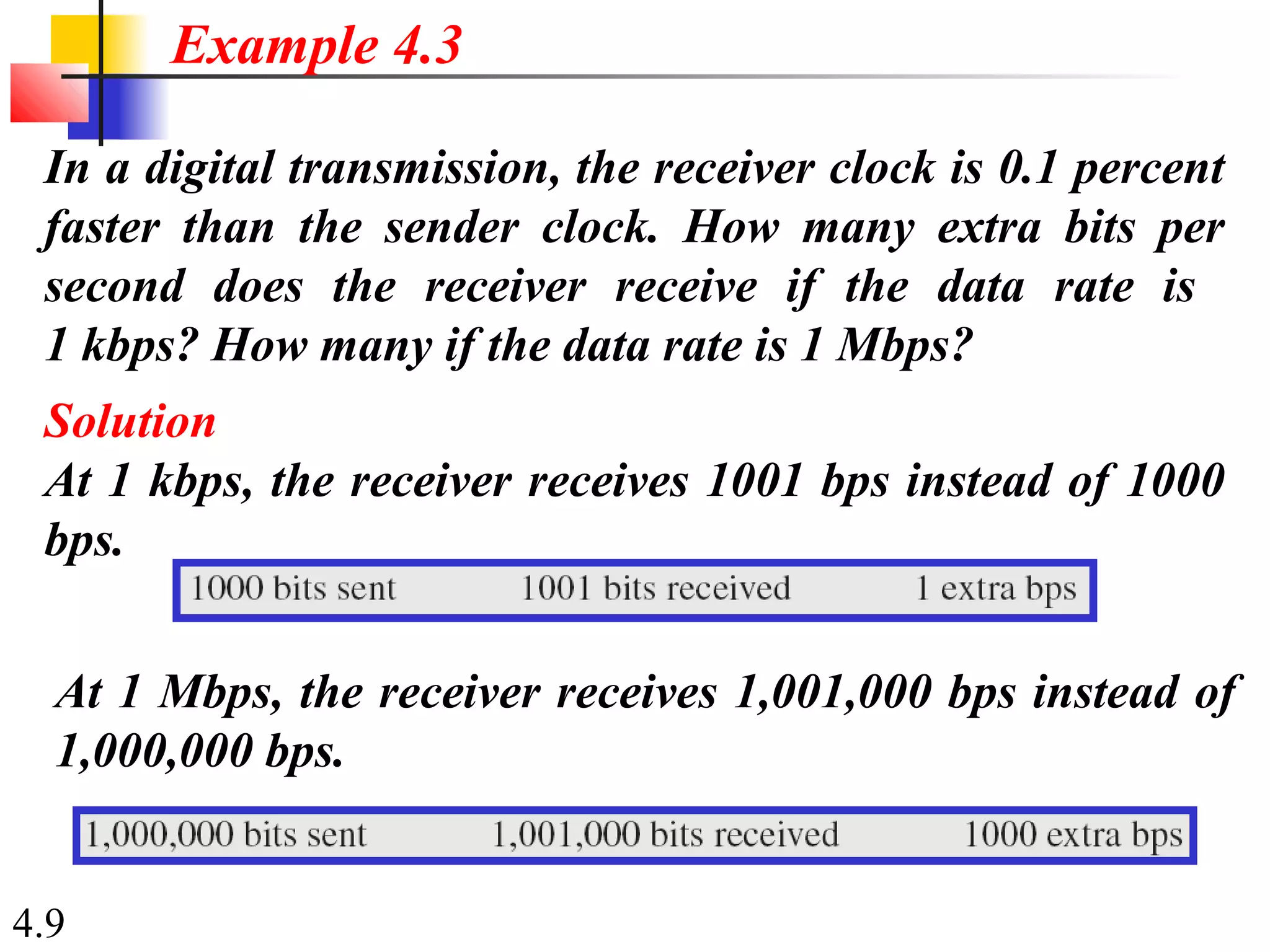
4.9
In a digital transmission, the receiver clock is 0.1 percent
faster than the sender clock. How many extra bits per
second does the receiver receive if the data rate is
1 kbps? How many if the data rate is 1 Mbps?
Solution
At 1 kbps, the receiver receives 1001 bps instead of 1000
bps.
Example 4.3
At 1 Mbps, the receiver receives 1,001,000 bps instead of
1,000,000 bps.
4.10
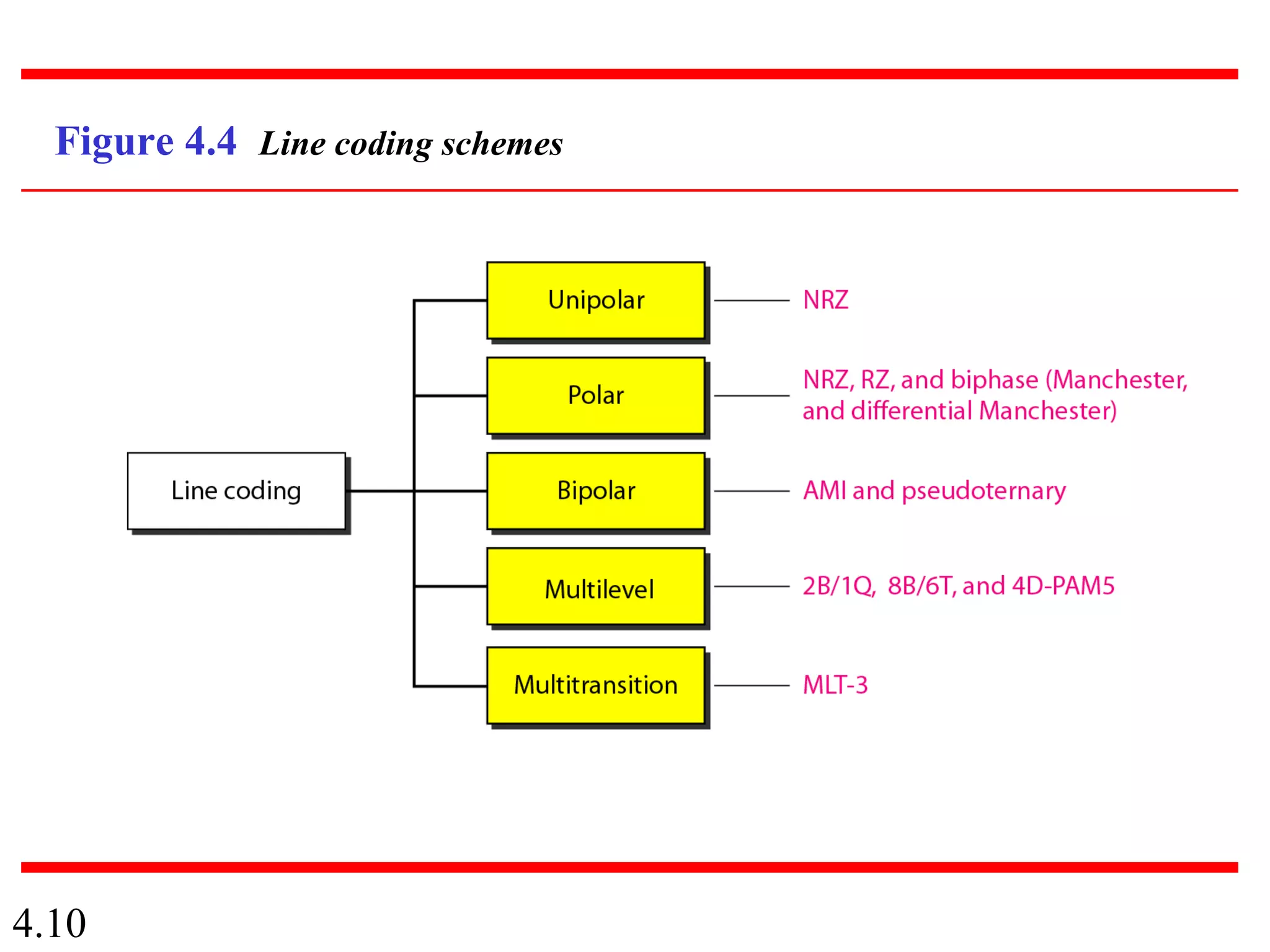
Figure 4.4 Line coding schemes
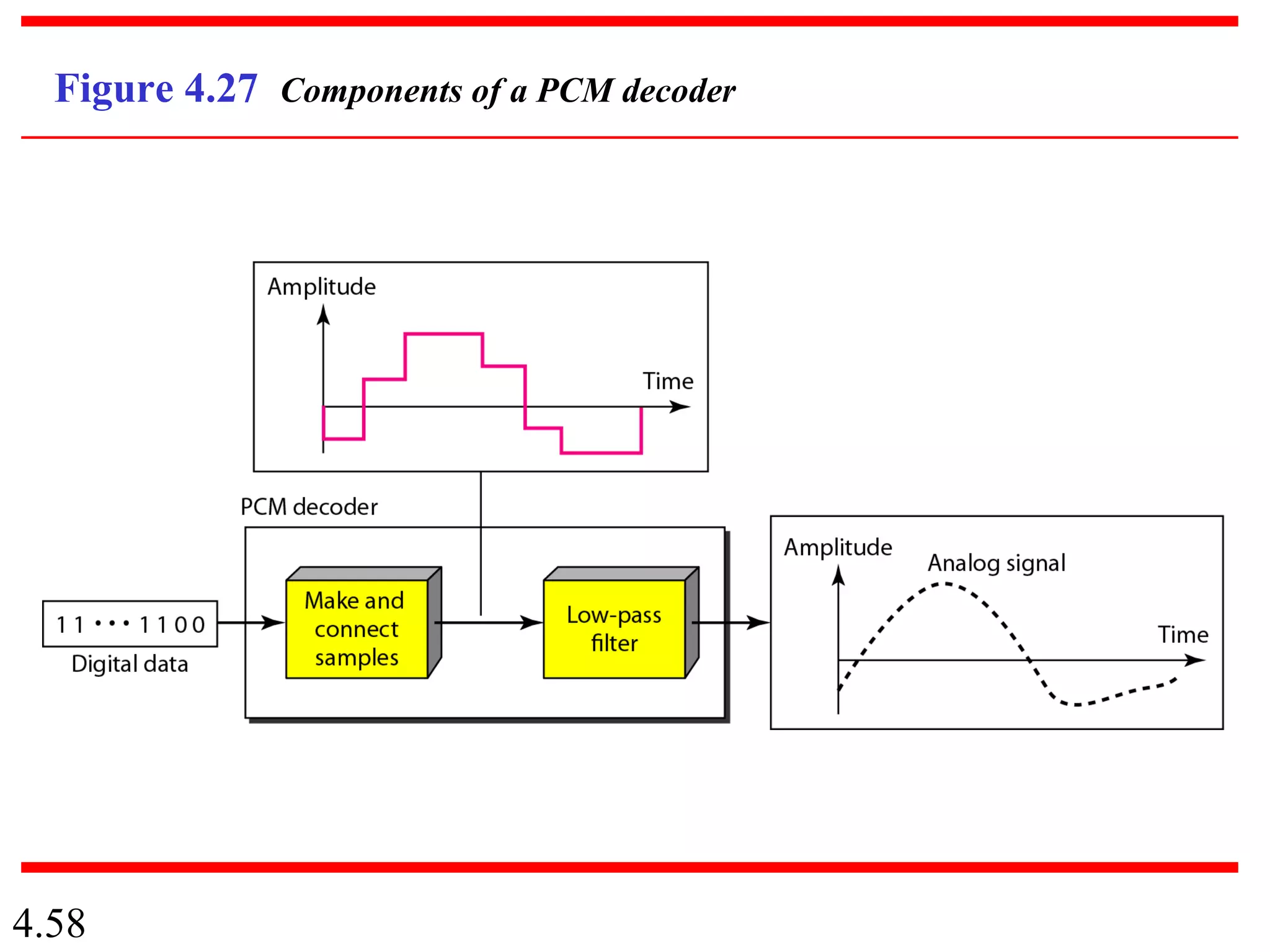
4.11
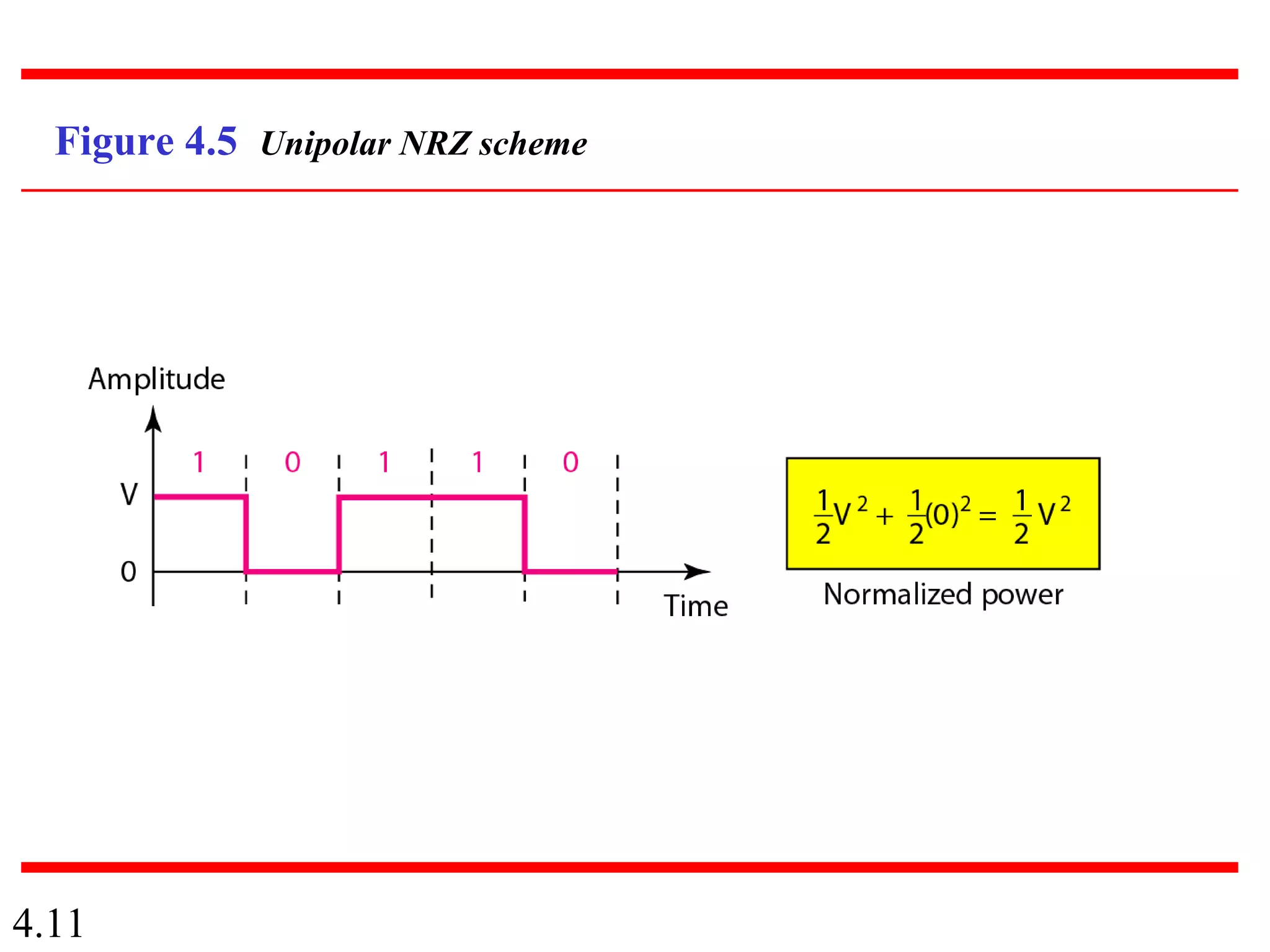
Figure 4.5 Unipolar NRZ scheme
4.12
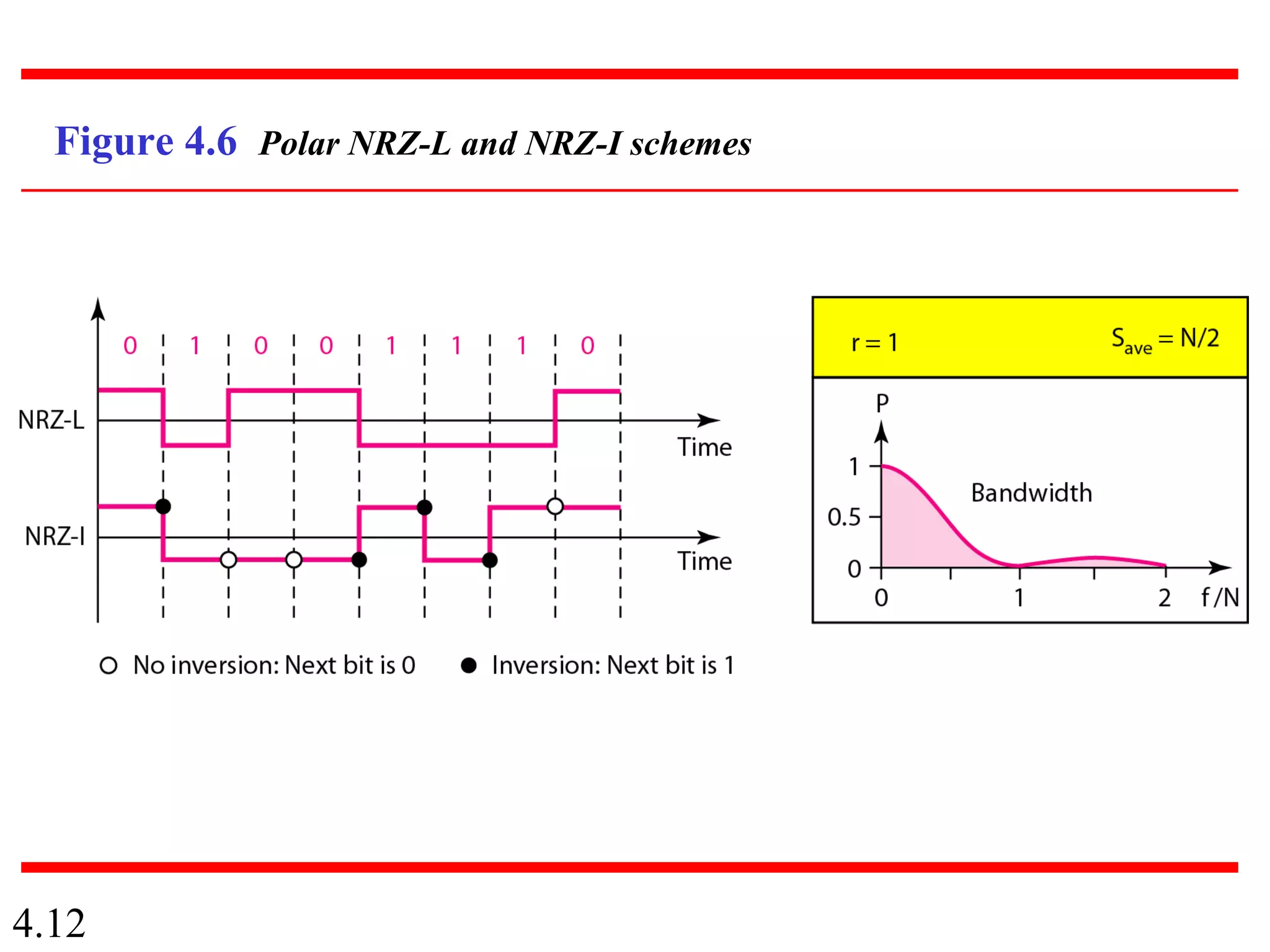
Figure 4.6 Polar NRZ-L and NRZ-I schemes
4.13
In NRZ-L the level of the voltage
determines the value of the bit.
In NRZ-I the inversion
or the lack of inversion
determines the value of the bit.
Note
4.14
NRZ-L and NRZ-I both have an average
signal rate of N/2 Bd.
Note
4.15
NRZ-L and NRZ-I both have a DC
component problem.
Note
4.16
A system is using NRZ-I to transfer 10-Mbps data. What
are the average signal rate and minimum bandwidth?
Solution
The average signal rate is S = N/2 = 500 kbaud. The
minimum bandwidth for this average baud rate is Bmin = S
= 500 kHz.
Example 4.4
4.17
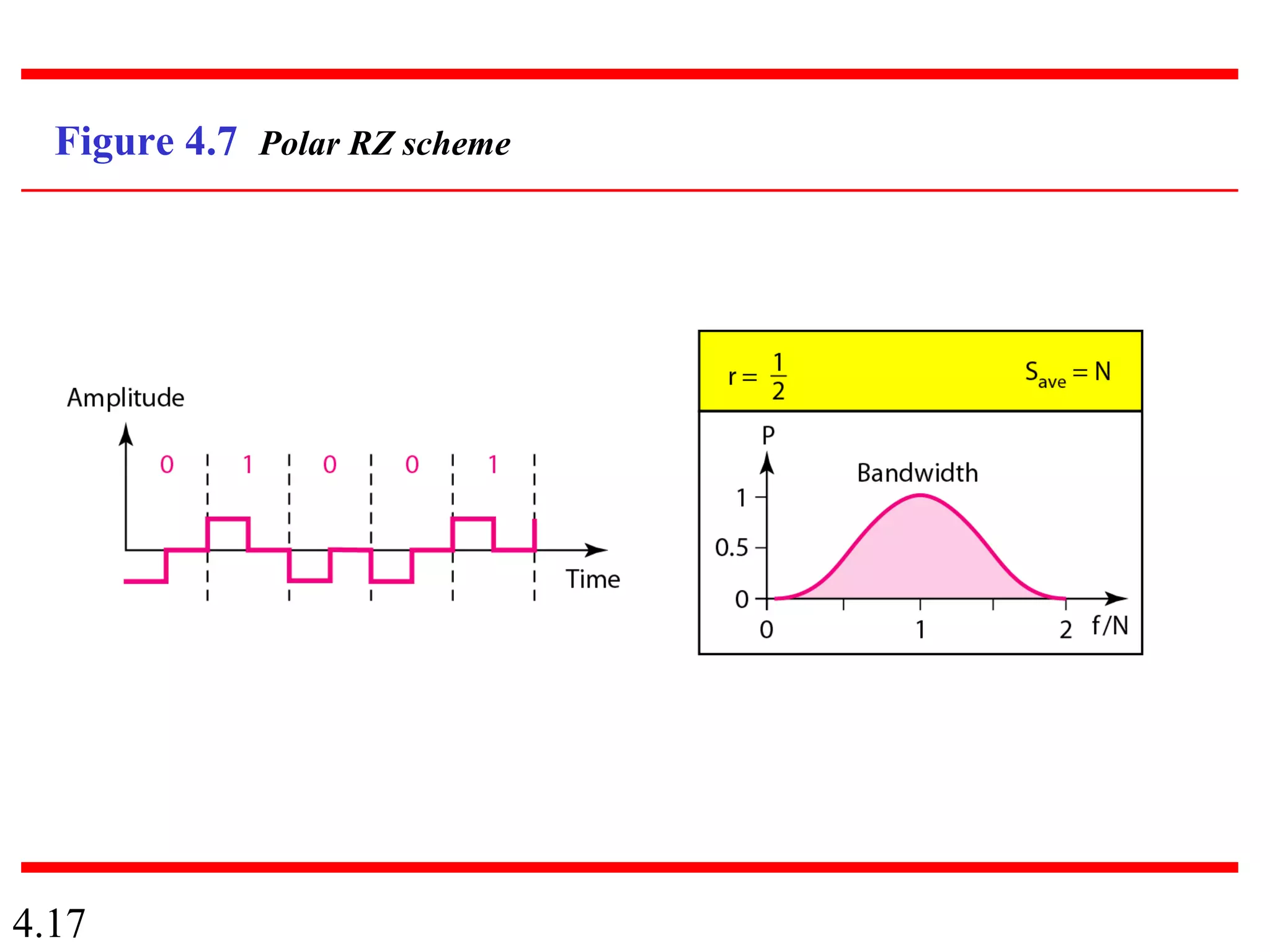
Figure 4.7 Polar RZ scheme
4.18
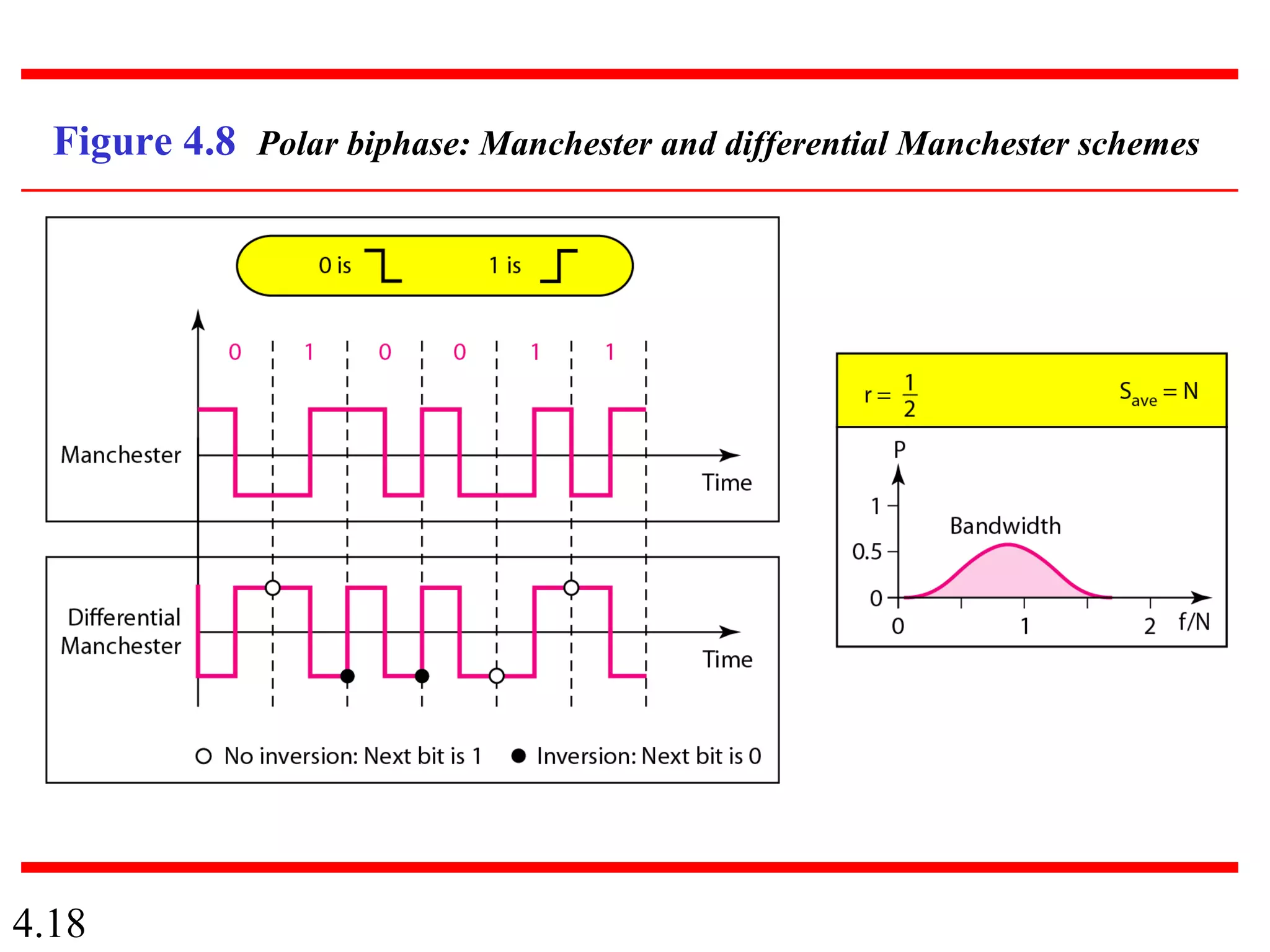
Figure 4.8 Polar biphase: Manchester and differential Manchester schemes
4.19
In Manchester and differential
Manchester encoding, the transition
at the middle of the bit is used for
synchronization.
Note
4.20
The minimum bandwidth of Manchester
and differential Manchester is 2 times
that of NRZ.
Note
4.21
In bipolar encoding, we use three levels:
positive, zero, and negative.
Note
4.22
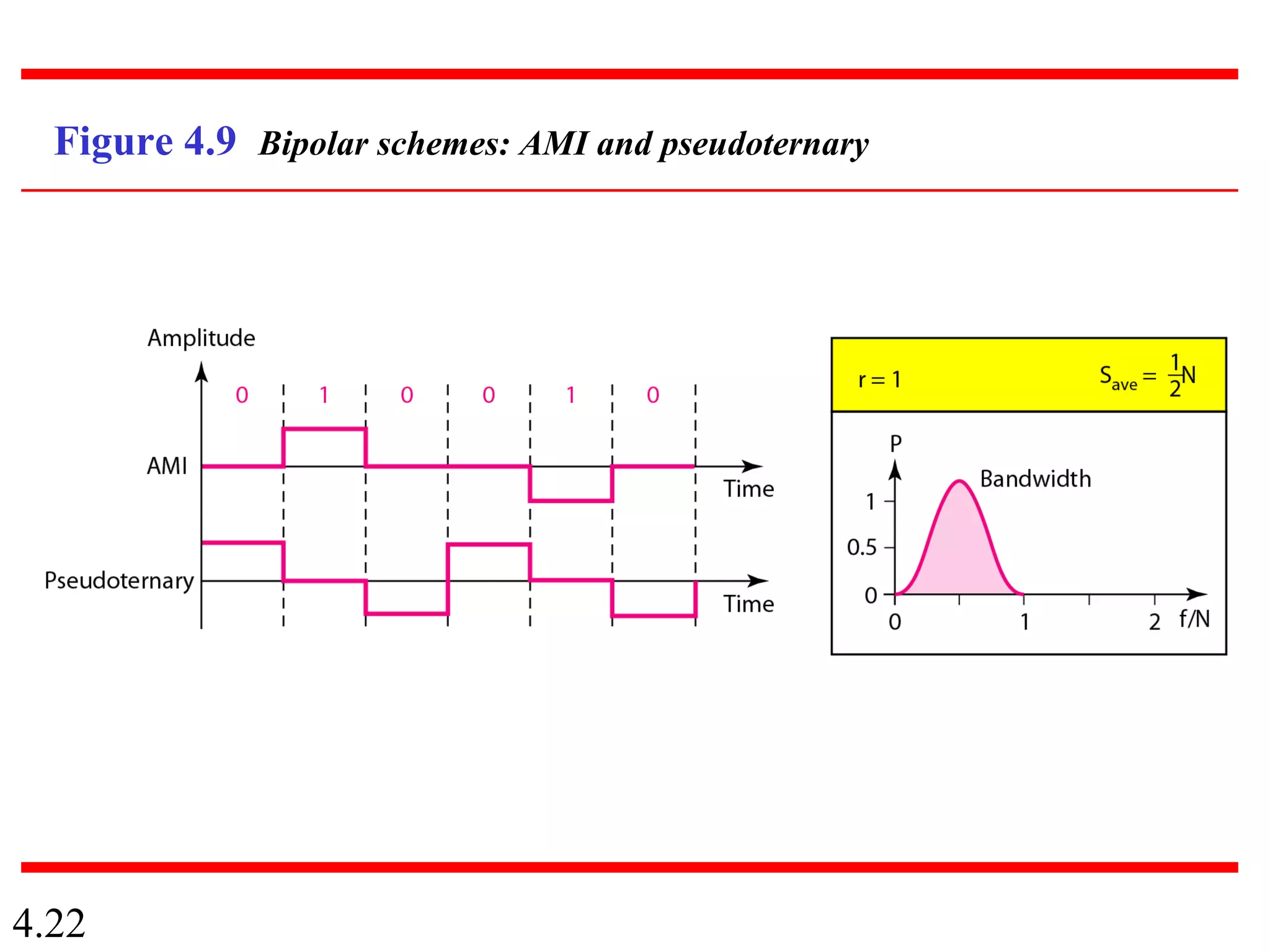
Figure 4.9 Bipolar schemes: AMI and pseudoternary
4.23
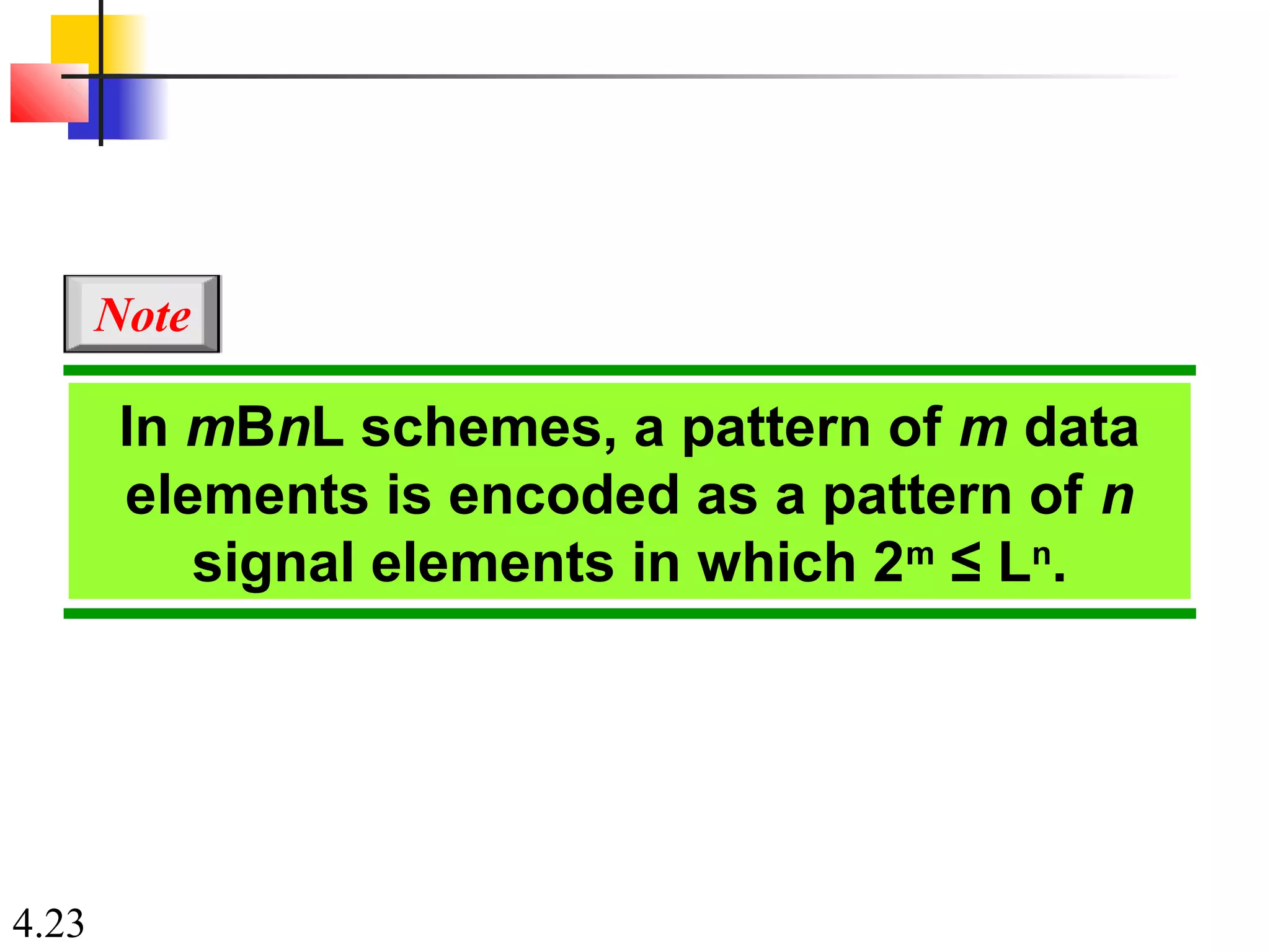
In mBnL schemes, a pattern of m data
elements is encoded as a pattern of n
signal elements in which 2m
≤ Ln
.
Note
4.24
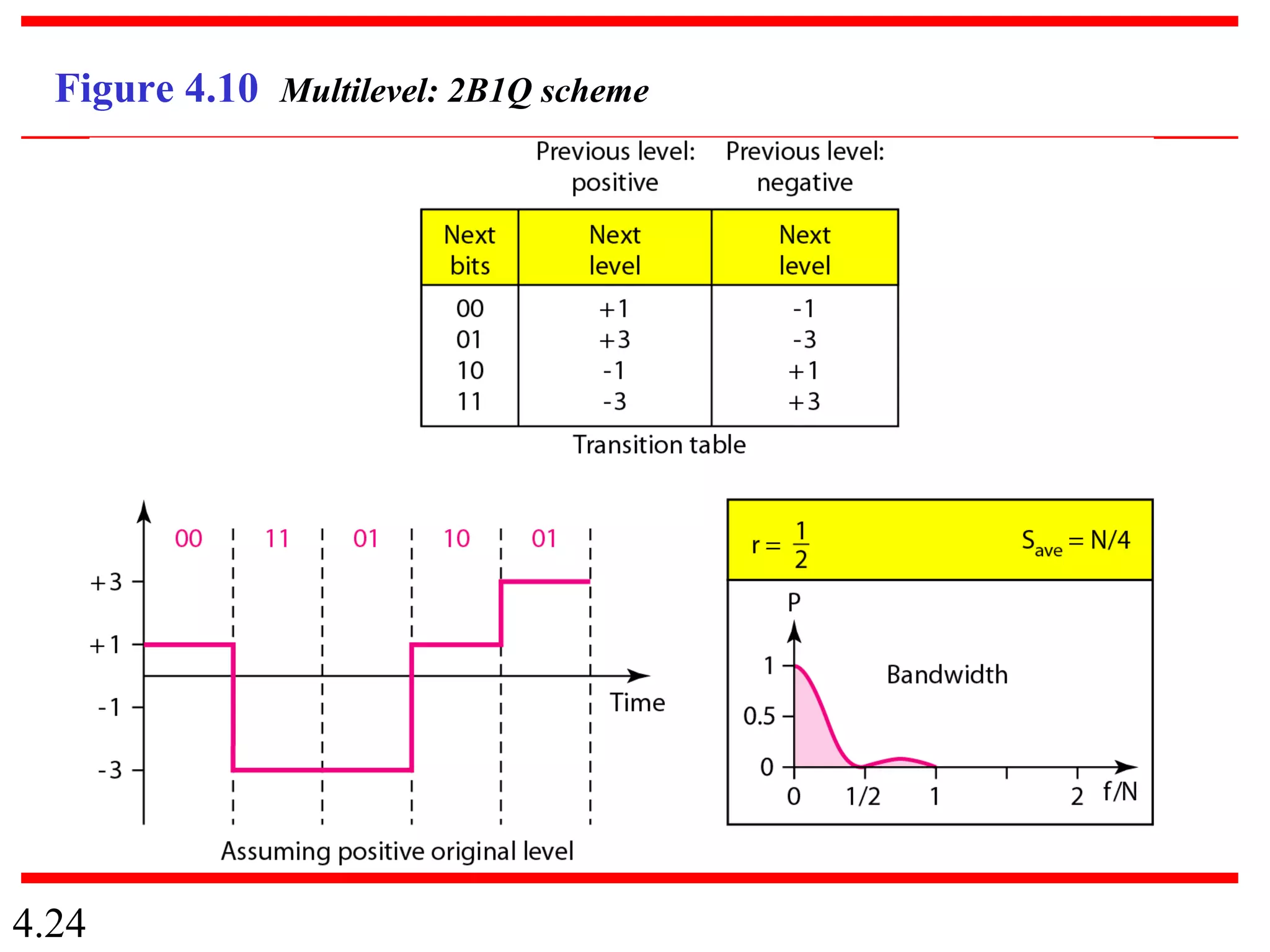
Figure 4.10 Multilevel: 2B1Q scheme
4.25
Figure 4.11 Multilevel: 8B6T scheme
4.26
Figure 4.12 Multilevel: 4D-PAM5 scheme
4.27
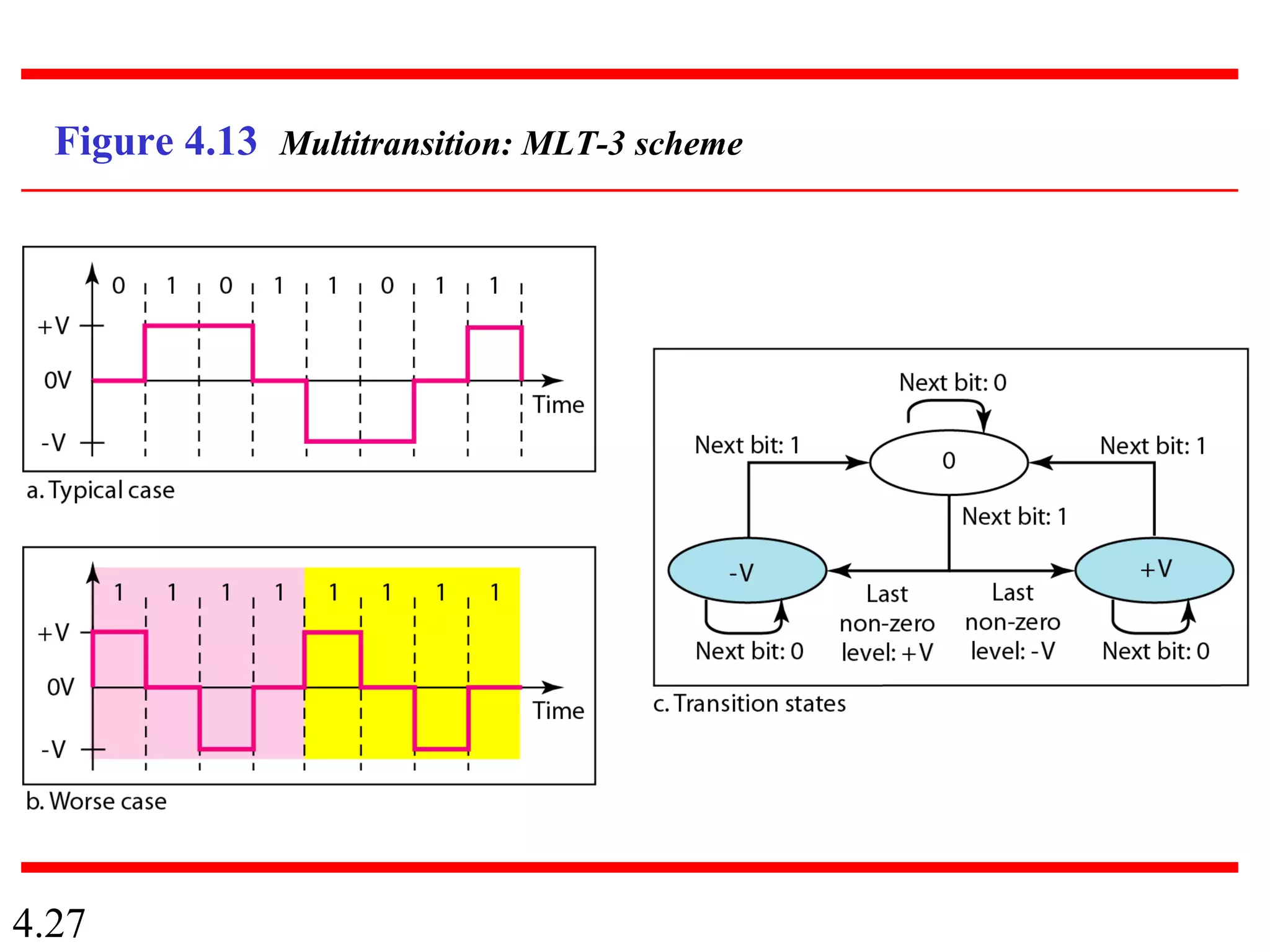
Figure 4.13 Multitransition: MLT-3 scheme
4.28
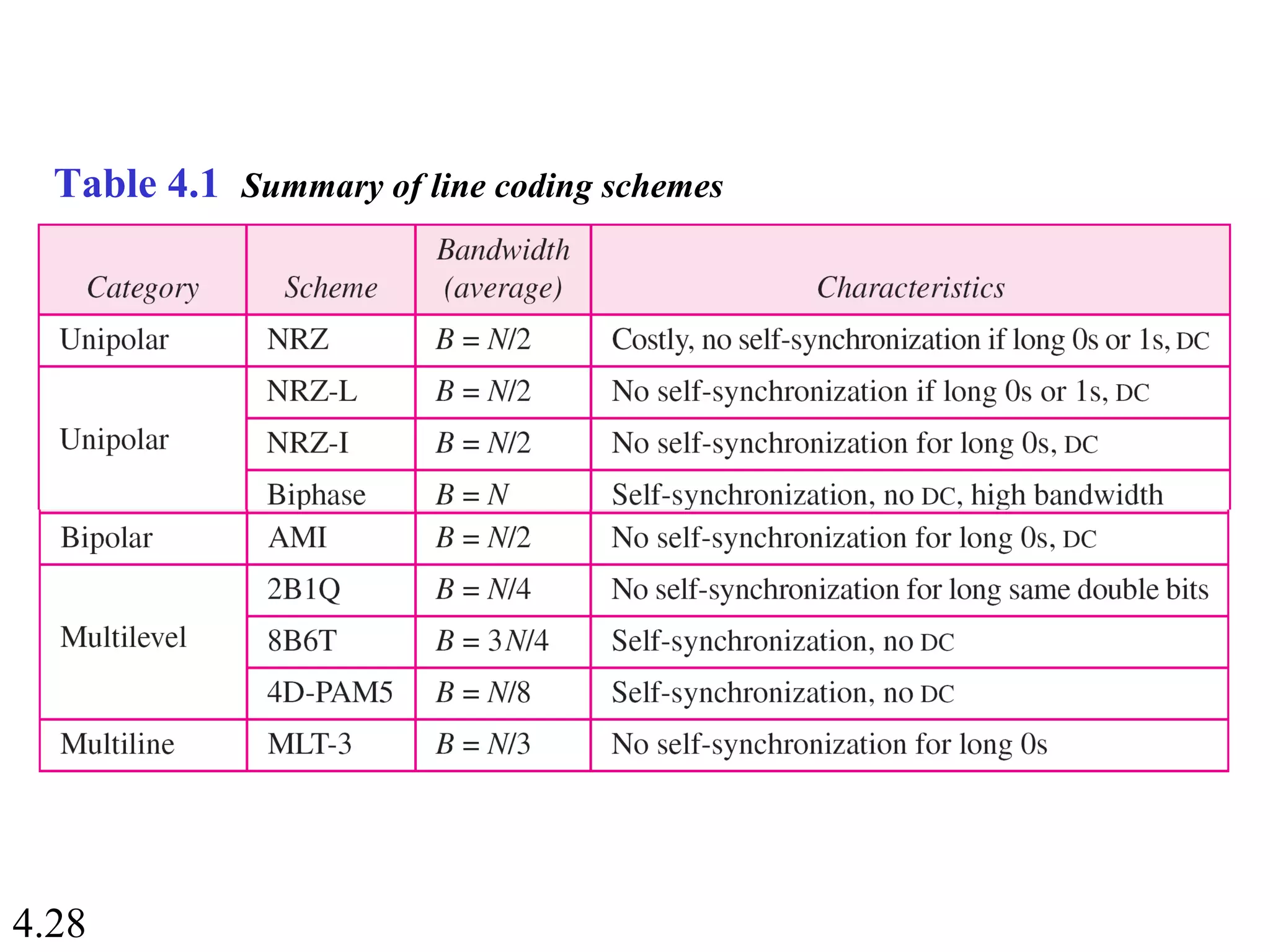
Table 4.1 Summary of line coding schemes
4.29
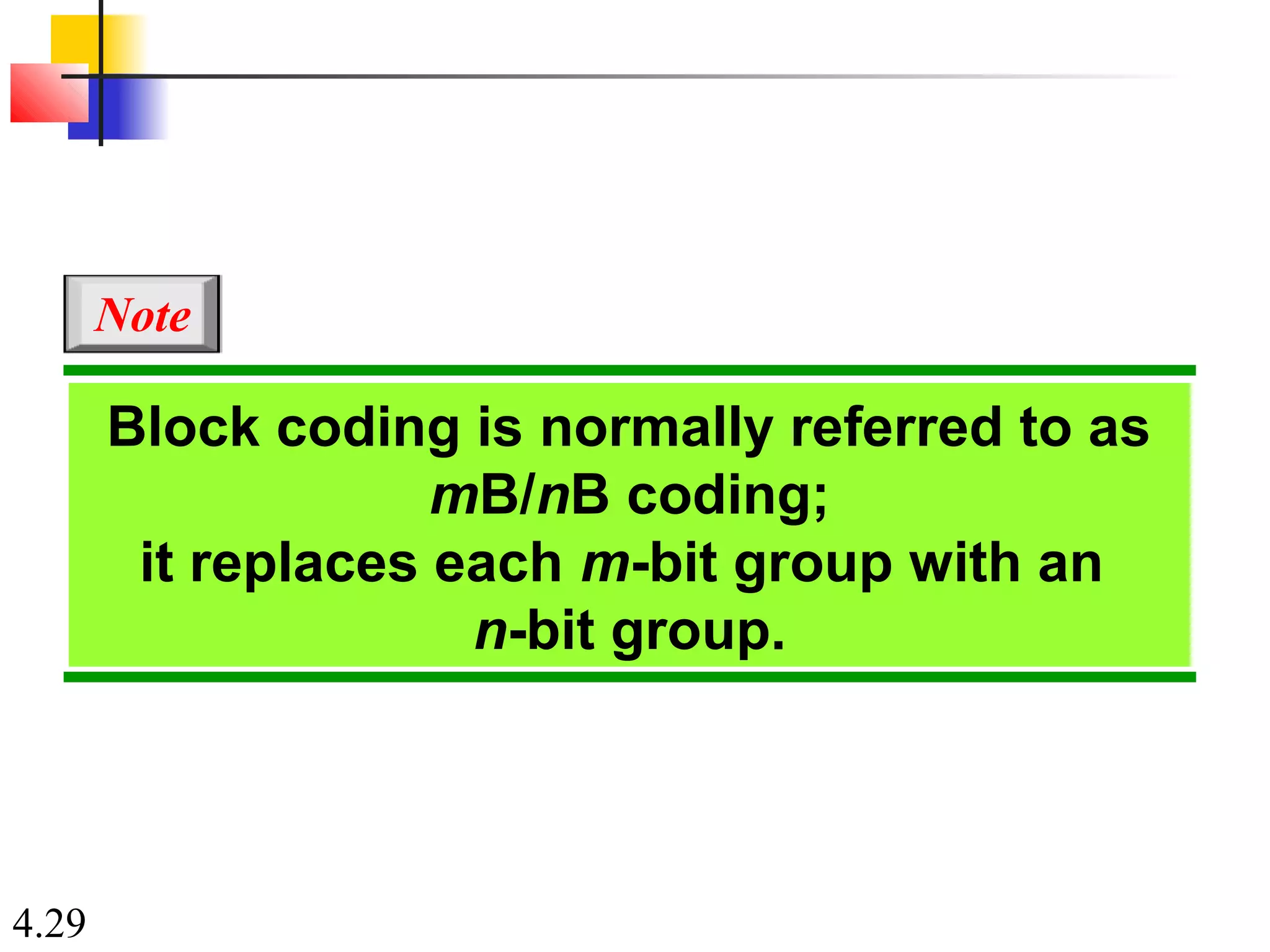
Block coding is normally referred to as
mB/nB coding;
it replaces each m-bit group with an
n-bit group.
Note
4.30
Figure 4.14 Block coding concept
4.31
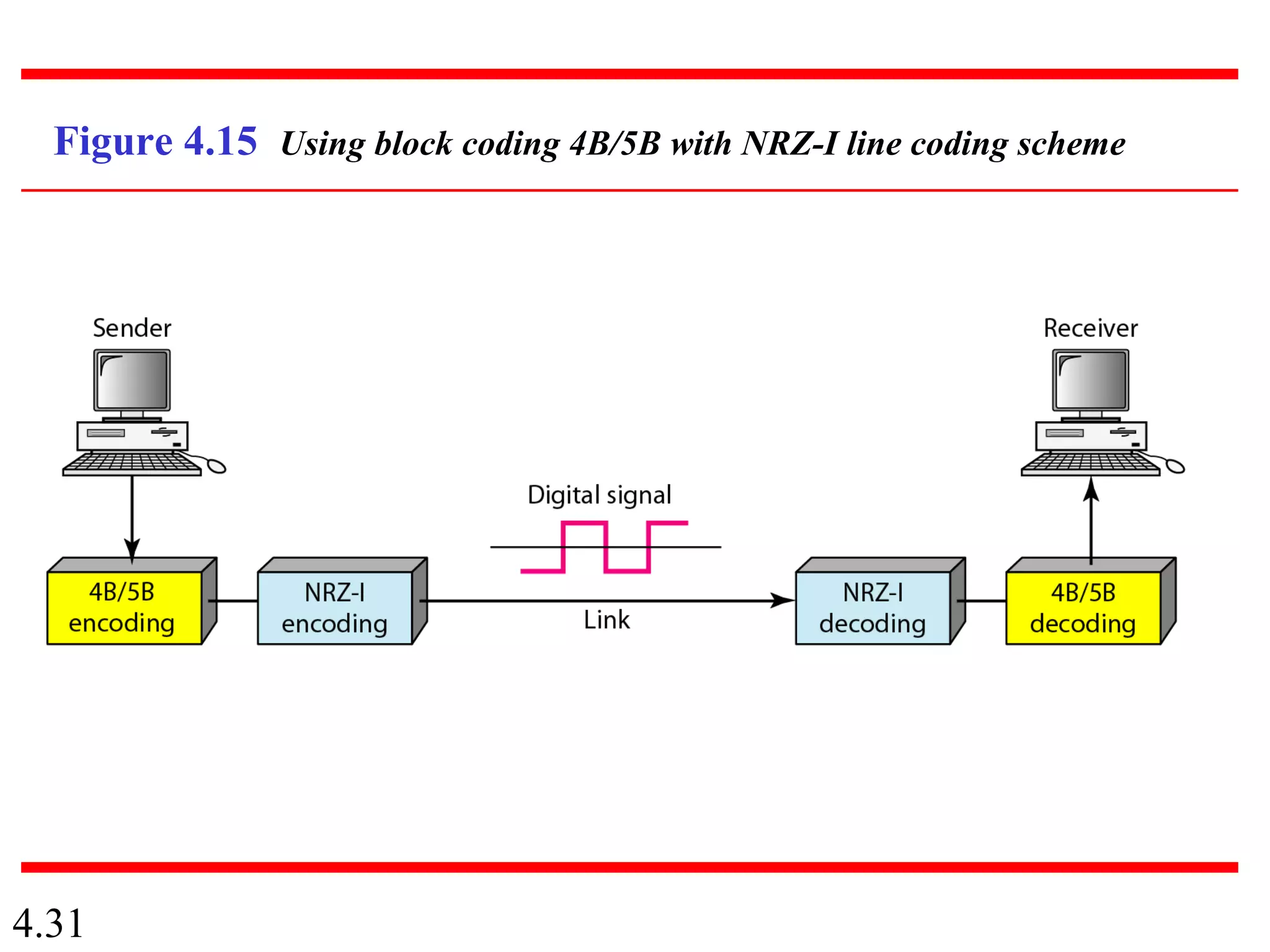
Figure 4.15 Using block coding 4B/5B with NRZ-I line coding scheme
4.32
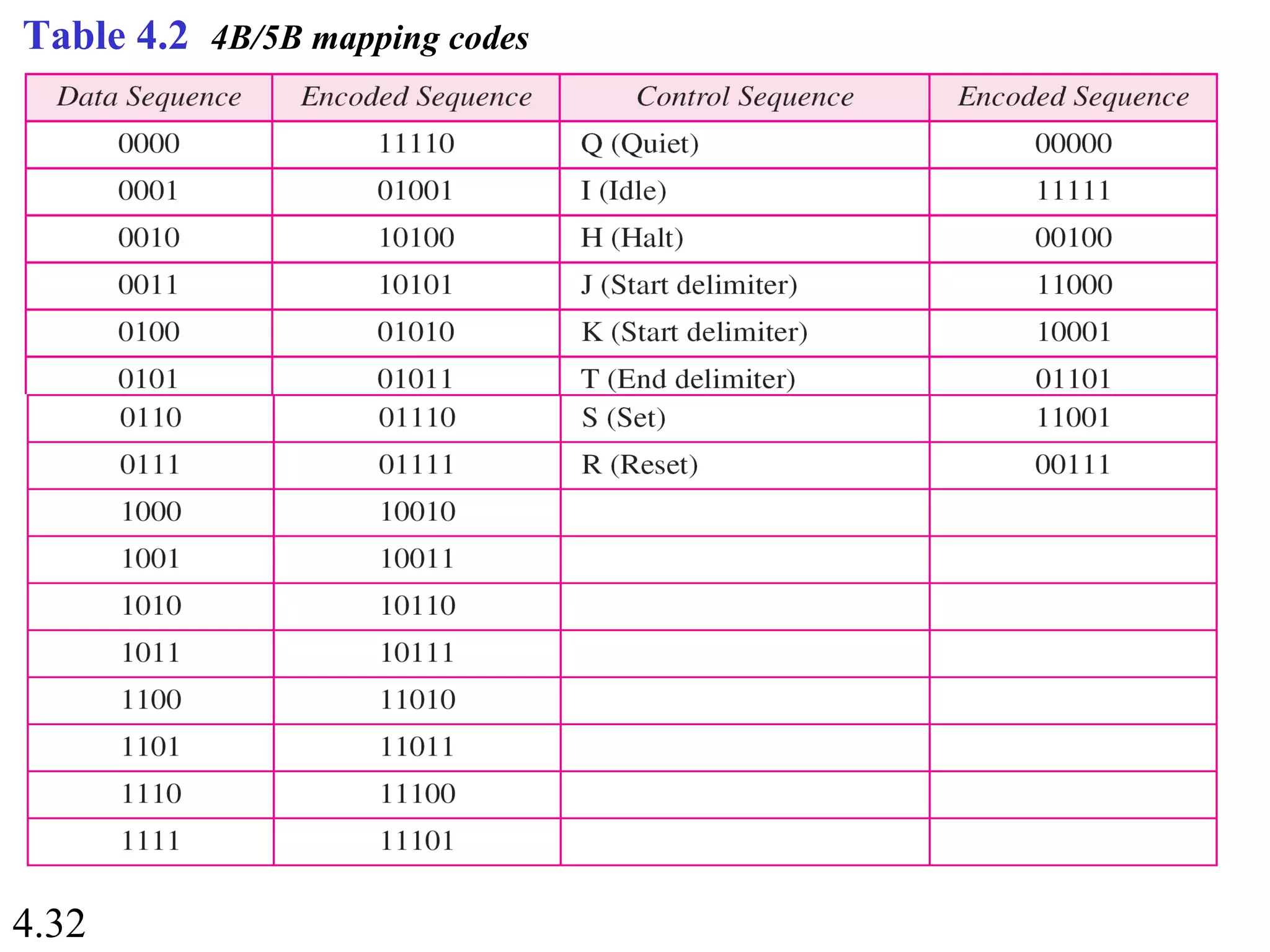
Table 4.2 4B/5B mapping codes
4.33
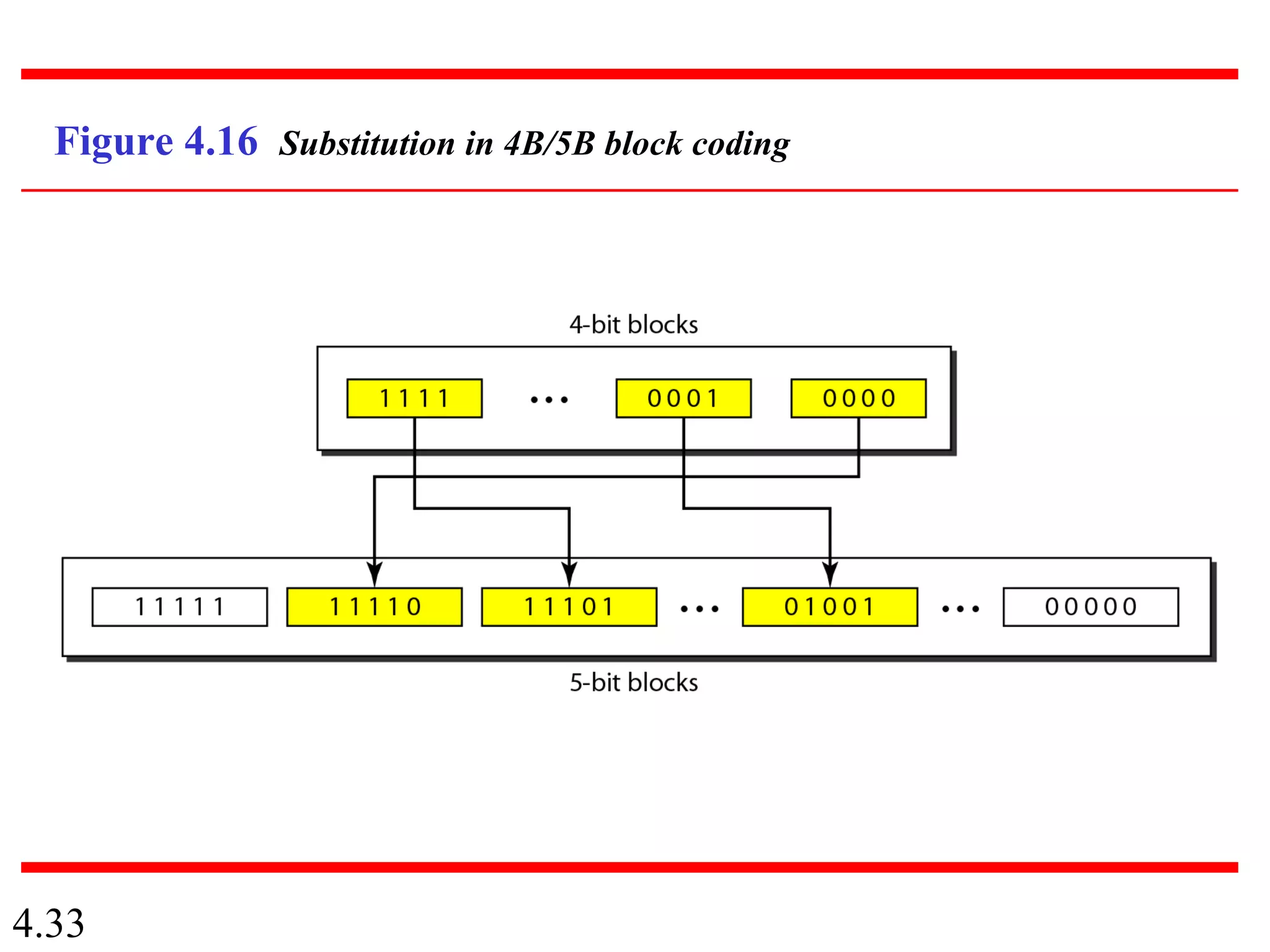
Figure 4.16 Substitution in 4B/5B block coding
4.34
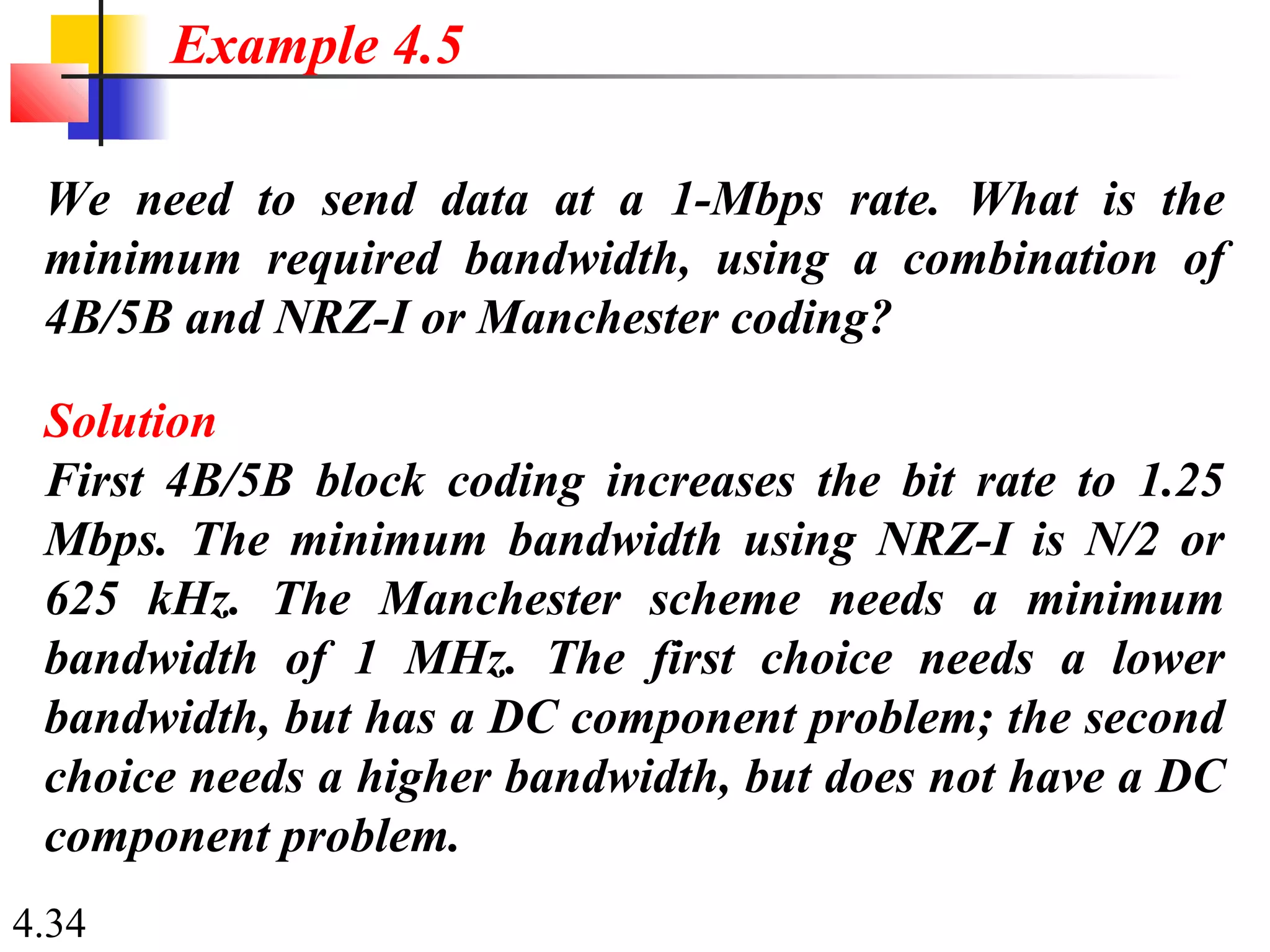
We need to send data at a 1-Mbps rate. What is the
minimum required bandwidth, using a combination of
4B/5B and NRZ-I or Manchester coding?
Solution
First 4B/5B block coding increases the bit rate to 1.25
Mbps. The minimum bandwidth using NRZ-I is N/2 or
625 kHz. The Manchester scheme needs a minimum
bandwidth of 1 MHz. The first choice needs a lower
bandwidth, but has a DC component problem; the second
choice needs a higher bandwidth, but does not have a DC
component problem.
Example 4.5
4.35
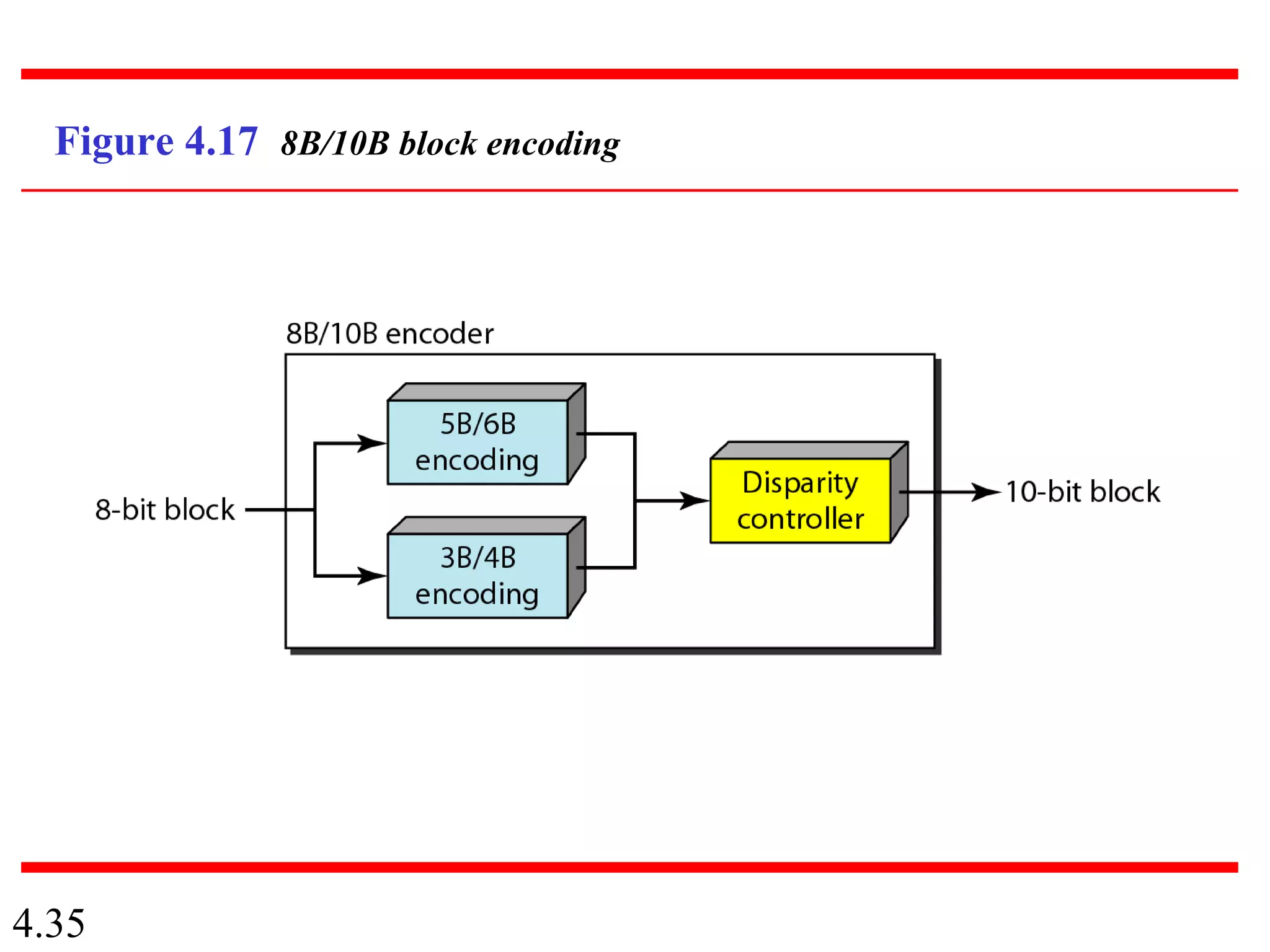
Figure 4.17 8B/10B block encoding
4.36
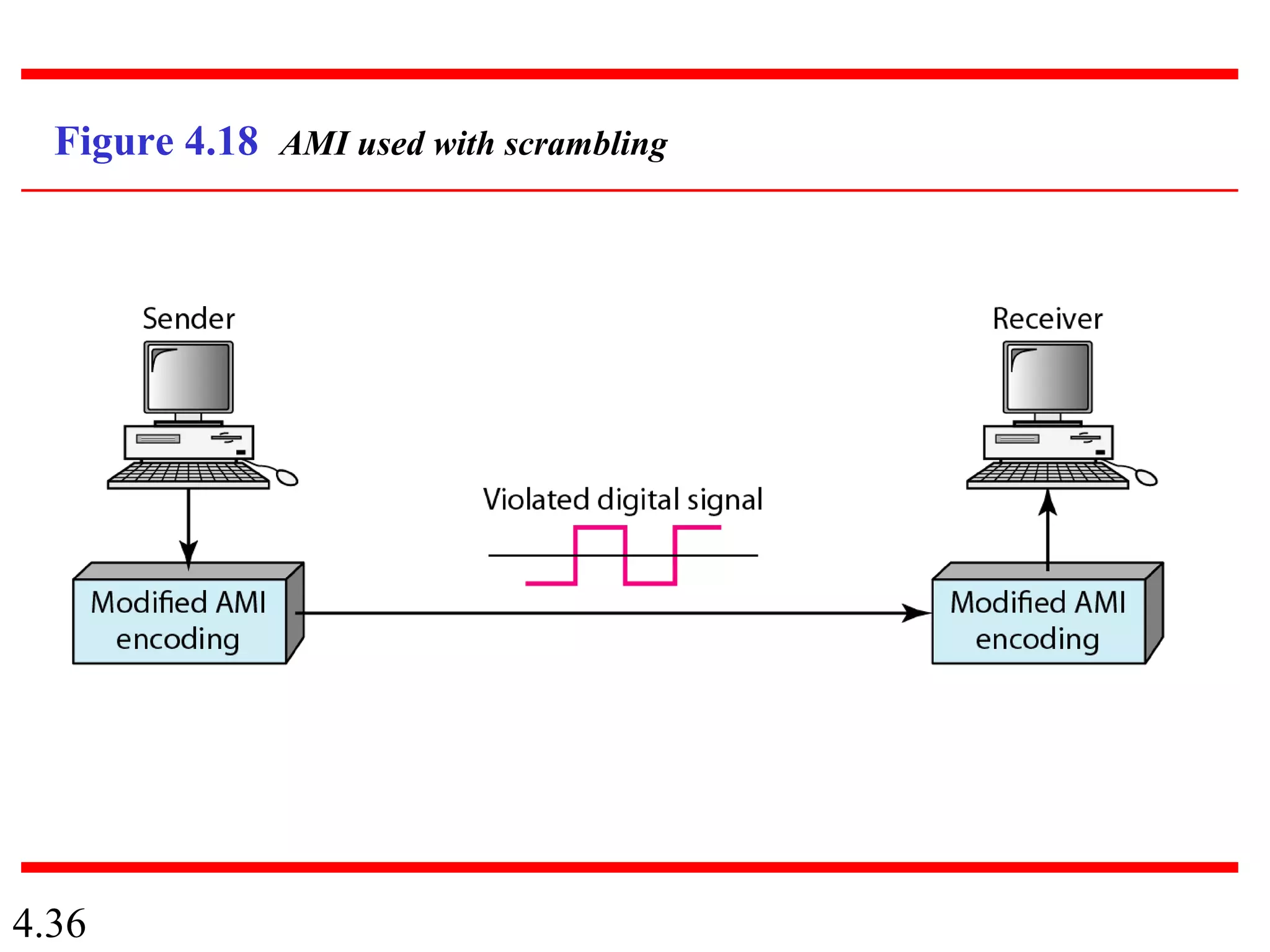
Figure 4.18 AMI used with scrambling
4.37
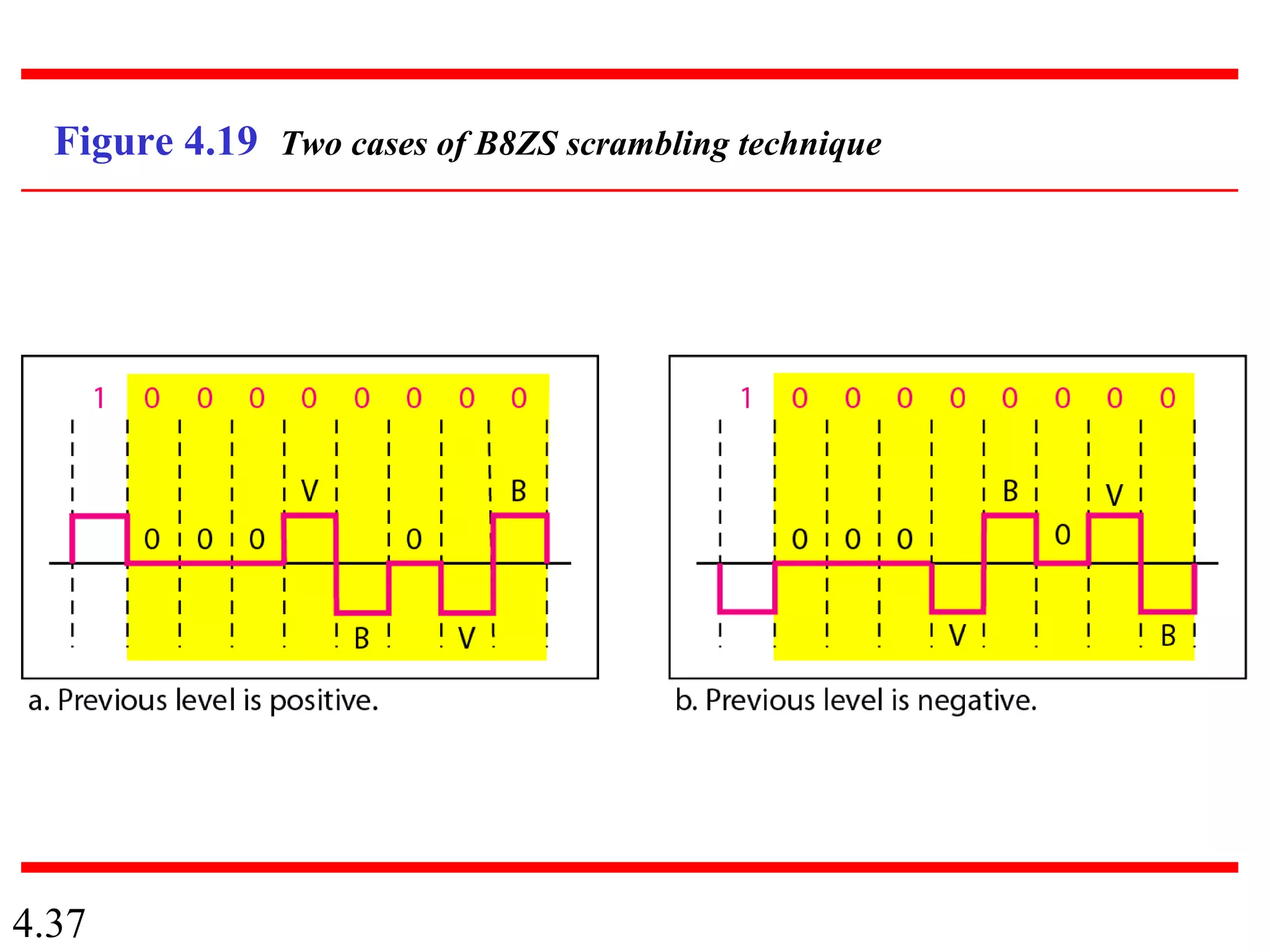
Figure 4.19 Two cases of B8ZS scrambling technique
4.38
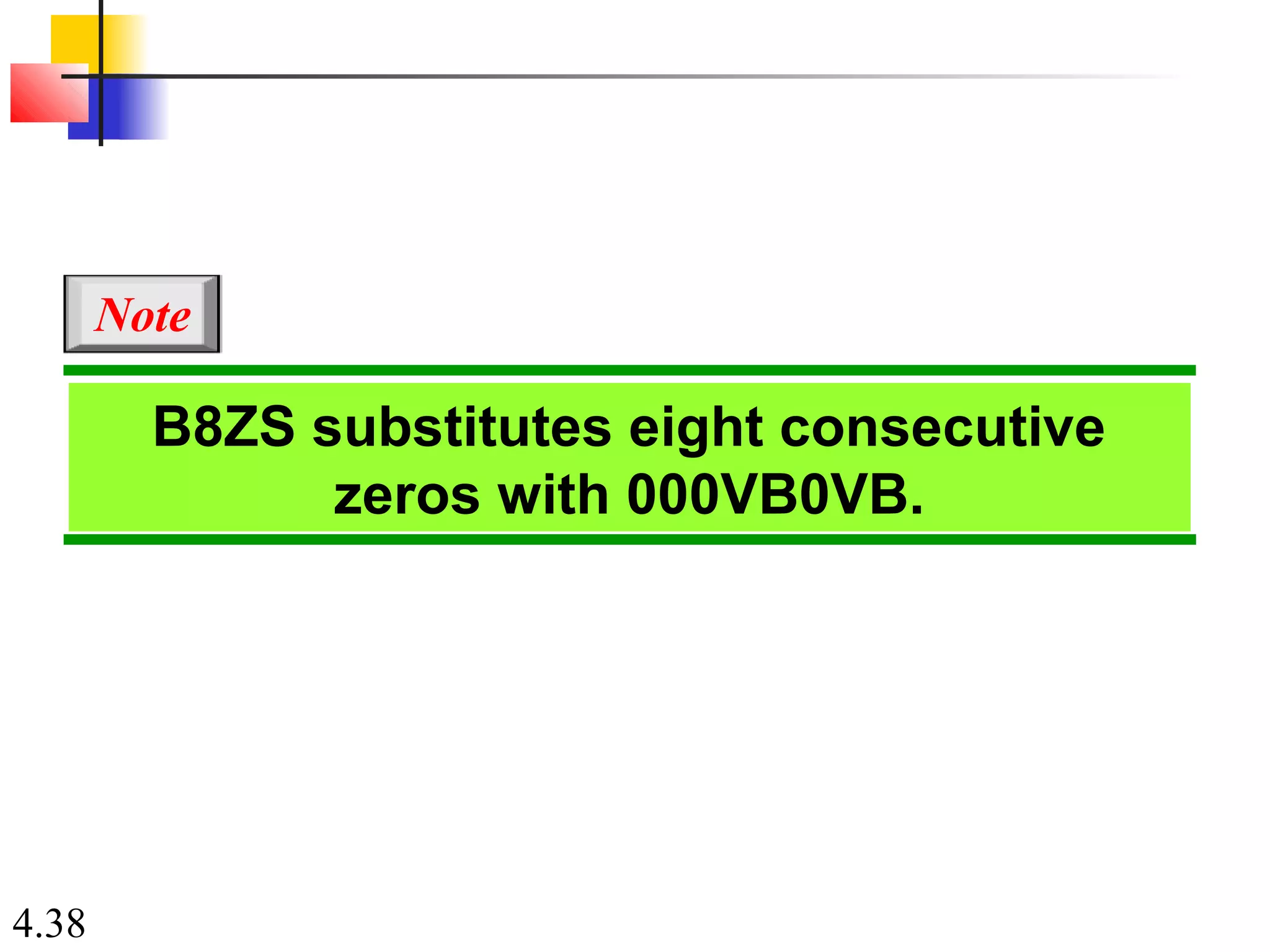
B8ZS substitutes eight consecutive
zeros with 000VB0VB.
Note
4.39
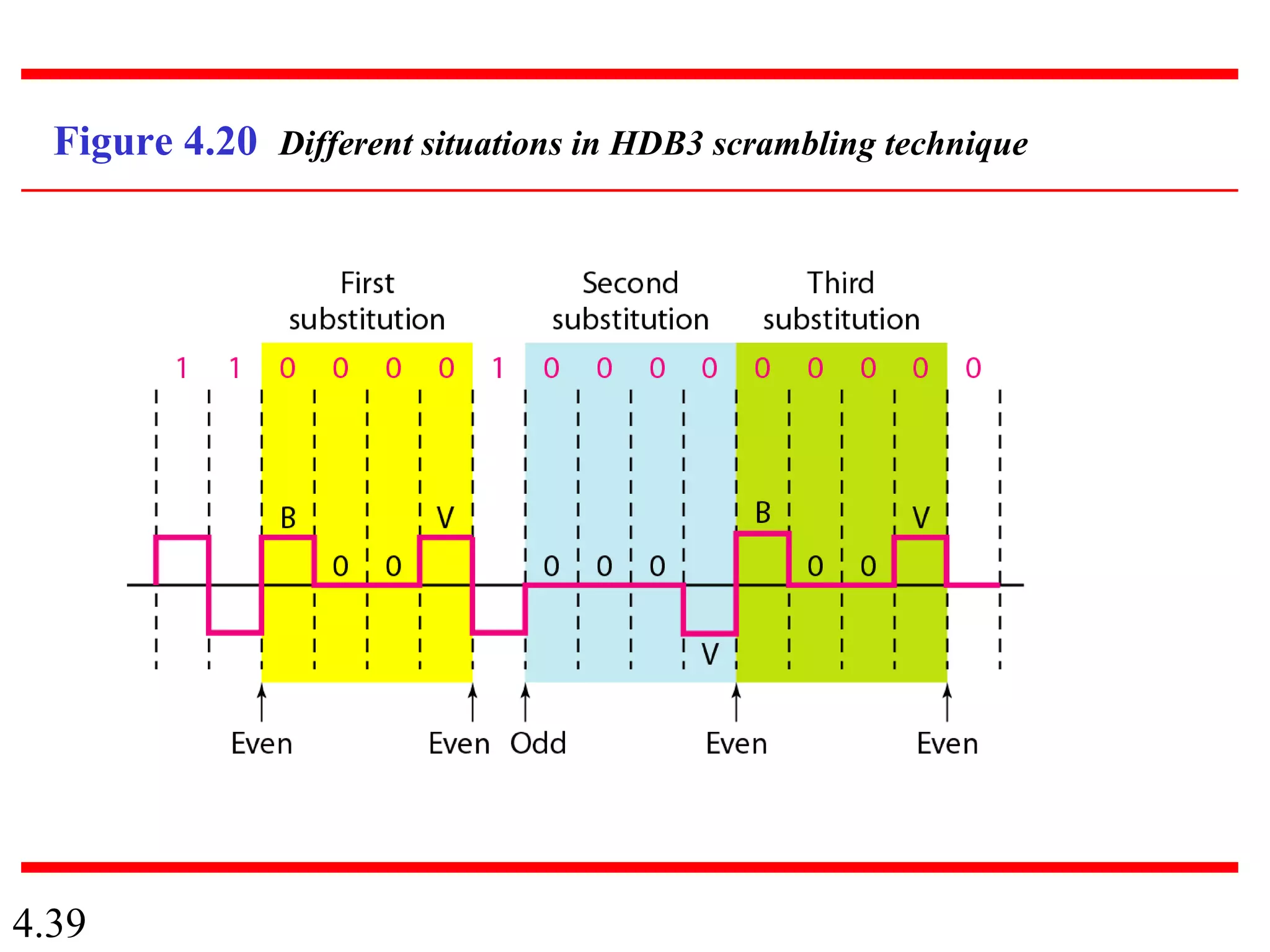
Figure 4.20 Different situations in HDB3 scrambling technique
4.40
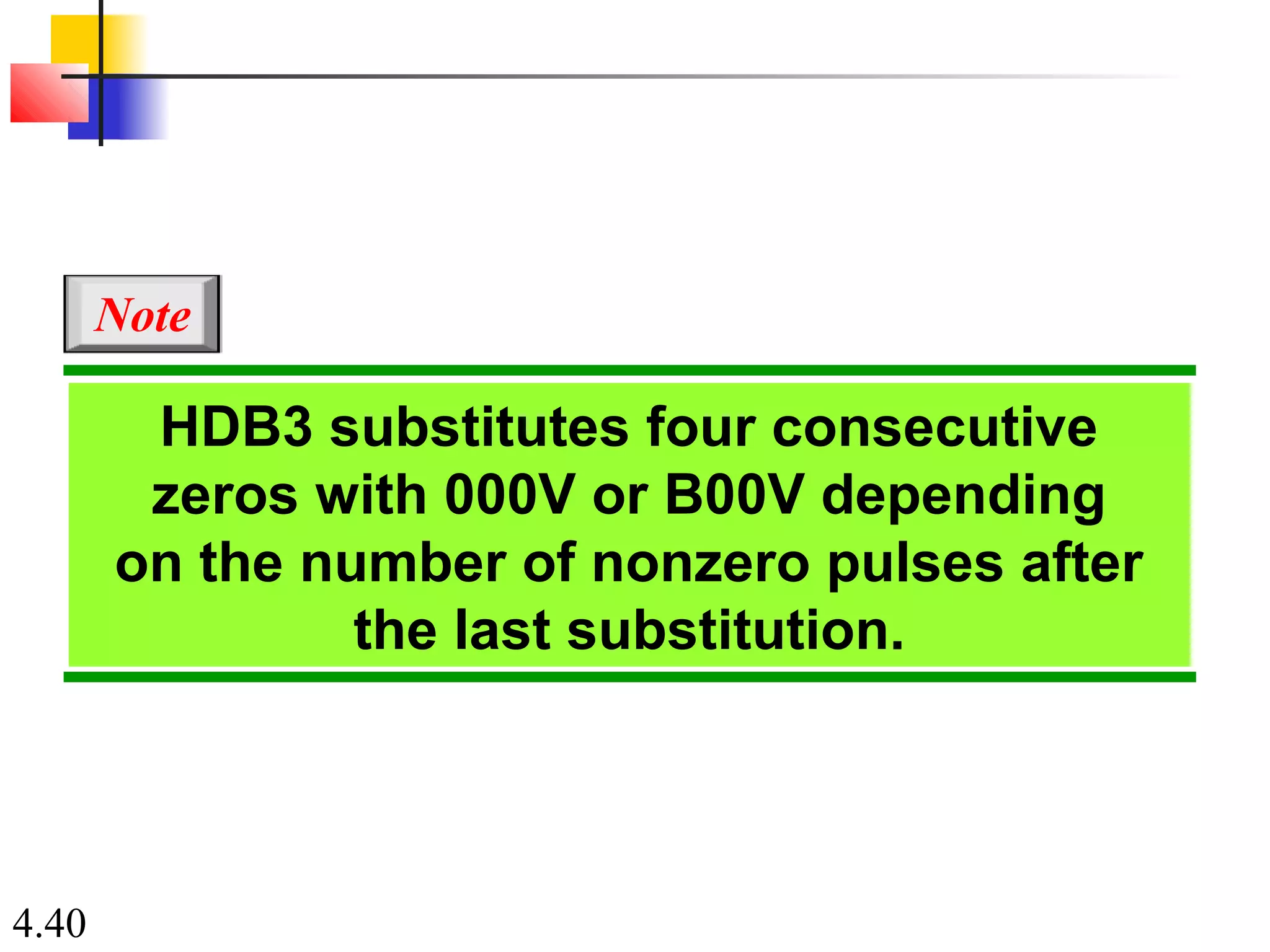
HDB3 substitutes four consecutive
zeros with 000V or B00V depending
on the number of nonzero pulses after
the last substitution.
Note
4.41
4-2 ANALOG-TO-DIGITAL CONVERSION4-2 ANALOG-TO-DIGITAL CONVERSION
We have seen in Chapter 3 that a digital signal isWe have seen in Chapter 3 that a digital signal is
superior to an analog signal. The tendency today is tosuperior to an analog signal. The tendency today is to
change an analog signal to digital data. In this sectionchange an analog signal to digital data. In this section
we describe two techniques,we describe two techniques, pulse code modulationpulse code modulation
andand delta modulationdelta modulation..
Pulse Code Modulation (PCM)
Delta Modulation (DM)
Topics discussed in this section:Topics discussed in this section:
4.42
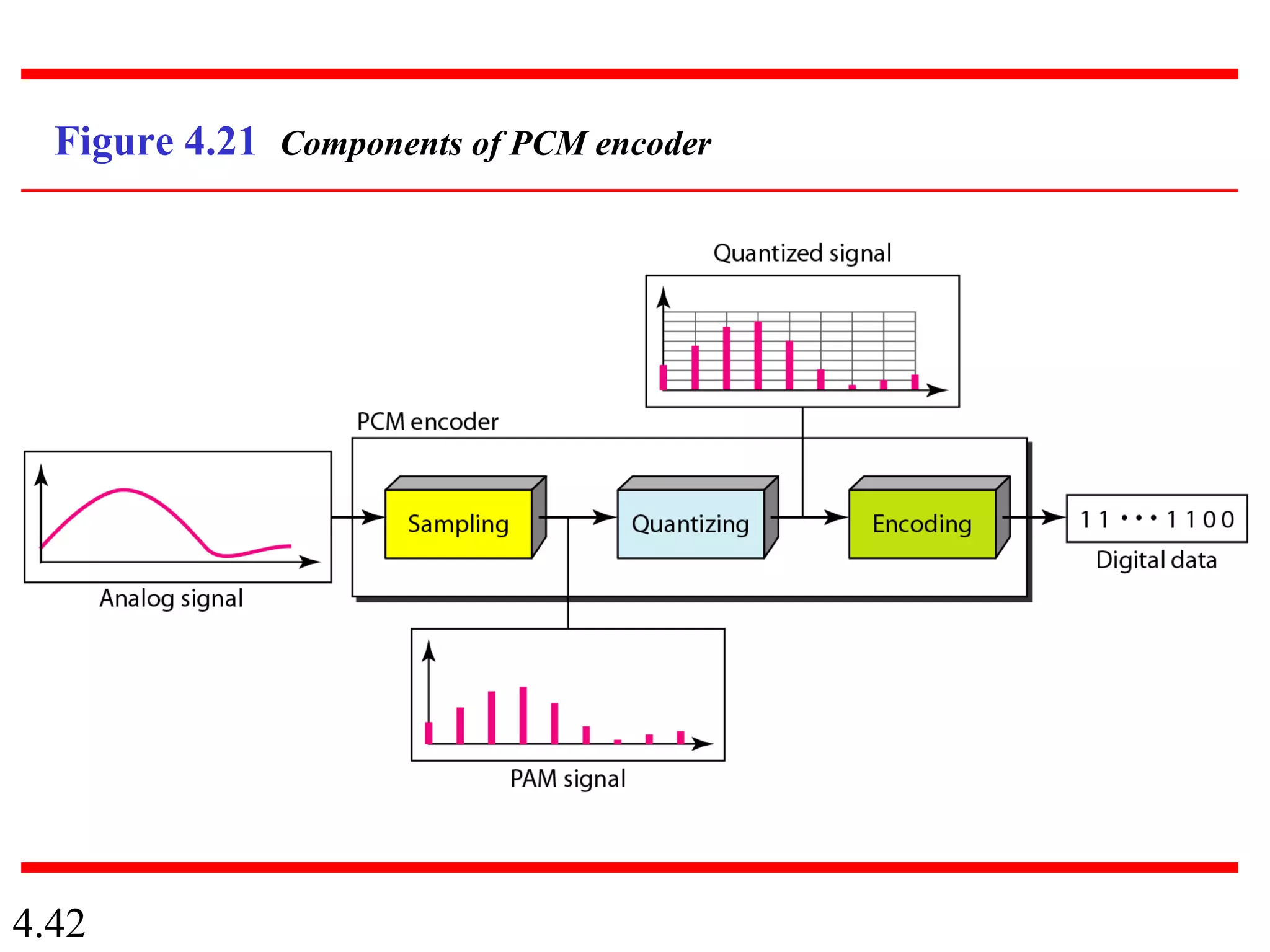
Figure 4.21 Components of PCM encoder
4.43
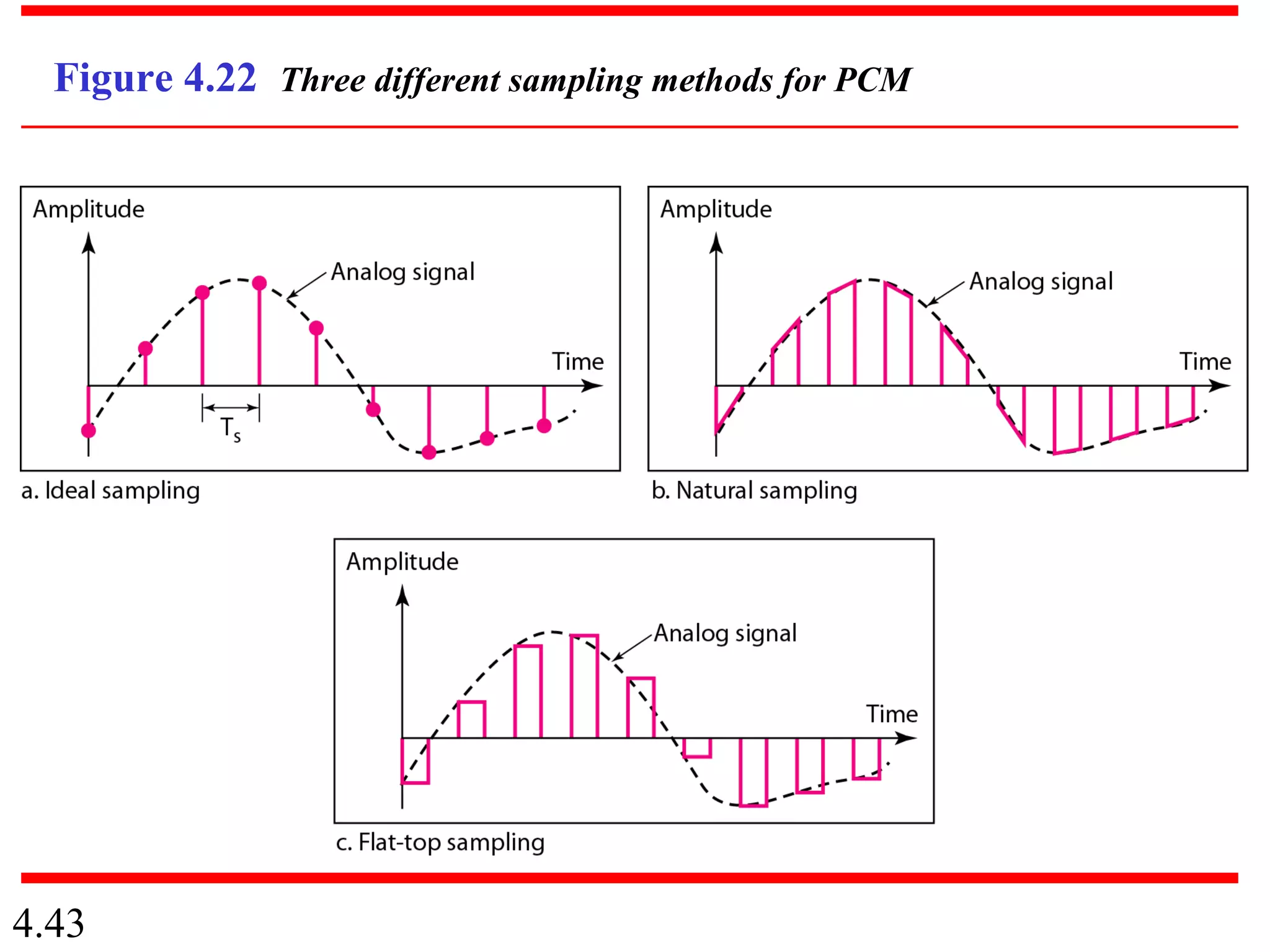
Figure 4.22 Three different sampling methods for PCM
4.44
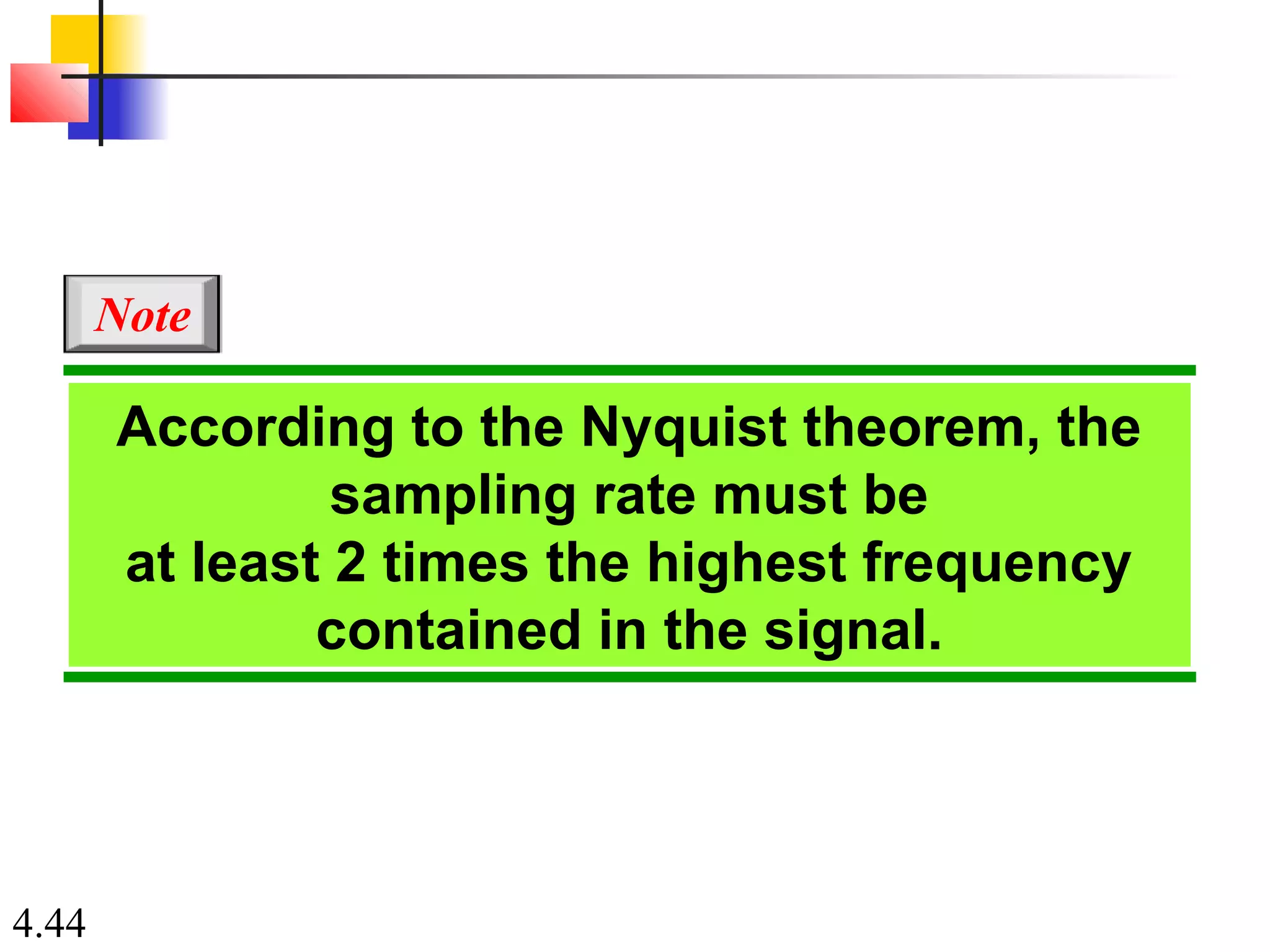
According to the Nyquist theorem, the
sampling rate must be
at least 2 times the highest frequency
contained in the signal.
Note
4.45
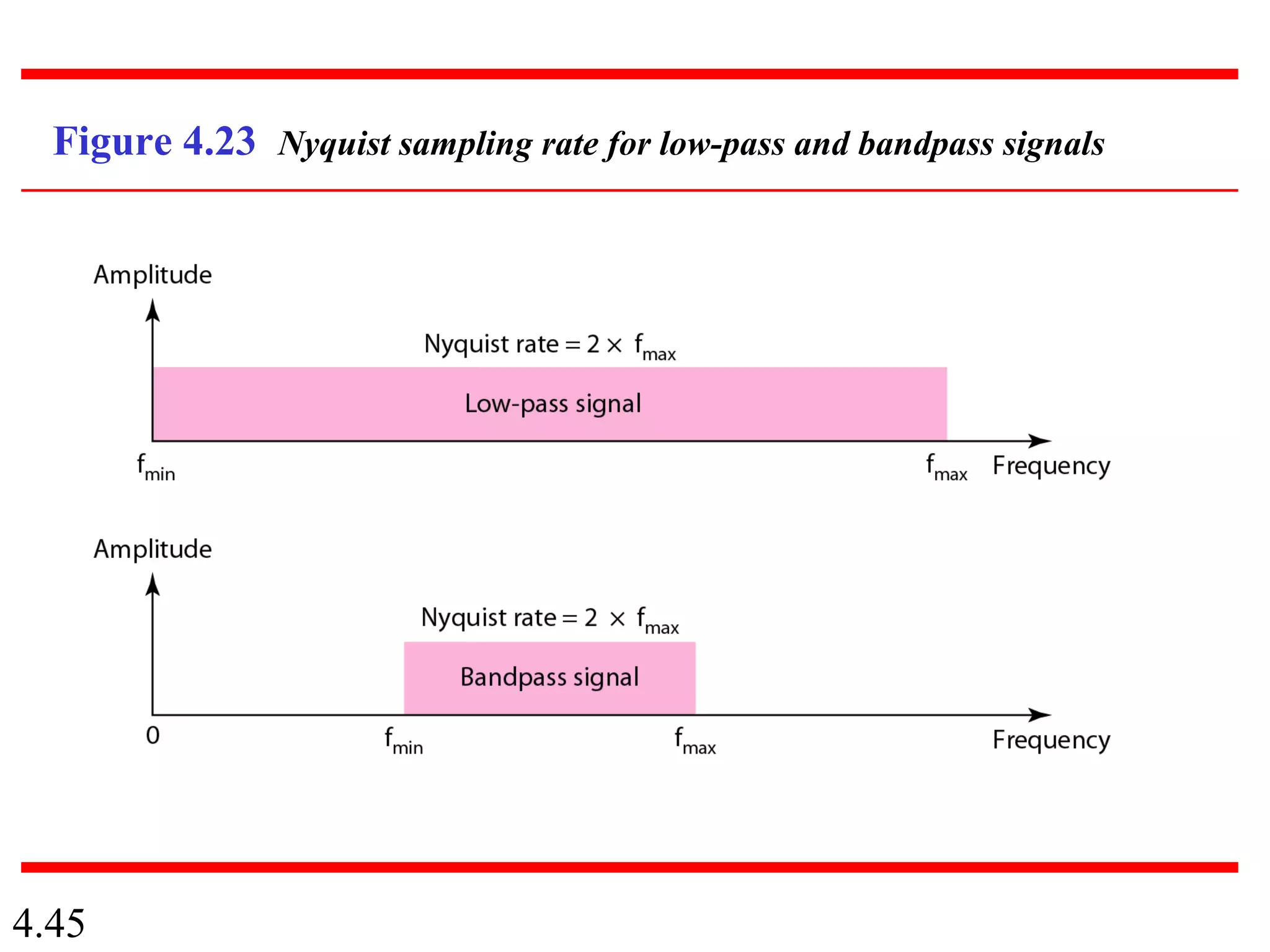
Figure 4.23 Nyquist sampling rate for low-pass and bandpass signals
4.46
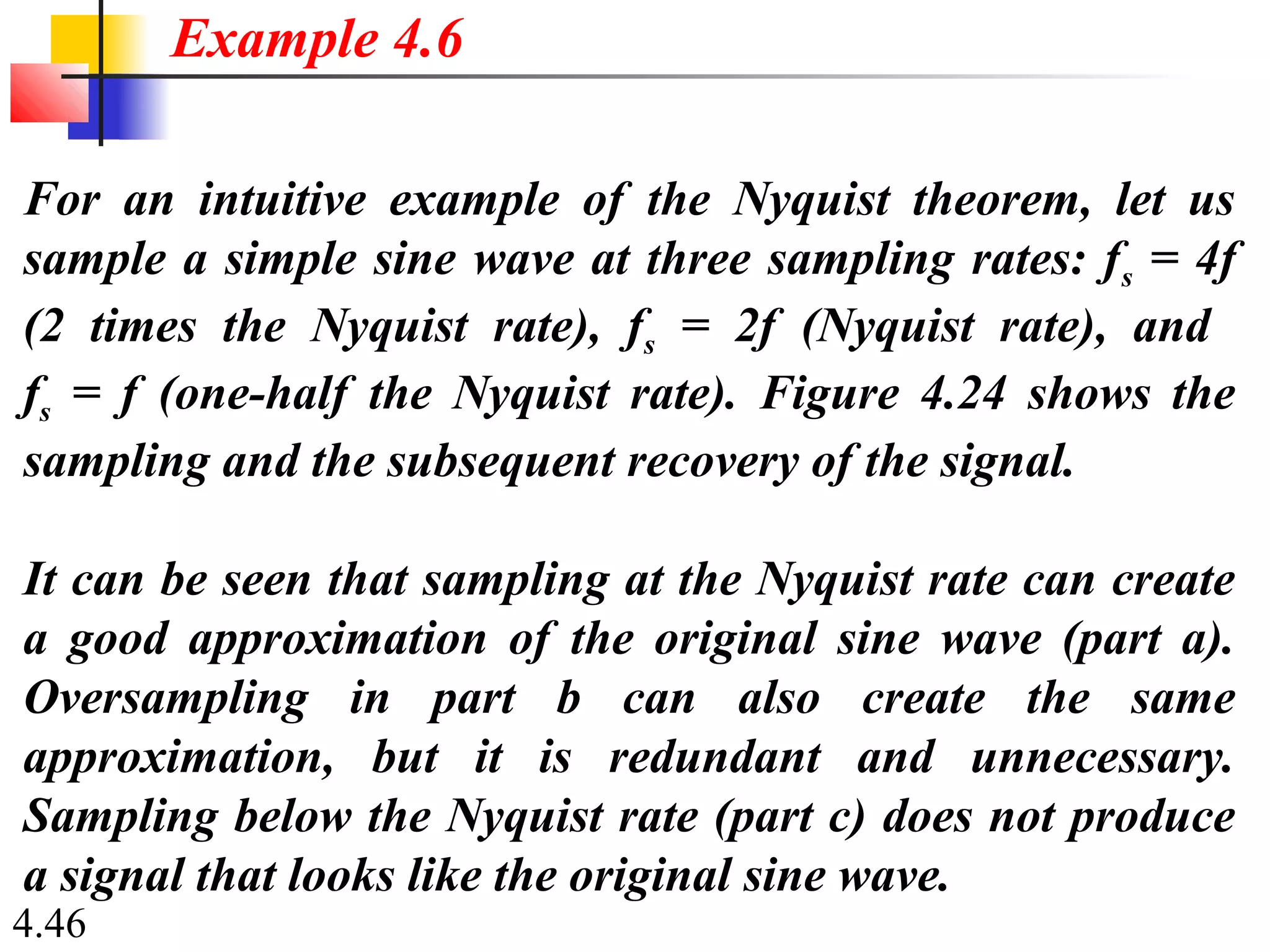
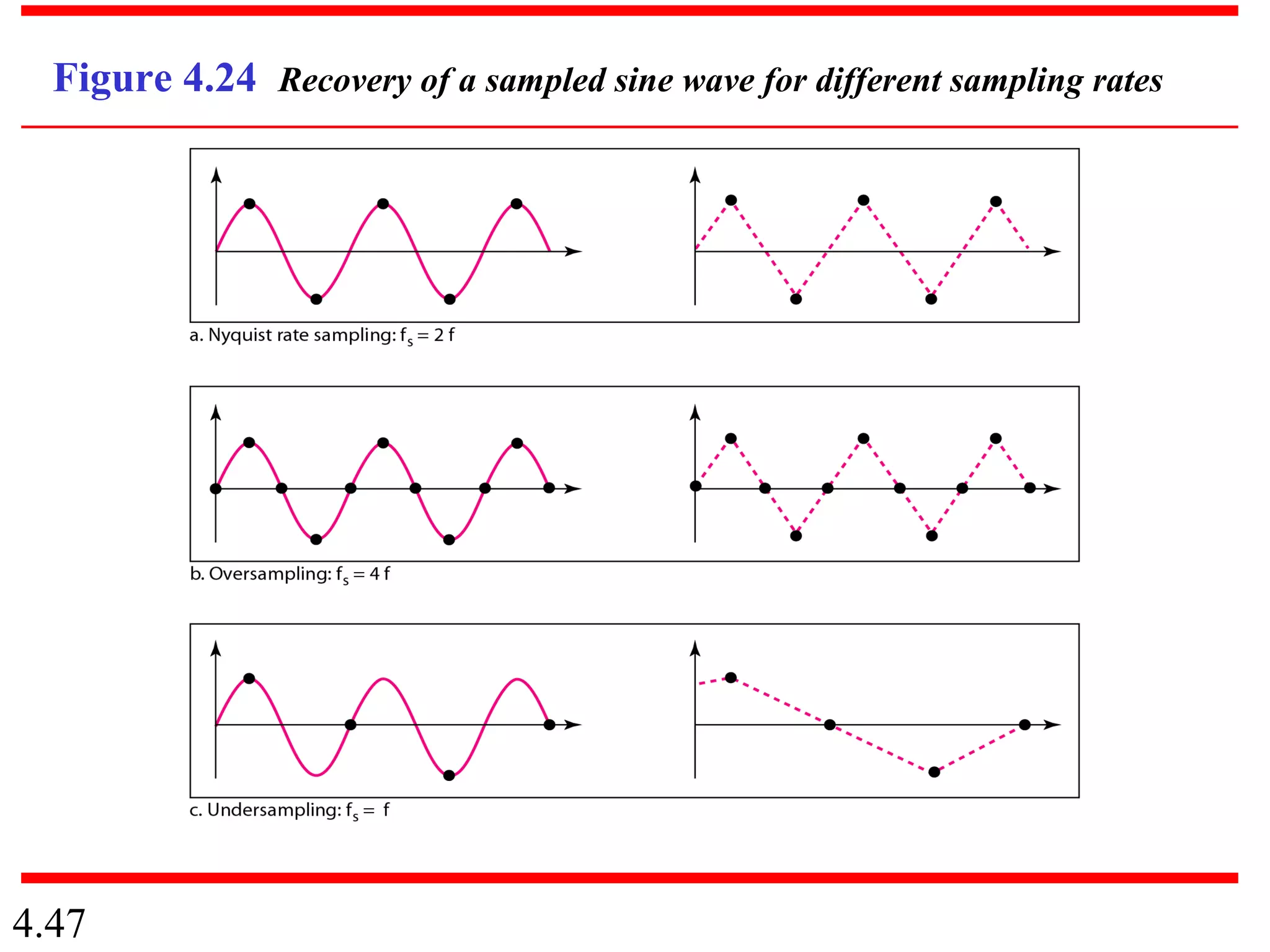
For an intuitive example of the Nyquist theorem, let us
sample a simple sine wave at three sampling rates: fs = 4f
(2 times the Nyquist rate), fs = 2f (Nyquist rate), and
fs = f (one-half the Nyquist rate). Figure 4.24 shows the
sampling and the subsequent recovery of the signal.
It can be seen that sampling at the Nyquist rate can create
a good approximation of the original sine wave (part a).
Oversampling in part b can also create the same
approximation, but it is redundant and unnecessary.
Sampling below the Nyquist rate (part c) does not produce
a signal that looks like the original sine wave.
Example 4.6
4.47
Figure 4.24 Recovery of a sampled sine wave for different sampling rates
4.48
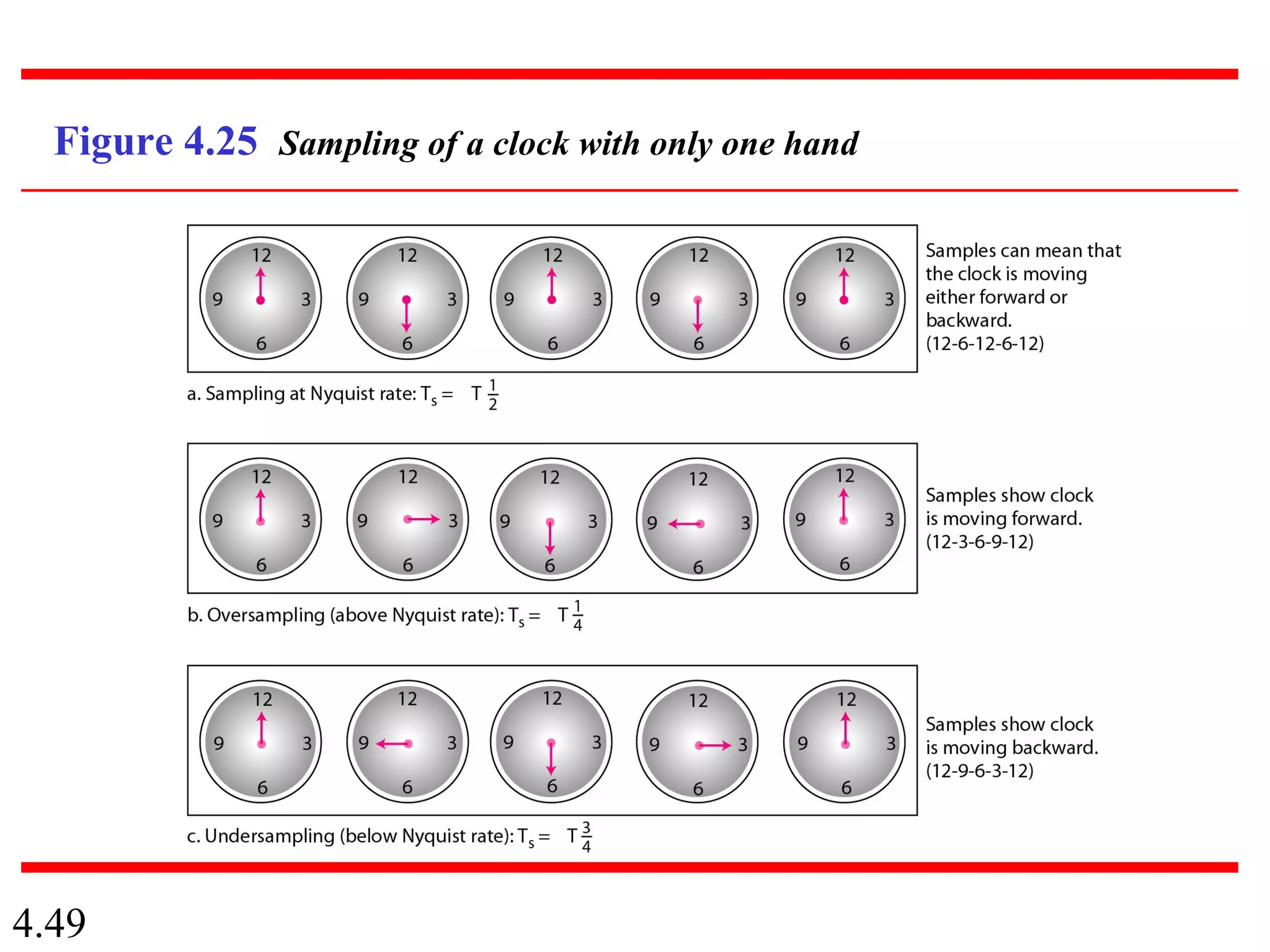
Consider the revolution of a hand of a clock. The second
hand of a clock has a period of 60 s. According to the
Nyquist theorem, we need to sample the hand every 30 s
(Ts = T or fs = 2f ). In Figure 4.25a, the sample points, in
order, are 12, 6, 12, 6, 12, and 6. The receiver of the
samples cannot tell if the clock is moving forward or
backward. In part b, we sample at double the Nyquist rate
(every 15 s). The sample points are 12, 3, 6, 9, and 12.
The clock is moving forward. In part c, we sample below
the Nyquist rate (Ts = T or fs = f ). The sample points are
12, 9, 6, 3, and 12. Although the clock is moving forward,
the receiver thinks that the clock is moving backward.
Example 4.7
4.49
Figure 4.25 Sampling of a clock with only one hand
4.50
An example related to Example 4.7 is the seemingly
backward rotation of the wheels of a forward-moving car
in a movie. This can be explained by under-sampling. A
movie is filmed at 24 frames per second. If a wheel is
rotating more than 12 times per second, the under-
sampling creates the impression of a backward rotation.
Example 4.8
4.51
Telephone companies digitize voice by assuming a
maximum frequency of 4000 Hz. The sampling rate
therefore is 8000 samples per second.
Example 4.9
4.52
A complex low-pass signal has a bandwidth of 200 kHz.
What is the minimum sampling rate for this signal?
Solution
The bandwidth of a low-pass signal is between 0 and f,
where f is the maximum frequency in the signal.
Therefore, we can sample this signal at 2 times the
highest frequency (200 kHz). The sampling rate is
therefore 400,000 samples per second.
Example 4.10
4.53
A complex bandpass signal has a bandwidth of 200 kHz.
What is the minimum sampling rate for this signal?
Solution
We cannot find the minimum sampling rate in this case
because we do not know where the bandwidth starts or
ends. We do not know the maximum frequency in the
signal.
Example 4.11
4.54
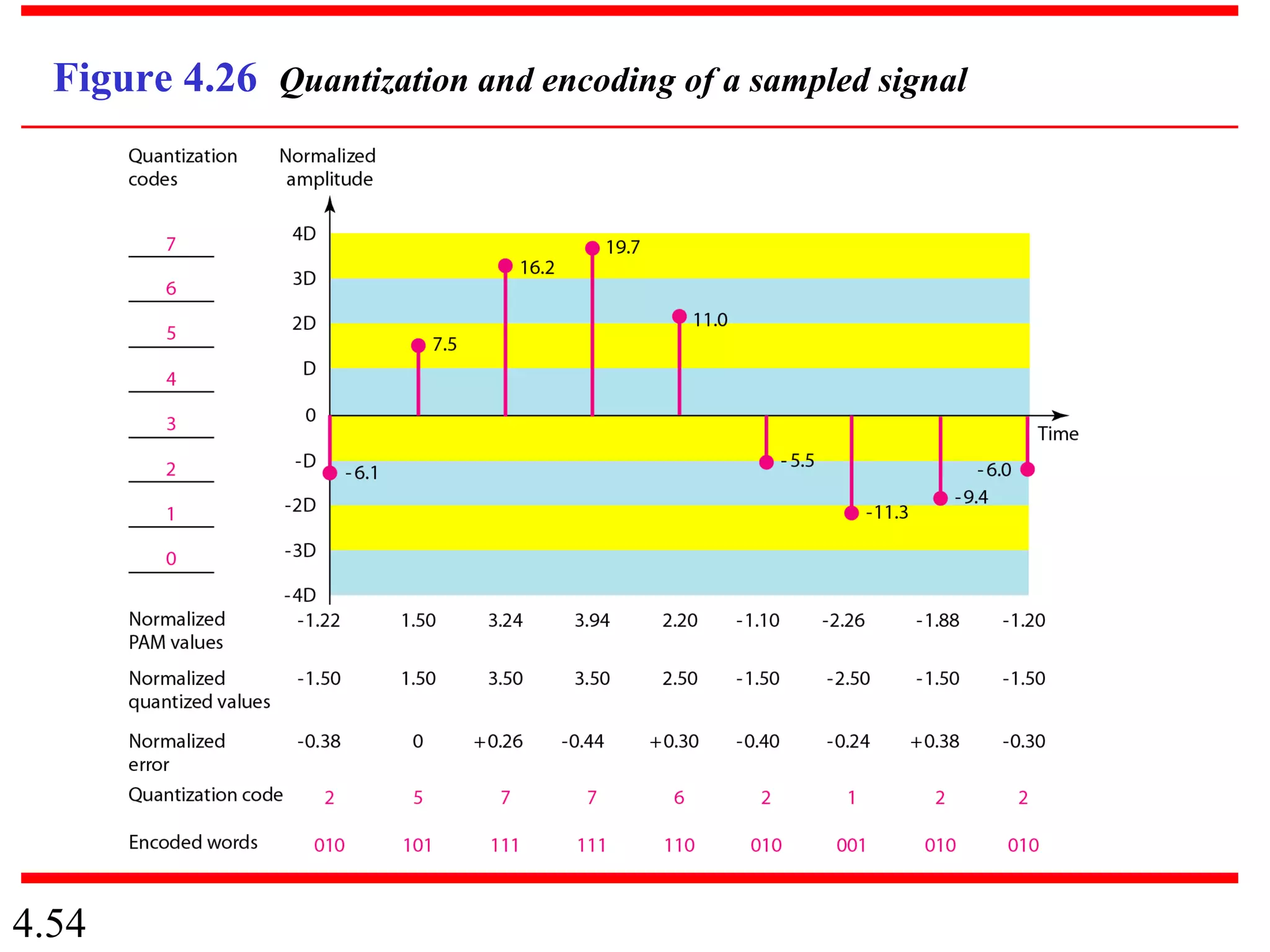
Figure 4.26 Quantization and encoding of a sampled signal
4.55
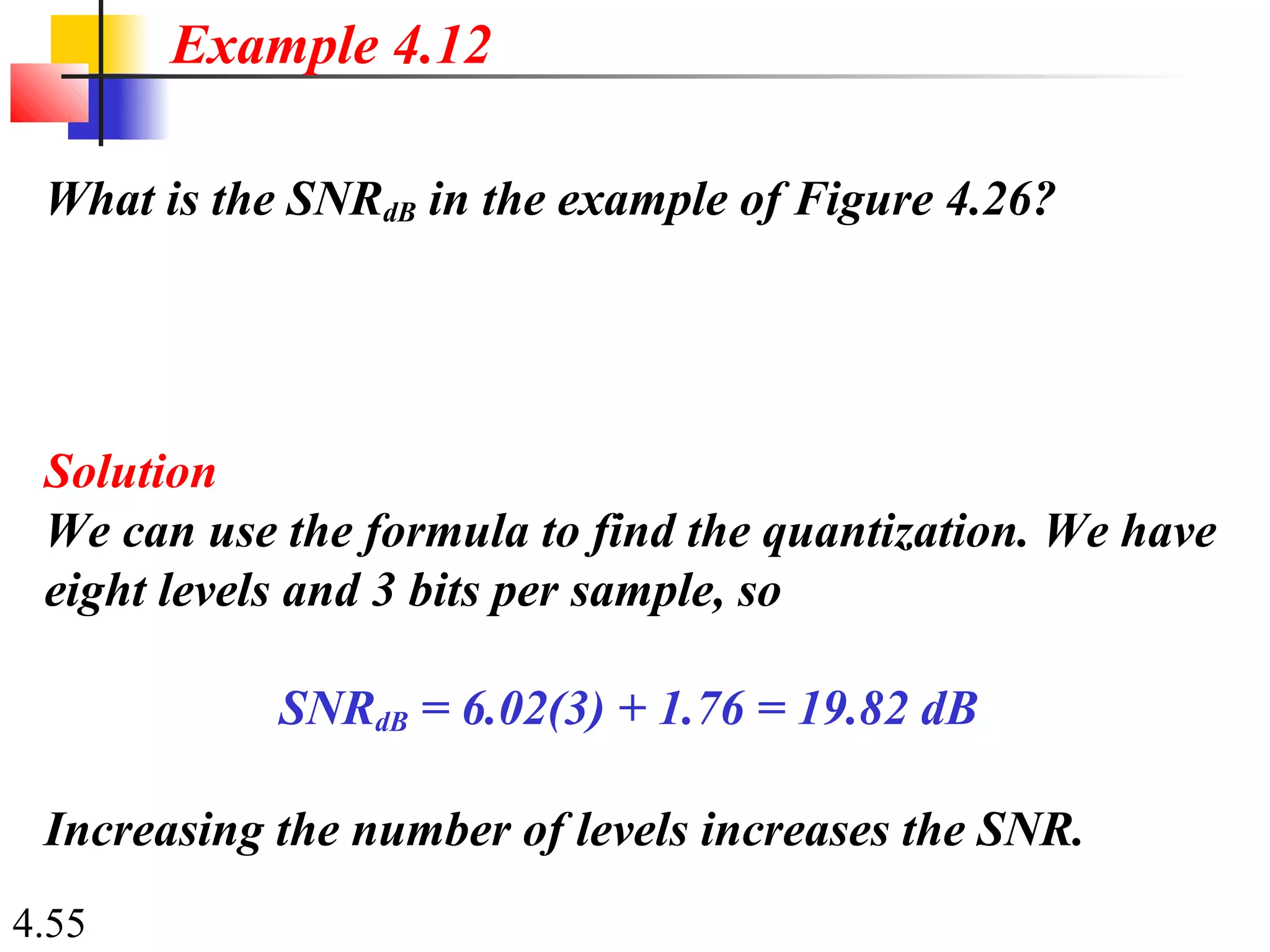
What is the SNRdB in the example of Figure 4.26?
Solution
We can use the formula to find the quantization. We have
eight levels and 3 bits per sample, so
SNRdB = 6.02(3) + 1.76 = 19.82 dB
Increasing the number of levels increases the SNR.
Example 4.12
4.56
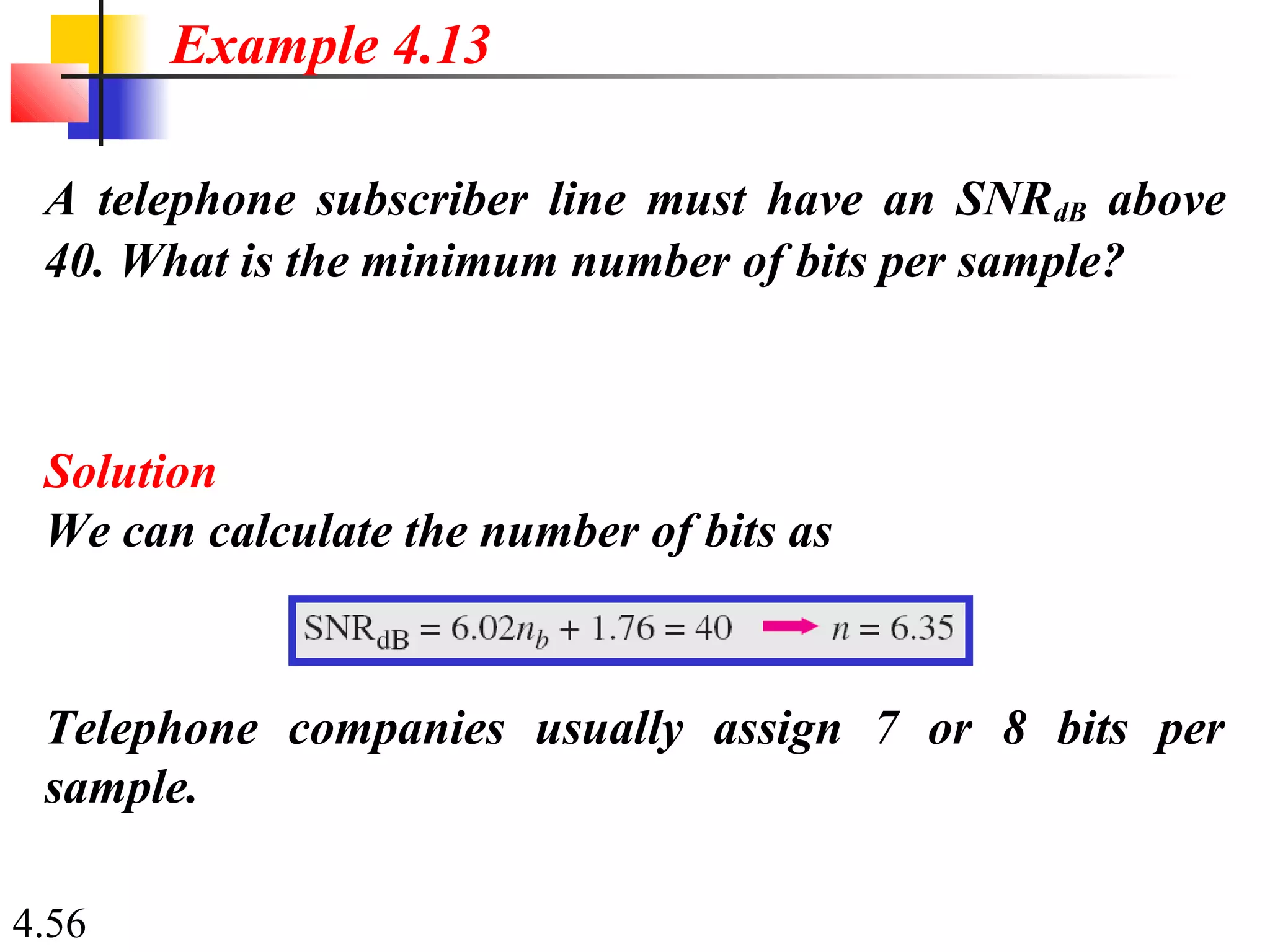
A telephone subscriber line must have an SNRdB above
40. What is the minimum number of bits per sample?
Solution
We can calculate the number of bits as
Example 4.13
Telephone companies usually assign 7 or 8 bits per
sample.
4.57
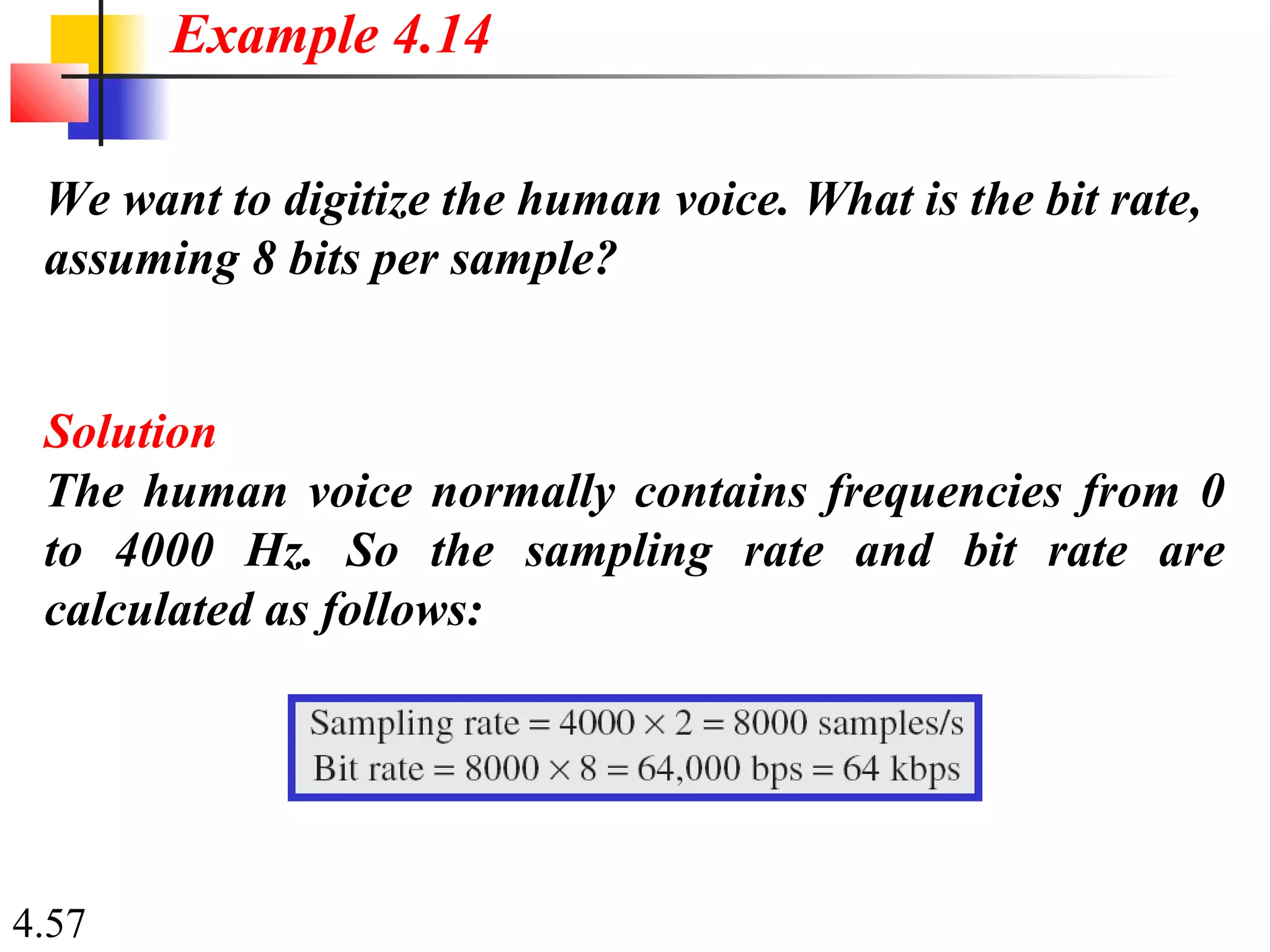
We want to digitize the human voice. What is the bit rate,
assuming 8 bits per sample?
Solution
The human voice normally contains frequencies from 0
to 4000 Hz. So the sampling rate and bit rate are
calculated as follows:
Example 4.14
4.58
Figure 4.27 Components of a PCM decoder
4.59
We have a low-pass analog signal of 4 kHz. If we send the
analog signal, we need a channel with a minimum
bandwidth of 4 kHz. If we digitize the signal and send 8
bits per sample, we need a channel with a minimum
bandwidth of 8 × 4 kHz = 32 kHz.
Example 4.15
4.60
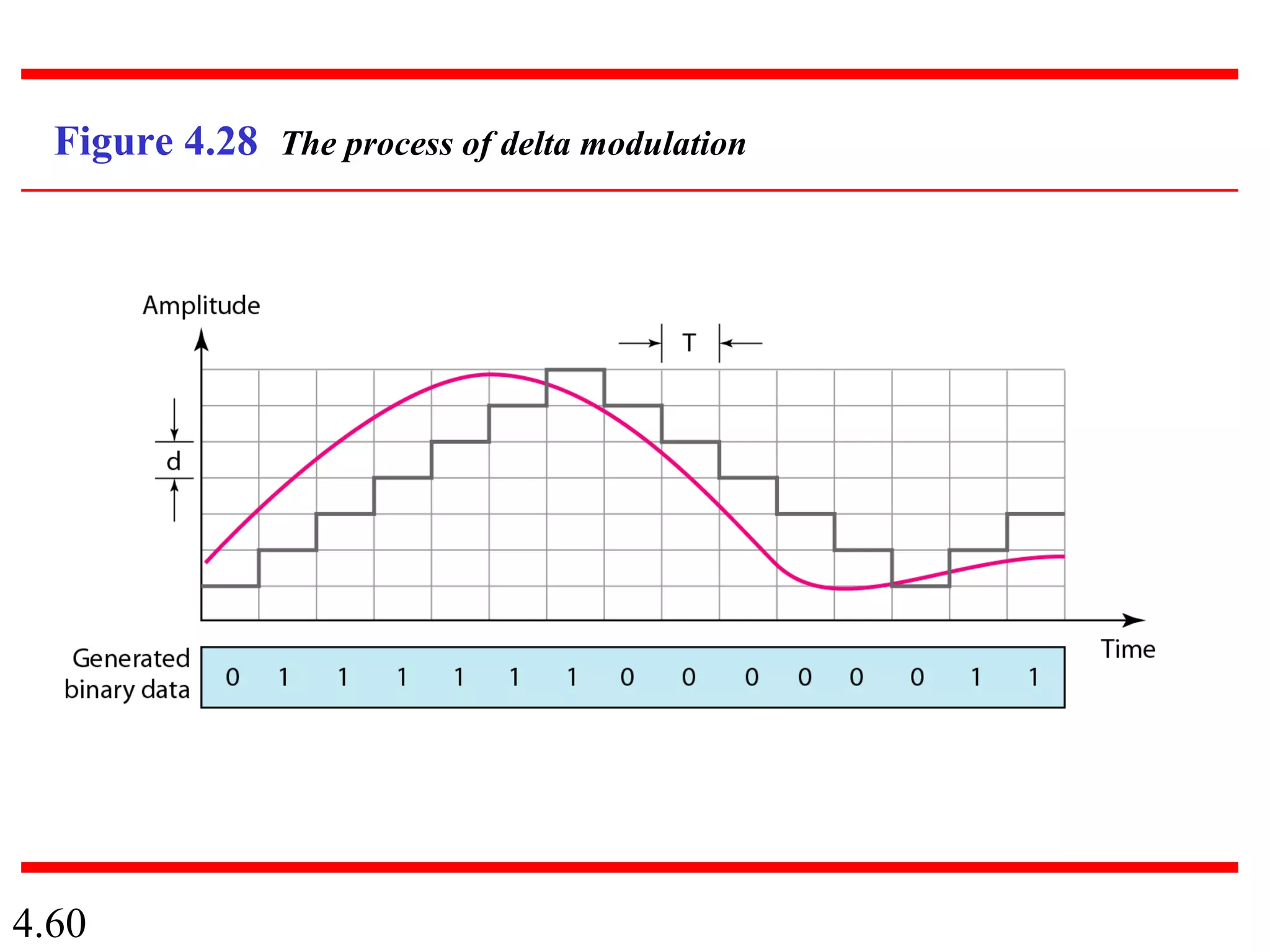
Figure 4.28 The process of delta modulation
4.61
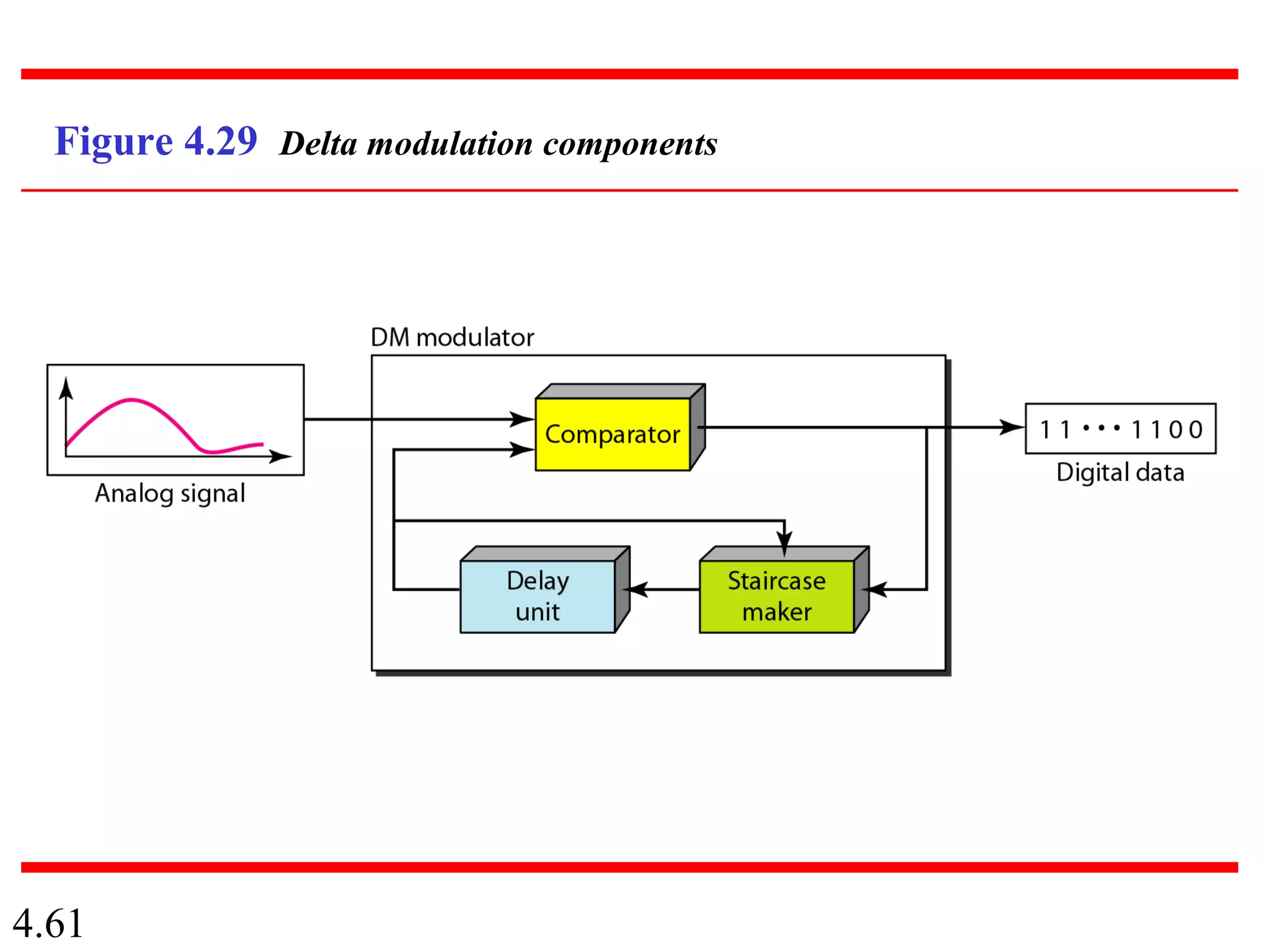
Figure 4.29 Delta modulation components
4.62
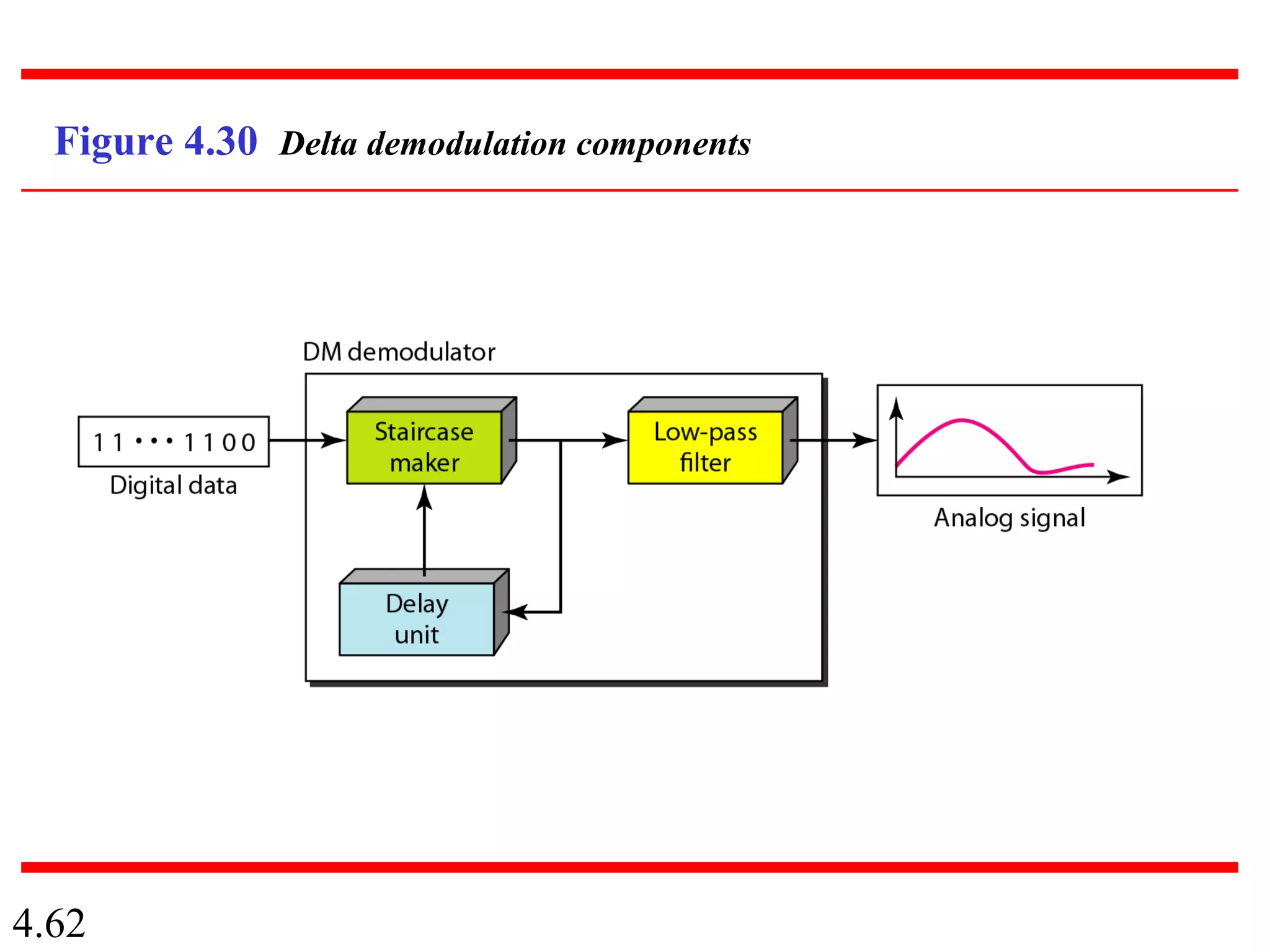
Figure 4.30 Delta demodulation components
4.63
4-3 TRANSMISSION MODES4-3 TRANSMISSION MODES
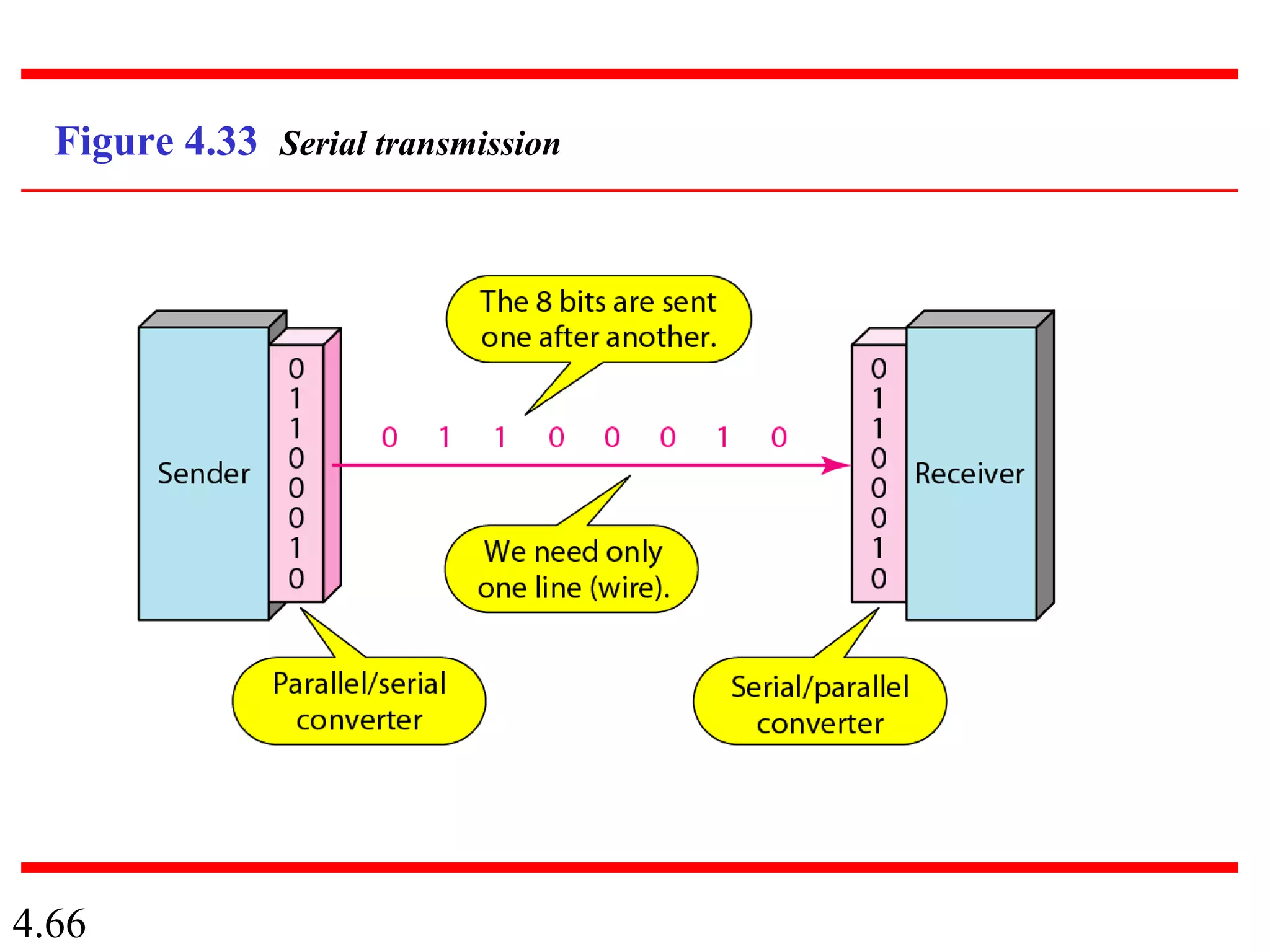
The transmission of binary data across a link can beThe transmission of binary data across a link can be
accomplished in either parallel or serial mode. Inaccomplished in either parallel or serial mode. In
parallel mode, multiple bits are sent with each clockparallel mode, multiple bits are sent with each clock
tick. In serial mode, 1 bit is sent with each clock tick.tick. In serial mode, 1 bit is sent with each clock tick.
While there is only one way to send parallel data, thereWhile there is only one way to send parallel data, there
are three subclasses of serial transmission:are three subclasses of serial transmission:
asynchronous, synchronous, and isochronous.asynchronous, synchronous, and isochronous.
Parallel Transmission
Serial Transmission
Topics discussed in this section:Topics discussed in this section:
4.64
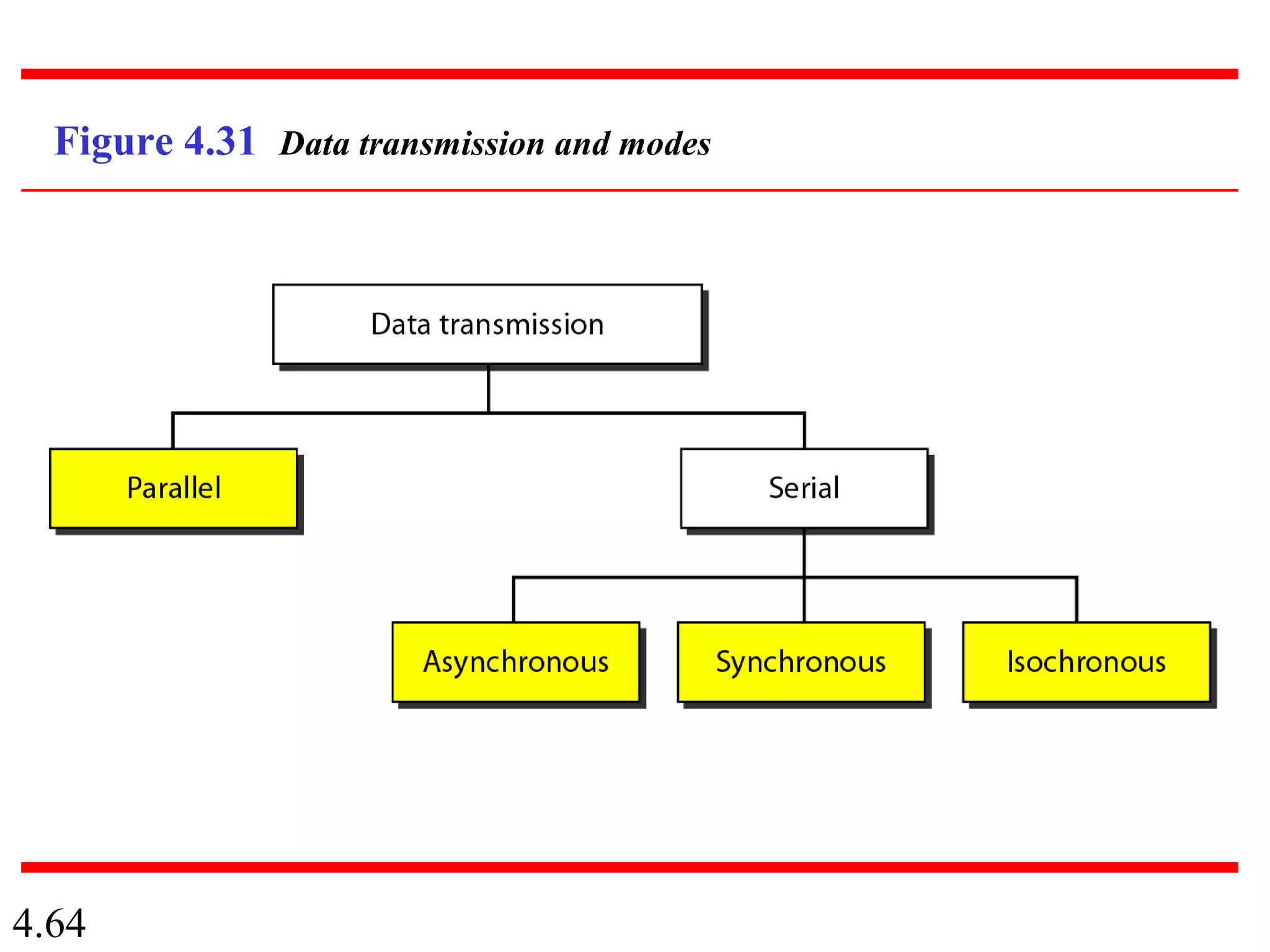
Figure 4.31 Data transmission and modes
4.65
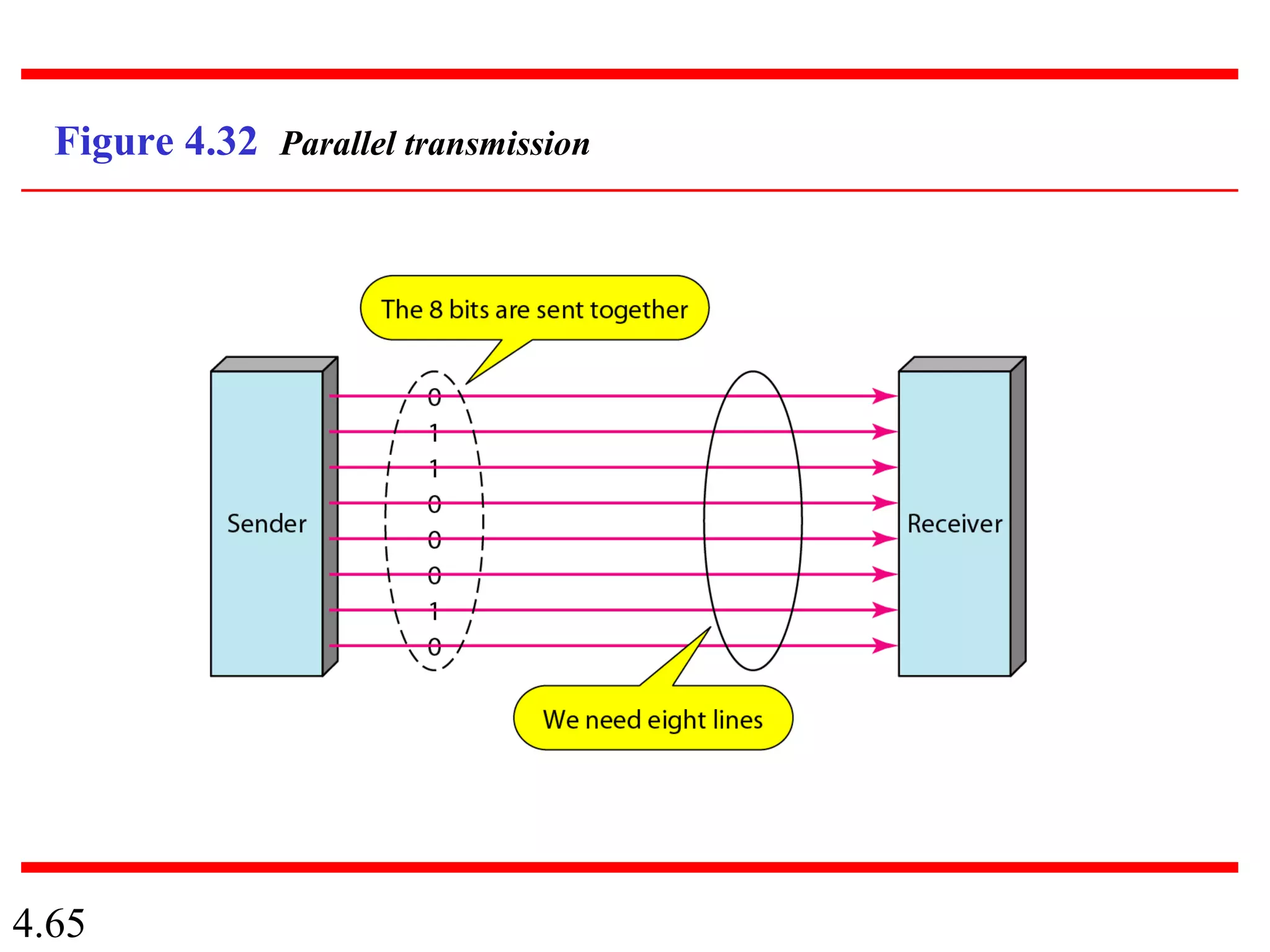
Figure 4.32 Parallel transmission
4.66
Figure 4.33 Serial transmission
4.67
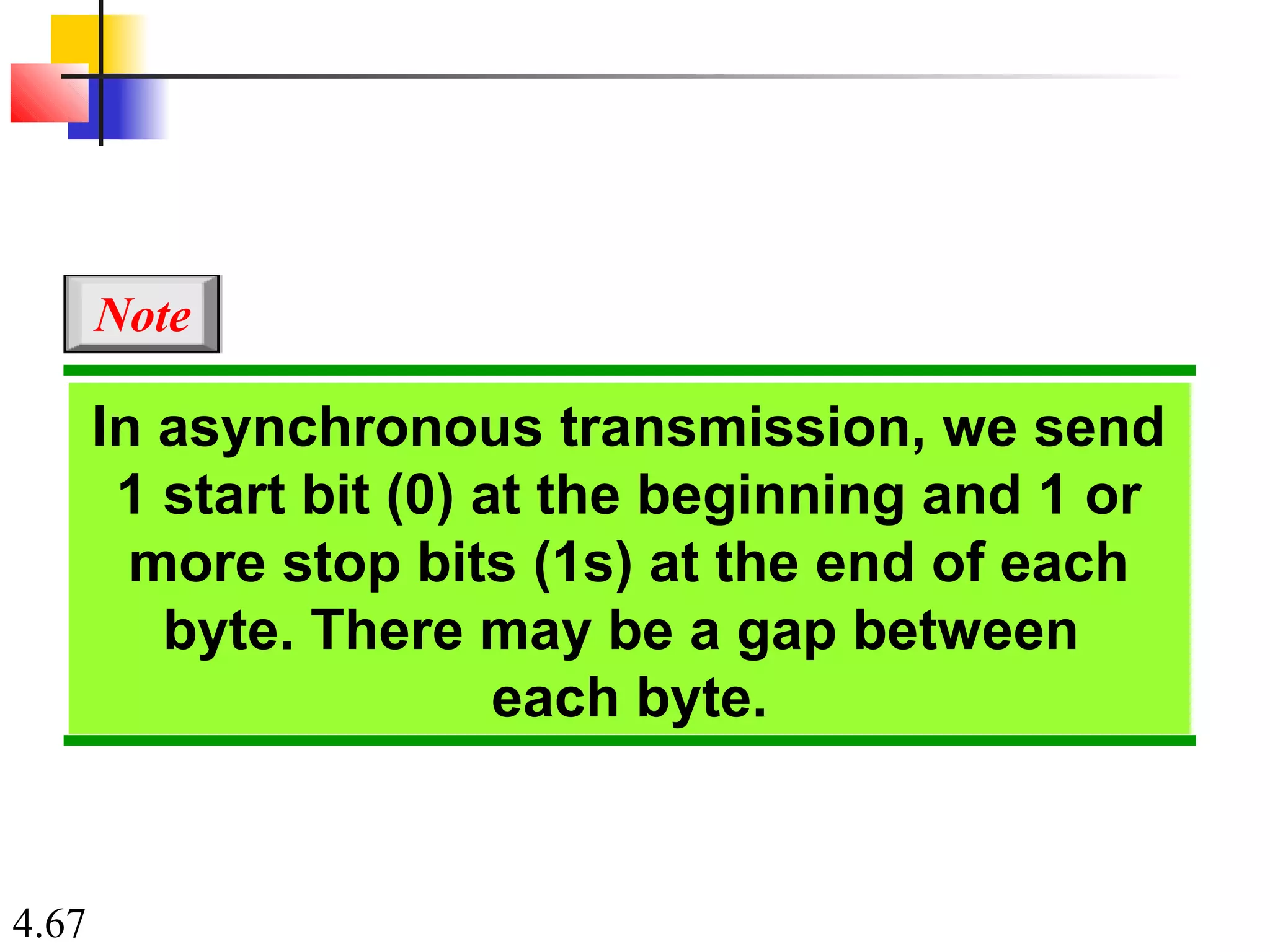
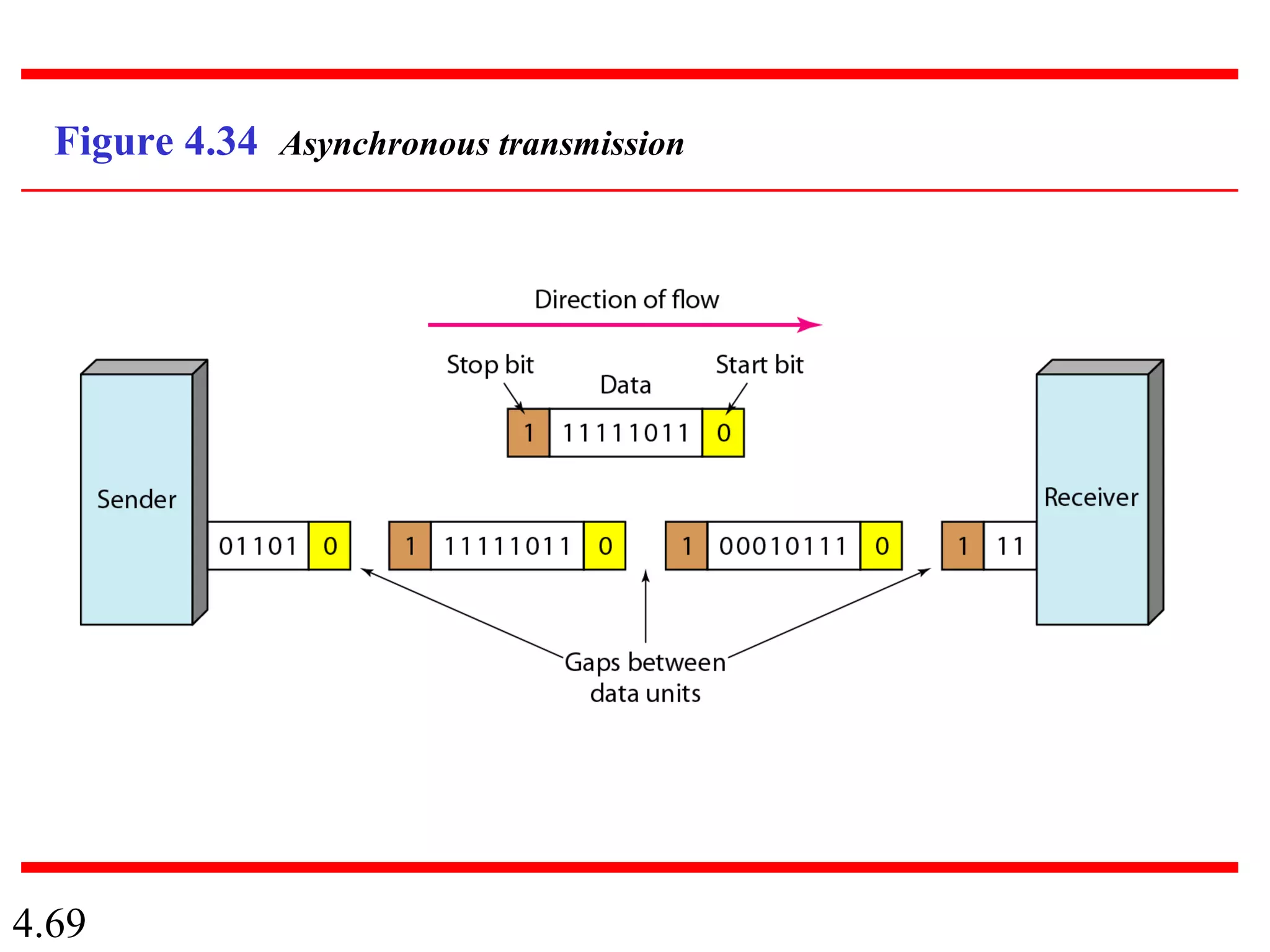
In asynchronous transmission, we send
1 start bit (0) at the beginning and 1 or
more stop bits (1s) at the end of each
byte. There may be a gap between
each byte.
Note
4.68
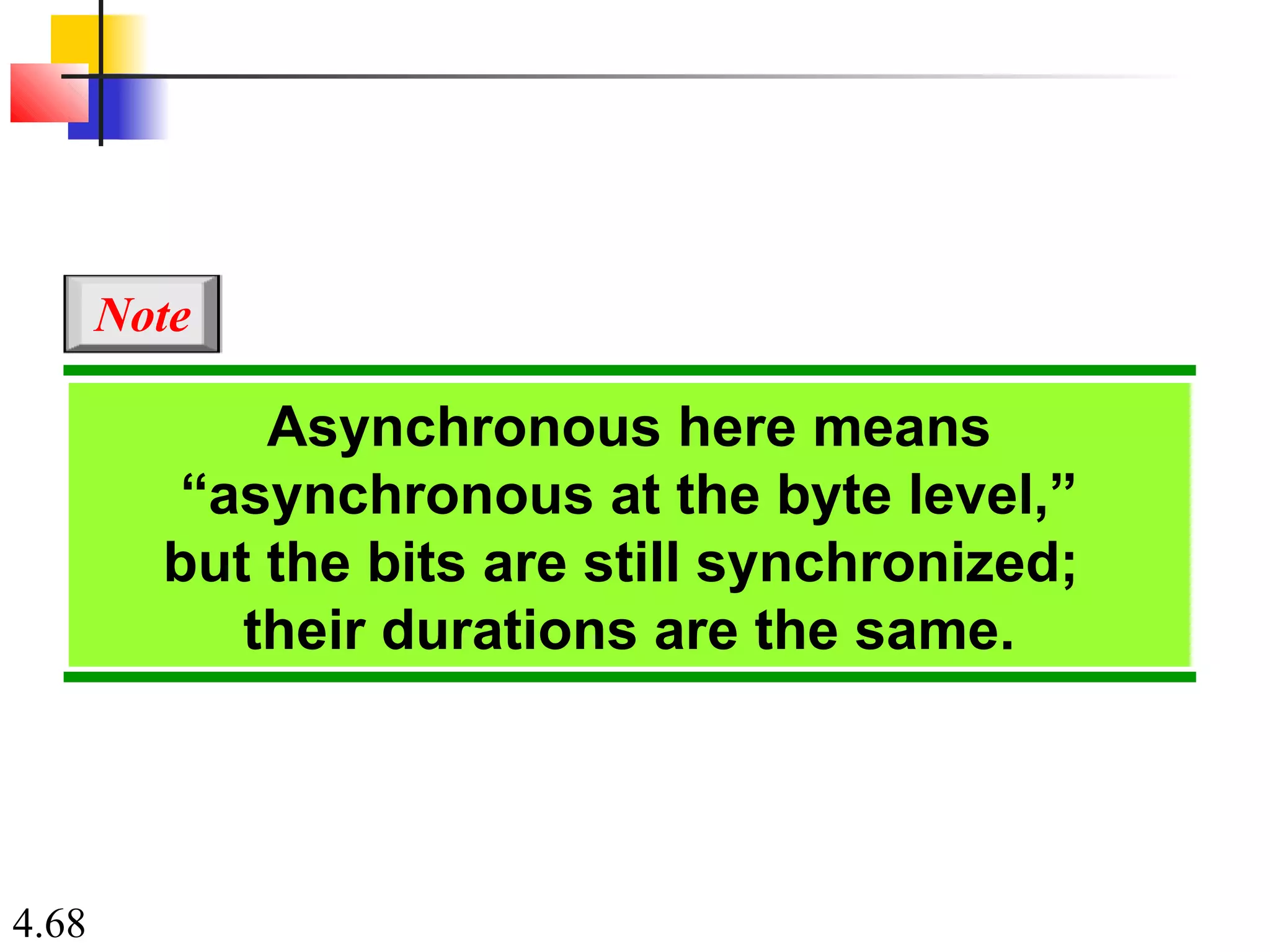
Asynchronous here means
“asynchronous at the byte level,”
but the bits are still synchronized;
their durations are the same.
Note
4.69
Figure 4.34 Asynchronous transmission
4.70
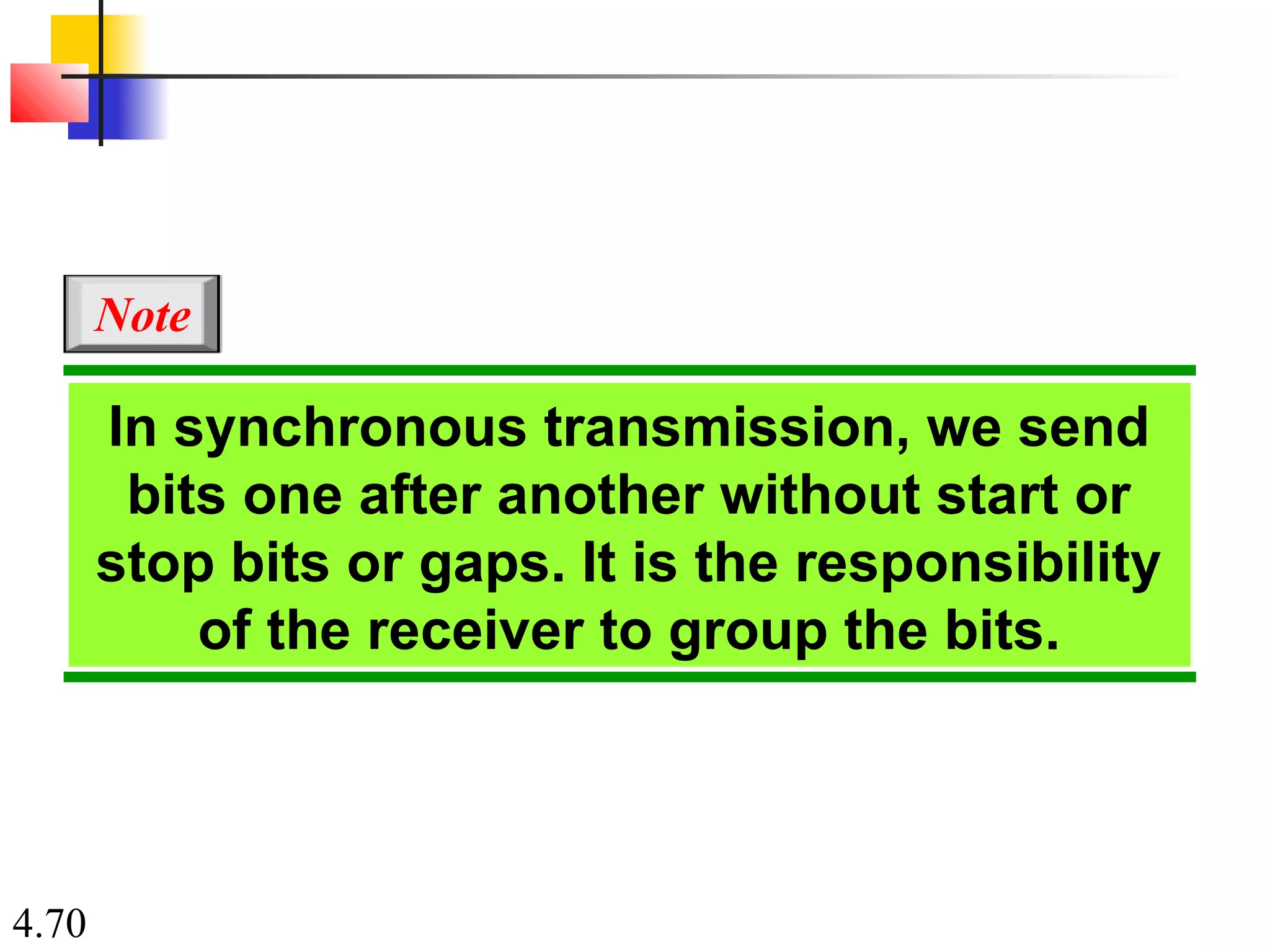
In synchronous transmission, we send
bits one after another without start or
stop bits or gaps. It is the responsibility
of the receiver to group the bits.
Note
4.71
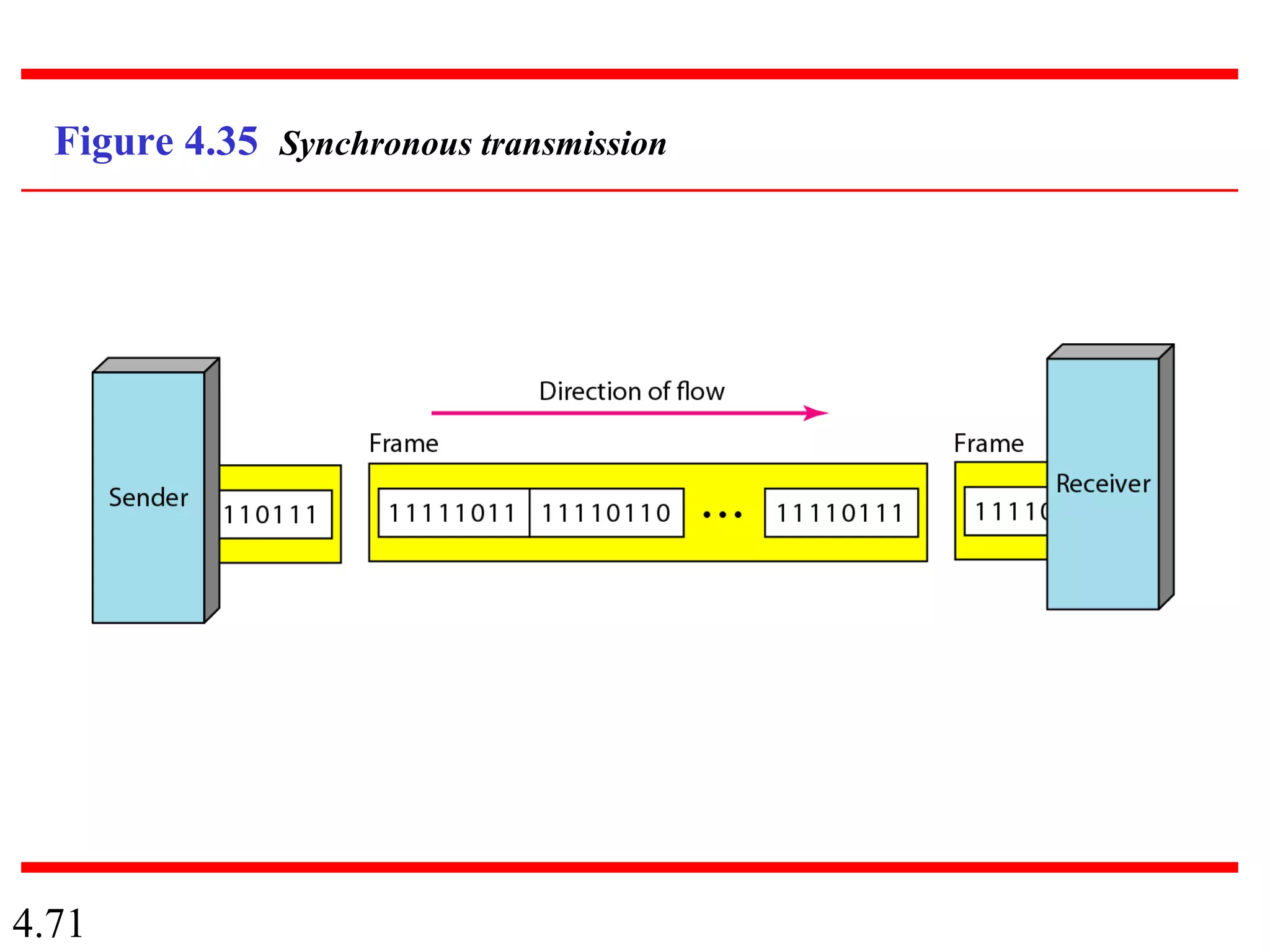
Figure 4.35 Synchronous transmission

Digital Transmission

  • 1.
    4.1 Chapter 4 Digital Transmission Copyright© The McGraw-Hill Companies, Inc. Permission required for reproduction or display.
  • 2.
    4.2 4-1 DIGITAL-TO-DIGITAL CONVERSION4-1DIGITAL-TO-DIGITAL CONVERSION In this section, we see how we can represent digitalIn this section, we see how we can represent digital data by using digital signals. The conversion involvesdata by using digital signals. The conversion involves three techniques:three techniques: line codingline coding,, block codingblock coding, and, and scramblingscrambling. Line coding is always needed; block. Line coding is always needed; block coding and scrambling may or may not be needed.coding and scrambling may or may not be needed. Line Coding Line Coding Schemes Block Coding Scrambling Topics discussed in this section:Topics discussed in this section:
  • 3.
    4.3 Figure 4.1 Linecoding and decoding
  • 4.
    4.4 Figure 4.2 Signalelement versus data element
  • 5.
    4.5 A signal iscarrying data in which one data element is encoded as one signal element ( r = 1). If the bit rate is 100 kbps, what is the average value of the baud rate if c is between 0 and 1? Solution We assume that the average value of c is 1/2 . The baud rate is then Example 4.1
  • 6.
    4.6 Although the actualbandwidth of a digital signal is infinite, the effective bandwidth is finite. Note
  • 7.
    4.7 The maximum datarate of a channel (see Chapter 3) is Nmax = 2 × B × log2 L (defined by the Nyquist formula). Does this agree with the previous formula for Nmax? Solution A signal with L levels actually can carry log2L bits per level. If each level corresponds to one signal element and we assume the average case (c = 1/2), then we have Example 4.2
  • 8.
    4.8 Figure 4.3 Effectof lack of synchronization
  • 9.
    4.9 In a digitaltransmission, the receiver clock is 0.1 percent faster than the sender clock. How many extra bits per second does the receiver receive if the data rate is 1 kbps? How many if the data rate is 1 Mbps? Solution At 1 kbps, the receiver receives 1001 bps instead of 1000 bps. Example 4.3 At 1 Mbps, the receiver receives 1,001,000 bps instead of 1,000,000 bps.
  • 10.
    4.10 Figure 4.4 Linecoding schemes
  • 11.
  • 12.
    4.12 Figure 4.6 PolarNRZ-L and NRZ-I schemes
  • 13.
    4.13 In NRZ-L thelevel of the voltage determines the value of the bit. In NRZ-I the inversion or the lack of inversion determines the value of the bit. Note
  • 14.
    4.14 NRZ-L and NRZ-Iboth have an average signal rate of N/2 Bd. Note
  • 15.
    4.15 NRZ-L and NRZ-Iboth have a DC component problem. Note
  • 16.
    4.16 A system isusing NRZ-I to transfer 10-Mbps data. What are the average signal rate and minimum bandwidth? Solution The average signal rate is S = N/2 = 500 kbaud. The minimum bandwidth for this average baud rate is Bmin = S = 500 kHz. Example 4.4
  • 17.
  • 18.
    4.18 Figure 4.8 Polarbiphase: Manchester and differential Manchester schemes
  • 19.
    4.19 In Manchester anddifferential Manchester encoding, the transition at the middle of the bit is used for synchronization. Note
  • 20.
    4.20 The minimum bandwidthof Manchester and differential Manchester is 2 times that of NRZ. Note
  • 21.
    4.21 In bipolar encoding,we use three levels: positive, zero, and negative. Note
  • 22.
    4.22 Figure 4.9 Bipolarschemes: AMI and pseudoternary
  • 23.
    4.23 In mBnL schemes,a pattern of m data elements is encoded as a pattern of n signal elements in which 2m ≤ Ln . Note
  • 24.
  • 25.
  • 26.
  • 27.
  • 28.
    4.28 Table 4.1 Summaryof line coding schemes
  • 29.
    4.29 Block coding isnormally referred to as mB/nB coding; it replaces each m-bit group with an n-bit group. Note
  • 30.
    4.30 Figure 4.14 Blockcoding concept
  • 31.
    4.31 Figure 4.15 Usingblock coding 4B/5B with NRZ-I line coding scheme
  • 32.
    4.32 Table 4.2 4B/5Bmapping codes
  • 33.
    4.33 Figure 4.16 Substitutionin 4B/5B block coding
  • 34.
    4.34 We need tosend data at a 1-Mbps rate. What is the minimum required bandwidth, using a combination of 4B/5B and NRZ-I or Manchester coding? Solution First 4B/5B block coding increases the bit rate to 1.25 Mbps. The minimum bandwidth using NRZ-I is N/2 or 625 kHz. The Manchester scheme needs a minimum bandwidth of 1 MHz. The first choice needs a lower bandwidth, but has a DC component problem; the second choice needs a higher bandwidth, but does not have a DC component problem. Example 4.5
  • 35.
  • 36.
    4.36 Figure 4.18 AMIused with scrambling
  • 37.
    4.37 Figure 4.19 Twocases of B8ZS scrambling technique
  • 38.
    4.38 B8ZS substitutes eightconsecutive zeros with 000VB0VB. Note
  • 39.
    4.39 Figure 4.20 Differentsituations in HDB3 scrambling technique
  • 40.
    4.40 HDB3 substitutes fourconsecutive zeros with 000V or B00V depending on the number of nonzero pulses after the last substitution. Note
  • 41.
    4.41 4-2 ANALOG-TO-DIGITAL CONVERSION4-2ANALOG-TO-DIGITAL CONVERSION We have seen in Chapter 3 that a digital signal isWe have seen in Chapter 3 that a digital signal is superior to an analog signal. The tendency today is tosuperior to an analog signal. The tendency today is to change an analog signal to digital data. In this sectionchange an analog signal to digital data. In this section we describe two techniques,we describe two techniques, pulse code modulationpulse code modulation andand delta modulationdelta modulation.. Pulse Code Modulation (PCM) Delta Modulation (DM) Topics discussed in this section:Topics discussed in this section:
  • 42.
  • 43.
    4.43 Figure 4.22 Threedifferent sampling methods for PCM
  • 44.
    4.44 According to theNyquist theorem, the sampling rate must be at least 2 times the highest frequency contained in the signal. Note
  • 45.
    4.45 Figure 4.23 Nyquistsampling rate for low-pass and bandpass signals
  • 46.
    4.46 For an intuitiveexample of the Nyquist theorem, let us sample a simple sine wave at three sampling rates: fs = 4f (2 times the Nyquist rate), fs = 2f (Nyquist rate), and fs = f (one-half the Nyquist rate). Figure 4.24 shows the sampling and the subsequent recovery of the signal. It can be seen that sampling at the Nyquist rate can create a good approximation of the original sine wave (part a). Oversampling in part b can also create the same approximation, but it is redundant and unnecessary. Sampling below the Nyquist rate (part c) does not produce a signal that looks like the original sine wave. Example 4.6
  • 47.
    4.47 Figure 4.24 Recoveryof a sampled sine wave for different sampling rates
  • 48.
    4.48 Consider the revolutionof a hand of a clock. The second hand of a clock has a period of 60 s. According to the Nyquist theorem, we need to sample the hand every 30 s (Ts = T or fs = 2f ). In Figure 4.25a, the sample points, in order, are 12, 6, 12, 6, 12, and 6. The receiver of the samples cannot tell if the clock is moving forward or backward. In part b, we sample at double the Nyquist rate (every 15 s). The sample points are 12, 3, 6, 9, and 12. The clock is moving forward. In part c, we sample below the Nyquist rate (Ts = T or fs = f ). The sample points are 12, 9, 6, 3, and 12. Although the clock is moving forward, the receiver thinks that the clock is moving backward. Example 4.7
  • 49.
    4.49 Figure 4.25 Samplingof a clock with only one hand
  • 50.
    4.50 An example relatedto Example 4.7 is the seemingly backward rotation of the wheels of a forward-moving car in a movie. This can be explained by under-sampling. A movie is filmed at 24 frames per second. If a wheel is rotating more than 12 times per second, the under- sampling creates the impression of a backward rotation. Example 4.8
  • 51.
    4.51 Telephone companies digitizevoice by assuming a maximum frequency of 4000 Hz. The sampling rate therefore is 8000 samples per second. Example 4.9
  • 52.
    4.52 A complex low-passsignal has a bandwidth of 200 kHz. What is the minimum sampling rate for this signal? Solution The bandwidth of a low-pass signal is between 0 and f, where f is the maximum frequency in the signal. Therefore, we can sample this signal at 2 times the highest frequency (200 kHz). The sampling rate is therefore 400,000 samples per second. Example 4.10
  • 53.
    4.53 A complex bandpasssignal has a bandwidth of 200 kHz. What is the minimum sampling rate for this signal? Solution We cannot find the minimum sampling rate in this case because we do not know where the bandwidth starts or ends. We do not know the maximum frequency in the signal. Example 4.11
  • 54.
    4.54 Figure 4.26 Quantizationand encoding of a sampled signal
  • 55.
    4.55 What is theSNRdB in the example of Figure 4.26? Solution We can use the formula to find the quantization. We have eight levels and 3 bits per sample, so SNRdB = 6.02(3) + 1.76 = 19.82 dB Increasing the number of levels increases the SNR. Example 4.12
  • 56.
    4.56 A telephone subscriberline must have an SNRdB above 40. What is the minimum number of bits per sample? Solution We can calculate the number of bits as Example 4.13 Telephone companies usually assign 7 or 8 bits per sample.
  • 57.
    4.57 We want todigitize the human voice. What is the bit rate, assuming 8 bits per sample? Solution The human voice normally contains frequencies from 0 to 4000 Hz. So the sampling rate and bit rate are calculated as follows: Example 4.14
  • 58.
  • 59.
    4.59 We have alow-pass analog signal of 4 kHz. If we send the analog signal, we need a channel with a minimum bandwidth of 4 kHz. If we digitize the signal and send 8 bits per sample, we need a channel with a minimum bandwidth of 8 × 4 kHz = 32 kHz. Example 4.15
  • 60.
    4.60 Figure 4.28 Theprocess of delta modulation
  • 61.
    4.61 Figure 4.29 Deltamodulation components
  • 62.
    4.62 Figure 4.30 Deltademodulation components
  • 63.
    4.63 4-3 TRANSMISSION MODES4-3TRANSMISSION MODES The transmission of binary data across a link can beThe transmission of binary data across a link can be accomplished in either parallel or serial mode. Inaccomplished in either parallel or serial mode. In parallel mode, multiple bits are sent with each clockparallel mode, multiple bits are sent with each clock tick. In serial mode, 1 bit is sent with each clock tick.tick. In serial mode, 1 bit is sent with each clock tick. While there is only one way to send parallel data, thereWhile there is only one way to send parallel data, there are three subclasses of serial transmission:are three subclasses of serial transmission: asynchronous, synchronous, and isochronous.asynchronous, synchronous, and isochronous. Parallel Transmission Serial Transmission Topics discussed in this section:Topics discussed in this section:
  • 64.
    4.64 Figure 4.31 Datatransmission and modes
  • 65.
  • 66.
  • 67.
    4.67 In asynchronous transmission,we send 1 start bit (0) at the beginning and 1 or more stop bits (1s) at the end of each byte. There may be a gap between each byte. Note
  • 68.
    4.68 Asynchronous here means “asynchronousat the byte level,” but the bits are still synchronized; their durations are the same. Note
  • 69.
  • 70.
    4.70 In synchronous transmission,we send bits one after another without start or stop bits or gaps. It is the responsibility of the receiver to group the bits. Note
  • 71.