Unit II
Understanding the learning
Disabilities - Approaches
K.Thangavel
Assistant Professor,
Thiagarajar College of Preceptors.
2/24/2021
K.Thangavel, Thiagarajar College of
Preceptors, Madurai-9.
Identifying Children with Disability
• Cognitive Approach:
Children With Disabilities could be easily
identified by observing the limitations in
individual’s cognitive abilities like receiving
information,
processing, interpreting and reacting to it.
2/24/2021
K.Thangavel, Thiagarajar College of
Preceptors, Madurai-9.
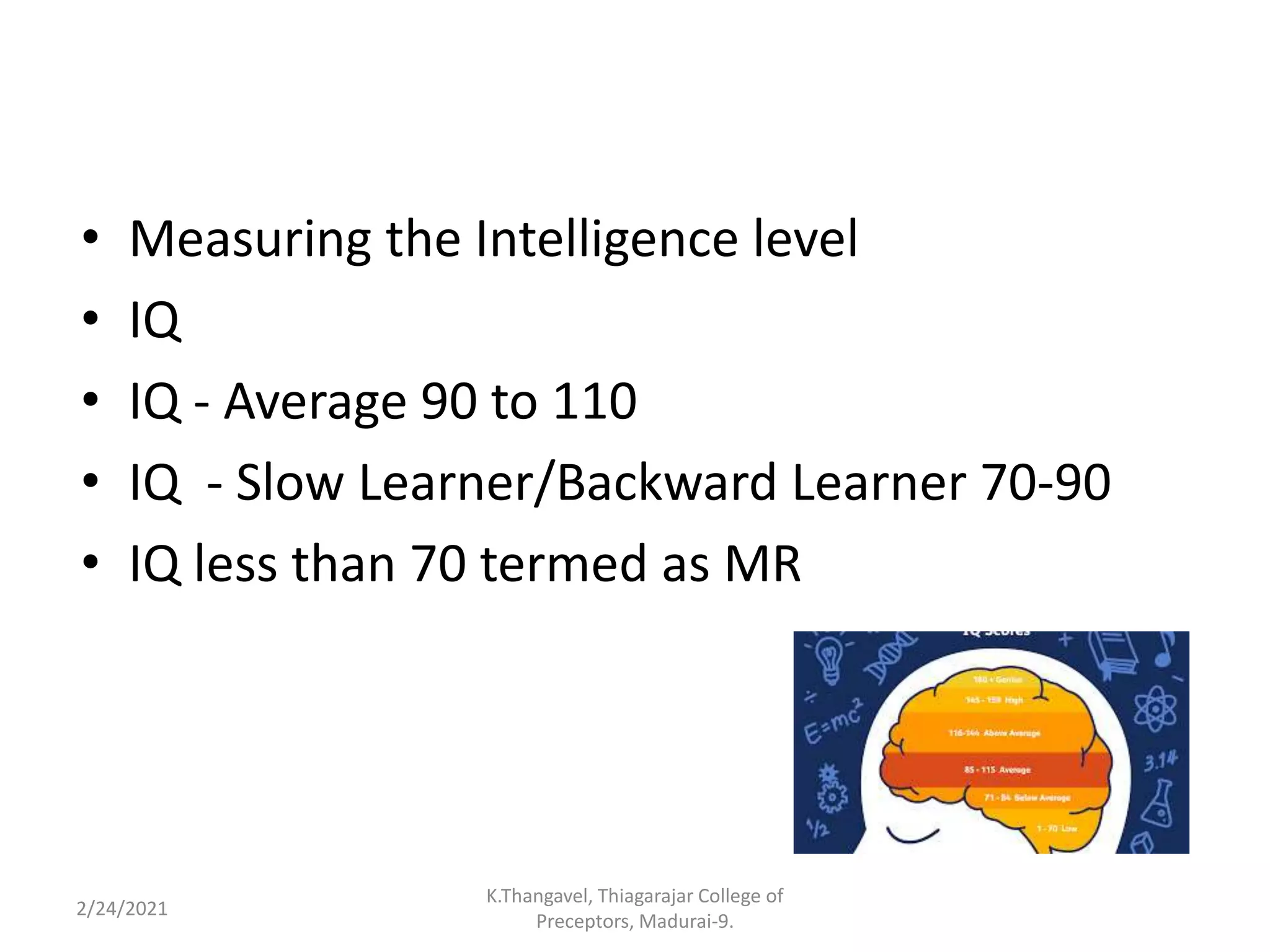
• Measuring the Intelligence level
• IQ
• IQ - Average 90 to 110
• IQ - Slow Learner/Backward Learner 70-90
• IQ less than 70 termed as MR
2/24/2021
K.Thangavel, Thiagarajar College of
Preceptors, Madurai-9.
• Intelligence tests are
Verbal test
Non – Verbal test
Performance test
Disabled – Individual test
Others like illiterate – Performance test.
2/24/2021
K.Thangavel, Thiagarajar College of
Preceptors, Madurai-9.
Drawbacks of the Cognitive Approach
in the Identification of the disabled
• It is not possible for visually, hearing and
speech impaired
• MR could be identified using cognitive
approach
• It gives priority to provide special education
• This approach is not contributing much in
improving the degree of disability.
2/24/2021
K.Thangavel, Thiagarajar College of
Preceptors, Madurai-9.
2/24/2021
K.Thangavel, Thiagarajar College of
Preceptors, Madurai-9.
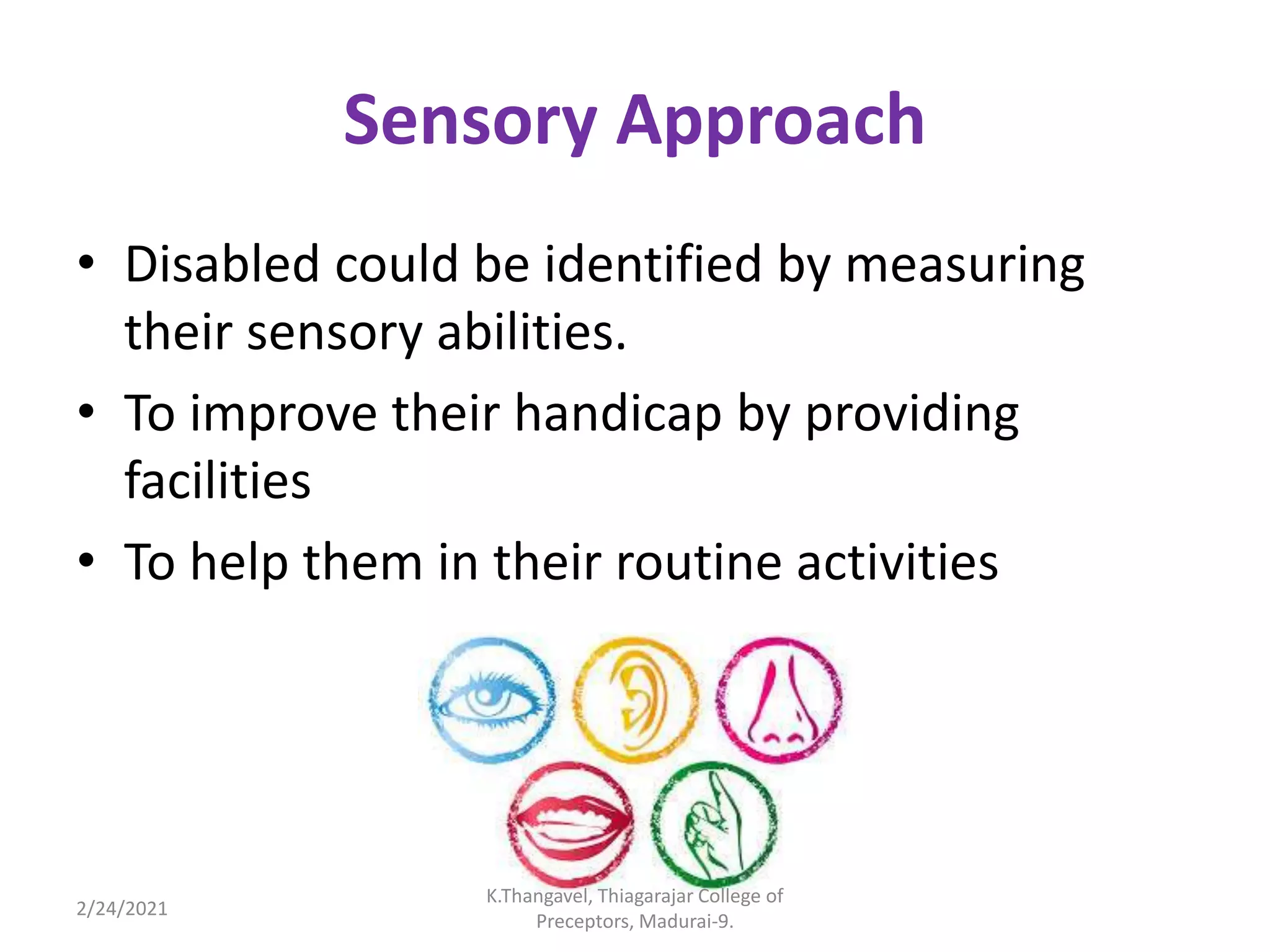
Sensory Approach
• Disabled could be identified by measuring
their sensory abilities.
• To improve their handicap by providing
facilities
• To help them in their routine activities
2/24/2021
K.Thangavel, Thiagarajar College of
Preceptors, Madurai-9.
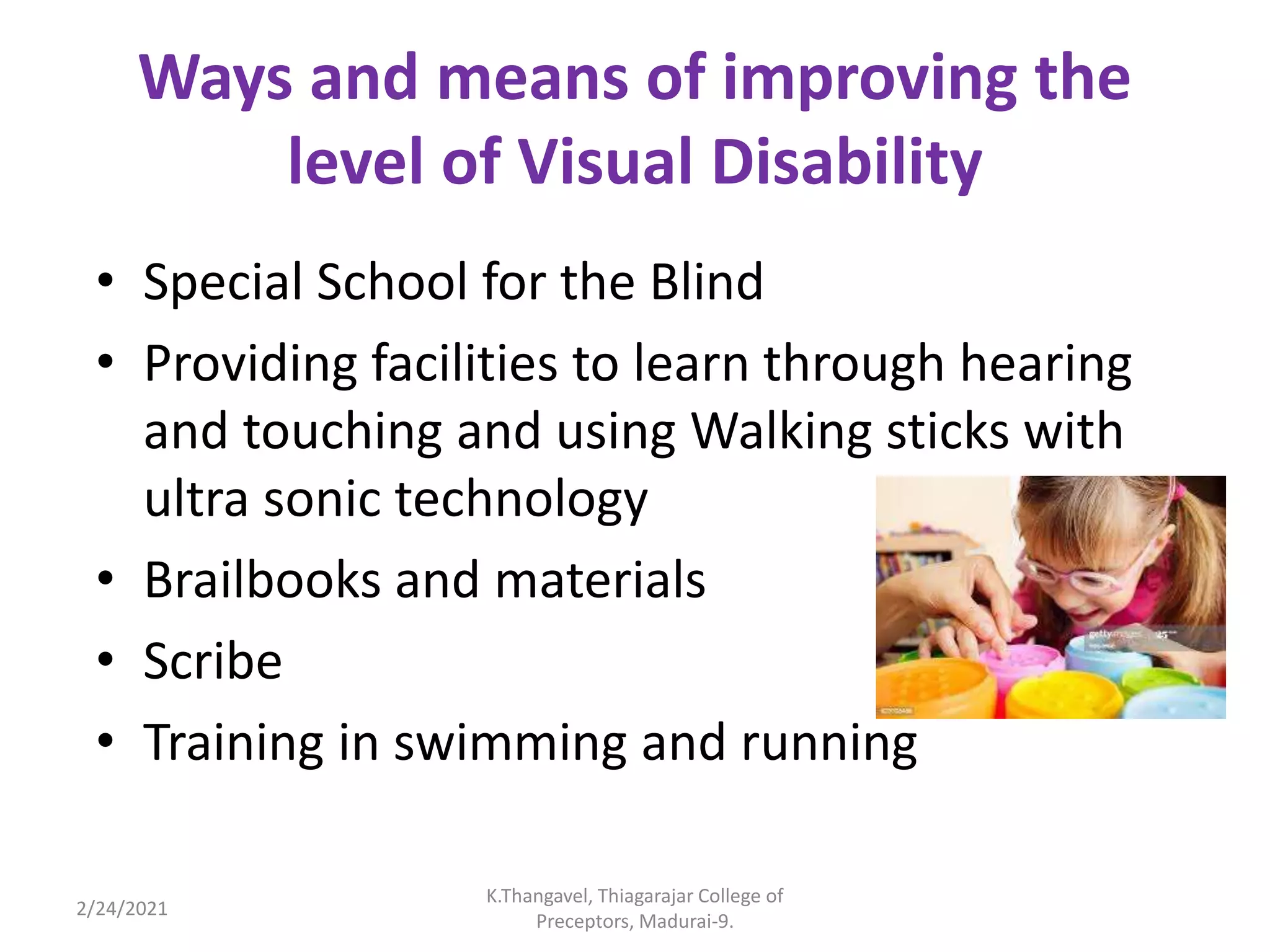
Ways and means of improving the
level of Visual Disability
• Special School for the Blind
• Providing facilities to learn through hearing
and touching and using Walking sticks with
ultra sonic technology
• Brailbooks and materials
• Scribe
• Training in swimming and running
2/24/2021
K.Thangavel, Thiagarajar College of
Preceptors, Madurai-9.
• Training in Musical Aptitude
• Vocational training like
• Weaving
• Candle-making
• Book binding
• Basket making to make them economically
independent.
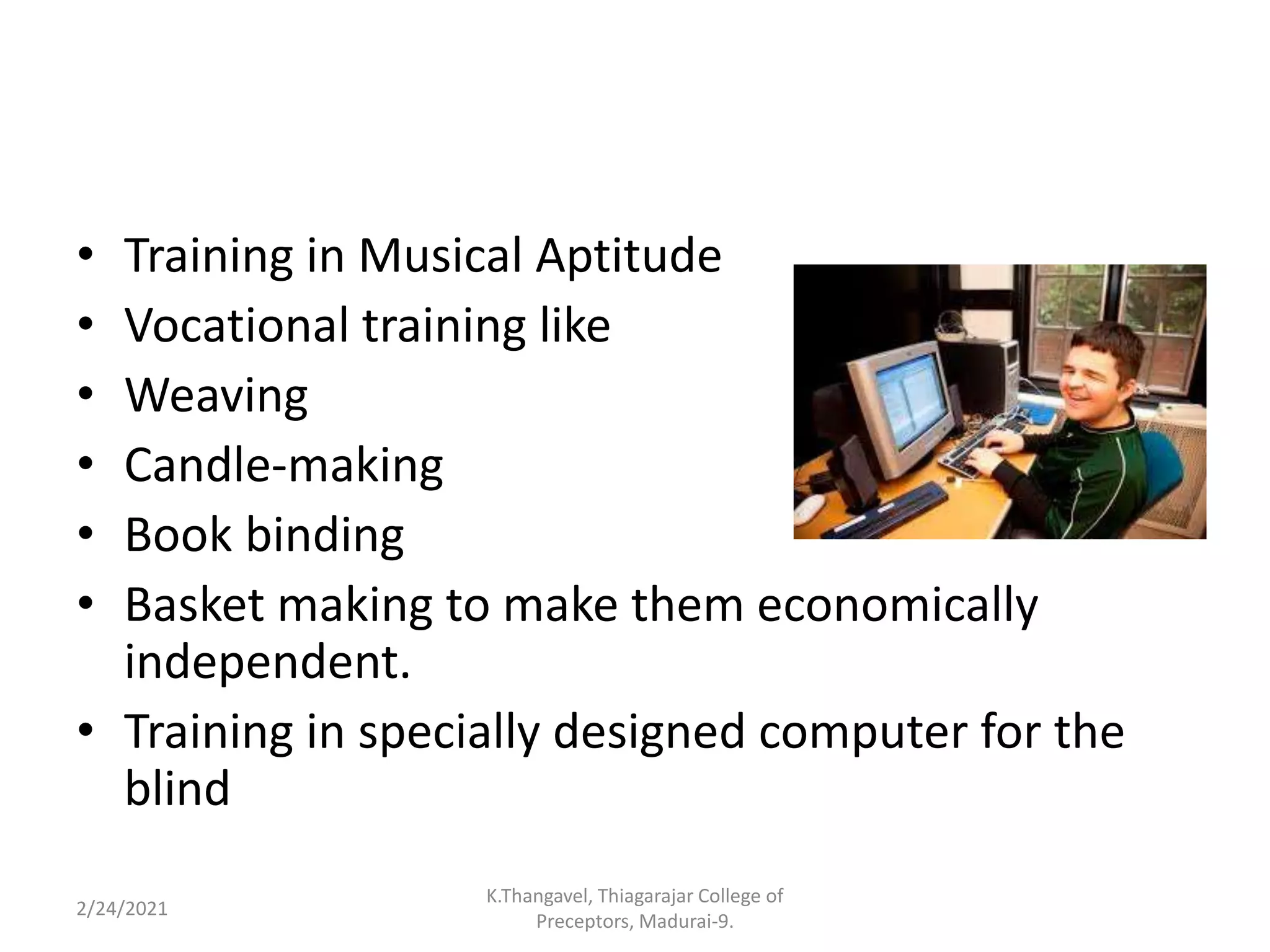
• Training in specially designed computer for the
blind
2/24/2021
K.Thangavel, Thiagarajar College of
Preceptors, Madurai-9.
Responsibilities of the Society and
State
• Allocation of specified percentage of
reservation for blind in the teaching post and
office assistant etc.
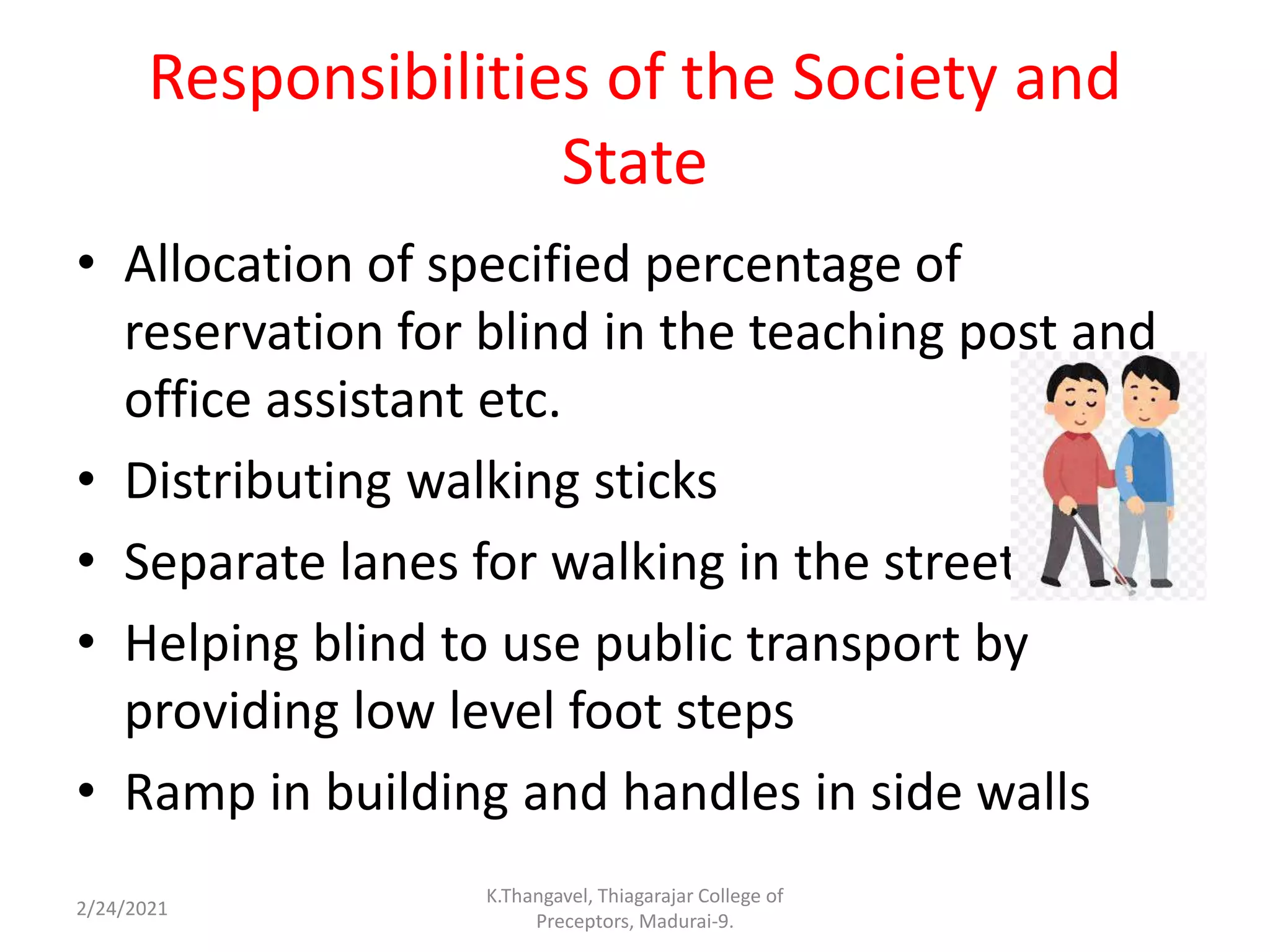
• Distributing walking sticks
• Separate lanes for walking in the streets
• Helping blind to use public transport by
providing low level foot steps
• Ramp in building and handles in side walls
2/24/2021
K.Thangavel, Thiagarajar College of
Preceptors, Madurai-9.
Ways and means of improving the
level of Hearing Disability
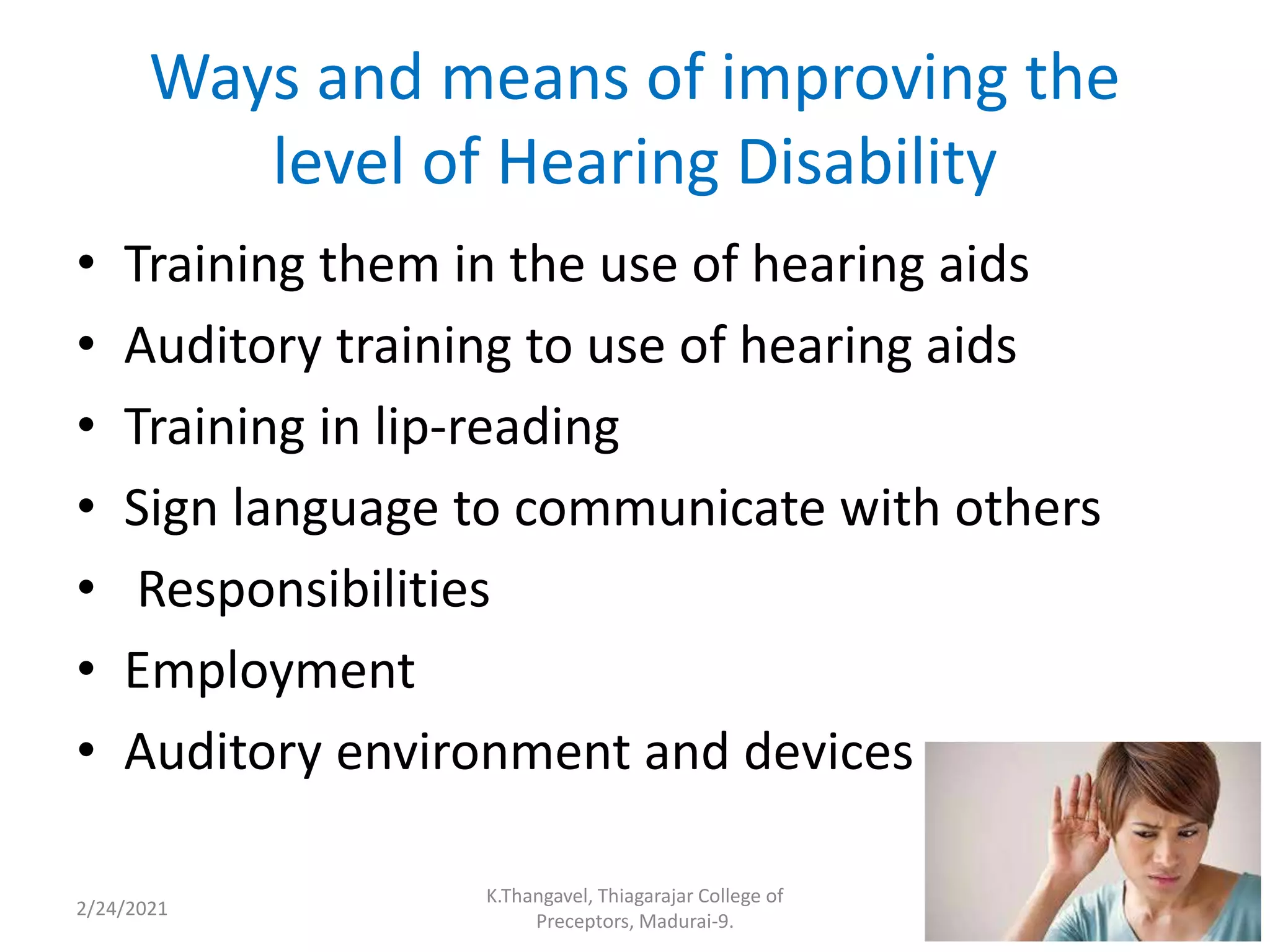
• Training them in the use of hearing aids
• Auditory training to use of hearing aids
• Training in lip-reading
• Sign language to communicate with others
• Responsibilities
• Employment
• Auditory environment and devices
2/24/2021
K.Thangavel, Thiagarajar College of
Preceptors, Madurai-9.
2/24/2021
K.Thangavel, Thiagarajar College of
Preceptors, Madurai-9.
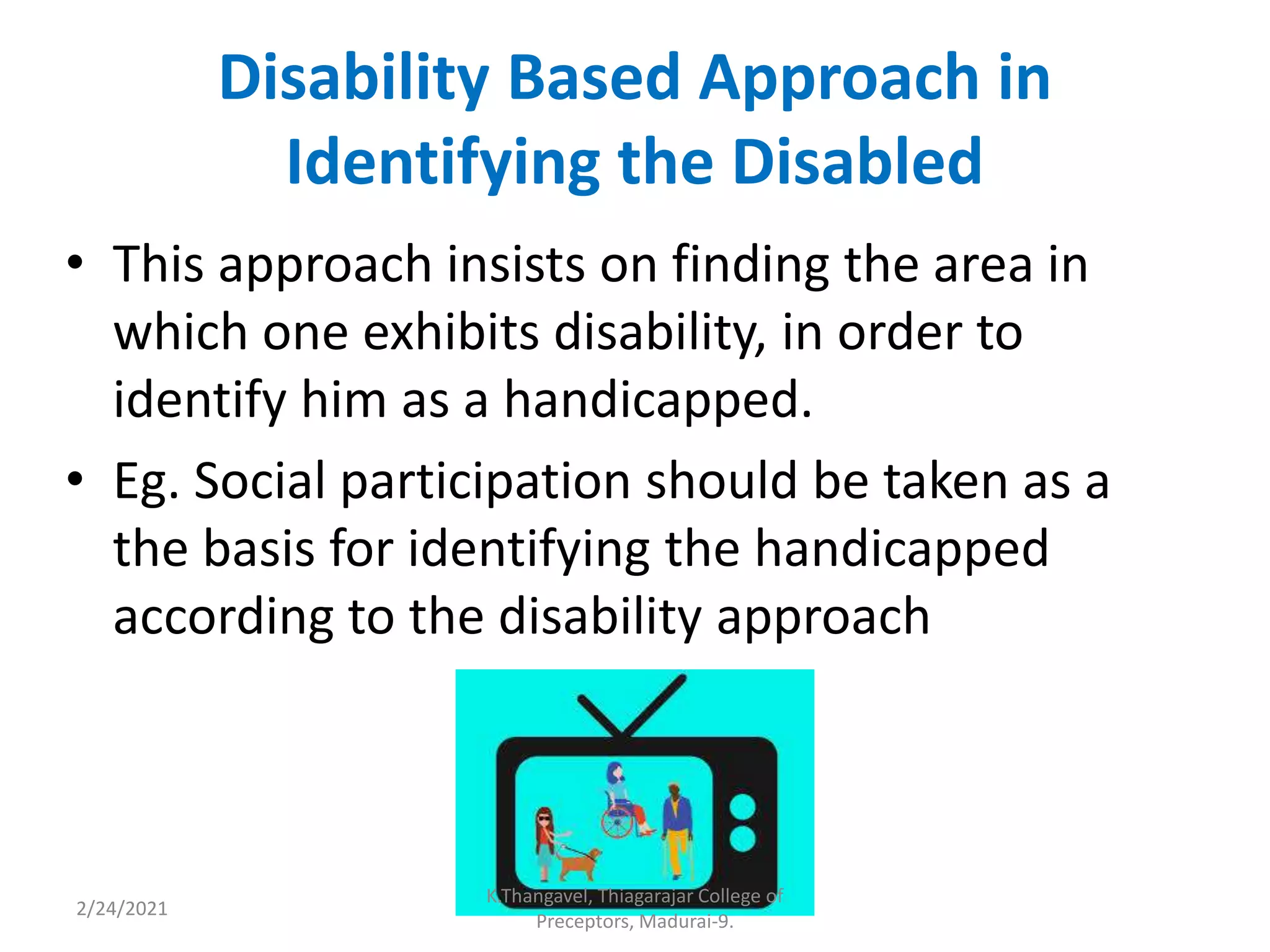
Disability Based Approach in
Identifying the Disabled
• This approach insists on finding the area in
which one exhibits disability, in order to
identify him as a handicapped.
• Eg. Social participation should be taken as a
the basis for identifying the handicapped
according to the disability approach
2/24/2021
K.Thangavel, Thiagarajar College of
Preceptors, Madurai-9.
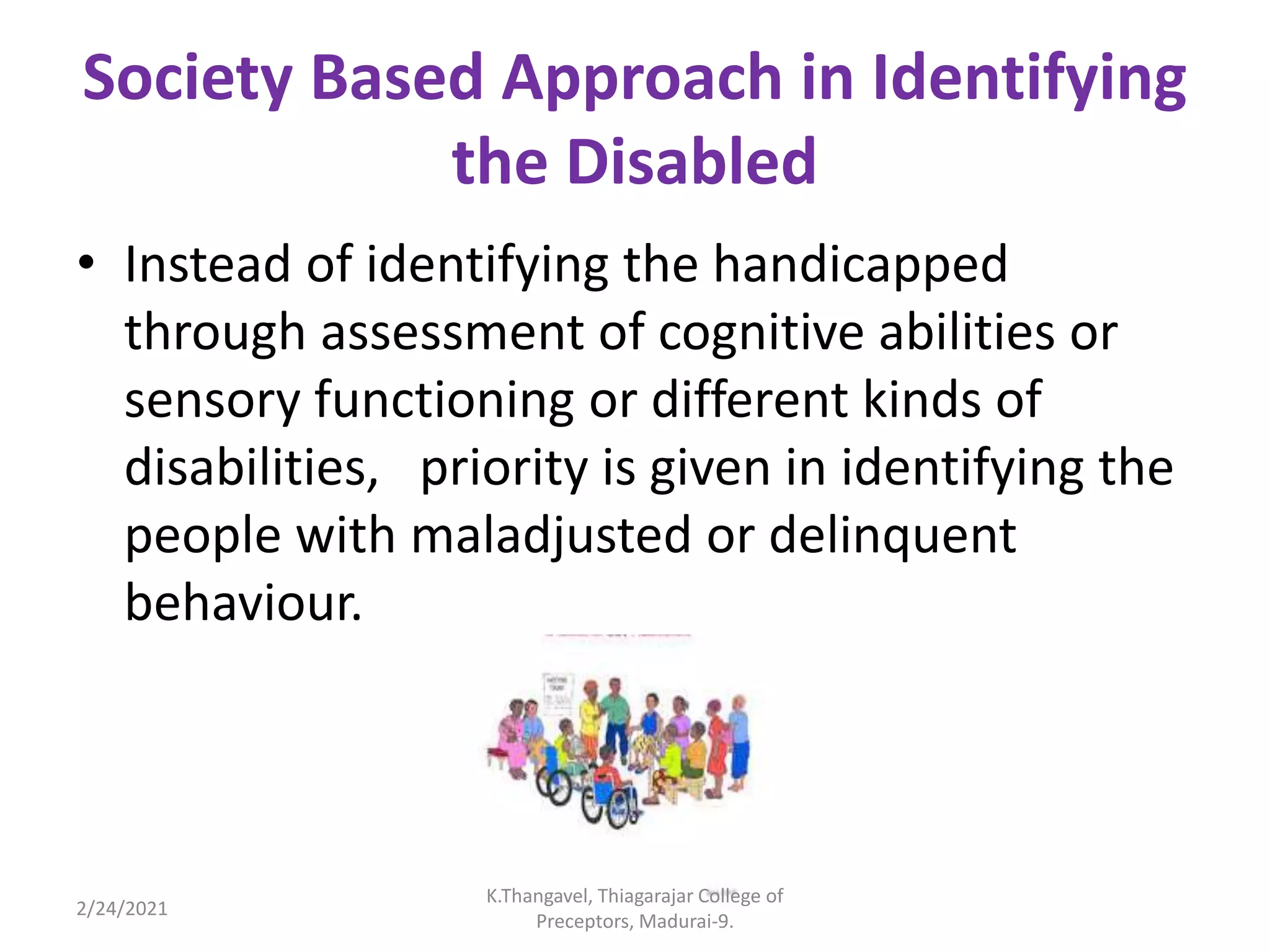
Society Based Approach in Identifying
the Disabled
• Instead of identifying the handicapped
through assessment of cognitive abilities or
sensory functioning or different kinds of
disabilities, priority is given in identifying the
people with maladjusted or delinquent
behaviour.
2/24/2021
K.Thangavel, Thiagarajar College of
Preceptors, Madurai-9.
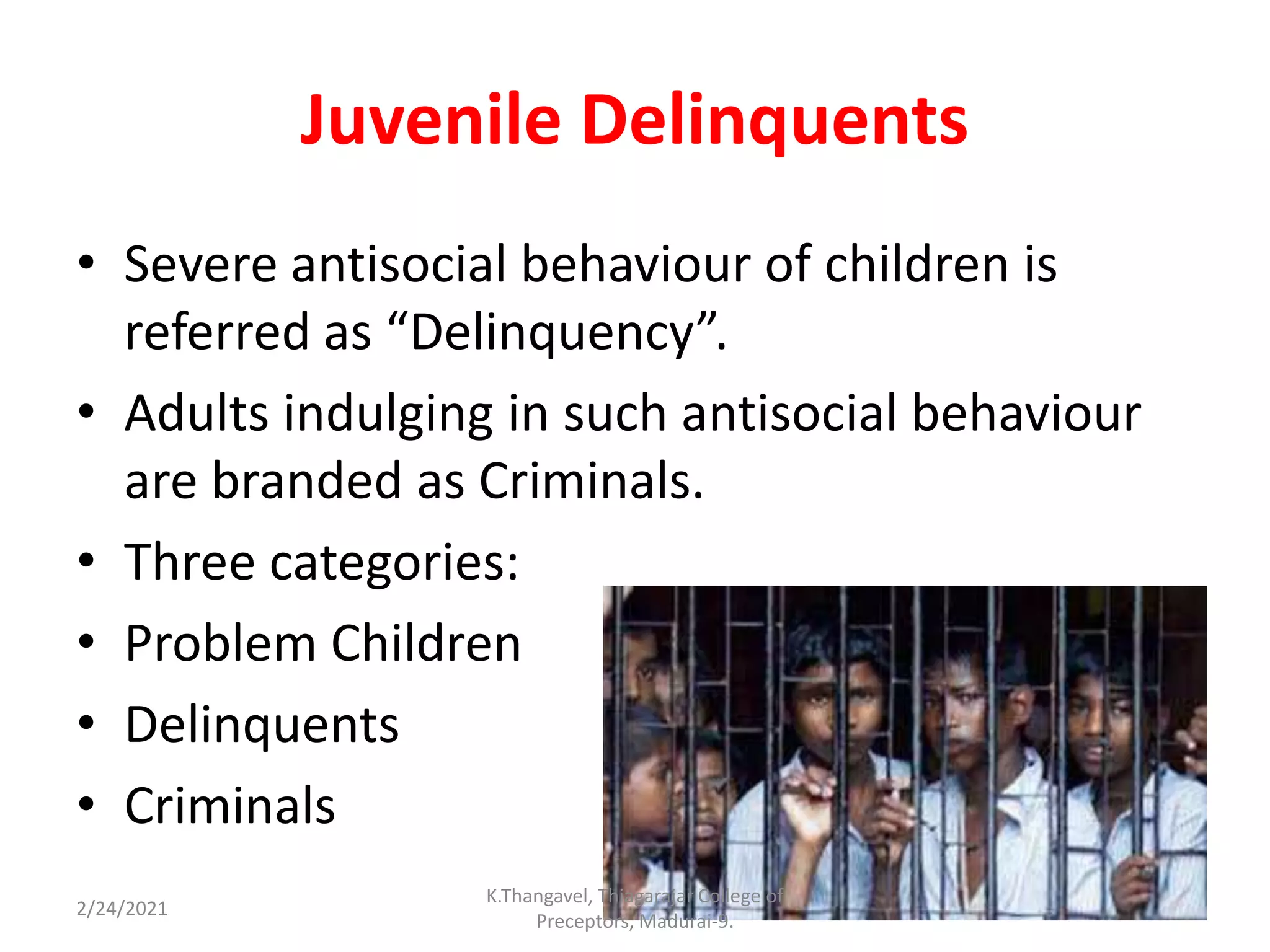
Juvenile Delinquents
• Severe antisocial behaviour of children is
referred as “Delinquency”.
• Adults indulging in such antisocial behaviour
are branded as Criminals.
• Three categories:
• Problem Children
• Delinquents
• Criminals
2/24/2021
K.Thangavel, Thiagarajar College of
Preceptors, Madurai-9.
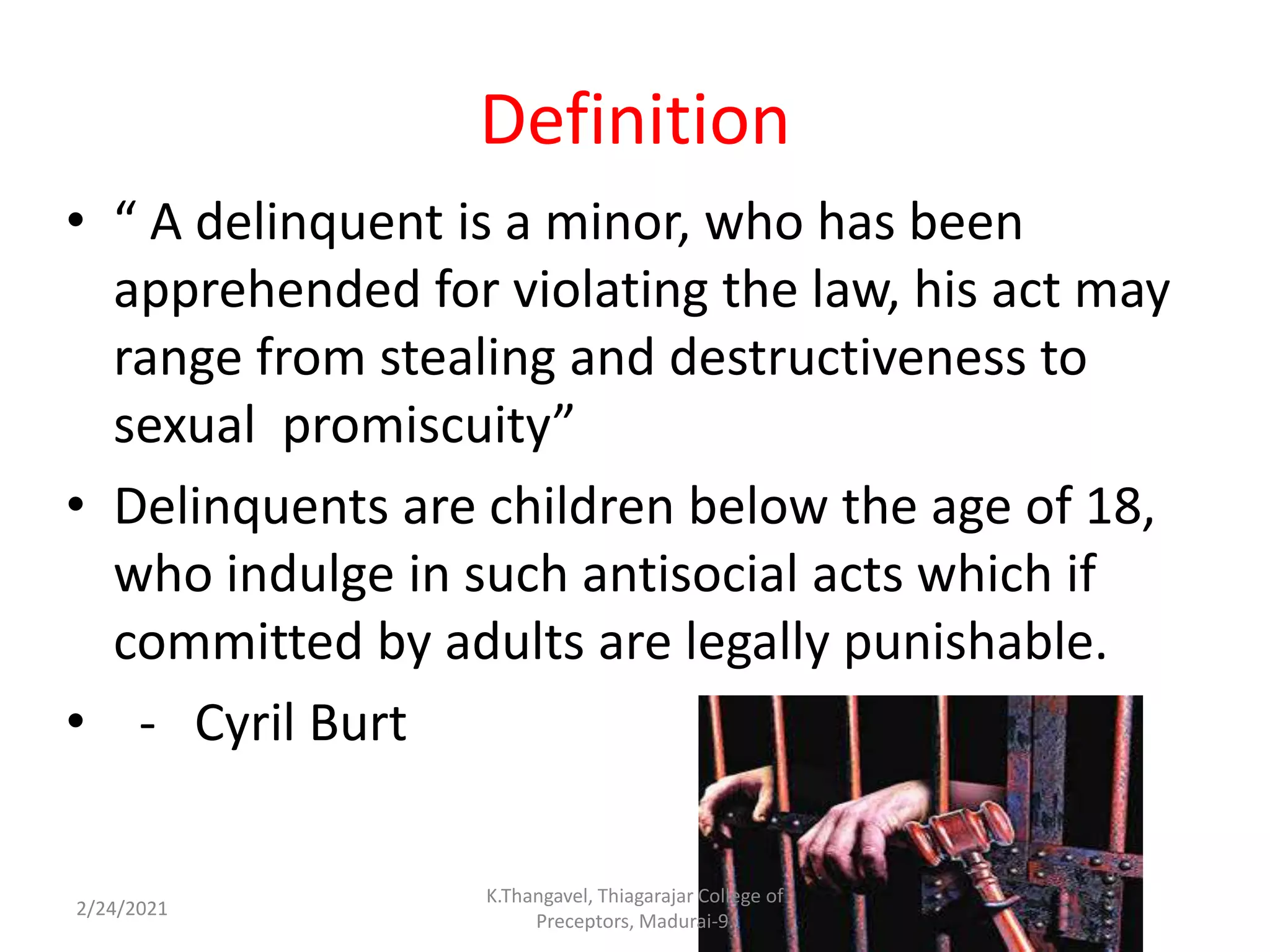
Definition
• “ A delinquent is a minor, who has been
apprehended for violating the law, his act may
range from stealing and destructiveness to
sexual promiscuity”
• Delinquents are children below the age of 18,
who indulge in such antisocial acts which if
committed by adults are legally punishable.
• - Cyril Burt
2/24/2021
K.Thangavel, Thiagarajar College of
Preceptors, Madurai-9.
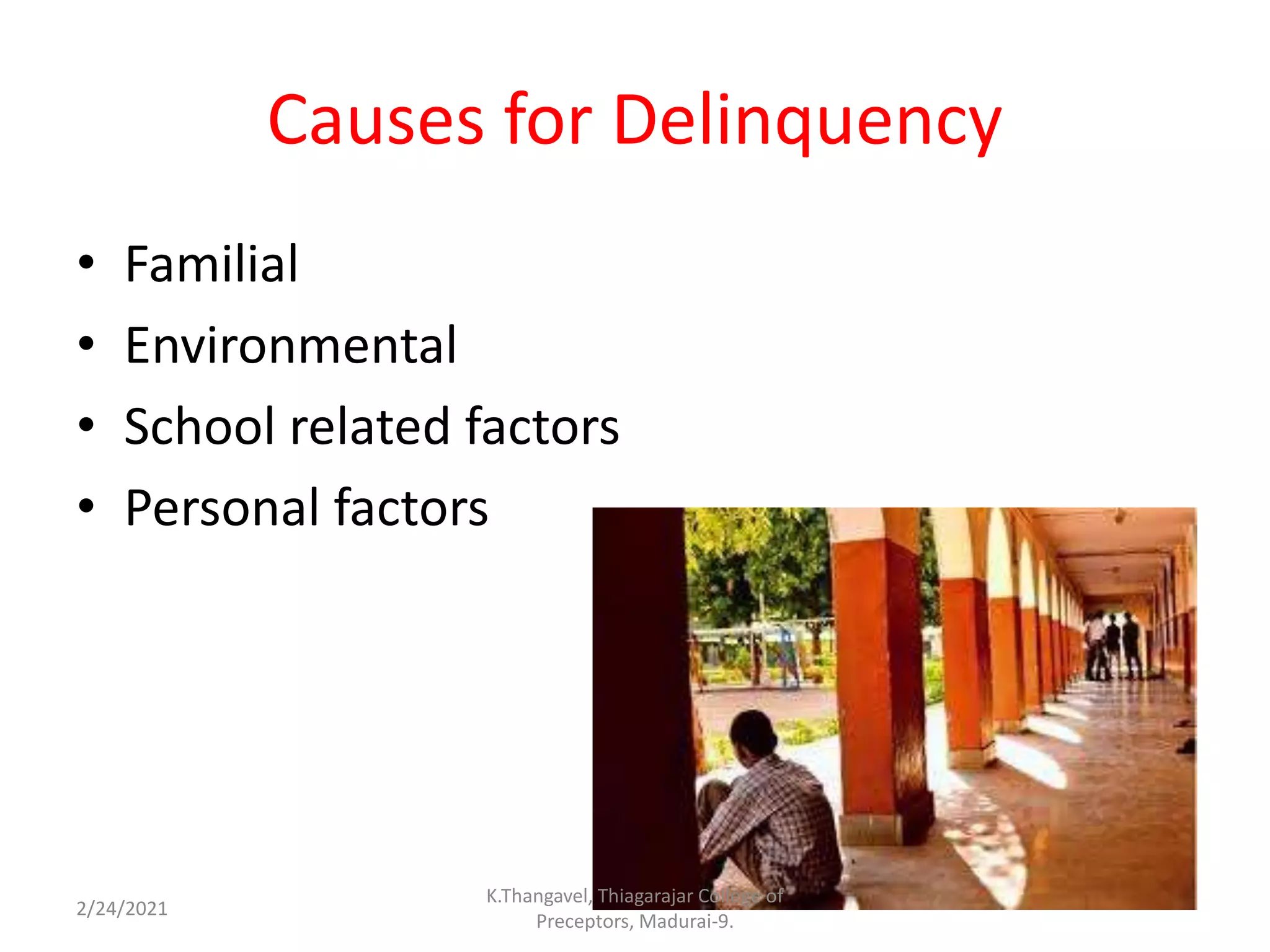
Causes for Delinquency
• Familial
• Environmental
• School related factors
• Personal factors
2/24/2021
K.Thangavel, Thiagarajar College of
Preceptors, Madurai-9.
2/24/2021
K.Thangavel, Thiagarajar College of
Preceptors, Madurai-9.
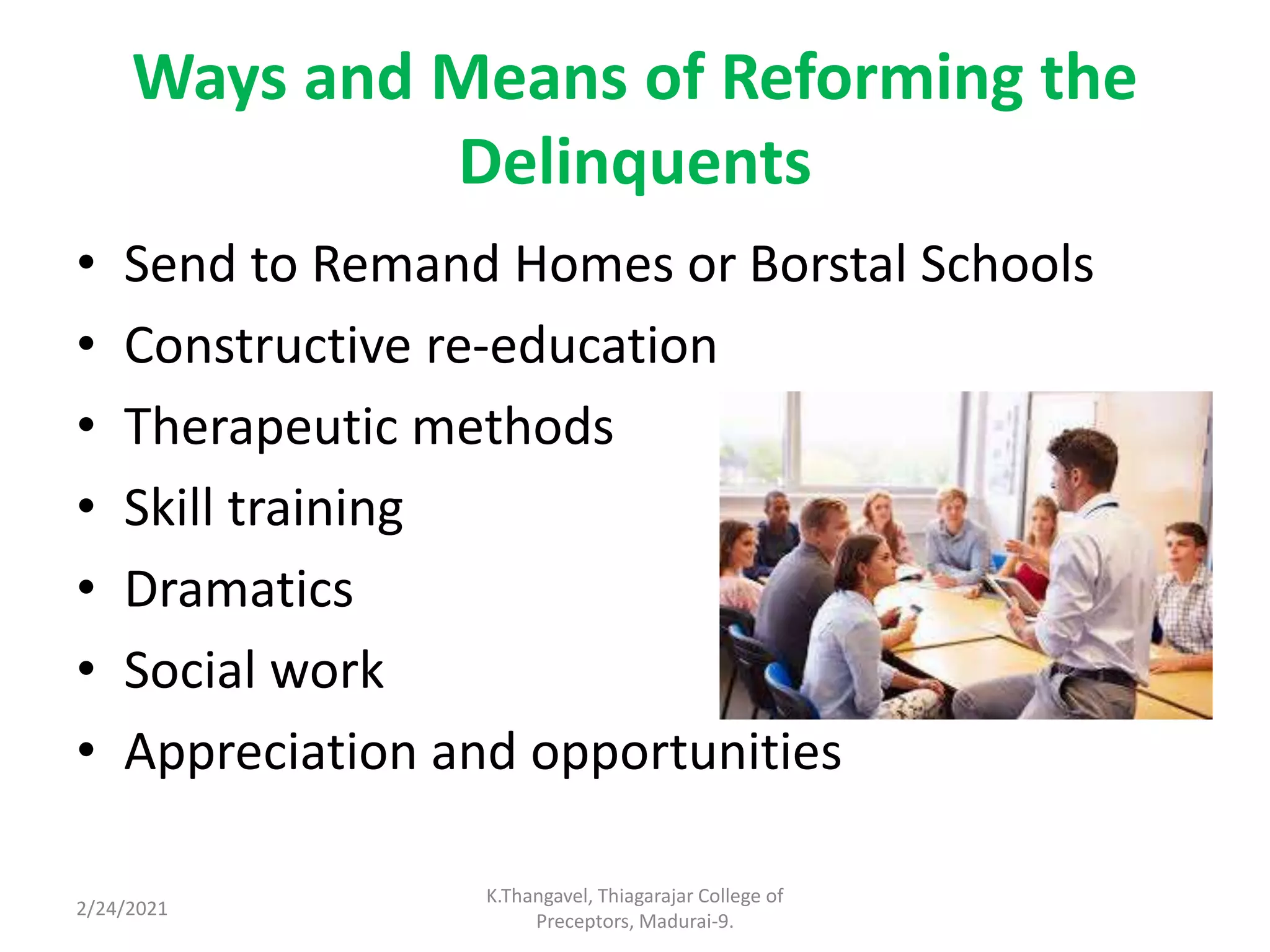
Ways and Means of Reforming the
Delinquents
• Send to Remand Homes or Borstal Schools
• Constructive re-education
• Therapeutic methods
• Skill training
• Dramatics
• Social work
• Appreciation and opportunities
2/24/2021
K.Thangavel, Thiagarajar College of
Preceptors, Madurai-9.
• To provide healthy and congenial environment
• Not falling back to the old environment.
• Boys Town help a lot in rehabilitating the
reformed youths.
• Arranging education
• School life should be joyous for everyone.
• Individual Differences are to be recognised
2/24/2021
K.Thangavel, Thiagarajar College of
Preceptors, Madurai-9.
• School should give importance for discipline
introducing programmes like NCC etc.
• Faith in god provides a kind of psychological
security
2/24/2021
K.Thangavel, Thiagarajar College of
Preceptors, Madurai-9.
Role of teachers in Managing Students
with Learning Disabilities
• Mastery model
Own level of mastery
Practice
Gain fundamental skills
Mainly for adult learners
2/24/2021
K.Thangavel, Thiagarajar College of
Preceptors, Madurai-9.
Direct Instruction
• Highly structured
• Intensive instruction
• Scripted lesson plans
• Rapid-paced interaction
• Correcting mistakes immediately
• Achievement based grouping
• Frequent progress assessments
2/24/2021
K.Thangavel, Thiagarajar College of
Preceptors, Madurai-9.
• Classroom adjustments
• Special equipments
• Classroom assistants
• Special education
2/24/2021
K.Thangavel, Thiagarajar College of
Preceptors, Madurai-9.
2/24/2021
K.Thangavel, Thiagarajar College of
Preceptors, Madurai-9.

Understanding the learning Disabilities-Approaches

  • 1.
    Unit II Understanding thelearning Disabilities - Approaches K.Thangavel Assistant Professor, Thiagarajar College of Preceptors. 2/24/2021 K.Thangavel, Thiagarajar College of Preceptors, Madurai-9.
  • 2.
    Identifying Children withDisability • Cognitive Approach: Children With Disabilities could be easily identified by observing the limitations in individual’s cognitive abilities like receiving information, processing, interpreting and reacting to it. 2/24/2021 K.Thangavel, Thiagarajar College of Preceptors, Madurai-9.
  • 3.
    • Measuring theIntelligence level • IQ • IQ - Average 90 to 110 • IQ - Slow Learner/Backward Learner 70-90 • IQ less than 70 termed as MR 2/24/2021 K.Thangavel, Thiagarajar College of Preceptors, Madurai-9.
  • 4.
    • Intelligence testsare Verbal test Non – Verbal test Performance test Disabled – Individual test Others like illiterate – Performance test. 2/24/2021 K.Thangavel, Thiagarajar College of Preceptors, Madurai-9.
  • 5.
    Drawbacks of theCognitive Approach in the Identification of the disabled • It is not possible for visually, hearing and speech impaired • MR could be identified using cognitive approach • It gives priority to provide special education • This approach is not contributing much in improving the degree of disability. 2/24/2021 K.Thangavel, Thiagarajar College of Preceptors, Madurai-9.
  • 6.
  • 7.
    Sensory Approach • Disabledcould be identified by measuring their sensory abilities. • To improve their handicap by providing facilities • To help them in their routine activities 2/24/2021 K.Thangavel, Thiagarajar College of Preceptors, Madurai-9.
  • 8.
    Ways and meansof improving the level of Visual Disability • Special School for the Blind • Providing facilities to learn through hearing and touching and using Walking sticks with ultra sonic technology • Brailbooks and materials • Scribe • Training in swimming and running 2/24/2021 K.Thangavel, Thiagarajar College of Preceptors, Madurai-9.
  • 9.
    • Training inMusical Aptitude • Vocational training like • Weaving • Candle-making • Book binding • Basket making to make them economically independent. • Training in specially designed computer for the blind 2/24/2021 K.Thangavel, Thiagarajar College of Preceptors, Madurai-9.
  • 10.
    Responsibilities of theSociety and State • Allocation of specified percentage of reservation for blind in the teaching post and office assistant etc. • Distributing walking sticks • Separate lanes for walking in the streets • Helping blind to use public transport by providing low level foot steps • Ramp in building and handles in side walls 2/24/2021 K.Thangavel, Thiagarajar College of Preceptors, Madurai-9.
  • 11.
    Ways and meansof improving the level of Hearing Disability • Training them in the use of hearing aids • Auditory training to use of hearing aids • Training in lip-reading • Sign language to communicate with others • Responsibilities • Employment • Auditory environment and devices 2/24/2021 K.Thangavel, Thiagarajar College of Preceptors, Madurai-9.
  • 12.
  • 13.
    Disability Based Approachin Identifying the Disabled • This approach insists on finding the area in which one exhibits disability, in order to identify him as a handicapped. • Eg. Social participation should be taken as a the basis for identifying the handicapped according to the disability approach 2/24/2021 K.Thangavel, Thiagarajar College of Preceptors, Madurai-9.
  • 14.
    Society Based Approachin Identifying the Disabled • Instead of identifying the handicapped through assessment of cognitive abilities or sensory functioning or different kinds of disabilities, priority is given in identifying the people with maladjusted or delinquent behaviour. 2/24/2021 K.Thangavel, Thiagarajar College of Preceptors, Madurai-9.
  • 15.
    Juvenile Delinquents • Severeantisocial behaviour of children is referred as “Delinquency”. • Adults indulging in such antisocial behaviour are branded as Criminals. • Three categories: • Problem Children • Delinquents • Criminals 2/24/2021 K.Thangavel, Thiagarajar College of Preceptors, Madurai-9.
  • 16.
    Definition • “ Adelinquent is a minor, who has been apprehended for violating the law, his act may range from stealing and destructiveness to sexual promiscuity” • Delinquents are children below the age of 18, who indulge in such antisocial acts which if committed by adults are legally punishable. • - Cyril Burt 2/24/2021 K.Thangavel, Thiagarajar College of Preceptors, Madurai-9.
  • 17.
    Causes for Delinquency •Familial • Environmental • School related factors • Personal factors 2/24/2021 K.Thangavel, Thiagarajar College of Preceptors, Madurai-9.
  • 18.
  • 19.
    Ways and Meansof Reforming the Delinquents • Send to Remand Homes or Borstal Schools • Constructive re-education • Therapeutic methods • Skill training • Dramatics • Social work • Appreciation and opportunities 2/24/2021 K.Thangavel, Thiagarajar College of Preceptors, Madurai-9.
  • 20.
    • To providehealthy and congenial environment • Not falling back to the old environment. • Boys Town help a lot in rehabilitating the reformed youths. • Arranging education • School life should be joyous for everyone. • Individual Differences are to be recognised 2/24/2021 K.Thangavel, Thiagarajar College of Preceptors, Madurai-9.
  • 21.
    • School shouldgive importance for discipline introducing programmes like NCC etc. • Faith in god provides a kind of psychological security 2/24/2021 K.Thangavel, Thiagarajar College of Preceptors, Madurai-9.
  • 22.
    Role of teachersin Managing Students with Learning Disabilities • Mastery model Own level of mastery Practice Gain fundamental skills Mainly for adult learners 2/24/2021 K.Thangavel, Thiagarajar College of Preceptors, Madurai-9.
  • 23.
    Direct Instruction • Highlystructured • Intensive instruction • Scripted lesson plans • Rapid-paced interaction • Correcting mistakes immediately • Achievement based grouping • Frequent progress assessments 2/24/2021 K.Thangavel, Thiagarajar College of Preceptors, Madurai-9.
  • 24.
    • Classroom adjustments •Special equipments • Classroom assistants • Special education 2/24/2021 K.Thangavel, Thiagarajar College of Preceptors, Madurai-9.
  • 25.