Allied Mathematics II
SWATHI SUNDARI.S
Assistant Professor of Mathematics
DEPARTMENT OF MATHEMATICSC(SF)
V.V.VANNIAPERUMAL COLLEGE FOR WOMEN
VIRUDHUNAGAR - 626001.
1 / 10
Formation of Equations
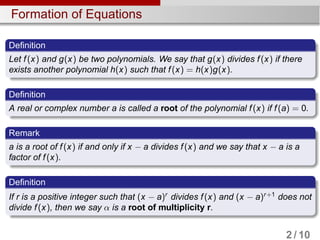
Definition
Let f(x) and g(x) be two polynomials. We say that g(x) divides f(x) if there
exists another polynomial h(x) such that f(x) = h(x)g(x).
Definition
A real or complex number a is called a root of the polynomial f(x) if f(a) = 0.
Remark
a is a root of f(x) if and only if x − a divides f(x) and we say that x − a is a
factor of f(x).
Definition
If r is a positive integer such that (x − a)r
divides f(x) and (x − a)r+1
does not
divide f(x), then we say α is a root of multiplicity r.
2 / 10
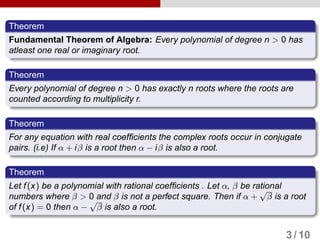
Theorem
Fundamental Theorem of Algebra: Every polynomial of degree n > 0 has
atleast one real or imaginary root.
Theorem
Every polynomial of degree n > 0 has exactly n roots where the roots are
counted according to multiplicity r.
Theorem
For any equation with real coefficients the complex roots occur in conjugate
pairs. (i.e) If α + iβ is a root then α − iβ is also a root.
Theorem
Let f(x) be a polynomial with rational coefficients . Let α, β be rational
numbers where β > 0 and β is not a perfect square. Then if α +
√
β is a root
of f(x) = 0 then α −
√
β is also a root.
3 / 10
Expansion of Sin θ,Cos θ and Tan θ
Theorem
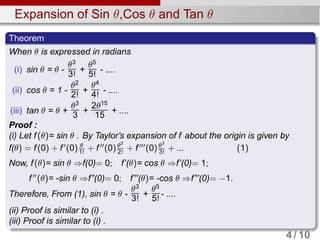
When θ is expressed in radians
(i) sin θ = θ -
θ3
3! +
θ5
5! - ....
(ii) cos θ = 1 -
θ2
2! +
θ4
4! - ....
(iii) tan θ = θ +
θ3
3 +
2θ15
15 + ....
Proof :
(i) Let f(θ)= sin θ . By Taylor’s expansion of f about the origin is given by
f(θ) = f(0) + f (0) θ
1! + f (0)θ2
2! + f (0)θ3
3! + ... (1)
Now, f(θ)= sin θ ⇒f(0)= 0; f’(θ)= cos θ ⇒f’(0)= 1;
f (θ)= -sin θ ⇒f”(0)= 0; f”’(θ)= -cos θ ⇒f”’(0)= −1.
Therefore, From (1), sin θ = θ -
θ3
3! +
θ5
5! - ....
(ii) Proof is similar to (i) .
(iii) Proof is similar to (i) .
4 / 10
Problem
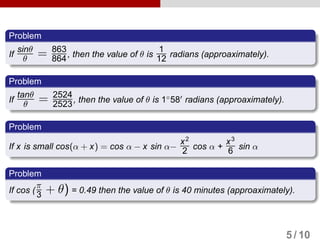
If
sinθ
θ = 863
864, then the value of θ is
1
12 radians (approaximately).
Problem
If
tanθ
θ = 2524
2523, then the value of θ is 1◦
58 radians (approaximately).
Problem
If x is small cos(α + x) = cos α − x sin α−
x2
2 cos α +
x3
6 sin α
Problem
If cos (
π
3 + θ) = 0.49 then the value of θ is 40 minutes (approaximately).
5 / 10
Problem
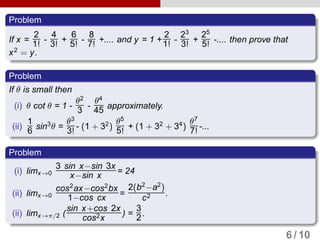
If x =
2
1! -
4
3! +
6
5! -
8
7! +.... and y = 1 +
2
1! -
23
3! +
25
5! -.... then prove that
x2
= y.
Problem
If θ is small then
(i) θ cot θ = 1 -
θ2
3 -
θ4
45 approximately.
(ii)
1
6 sin3
θ =
θ3
3! - (1 + 32
)
θ5
5! + (1 + 32
+ 34
)
θ7
7! -...
Problem
(i) limx→0
3 sin x−sin 3x
x−sin x = 24
(ii) limx→0
cos2
ax−cos2
bx
1−cos cx =
2(b2
−a2
)
c2 .
(ii) limx→π/2 (
sin x+cos 2x
cos2x
) =
3
2.
6 / 10
Hyperbolic Functions
Definition
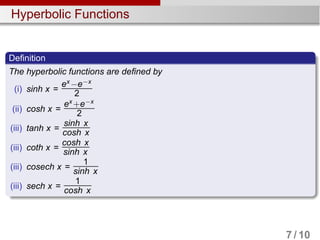
The hyperbolic functions are defined by
(i) sinh x =
ex
−e−x
2
(ii) cosh x =
ex
+e−x
2
(iii) tanh x =
sinh x
cosh x
(iii) coth x =
cosh x
sinh x
(iii) cosech x =
1
sinh x
(iii) sech x =
1
cosh x
7 / 10
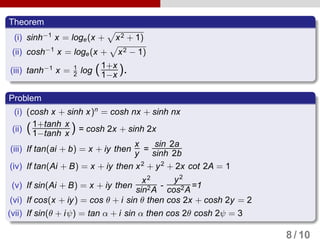
Theorem
(i) sinh−1
x = loge(x + x2 + 1)
(ii) cosh−1
x = loge(x + x2 − 1)
(iii) tanh−1
x = 1
2 log (1+x
1−x ).
Problem
(i) (cosh x + sinh x)n
= cosh nx + sinh nx
(ii) (1+tanh x
1−tanh x ) = cosh 2x + sinh 2x
(iii) If tan(ai + b) = x + iy then
x
y =
sin 2a
sinh 2b
(iv) If tan(Ai + B) = x + iy then x2
+ y2
+ 2x cot 2A = 1
(v) If sin(Ai + B) = x + iy then
x2
sin2A
-
y2
cos2A
=1
(vi) If cos(x + iy) = cos θ + i sin θ then cos 2x + cosh 2y = 2
(vii) If sin(θ + iψ) = tan α + i sin α then cos 2θ cosh 2ψ = 3
8 / 10
Problem
(viii) If cos(x + iy) = r(cos α + i sin α) then y = 1
2 log [sin(x−α)
sin(x+α)]
(ix) If tan(x
2 ) = tanh(x
2 ) then cos x cosh x = 1
(x) Let u = logetan(π
4 + θ
2 ) iff cosh u = sec θ
(xi) Let cos α + i sin α = logetan(π
4 + θ
2 ) iff cosh u = sec θ
(xii) If cos(θ + iψ) = cos(θ + iψ) then sin2
θ = ±sin α
(xii) If tan(θ + iψ) = (cos α + i sin α) then θ = 1
2 nπ + 1
4 π and
ψ = 1
2 log tann(1
4 π + 1
2 α)
9 / 10
Thank You
10 / 10

Allied maths ii

  • 1.
    Allied Mathematics II SWATHISUNDARI.S Assistant Professor of Mathematics DEPARTMENT OF MATHEMATICSC(SF) V.V.VANNIAPERUMAL COLLEGE FOR WOMEN VIRUDHUNAGAR - 626001. 1 / 10
  • 2.
    Formation of Equations Definition Letf(x) and g(x) be two polynomials. We say that g(x) divides f(x) if there exists another polynomial h(x) such that f(x) = h(x)g(x). Definition A real or complex number a is called a root of the polynomial f(x) if f(a) = 0. Remark a is a root of f(x) if and only if x − a divides f(x) and we say that x − a is a factor of f(x). Definition If r is a positive integer such that (x − a)r divides f(x) and (x − a)r+1 does not divide f(x), then we say α is a root of multiplicity r. 2 / 10
  • 3.
    Theorem Fundamental Theorem ofAlgebra: Every polynomial of degree n > 0 has atleast one real or imaginary root. Theorem Every polynomial of degree n > 0 has exactly n roots where the roots are counted according to multiplicity r. Theorem For any equation with real coefficients the complex roots occur in conjugate pairs. (i.e) If α + iβ is a root then α − iβ is also a root. Theorem Let f(x) be a polynomial with rational coefficients . Let α, β be rational numbers where β > 0 and β is not a perfect square. Then if α + √ β is a root of f(x) = 0 then α − √ β is also a root. 3 / 10
  • 4.
    Expansion of Sinθ,Cos θ and Tan θ Theorem When θ is expressed in radians (i) sin θ = θ - θ3 3! + θ5 5! - .... (ii) cos θ = 1 - θ2 2! + θ4 4! - .... (iii) tan θ = θ + θ3 3 + 2θ15 15 + .... Proof : (i) Let f(θ)= sin θ . By Taylor’s expansion of f about the origin is given by f(θ) = f(0) + f (0) θ 1! + f (0)θ2 2! + f (0)θ3 3! + ... (1) Now, f(θ)= sin θ ⇒f(0)= 0; f’(θ)= cos θ ⇒f’(0)= 1; f (θ)= -sin θ ⇒f”(0)= 0; f”’(θ)= -cos θ ⇒f”’(0)= −1. Therefore, From (1), sin θ = θ - θ3 3! + θ5 5! - .... (ii) Proof is similar to (i) . (iii) Proof is similar to (i) . 4 / 10
  • 5.
    Problem If sinθ θ = 863 864,then the value of θ is 1 12 radians (approaximately). Problem If tanθ θ = 2524 2523, then the value of θ is 1◦ 58 radians (approaximately). Problem If x is small cos(α + x) = cos α − x sin α− x2 2 cos α + x3 6 sin α Problem If cos ( π 3 + θ) = 0.49 then the value of θ is 40 minutes (approaximately). 5 / 10
  • 6.
    Problem If x = 2 1!- 4 3! + 6 5! - 8 7! +.... and y = 1 + 2 1! - 23 3! + 25 5! -.... then prove that x2 = y. Problem If θ is small then (i) θ cot θ = 1 - θ2 3 - θ4 45 approximately. (ii) 1 6 sin3 θ = θ3 3! - (1 + 32 ) θ5 5! + (1 + 32 + 34 ) θ7 7! -... Problem (i) limx→0 3 sin x−sin 3x x−sin x = 24 (ii) limx→0 cos2 ax−cos2 bx 1−cos cx = 2(b2 −a2 ) c2 . (ii) limx→π/2 ( sin x+cos 2x cos2x ) = 3 2. 6 / 10
  • 7.
    Hyperbolic Functions Definition The hyperbolicfunctions are defined by (i) sinh x = ex −e−x 2 (ii) cosh x = ex +e−x 2 (iii) tanh x = sinh x cosh x (iii) coth x = cosh x sinh x (iii) cosech x = 1 sinh x (iii) sech x = 1 cosh x 7 / 10
  • 8.
    Theorem (i) sinh−1 x =loge(x + x2 + 1) (ii) cosh−1 x = loge(x + x2 − 1) (iii) tanh−1 x = 1 2 log (1+x 1−x ). Problem (i) (cosh x + sinh x)n = cosh nx + sinh nx (ii) (1+tanh x 1−tanh x ) = cosh 2x + sinh 2x (iii) If tan(ai + b) = x + iy then x y = sin 2a sinh 2b (iv) If tan(Ai + B) = x + iy then x2 + y2 + 2x cot 2A = 1 (v) If sin(Ai + B) = x + iy then x2 sin2A - y2 cos2A =1 (vi) If cos(x + iy) = cos θ + i sin θ then cos 2x + cosh 2y = 2 (vii) If sin(θ + iψ) = tan α + i sin α then cos 2θ cosh 2ψ = 3 8 / 10
  • 9.
    Problem (viii) If cos(x+ iy) = r(cos α + i sin α) then y = 1 2 log [sin(x−α) sin(x+α)] (ix) If tan(x 2 ) = tanh(x 2 ) then cos x cosh x = 1 (x) Let u = logetan(π 4 + θ 2 ) iff cosh u = sec θ (xi) Let cos α + i sin α = logetan(π 4 + θ 2 ) iff cosh u = sec θ (xii) If cos(θ + iψ) = cos(θ + iψ) then sin2 θ = ±sin α (xii) If tan(θ + iψ) = (cos α + i sin α) then θ = 1 2 nπ + 1 4 π and ψ = 1 2 log tann(1 4 π + 1 2 α) 9 / 10
  • 10.