Supported by the NIH grant 1U24 AI117966-01 to UCSD
PI , Co-Investigators at:
The model
annotated with schema.org
Susanna-Assunta Sansone, Alejandra Gonzalez-Beltran, Philippe Rocca-Serra
Oxford e-Research Centre, University of Oxford, UK
Like JATS (Journal Article Tag Suite) is used by PubMed to index literature,
DATS (DatA Tag Suite) is needed for a scalable way to
index data sources in the DataMed prototype
A community effort
v  Enabling discoverability: find and access datasets
v  Focusing on surfacing key metadata descriptors, such as
²  information and relations between authors, datasets, publication,
funding sources, nature of biological signal and perturbation etc.
v  Not the perfect model to represent the experimental details
²  the level of details and metadata needed to ensure interoperability
and reusability are left to the indexed databases
v  Better than just having keywords
²  we have aimed to have maximum coverage of use cases with
minimal number of data elements and relations
What is support to do and be?
Metadata elements identified by combining the two complementary approaches
USE CASES: top-down approach SCHEMAS: bottom-up approach
The development process in a nutshell
Model serialized as JSON schemas and mapping to schema.org
(v1.0, v1.1, v2.0, v2.1)
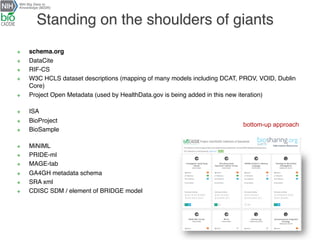
bottom-up approach
Standing on the shoulders of giants
v  schema.org
v  DataCite
v  RIF-CS
v  W3C HCLS dataset descriptions (mapping of many models including DCAT, PROV, VOID, Dublin
Core)
v  Project Open Metadata (used by HealthData.gov is being added in this new iteration)
v  ISA
v  BioProject
v  BioSample
v  MiNIML
v  PRIDE-ml
v  MAGE-tab
v  GA4GH metadata schema
v  SRA xml
v  CDISC SDM / element of BRIDGE model
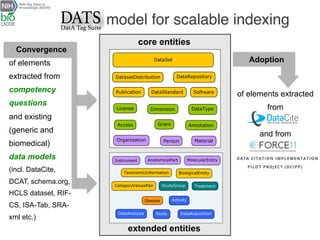
Convergence
of elements
extracted from
competency
questions
and existing
(generic and
biomedical)
data models
(incl. DataCite,
DCAT, schema.org,
HCLS dataset, RIF-
CS, ISA-Tab, SRA-
xml etc.)
model for scalable indexing
Adoption
of elements extracted
from
and from
core entities
extended entities
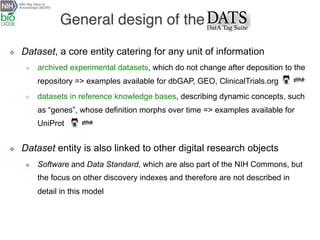
v  Dataset, a core entity catering for any unit of information
²  archived experimental datasets, which do not change after deposition to the
repository => examples available for dbGAP, GEO, ClinicalTrials.org
²  datasets in reference knowledge bases, describing dynamic concepts, such
as “genes”, whose definition morphs over time => examples available for
UniProt
v  Dataset entity is also linked to other digital research objects
v  Software and Data Standard, which are also part of the NIH Commons, but
the focus on other discovery indexes and therefore are not described in
detail in this model
General design of the
Serializations and use of schema.org
v  DATS model in JSON schema, serialized as:
²  JSON* format, and
²  JSON-LD** with vocabulary from schema.org
²  serializations in other formats can also be done, as / if needed
v  Benefits for DataMed and databases index by DataMed
v  Increased visibility (by both popular search engines), accessibility
(via common query interfaces) and possibly improve ranking
v  Extending schema.org
²  Submitted to their tracker missing DATS core elements
²  Coordinating via the bioschemas.org initiative (ELIXIR is also part of)
the extension of schema.org for life science
* JavaScript Object Notation
** JavaScript Object Notation for Linked Data
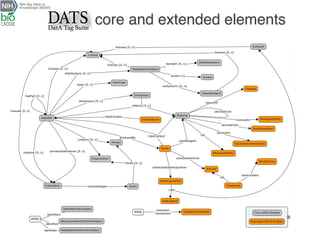
core and extended elements
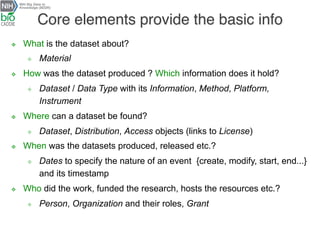
v  What is the dataset about?
²  Material
v  How was the dataset produced ? Which information does it hold?
²  Dataset / Data Type with its Information, Method, Platform,
Instrument
v  Where can a dataset be found?
²  Dataset, Distribution, Access objects (links to License)
v  When was the datasets produced, released etc.?
²  Dates to specify the nature of an event {create, modify, start, end...}
and its timestamp
v  Who did the work, funded the research, hosts the resources etc.?
²  Person, Organization and their roles, Grant
Core elements provide the basic info
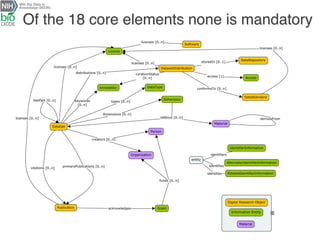
Of the 18 core elements none is mandatory
Only few properties of the 18
core elements are mandatory
Other adopters
exporting
DATS in their APIs
To evaluate DATS
model capabilities
Work in progress:
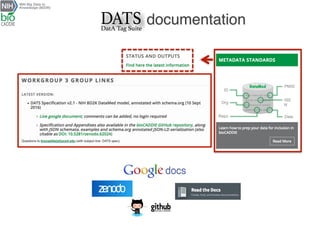
documentation and
curation guidelines for
adopters
Implementations and documentation
relations to other BD2K efforts
v  Mapping DATS to omicsDI model
²  To be able to index datasets in this aggregator
v  For datasets not yet in a formal repositories
²  CEDAR metadata authoring tool can be used to
provide DATS-compliant metadata to be later
indexed by DataMed
v  Ensure that the citation metadata for repositories’
landing page maps to core DATS elements
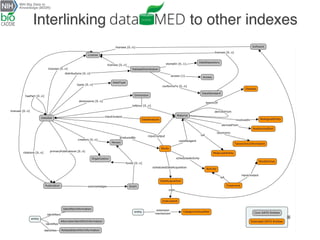
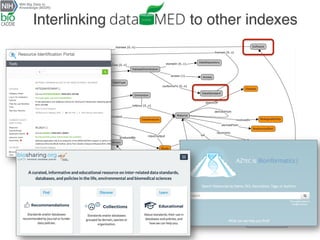
Interlinking to other indexes
documentation

NIH BD2K DataMed model, DATS

  • 1.
    Supported by theNIH grant 1U24 AI117966-01 to UCSD PI , Co-Investigators at: The model annotated with schema.org Susanna-Assunta Sansone, Alejandra Gonzalez-Beltran, Philippe Rocca-Serra Oxford e-Research Centre, University of Oxford, UK
  • 2.
    Like JATS (JournalArticle Tag Suite) is used by PubMed to index literature, DATS (DatA Tag Suite) is needed for a scalable way to index data sources in the DataMed prototype A community effort
  • 3.
    v  Enabling discoverability:find and access datasets v  Focusing on surfacing key metadata descriptors, such as ²  information and relations between authors, datasets, publication, funding sources, nature of biological signal and perturbation etc. v  Not the perfect model to represent the experimental details ²  the level of details and metadata needed to ensure interoperability and reusability are left to the indexed databases v  Better than just having keywords ²  we have aimed to have maximum coverage of use cases with minimal number of data elements and relations What is support to do and be?
  • 4.
    Metadata elements identifiedby combining the two complementary approaches USE CASES: top-down approach SCHEMAS: bottom-up approach The development process in a nutshell Model serialized as JSON schemas and mapping to schema.org (v1.0, v1.1, v2.0, v2.1)
  • 5.
    bottom-up approach Standing onthe shoulders of giants v  schema.org v  DataCite v  RIF-CS v  W3C HCLS dataset descriptions (mapping of many models including DCAT, PROV, VOID, Dublin Core) v  Project Open Metadata (used by HealthData.gov is being added in this new iteration) v  ISA v  BioProject v  BioSample v  MiNIML v  PRIDE-ml v  MAGE-tab v  GA4GH metadata schema v  SRA xml v  CDISC SDM / element of BRIDGE model
  • 6.
    Convergence of elements extracted from competency questions andexisting (generic and biomedical) data models (incl. DataCite, DCAT, schema.org, HCLS dataset, RIF- CS, ISA-Tab, SRA- xml etc.) model for scalable indexing Adoption of elements extracted from and from core entities extended entities
  • 7.
    v  Dataset, acore entity catering for any unit of information ²  archived experimental datasets, which do not change after deposition to the repository => examples available for dbGAP, GEO, ClinicalTrials.org ²  datasets in reference knowledge bases, describing dynamic concepts, such as “genes”, whose definition morphs over time => examples available for UniProt v  Dataset entity is also linked to other digital research objects v  Software and Data Standard, which are also part of the NIH Commons, but the focus on other discovery indexes and therefore are not described in detail in this model General design of the
  • 8.
    Serializations and useof schema.org v  DATS model in JSON schema, serialized as: ²  JSON* format, and ²  JSON-LD** with vocabulary from schema.org ²  serializations in other formats can also be done, as / if needed v  Benefits for DataMed and databases index by DataMed v  Increased visibility (by both popular search engines), accessibility (via common query interfaces) and possibly improve ranking v  Extending schema.org ²  Submitted to their tracker missing DATS core elements ²  Coordinating via the bioschemas.org initiative (ELIXIR is also part of) the extension of schema.org for life science * JavaScript Object Notation ** JavaScript Object Notation for Linked Data
  • 9.
  • 10.
    v  What isthe dataset about? ²  Material v  How was the dataset produced ? Which information does it hold? ²  Dataset / Data Type with its Information, Method, Platform, Instrument v  Where can a dataset be found? ²  Dataset, Distribution, Access objects (links to License) v  When was the datasets produced, released etc.? ²  Dates to specify the nature of an event {create, modify, start, end...} and its timestamp v  Who did the work, funded the research, hosts the resources etc.? ²  Person, Organization and their roles, Grant Core elements provide the basic info
  • 11.
    Of the 18core elements none is mandatory
  • 12.
    Only few propertiesof the 18 core elements are mandatory
  • 13.
    Other adopters exporting DATS intheir APIs To evaluate DATS model capabilities Work in progress: documentation and curation guidelines for adopters Implementations and documentation
  • 14.
    relations to otherBD2K efforts v  Mapping DATS to omicsDI model ²  To be able to index datasets in this aggregator v  For datasets not yet in a formal repositories ²  CEDAR metadata authoring tool can be used to provide DATS-compliant metadata to be later indexed by DataMed v  Ensure that the citation metadata for repositories’ landing page maps to core DATS elements
  • 15.
  • 16.
  • 17.